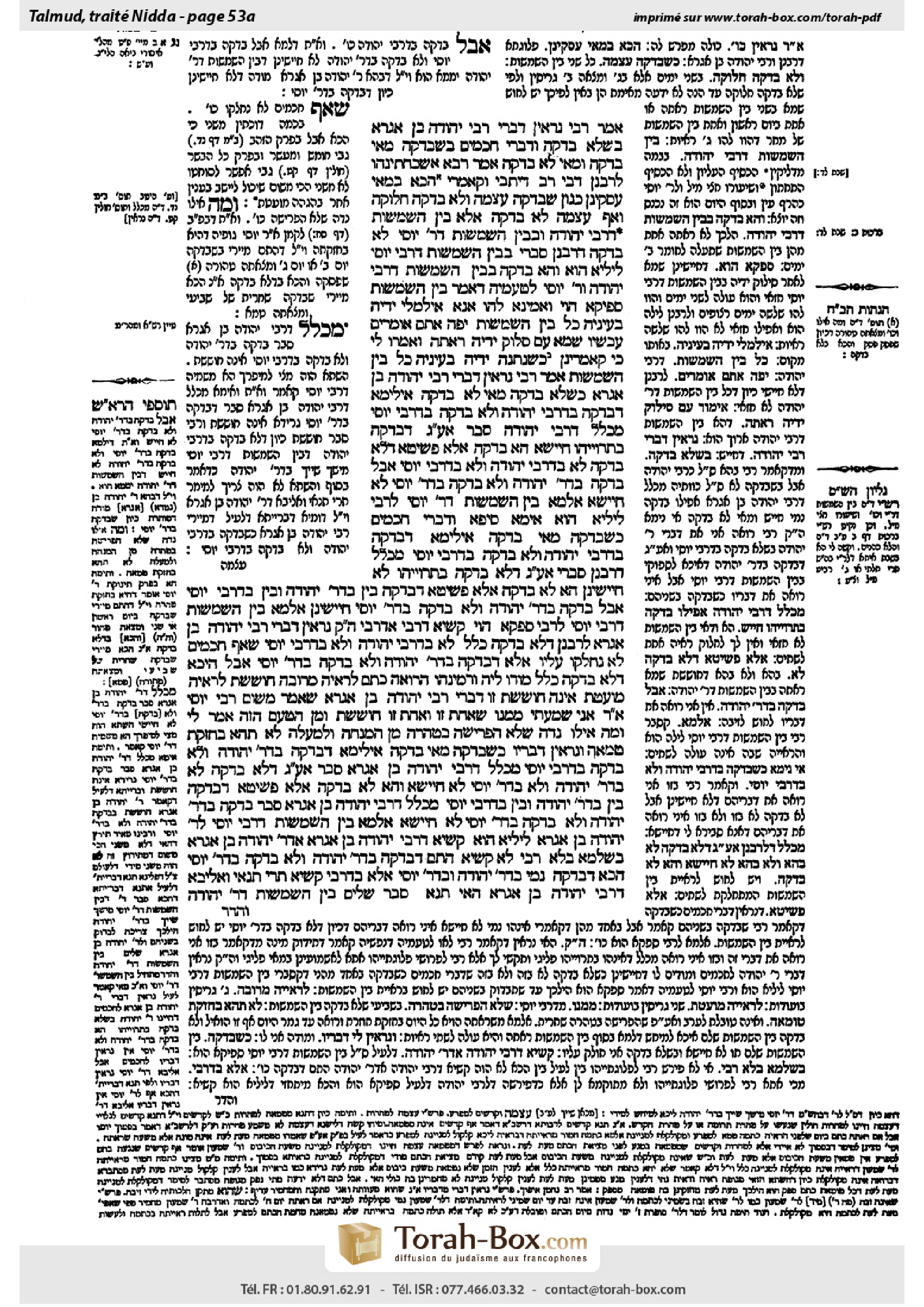
Niddah 53a: Talmud study for Daf Yomi
Daf Yomi is the daily study of one Talmud folio. Explore 37 tractates with scans, Hebrew text, Sefaria English and AI-generated French translations where annotated.
Passage selection and English or AI-generated French translation are available where the scan has annotations. Daf Study is independent of Torah-Box and Sefaria.
Browse Niddah · נידה · All tractatesNiddah 53a text and translations
This page of Niddah includes the Aramaic text, an English translation and an AI-generated French translation, alongside the scan above.
נידה נ״ג א · Aramaic and Hebrew text
אָמַר רַבִּי: נִרְאִין דִּבְרֵי רַבִּי יְהוּדָה בֶּן אַגְרָא בְּשֶׁלֹּא בָּדְקָה, וְדִבְרֵי חֲכָמִים בְּשֶׁבָּדְקָה.
מַאי ״בָּדְקָה״, וּמַאי ״לֹא בָּדְקָה״? אֲמַר רָבָא: אַשְׁכַּחְתִּינְהוּ לְרַבָּנַן דְּבֵי רַב דְּיָתְבִי וְקָאָמְרִי — הָכָא בְמַאי עָסְקִינַן? כְּגוֹן שֶׁבָּדְקָה עַצְמָהּ, וְלֹא בָּדְקָה חֲלוּקָהּ, וְאַף עַצְמָהּ לֹא בָּדְקָה אֶלָּא בֵּין הַשְּׁמָשׁוֹת דְּרַבִּי יְהוּדָה, וּבְבֵין הַשְּׁמָשׁוֹת דְּרַבִּי יוֹסֵי לֹא בָּדְקָה.
דְּרַבָּנַן סָבְרִי בְּבֵין הַשְּׁמָשׁוֹת דְּרַבִּי יוֹסֵי לֵילְיָא הוּא, וְהָא בָּדְקָה בְּבֵין הַשְּׁמָשׁוֹת דְּרַבִּי יְהוּדָה, וְרַבִּי יוֹסֵי לְטַעְמֵיהּ, דְּאָמַר בֵּין הַשְּׁמָשׁוֹת סְפֵיקָא הָוֵי.
וְאָמֵינָא לְהוּ אֲנָא: אִילְמָלֵי יָדֶיהָ בְּעֵינֶיהָ כׇּל בֵּין הַשְּׁמָשׁוֹת — יָפֶה אַתֶּם אוֹמְרִים, עַכְשָׁיו שֶׁמָּא עִם סִלּוּק יָדֶיהָ רָאֲתָה? וְאָמְרוּ לִי: כִּי קָאָמְרִינַן כְּשֶׁנָּתְנָה יָדֶיהָ בְּעֵינֶיהָ כׇּל בֵּין הַשְּׁמָשׁוֹת.
אָמַר רַבִּי: נִרְאִין דִּבְרֵי רַבִּי יְהוּדָה בֶּן אַגְרָא כְּשֶׁלֹּא בָּדְקָה. מַאי ״לֹא בָּדְקָה״?
אִילֵּימָא דְּבָדְקָה בִּדְרַבִּי יְהוּדָה, וְלֹא בָּדְקָה בִּדְרַבִּי יוֹסֵי, מִכְּלָל דְּרַבִּי יְהוּדָה סָבַר: אַף עַל גַּב דְּבָדְקָה בְּתַרְוַיְיהוּ חָיְישָׁא? הָא בָּדְקָה!
אֶלָּא פְּשִׁיטָא דְּלֹא בָּדְקָה, לָא בִּדְרַבִּי יְהוּדָה וְלָא בִּדְרַבִּי יוֹסֵי, אֲבָל בָּדְקָה בִּדְרַבִּי יְהוּדָה וְלֹא בָּדְקָה בִּדְרַבִּי יוֹסֵי — לָא חָיְישָׁא.
אַלְמָא, בֵּין הַשְּׁמָשׁוֹת דְּרַבִּי יוֹסֵי לְרַבִּי לֵילְיָא הוּא. אֵימָא סֵיפָא: ״וְדִבְרֵי חֲכָמִים כְּשֶׁבָּדְקָה״. מַאי ״בָּדְקָה״?
אִילֵּימָא דְּבָדְקָה בִּדְרַבִּי יְהוּדָה, וְלֹא בָּדְקָה בִּדְרַבִּי יוֹסֵי, מִכְּלָל דְּרַבָּנַן סָבְרִי אַף עַל גַּב דְּלֹא בָּדְקָה בְּתַרְוַיְיהוּ — לָא חָיְישִׁינַן, הָא לֹא בָּדְקָה!
אֶלָּא פְּשִׁיטָא דְּבָדְקָה בֵּין בִּדְרַבִּי יְהוּדָה, וּבֵין בִּדְרַבִּי יוֹסֵי, אֲבָל בָּדְקָה בִּדְרַבִּי יְהוּדָה וְלֹא בָּדְקָה בִּדְרַבִּי יוֹסֵי — חָיְישִׁינַן.
אַלְמָא, בֵּין הַשְּׁמָשׁוֹת דְּרַבִּי יוֹסֵי לְרַבִּי סְפֵקָא הָוֵי, קַשְׁיָא דְּרַבִּי אַדְּרַבִּי!
הָכִי קָאָמַר: נִרְאִין דִּבְרֵי רַבִּי יְהוּדָה בֶּן אַגְרָא לְרַבָּנַן, דְּלָא בָּדְקָה כְּלָל — לֹא בִּדְרַבִּי יְהוּדָה וְלֹא בִּדְרַבִּי יוֹסֵי, שֶׁאַף חֲכָמִים לֹא נֶחְלְקוּ עָלָיו אֶלָּא דְּבָדְקָה בִּדְרַבִּי יְהוּדָה וְלֹא בָּדְקָה בִּדְרַבִּי יוֹסֵי. אֲבָל הֵיכָא דְּלֹא בָּדְקָה כְּלָל — מוֹדוּ לֵיהּ.
וּרְמִינְהוּ: הָרוֹאָה כֶּתֶם, לִרְאִיָּה מְרוּבָּה — חוֹשֶׁשֶׁת, לִרְאִיָּה מוּעֶטֶת — אֵינָהּ חוֹשֶׁשֶׁת. זוֹ דִּבְרֵי רַבִּי יְהוּדָה בֶּן אַגְרָא שֶׁאָמַר מִשּׁוּם רַבִּי יוֹסֵי.
אָמַר רַבִּי: אֲנִי שָׁמַעְתִּי מִמֶּנּוּ שֶׁאַחַת זוֹ וְאַחַת זוֹ חוֹשֶׁשֶׁת, וּמִן הַטַּעַם הַזֶּה אָמַר לִי: וּמָה אִילּוּ נִדָּה שֶׁלֹּא הִפְרִישָׁה בְּטָהֳרָה מִן הַמִּנְחָה וּלְמַעְלָה — לֹא תְּהֵא בְּחֶזְקַת טְמֵאָה? וְנִרְאִין דְּבָרָיו כְּשֶׁבָּדְקָה.
מַאי בָּדְקָה? אִילֵּימָא דְּבָדְקָה בִּדְרַבִּי יְהוּדָה, וְלֹא בָּדְקָה בִּדְרַבִּי יוֹסֵי, מִכְּלָל דְּרַבִּי יְהוּדָה בֶּן אַגְרָא סָבַר אַף עַל גַּב דְּלֹא בָּדְקָה לָא בִּדְרַבִּי יְהוּדָה וְלָא בִּדְרַבִּי יוֹסֵי — לָא חָיְישָׁא? וְהָא לֹא בָּדְקָה!
אֶלָּא פְּשִׁיטָא דְּבָדְקָה בֵּין בִּדְרַבִּי יְהוּדָה וּבֵין בִּדְרַבִּי יוֹסֵי, מִכְּלָל דְּרַבִּי יְהוּדָה בֶּן אַגְרָא סָבַר: בָּדְקָה בִּדְרַבִּי יְהוּדָה וְלֹא בָּדְקָה בִּדְרַבִּי יוֹסֵי — לָא חָיְישָׁא.
אַלְמָא, בֵּין הַשְּׁמָשׁוֹת דְּרַבִּי יוֹסֵי לְרַבִּי יְהוּדָה בֶּן אַגְרָא — לֵילְיָא הוּא. קַשְׁיָא דְּרַבִּי יְהוּדָה בֶּן אַגְרָא אַדְּרַבִּי יְהוּדָה בֶּן אַגְרָא!
בִּשְׁלָמָא בְּלֹא רַבִּי — לָא קַשְׁיָא: הָתָם דְּבָדְקָה בִּדְרַבִּי יְהוּדָה וְלֹא בָּדְקָה בִּדְרַבִּי יוֹסֵי, הָכָא דְּבָדְקָה נָמֵי בִּדְרַבִּי יְהוּדָה וּבִדְרַבִּי יוֹסֵי, אֶלָּא בִּדְרַבִּי קַשְׁיָא!
תְּרֵי תַּנָּאֵי וְאַלִּיבָּא דְּרַבִּי יְהוּדָה בֶּן אַגְרָא: הַאי תַּנָּא סָבַר, שָׁלֵים בֵּין הַשְּׁמָשׁוֹת דְּרַבִּי יְהוּדָה,
Niddah 53a · English translation
Rabbi Yehuda HaNasi says that the dispute between Rabbi Yehuda ben Agra and the Rabbis should be decided as follows: The statement of Rabbi Yehuda ben Agra, who maintains that there is a concern for the possibility that the woman might have seen blood at twilight, appears to be correct in a case where she did not examine. And the statement of the Rabbis, who are not concerned about that possibility, appears to be correct in a case where she did examine.
The Gemara asks: What did Rabbi Yehuda HaNasi mean by: Where she did examine, and what did he mean by: Where she did not examine? Rava says: I found the Sages in the study hall of Rav sitting and saying the following explanation of the baraita: Here we are dealing with a case where the woman examined herself but did not examine her robe. And even with regard to herself, she examined herself only during twilight [bein hashemashot] as defined by Rabbi Yehuda, i.e., the time it takes to walk a half mil before the emergence of the stars. But during twilight as defined by Rabbi Yosei, i.e., the blink of an eye before the emergence of the stars, she did not examine herself.
As the Rabbis hold that during the period of twilight as defined by Rabbi Yosei it is already night, and therefore it does not matter that she did not examine herself then. And as she did examine herself during the period of twilight as defined by Rabbi Yehuda, and she found no blood, there is no concern that she saw during twilight, which would count as two sightings. And Rabbi Yosei conforms to his line of reasoning, as Rabbi Yosei, in whose name Rabbi Yehuda ben Agra said his ruling, stated that the time that he defines as twilight is considered uncertain, i.e., it is not definitely night or day, and therefore there is a concern that she might have seen blood at that time, which would count as seeing twice.
Rava continues: And I said to those Sages: Had the woman’s hands been in her eyes, a euphemism for her private parts, for the entire twilight period, what you say would be fine. But now that this is not the case, perhaps when she removed her hands from examining herself she saw blood. And those Sages said to me: The case about which we said that opinion was where she placed her hands in her eyes for the entire twilight period.
The Gemara further clarifies the baraita. Rabbi Yehuda HaNasi says: The statement of Rabbi Yehuda ben Agra in the name of Rabbi Yosei, who maintains that one needs to be concerned for the possibility that the woman saw blood at twilight, which would count as though she saw blood twice, appears to be correct in a case where she did not examine. The Gemara asks: What is meant by: Where she did not examine?
If we say that she examined herself during the period that is defined by Rabbi Yehuda as twilight, but she did not examine herself during the time period that is defined by Rabbi Yosei as twilight, this is difficult: If Rabbi Yehuda HaNasi accepted the opinion of Rabbi Yehuda ben Agra only in such a case, this indicates, by inference, that Rabbi Yehuda ben Agra himself, whose ruling is more strict than that of the Rabbis, holds that even though she examined herself during the twilight period as defined by both Rabbi Yehuda and Rabbi Yosei, she must be concerned. This conclusion is untenable, as she examined herself throughout twilight and there was no blood.
Rather, it is obvious that when Rabbi Yehuda HaNasi referred to a case where she did not examine herself, he meant that she examined herself neither during the period that Rabbi Yehuda defines as twilight, nor during the period that Rabbi Yosei defines as twilight. But if she examined herself during the period that Rabbi Yehuda defines as twilight, but she did not examine herself during the period that Rabbi Yosei defines as twilight, then she does not need to be concerned.
Evidently, the time period that Rabbi Yosei defines as twilight is considered nighttime according to Rabbi Yehuda HaNasi. But if so, say the latter clause: And the statement of the Rabbis appears to be correct in a case where she did examine. What is meant by: Where she did examine?
If we say that she examined herself during the period that is defined by Rabbi Yehuda as twilight, but she did not examine herself during the period that is defined by Rabbi Yosei as twilight, this is difficult: If Rabbi Yehuda HaNasi accepted the opinion of the Rabbis only in such a case, this indicates by inference that the Rabbis themselves hold that even though she did not examine herself during the twilight period as defined by both Rabbi Yehuda and Rabbi Yosei, nevertheless, we are not concerned. But in such a case, she did not examine herself at twilight at all.
Rather, it is obvious that she examined herself both during the period that Rabbi Yehuda defines as twilight, and during the period that Rabbi Yosei defines as twilight. But if she examined herself during the period that Rabbi Yehuda defines as twilight, and she did not examine herself during the period that Rabbi Yosei defines as twilight, then we are concerned.
Evidently, the time period that Rabbi Yosei defines as twilight is considered to be of uncertain status regarding whether it is day or night according to Rabbi Yehuda HaNasi. The Gemara asks: If so, one statement of Rabbi Yehuda HaNasi poses a difficulty for another statement of Rabbi Yehuda HaNasi, as the inferences from the two parts of Rabbi Yehuda HaNasi’s observation contradict one another.
The Gemara explains that this is what Rabbi Yehuda HaNasi is saying: The statement of Rabbi Yehuda ben Agra appears correct to the Rabbis in a case where she did not examine herself at all, neither during the period that Rabbi Yehuda defines as twilight, nor during the period that Rabbi Yosei defines as twilight. As, even the Rabbis disagree with Rabbi Yehuda ben Agra only in a case where she examined herself during the period that Rabbi Yehuda defines as twilight but she did not examine herself during the time period that Rabbi Yosei defines as twilight. But in a case where she did not examine herself at all, they concede to him that we are concerned that she might have emitted blood at twilight.
And the Gemara raises a contradiction from a baraita: In the case of a woman who sees a red stain, if she saw a large stain, covering an area the size of at least three split beans, she must be concerned that she might be a zava. But if she saw a small stain, covering an area of less than the size of three split beans, she does not need to be concerned that she is a zava. This is the statement of Rabbi Yehuda ben Agra, who said it in the name of Rabbi Yosei.
Rabbi Yehuda HaNasi said: I heard from Rabbi Yosei that with regard to both this one and that one, i.e., whether it is a large or small stain, she must be concerned that she is a zava. And Rabbi Yosei said this halakha to me based on this reasoning: And what would be the case if a menstruating woman did not perform the examination marking the first step in her transition from ritual impurity to ritual purity on the seventh day from minḥa time onward? Would she not have a presumptive status of ritual impurity? Rabbi Yehuda HaNasi added: And Rabbi Yosei’s statement appears to be correct with regard to the case where she examined.
Once again, the Gemara asks: What is meant by the term: Where she examined? If we say that she examined herself during the period that is defined by Rabbi Yehuda as twilight, but she did not examine herself during the period that is defined by Rabbi Yosei as twilight, this indicates by inference that Rabbi Yehuda ben Agra, who disagrees in the second baraita with this version of Rabbi Yosei’s opinion and rules more leniently, holds that even though she did not examine herself during the twilight period as defined by both Rabbi Yehuda and Rabbi Yosei, nevertheless, she does not need to be concerned that she is a zava. But this conclusion is untenable, as she did not examine herself at twilight at all.
Rather, it is obvious that Rabbi Yehuda HaNasi is referring to a case where she examined herself both during the period that Rabbi Yehuda defines as twilight and during the period that Rabbi Yosei defines as twilight. This indicates, by inference, that Rabbi Yehuda ben Agra holds that if she examined herself during the period that Rabbi Yehuda defines as twilight, but she did not examine herself during the time period that Rabbi Yosei defines as twilight, then she does not need to be concerned, as a sighting at that time would not count as two.
Evidently, the period that Rabbi Yosei defines as twilight is considered to be nighttime according to Rabbi Yehuda ben Agra. If so, one statement of Rabbi Yehuda ben Agra poses a difficulty with regard to another statement of Rabbi Yehuda ben Agra, as earlier it was stated that according to Rabbi Yehuda ben Agra twilight is not definitely night.
Granted, without the statement of Rabbi Yehuda HaNasi, the apparent contradiction between these statements of Rabbi Yehuda ben Agra in the two baraitot is not difficult, as one could explain as follows: There, with regard to the first baraita, it is referring to a case where she examined herself during the period that is defined by Rabbi Yehuda as twilight, but she did not examine herself during the period that is defined by Rabbi Yosei as twilight. By contrast, here it is referring to a case where she examined herself both during the period that is defined by Rabbi Yehuda as twilight and during the period that is defined by Rabbi Yosei as twilight. But in light of the statement of Rabbi Yehuda HaNasi, one cannot explain in this manner, and therefore the contradiction poses a difficulty.
The Gemara answers: This is not a contradiction, as there are two tanna’im and they disagree with regard to the opinion of Rabbi Yehuda ben Agra. This tanna holds that Rabbi Yehuda’s twilight ends,
Niddah 53a · Traduction française (IA)
Rabbi Yehouda HaNassi dit qu’il faut trancher la controverse entre Rabbi Yehouda ben Agra et les Sages de la manière suivante : l’avis de Rabbi Yehouda ben Agra, qui estime qu’il faut craindre que la femme ait vu du sang au crépuscule, paraît juste dans le cas où elle ne s’est pas examinée. Quant à l’avis des Sages, qui ne tiennent pas compte de cette éventualité, il paraît juste dans le cas où elle s’est examinée.
La Guemara demande : Qu’entendait Rabbi Yehouda HaNassi par « dans le cas où elle s’est examinée », et par « dans le cas où elle ne s’est pas examinée » ? Rava dit : J’ai trouvé les Sages assis dans la maison d’étude de Rav et exposant ainsi la baraïta : il s’agit ici d’un cas où la femme s’est examinée, mais n’a pas examiné son vêtement. Même en ce qui la concerne, elle ne s’est examinée que pendant le crépuscule [bein hashemashot] selon la définition de Rabbi Yehouda, c’est-à-dire pendant le temps nécessaire pour parcourir un demi-mil avant l’apparition des étoiles. Mais elle ne s’est pas examinée pendant le crépuscule selon la définition de Rabbi Yossi, c’est-à-dire pendant l’instant précédant l’apparition des étoiles.
En effet, les Sages considèrent que pendant la période crépusculaire définie par Rabbi Yossi, il fait déjà nuit ; le fait qu’elle ne se soit pas examinée alors n’a donc aucune importance. Et puisqu’elle s’est examinée pendant la période crépusculaire définie par Rabbi Yehouda et n’a trouvé aucun sang, il n’y a pas lieu de craindre qu’elle ait vu du sang au crépuscule, ce qui compterait comme deux écoulements. Rabbi Yossi reste fidèle à son raisonnement : Rabbi Yossi, au nom duquel Rabbi Yehouda ben Agra a rapporté sa décision, a dit que la période qu’il définit comme le crépuscule est de statut incertain, c’est-à-dire qu’elle n’est assurément ni le jour ni la nuit. Il faut donc craindre qu’elle ait vu du sang pendant cette période, ce qui compterait comme deux écoulements.
Rava poursuit : Je dis à ces Sages : Si les mains de la femme étaient restées sur ses yeux — euphémisme désignant ses parties intimes — pendant toute la période crépusculaire, votre explication conviendrait. Mais puisque ce n’est pas le cas, peut-être a-t-elle vu du sang lorsqu’elle a retiré ses mains après s’être examinée. Ces Sages me répondirent : Le cas auquel nous appliquions cet avis était celui où elle avait gardé les mains sur ses yeux pendant toute la période crépusculaire.
La Guemara précise encore la baraïta. Rabbi Yehouda HaNassi dit : L’avis de Rabbi Yehouda ben Agra, au nom de Rabbi Yossi, selon lequel il faut craindre que la femme ait vu du sang au crépuscule, ce qui compterait comme si elle avait vu du sang deux fois, paraît juste dans le cas où elle ne s’est pas examinée. La Guemara demande : Que signifie « dans le cas où elle ne s’est pas examinée » ?
Si l’on dit qu’elle s’est examinée pendant la période définie par Rabbi Yehouda comme le crépuscule, mais pas pendant celle que Rabbi Yossi définit ainsi, cela pose une difficulté : si Rabbi Yehouda HaNassi n’a retenu l’avis de Rabbi Yehouda ben Agra que dans un tel cas, on en déduit que Rabbi Yehouda ben Agra lui-même, dont la décision est plus stricte que celle des Sages, considère qu’elle doit s’inquiéter même si elle s’est examinée pendant les périodes crépusculaires définies à la fois par Rabbi Yehouda et par Rabbi Yossi. Une telle conclusion est intenable, puisqu’elle s’est examinée pendant toute la période crépusculaire et qu’il n’y avait pas de sang.
Il est donc évident que, lorsque Rabbi Yehouda HaNassi a parlé d’un cas où elle ne s’était pas examinée, il voulait dire qu’elle ne s’était examinée ni pendant la période que Rabbi Yehouda définit comme le crépuscule, ni pendant celle que Rabbi Yossi définit ainsi. Mais si elle s’est examinée pendant la période que Rabbi Yehouda définit comme le crépuscule et ne s’est pas examinée pendant celle que Rabbi Yossi définit ainsi, elle n’a pas à s’inquiéter.
Il ressort de là que, selon Rabbi Yehouda HaNassi, la période que Rabbi Yossi définit comme le crépuscule est considérée comme la nuit. Mais si tel est le cas, examinons la dernière partie de sa déclaration : « Et l’avis des Sages paraît juste dans le cas où elle s’est examinée. » Que signifie « dans le cas où elle s’est examinée » ?
Si l’on dit qu’elle s’est examinée pendant la période définie par Rabbi Yehouda comme le crépuscule, mais pas pendant celle que Rabbi Yossi définit ainsi, cela pose une difficulté : si Rabbi Yehouda HaNassi n’a retenu l’avis des Sages que dans un tel cas, on en déduit que les Sages eux-mêmes considèrent qu’il n’y a pas lieu de s’inquiéter même si elle ne s’est examinée ni pendant la période crépusculaire définie par Rabbi Yehouda ni pendant celle définie par Rabbi Yossi. Or, dans ce cas, elle ne s’est pas examinée du tout au crépuscule.
Il est donc évident qu’elle s’est examinée à la fois pendant la période que Rabbi Yehouda définit comme le crépuscule et pendant celle que Rabbi Yossi définit ainsi. Mais si elle s’est examinée pendant la période que Rabbi Yehouda définit comme le crépuscule et ne s’est pas examinée pendant celle que Rabbi Yossi définit ainsi, il y a lieu de s’inquiéter.
Il ressort de là que, selon Rabbi Yehouda HaNassi, la période que Rabbi Yossi définit comme le crépuscule est de statut incertain : on ne sait pas si elle relève du jour ou de la nuit. La Guemara demande : Si tel est le cas, une déclaration de Rabbi Yehouda HaNassi pose une difficulté à une autre de ses déclarations, car les déductions tirées des deux parties de son observation se contredisent.
La Guemara explique que voici ce que dit Rabbi Yehouda HaNassi : L’avis de Rabbi Yehouda ben Agra paraît juste aux yeux des Sages dans le cas où elle ne s’est pas examinée du tout, ni pendant la période que Rabbi Yehouda définit comme le crépuscule, ni pendant celle que Rabbi Yossi définit ainsi. En effet, les Sages ne sont en désaccord avec Rabbi Yehouda ben Agra que dans le cas où elle s’est examinée pendant la période que Rabbi Yehouda définit comme le crépuscule, mais pas pendant celle que Rabbi Yossi définit ainsi. Toutefois, dans le cas où elle ne s’est pas examinée du tout, ils reconnaissent avec lui qu’il faut craindre qu’elle ait émis du sang au crépuscule.
La Guemara soulève ensuite une contradiction à partir d’une baraïta : dans le cas d’une femme qui voit une tache rouge, si la tache est grande et couvre une surface d’au moins trois fèves fendues, elle doit craindre d’être une zava. Mais si la tache est petite et couvre une surface inférieure à celle de trois fèves fendues, elle n’a pas à craindre d’être une zava. Telle est la déclaration de Rabbi Yehouda ben Agra, qui l’a rapportée au nom de Rabbi Yossi.
Rabbi Yehouda HaNassi dit : J’ai entendu de Rabbi Yossi que, dans les deux cas — que la tache soit grande ou petite —, elle doit craindre d’être une zava. Rabbi Yossi m’a enseigné cette halakha en s’appuyant sur le raisonnement suivant : Que se passerait-il si une femme menstruée ne procédait pas, à partir de l’heure de minha le septième jour, à l’examen marquant la première étape de son passage de l’impureté rituelle à la pureté rituelle ? Ne conserverait-elle pas alors un statut présumé d’impureté rituelle ? Rabbi Yehouda HaNassi ajouta : L’avis de Rabbi Yossi paraît juste dans le cas où elle s’est examinée.
La Guemara demande à nouveau : Que signifie l’expression « dans le cas où elle s’est examinée » ? Si l’on dit qu’elle s’est examinée pendant la période définie par Rabbi Yehouda comme le crépuscule, mais pas pendant celle que Rabbi Yossi définit ainsi, on en déduit que Rabbi Yehouda ben Agra, qui conteste dans la seconde baraïta cette version de l’avis de Rabbi Yossi et statue avec plus de souplesse, considère que, même si elle ne s’est examinée ni pendant la période crépusculaire définie par Rabbi Yehouda ni pendant celle définie par Rabbi Yossi, elle n’a pas à craindre d’être une zava. Mais cette conclusion est intenable, puisqu’elle ne s’est pas examinée du tout au crépuscule.
Il est donc évident que Rabbi Yehouda HaNassi se réfère à un cas où elle s’est examinée à la fois pendant la période que Rabbi Yehouda définit comme le crépuscule et pendant celle que Rabbi Yossi définit ainsi. On en déduit que Rabbi Yehouda ben Agra considère que si elle s’est examinée pendant la période que Rabbi Yehouda définit comme le crépuscule, mais ne s’est pas examinée pendant celle que Rabbi Yossi définit ainsi, elle n’a pas à s’inquiéter, car une vision à ce moment-là ne compterait pas comme deux.
Il ressort de là que, selon Rabbi Yehouda ben Agra, la période que Rabbi Yossi définit comme le crépuscule est considérée comme la nuit. Si tel est le cas, une déclaration de Rabbi Yehouda ben Agra pose une difficulté à une autre de ses déclarations, puisqu’il a été dit précédemment que, selon Rabbi Yehouda ben Agra, le crépuscule n’est pas assurément la nuit.
Certes, sans la déclaration de Rabbi Yehouda HaNassi, la contradiction apparente entre les déclarations de Rabbi Yehouda ben Agra dans les deux baraïtot ne serait pas difficile à résoudre : on pourrait expliquer que là, dans la première baraïta, il s’agit d’un cas où elle s’est examinée pendant la période définie par Rabbi Yehouda comme le crépuscule, mais pas pendant celle que Rabbi Yossi définit ainsi. En revanche, ici, il s’agit d’un cas où elle s’est examinée à la fois pendant la période définie par Rabbi Yehouda comme le crépuscule et pendant celle que Rabbi Yossi définit ainsi. Mais à la lumière de la déclaration de Rabbi Yehouda HaNassi, on ne peut pas donner cette explication ; la contradiction pose donc une difficulté.
La Guemara répond : Il n’y a pas de contradiction, car il y a deux tanaïm qui sont en désaccord sur l’avis de Rabbi Yehouda ben Agra. Ce tanna considère que la période crépusculaire de Rabbi Yehouda prend fin,
Traduction française générée par IA à partir de l’édition anglaise de Sefaria. Vérifie toujours un passage avec le texte source.
Text from Sefaria: William Davidson Edition - Vocalized Aramaic (CC BY NC); William Davidson Edition - English (CC BY NC).