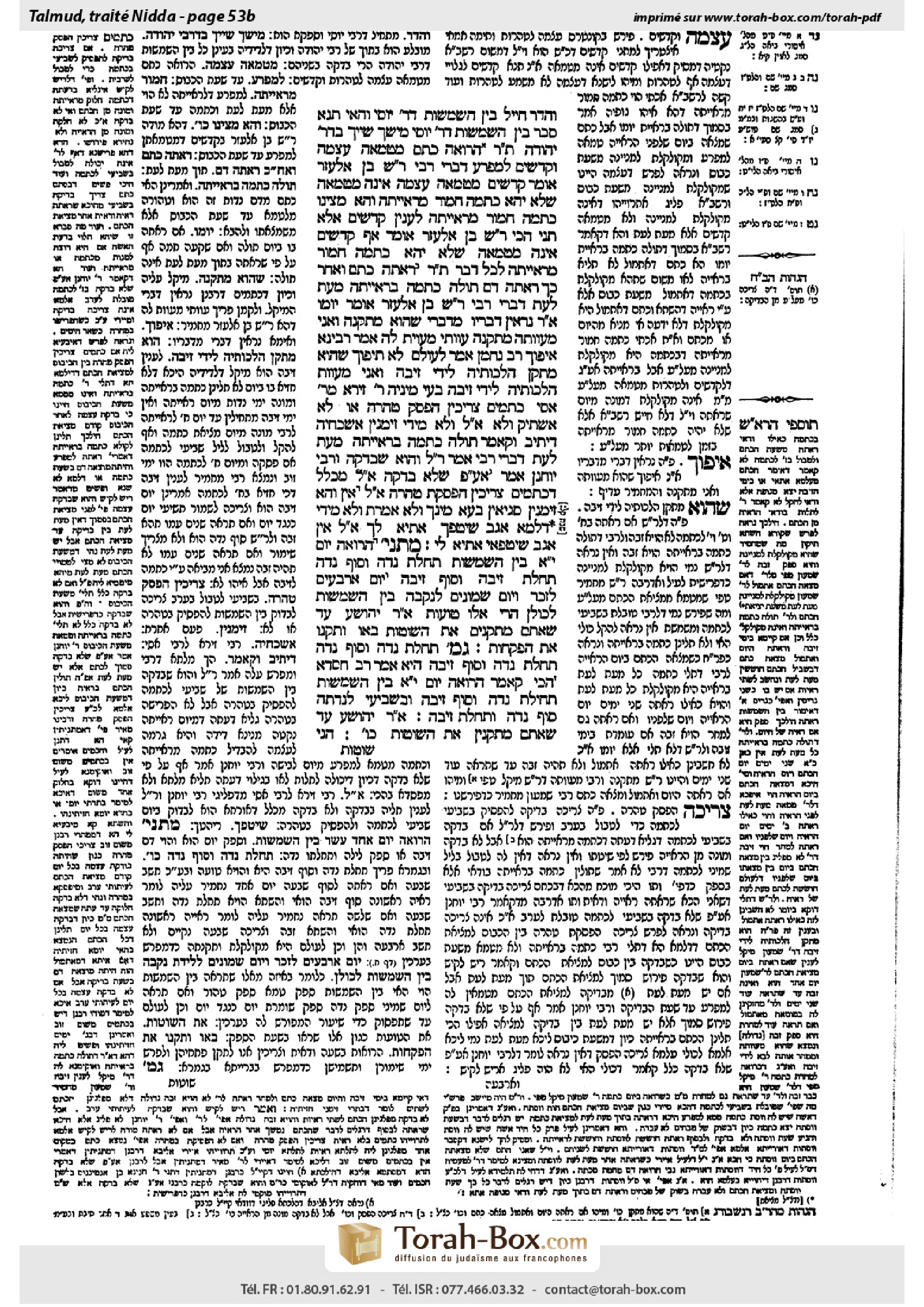
Niddah 53b: Talmud study for Daf Yomi
Daf Yomi is the daily study of one Talmud folio. Explore 37 tractates with scans, Hebrew text, Sefaria English and AI-generated French translations where annotated.
Passage selection and English or AI-generated French translation are available where the scan has annotations. Daf Study is independent of Torah-Box and Sefaria.
Browse Niddah · נידה · All tractatesNiddah 53b text and translations
This page of Niddah includes the Aramaic text, an English translation and an AI-generated French translation, alongside the scan above.
נידה נ״ג ב · Aramaic and Hebrew text
וַהֲדַר חָיֵיל בֵּין הַשְּׁמָשׁוֹת דְּרַבִּי יוֹסֵי, וְהַאי תַּנָּא סָבַר, בֵּין הַשְּׁמָשׁוֹת דְּרַבִּי יוֹסֵי מֵישָׁךְ שָׁיֵיךְ בִּדְרַבִּי יְהוּדָה.
תָּנוּ רַבָּנַן: הָרוֹאָה כֶּתֶם — מְטַמְּאָה עַצְמָהּ וְקָדָשִׁים לְמַפְרֵעַ, דִּבְרֵי רַבִּי.
רַבִּי שִׁמְעוֹן בֶּן אֶלְעָזָר אוֹמֵר: קָדָשִׁים — מְטַמְּאָה, עַצְמָהּ — אֵינָהּ מְטַמְּאָה, שֶׁלֹּא יְהֵא כִּתְמָהּ חָמוּר מֵרְאִיָּיתָהּ.
וְהָא מָצִינוּ, כִּתְמָהּ חָמוּר מֵרְאִיָּיתָהּ לְעִנְיַן קָדָשִׁים!
אֶלָּא תָּנֵי הָכִי: רַבִּי שִׁמְעוֹן בֶּן אֶלְעָזָר אוֹמֵר: אַף קָדָשִׁים אֵינָהּ מְטַמְּאָה, שֶׁלֹּא יְהֵא כִּתְמָהּ חָמוּר מֵרְאִיָּיתָהּ לְכׇל דָּבָר.
תָּנוּ רַבָּנַן: רָאֲתָה כֶּתֶם, וְאַחַר כָּךְ רָאֲתָה דָּם — תּוֹלָה כִּתְמָהּ בִּרְאִיָּיתָהּ מֵעֵת לְעֵת, דִּבְרֵי רַבִּי.
רַבִּי שִׁמְעוֹן בֶּן אֶלְעָזָר אוֹמֵר: יוֹמוֹ. אָמַר רַבִּי: נִרְאִין דְּבָרָיו מִדְּבָרַי, שֶׁהוּא — מְתַקְּנָהּ, וַאֲנִי — מְעַוְּותָהּ.
מְתַקְּנָהּ? עַוּוֹתֵי מְעַוֵּית לַהּ! אָמַר רָבִינָא: אֵיפוֹךְ.
רַב נַחְמָן אָמַר: לְעוֹלָם לָא תֵּיפוֹךְ, שֶׁהוּא מְתַקֵּן הִלְכוֹתֶיהָ לִידֵי זִיבָה,
וַאֲנִי מְעַוֵּות הִלְכוֹתֶיהָ לִידֵי זִיבָה.
בָּעֵי מִינֵּיהּ רַבִּי זֵירָא מֵרַבִּי אַסִּי: כְּתָמִים צְרִיכִין הֶפְסֵק טׇהֳרָה אוֹ לָא? אִשְׁתִּיק, וְלָא אֲמַר לֵיהּ וְלָא מִידֵי.
זִימְנִין אַשְׁכְּחֵיהּ דְּיָתֵיב וְקָאָמַר: תּוֹלָה כִּתְמָהּ בִּרְאִיָּיתָהּ מֵעֵת לְעֵת, דִּבְרֵי רַבִּי.
אָמַר רֵישׁ לָקִישׁ: וְהוּא שֶׁבָּדְקָה, וְרַבִּי יוֹחָנָן אָמַר: אַף עַל פִּי שֶׁלֹּא בָּדְקָה.
אֲמַר לֵיהּ: מִכְּלָל דִּכְתָמִים צְרִיכִין (הפסקת) [הֶפְסֵק] טׇהֳרָה? אֲמַר לֵיהּ: אִין. וְהָא זִימְנִין סַגִּיאִין (בעא) [בְּעַאי] מִינָּךְ, וְלָא אֲמַרְתְּ וְלָא מִידֵּי, דִּלְמָא אַגַּב שִׁיטְפָךְ אָתְיָא לָךְ? אֲמַר לֵיהּ: אִין, אַגַּב שִׁיטְפַאי אָתְיָא לִי.
מַתְנִי' הָרוֹאָה יוֹם אַחַד עָשָׂר בֵּין הַשְּׁמָשׁוֹת — תְּחִלַּת נִדָּה וְסוֹף נִדָּה, תְּחִלַּת זִיבָה וְסוֹף זִיבָה.
יוֹם אַרְבָּעִים לַזָּכָר, וְיוֹם שְׁמוֹנִים לַנְּקֵבָה, בֵּין הַשְּׁמָשׁוֹת לְכוּלָּן — הֲרֵי אֵלּוּ טוֹעוֹת.
אָמַר רַבִּי יְהוֹשֻׁעַ: עַד שֶׁאַתֶּם מְתַקְּנִים אֶת הַשּׁוֹטוֹת, בֹּאוּ וְתַקְּנוּ אֶת הַפִּקְּחוֹת.
גְּמָ' תְּחִלַּת נִדָּה וְסוֹף נִדָּה? תְּחִלַּת נִדָּה וְסוֹף זִיבָה הִיא!
אָמַר רַב חִסְדָּא: הָכִי קָאָמַר — הָרוֹאָה יוֹם אַחַד עָשָׂר בֵּין הַשְּׁמָשׁוֹת, תְּחִילַּת נִדָּה וְסוֹף זִיבָה.
וּבַשְּׁבִיעִי לְנִדָּתָהּ — סוֹף נִדָּה וּתְחִלַּת זִיבָה.
אָמַר רַבִּי יְהוֹשֻׁעַ: עַד שֶׁאַתֶּם מְתַקְּנִין אֶת הַשּׁוֹטוֹת כּוּ׳. הָנֵי
Niddah 53b · English translation
and only thereafter the twilight of Rabbi Yosei begins, when there is uncertainty, and there is a concern that perhaps she saw blood at that time. And that tanna of the second baraita holds that the twilight of Rabbi Yosei is subsumed within and occurs at the end of the twilight of Rabbi Yehuda. According to the opinion of this tanna, since she examined herself throughout the twilight of Rabbi Yehuda, she also necessarily examined herself throughout the twilight of Rabbi Yosei and therefore there is no need to be concerned about her status.
§ On the topic of a woman seeing a stain, the Sages taught in a baraita: A woman who sees a red stain on her garment renders herself and consecrated items that she touched impure retroactively, from the time when that garment was last laundered. This is the statement of Rabbi Yehuda HaNasi.
Rabbi Shimon ben Elazar says: She does render consecrated items that she touched impure retroactively, but she does not render herself impure with regard to rendering impure objects that she touched since the time the garment was last laundered. The reason is that her stain should not be more stringent than her actual seeing of blood. If she experiences bleeding, she renders impure only objects that she touched during the previous twenty-four-hour period.
The Gemara asks: But don’t we find that Rabbi Shimon ben Elazar himself holds that her stain is more stringent than her actual seeing of blood with regard to consecrated items? Her stain renders such items impure retroactively from the time that the garment was laundered, whereas her actually seeing blood renders impure only those items that she touched during the past twenty-four-hour period.
The Gemara answers: Rather, teach the baraita like this: Rabbi Shimon ben Elazar says that she does not even render consecrated items that she touched impure retroactively from the time that the garment was laundered, but only those items that she touched during the past twenty-four-hour period. The reason is that her stain should not be more stringent than her actual seeing of blood with regard to any matter.
§ The Sages taught in a baraita: In the case of a woman who saw a red stain on her garment, and afterward saw blood, what is the halakha? She attributes her stain to her seeing blood, i.e., the stain is treated as part of the seeing of blood, which means that she is impure only from when she found the stain, as it assumed that it appeared no earlier. This is the halakha provided that she saw the blood within a twenty-four-hour period of her discovery of the stain. But if more than twenty-four hours passed, she cannot attribute the stain to her sighting. This is the statement of Rabbi Yehuda HaNasi.
Rabbi Shimon ben Elazar says: She may attribute the stain to the sighting only if she experienced bleeding on the day of discovering the stain. If she experienced bleeding after that day, even if it was within twenty-four hours, she may not attribute the stain to the sighting, which means that she is impure retroactively from when she found the stain, in case it appeared earlier. Rabbi Yehuda HaNasi said: The statement of Rabbi Shimon ben Elazar appears to be more correct than mine, as he fixes her situation, i.e., he is lenient, and I ruin her situation, as my ruling is stringent. Since the impurity of a stain applies by rabbinic law, one should follow the more lenient opinion.
The Gemara asks: But does Rabbi Shimon ben Elazar actually fix her situation? Does he not ruin her situation? If she experiences bleeding the day after she found the stain, but within twenty-four hours of finding the stain, according to Rabbi Shimon ben Elazar she renders items impure retroactively. By contrast, according to Rabbi Yehuda HaNasi she renders objects impure only from when she discovered the stain. Ravina says: Reverse Rabbi Yehuda HaNasi’s statement, so that it states: My statement appears to be more correct than that of Rabbi Shimon ben Elazar, as I fix her situation and he ruins her situation.
Rav Naḥman says: Actually, do not reverse Rabbi Yehuda HaNasi’s statement, as Rabbi Yehuda HaNasi meant the following: Rabbi Shimon ben Elazar’s opinion appears to be more correct, as he fixes her halakhot with regard to ziva. If she experiences bleeding on the day after discovering the stain, the count of her seven days of menstrual flow begins on that day of her actual sighting, not from when she saw the stain. This is due to the fact that the stain is not attributable to the seeing of the blood. Therefore, if she experiences bleeding on the seventh day after first experiencing bleeding, which is the eighth day after discovering the stain, she is not considered a lesser zava, and she can be purified from her status as a menstruating woman.
But I, Rabbi Yehuda HaNasi, ruin her halakhot with regard to ziva. Since the stain is attributable to the seeing of the blood within twenty-four hours, her counting starts from when she found the stain, and therefore the blood that she sees on the eighth day after discovering the stain is considered ziva. Consequently, she is considered a lesser zava and must observe a clean day for each day she experiences a discharge.
§ Rabbi Zeira asked Rabbi Asi: Are stains like the actual sight of blood, in that they require an examination in which she is clean of blood, marking the first step in her transition from impurity to purity before immersion on the night following the seventh day, or not? Rabbi Asi was silent and said nothing to Rabbi Zeira.
The Gemara relates that on another occasion Rabbi Zeira found Rabbi Asi sitting and saying that a woman who sees a stain and afterward experiences bleeding attributes her stain to her seeing blood, if she saw the blood within a twenty-four-hour period of when she discovered the stain. This is the statement of Rabbi Yehuda HaNasi.
Rabbi Asi added that there is a dispute with regard to the details of this halakha. Reish Lakish says: This applies only in a case where she examined herself at the end of the seventh day from the discovery of the stain. This examination indicates that the stain is related to her experiencing bleeding, and therefore the standard halakha of a woman who becomes pure at the end of her seven menstrual days applies to her. By contrast, if she examined herself only at the end of the eighth day, the stain is not attributable to her bleeding. And Rabbi Yoḥanan says: The stain is attributable to her bleeding under all circumstances, even if she did not examine herself until the eighth day.
Upon hearing this, Rabbi Zeira said to Rabbi Asi: Does that mean, by inference, that stains require an examination marking the first step in her transition from impurity to purity? Rabbi Asi said to Rabbi Zeira: Yes, that is the halakha. Rabbi Zeira further said to Rabbi Asi: But on many occasions I asked you about this matter and you did not say anything to me. Perhaps in the course of your studies this halakha came back to you? Rabbi Asi said to him: Yes, in the course of my studies this halakha came back to me.
MISHNA: In the case of a woman who sees an emission of blood during twilight on the eleventh day of the days in which she can assume the status of a zava, as there is uncertainty whether the emission was during the day and it is the flow of a zava or whether it was at night and it is menstrual flow, she observes seven days of impurity like the beginning of the seven days of menstruation and the end of menstruation. If she experienced an emission on the two previous days as well, she observes seven clean days before immersion like the beginning of the flow of ziva and the end of the flow of ziva.
Similarly, in the case of a woman who experiences an emission of blood during twilight on the fortieth day after the birth of a male or the eightieth day after the birth of a female, there is uncertainty whether it is considered daytime and therefore part of the final day of the blood of purity, or night that is part of the following day when the blood is impure. With regard to experiencing bleeding during twilight in all those cases, these women are mistaken in their calculation of the days of menstrual flow and the flow of a zava. Consequently, if they experience bleeding for three consecutive days at the beginning or at the end of the eleven days of ziva, they bring the offering of a zava but it is not eaten, as it was brought based on uncertainty.
Rabbi Yehoshua said: Instead of making provisions to remedy the uncertainties of the misguided, come and remedy the uncertainties of the competent women who know what day they saw the blood but require guidance, due to the multitude of emissions that they experienced.
GEMARA: The mishna teaches that if a woman experiences bleeding during twilight on the eleventh day of the days on which she can assume the status of a zava, the flow is considered to be the beginning of the seven days of menstruation and the end of menstruation. The Gemara raises a difficulty: But the concern is only that this flow might be either the beginning of the seven days of menstruation, if twilight is treated as night, or the end of ziva, if twilight is treated as day.
Rav Ḥisda says that this is what the mishna is saying: A woman who sees an emission of blood during twilight on the eleventh day of the days on which she can assume the status of a zava must be concerned both for the possibility that it is the beginning of the seven days of menstruation and for the possibility that it is the end of the flow of ziva. If she had also seen an emission on the two previous days, she observes seven clean days before immersion, due to uncertainty.
With regard to the continuation of the mishna, which states: The beginning of the flow of ziva and the end of the flow of ziva, this should be understood as follows: And in the case of a woman who experiences an emission of blood during twilight on the seventh day of the seven days of the flow of her menstruation, she must be concerned both for the possibility that it is the end of the seven days of menstruation and for the possibility that it is the beginning of the flow of ziva.
§ The mishna teaches that Rabbi Yehoshua said to the Rabbis: Instead of making provisions to remedy the uncertainties of the misguided, come and remedy the uncertainties of the competent women. The Gemara asks: Are these women who experience bleeding during twilight
Niddah 53b · Traduction française (IA)
Et seulement ensuite commence le crépuscule de Rabbi Yosei, période d’incertitude où l’on craint qu’elle ait peut-être vu du sang. Le tanna de la seconde baraïta considère que le crépuscule de Rabbi Yosei est inclus dans celui de Rabbi Yehouda et survient à sa fin. Selon l’opinion de ce tanna, puisqu’elle s’est examinée pendant tout le crépuscule de Rabbi Yehouda, elle s’est nécessairement aussi examinée pendant tout celui de Rabbi Yosei ; il n’y a donc pas lieu de s’inquiéter quant à son statut.
§ À propos d’une femme qui voit une tache, les Sages ont enseigné dans une baraïta : Une femme qui voit une tache rouge sur son vêtement se rend impure rétroactivement, ainsi que les objets consacrés qu’elle a touchés, depuis le dernier lavage de ce vêtement. Telle est la déclaration de Rabbi Yehouda HaNassi.
Rabbi Shimon ben Elazar dit : Elle rend bien impurs rétroactivement les objets consacrés qu’elle a touchés, mais elle ne se rend pas impure, s’agissant des objets qu’elle a touchés depuis le dernier lavage du vêtement. En effet, l’impureté due à sa tache ne doit pas être plus sévère que celle due à une vision effective de sang. Si elle a un écoulement de sang, elle ne rend impurs que les objets qu’elle a touchés au cours des vingt-quatre heures précédentes.
La Guemara demande : Mais ne voit-on pas que Rabbi Shimon ben Elazar lui-même considère que sa tache est plus sévère que sa vision effective de sang en ce qui concerne les objets consacrés ? Sa tache rend ces objets impurs rétroactivement depuis le dernier lavage du vêtement, tandis qu’une vision effective de sang ne rend impurs que les objets qu’elle a touchés au cours des vingt-quatre heures précédentes.
La Guemara répond : Il faut plutôt enseigner la baraïta ainsi : Rabbi Shimon ben Elazar dit qu’elle ne rend même pas impurs rétroactivement les objets consacrés qu’elle a touchés depuis le dernier lavage du vêtement, mais seulement ceux qu’elle a touchés au cours des vingt-quatre heures précédentes. En effet, en toute matière, l’impureté due à sa tache ne doit pas être plus sévère que celle due à une vision effective de sang.
§ Les Sages ont enseigné dans une baraïta : Quel est le halakha dans le cas d’une femme qui voit une tache rouge sur son vêtement, puis du sang ? Elle attribue sa tache à sa vision de sang, c’est-à-dire que la tache est considérée comme faisant partie de cette vision ; elle n’est donc impure qu’à partir du moment où elle a découvert la tache, car on présume que celle-ci n’est pas apparue plus tôt. Cela vaut à condition qu’elle ait vu le sang dans les vingt-quatre heures suivant la découverte de la tache. Mais si plus de vingt-quatre heures se sont écoulées, elle ne peut pas attribuer la tache à cette vision. Telle est la déclaration de Rabbi Yehouda HaNassi.
Rabbi Shimon ben Elazar dit : Elle ne peut attribuer la tache à sa vision que si elle a eu un écoulement de sang le jour où elle a découvert la tache. Si elle a eu un écoulement après ce jour, même dans les vingt-quatre heures, elle ne peut pas attribuer la tache à cette vision ; elle est donc impure rétroactivement depuis le moment où elle a découvert la tache, au cas où celle-ci serait apparue plus tôt. Rabbi Yehouda HaNassi dit : L’opinion de Rabbi Shimon ben Elazar me paraît plus juste que la mienne, car il améliore sa situation, c’est-à-dire qu’il se montre indulgent, tandis que moi, je la pénalise, puisque ma décision est sévère. Étant donné que l’impureté due à une tache relève de la loi rabbinique, il convient de suivre l’opinion la plus indulgente.
La Guemara demande : Mais Rabbi Shimon ben Elazar améliore-t-il vraiment sa situation ? Ne la pénalise-t-il pas ? Si elle a un écoulement de sang le lendemain de la découverte de la tache, mais dans les vingt-quatre heures qui suivent cette découverte, selon Rabbi Shimon ben Elazar, elle rend impurs des objets rétroactivement. En revanche, selon Rabbi Yehouda HaNassi, elle ne rend impurs les objets qu’à partir du moment où elle a découvert la tache. Ravina dit : Inversez la déclaration de Rabbi Yehouda HaNassi, de sorte qu’elle dise : Mon opinion me paraît plus juste que celle de Rabbi Shimon ben Elazar, car moi, j’améliore sa situation, tandis que lui, il la pénalise.
Rav Naḥman dit : En réalité, n’inversez pas la déclaration de Rabbi Yehouda HaNassi, car celui-ci voulait dire ceci : L’opinion de Rabbi Shimon ben Elazar me paraît plus juste, car il améliore son statut halakhique en matière de ziva. Si elle a un écoulement de sang le lendemain de la découverte de la tache, le décompte de ses sept jours de flux menstruel commence le jour de sa vision effective, et non au moment où elle a vu la tache. En effet, la tache n’est pas attribuée à la vision de sang. Par conséquent, si elle a un écoulement de sang le septième jour après son premier écoulement, c’est-à-dire le huitième jour après la découverte de la tache, elle n’est pas considérée comme une zava mineure et peut être purifiée de son statut de femme menstruée.
Mais moi, Rabbi Yehouda HaNassi, je détériore son statut halakhique en matière de ziva. Puisque la tache est attribuée à la vision de sang si celle-ci survient dans les vingt-quatre heures, son décompte commence au moment où elle a découvert la tache ; le sang qu’elle voit le huitième jour après cette découverte est donc considéré comme de la ziva. Par conséquent, elle est considérée comme une zava mineure et doit observer un jour de pureté pour chaque jour où elle a un écoulement.
§ Rabbi Zeira demanda à Rabbi Asi : Les taches sont-elles assimilées à une vision effective de sang, en ce sens qu’elles nécessitent un examen confirmant l’absence de sang, première étape du passage de l’impureté à la pureté avant l’immersion dans la nuit qui suit le septième jour, ou non ? Rabbi Asi resta silencieux et ne répondit rien à Rabbi Zeira.
La Guemara rapporte qu’une autre fois, Rabbi Zeira trouva Rabbi Asi assis et déclarant qu’une femme qui voit une tache puis a un écoulement de sang attribue sa tache à sa vision de sang si elle a vu le sang dans les vingt-quatre heures suivant la découverte de la tache. Telle est la déclaration de Rabbi Yehouda HaNassi.
Rabbi Asi ajouta qu’il existe une controverse sur les détails de ce halakha. Reish Lakish dit : Cela ne s’applique que si elle s’est examinée à la fin du septième jour suivant la découverte de la tache. Cet examen indique que la tache est liée à son écoulement de sang ; le halakha habituel d’une femme qui devient pure au terme de ses sept jours menstruels s’applique donc à elle. En revanche, si elle ne s’est examinée qu’à la fin du huitième jour, la tache n’est pas attribuée à son écoulement. Rabbi Yoḥanan dit, quant à lui : En toute circonstance, la tache est attribuée à son écoulement, même si elle ne s’est examinée qu’au huitième jour.
En entendant cela, Rabbi Zeira dit à Rabbi Asi : Faut-il en déduire que les taches nécessitent un examen marquant la première étape du passage de l’impureté à la pureté ? Rabbi Asi répondit à Rabbi Zeira : Oui, tel est le halakha. Rabbi Zeira lui dit encore : Mais, à de nombreuses reprises, je t’ai interrogé à ce sujet et tu ne m’as rien répondu. Peut-être ce halakha t’est-il revenu à l’esprit au cours de tes études ? Rabbi Asi lui répondit : Oui, ce halakha m’est revenu à l’esprit au cours de mes études.
MICHNA : Dans le cas d’une femme qui voit un écoulement de sang au crépuscule du onzième jour des jours où elle peut être considérée comme une zava, il y a incertitude : l’écoulement a-t-il eu lieu pendant le jour et s’agit-il alors du flux d’une zava, ou a-t-il eu lieu pendant la nuit et s’agit-il alors d’un flux menstruel ? Elle observe sept jours d’impureté, comme au début et à la fin des sept jours de menstruation. Si elle a également eu un écoulement au cours des deux jours précédents, elle observe sept jours de pureté avant l’immersion, comme au début et à la fin du flux de ziva.
De même, dans le cas d’une femme qui a un écoulement de sang au crépuscule du quarantième jour après la naissance d’un garçon ou du quatre-vingtième jour après la naissance d’une fille, il y a incertitude : fait-il encore jour et s’agit-il donc du dernier jour du sang de pureté, ou fait-il nuit et s’agit-il alors du jour suivant, où le sang est impur ? Dans tous ces cas d’écoulement au crépuscule, ces femmes se trompent dans leur décompte des jours de flux menstruel et de flux de ziva. Par conséquent, si elles ont un écoulement pendant trois jours consécutifs au début ou à la fin des onze jours de ziva, elles apportent le sacrifice de culpabilité d’une zava, mais celui-ci n’est pas consommé, car il a été apporté en raison d’une incertitude.
Rabbi Yehoshua dit : Au lieu de prendre des dispositions pour remédier aux incertitudes des femmes qui se trompent, venez remédier à celles des femmes compétentes, qui savent quel jour elles ont vu le sang, mais ont besoin d’être guidées en raison des nombreux écoulements qu’elles ont eus.
GUEMARA : La Michna enseigne que si une femme a un écoulement de sang au crépuscule du onzième jour des jours où elle peut être considérée comme une zava, cet écoulement est considéré comme le début des sept jours de menstruation et comme la fin de la menstruation. La Guemara soulève une difficulté : Mais la seule incertitude est que cet écoulement puisse être soit le début des sept jours de menstruation, si l’on considère le crépuscule comme la nuit, soit la fin de la ziva, si l’on considère le crépuscule comme le jour.
Rav Ḥisda dit que voici ce que veut dire la Michna : Une femme qui voit un écoulement de sang au crépuscule du onzième jour des jours où elle peut être considérée comme une zava doit tenir compte à la fois de la possibilité qu’il s’agisse du début des sept jours de menstruation et de celle qu’il s’agisse de la fin du flux de ziva. Si elle a également eu un écoulement au cours des deux jours précédents, elle observe sept jours de pureté avant l’immersion, en raison de l’incertitude.
Quant à la suite de la Michna, qui dit : « Le début du flux de ziva et la fin du flux de ziva », il faut la comprendre ainsi : dans le cas d’une femme qui a un écoulement de sang au crépuscule du septième jour des sept jours de son flux menstruel, elle doit tenir compte à la fois de la possibilité qu’il s’agisse de la fin des sept jours de menstruation et de celle qu’il s’agisse du début du flux de ziva.
§ La Michna enseigne que Rabbi Yehoshua dit aux Sages : Au lieu de prendre des dispositions pour remédier aux incertitudes des femmes qui se trompent, venez remédier à celles des femmes compétentes. La Guemara demande : Ces femmes qui ont un écoulement de sang au crépuscule
Traduction française générée par IA à partir de l’édition anglaise de Sefaria. Vérifie toujours un passage avec le texte source.
Text from Sefaria: William Davidson Edition - Vocalized Aramaic (CC BY NC); William Davidson Edition - English (CC BY NC).