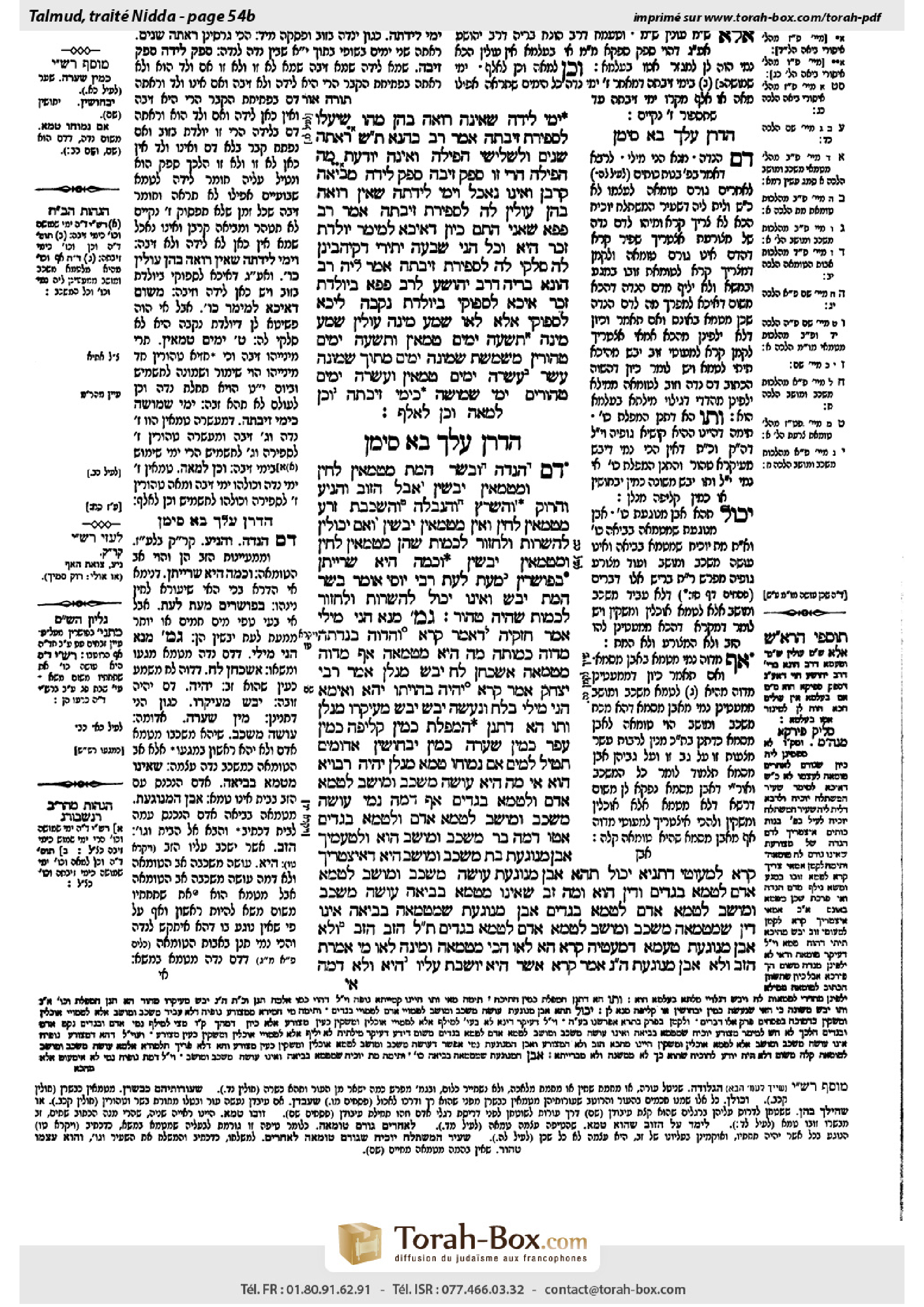
Niddah 54b: Talmud study for Daf Yomi
Daf Yomi is the daily study of one Talmud folio. Explore 37 tractates with scans, Hebrew text, Sefaria English and AI-generated French translations where annotated.
Passage selection and English or AI-generated French translation are available where the scan has annotations. Daf Study is independent of Torah-Box and Sefaria.
Browse Niddah · נידה · All tractatesNiddah 54b text and translations
This page of Niddah includes the Aramaic text, an English translation and an AI-generated French translation, alongside the scan above.
נידה נ״ד ב · Aramaic and Hebrew text
יְמֵי לֵידָה שֶׁאֵינָהּ רוֹאָה בָּהֶן מַהוּ שֶׁיַּעֲלוּ לִסְפִירַת זִיבָתָהּ?
אָמַר רַב כָּהֲנָא: תָּא שְׁמַע, רָאֲתָה שְׁנַיִם, וְלַשְּׁלִישִׁי הִפִּילָה, וְאֵינָהּ יוֹדַעַת מָה הִפִּילָה —
הֲרֵי זוֹ סְפֵק זִיבָה, סְפֵק לֵידָה.
מְבִיאָה קׇרְבָּן, וְאֵינוֹ נֶאֱכָל, וִימֵי לֵידָתָהּ שֶׁאֵין רוֹאָה בָּהֶן — עוֹלִין לָהּ לִסְפִירַת זִיבָתָהּ.
אָמַר רַב פָּפָּא: שָׁאנֵי הָתָם, כֵּיוָן דְּאִיכָּא לְמֵימַר יוֹלֶדֶת זָכָר הִיא, וְכֹל הָנֵי שִׁבְעָה יַתִּירֵי דְּקָיָהֲבִינַן לַהּ סָלְקִי לַהּ לִסְפִירַת זִיבָתָהּ.
אֲמַר לֵיהּ רַב הוּנָא בְּרֵיהּ דְּרַב יְהוֹשֻׁעַ לְרַב פָּפָּא: בְּיוֹלֶדֶת זָכָר אִיכָּא לְסַפּוֹקֵי, בְּיוֹלֶדֶת נְקֵבָה לֵיכָּא לְסַפּוֹקֵי? אֶלָּא לָאו שְׁמַע מִינַּהּ עוֹלִין, שְׁמַע מִינַּהּ.
תִּשְׁעָה יָמִים טְמֵאִין, וְתִשְׁעָה יָמִים טְהוֹרִין — מְשַׁמֶּשֶׁת שְׁמוֹנָה יָמִים מִתּוֹךְ שְׁמוֹנָה עָשָׂר.
עֲשָׂרָה יָמִים טְמֵאִין וַעֲשָׂרָה יָמִים טְהוֹרִים — יְמֵי שִׁמּוּשָׁהּ כִּימֵי זִיבָתָהּ, וְכֵן לְמֵאָה וְכֵן לְאֶלֶף.
הֲדַרַן עֲלָךְ בָּא סִימָן.
מַתְנִי' דַּם הַנִּדָּה, וּבְשַׂר הַמֵּת — מְטַמְּאִין לַחִין, וּמְטַמְּאִין יְבֵשִׁין. אֲבָל הַזּוֹב, וְהַנִּיעַ, וְהָרוֹק, וְהַשֶּׁרֶץ, וְהַנְּבֵלָה, (והשכבת) [וְשִׁכְבַת] זֶרַע — מְטַמְּאִין לַחִין, וְאֵין מְטַמְּאִין יְבֵשִׁין. וְאִם יְכוֹלִין לְהִשָּׁרוֹת וְלַחְזוֹר לִכְמוֹת שֶׁהֵן — מְטַמְּאִין לַחִין וּמְטַמְּאִין יְבֵשִׁין.
וְכַמָּה הִיא שְׁרִיָּיתָן? בְּפוֹשְׁרִין מֵעֵת לְעֵת. רַבִּי יוֹסֵי אוֹמֵר: בְּשַׂר הַמֵּת יָבֵשׁ, וְאֵינוֹ יָכוֹל לְהִשָּׁרוֹת וְלַחְזוֹר לִכְמוֹת שֶׁהָיָה — טָהוֹר.
גְּמָ' מְנָא הָנֵי מִילֵּי? אָמַר חִזְקִיָּה: דְּאָמַר קְרָא ״וְהַדָּוָה בְּנִדָּתָהּ״ — מַדְוֶהָ כְּמוֹתָהּ, מָה הִיא מְטַמְּאָה, אַף מַדְוֶהָ מְטַמְּאָה.
אַשְׁכְּחַן לַח, יָבֵשׁ מְנָלַן? אָמַר רַבִּי יִצְחָק: אָמַר קְרָא ״יִהְיֶה״ — בַּהֲוָיָתוֹ יְהֵא.
וְאֵימָא: הָנֵי מִילֵּי בְּלַח וְנַעֲשָׂה יָבֵשׁ, יָבֵשׁ מֵעִיקָּרוֹ מְנָלַן? וְתוּ, הָא דִּתְנַן: הַמַּפֶּלֶת כְּמִין קְלִיפָּה, כְּמִין עָפָר, כְּמִין שַׂעֲרָה, כְּמִין יַבְחוּשִׁין אֲדוּמִּים — תָּטִיל לַמַּיִם, אִם נִמּוֹחוּ טָמֵא, מְנָלַן? ״יִהְיֶה״ — רִבּוּיָא הוּא.
אִי מָה הִיא עוֹשָׂה מִשְׁכָּב וּמוֹשָׁב לְטַמֵּא אָדָם וּלְטַמֵּא בְּגָדִים, אַף דָּמָהּ נָמֵי עוֹשֶׂה מִשְׁכָּב וּמוֹשָׁב לְטַמֵּא אָדָם וּלְטַמֵּא בְּגָדִים? אַטּוּ דָּמָה בַּר מִשְׁכָּב וּמוֹשָׁב הוּא?!
וּלְטַעְמָיךְ, אֶבֶן מְנוּגַּעַת בַּת מִשְׁכָּב וּמוֹשָׁב הִיא, דְּאִיצְטְרִיךְ קְרָא לְמַעוֹטֵי? דְּתַנְיָא: יָכוֹל תְּהֵא אֶבֶן מְנוּגַּעַת עוֹשָׂה מִשְׁכָּב וּמוֹשָׁב, לְטַמֵּא אָדָם לְטַמֵּא בְּגָדִים.
וְדִין הוּא: וּמָה זָב, שֶׁאֵינוֹ מְטַמֵּא בְּבִיאָה, עוֹשֶׂה מִשְׁכָּב וּמוֹשָׁב לְטַמֵּא אָדָם לְטַמֵּא בְּגָדִים. אֶבֶן מְנוּגַּעַת, שֶׁמְּטַמְּאָה בְּבִיאָה, אֵינוֹ דִּין שֶׁמְּטַמְּאָה מִשְׁכָּב וּמוֹשָׁב לְטַמֵּא אָדָם לְטַמֵּא בְּגָדִים!
תַּלְמוּד לוֹמַר ״הַזָּב״ — ״הַזָּב״ וְלֹא אֶבֶן מְנוּגַּעַת. טַעְמָא דְּמַעֲטַיהּ קְרָא, הָא לָאו הָכִי מְטַמְּאָה.
וּמִינַּהּ: לָאו מִי אָמְרַתְּ ״הַזָּב״ — וְלֹא אֶבֶן מְנוּגַּעַת, הָכִי נָמֵי אָמַר קְרָא ״אֲשֶׁר הִיא יוֹשֶׁבֶת עָלָיו״ — הִיא, וְלֹא דָּמָהּ.
Niddah 54b · English translation
What is the halakha in the case of a woman who gave birth when she was a zava? There are seven days of impurity following the birth of a son and fourteen days of impurity following the birth of a daughter, during which the mother is impure even if she did not experience bleeding. With regard to those days during this period on which she does not see blood, are they reckoned in the counting of her seven clean days required to become purified from the status of ziva?
Rav Kahana says: Come and hear a baraita: A woman saw blood on two consecutive days during the period of ziva, and on the third day she miscarried, but she does not know what she miscarried, i.e., whether it was a stillborn human fetus for which a woman contracts the impurity of childbirth, or whether she discharged an amorphous piece of tissue. In addition, she does not know whether she emitted blood during the miscarriage.
In such a case, it is uncertain whether she has the status of one who experienced ziva or whether she has the status of a woman who gave birth. If she gave birth to a fetus and did not emit blood, she is a woman after childbirth but not a zava. If the discharge was an amorphous piece of tissue and she saw blood, she is a zava. If it was a human fetus and she saw blood, she is one who gives birth as a zava. Finally, if she did not emit blood and it was a discharge of an amorphous piece of tissue, she is not obligated to bring an offering at all.
Consequently, she brings an offering but it is not eaten by the priests, as it is uncertain whether it is an offering of ziva or an offering for her childbirth, or whether it is non-sacred. And the days of impurity following this uncertain birth, on which she does not see blood, are reckoned in the counting of her seven clean days required to become purified from the status of ziva. This resolves the dilemma raised by the Sages.
Rav Pappa says that this does not resolve the dilemma, as it is different there, since it can be said that she is a woman who gave birth to a male, and it is only for that reason that all of these additional seven days that we give her due to the concern that she might have given birth to a female, which would render her impure for fourteen days, are reckoned in the counting of her seven clean days of ziva. But if it was certain that she gave birth to a female, those days after the birth would not count toward her period of ziva.
Rav Huna, son of Rav Yehoshua, said to Rav Pappa: Is there uncertainty that perhaps she is a woman who gave birth to a male, but there is no uncertainty that she might be a woman who gave birth to a female? In fact, both possibilities must be taken into account. And yet, despite the fact that she might have given birth to a female, these seven days are included in the counting of her seven clean days. Rather, isn’t it correct to conclude from it that such days are reckoned in the counting? The Gemara comments: Indeed, conclude from the baraita that these days do count.
The Gemara concludes its citation of the baraita: In the case of a woman whose set pattern is that nine days she is impure, i.e., experiences bleeding, and nine days she is pure, she may engage in intercourse with her husband during eight days out of eighteen. The last two days of the nine with blood are part of her ziva period, after which she must observe one clean day, leaving her with eight days when she may engage in intercourse before the cycle begins again.
In the case of a woman whose set pattern is that ten days she is impure and ten days she is pure, the number of days of her being permitted to engage in intercourse with her husband is equivalent to the number of days of her experiencing the flow of ziva. In the first seven days she is a menstruating woman, followed by three days of blood that render her a zava. She must count seven of the ten days without blood to be purified from her ziva, which leaves her three days in which she may engage in intercourse, exactly the same as the three days of ziva on which she saw blood. And so too, the same applies in the case of one hundred days, as she experiences bleeding of ziva for ninety-three days, and is subsequently permitted to her husband for ninety-three days, and so too in the case of one thousand days.
MISHNA: The blood of a menstruating woman and the flesh of a corpse transmit impurity by contact and by carrying when they are moist, and likewise transmit impurity when they are dry. But with regard to the gonorrhea-like discharge of a zav [ziva], and the mucus and the saliva of a zav, and the carcass of a creeping animal, and an animal carcass, and semen, all transmit impurity when they are moist but do not transmit impurity when they are dry. And if one could soak those dry substances in water and thereby restore them to their previous state, they transmit impurity when moist and transmit impurity when dry.
The mishna asks: And how long is the process of soaking these substances that determines whether they can be restored to their previous state? This is referring to soaking them in lukewarm water for a twenty-four-hour period. Rabbi Yosei says: With regard to the flesh of a corpse that is dry and cannot be soaked to restore it to its previous state, it is ritually pure, in the sense that an olive-bulk of the flesh does not transmit impurity imparted by a corpse. But a ladleful of the flesh transmits the impurity of the decayed flesh of a corpse.
GEMARA: The mishna teaches that the blood of a menstruating woman transmits impurity by contact and by carrying both when moist and when dry. The Gemara asks: From where are these matters derived? Ḥizkiyya says: They are derived from a verse, as the verse states with regard to a menstruating woman: “This is the law of him that has an issue…And of her who experiences the flow of her menstrual impurity” (Leviticus 15:32–33). The verse compares the status of the menstrual flow to that of the menstruating woman. This teaches that the status of the menstrual flow is like the status of the woman herself: Just as she transmits impurity by contact and by carrying, so too, the menstrual flow transmits impurity by contact and by carrying.
The Gemara asks: We found a source for the impurity of the menstrual blood when it is moist, since it is called the menstrual flow; from where do we derive that dry menstrual blood also transmits impurity? Rabbi Yitzḥak says that the verse states with regard to menstrual impurity: “And if a woman should have an issue, and her issue in her flesh shall be blood, she shall be in her impurity seven days, and whoever touches her shall be impure until the evening” (Leviticus 15:19). The term “shall be” indicates that the blood shall remain in its impure status even once it is dry.
The Gemara objects: But one may say that this statement applies only to blood that was initially moist and subsequently became dry, as it retains its initial status. With regard to blood that was dry at the outset, from where do we derive that it too transmits impurity? And furthermore, this inference does not provide a source for that which we learned in a mishna (21a): In the case of a woman who discharges an item whose shape is similar to a type of shell, similar to a type of soil, similar to a type of hair, or similar to a type of mosquito, if such items are red, she should cast them into water to ascertain their nature. If they dissolved, it is blood, and the woman is impure. From where do we derive that even this type of blood is impure? The Gemara explains: The term “shall be” is an amplification, indicating that menstrual blood in all these forms is impure.
The Gemara objects: If so, one can likewise infer the following: Just as she, a menstruating woman, renders an item designated for lying or sitting impure to the extent that it transmits impurity to a person and to the extent that that person transmits impurity to his garments, despite the fact that the garments did not come into contact with the couch, so too, her blood also renders items designated for lying or sitting impure to the extent that they transmit impurity to a person and to the extent that he transmits impurity to his garments, in the manner of a primary source of ritual impurity. The Gemara replies: Is that to say that the concepts of lying and sitting apply to her menstrual blood? These categories of impurity are limited to people.
The Gemara asks: But according to your reasoning that this category of impurity is limited to people, do the concepts of lying and sitting apply to a stone afflicted with leprosy, so that a verse was necessary to exclude it? As it is taught in a baraita: One might have thought that a stone afflicted with leprosy should render an item designated for lying or sitting impure to the extent that it transmits impurity to a person and to the extent that he transmits impurity to his garments.
The baraita explains: And this ruling might be derived by logical inference: If one enters a house where there is a stone afflicted with leprosy he becomes impure, but one who enters a house together with a man who experienced a gonorrhea-like discharge [zav] does not become impure. One may therefore infer as follows: If a zav, who does not transmit impurity by entering a house, nevertheless renders an item designated for lying or sitting impure to the extent that it transmits impurity to a person and to the extent that that person transmits impurity to his garments, then with regard to a stone afflicted with leprosy, which does transmit impurity by entering a house, is it not logical that it renders an item designated for lying or sitting impure to the extent that it transmits impurity to a person and to the extent that he transmits impurity to the garments he is wearing?
The baraita concludes: Therefore, the verse states: “Every bed upon which the zav lies shall be impure, and every item upon which he sits shall be impure” (Leviticus 15:4). The term “the zav” indicates that only the zav, and not a stone afflicted with leprosy, renders items designated for lying or sitting impure. The Gemara infers from the baraita: The reason a stone afflicted with leprosy does not transmit impurity to items designated for lying or sitting is that the verse excluded it, but were it not so, the stone would transmit impurity to items designated for lying or sitting, despite the fact that the concepts of lying and sitting do not apply to a stone.
The Gemara replies that from this same derivation one can infer that menstrual blood does not render items designated for lying or sitting impure: Didn’t you say that the term “the zav” teaches that only the zav, and not a stone afflicted with leprosy, renders items designated for lying or sitting impure? So too, a verse excludes menstrual blood from this category of impurity, as the verse states: “And he if is on the bed, or on any item upon which she sits, when he touches it, he shall be impure until the evening” (Leviticus 15:23). The term “she” indicates that she, the menstruating woman, but not her blood, transmits impurity to items designated for lying or sitting.
Niddah 54b · Traduction française (IA)
Quelle est la halakha dans le cas d’une femme qui a accouché alors qu’elle était zava ? Après la naissance d’un garçon, il y a sept jours d’impureté, et après celle d’une fille, quatorze jours d’impureté, durant lesquels la mère est impure même si elle n’a pas eu de saignement. Les jours de cette période où elle ne voit pas de sang sont-ils comptés parmi les sept jours propres qu’elle doit décompter pour se purifier de son statut de ziva ?
Rav Kahana dit : Viens et entends une baraïta : une femme a vu du sang pendant deux jours consécutifs au cours de la période de ziva, et, le troisième jour, elle a fait une fausse couche, mais elle ignore ce qu’elle a expulsé, c’est-à-dire s’il s’agissait d’un fœtus humain mort-né, auquel cas elle contracte l’impureté liée à l’accouchement, ou d’un morceau de tissu informe. De plus, elle ignore si elle a perdu du sang au moment de la fausse couche.
Dans un tel cas, on ne sait pas si elle a le statut d’une femme ayant connu la ziva ou celui d’une femme qui a accouché. Si elle a accouché d’un fœtus et n’a pas perdu de sang, elle est une femme en période post-partum, mais pas une zava. Si l’expulsion était un morceau de tissu informe et qu’elle a vu du sang, elle est une zava. Si c’était un fœtus humain et qu’elle a vu du sang, elle a accouché alors qu’elle était zava. Enfin, si elle n’a pas perdu de sang et qu’il s’agissait de l’expulsion d’un morceau de tissu informe, elle n’est tenue d’apporter aucun sacrifice.
Par conséquent, elle apporte un sacrifice, mais celui-ci n’est pas consommé par les prêtres, car on ne sait pas s’il s’agit d’un sacrifice pour la ziva, d’un sacrifice lié à son accouchement ou d’un sacrifice profane. Les jours d’impureté suivant cette naissance incertaine où elle ne voit pas de sang sont comptés parmi les sept jours propres qu’elle doit décompter pour se purifier de son statut de ziva. Cela résout le dilemme soulevé par les Sages.
Rav Pappa dit que cela ne résout pas le dilemme, car le cas est différent ici : on peut dire qu’elle a accouché d’un garçon et que c’est uniquement pour cette raison que les sept jours supplémentaires qu’on lui accorde, par crainte qu’elle ait accouché d’une fille — ce qui la rendrait impure pendant quatorze jours — sont comptés parmi les sept jours propres de ziva. Mais s’il était certain qu’elle a accouché d’une fille, ces jours suivant l’accouchement ne seraient pas comptés pour sa période de ziva.
Rav Houna, fils de Rav Yehoshoua, dit à Rav Pappa : Y a-t-il incertitude quant à la possibilité qu’elle ait accouché d’un garçon, mais aucune incertitude quant à la possibilité qu’elle ait accouché d’une fille ? En réalité, il faut tenir compte des deux possibilités. Pourtant, bien qu’elle ait peut-être accouché d’une fille, ces sept jours sont inclus dans le décompte de ses sept jours propres. Ne faut-il donc pas conclure de là que de tels jours sont comptés dans ce décompte ? La Guemara commente : En effet, concluons de cette baraïta que ces jours sont bien comptés.
La Guemara achève de citer la baraïta : dans le cas d’une femme dont le cycle établi est de neuf jours d’impureté, c’est-à-dire avec des saignements, puis de neuf jours de pureté, elle peut avoir des relations avec son mari pendant huit jours sur dix-huit. Les deux derniers jours des neuf jours de saignement relèvent de sa période de ziva ; elle doit ensuite observer un jour propre, ce qui lui laisse huit jours durant lesquels elle peut avoir des relations avant que le cycle ne recommence.
Dans le cas d’une femme dont le cycle établi est de dix jours d’impureté, puis de dix jours de pureté, le nombre de jours où elle est autorisée à avoir des relations avec son mari équivaut au nombre de jours où elle connaît un flux de ziva. Pendant les sept premiers jours, elle est nidda, puis viennent trois jours de saignement qui font d’elle une zava. Elle doit décompter sept des dix jours sans saignement pour se purifier de sa ziva ; il lui reste alors trois jours durant lesquels elle peut avoir des relations, soit exactement le nombre de jours de ziva où elle a vu du sang. Il en va de même pour une période de cent jours : elle connaît un saignement de ziva pendant quatre-vingt-treize jours, puis est autorisée à avoir des relations avec son mari pendant quatre-vingt-treize jours ; et il en va de même pour une période de mille jours.
MICHNA : Le sang d’une femme nidda et la chair d’un cadavre transmettent l’impureté par contact et par portage lorsqu’ils sont humides, et la transmettent également lorsqu’ils sont secs. En revanche, l’écoulement semblable à la gonorrhée d’un zav [ziva], le mucus et la salive d’un zav, la carcasse d’un animal rampant, la carcasse d’un animal et le sperme transmettent tous l’impureté lorsqu’ils sont humides, mais ne la transmettent pas lorsqu’ils sont secs. Si l’on peut faire tremper ces substances sèches dans l’eau et leur rendre ainsi leur état antérieur, elles transmettent l’impureté aussi bien humides que sèches.
La Michna demande : Combien de temps faut-il faire tremper ces substances pour déterminer si elles peuvent retrouver leur état antérieur ? Il faut les faire tremper dans de l’eau tiède pendant vingt-quatre heures. Rabbi Yossi dit : Quant à la chair sèche d’un cadavre, qu’on ne peut pas faire tremper pour lui rendre son état antérieur, elle est rituellement pure, en ce sens qu’un volume d’olive de cette chair ne transmet pas l’impureté d’un cadavre. Mais une pleine louche de cette chair transmet l’impureté de la chair putréfiée d’un cadavre.
GUEMARA : La Michna enseigne que le sang d’une femme nidda transmet l’impureté par contact et par portage, qu’il soit humide ou sec. La Guemara demande : De quelle source déduit-on ces règles ? Hizkiya dit : Elles se déduisent d’un verset, car celui-ci dit au sujet d’une femme nidda : « Telle est la loi de celui qui a un écoulement… et de celle qui a un écoulement de sang menstruel impur » (Lévitique 15, 32-33). Le verset établit une comparaison entre le statut du flux menstruel et celui de la femme nidda. Il enseigne que le statut du flux menstruel est comme celui de la femme elle-même : de même qu’elle transmet l’impureté par contact et par portage, de même le flux menstruel transmet l’impureté par contact et par portage.
La Guemara demande : Nous avons trouvé une source établissant l’impureté du sang menstruel lorsqu’il est humide, puisqu’il est appelé « flux menstruel » ; d’où déduit-on que le sang menstruel sec transmet lui aussi l’impureté ? Rabbi Yitzhak dit que le verset relatif à l’impureté menstruelle énonce : « Si une femme a un écoulement, et que son écoulement dans sa chair soit du sang, elle sera dans son impureté pendant sept jours, et quiconque la touchera sera impur jusqu’au soir » (Lévitique 15, 19). L’expression « sera dans son impureté » indique que le sang conserve son statut d’impureté même une fois sec.
La Guemara objecte : Mais on pourrait dire que cette déclaration ne s’applique qu’au sang qui était d’abord humide puis est devenu sec, puisqu’il conserve son statut initial. D’où déduit-on que le sang qui était sec dès le départ transmet lui aussi l’impureté ? De plus, cette déduction ne fournit pas de source pour ce que nous avons appris dans une Michna (21a) : si une femme expulse un objet ayant la forme d’une sorte de coquille, d’une sorte de terre, d’une sorte de cheveu ou d’un moustique, s’il est rouge, elle doit le jeter dans l’eau pour en déterminer la nature. S’il se dissout, c’est du sang et la femme est impure. D’où déduit-on que ce type de sang est lui aussi impur ? La Guemara explique : l’expression « sera dans son impureté » est une amplification, indiquant que le sang menstruel sous toutes ces formes est impur.
La Guemara objecte : Dans ce cas, on pourrait également déduire ce qui suit : de même qu’une femme nidda rend impur un objet destiné à servir de couche ou de siège, au point que cet objet transmet l’impureté à une personne, puis que cette personne transmet l’impureté à ses vêtements, bien que ceux-ci n’aient pas été en contact avec la couche, de même son sang rendrait lui aussi impurs les objets destinés à servir de couche ou de siège, au point qu’ils transmettraient l’impureté à une personne, puis que celle-ci la transmettrait à ses vêtements, à la manière d’une source primaire d’impureté rituelle. La Guemara répond : Veut-on dire que les notions de couche et de siège s’appliquent à son sang menstruel ? Ces catégories d’impureté sont réservées aux personnes.
La Guemara demande : Mais, selon votre raisonnement, si cette catégorie d’impureté est réservée aux personnes, les notions de couche et de siège s’appliquent-elles à une pierre atteinte de lèpre, au point qu’un verset ait été nécessaire pour l’exclure ? Car il est enseigné dans une baraïta : On aurait pu penser qu’une pierre atteinte de lèpre rend impur un objet destiné à servir de couche ou de siège, au point que cet objet transmette l’impureté à une personne, puis que celle-ci la transmette à ses vêtements.
La baraïta explique : On pourrait déduire cette règle par raisonnement a fortiori : celui qui entre dans une maison où se trouve une pierre atteinte de lèpre devient impur, tandis que celui qui entre dans une maison avec un homme qui a connu un écoulement semblable à la gonorrhée [zav] ne devient pas impur. On pourrait donc conclure ainsi : si un zav, qui ne transmet pas l’impureté en entrant dans une maison, rend néanmoins impur un objet destiné à servir de couche ou de siège, au point que cet objet transmette l’impureté à une personne, puis que cette personne la transmette à ses vêtements, alors, à plus forte raison, une pierre atteinte de lèpre, qui transmet l’impureté en entrant dans une maison, rend-elle impur un objet destiné à servir de couche ou de siège, au point que celui-ci transmette l’impureté à une personne, puis que celle-ci la transmette aux vêtements qu’elle porte.
La baraïta conclut : C’est pourquoi le verset dit : « Tout lit sur lequel le zav se couche sera impur, et tout objet sur lequel il s’assied sera impur » (Lévitique 15, 4). L’expression « le zav » indique que seul le zav, et non une pierre atteinte de lèpre, rend impurs les objets destinés à servir de couche ou de siège. La Guemara déduit de la baraïta : La raison pour laquelle une pierre atteinte de lèpre ne transmet pas l’impureté aux objets destinés à servir de couche ou de siège est que le verset l’en exclut ; sans cela, la pierre transmettrait l’impureté à ces objets, bien que les notions de couche et de siège ne s’appliquent pas à une pierre.
La Guemara répond qu’on peut déduire de cette même interprétation que le sang menstruel ne rend pas impurs les objets destinés à servir de couche ou de siège : n’avez-vous pas dit que l’expression « le zav » enseigne que seul le zav, et non une pierre atteinte de lèpre, rend impurs les objets destinés à servir de couche ou de siège ? De même, un verset exclut le sang menstruel de cette catégorie d’impureté, car le verset dit : « Et s’il est sur le lit, ou sur tout objet sur lequel elle s’assied, lorsqu’il le touche, il sera impur jusqu’au soir » (Lévitique 15, 23). L’expression « elle » indique que c’est elle, la femme nidda, mais non son sang, qui transmet l’impureté aux objets destinés à servir de couche ou de siège.
Traduction française générée par IA à partir de l’édition anglaise de Sefaria. Vérifie toujours un passage avec le texte source.
Text from Sefaria: William Davidson Edition - Vocalized Aramaic (CC BY NC); William Davidson Edition - English (CC BY NC).