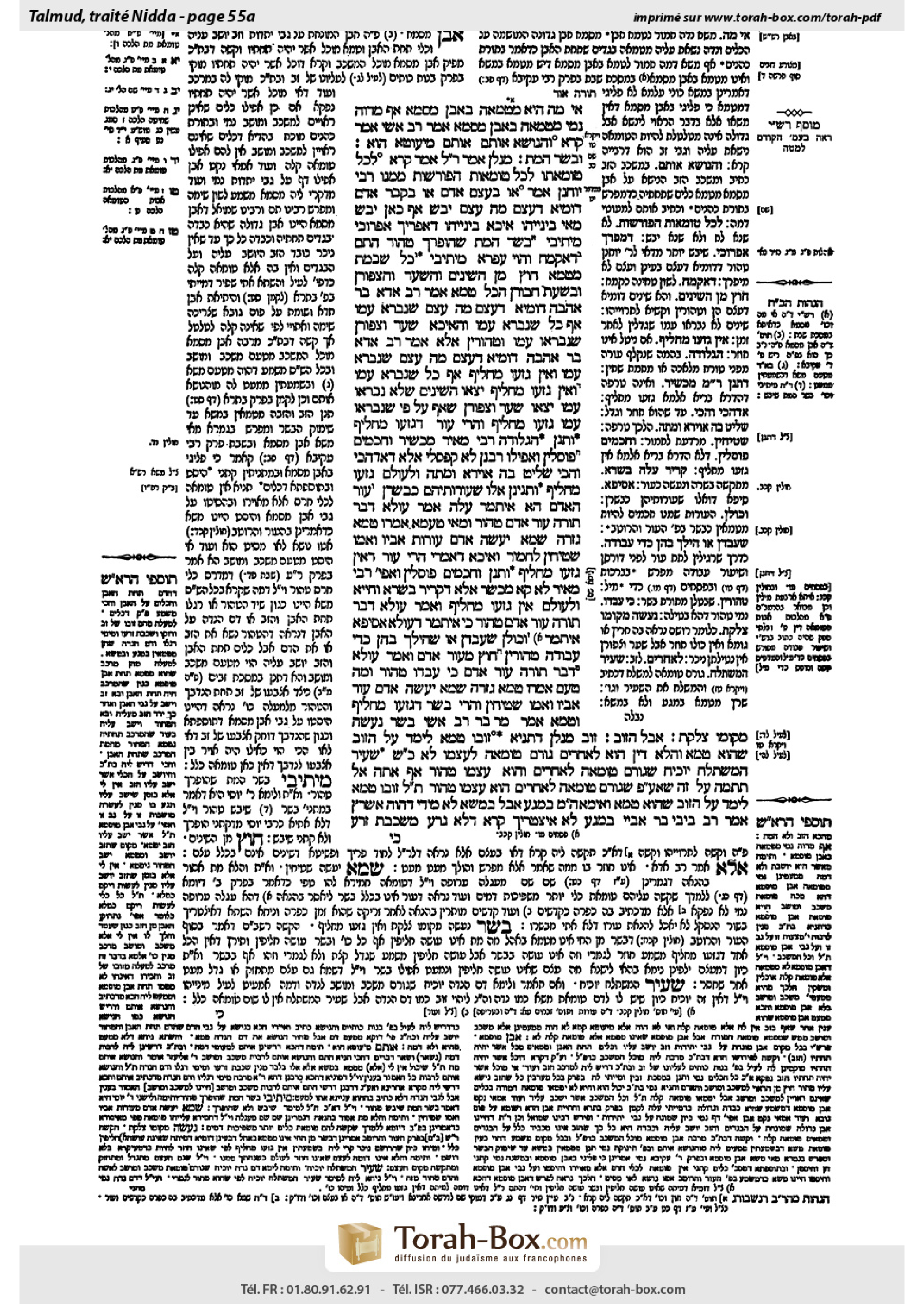
Niddah 55a: Talmud study for Daf Yomi
Daf Yomi is the daily study of one Talmud folio. Explore 37 tractates with scans, Hebrew text, Sefaria English and AI-generated French translations where annotated.
Passage selection and English or AI-generated French translation are available where the scan has annotations. Daf Study is independent of Torah-Box and Sefaria.
Browse Niddah · נידה · All tractatesNiddah 55a text and translations
This page of Niddah includes the Aramaic text, an English translation and an AI-generated French translation, alongside the scan above.
נידה נ״ה א · Aramaic and Hebrew text
אִי מָה הִיא מְטַמְּאָה בְּאֶבֶן מְסָמָא, אַף מַדְוֶהָ נָמֵי מְטַמְּאָה בְּאֶבֶן מְסָמָא?
אָמַר רַב אָשֵׁי: אָמַר קְרָא ״וְהַנּוֹשֵׂא אוֹתָם״ — ״אוֹתָם״ מִיעוּטָא הוּא.
וּבְשַׂר הַמֵּת, מְנָלַן? אָמַר רֵישׁ לָקִישׁ: אָמַר קְרָא ״לְכֹל טֻמְאָתוֹ״ — לְכׇל טְמָאוֹת הַפּוֹרְשׁוֹת מִמֶּנּוּ.
רַבִּי יוֹחָנָן אָמַר: ״אוֹ בְעֶצֶם אָדָם אוֹ בְקָבֶר״ — אָדָם דּוּמְיָא דְּעֶצֶם: מָה עֶצֶם יָבֵשׁ, אַף כָּאן יָבֵשׁ.
מַאי בֵּינַיְיהוּ? אִיכָּא בֵּינַיְיהוּ דְּאִפְּרִיךְ אִפְּרוֹכֵי.
מֵיתִיבִי: בְּשַׂר הַמֵּת שֶׁהוּפְרַךְ טָהוֹר! הָתָם דְּאַקְמַח וְהָוֵי עַפְרָא.
מֵיתִיבִי: כֹּל שֶׁבַּמֵּת מְטַמֵּא, חוּץ מִן הַשִּׁינַּיִם, וְהַשֵּׂעָר, וְהַצִּפּוֹרֶן, וּבִשְׁעַת חִבּוּרָן — הַכֹּל טָמֵא!
אָמַר רַב אַדָּא בַּר אַהֲבָה: דּוּמְיָא דְּעֶצֶם, מָה עֶצֶם שֶׁנִּבְרָא עִמּוֹ, אַף כֹּל שֶׁנִּבְרָא עִמּוֹ. וְהָאִיכָּא שֵׂעָר וְצִפּוֹרֶן, שֶׁנִּבְרְאוּ עִמּוֹ וּטְהוֹרִין!
אֶלָּא אָמַר רַב אַדָּא בַּר אַהֲבָה: דּוּמְיָא דְּעֶצֶם, מָה עֶצֶם שֶׁנִּבְרָא עִמּוֹ וְאֵין גִּזְעוֹ מַחְלִיף, אַף כֹּל שֶׁנִּבְרָא עִמּוֹ וְאֵין גִּזְעוֹ מַחְלִיף. יָצְאוּ הַשִּׁינַּיִם — שֶׁלֹּא נִבְרְאוּ עִמּוֹ, יָצְאוּ שֵׂעָר וְצִפּוֹרֶן — שֶׁאַף עַל פִּי שֶׁנִּבְרְאוּ עִמּוֹ, גִּזְעוֹ מַחְלִיף.
וַהֲרֵי עוֹר, דְּגִזְעוֹ מַחְלִיף, וּתְנַן: הַגְּלוּדָה — רַבִּי מֵאִיר מַכְשִׁיר וַחֲכָמִים פּוֹסְלִין. וַאֲפִילּוּ רַבָּנַן לָא קָפָסְלִי אֶלָּא דְּאַדְּהָכֵי וְהָכֵי שָׁלֵיט בַּהּ אַוֵּירָא וּמִתָה, וּלְעוֹלָם גִּזְעוֹ מַחְלִיף. וּתְנֵינַן: אֵלּוּ שֶׁעוֹרוֹתֵיהֶם כִּבְשָׂרָן — עוֹר הָאָדָם!
הָא אִיתְּמַר עֲלַהּ, אָמַר עוּלָּא: דְּבַר תּוֹרָה — עוֹר אָדָם טָהוֹר, וּמַאי טַעְמָא אָמְרוּ טָמֵא? גְּזֵרָה שֶׁמָּא יַעֲשֶׂה אָדָם עוֹרוֹת אָבִיו וְאִמּוֹ שְׁטִיחִין לַחֲמוֹר.
וְאִיכָּא דְאָמְרִי: הֲרֵי עוֹר, דְּאֵין גִּזְעוֹ מַחְלִיף, וּתְנַן: וַחֲכָמִים פּוֹסְלִין, וַאֲפִילּוּ רַבִּי מֵאִיר לָא קָא מַכְשַׁר אֶלָּא דְּקָרִיר בִּשְׂרָא וְחָיֵיא, וּלְעוֹלָם אֵין גִּזְעוֹ מַחְלִיף. וְאָמַר עוּלָּא: דְּבַר תּוֹרָה עוֹר אָדָם טָהוֹר!
כִּי אִיתְּמַר דְּעוּלָּא אַסֵּיפָא אִיתְּמַר, ״וְכוּלָּן שֶׁעִבְּדָן אוֹ שֶׁהִילֵּךְ בָּהֶן כְּדֵי עֲבוֹדָה טְהוֹרִין, חוּץ מֵעוֹר אָדָם״, וְאָמַר עוּלָּא: דְּבַר תּוֹרָה עוֹר אָדָם כִּי עִבְּדּוֹ טָהוֹר, וּמָה טַעַם אָמְרוּ טָמֵא? גְּזֵרָה שֶׁמָּא יַעֲשֶׂה אָדָם עוֹר אָבִיו וְאִמּוֹ שְׁטִיחִין.
וַהֲרֵי בָּשָׂר, דְּגִזְעוֹ מַחְלִיף, וְטָמֵא! אָמַר מָר בַּר רַב אָשֵׁי: בָּשָׂר נַעֲשֶׂה מְקוֹמוֹ צַלֶּקֶת.
אֲבָל הַזּוֹב. זוֹב מְנָלַן? דְּתַנְיָא: ״זוֹבוֹ טָמֵא״ — לִימֵּד עַל הַזּוֹב שֶׁהוּא טָמֵא.
וַהֲלֹא דִין הוּא: לַאֲחֵרִים גּוֹרֵם טוּמְאָה, לְעַצְמוֹ לֹא כׇּל שֶׁכֵּן? שָׂעִיר הַמִּשְׁתַּלֵּחַ יוֹכִיחַ, שֶׁגּוֹרֵם טוּמְאָה לַאֲחֵרִים, וְהוּא עַצְמוֹ טָהוֹר. אַף אַתָּה אַל תִּתְמַהּ עַל זֶה, שֶׁאַף עַל פִּי שֶׁגּוֹרֵם טוּמְאָה לַאֲחֵרִים — הוּא עַצְמוֹ טָהוֹר. תַּלְמוּד לוֹמַר ״זוֹבוֹ טָמֵא״ — לִימֵּד עַל הַזּוֹב שֶׁהוּא טָמֵא.
וְאֵימָא: הָנֵי מִילֵּי בְּמַגָּע, אֲבָל בְּמַשָּׂא לָא, מִידֵּי דְּהָוֵה אַשֶּׁרֶץ! אָמַר רַב בִּיבִי בַּר אַבָּיֵי: בְּמַגָּע לָא אִיצְטְרִיךְ קְרָא, דְּלָא גָּרַע מִשִּׁכְבַת זֶרַע,
Niddah 55a · English translation
The Gemara raises an objection: There is a unique halakha with regard to the impurity of a zav and a menstruating woman: In a case where one of them sits on an item, including one that cannot become ritually impure, e.g., a stone, and beneath that item is a vessel, that vessel becomes impure, even if their weight has no effect on the vessel, as in the case of a very heavy stone. If the verse compares the status of the menstrual blood to the status of the menstruating woman, as derived above, one can infer as follows: Just as a menstruating woman transmits impurity to items that lie beneath a very heavy stone, so too, her menstrual flow also transmits impurity to items that lie beneath a very heavy stone.
Rav Ashi said in response: Items designated for lying or sitting also transmit impurity to items that lie beneath a very heavy stone. The verse states with regard to an item of this kind, which was rendered impure by a zav: “And whoever touches anything that was under him shall be impure until the evening, and he that carries them shall wash his clothes, and bathe himself in water, and he shall be impure until the evening” (Leviticus 15:10). The term “them” is an exclusion, indicating that items designated for lying or sitting transmit impurity to items that lie beneath a very heavy stone, but menstrual blood does not.
§ The mishna teaches: And the flesh of a corpse transmits impurity both when moist and when dry. The Gemara asks: From where do we derive this halakha? Reish Lakish said that this is as the verse states: “Or whoever touches any creeping thing by which he may be made impure, or a man from whom he may be made impure, from any impurity that he has” (Leviticus 22:5). The term “from any” is an amplification, indicating that one may become impure from any impurities that come from a dead person, whether they are moist or dry.
Rabbi Yoḥanan said that this halakha is derived from the verse: “And whoever touches in the open field one who is slain with a sword, or one who died, or the bone of a man, or a grave, shall be impure seven days” (Numbers 19:16). The verse indicates that the impurity of a dead man is similar to the impurity of a bone: Just as a bone is dry, so too here, with regard to the impurity of a corpse, it transmits impurity even when it is dry.
The Gemara asks: What is the practical difference between the inferences of Reish Lakish and Rabbi Yoḥanan? The Gemara answers that the practical difference between them is the case of a corpse which is so dry that it crumbles. Reish Lakish maintains it is impure, as the term “from any” indicates that a corpse transmits impurity in any form, whereas Rabbi Yoḥanan maintains it is ritually pure, as it is unlike a bone, which does not crumble.
The Gemara raises an objection to the opinion of Reish Lakish from a baraita: The flesh of a corpse that crumbled is ritually pure. The Gemara answers that this is not difficult, as the baraita there is referring to where the flesh is so dry that it has become like flour and is therefore classified as dust.
The Gemara raises an objection to the opinions of both Reish Lakish and Rabbi Yoḥanan from a mishna (Oholot 3:3): Everything that is in a corpse transmits impurity, except for the teeth, and the hair, and the nails. This is the halakha only when these items are separated from the body, but when they are attached to the corpse they are all impure. According to Rabbi Yoḥanan teeth should transmit impurity because they are similar to bones, while according to Reish Lakish they should be included in the term “from any.”
Rav Adda bar Ahava said: Only items that are similar to a bone transmit impurity: Just as a bone is an item that was created with him at the time of birth, so too, all items that transmit impurity are those that were created with him, whereas teeth are not present at the time of birth. The Gemara asks: But are there not the cases of hair and nails, which were created with him, and yet the mishna states that they are ritually pure?
Rather, Rav Adda bar Ahava said a different explanation: Only those items that are similar to a bone transmit impurity: Just as a bone is an item that was created with him and its root does not renew itself, i.e., if a bone is removed a new bone does not grow in its place, so too, any item that was created with him and whose root does not renew itself transmits impurity. The teeth were excluded from this category, as they were not created with him. The hair and nails were excluded, as even though they were created with him their roots renew themselves, since they grow again after they are cut off.
The Gemara objects: But isn’t there the case of skin, whose root renews itself, and this is as we learned in a mishna (Ḥullin 54a): In the case of an animal whose hide was removed [hageluda], Rabbi Meir deems it kosher, as the skin renews itself, and the Rabbis deem it an animal with a wound that will cause it to die within twelve months [tereifa] and unfit for consumption. The Gemara explains: And even the Rabbis deem it unfit only due to the fact that in the meantime, between the removal of the old hide and the growth of the new one, the air affects it and as a result it will die, but they concede that actually the skin’s root renews itself. And nevertheless we learned in a mishna (Ḥullin 122a): These are the entities whose skin has the same halakhic status as their flesh: The skin of a dead person, and the skin of a domesticated pig…and the skin of the hump of a young camel, etc.
The Gemara explains that it was stated with regard to that mishna that Ulla said: By Torah law, the skin of a dead person is ritually pure. And what is the reason the Sages said that it is impure? It is a rabbinic decree lest a person should fashion rugs for a donkey out of the skins of his deceased father and mother.
And some say a different version of the above discussion: Isn’t there the case of skin, whose root does not renew itself, and this is as we learned in a mishna (Ḥullin 54a): In the case of an animal whose hide was removed, Rabbi Meir deems it kosher, and the Rabbis deem it a tereifa and unfit for consumption, as its skin does not regrow? The Gemara explains: And even Rabbi Meir deems it fit only because the flesh cools and the animal heals, but he concedes that actually the skin’s root does not renew itself. Accordingly, the skin of a corpse should be impure. But Ulla said: By Torah law, the skin of a dead person is ritually pure.
The Gemara answers that when the opinion of Ulla was stated, it was stated with regard to the latter clause of that mishna: And for all of these skins, in a case where one tanned them or where one spread them on the ground and trod on them for the same amount of time it takes for tanning, they are no longer classified as flesh and are ritually pure, except for the skin of a dead person, which maintains the status of flesh. And with regard to this Ulla said that by Torah law the skin of a dead person, when one tanned it, is ritually pure. And what is the reason the Sages said it is impure? It is a rabbinic decree lest a person should fashion rugs out of the skin of his deceased father and mother.
The Gemara asks: But isn’t there the case of flesh, whose root renews itself, as when one’s flesh is cut it regrows and heals, and yet it is impure? Mar bar Rav Ashi says: Flesh does not renew itself, as although when someone is cut his flesh regrows and heals, a scar is formed in its place.
§ The mishna teaches: But ziva transmits impurity when moist, although not when dry. The Gemara asks: From where do we derive that ziva transmits impurity? As it is taught in a baraita that discusses the verse: “When any man has an issue out of his flesh, his issue, it is impure” (Leviticus 15:2). This taught with regard to ziva that it is impure.
The baraita asks: Why is this derivation necessary? Could this not be derived through an a fortiori inference? Since ziva causes impurity to others, i.e., to the one who emitted the discharge, is it not all the more so that ziva itself is impure? The baraita replies that the case of the scapegoat brought on Yom Kippur may prove that this inference is not valid, as it causes impurity to others, i.e., the dispatcher of the scapegoat is rendered impure, and yet the goat itself is pure. So too, you should not be surprised about this, the discharge of ziva, that even though it causes impurity to others, ziva itself is pure. Therefore, the verse states: “His issue, it is impure.” This taught with regard to ziva that it is impure.
The Gemara objects: But one may say that this statement, that the discharge of ziva transmits impurity, applies only to transmitting impurity by contact. But with regard to transmitting impurity by carrying it does not transmit impurity, just as it is with regard to the carcass of a creeping animal, which transmits impurity by contact but not by carrying. Rav Beivai bar Abaye said: A verse was not necessary to teach that ziva transmits ritual impurity by contact, as the halakha with regard to ziva is no less stringent than with regard to semen, which transmits impurity by contact.
Niddah 55a · Traduction française (IA)
La Guemara soulève une objection : il existe une halakha particulière concernant l’impureté d’un zav et d’une femme menstruée. Si l’un d’eux s’assoit sur un objet, y compris un objet qui ne peut pas devenir rituellement impur, par exemple une pierre, et qu’un récipient se trouve sous cet objet, le récipient devient impur, même si leur poids n’a aucun effet sur lui, comme dans le cas d’une pierre très lourde. Si le verset compare le statut du sang menstruel à celui de la femme menstruée, comme cela a été déduit précédemment, on peut en inférer ceci : de même qu’une femme menstruée transmet l’impureté aux objets placés sous une pierre très lourde, de même son écoulement menstruel transmet l’impureté aux objets placés sous une pierre très lourde.
Rav Ashi répondit : les objets destinés à servir de couche ou de siège transmettent eux aussi l’impureté aux objets placés sous une pierre très lourde. À propos d’un objet de ce type, rendu impur par un zav, le verset dit : « Quiconque touchera quoi que ce soit qui était sous lui sera impur jusqu’au soir ; et celui qui les portera lavera ses vêtements, se baignera dans l’eau et sera impur jusqu’au soir » (Lévitique 15:10). Le terme « les » constitue une exclusion et indique que les objets destinés à servir de couche ou de siège transmettent l’impureté aux objets placés sous une pierre très lourde, mais que le sang menstruel ne la transmet pas.
§ La Michna enseigne : la chair d’un cadavre transmet l’impureté, qu’elle soit humide ou sèche. La Guemara demande : d’où déduisons-nous cette halakha ? Reish Lakish dit que cela découle du verset : « Ou quiconque touche un reptile par lequel il peut devenir impur, ou un homme par lequel il peut devenir impur, quelle que soit l’impureté qu’il a » (Lévitique 22:5). L’expression « quelle que soit » est une amplification indiquant que l’on peut devenir impur par toute impureté provenant d’un mort, qu’elle soit humide ou sèche.
Rabbi Yoḥanan dit que cette halakha se déduit du verset : « Quiconque touchera dans un champ ouvert un homme tué par l’épée, un mort, un os humain ou une tombe sera impur pendant sept jours » (Nombres 19:16). Le verset indique que l’impureté d’un mort est semblable à celle d’un os : de même qu’un os est sec, de même, ici, la chair d’un cadavre transmet l’impureté même lorsqu’elle est sèche.
La Guemara demande : quelle différence pratique y a-t-il entre les déductions de Reish Lakish et de Rabbi Yoḥanan ? La Guemara répond que la différence pratique concerne le cas d’un cadavre si sec qu’il s’effrite. Reish Lakish considère qu’il est impur, puisque l’expression « quelle que soit » indique qu’un cadavre transmet l’impureté sous toutes ses formes, tandis que Rabbi Yoḥanan considère qu’il est rituellement pur, car il est différent d’un os, qui ne s’effrite pas.
La Guemara soulève une objection à l’opinion de Reish Lakish à partir d’une baraïta : la chair d’un cadavre qui s’est effritée est rituellement pure. La Guemara répond que cela ne pose pas de difficulté, car la baraïta parle d’une chair si sèche qu’elle est devenue semblable à de la farine et est donc considérée comme de la poussière.
La Guemara soulève une objection aux opinions de Reish Lakish et de Rabbi Yoḥanan à partir d’une Michna (Oholot 3:3) : tout ce qui se trouve dans un cadavre transmet l’impureté, à l’exception des dents, des cheveux et des ongles. Cette halakha ne s’applique que lorsque ces éléments sont séparés du corps ; lorsqu’ils sont attachés au cadavre, ils sont tous impurs. Selon Rabbi Yoḥanan, les dents devraient transmettre l’impureté, puisqu’elles sont semblables aux os ; selon Reish Lakish, elles devraient être incluses dans l’expression « quelle que soit ».
Rav Adda bar Ahava dit : seuls les éléments semblables à un os transmettent l’impureté. De même qu’un os est un élément qui s’est formé avec l’homme au moment de sa naissance, de même, les éléments qui transmettent l’impureté sont ceux qui se sont formés avec lui, tandis que les dents ne sont pas présentes à la naissance. La Guemara demande : mais n’y a-t-il pas aussi les cheveux et les ongles, qui se sont formés avec lui, alors que la Michna enseigne qu’ils sont rituellement purs ?
Rav Adda bar Ahava proposa plutôt une autre explication : seuls les éléments semblables à un os transmettent l’impureté. De même qu’un os est un élément qui s’est formé avec l’homme et dont la racine ne se renouvelle pas — c’est-à-dire que si un os est retiré, un nouvel os ne pousse pas à sa place —, de même, tout élément qui s’est formé avec lui et dont la racine ne se renouvelle pas transmet l’impureté. Les dents sont exclues de cette catégorie, car elles ne se sont pas formées avec lui. Les cheveux et les ongles en sont exclus, car, bien qu’ils se soient formés avec lui, leurs racines se renouvellent : ils repoussent après avoir été coupés.
La Guemara objecte : mais n’y a-t-il pas le cas de la peau, dont la racine se renouvelle ? C’est ce que nous avons appris dans une Michna (Ḥullin 54a) : dans le cas d’un animal dont la peau a été arrachée [hageluda], Rabbi Meir le considère comme casher, car la peau se renouvelle, tandis que les Sages le considèrent comme un animal atteint d’une lésion qui entraînera sa mort dans les douze mois [tereifa] et impropre à la consommation. La Guemara explique : même les Sages le déclarent impropre uniquement parce que, dans l’intervalle entre l’ablation de l’ancienne peau et la pousse de la nouvelle, l’air l’affecte et l’animal en mourra ; mais ils reconnaissent qu’en réalité la racine de la peau se renouvelle. Et pourtant, nous avons appris dans une Michna (Ḥullin 122a) : voici les éléments dont la peau a le même statut halakhique que la chair : la peau d’un mort, celle d’un porc domestique… et celle de la bosse d’un jeune chameau, etc.
La Guemara explique qu’au sujet de cette Michna, Ulla a dit : selon la Torah, la peau d’un mort est rituellement pure. Pourquoi les Sages ont-ils déclaré qu’elle est impure ? C’est par décret rabbinique, de peur qu’une personne ne confectionne des tapis pour un âne avec la peau de son père et de sa mère décédés.
Certains rapportent une autre version de la discussion précédente : mais n’y a-t-il pas le cas de la peau, dont la racine ne se renouvelle pas ? C’est ce que nous avons appris dans une Michna (Ḥullin 54a) : dans le cas d’un animal dont la peau a été arrachée, Rabbi Meir le considère comme casher, tandis que les Sages le considèrent comme un tereifa et impropre à la consommation, car sa peau ne repousse pas. La Guemara explique : même Rabbi Meir le considère comme apte uniquement parce que la chair se refroidit et que l’animal guérit ; mais il reconnaît qu’en réalité la racine de la peau ne se renouvelle pas. En conséquence, la peau d’un cadavre devrait être impure. Or, Ulla a dit : selon la Torah, la peau d’un mort est rituellement pure.
La Guemara répond que lorsque l’opinion d’Ulla a été rapportée, c’était à propos de la dernière partie de cette Michna : pour toutes ces peaux, si on les a tannées ou si on les a étendues par terre et piétinées pendant le temps nécessaire au tannage, elles ne sont plus considérées comme de la chair et sont rituellement pures, à l’exception de la peau d’un mort, qui conserve le statut de chair. À ce sujet, Ulla a dit que, selon la Torah, la peau d’un mort, lorsqu’elle a été tannée, est rituellement pure. Pourquoi les Sages ont-ils déclaré qu’elle est impure ? C’est par décret rabbinique, de peur qu’une personne ne confectionne des tapis avec la peau de son père et de sa mère décédés.
La Guemara demande : mais n’y a-t-il pas le cas de la chair, dont la racine se renouvelle, puisque lorsqu’elle est coupée, elle repousse et guérit, alors qu’elle est impure ? Mar bar Rav Ashi dit : la chair ne se renouvelle pas, car même si, lorsqu’une personne est coupée, sa chair repousse et guérit, une cicatrice se forme à sa place.
§ La Michna enseigne : mais la ziva transmet l’impureté lorsqu’elle est humide, et non lorsqu’elle est sèche. La Guemara demande : d’où déduisons-nous que la ziva transmet l’impureté ? Une baraïta enseigne à propos du verset : « Lorsqu’un homme a un écoulement sortant de sa chair, son écoulement est impur » (Lévitique 15:2). Cela enseigne, au sujet de la ziva, qu’elle est impure.
La baraïta demande : pourquoi cette déduction est-elle nécessaire ? Ne peut-on pas le déduire par un raisonnement a fortiori ? Puisque la ziva rend impur celui qui a émis l’écoulement, n’est-il pas d’autant plus évident que la ziva elle-même est impure ? La baraïta répond que le cas du bouc émissaire envoyé le jour de Yom Kippour peut montrer que ce raisonnement n’est pas valable : il rend impur celui qui l’envoie, et pourtant le bouc lui-même est pur. De même, il ne faut pas s’étonner, dans le cas présent, que l’écoulement de ziva, bien qu’il rende autrui impur, soit lui-même pur. C’est pourquoi le verset dit : « Son écoulement est impur. » Cela enseigne, au sujet de la ziva, qu’elle est impure.
La Guemara objecte : mais on pourrait dire que cette déclaration, selon laquelle l’écoulement de ziva transmet l’impureté, ne concerne que la transmission de l’impureté par contact. Quant à la transmission de l’impureté par portage, il ne transmet pas l’impureté, comme dans le cas de la carcasse d’un reptile, qui transmet l’impureté par contact, mais non par portage. Rav Beivai bar Abaye dit : un verset n’était pas nécessaire pour enseigner que la ziva transmet l’impureté rituelle par contact, car la halakha relative à la ziva n’est pas moins rigoureuse que celle relative au sperme, qui transmet l’impureté par contact.
Traduction française générée par IA à partir de l’édition anglaise de Sefaria. Vérifie toujours un passage avec le texte source.
Text from Sefaria: William Davidson Edition - Vocalized Aramaic (CC BY NC); William Davidson Edition - English (CC BY NC).