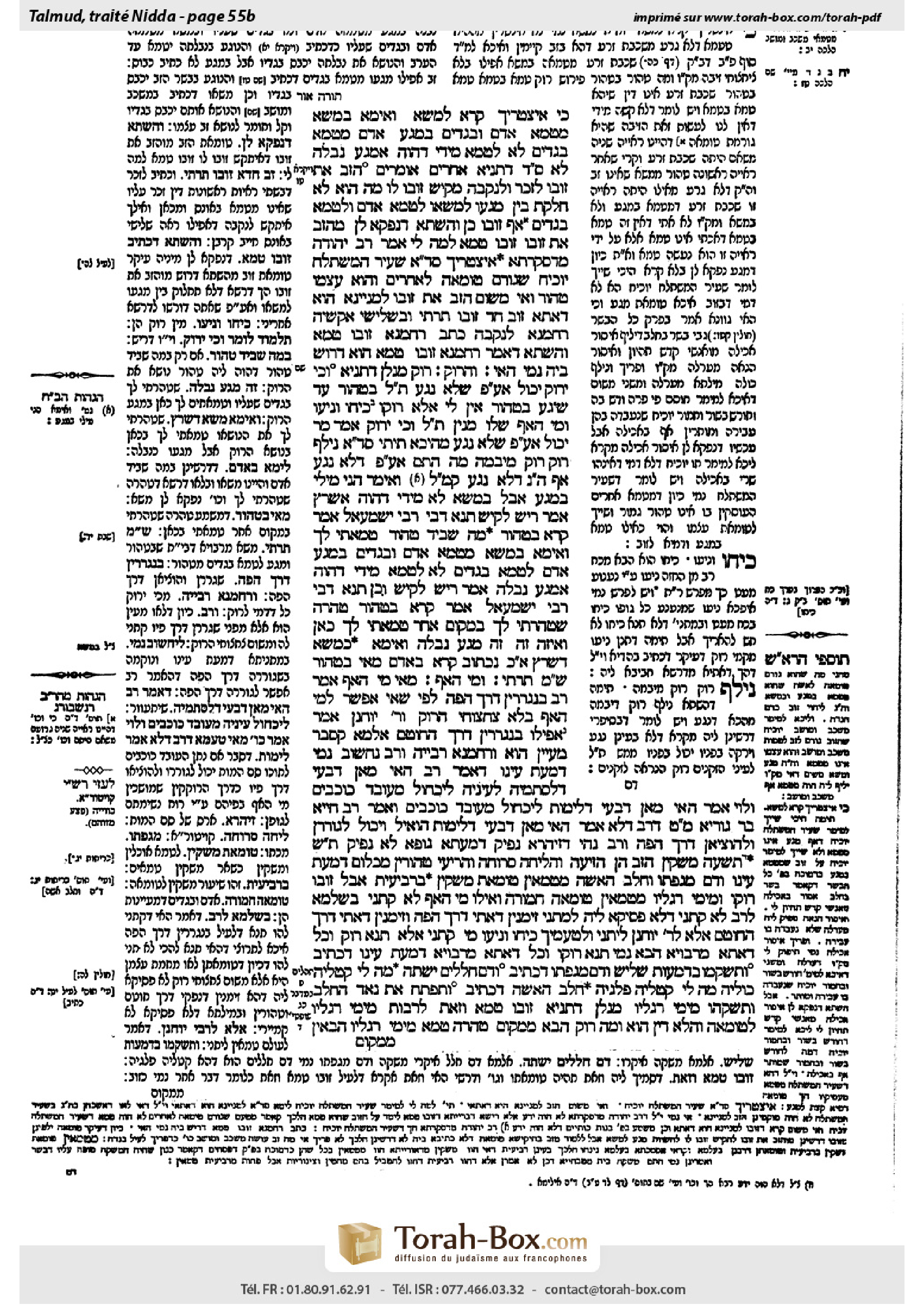
Niddah 55b: Talmud study for Daf Yomi
Daf Yomi is the daily study of one Talmud folio. Explore 37 tractates with scans, Hebrew text, Sefaria English and AI-generated French translations where annotated.
Passage selection and English or AI-generated French translation are available where the scan has annotations. Daf Study is independent of Torah-Box and Sefaria.
Browse Niddah · נידה · All tractatesNiddah 55b text and translations
This page of Niddah includes the Aramaic text, an English translation and an AI-generated French translation, alongside the scan above.
נידה נ״ה ב · Aramaic and Hebrew text
כִּי אִיצְטְרִיךְ קְרָא לְמַשָּׂא. וְאֵימָא: בְּמַשָּׂא מְטַמֵּא אָדָם וּבְגָדִים, וּבְמַגָּע אָדָם מְטַמֵּא בְּגָדִים לָא לְטַמֵּא, מִידֵּי דְּהָוֵה אַמַּגַּע נְבֵלָה!
לָא סָלְקָא דַעְתָּךְ, דְּתַנְיָא: אֲחֵרִים אוֹמְרִים: ״הַזָּב אֶת זוֹבוֹ לַזָּכָר וְלַנְּקֵבָה״ — מַקִּישׁ זוֹבוֹ לוֹ, מָה הוּא לֹא חִלַּקְתָּ בֵּין מַגָּעוֹ לְמַשָּׂאוֹ לְטַמֵּא אָדָם וּלְטַמֵּא בְּגָדִים, אַף זוֹבוֹ כֵּן.
וְהַשְׁתָּא דְּנָפְקָא לַן מֵ״הַזָּב אֶת זוֹבוֹ״, ״זוֹבוֹ טָמֵא״ לְמָה לִי?
אָמַר רַב יְהוּדָה מִדִּסְקַרְתָּא: אִיצְטְרִיךְ, סָלְקָא דַעְתָּךְ אָמֵינָא שָׂעִיר הַמִּשְׁתַּלֵּחַ יוֹכִיחַ, שֶׁגּוֹרֵם טוּמְאָה לַאֲחֵרִים וְהוּא עַצְמוֹ טָהוֹר. וְאִי מִשּׁוּם ״הַזָּב אֶת זוֹבוֹ״, לְמִנְיָינָא הוּא דַּאֲתָא.
״זוֹב״ — חַד, ״זוֹבוֹ״ — תַּרְתֵּי, וּבַשְּׁלִישִׁי אַקְּשֵׁיהּ רַחֲמָנָא לִנְקֵבָה!
כְּתַב רַחֲמָנָא ״זוֹבוֹ טָמֵא״. וְהַשְׁתָּא דְּאָמַר רַחֲמָנָא ״זוֹבוֹ טָמֵא הוּא״, דְּרוֹשׁ בֵּיהּ נָמֵי הַאי.
וְהָרוֹק. רוֹק מְנָלַן? דְּתַנְיָא: ״וְכִי יָרוֹק״ — יָכוֹל אַף עַל פִּי שֶׁלֹּא נָגַע? תַּלְמוּד לוֹמַר: ״בַּטָּהוֹר״ — עַד שֶׁיִּגַּע בַּטָּהוֹר.
אֵין לִי אֶלָּא רוּקּוֹ, כִּיחוֹ וְנִיעוֹ וּמֵי הָאַף שֶׁלּוֹ מִנַּיִן? תַּלְמוּד לוֹמַר ״וְכִי יָרוֹק״.
אָמַר מָר: יָכוֹל אַף עַל פִּי שֶׁלֹּא נָגַע? מֵהֵיכָא תֵּיתֵי?
סָלְקָא דַעְתָּךְ אָמֵינָא, נֵילַף ״רוֹק״ ״רוֹק״ מִיבָמָה — מָה הָתָם, אַף עַל פִּי דְּלָא נְגַע, אַף הָכָא נָמֵי דְּלָא נְגַע, קָא מַשְׁמַע לַן.
וְאֵימַר: הָנֵי מִילֵּי בְּמַגָּע, אֲבָל בְּמַשָּׂא — לָא, מִידֵי דְּהָוֵה אַשֶּׁרֶץ! אָמַר רֵישׁ לָקִישׁ: תָּנָא דְּבֵי רַבִּי יִשְׁמָעֵאל, אָמַר קְרָא: ״בַּטָּהוֹר״ — מַה שֶּׁבְּיַד טָהוֹר טִמֵּאתִי לָךְ.
וְאֵימָא: בְּמַשָּׂא מְטַמֵּא אָדָם וּבְגָדִים, בְּמַגָּע אָדָם לְטַמֵּא בְּגָדִים לָא לְטַמֵּא, מִידֵּי דְּהָוֵה אַמַּגַּע נְבֵלָה!
אָמַר רֵישׁ לָקִישׁ, וְכֵן תָּנָא דְּבֵי רַבִּי יִשְׁמָעֵאל: אָמַר קְרָא ״בַּטָּהוֹר״ — טׇהֳרָה שֶׁטִּהַרְתִּי לְךָ בְּמָקוֹם אַחֵר, טִמֵּאתִי לְךָ כָּאן, וְאֵיזֶה זֶה? מַגַּע נְבֵלָה.
וְאֵימָא כְּמַשָּׂא דְּשֶׁרֶץ! אִם כֵּן נִכְתּוֹב קְרָא ״בָּאָדָם״, מַאי ״בַּטָּהוֹר״? שְׁמַע מִינַּהּ תַּרְתֵּי.
וּמֵי הָאַף. מַאי מֵי הָאַף? אָמַר רַב: בְּנִגְרָרִין דֶּרֶךְ הַפֶּה, לְפִי שֶׁאִי אֶפְשָׁר לְמֵי הָאַף בְּלֹא צִחְצוּחֵי הָרוֹק. וְרַבִּי יוֹחָנָן אָמַר: אֲפִילּוּ בְּנִגְרָרִין דֶּרֶךְ הַחוֹטֶם. אַלְמָא קָסָבַר: מַעְיָין הוּא, וְרַחֲמָנָא רַבְּיֵיהּ.
וְרַב, נַחְשׁוֹב נָמֵי דִּמְעַת עֵינוֹ! דְּאָמַר רַב: הַאי מָאן דְּבָעֵי דְּלִסְתַּמֵּיה (לְעֵינֵיהּ) — לִיכְחוֹל מִגּוֹי. וְלֵוִי אֲמַר: הַאי מָאן דְּבָעֵי דְּלֵימוּת — לִיכְחוֹל מִגּוֹי.
וְאָמַר רַב חִיָּיא בַּר גּוּרְיָא: מַאי טַעְמָא דְּרַב דְּלָא אָמַר הָא ״מַאן דְּבָעֵי דְּלֵימוּת״, הוֹאִיל וְיָכוֹל לְגוֹרְרָן וּלְהוֹצִיאָן דֶּרֶךְ הַפֶּה? וְרַב: נְהִי דְּזִיהֲרָא נָפֵיק, דִּמְעֲתָא גּוּפַאּ לָא נָפֵיק.
תָּא שְׁמַע: תִּשְׁעָה מַשְׁקֵה הַזָּב הֵן — הַזֵּיעָה, וְהַלֵּיחָה סְרוּחָה, וְהָרֶיעִי — טְהוֹרִין מִכְּלוּם; דִּמְעַת עֵינוֹ, וְדַם מַגֵּפָתוֹ, וַחֲלֵב הָאִשָּׁה — מְטַמְּאִין טוּמְאַת מַשְׁקִין בִּרְבִיעִית; אֲבָל זוֹבוֹ, רוּקּוֹ, וּמֵימֵי רַגְלָיו — מְטַמְּאִין טוּמְאָה חֲמוּרָה; וְאִילּוּ ״מֵי הָאַף״ לָא קָתָנֵי.
בִּשְׁלָמָא לְרַב, לָא קָתָנֵי דְּלָא פְּסִיקָא לֵיהּ לְמִתְנֵי, זִימְנִין דְּאָתֵי דֶּרֶךְ הַפֶּה, וְזִימְנִין דְּאָתֵי דֶּרֶךְ הַחוֹטֶם, אֶלָּא לְרַבִּי יוֹחָנָן לִיתְנֵי.
וּלְטַעְמָיךְ, ״כִּיחוֹ וְנִיעוֹ״ מִי קָתָנֵי? אֶלָּא תְּנָא רוֹק, וְכֹל דְּאָתֵי מֵרִבּוּיָא. הָכָא נָמֵי תְּנָא רוּקּוֹ, וְכֹל דְּאָתֵי מֵרִבּוּיָא.
דִּמְעַת עֵינוֹ — דִּכְתִיב ״וַתַּשְׁקֵמוֹ בִּדְמָעוֹת שָׁלִישׁ״. וְדַם מַגֵּפָתוֹ — דִּכְתִיב ״וְדַם חֲלָלִים יִשְׁתֶּה״. מָה לִי קַטְלֵיהּ כּוּלֵּיהּ, מָה לִי קַטְלֵיהּ פַּלְגֵיהּ. חֲלֵב הָאִשָּׁה — דִּכְתִיב ״וַתִּפְתַּח אֶת נֹאוֹד הֶחָלָב וַתַּשְׁקֵהוּ״.
מֵימֵי רַגְלָיו — מְנָלַן? דְּתַנְיָא: ״זוֹבוֹ טָמֵא... וְזֹאת״ — לְרַבּוֹת מֵימֵי רַגְלָיו לְטוּמְאָה. וַהֲלֹא דִּין הוּא: וּמָה רוֹק הַבָּא מִמְּקוֹם טׇהֳרָה טָמֵא, מֵימֵי רַגְלָיו הַבָּאִין
Niddah 55b · English translation
When the verse was necessary, it was to teach that ziva transmits impurity by carrying. The Gemara asks: And yet one may say that ziva transmits impurity to a person and to his garments only by carrying, but as for impurity by contact, although ziva transmits impurity to the person who touches it, it does not transmit impurity to his garments, just as is the halakha with regard to contact with an unslaughtered animal carcass. If one touches a carcass he is rendered impure but his garments remain pure, despite the fact that if one carries a carcass his garments are also rendered impure.
The Gemara answers: This could not enter your mind, as it is taught in a baraita that Aḥerim say, with regard to the verse: “This is the law of him that has an issue…And of her who experiences the flow of her menstrual impurity, and of one who emits his issue [zovo], in the case of a male or a female” (Leviticus 15:32–33). The verse juxtaposes the impurity of the issue of the zav to the impurity of the zav himself: Just as with regard to him you did not distinguish between impurity transmitted by contact with him and impurity transmitted by carrying him, as in both cases the zav transmits impurity to a person and transmits impurity to his garments, so too, with regard to the issue of the zav the halakha is the same.
The Gemara asks: And now that we have derived the impurity of the discharge of a zav from the verse: “And of one who emits his issue” (Leviticus 15:33), why do I need the verse: “When any man has an issue out of his flesh, his issue, it is impure” (Leviticus 15:2)?
Rav Yehuda of Diskarta said: This verse was necessary, as it might enter your mind to say that the case of the scapegoat may prove that the discharge of a zav is not impure, as the scapegoat causes impurity to others and yet the goat itself is pure. Likewise, one might conclude that although the discharge of a zav causes impurity to others, ziva itself is pure. And if one were to dismiss this possibility, due to the verse: “And of one who emits his issue [zovo], in the case of a male or a female” (Leviticus 15:33), one could reply that it does not indicate the impurity of ziva. Rather, it comes to teach the number of emissions by which one becomes impure with the impurity of a zav.
Rav Yehuda of Diskarta clarifies this interpretation of the verse. The term: An issue [zov], would indicate one emission of ziva. Since the verse uses the term “his issue [zovo],” the superfluous addition indicates two emissions of ziva. With regard to these two emissions, the verse states: “In the case of a male,” indicating that the status of a male zav differs from the status of a female zava in that he is not rendered impure if the emission occurred due to an accident, which would render a female impure. But in the case of the third emission of ziva the Merciful One juxtaposed the status of a male zav to that of a female, as the verse states: “Or a female,” indicating that even if the third emission was due to an accident he is nevertheless obligated to bring an offering.
Since one would not have derived the impurity of ziva from this verse, the Merciful One wrote: “His issue, it is impure” (Leviticus 15:2). And now that the Merciful One states: “His issue, it is impure,” one may derive from the verse “and of one who emits his issue” not only the number of emissions, but also this interpretation, that there is no difference between the impurity imparted by ziva by contact and by carrying.
§ The mishna teaches: And the mucus and the saliva of a zav transmit impurity when moist but not when dry. The Gemara asks: From where do we derive the ritual impurity of the saliva of a zav? The Gemara answers that this is derived as it is taught in a baraita: The verse states: “And if one who has an issue spits on the pure person, then he shall wash his clothes, and bathe himself in water, and he is impure until the evening” (Leviticus 15:8). One might have thought that the saliva transmits impurity even if the zav merely spat in the direction of a pure person, despite the fact that it did not come into contact with him. Therefore, the verse states: “And if one who has an issue spits on the pure person,” which teaches that unless the saliva comes into contact with the pure person he is not rendered impure.
The baraita continues: I have derived only that his saliva is impure. From where is it derived that his phlegm, his mucus, and his nasal fluids are also impure? The verse states: “And if one who has an issue spits.” The superfluous “and” is an amplification, indicating that these substances also transmit impurity.
The Master said above: One might have thought that the saliva transmits impurity even if the zav merely spat in the direction of a pure person, despite the fact that it did not come into contact with him. The Gemara asks: From where would this be derived? Why would one think that a person becomes impure from saliva that did not come into contact with him, making it necessary for a verse to exclude this possibility?
The Gemara explains: It might enter your mind to say that we should derive a verbal analogy from the term saliva in the verse “and if one who has an issue spits,” and the term saliva stated in connection with a yevama, a widow whose husband died childless and who participates in ḥalitza, as the verse states: “His yevama shall approach him, before the Elders, and remove his shoe from on his foot and spit before him” (Deuteronomy 25:9). Just as there, with regard to ḥalitza, the ritual is valid even though the saliva did not touch her brother-in-law, so too here, with regard to the saliva of a zav, it transmits impurity despite the fact that it did not come into contact with the pure person. Therefore, the verse teaches us that the saliva of a zav transmits impurity only if it comes into contact with the pure person.
The Gemara objects: And yet one may say that this statement, that the saliva of a zav transmits impurity, applies only to transmitting impurity by contact. But with regard to transmitting impurity by carrying it does not transmit impurity, just as is the halakha with regard to the carcass of a creeping animal, which transmits impurity by contact but not by carrying. Reish Lakish said that the school of Rabbi Yishmael taught in a baraita: The verse states: “And if one who has an issue spits on the pure person.” The term “on the pure person” is interpreted to mean that in any case where something of the saliva is in the hand of the pure person I deemed him impure for you, even if he did not come into direct contact with the saliva but merely carried it.
The Gemara objects: But one may say that although the saliva of a zav transmits impurity both by carrying and by contact, nevertheless there is the following difference between them: By carrying the saliva of a zav, it transmits impurity to a person and to his garments, but by contact, although it transmits impurity to the person who touches it, it does not transmit impurity to his garments, just as is the halakha with regard to contact with an unslaughtered animal carcass.
Reish Lakish said, and so too the school of Rabbi Yishmael taught, that the verse states: “And if one who has an issue spits on the pure person.” The term “on the pure person” teaches that a case of purity, i.e., that which I deemed pure for you in a different case, I have deemed impure for you here. And which case is this? This is referring to contact with an animal carcass, which renders only the one touching it impure, but not his garments, whereas the saliva of a zav renders them both impure.
The Gemara objects: But one can say that the case deemed pure elsewhere but deemed impure here is that of carrying the carcass of a creeping animal. Perhaps the verse is teaching that whereas a creeping animal does not transmit impurity by carrying, the saliva of a zav does transmit impurity by carrying. By contrast, contact with the saliva of a zav renders only the one touching it impure, but not his garments, as is the halakha with regard to an animal carcass. The Gemara responds: If that is so, let the verse write: If one who has an issue spits on the person. What is the reason the verse states specifically: “On the pure person”? Conclude two conclusions from it, both that the saliva of a zav transmits impurity by carrying and that contact with the saliva renders impure both the person and his garments.
§ The aforementioned baraita teaches: And the nasal fluids of a zav also transmit impurity. The Gemara asks: What are these nasal fluids? Rav says: This is referring to fluids that are emitted via the mouth of a person. They are impure because it is impossible for the nasal fluids to flow through the mouth without containing traces of saliva, which are impure. And Rabbi Yoḥanan says: The baraita is referring even to fluids that are emitted via the nose. Evidently, Rabbi Yoḥanan maintains that nasal fluids are categorized as a flow of bodily fluids, and the Merciful One included it among the impure bodily fluids of a zav, by the amplification: “And if one who has an issue spits.”
The Gemara asks: But according to Rav, who maintains that nasal fluids are impure because they contain traces of saliva, this is difficult: Let the mishna also count among the impure bodily fluids of the zav the tears of his eye, as Rav said: He who desires to blind his eye should have a gentile paint [likhḥol] his eye, as the gentile is apt to add a substance that causes blindness. And Levi said: He who desires to die should have a gentile paint his eye, as the gentile is apt to add poison to the paint.
The Gemara continues: And Rav Ḥiyya bar Gurya said: What is the reasoning of Rav, that he did not say like Levi: He who desires to die should have a gentile paint his eye? Rav did not say this because he maintains one can prevent the poisonous substances from killing him, since he can suck the poisonous substances into his mouth by inhaling and emit them via the mouth. This indicates that the fluids of the eye can also be emitted through the mouth, and if so, the tears of a zav should likewise transmit impurity. The Gemara answers: And Rav would say that although the poison [dezihara] placed in one’s eye can exit the body via the mouth, the tears themselves do not exit the body through the mouth.
The Gemara states: With regard to the above dispute between Rav and Rabbi Yoḥanan, come and hear a baraita: There are nine types of fluids of the zav. The sweat, the foul secretion from an infected wound, and the excrement are pure from any form of impurity. The tears that emerge from his eye, the blood from his wound, and the milk of a woman who is a zava all transmit the ritual impurity of liquids, i.e., they render food and liquids impure, as other impure liquids do, in a situation where there is at least a quarter-log of the fluid. But his ziva, his saliva, and his urine all transmit a severe form of ritual impurity. The Gemara comments: The baraita lists many substances, and yet it does not teach that nasal fluids are impure.
Granted, according to the opinion of Rav, the tanna of the baraita does not teach that nasal fluids are impure, as he could not teach it categorically, since sometimes the nasal fluid comes via the mouth, and is impure, and sometimes it comes via the nose, and is not impure. But according to the opinion of Rabbi Yoḥanan, let the tanna teach that nasal fluids are impure.
The Gemara responds: And according to your reasoning, does this tanna teach that his phlegm and his mucus are impure? Rather, he taught that saliva is impure, and this includes the impurity of all substances that are derived from its amplification, e.g., his phlegm and his mucus. Here too, with regard to nasal fluids, the tanna taught the halakha of his saliva, and this includes all substances that are derived from its amplification, including nasal fluids.
The baraita teaches that in the case of a zav or zava, the tears of their eyes and the blood from their wounds, as well as the milk of a zava, all transmit the ritual impurity of liquids. The Gemara cites the source for these cases of impurity: The tears of his eye are classified as a liquid, as it is written: “You have fed them with the bread of tears, and given them tears to drink in great measure” (Psalms 80:6). And the blood from his wound is classified as a liquid, as it is written: “And he shall drink the blood of the slain” (Numbers 23:24). Although the verse is referring to the blood of a dead person, and not to the blood of a wound, what difference does it make to me if one killed all of him, and what difference does it make to me if one killed part of him, i.e., wounded him? With regard to the milk of a woman, it too is classified as a liquid, as it is written: “And she opened the bottle of milk, and gave him to drink” (Judges 4:19).
The baraita teaches that the urine of a zav transmits a severe form of ritual impurity, as do his ziva and his saliva. The Gemara asks: From where do we derive that the urine of a zav is impure? As it is taught in a baraita: The verse states: “When any man has an issue out of his flesh, his issue, it is impure. And this shall be his impurity” (Leviticus 15:2–3). The term “and this” comes to include his urine with regard to a severe form of ritual impurity. The baraita asks: And could this not be derived through an a fortiori inference? If saliva, which comes from a place of purity, i.e., one’s mouth, whose secretions are not usually impure, is nevertheless impure, then with regard to his urine, which comes
Niddah 55b · Traduction française (IA)
Lorsque le verset était nécessaire, c’était pour enseigner que la ziva transmet l’impureté par portage. La Guemara demande : Pourtant, on pourrait dire que la ziva ne transmet l’impureté à une personne et à ses vêtements que par portage ; quant à l’impureté par contact, bien que la ziva rende impur celui qui la touche, elle ne transmet pas l’impureté à ses vêtements, comme c’est la halakha pour le contact avec la carcasse d’un animal non abattu rituellement. Celui qui touche une carcasse devient impur, mais ses vêtements restent purs, bien que celui qui porte une carcasse rende aussi ses vêtements impurs.
La Guemara répond : Cela ne peut pas te venir à l’esprit, car il est enseigné dans une baraïta qu’Aḥerim disent, à propos du verset : « Telle est la loi de celui qui a un écoulement… et de celle qui éprouve l’écoulement de son impureté menstruelle, et de celui qui émet son écoulement [zovo], qu’il s’agisse d’un homme ou d’une femme » (Lévitique 15:32–33). Le verset rapproche l’impureté de l’écoulement du zav de celle du zav lui-même : de même que, dans son cas, tu n’as pas distingué entre l’impureté transmise par contact avec lui et celle transmise en le portant, puisque, dans les deux cas, le zav transmet l’impureté à une personne et à ses vêtements, de même, la halakha est identique pour l’écoulement du zav.
La Guemara demande : Or, maintenant que nous avons déduit l’impureté de l’écoulement d’un zav du verset : « Et de celui qui émet son écoulement » (Lévitique 15:33), pourquoi avons-nous besoin du verset : « Lorsqu’un homme a un écoulement de son corps, son écoulement est impur » (Lévitique 15:2) ?
Rav Yehuda de Diskarta a dit : Ce verset était nécessaire, car on aurait pu penser que le cas du bouc émissaire prouve que l’écoulement d’un zav n’est pas impur : le bouc émissaire rend d’autres personnes impures, et pourtant lui-même est pur. De même, on aurait pu conclure que, bien que l’écoulement d’un zav rende d’autres personnes impures, la ziva elle-même est pure. Et si l’on écartait cette possibilité en raison du verset : « Et de celui qui émet son écoulement [zovo], qu’il s’agisse d’un homme ou d’une femme » (Lévitique 15:33), on pourrait répondre que le verset n’indique pas que la ziva est impure ; il vient plutôt enseigner le nombre d’émissions qui rend une personne impure de l’impureté du zav.
Rav Yehuda de Diskarta précise cette interprétation du verset. Le terme « écoulement [zov] » indiquerait une seule émission de ziva. Puisque le verset emploie le terme « son écoulement [zovo] », cet ajout superflu indique deux émissions de ziva. À propos de ces deux émissions, le verset dit : « Dans le cas d’un homme », ce qui indique que le statut d’un zav diffère de celui d’une zava : il ne devient pas impur si l’émission résulte d’un accident, alors qu’une femme deviendrait impure dans ce cas. Mais, pour la troisième émission de ziva, le Miséricordieux a rapproché le statut du zav de celui de la femme, comme le dit le verset : « Ou une femme », ce qui indique que même si la troisième émission résulte d’un accident, il est néanmoins tenu d’apporter un sacrifice.
Puisqu’on n’aurait pas déduit l’impureté de la ziva de ce verset, le Miséricordieux a écrit : « Son écoulement est impur » (Lévitique 15:2). Et maintenant que le Miséricordieux déclare : « Son écoulement est impur », on peut déduire du verset « et de celui qui émet son écoulement » non seulement le nombre d’émissions, mais aussi cette interprétation : la ziva transmet l’impureté de la même manière par contact et par portage.
§ La Michna enseigne : Le mucus et la salive d’un zav transmettent l’impureté lorsqu’ils sont humides, mais pas lorsqu’ils sont secs. La Guemara demande : D’où déduit-on l’impureté rituelle de la salive d’un zav ? La Guemara répond que cela se déduit, comme il est enseigné dans une baraïta : Le verset dit : « Si celui qui a un écoulement crache sur une personne pure, celle-ci lavera ses vêtements, se baignera dans l’eau et sera impure jusqu’au soir » (Lévitique 15:8). On aurait pu penser que la salive transmet l’impureté même si le zav avait simplement craché en direction d’une personne pure, sans entrer en contact avec elle. C’est pourquoi le verset dit : « Si celui qui a un écoulement crache sur une personne pure », ce qui enseigne que la personne pure ne devient impure que si la salive entre en contact avec elle.
La baraïta poursuit : J’ai déduit uniquement que sa salive est impure. D’où déduit-on que ses glaires, son mucus et ses sécrétions nasales sont également impurs ? Le verset dit : « Et si celui qui a un écoulement crache ». Le « et » superflu constitue une amplification, indiquant que ces substances transmettent elles aussi l’impureté.
Le Maître a dit plus haut : On aurait pu penser que la salive transmet l’impureté même si le zav avait simplement craché en direction d’une personne pure, sans entrer en contact avec elle. La Guemara demande : D’où aurait-on déduit cela ? Pourquoi penserait-on qu’une personne devient impure à cause d’une salive qui n’est pas entrée en contact avec elle, au point qu’un verset doive exclure cette possibilité ?
La Guemara explique : On aurait pu penser qu’il faut déduire une analogie verbale entre le terme « salive » du verset « et si celui qui a un écoulement crache » et le terme « salive » employé à propos d’une yevama, veuve dont le mari est mort sans enfant et qui participe à la ḥalitza, comme le dit le verset : « Sa yevama s’approchera de lui, devant les Anciens, lui retirera sa chaussure du pied et crachera devant lui » (Deutéronome 25:9). De même que, dans le cas de la ḥalitza, le rite est valide même si la salive n’a pas touché son beau-frère, de même ici, la salive d’un zav transmet l’impureté même si elle n’est pas entrée en contact avec la personne pure. Le verset nous enseigne donc que la salive d’un zav ne transmet l’impureté que si elle entre en contact avec la personne pure.
La Guemara objecte : Pourtant, on pourrait dire que cette déclaration, selon laquelle la salive d’un zav transmet l’impureté, ne concerne que la transmission de l’impureté par contact. Mais, lorsqu’on la porte, elle ne transmet pas l’impureté, comme c’est la halakha pour la carcasse d’un animal rampant, qui transmet l’impureté par contact, mais pas par portage. Reish Lakish a dit que l’école de Rabbi Yishmael a enseigné dans une baraïta : Le verset dit : « Et si celui qui a un écoulement crache sur la personne pure. » L’expression « sur la personne pure » signifie que, dans tout cas où une partie de la salive se trouve dans la main de la personne pure, je l’ai déclarée impure pour toi, même si elle n’a pas été en contact direct avec la salive, mais l’a simplement portée.
La Guemara objecte : Mais on pourrait dire que, bien que la salive d’un zav transmette l’impureté tant par portage que par contact, il existe néanmoins la différence suivante entre les deux : lorsqu’on porte la salive d’un zav, elle transmet l’impureté à une personne et à ses vêtements ; mais, par contact, bien qu’elle rende impur celui qui la touche, elle ne transmet pas l’impureté à ses vêtements, comme c’est la halakha pour le contact avec la carcasse d’un animal non abattu rituellement.
Reish Lakish a dit, et l’école de Rabbi Yishmael a également enseigné, que le verset dit : « Et si celui qui a un écoulement crache sur la personne pure. » L’expression « sur la personne pure » enseigne que ce qui est considéré comme pur dans un autre cas, c’est-à-dire ce que je t’ai déclaré pur dans un autre cas, je te l’ai déclaré impur ici. Et de quel cas s’agit-il ? Du contact avec une carcasse animale, qui ne rend impur que celui qui la touche, mais pas ses vêtements, alors que la salive d’un zav rend impurs l’un et les autres.
La Guemara objecte : Mais on pourrait dire que le cas déclaré pur ailleurs mais impur ici est celui du portage de la carcasse d’un animal rampant. Peut-être le verset enseigne-t-il que, tandis qu’un animal rampant ne transmet pas l’impureté par portage, la salive d’un zav la transmet. En revanche, le contact avec la salive d’un zav ne rend impur que celui qui la touche, mais pas ses vêtements, comme c’est la halakha pour une carcasse animale. La Guemara répond : Si tel était le cas, que le verset écrive : « Si celui qui a un écoulement crache sur la personne. » Pourquoi le verset dit-il précisément : « sur la personne pure » ? Tire-en deux conclusions : la salive d’un zav transmet l’impureté par portage, et le contact avec sa salive rend impurs à la fois la personne et ses vêtements.
§ La baraïta susmentionnée enseigne que les sécrétions nasales d’un zav transmettent elles aussi l’impureté. La Guemara demande : Que sont ces sécrétions nasales ? Rav dit : Il s’agit de sécrétions émises par la bouche d’une personne. Elles sont impures, car il est impossible que les sécrétions nasales passent par la bouche sans contenir des traces de salive, qui est impure. Rabbi Yoḥanan dit : La baraïta parle même de sécrétions émises par le nez. De toute évidence, Rabbi Yoḥanan considère les sécrétions nasales comme un écoulement de fluides corporels, que le Miséricordieux a inclus parmi les fluides corporels impurs d’un zav par l’amplification : « Et si celui qui a un écoulement crache. »
La Guemara demande : Mais, selon Rav, qui considère que les sécrétions nasales sont impures parce qu’elles contiennent des traces de salive, une difficulté se pose : que la Michna compte aussi les larmes de l’œil parmi les fluides corporels impurs du zav. Car Rav a dit : Celui qui souhaite devenir aveugle devrait faire peindre [likhḥol] son œil par un non-Juif, car celui-ci est susceptible d’y ajouter une substance qui provoque la cécité. Et Levi a dit : Celui qui souhaite mourir devrait faire peindre son œil par un non-Juif, car celui-ci est susceptible d’ajouter du poison à la peinture.
La Guemara poursuit : Rav Ḥiyya bar Gurya a dit : Pourquoi Rav n’a-t-il pas dit, comme Levi : « Celui qui souhaite mourir devrait faire peindre son œil par un non-Juif » ? Rav ne l’a pas dit parce qu’il estime qu’on peut empêcher les substances toxiques de tuer la personne : elle peut aspirer les substances toxiques dans sa bouche en inspirant, puis les expulser par la bouche. Cela indique que les fluides de l’œil peuvent eux aussi être expulsés par la bouche ; dès lors, les larmes d’un zav devraient également transmettre l’impureté. La Guemara répond : Rav dirait que, bien que le poison [dezihara] placé dans l’œil puisse sortir du corps par la bouche, les larmes elles-mêmes ne sortent pas du corps par la bouche.
La Guemara dit, à propos du différend ci-dessus entre Rav et Rabbi Yoḥanan : Viens et entends une baraïta : Il existe neuf types de fluides d’un zav. La sueur, la sécrétion nauséabonde d’une plaie infectée et les excréments sont purs de toute forme d’impureté. Les larmes qui sortent de son œil, le sang de sa plaie et le lait d’une femme zava transmettent l’impureté rituelle des liquides, c’est-à-dire qu’ils rendent impurs les aliments et les liquides, comme le font les autres liquides impurs, lorsqu’il y a au moins un quart de log de liquide. Mais sa ziva, sa salive et son urine transmettent une forme grave d’impureté rituelle. La Guemara remarque : La baraïta énumère de nombreuses substances, et pourtant elle n’enseigne pas que les sécrétions nasales sont impures.
Certes, selon Rav, le tanna de la baraïta n’enseigne pas que les sécrétions nasales sont impures, car il ne pouvait pas l’enseigner sans réserve : parfois, les sécrétions nasales passent par la bouche et sont impures, et parfois elles passent par le nez et ne sont pas impures. Mais, selon Rabbi Yoḥanan, que le tanna enseigne donc que les sécrétions nasales sont impures.
La Guemara répond : Et selon ton raisonnement, ce tanna enseigne-t-il que ses glaires et son mucus sont impurs ? Au contraire, il a enseigné que la salive est impure, ce qui inclut l’impureté de toutes les substances comprises dans l’amplification qui s’y rapporte, par exemple ses glaires et son mucus. Ici aussi, à propos des sécrétions nasales, le tanna a enseigné la halakha de la salive, ce qui inclut toutes les substances comprises dans l’amplification qui s’y rapporte, y compris les sécrétions nasales.
La baraïta enseigne que, dans le cas d’un zav ou d’une zava, les larmes de leurs yeux et le sang de leurs plaies, ainsi que le lait d’une zava, transmettent tous l’impureté rituelle des liquides. La Guemara cite la source de ces cas d’impureté : les larmes de son œil sont classées parmi les liquides, comme il est écrit : « Tu les as nourris du pain des larmes et leur as fait boire des larmes à pleines mesures » (Psaumes 80:6). Le sang de sa plaie est classé parmi les liquides, comme il est écrit : « Il boira le sang des victimes » (Nombres 23:24). Bien que le verset parle du sang d’un mort, et non du sang d’une plaie, quelle différence cela fait-il que l’on ait tué tout son corps, ou seulement une partie, c’est-à-dire qu’on l’ait blessé ? Quant au lait d’une femme, il est lui aussi classé parmi les liquides, comme il est écrit : « Elle ouvrit l’outre de lait et lui donna à boire » (Juges 4:19).
La baraïta enseigne que l’urine d’un zav transmet une forme grave d’impureté rituelle, tout comme sa ziva et sa salive. La Guemara demande : D’où déduit-on que l’urine d’un zav est impure ? Comme il est enseigné dans une baraïta : Le verset dit : « Lorsqu’un homme a un écoulement de son corps, son écoulement est impur. Et telle sera son impureté » (Lévitique 15:2–3). L’expression « et telle » vient inclure son urine parmi les substances transmettant une forme grave d’impureté rituelle. La baraïta demande : Ne pourrait-on pas le déduire au moyen d’un raisonnement a fortiori ? Si la salive, qui provient d’un endroit pur, c’est-à-dire la bouche, dont les sécrétions ne sont généralement pas impures, est néanmoins impure, alors, en ce qui concerne son urine, qui provient
Traduction française générée par IA à partir de l’édition anglaise de Sefaria. Vérifie toujours un passage avec le texte source.
Text from Sefaria: William Davidson Edition - Vocalized Aramaic (CC BY NC); William Davidson Edition - English (CC BY NC).