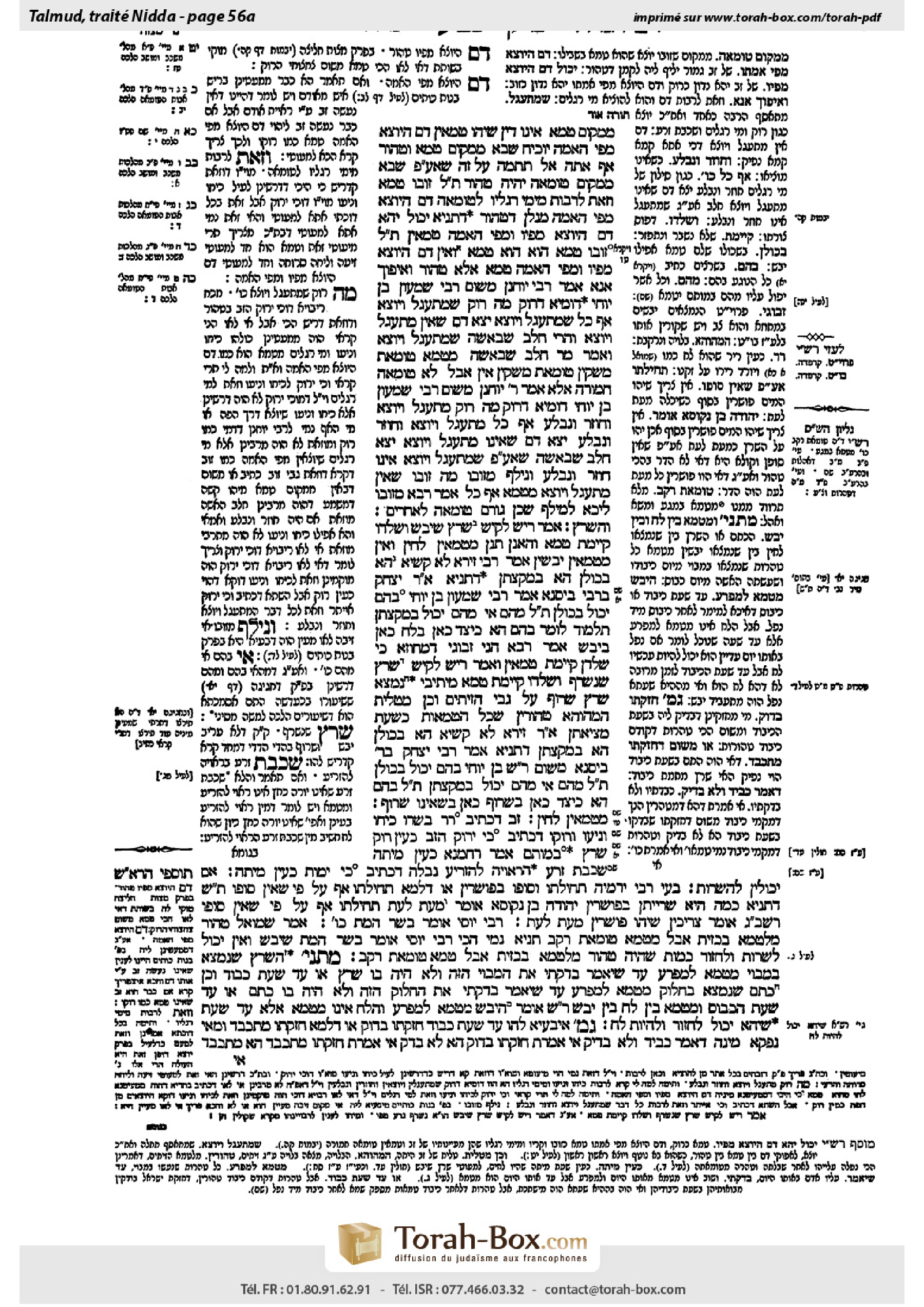
Niddah 56a: Talmud study for Daf Yomi
Daf Yomi is the daily study of one Talmud folio. Explore 37 tractates with scans, Hebrew text, Sefaria English and AI-generated French translations where annotated.
Passage selection and English or AI-generated French translation are available where the scan has annotations. Daf Study is independent of Torah-Box and Sefaria.
Browse Niddah · נידה · All tractatesNiddah 56a text and translations
This page of Niddah includes the Aramaic text, an English translation and an AI-generated French translation, alongside the scan above.
נידה נ״ו א · Aramaic and Hebrew text
מִמָּקוֹם טָמֵא — אֵינוֹ דִּין שֶׁיְּהוּ טְמֵאִין? דָּם הַיּוֹצֵא מִפִּי הָאַמָּה יוֹכִיחַ, שֶׁבָּא מִמָּקוֹם טָמֵא וְטָהוֹר. אַף אַתָּה אַל תִּתְמַהּ עַל זֶה, שֶׁאַף עַל פִּי שֶׁבָּא מִמְּקוֹם טוּמְאָה יִהְיֶה טָהוֹר. תַּלְמוּד לוֹמַר: ״זוֹבוֹ טָמֵא... וְזֹאת״ — לְרַבּוֹת מֵימֵי רַגְלָיו לְטוּמְאָה.
דָּם הַיּוֹצֵא מִפִּי הָאַמָּה, מְנָלַן דְּטָהוֹר? דְּתַנְיָא: יָכוֹל יְהֵא דָּם הַיּוֹצֵא מִפִּיו וּמִפִּי הָאַמָּה טְמֵאִין? תַּלְמוּד לוֹמַר ״זוֹבוֹ טָמֵא הוּא״ — הוּא טָמֵא, וְאֵין דָּם הַיּוֹצֵא מִפִּיו וּמִפִּי הָאַמָּה טָמֵא, אֶלָּא טָהוֹר.
וְאֵיפוֹךְ אֲנָא! אָמַר רַבִּי יוֹחָנָן מִשּׁוּם רַבִּי שִׁמְעוֹן בֶּן יוֹחַי: דּוּמְיָא דְּרוֹק, מָה רוֹק שֶׁמִּתְעַגֵּל וְיוֹצֵא, אַף כֹּל שֶׁמִּתְעַגֵּל וְיוֹצֵא. יָצָא דָּם שֶׁאֵין מִתְעַגֵּל וְיוֹצֵא.
וַהֲרֵי חָלָב שֶׁבָּאִשָּׁה, שֶׁמִּתְעַגֵּל וְיוֹצֵא, וְאָמַר מָר: חָלָב שֶׁבָּאִשָּׁה מְטַמֵּא טוּמְאַת מַשְׁקִין. טוּמְאַת מַשְׁקִין — אִין, אֲבָל לָא טוּמְאָה חֲמוּרָה!
אֶלָּא אָמַר רַבִּי יוֹחָנָן מִשּׁוּם רַבִּי שִׁמְעוֹן בֶּן יוֹחַי: דּוּמְיָא דְּרוֹק, מָה רוֹק מִתְעַגֵּל וְיוֹצֵא, וְחוֹזֵר וְנִבְלָע — אַף כׇּל מִתְעַגֵּל וְיוֹצֵא, וְחוֹזֵר וְנִבְלָע. יָצָא דָּם, שֶׁאֵינוֹ מִתְעַגֵּל וְיוֹצֵא. יָצָא חָלָב שֶׁבָּאִשָּׁה, שֶׁאַף עַל פִּי שֶׁמִּתְעַגֵּל וְיוֹצֵא — אֵינוֹ חוֹזֵר וְנִבְלָע.
וְנֵילַף מִ״זּוֹבוֹ״, מָה ״זוֹבוֹ״ שֶׁאֵין מִתְעַגֵּל וְיוֹצֵא מְטַמֵּא, אַף כֹּל! אָמַר רָבָא: מִ״זּוֹבוֹ״ לֵיכָּא לְמֵילַף, שֶׁכֵּן גּוֹרֵם טוּמְאָה לַאֲחֵרִים.
וְהַשֶּׁרֶץ. אָמַר רֵישׁ לָקִישׁ: ״שֶׁרֶץ שֶׁיָּבַשׁ וְשִׁלְדּוֹ קַיֶּימֶת״ — טָמֵא. וְהָאֲנַן תְּנַן: מְטַמְּאִין לַחִין וְאֵין מְטַמְּאִין יְבֵשִׁין! אָמַר רַבִּי זֵירָא: לָא קַשְׁיָא, הָא — בְּכוּלָּן, הָא — בְּמִקְצָתָן.
דְּתַנְיָא, אָמַר רַבִּי יִצְחָק בְּרַבִּי בִּיסְנָא, אָמַר רַבִּי שִׁמְעוֹן בֶּן יוֹחַי: ״בָּהֶם״ — יָכוֹל בְּכוּלָּן, תַּלְמוּד לוֹמַר ״מֵהֶם״.
אִי מֵהֶם — יָכוֹל בְּמִקְצָתָן, תַּלְמוּד לוֹמַר ״בָּהֶם״. הָא כֵּיצַד? כָּאן — בְּלַח, כָּאן — בְּיָבֵשׁ.
אָמַר רָבָא: הָנֵי זְבוּגֵי דְּמָחוֹזָא, כִּי שִׁלְדָּן קַיֶּימֶת — טְמֵאִין. וְאָמַר רֵישׁ לָקִישׁ: שֶׁרֶץ שֶׁנִּשְׂרַף וְשִׁלְדּוֹ קַיֶּימֶת — טָמֵא.
מֵיתִיבִי: נִמְצָא שֶׁרֶץ שָׂרוּף עַל גַּבֵּי הַזֵּיתִים, וְכֵן מַטְלֵית הַמְּהוּהָא — טְהוֹרִין, שֶׁכׇּל הַטְּמָאוֹת כִּשְׁעַת מְצִיאָתָן! אָמַר רַבִּי זֵירָא: לָא קַשְׁיָא — הָא בְּכוּלָּן, הָא בְּמִקְצָתָן.
דְּתַנְיָא, אָמַר רַבִּי יִצְחָק בְּרַבִּי בִּיסְנָא מִשּׁוּם רַבִּי שִׁמְעוֹן בֶּן יוֹחַי: ״בָּהֶם״ — יָכוֹל בְּכוּלָּן? תַּלְמוּד לוֹמַר ״מֵהֶם״.
אִי ״מֵהֶם״ — יָכוֹל בְּמִקְצָתָן? תַּלְמוּד לוֹמַר ״בָּהֶם״. הָא כֵּיצַד? כָּאן — בְּשָׂרוּף, כָּאן — בְּשֶׁאֵינוֹ שָׂרוּף.
מְטַמְּאִין לַחִין. זָב — דִּכְתִיב ״רָר בְּשָׂרוֹ״, כִּיחוֹ וְנִיעוֹ וְרוּקּוֹ — דִּכְתִיב ״כִּי יָרוֹק הַזָּב״, כְּעֵין רוֹק.
שֶׁרֶץ — ״בְּמוֹתָם״ אָמַר רַחֲמָנָא, כְּעֵין מִיתָה. שִׁכְבַת זֶרַע הָרְאוּיָה לְהַזְרִיעַ, נְבֵלָה — דִּכְתִיב ״כִּי יָמוּת״ — כְּעֵין מִיתָה.
אִם יְכוֹלִין לְהִשָּׁרוֹת. בָּעֵי רַבִּי יִרְמְיָה: תְּחִילָּתוֹ וְסוֹפוֹ בְּפוֹשְׁרִין, אוֹ דִלְמָא תְּחִילָּתוֹ אַף עַל פִּי שֶׁאֵין סוֹפוֹ?
תָּא שְׁמַע, דְּתַנְיָא: כַּמָּה הִיא שְׁרִיָּיתָן בְּפוֹשְׁרִין? יְהוּדָה בֶּן נָקוֹסָא אוֹמֵר: מֵעֵת לְעֵת, תְּחִילָּתוֹ אַף עַל פִּי שֶׁאֵין סוֹפוֹ. רַבָּן שִׁמְעוֹן בֶּן גַּמְלִיאֵל אוֹמֵר: צְרִיכִין שֶׁיְּהוּ פּוֹשְׁרִין מֵעֵת לְעֵת.
רַבִּי יוֹסֵי אוֹמֵר: בְּשַׂר הַמֵּת כּוּ׳. אָמַר שְׁמוּאֵל: טָהוֹר מִלְּטַמֵּא בִּכְזַיִת, אֲבָל מְטַמֵּא טוּמְאַת רָקָב. תַּנְיָא נָמֵי הָכִי: רַבִּי יוֹסֵי אוֹמֵר: בְּשַׂר הַמֵּת שֶׁיָּבַשׁ וְאֵין יָכוֹל לִשְׁרוֹת וְלַחֲזוֹר כְּמוֹת שֶׁהָיָה — טָהוֹר מִלְּטַמֵּא בִּכְזַיִת, אֲבָל טָמֵא טוּמְאַת רָקָב.
מַתְנִי' הַשֶּׁרֶץ שֶׁנִּמְצָא בַּמָּבוֹי — מְטַמֵּא לְמַפְרֵעַ, עַד שֶׁיֹּאמַר: ״בָּדַקְתִּי אֶת הַמָּבוֹי הַזֶּה וְלֹא הָיָה בּוֹ שֶׁרֶץ״, אוֹ עַד שְׁעַת כִּבּוּד.
וְכֵן כֶּתֶם שֶׁנִּמְצָא בֶּחָלוּק — מְטַמֵּא לְמַפְרֵעַ, עַד שֶׁיֹּאמַר ״בָּדַקְתִּי אֶת הֶחָלוּק הַזֶּה וְלֹא הָיָה בּוֹ כֶּתֶם״, אוֹ עַד שְׁעַת הַכִּבּוּס.
וּמְטַמֵּא בֵּין לַח, בֵּין יָבֵשׁ. רַבִּי שִׁמְעוֹן אוֹמֵר: הַיָּבֵשׁ מְטַמֵּא לְמַפְרֵעַ, וְהַלַּח אֵינוֹ מְטַמֵּא אֶלָּא עַד שְׁעַת שֶׁיְּהֵא יָכוֹל לַחֲזוֹר וְלִהְיוֹת לַח.
גְּמָ' אִיבַּעְיָא לְהוּ: ״עַד שְׁעַת כִּבּוּד״ — חֶזְקָתוֹ בָּדוּק, אוֹ דִלְמָא חֶזְקָתוֹ מִתְכַּבֵּד?
וּמַאי נָפְקָא מִינַּהּ? דְּאָמַר: ״כַּבֻּיד וְלָא בְּדֻיק״. אִי אָמְרַתְּ חֶזְקָתוֹ בָּדוּק — הָא לָא בְּדִק, אִי אָמְרַתְּ חֶזְקָתוֹ מִתְכַּבֵּד — הָא מִתְכַּבֵּד.
Niddah 56a · English translation
from a place of impurity, the same place that emits ziva, is it not logical that it should be impure? The baraita answers: The case of blood that issues from the opening of the penis may prove that this inference is invalid, as the blood comes from a place of impurity and yet it is pure. Likewise, you should not be surprised about this, the urine of a zav, that even though it comes from a place of impurity it should be pure. Therefore, the verse states: “When any man has an issue out of his flesh, his issue, it is impure. And this shall be his impurity” (Leviticus 15:2–3). The term “and this” comes to include his urine with regard to the severe form of ritual impurity.
The Gemara asks: From where do we derive that blood that issues from the opening of the penis is pure? As it is taught in a baraita concerning a zav: One might have thought that blood that issues from his mouth or from the opening of the penis is impure, like his saliva and urine. Therefore, the verse states: “His issue, it is impure” (Leviticus 15:2). The term “it” is an exclusion, indicating that it, ziva, is impure, but blood that issues from his mouth or from the opening of the penis is not impure; rather, it is pure.
The Gemara suggests: But perhaps I should reverse the halakhot. One could derive from the amplification “and this” that blood issuing from the penis of the zav is impure, and from the exclusion “it” that his urine is pure. Rabbi Yoḥanan said in the name of Rabbi Shimon ben Yoḥai: Urine, rather than blood, should be included among the impure fluids of the zav, as it is similar to saliva: Just as saliva is a fluid that first gathers together and then comes out of the mouth, so too, all impure fluids are those that gather together and then come out of the body. Blood is therefore excluded, as it does not first gather together and then come out of the body.
The Gemara objects: But there is the case of the milk that is emitted from a woman, which first gathers together and then comes out of the body, and it should therefore transmit a severe form of ritual impurity, like saliva and ziva. And yet the Master said in the aforementioned baraita: The milk of a woman transmits the ritual impurity of liquids. One may infer that with regard to the ritual impurity of liquids, yes, it transmits impurity, but it does not transmit a severe form of ritual impurity.
Rather, Rabbi Yoḥanan said in the name of Rabbi Shimon ben Yoḥai: In order to transmit a severe form of impurity the fluid must be similar to saliva: Just as saliva first gathers together and then comes out of the mouth, and if it is not expectorated it is reabsorbed, so too, all impure fluids first gather together and then come out of the body, and are reabsorbed by the body if they are not emitted. Blood is therefore excluded, as it does not first gather together and then come out of the body. The milk that is emitted from a woman is also excluded, as even though it gathers together and then comes out of the body it cannot be reabsorbed.
The Gemara further objects: But let us derive from the case of ziva that both blood and breast milk transmit impurity: Just as his ziva does not first gather together and then come out of the body, and yet it transmits impurity, so too, all the fluids of a zav should transmit impurity, even if they do not gather together before they are emitted from the body. Rava said in explanation: One cannot derive the halakha with regard to the blood and breast milk of a zav or zava from the halakha with regard to his ziva, as the case of ziva is unique in that it causes impurity to others, i.e., to the one who emitted ziva.
§ The mishna teaches: And the carcass of a creeping animal transmits impurity when moist but not when dry. Reish Lakish says: With regard to the carcass of a creeping animal that dried up but its skeleton is intact, i.e., its bone structure remains in place, it is ritually impure. The Gemara asks: But didn’t we learn in the mishna that the items it lists, including the creeping animal, all transmit impurity when they are moist, but they do not transmit impurity when they are dry? Rabbi Zeira said: It is not difficult. This statement of Reish Lakish, that creeping animals transmit impurity even when dry, is referring to a case where all of the bones are intact. By contrast, that ruling of the mishna, that they do not transmit impurity when dry, is referring to a situation where only part of the bones are intact.
This is as it is taught in a baraita that Rabbi Yitzḥak, son of Rabbi Bisna, says that Rabbi Shimon ben Yoḥai says: The verse states with regard to creeping animals: “Whoever touches them when they are dead shall be impure until the evening” (Leviticus 11:31). One might have thought that the carcasses of creeping animals transmit impurity only if one comes into contact with all of them, i.e., with creeping animals that are completely intact. Therefore, the verse states: “And upon whatever any of them falls when they are dead shall be impure” (Leviticus 11:32). The term “any of them” indicates that this halakha applies even if one comes into contact with only part of a creeping animal.
If the halakha is derived from the term “of them,” one might have thought that even if one comes into contact with a part of them he is rendered impure. Therefore, the verse states: “Whoever touches them,” which indicates completely intact creeping animals. The baraita concludes: How can these texts be reconciled? Here, where the verse indicates that even part of them transmits impurity, it is referring to a moist creeping animal. There, where the verse teaches that only a complete creeping animal transmits impurity, it is speaking of a dry creature.
Rava said: With regard to these lizards of the city of Meḥoza, when their skeleton is intact they are impure. The dab lizard is one of the creeping animals listed in the Torah. And Reish Lakish says: With regard to the carcass of a creeping animal that was burned but its skeleton is intact, it is ritually impure.
The Gemara raises an objection from a mishna that indicates a burnt carcass of a creeping animal is pure (Teharot 9:9): In a case where a burnt creeping animal was found on top of a pile of olives, and likewise, if the tattered rag of a zav was found on a pile of olives, the olives and the rag are pure. One is not concerned that the carcass of the creeping animal touched the olives or rag before it was burned, because with regard to all matters of impurity, it is assumed that when the item in question came into contact with the potential sources of impurity, the potential sources of impurity were in the same state as they were at the time they were found, and a burnt carcass does not transmit impurity. Rabbi Zeira said: It is not difficult; this statement of Reish Lakish refers to a case where all of the bones are intact, whereas that ruling of the mishna is referring to a situation where only part of the bones are intact.
As it is taught in a baraita that Rabbi Yitzḥak, son of Rabbi Bisna, says in the name of Rabbi Shimon ben Yoḥai: When the verse states: “Whoever touches them when they are dead shall be impure” (Leviticus 11:31), one might have thought that creeping animals transmit impurity only if one comes into contact with all of them, i.e., with creeping animals that are completely intact. Therefore, the verse states: “And upon whatever any of them falls when they are dead shall be impure” (Leviticus 11:32), indicating that even a part of them transmits impurity.
If the halakha is derived from the term “of them,” one might have thought that even contact with a part of them transmits impurity. Therefore, the verse states: “Whoever touches them.” How can these texts be reconciled? Here, where the verse teaches that only the complete carcass of a creeping animal transmits impurity, it is referring to a burnt creeping animal. There, where the verse indicates that even a part of them transmits impurity, it is referring to the carcass of a creeping animal that is not burnt.
§ The mishna teaches that the ziva of a zav, the mucus and saliva of a zav, the carcass of a creeping animal, an animal carcass, and semen all transmit impurity when they are moist, but they do not transmit impurity when they are dry. The Gemara cites the sources for these halakhot: The ziva of a zav transmits impurity only when moist, as it is written: “His flesh runs with his issue” (Leviticus 15:3), which is referring to a moist discharge. His phlegm and his mucus and his saliva likewise transmit impurity only when moist, as it is written: “And if one who has an issue spits” (Leviticus 15:8), which is referring to a substance that is like saliva, which is moist.
The carcass of a creeping animal transmits impurity only when moist, as the Merciful One states: “Whoever touches them when they are dead shall be impure” (Leviticus 11:31). This indicates that they transmit impurity when they are in a state similar to their state at the time of death, when creatures are still moist. Semen transmits impurity only when moist, as it must be fit to inseminate. An animal carcass transmits impurity only when moist, as it is written: “And if any animal of which you may eat dies, he who touches its carcass shall be impure until the evening” (Leviticus 11:39), which teaches that the carcass transmits impurity when it is in a state similar to its state at the time of death.
§ The mishna teaches that if one could soak those dry substances in water and restore them to their previous state they would transmit impurity both when moist and when dry. The mishna further teaches that this is referring to soaking them in lukewarm water for a twenty-four-hour period. Rabbi Yirmeya raises a dilemma: Does the mishna mean that the soaking must be performed in lukewarm water from the beginning of the soaking until its end, or perhaps it is sufficient if the water is lukewarm at the beginning of the soaking, even if at the end of the soaking the water is not lukewarm?
The Gemara explains: Come and hear, as it is taught in a baraita: How much time is their soaking in lukewarm water? Yehuda ben Nekosa says: This is referring to a twenty-four-hour period, and it is sufficient if the water is lukewarm at its beginning, even if it is not lukewarm at its end. Rabban Shimon ben Gamliel says: The water must be lukewarm for the entire twenty-four-hour period.
§ The mishna teaches that Rabbi Yosei says: With regard to the flesh of a corpse that is dry and cannot be soaked to restore it to its previous state, it is ritually pure. Shmuel says: It is pure from transmitting impurity by the amount of an olive-bulk, but if there is a ladleful of the flesh it transmits the impurity of the decayed flesh of a corpse. This is also taught in a baraita: Rabbi Yosei says: With regard to the flesh of a corpse that dried up and cannot be soaked and restored to its previous state, it is ritually pure from transmitting impurity by the amount of an olive-bulk, but it is impure with the impurity of the decayed flesh of a corpse.
MISHNA: The carcass of a creeping animal that was found in an alleyway renders pure items impure retroactively. All items that passed through that alleyway from the time about which one may state: I examined this alleyway and there was no carcass of a creeping animal in it, or from the time of the sweeping of the alleyway, are impure.
And likewise, a blood stain that was discovered on the robe of a woman renders her impure retroactively. Any pure items that she handled from the time about which one may state: I examined this robe and there was no blood stain on it, or from the time of the laundering of the robe, are impure.
And the carcass of a creeping animal or a blood stain renders items impure retroactively whether they are still moist or are already dried out. Rabbi Shimon says: The dry one renders items impure retroactively, but the moist one does not render items impure from the aforementioned times, but only from such a time that it could still be moist from then up to the moment it was discovered.
GEMARA: With regard to the case of the carcass of a creeping animal that was found in an alleyway, a dilemma was raised before the Sages: The mishna teaches that any pure items that passed through that alleyway from the time of the sweeping of the alleyway are impure. Does this mean that once the alleyway is swept its presumptive status is that it has been examined, as it is examined during the sweeping and any impure item would have been discovered, and therefore any pure items that passed through the alleyway beforehand remain pure? Or perhaps the mishna means that once the alleyway is swept its presumptive status is that it has been entirely swept, and therefore any creeping animal would have been removed by the sweeping.
The Gemara asks: And what is the practical difference that arises from this dilemma? The Gemara answers: There is a difference in a case where the one who swept the alleyway said he swept it but did not examine it. If you say that items that were present in the alleyway before it was swept remain pure because the presumptive status of a swept alleyway is that it has been examined, in this case the man explicitly said that he did not examine it, so it does not have this presumptive status. By contrast, if you say that the items remain pure because the presumptive status of the alleyway is that it has been completely swept, in this case too it has been swept, and therefore the items that were present earlier remain pure.
Niddah 56a · Traduction française (IA)
provenant d’un endroit impur, du même endroit d’où s’écoule la ziva, n’est-il pas logique qu’elle soit impure ? La baraïta répond : Le cas du sang qui s’écoule par l’orifice du pénis peut prouver que cette déduction est invalide, car le sang provient d’un endroit impur et pourtant il est pur. De même, il ne faut pas s’étonner que l’urine d’un zav soit pure, bien qu’elle provienne d’un endroit impur. C’est pourquoi le verset énonce : « Lorsqu’un homme a un écoulement de sa chair, son écoulement est impur. Telle est son impureté » (Lévitique 15, 2-3). L’expression « telle est » vient inclure son urine parmi les substances qui transmettent une forme grave d’impureté rituelle.
La Guemara demande : D’où déduisons-nous que le sang qui s’écoule par l’orifice du pénis est pur ? Car il est enseigné dans une baraïta au sujet d’un zav : On aurait pu penser que le sang qui s’écoule de sa bouche ou par l’orifice de son pénis est impur, comme sa salive et son urine. C’est pourquoi le verset énonce : « Son écoulement est impur » (Lévitique 15, 2). Le terme « il » est une exclusion, qui indique que c’est la ziva qui est impure, mais que le sang qui s’écoule de sa bouche ou par l’orifice de son pénis n’est pas impur ; il est au contraire pur.
La Guemara propose : Mais peut-être faudrait-il inverser les halakhot. On pourrait déduire de l’ajout « telle est » que le sang qui s’écoule du pénis du zav est impur, et de l’exclusion « il » que son urine est pure. Rabbi Yoḥanan a dit au nom de Rabbi Shimon ben Yoḥai : C’est l’urine, et non le sang, qu’il faut inclure parmi les liquides impurs du zav, car elle ressemble à la salive : de même que la salive est un liquide qui s’accumule d’abord, puis sort de la bouche, de même, tous les liquides impurs sont ceux qui s’accumulent puis sortent du corps. Le sang est donc exclu, puisqu’il ne s’accumule pas avant de sortir du corps.
La Guemara objecte : Mais il y a le cas du lait qui s’écoule d’une femme, qui s’accumule d’abord puis sort du corps ; il devrait donc transmettre une forme grave d’impureté rituelle, comme la salive et la ziva. Pourtant, le Maître a dit dans la baraïta précitée : Le lait d’une femme transmet l’impureté des liquides. On peut en déduire que, s’agissant de l’impureté des liquides, il transmet bien l’impureté, mais qu’il ne transmet pas une forme grave d’impureté rituelle.
Mais Rabbi Yoḥanan a dit au nom de Rabbi Shimon ben Yoḥai : Pour transmettre une forme grave d’impureté, un liquide doit ressembler à la salive : de même que la salive s’accumule d’abord puis sort de la bouche et que, si elle n’est pas crachée, elle est réabsorbée, de même, tous les liquides impurs s’accumulent d’abord puis sortent du corps et sont réabsorbés par le corps s’ils ne sont pas expulsés. Le sang est donc exclu, puisqu’il ne s’accumule pas avant de sortir du corps. Le lait qui s’écoule d’une femme est également exclu, car, même s’il s’accumule avant de sortir du corps, il ne peut pas être réabsorbé.
La Guemara objecte encore : Mais ne pourrait-on pas déduire du cas de la ziva que le sang et le lait maternel transmettent tous deux l’impureté ? De même que sa ziva ne s’accumule pas d’abord avant de sortir du corps, et qu’elle transmet pourtant l’impureté, de même, tous les liquides d’un zav devraient transmettre l’impureté, même s’ils ne s’accumulent pas avant d’être expulsés du corps. Rava expliqua : On ne peut pas déduire la halakha relative au sang et au lait maternel d’un zav ou d’une zava de celle qui concerne sa ziva, car le cas de la ziva est particulier en ce qu’elle rend impur celui qui l’a émise.
§ La Michna enseigne : La carcasse d’un animal rampant transmet l’impureté lorsqu’elle est humide, mais pas lorsqu’elle est sèche. Reish Lakish dit : La carcasse d’un animal rampant qui a séché, mais dont le squelette est intact, c’est-à-dire que sa structure osseuse est restée en place, est rituellement impure. La Guemara demande : Mais n’avons-nous pas appris dans la Michna que les éléments qui y sont énumérés, y compris l’animal rampant, transmettent tous l’impureté lorsqu’ils sont humides, mais pas lorsqu’ils sont secs ? Rabbi Zeira dit : Il n’y a pas de difficulté. L’affirmation de Reish Lakish, selon laquelle les animaux rampants transmettent l’impureté même lorsqu’ils sont secs, concerne un cas où tous les os sont intacts. En revanche, la règle de la Michna, selon laquelle ils ne transmettent pas l’impureté lorsqu’ils sont secs, concerne une situation où seuls certains os sont intacts.
C’est ce qui est enseigné dans une baraïta : Rabbi Yitzḥak, fils de Rabbi Bisna, rapporte que Rabbi Shimon ben Yoḥai dit : Au sujet des animaux rampants, le verset énonce : « Quiconque les touche lorsqu’ils sont morts sera impur jusqu’au soir » (Lévitique 11, 31). On aurait pu penser que les carcasses des animaux rampants ne transmettent l’impureté que si l’on entre en contact avec eux tout entiers, c’est-à-dire avec des animaux rampants parfaitement intacts. C’est pourquoi le verset énonce : « Tout ce sur quoi tombera une partie quelconque de leur carcasse sera impur » (Lévitique 11, 32). L’expression « une partie quelconque de leur carcasse » indique que cette halakha s’applique même si l’on entre en contact avec une partie seulement d’un animal rampant.
Si la halakha est déduite de l’expression « une partie quelconque de leur carcasse », on aurait pu penser que le contact avec une partie seulement d’un animal rampant rend impur. C’est pourquoi le verset énonce : « Quiconque les touche », ce qui indique qu’il s’agit d’animaux rampants entièrement intacts. La baraïta conclut : Comment concilier ces textes ? Ici, là où le verset indique que même une partie de leur carcasse transmet l’impureté, il s’agit d’un animal rampant humide. Là, là où le verset enseigne que seul un animal rampant entier transmet l’impureté, il s’agit d’une créature sèche.
Rava dit : Ces lézards de la ville de Meḥoza sont impurs lorsque leur squelette est intact. Le lézard dab est l’un des animaux rampants énumérés dans la Torah. Et Reish Lakish dit : La carcasse d’un animal rampant qui a été brûlé, mais dont le squelette est intact, est rituellement impure.
La Guemara soulève une objection à partir d’une Michna qui indique qu’une carcasse brûlée d’un animal rampant est pure (Teharot 9, 9) : Si un animal rampant brûlé a été trouvé sur un tas d’olives, et de même si le chiffon déchiré d’un zav a été trouvé sur un tas d’olives, les olives et le chiffon sont purs. On ne craint pas que la carcasse de l’animal rampant ait touché les olives ou le chiffon avant d’être brûlée, car, pour toutes les questions d’impureté, on présume qu’au moment où l’objet en question est entré en contact avec les sources potentielles d’impureté, celles-ci se trouvaient dans le même état qu’au moment où elles ont été découvertes ; or, une carcasse brûlée ne transmet pas l’impureté. Rabbi Zeira dit : Il n’y a pas de difficulté ; l’affirmation de Reish Lakish concerne un cas où tous les os sont intacts, tandis que la règle de la Michna concerne une situation où seuls certains os sont intacts.
Car il est enseigné dans une baraïta que Rabbi Yitzḥak, fils de Rabbi Bisna, dit au nom de Rabbi Shimon ben Yoḥai : Lorsque le verset énonce : « Quiconque les touche lorsqu’ils sont morts sera impur » (Lévitique 11, 31), on aurait pu penser que les animaux rampants ne transmettent l’impureté que si l’on entre en contact avec eux tout entiers, c’est-à-dire avec des animaux rampants parfaitement intacts. C’est pourquoi le verset énonce : « Tout ce sur quoi tombera une partie quelconque de leur carcasse sera impur » (Lévitique 11, 32), indiquant qu’une partie seulement de leur carcasse transmet également l’impureté.
Si la halakha est déduite de l’expression « une partie quelconque de leur carcasse », on aurait pu penser que le contact avec une partie seulement d’un animal rampant transmet l’impureté. C’est pourquoi le verset énonce : « Quiconque les touche ». Comment concilier ces textes ? Ici, là où le verset enseigne que seule la carcasse complète d’un animal rampant transmet l’impureté, il s’agit d’un animal rampant brûlé. Là, là où le verset indique que même une partie de leur carcasse transmet l’impureté, il s’agit de la carcasse d’un animal rampant qui n’a pas été brûlé.
§ La Michna enseigne que la ziva d’un zav, ses glaires et sa salive, la carcasse d’un animal rampant, la carcasse d’un animal et le sperme transmettent tous l’impureté lorsqu’ils sont humides, mais pas lorsqu’ils sont secs. La Guemara cite les sources de ces halakhot : La ziva d’un zav ne transmet l’impureté que lorsqu’elle est humide, comme il est écrit : « Sa chair s’écoule avec son écoulement » (Lévitique 15, 3), ce qui désigne un écoulement humide. De même, son flegme, ses glaires et sa salive ne transmettent l’impureté que lorsqu’ils sont humides, comme il est écrit : « Si celui qui a un écoulement crache » (Lévitique 15, 8), ce qui désigne une substance semblable à la salive, laquelle est humide.
La carcasse d’un animal rampant ne transmet l’impureté que lorsqu’elle est humide, car le Miséricordieux énonce : « Quiconque les touche lorsqu’ils sont morts sera impur » (Lévitique 11, 31). Cela indique qu’ils transmettent l’impureté lorsqu’ils se trouvent dans un état semblable à celui où ils étaient au moment de leur mort, quand les créatures sont encore humides. Le sperme ne transmet l’impureté que lorsqu’il est humide, car il doit être apte à féconder. La carcasse d’un animal ne transmet l’impureté que lorsqu’elle est humide, comme il est écrit : « Si un animal dont vous pouvez manger la chair meurt, celui qui touchera sa carcasse sera impur jusqu’au soir » (Lévitique 11, 39), ce qui enseigne que la carcasse transmet l’impureté lorsqu’elle se trouve dans un état semblable à celui où elle était au moment de sa mort.
§ La Michna enseigne que si l’on pouvait faire tremper ces substances sèches dans l’eau et leur rendre leur état antérieur, elles transmettraient l’impureté aussi bien lorsqu’elles sont humides que lorsqu’elles sont sèches. La Michna enseigne en outre qu’il s’agit de les faire tremper dans de l’eau tiède pendant vingt-quatre heures. Rabbi Yirmeya soulève une question : La Michna signifie-t-elle que le trempage doit se faire dans de l’eau tiède du début à la fin, ou peut-être suffit-il que l’eau soit tiède au début du trempage, même si elle ne l’est plus à la fin ?
La Guemara explique : Écoute donc, car il est enseigné dans une baraïta : Combien de temps faut-il les faire tremper dans de l’eau tiède ? Yehuda ben Nekosa dit : Il s’agit d’une période de vingt-quatre heures, et il suffit que l’eau soit tiède au début, même si elle ne l’est plus à la fin. Rabban Shimon ben Gamliel dit : L’eau doit être tiède pendant toute la période de vingt-quatre heures.
§ La Michna enseigne que Rabbi Yosei dit : La chair d’un cadavre qui est sèche et qu’on ne peut pas faire tremper pour lui rendre son état antérieur est rituellement pure. Shmuel dit : Elle est pure en ce qui concerne la transmission de l’impureté par le volume d’une olive, mais si la quantité de chair équivaut à une pleine louche, elle transmet l’impureté de la chair putréfiée d’un cadavre. C’est également enseigné dans une baraïta : Rabbi Yosei dit : La chair d’un cadavre qui a séché et qu’on ne peut pas faire tremper pour lui rendre son état antérieur est rituellement pure en ce qui concerne la transmission de l’impureté par le volume d’une olive, mais elle est impure au titre de l’impureté de la chair putréfiée d’un cadavre.
MICHNA : La carcasse d’un animal rampant trouvée dans une ruelle rend rétroactivement impurs les objets purs. Tous les objets qui sont passés par cette ruelle depuis le moment où l’on peut déclarer : « J’ai inspecté cette ruelle et il n’y avait pas de carcasse d’animal rampant », ou depuis le moment où la ruelle a été balayée, sont impurs.
De même, une tache de sang découverte sur le vêtement d’une femme la rend impure rétroactivement. Tous les objets purs qu’elle a manipulés depuis le moment où l’on peut déclarer : « J’ai inspecté ce vêtement et il n’y avait pas de tache de sang », ou depuis le moment où le vêtement a été lavé, sont impurs.
La carcasse d’un animal rampant ou une tache de sang rend les objets impurs rétroactivement, que l’une ou l’autre soit encore humide ou déjà sèche. Rabbi Shimon dit : La chose sèche rend les objets impurs rétroactivement, mais la chose humide ne les rend pas impurs depuis les moments susmentionnés ; elle ne les rend impurs qu’à partir d’un moment où elle aurait encore pu rester humide jusqu’à l’instant de sa découverte.
GUEMARA : Au sujet du cas de la carcasse d’un animal rampant trouvée dans une ruelle, les Sages ont soulevé une question : La Michna enseigne que tous les objets purs passés par cette ruelle depuis le moment où elle a été balayée sont impurs. Cela signifie-t-il qu’une fois la ruelle balayée, on présume qu’elle a été inspectée, puisqu’on l’examine pendant qu’on la balaie et que tout objet impur aurait été découvert, et que, par conséquent, les objets purs qui y sont passés auparavant restent purs ? Ou bien la Michna veut-elle dire qu’une fois la ruelle balayée, on présume qu’elle a été entièrement balayée et que, par conséquent, tout animal rampant aurait été enlevé par le balayage ?
La Guemara demande : Quelle différence pratique découle de cette question ? La Guemara répond : Il y a une différence dans le cas où celui qui a balayé la ruelle dit qu’il l’a balayée, mais ne l’a pas inspectée. Si l’on dit que les objets qui se trouvaient dans la ruelle avant qu’elle ne soit balayée restent purs parce qu’on présume qu’une ruelle balayée a été inspectée, dans ce cas, l’homme a explicitement dit qu’il ne l’avait pas inspectée ; elle ne bénéficie donc pas de cette présomption. En revanche, si l’on dit que les objets restent purs parce qu’on présume que la ruelle a été entièrement balayée, dans ce cas également, elle a bien été balayée et, par conséquent, les objets qui s’y trouvaient auparavant restent purs.
Traduction française générée par IA à partir de l’édition anglaise de Sefaria. Vérifie toujours un passage avec le texte source.
Text from Sefaria: William Davidson Edition - Vocalized Aramaic (CC BY NC); William Davidson Edition - English (CC BY NC).