Niddah 56b: Talmud study for Daf Yomi
Daf Yomi is the daily study of one Talmud folio. Explore 37 tractates with scans, Hebrew text, Sefaria English and AI-generated French translations where annotated.
Passage selection and English or AI-generated French translation are available where the scan has annotations. Daf Study is independent of Torah-Box and Sefaria.
Browse Niddah · נידה · All tractatesNiddah 56b text and translations
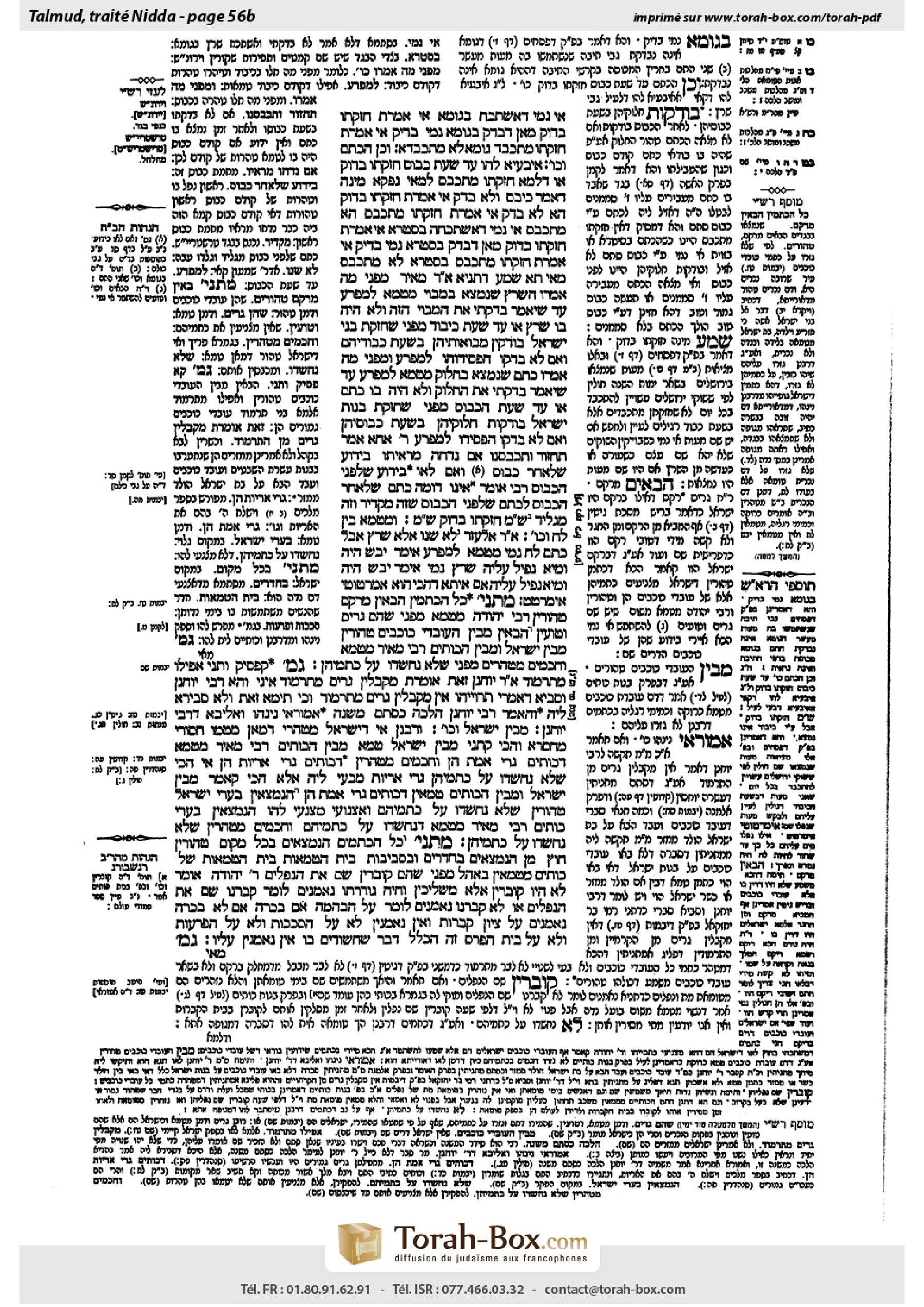
This page of Niddah includes the Aramaic text, an English translation and an AI-generated French translation, alongside the scan above.
נידה נ״ו ב · Aramaic and Hebrew text
אִי נָמֵי דְּאִשְׁתְּכַח בְּגוּמָּא, אִי אָמְרַתְּ חֶזְקָתוֹ בָּדוּק — מַאן דְּבָדֵק בְּגוּמָּא נָמֵי בָּדֵיק, אִי אָמְרַתְּ חֶזְקָתוֹ מִתְכַּבֵּד — גּוּמָּא לָא מִתְכַּבְּדָא.
וְכֵן הַכֶּתֶם וְכוּ׳. אִיבַּעְיָא לְהוּ: עַד שְׁעַת כִּבּוּס — חֶזְקָתוֹ בָּדוּק, אוֹ דִלְמָא חֶזְקָתוֹ מִתְכַּבֵּס?
לְמַאי נָפְקָא מִינַּהּ? דְּאָמַר: כַּיבֻּס וְלָא בְּדֻק. אִי אָמְרַתְּ חֶזְקָתוֹ בָּדוּק — הָא לָא בְּדִק, אִי אָמְרַתְּ חֶזְקָתוֹ מִתְכַּבֵּס — הָא מִתְכַּבֵּס.
אִי נָמֵי, דְּאִשְׁתְּכַח בְּסִטְרָא. אִי אָמְרַתְּ: ״חֶזְקָתוֹ בָּדוּק״ — מַאן דְּבָדֵק, בְּסִטְרָא נָמֵי בָּדֵיק. אִי אָמְרַתְּ: ״חֶזְקָתוֹ מִתְכַּבֵּס״ — בְּסִטְרָא לָא מִתְכַּבֵּס.
מַאי? תָּא שְׁמַע, דְּתַנְיָא: אָמַר רַבִּי מֵאִיר: מִפְּנֵי מָה אָמְרוּ הַשֶּׁרֶץ שֶׁנִּמְצָא בְּמָבוֹי מְטַמֵּא לְמַפְרֵעַ, עַד שֶׁיֹּאמַר ״בָּדַקְתִּי אֶת הַמָּבוֹי הַזֶּה וְלֹא הָיָה בּוֹ שֶׁרֶץ״, אוֹ עַד שְׁעַת כִּיבּוּד, מִפְּנֵי שֶׁחֶזְקַת בְּנֵי יִשְׂרָאֵל בּוֹדְקִין מְבוֹאוֹתֵיהֶן בִּשְׁעַת כִּבּוּדֵיהֶם, וְאִם לֹא בָּדְקוּ הִפְסִידוּהוּ לְמַפְרֵעַ.
וּמִפְּנֵי מָה אָמְרוּ, כֶּתֶם שֶׁנִּמְצָא בֶּחָלוּק מְטַמֵּא לְמַפְרֵעַ, עַד שֶׁיֹּאמַר ״בָּדַקְתִּי אֶת הֶחָלוּק וְלֹא הָיָה בּוֹ כֶּתֶם״, אוֹ עַד שְׁעַת הַכִּבּוּס — מִפְּנֵי שֶׁחֶזְקַת בְּנוֹת יִשְׂרָאֵל בּוֹדְקוֹת חֲלוּקֵיהֶן בִּשְׁעַת כִּבּוּסֵיהֶן, וְאִם לֹא בָּדְקוּ הִפְסִידוּ לְמַפְרֵעַ.
רַבִּי אַחָא אָמַר: תַּחְזוֹר וּתְכַבְּסֶנּוּ, אִם (נִדְחָה מַרְאִיתוֹ) [נִדְחוּ מַרְאָיו] — בְּיָדוּעַ שֶׁלְּאַחַר כִּבּוּס, וְאִם לָאו — בְּיָדוּעַ שֶׁלִּפְנֵי הַכִּבּוּס.
רַבִּי אוֹמֵר: אֵינוֹ דּוֹמֶה כֶּתֶם שֶׁלְּאַחַר הַכִּבּוּס לְכֶתֶם שֶׁלִּפְנֵי הַכִּבּוּס, שֶׁזֶּה מַקְדִּיר וְזֶה מַגְלִיד. שְׁמַע מִינַּהּ: חֶזְקָתוֹ בָּדוּק, שְׁמַע מִינַּהּ.
וּמְטַמֵּא בֵּין לַח וְכוּ׳. אָמַר רַבִּי אֶלְעָזָר: לֹא שָׁנוּ אֶלָּא שֶׁרֶץ, אֲבָל כֶּתֶם לַח נָמֵי מְטַמֵּא לְמַפְרֵעַ, אֵימַר יָבֵשׁ הָיָה וּמַיָּא נְפֻיל עֲלֵיהּ.
שֶׁרֶץ נָמֵי, אֵימַר יָבֵשׁ הָיָה וּמַיָּא נְפֻיל עֲלֵיהּ! אִם אִיתָא דְּהָכִי הוּא — אִמַּרְטוּטֵי אִימַּרְטַט.
מַתְנִי' כׇּל הַכְּתָמִין הַבָּאִין מֵרְקָם — טְהוֹרִין, רַבִּי יְהוּדָה מְטַמֵּא מִפְּנֵי שֶׁהֵם גֵּרִים וְטוֹעִין. הַבָּאִין מִבֵּין הַגּוֹיִם — טְהוֹרִין, מִבֵּין יִשְׂרָאֵל וּמִבֵּין הַכּוּתִים — רַבִּי מֵאִיר מְטַמֵּא, וַחֲכָמִים מְטַהֲרִים מִפְּנֵי שֶׁלֹּא נֶחְשְׁדוּ עַל כִּתְמֵיהֶן.
גְּמָ' קָפָסֵיק וְתָנֵי: אֲפִילּוּ מִתַּרְמוֹד! אָמַר רַבִּי יוֹחָנָן: זֹאת אוֹמֶרֶת, מְקַבְּלִין גֵּרִים מִתַּרְמוֹד.
אִינִי? וְהָא רַבִּי יוֹחָנָן וְסָבַיָּא, דְּאָמְרִי תַּרְוַיְיהוּ: אֵין מְקַבְּלִין גֵּרִים מִתַּרְמוֹד!
וְכִי תֵימָא, ״זֹאת״ וְלָא סְבִירָא לֵיהּ, וְהָאָמַר רַבִּי יוֹחָנָן: הֲלָכָה כִּסְתַם מִשְׁנָה!
אָמוֹרָאֵי נִינְהוּ, וְאַלִּיבָּא דְּרַבִּי יוֹחָנָן.
מִבֵּין יִשְׂרָאֵל וְכוּ׳. וְרַבָּנַן, אִי דְּיִשְׂרָאֵל מְטַהֲרִי, דְּמַאן מְטַמּוּ?
חַסּוֹרֵי מִחַסְּרָא, וְהָכִי קָתָנֵי: מִבֵּין יִשְׂרָאֵל — טָמֵא, מִבֵּין הַכּוּתִים — רַבִּי מֵאִיר מְטַמֵּא, דְּכוּתִים גֵּרֵי אֱמֶת הֵן, וַחֲכָמִים מְטַהֲרִין, דְּכוּתִים גֵּרֵי אֲרָיוֹת הֵן.
אִי הָכִי, שֶׁלֹּא נֶחְשְׁדוּ עַל כִּתְמֵיהֶן? גֵּרֵי אֲרָיוֹת מִבָּעֵי לֵיהּ!
אֶלָּא הָכִי קָאָמַר: מִבֵּין יִשְׂרָאֵל וּמִבֵּין הַכּוּתִים — טְמֵאִין, דְּכוּתִים גֵּרֵי אֱמֶת הֵן. הַנִּמְצָאִין בְּעָרֵי יִשְׂרָאֵל — טְהוֹרִין, שֶׁלֹּא נֶחְשְׁדוּ עַל כִּתְמֵיהֶם, וְאַצְנוֹעֵי מַצְנְעִי לְהוּ.
הַנִּמְצָאִין בְּעָרֵי כּוּתִים — רַבִּי מֵאִיר מְטַמֵּא, דְּנֶחְשְׁדוּ עַל כִּתְמֵיהֶם, וַחֲכָמִים מְטַהֲרִין, שֶׁלֹּא נֶחְשְׁדוּ עַל כִּתְמֵיהֶן.
מַתְנִי' כׇּל הַכְּתָמִים הַנִּמְצָאִים בְּכׇל מָקוֹם — טְהוֹרִין, חוּץ מִן הַנִּמְצָאִים בַּחֲדָרִים, וּבִסְבִיבוֹת בֵּית הַטְּמָאוֹת.
בֵּית הַטְּמָאוֹת שֶׁל כּוּתִים מְטַמְּאִין בְּאֹהֶל, מִפְּנֵי שֶׁהֵם קוֹבְרִין שָׁם אֶת הַנְּפָלִים. רַבִּי יְהוּדָה אוֹמֵר: לֹא הָיוּ קוֹבְרִין, אֶלָּא מַשְׁלִיכִין, וְחַיָּה גּוֹרַרְתּוֹ.
נֶאֱמָנִים לוֹמַר ״קָבַרְנוּ שָׁם אֶת הַנְּפָלִים״, אוֹ ״לֹא קָבַרְנוּ״, נֶאֱמָנִים לוֹמַר עַל הַבְּהֵמָה אִם בִּכְּרָה אִם לֹא בִּכְּרָה, נֶאֱמָנִים עַל צִיּוּן קְבָרוֹת.
וְאֵין נֶאֱמָנִין לֹא עַל הַסְּכָכוֹת, וְלֹא עַל הַפְּרָעוֹת, וְלֹא עַל בֵּית הַפְּרָס.
זֶה הַכְּלָל: דָּבָר שֶׁחֲשׁוּדִים בּוֹ — אֵין נֶאֱמָנִין עָלָיו.
Niddah 56b · English translation
Alternatively, there is a difference between these explanations in a case where the creeping animal was found in a hole in the ground. If you say the presumptive status of a swept alleyway is that it has been examined, it is clear that one who examines the alleyway also examines any holes, and any items that were in the alleyway beforehand should remain pure. By contrast, if you say its presumptive status is that it has been completely swept, this applies only to items that are on the ground, whereas a hole is not considered to have been swept. Consequently, even items that passed through the alleyway before it was swept should be deemed impure.
The mishna teaches: And likewise, a blood stain that was discovered on the robe of a woman renders her impure retroactively. With regard to this halakha as well a dilemma was raised before the Sages: The mishna states that any pure items the woman handled from the time of laundering are impure. Does this mean that once the robe has been laundered its presumptive status is that it has been examined, as when it is laundered it is examined thoroughly, and any blood stain would have been discovered? Or perhaps the mishna means that its presumptive status is that it is thoroughly laundered, and any blood stain would have been removed by the laundering.
The Gemara asks: What is the practical difference that arises from this dilemma? The Gemara replies: There is a difference in a case where the person who laundered the robe said he laundered it but did not examine it. If you say its presumptive status is that it has been examined, in this case the man explicitly said that he did not examine the robe, so it does not have this presumptive status. By contrast, if you say its presumptive status is that it is thoroughly laundered, in this case too it has been laundered.
Alternatively, there is a difference between these explanations in a case where the blood stain was found on the side of the robe, in an area where there are folds and stitches. If you say its presumptive status is that it has been examined, it is clear that one who examines the robe also examines the side of the robe, and therefore any items that the woman handled before the robe was laundered should remain pure. By contrast, if you say its presumptive status is that it is thoroughly laundered, this applies only to the main part of the robe, but on its side it is not laundered thoroughly enough to remove a blood stain.
What is the halakha with regard to these two dilemmas? Come and hear, as it is taught in a baraita that Rabbi Meir says: For what reason did the Sages say that the carcass of a creeping animal that was found in an alleyway renders pure items impure retroactively from the time about which one may state: I examined this alleyway and there was no creeping animal in it, or from the time of the sweeping of the alleyway? It is due to the fact that there is a presumption with regard to Jewish people that they examine their alleyways at the time of their sweeping. And therefore, if they did not examine the alleyway they retroactively lose the purity of any items that were there from the last time it was examined.
And similarly, for what reason did the Sages say that a blood stain that was found on the robe of a woman renders her impure retroactively from the time about which one may state: I examined the robe and there was no blood stain on it, or from the time of the laundering of the robe? It is due to the fact that there is a presumption with regard to the Jewish women that they examine their robes at the time of their laundering. And therefore, if they did not examine the robe they retroactively lose the purity of any items they handled since it was last examined.
Rabbi Aḥa says: Even in a case where the robe was not examined when it was laundered and a blood stain was subsequently found on it, and it is unknown whether the stain was present before the laundering, there is a remedy to the dilemma: Let her launder it again. If the appearance of the blood stain changes as a result of this laundering it is known that the robe became stained after the previous laundering, which is why the present laundering affected its appearance. Consequently, those pure items that the woman handled before the earlier laundering remain pure. And if the blood stain’s appearance does not change due to the second laundering it is known that the robe became stained before the previous laundering, and therefore the items that she handled before the laundering are impure.
Rabbi Yehuda HaNasi says: One can differentiate between a blood stain that was on the robe before it was laundered and one that stained the robe afterward by inspecting the stain itself. This is because the appearance of a blood stain after the laundering is not similar to the appearance of a blood stain before the laundering, as this stain, from after the laundering, penetrates [makdir] the garment, and that stain, from before the laundering, forms a crust [maglid] that can be scraped off the robe. With regard to the Gemara’s dilemma, one may conclude from Rabbi Meir’s statement that the presumptive status of a swept alleyway or a laundered robe is that it has been examined. The Gemara concludes: Indeed, conclude from it that this is so.
§ The mishna teaches: And the carcass of a creeping animal or a blood stain renders items impure retroactively whether they are still moist or are already dried out. Rabbi Shimon says: The dry one renders items impure retroactively, whereas the moist one does not render items impure since the aforementioned times, but only from such a time that it could still be moist from then up to the moment it was discovered. With regard to the opinion of Rabbi Shimon, Rabbi Elazar says: The mishna taught this halakha only with regard to the carcass of a creeping animal, but Rabbi Shimon concedes that a moist blood stain also renders the woman impure retroactively from the time that the robe was examined. This is because one can say the blood stain was dry beforehand and water fell upon it, causing it to become moist.
The Gemara asks: With regard to the moist carcass of a creeping animal as well, one can say it was dried out beforehand and water fell on it. It should therefore render items impure retroactively from the time that the alleyway was swept. The Gemara answers: If it is so, that this is what occurred, the dead creeping animal would be sundered apart and would not have its current appearance.
MISHNA: Any blood stains on garments that come from the town of Rekem are ritually pure, as most of the residents there are gentiles, and the blood stains of gentile women are not ritually impure. Rabbi Yehuda deems those stains impure because in his opinion the residents of Rekem are not gentiles; rather, they are converts whose halakhic status is that of Jews, but they are misguided and do not put away their bloodstained garments. The blood stains on garments that come from among the gentiles are ritually pure. With regard to blood stains on garments that come from among the Jews and from among the Samaritans, Rabbi Meir deems them impure, as they may have come from the Jews. And the Rabbis deem them ritually pure due to the fact that Jews are not suspected of failing to put away their garments on which there are blood stains.
GEMARA: The mishna categorically teaches that any blood stains on garments that come from among the gentiles are ritually pure, thereby indicating that this applies even to garments that come from among the gentile population of Tarmod. Rabbi Yoḥanan says: That is to say, one may accept converts from Tarmod, i.e., there is no concern with regard to whether they are actually Jews of flawed lineage, who may not marry Jews of fit lineage.
The Gemara asks: Is that so? But aren’t there Rabbi Yoḥanan and the Elders who both say that one may not accept converts from Tarmod? This is due to a concern that the daughters of the ten tribes exiled during the First Temple period might have intermingled with them, and according to Rabbi Yoḥanan the offspring of a Jewish woman and a gentile is a mamzer, who may not marry a Jew of fit lineage.
And if you would say that Rabbi Yoḥanan merely infers that this is the opinion of the mishna, as indicated by the term: That is to say, but he himself does not hold accordingly, that is not so. Didn’t Rabbi Yoḥanan say a principle that the halakha is in accordance with the ruling of an unattributed mishna, as is the case here?
The Gemara answers: They are amora’im, and they disagree with regard to the opinion of Rabbi Yoḥanan. According to one amora, Rabbi Yoḥanan maintains that converts from Tarmod are not accepted, and he did not state that it is a principle that the halakha is in accordance with the ruling of an unattributed mishna. According to another amora, Rabbi Yoḥanan holds that the halakha is in accordance with the unattributed mishna, and therefore one may accept converts from Tarmod.
§ The mishna teaches with regard to blood stains on garments that come from among the Jews and from among the Samaritans that Rabbi Meir deems them impure, and the Rabbis deem them ritually pure. The Gemara asks: But with regard to the opinion of the Rabbis, if they deem stains that come from a Jewish woman pure, whose stains do they deem impure?
The Gemara answers: The mishna is incomplete and this is what it is teaching: Everyone agrees that blood stains on garments that come from among the Jews are impure. With regard to blood stains that come from among the Samaritans, Rabbi Meir deems them impure, as he maintains the Samaritans are true converts and have the halakhic status of Jews, whose blood stains are impure. And the Rabbis deem them ritually pure, as they maintain the Samaritans are converts who converted under duress due to the threat posed by lions, and therefore their conversion is void, and their halakhic status is that of gentiles.
The Gemara asks: If so, why does the mishna state that according to the Rabbis the blood stains of the Samaritans are ritually pure due to the fact that they are not suspected of failing to put away their garments on which there are blood stains? The mishna should state that their blood stains are pure, as they are converts who converted due to the threat of lions.
Rather, this is what the mishna is saying: Blood stains on garments that come from among the Jews and from among the Samaritans are ritually impure, as everyone agrees the Samaritans are true converts. With regard to blood stains that are found in the towns of Jews, they are pure, as they are not suspected of failing to put away their garments on which there are blood stains, and they certainly put them away. Therefore, the stains necessarily come from gentiles.
The Gemara continues paraphrasing the mishna: With regard to blood stains that are found in the towns of Samaritans, Rabbi Meir deems them impure, as the inhabitants are suspected of failing to put away their garments on which there are blood stains. And the Rabbis deem them pure, as they maintain that even Samaritans are not suspected of failing to put away their garments on which there are blood stains, and the stains are necessarily from gentiles.
MISHNA: All blood stains on garments that are found anywhere where Jews and gentiles reside are ritually pure, since they must not belong to Jews, who put away their stained garments. This is the halakha except for the stained garments that are found in the inner rooms of the house, as these might be garments that the Jews put away there; and except for the stained garments found in proximity to the house of impurity, i.e., the room that women used when they were impure due to menstruation.
The house of impurity of Samaritans imparts the impurity that is imparted by a corpse by means of a tent, due to the fact that they bury the stillborn children there. Rabbi Yehuda says: The house of impurity of Samaritans does not impart that impurity, as they would not bury a stillborn child there. Rather, they would cast it outside and an animal would drag it away.
Samaritans are deemed credible to state: We buried the stillborn children there, in a certain place, and it transmits ritual impurity; or to state: We did not bury the stillborn children there, and it does not transmit ritual impurity. They are likewise deemed credible to state about an animal whether it previously gave birth or whether it did not previously give birth; and their testimony is accepted with regard to determining whether the animal’s offspring has the status of a firstborn animal, which is sacred. They are also deemed credible to testify about the marking of graves, i.e., that where they marked is deemed a grave and where they did not mark is deemed a place where there is no grave.
But with regard to the following cases, in which the exact location of a grave is unknown, the Samaritans are not deemed credible to testify: They are not deemed credible to testify about the overhanging boughs, nor about the protrusions that jut out of stone fences and cover the ground. If it is unknown which bough or protrusion hangs over a grave, forming a tent that transmits the impurity of a corpse, and if a Samaritan testifies that the grave is not beneath a particular bough or protrusion his testimony is not accepted. And likewise they are not deemed credible to testify about a beit haperas. The Sages issued a decree that in such a case, the area that was plowed is impure as far as one hundred cubits from the original grave, due to the concern that the bones were dispersed by the plow.
This is the principle governing the credibility of Samaritans: In the case of any matter of halakha that they are suspected of not fulfilling, they are not deemed credible to testify about it.
Niddah 56b · Traduction française (IA)
Autre possibilité : ces explications diffèrent dans le cas où une créature rampante a été trouvée dans un trou du sol. Si l’on dit que le statut présumé d’une ruelle balayée est qu’elle a été inspectée, il est clair que celui qui inspecte la ruelle inspecte aussi les trous ; les objets qui s’y trouvaient auparavant doivent donc rester purs. En revanche, si l’on dit que son statut présumé est qu’elle a été entièrement balayée, cela ne s’applique qu’aux objets qui se trouvent au sol, tandis qu’un trou n’est pas considéré comme ayant été balayé. Par conséquent, même les objets qui ont traversé la ruelle avant qu’elle ne soit balayée doivent être considérés comme impurs.
La Michna enseigne : De même, une tache de sang découverte sur le vêtement d’une femme la rend impure rétroactivement. À propos de cette halakha également, les Sages ont soulevé une question : la Michna indique que tous les objets purs que la femme a manipulés depuis le lavage sont impurs. Cela signifie-t-il qu’une fois le vêtement lavé, son statut présumé est qu’il a été inspecté, puisqu’en le lavant on l’examine minutieusement et que toute tache de sang aurait été découverte ? Ou bien la Michna veut-elle dire que son statut présumé est qu’il a été lavé à fond, et que toute tache de sang aurait été éliminée par le lavage ?
La Guemara demande : Quelle différence pratique découle de cette question ? La Guemara répond : Il y a une différence dans le cas où la personne qui a lavé le vêtement déclare l’avoir lavé, mais ne pas l’avoir inspecté. Si l’on dit que son statut présumé est qu’il a été inspecté, dans ce cas, cette personne a explicitement dit qu’elle n’avait pas inspecté le vêtement ; celui-ci ne bénéficie donc pas de ce statut présumé. En revanche, si l’on dit que son statut présumé est qu’il a été lavé à fond, dans ce cas également, il a été lavé.
Autre possibilité : ces explications diffèrent dans le cas où la tache de sang a été trouvée sur le bord du vêtement, dans une zone où il y a des plis et des coutures. Si l’on dit que son statut présumé est qu’il a été inspecté, il est clair que celui qui inspecte le vêtement en examine aussi le bord ; par conséquent, tous les objets que la femme a manipulés avant que le vêtement ne soit lavé doivent rester purs. En revanche, si l’on dit que son statut présumé est qu’il a été lavé à fond, cela ne s’applique qu’à la partie principale du vêtement ; son bord, lui, n’est pas lavé assez soigneusement pour éliminer une tache de sang.
Quelle est la halakha concernant ces deux questions ? Viens et écoute, car il est enseigné dans une baraïta que Rabbi Meïr dit : Pour quelle raison les Sages ont-ils dit que la carcasse d’une créature rampante trouvée dans une ruelle rend impurs rétroactivement les objets purs à partir du moment au sujet duquel on peut déclarer : « J’ai inspecté cette ruelle et il n’y avait pas de créature rampante », ou à partir du balayage de la ruelle ? C’est parce qu’il existe une présomption concernant les Juifs : ils inspectent leurs ruelles au moment où ils les balayent. Par conséquent, s’ils n’ont pas inspecté la ruelle, ils perdent rétroactivement le statut de pureté de tous les objets qui s’y trouvaient depuis la dernière inspection.
De même, pour quelle raison les Sages ont-ils dit qu’une tache de sang trouvée sur le vêtement d’une femme la rend impure rétroactivement à partir du moment au sujet duquel on peut déclarer : « J’ai inspecté le vêtement et il n’y avait pas de tache de sang dessus », ou à partir du lavage du vêtement ? C’est parce qu’il existe une présomption concernant les femmes juives : elles inspectent leurs vêtements au moment où elles les lavent. Par conséquent, si elles n’ont pas inspecté le vêtement, elles perdent rétroactivement le statut de pureté de tous les objets qu’elles ont manipulés depuis la dernière inspection.
Rabbi Aḥa dit : Même dans le cas où le vêtement n’a pas été inspecté lors du lavage et qu’une tache de sang y a ensuite été trouvée, sans que l’on sache si elle était présente avant le lavage, il existe un moyen de résoudre la question : qu’elle le lave de nouveau. Si l’aspect de la tache de sang change à la suite de ce lavage, on sait que le vêtement s’est taché après le lavage précédent, raison pour laquelle le lavage actuel en a modifié l’aspect. Par conséquent, les objets purs que la femme a manipulés avant le lavage précédent restent purs. Et si l’aspect de la tache de sang ne change pas lors du second lavage, on sait que le vêtement s’est taché avant le lavage précédent ; les objets qu’elle a manipulés avant le lavage sont donc impurs.
Rabbi Yehouda HaNassi dit : On peut distinguer une tache de sang qui se trouvait sur le vêtement avant son lavage d’une tache qui l’a marqué après le lavage en examinant la tache elle-même. En effet, l’aspect d’une tache de sang après le lavage diffère de son aspect avant le lavage : la tache apparue après le lavage pénètre [makdir] dans le vêtement, tandis que celle apparue avant le lavage forme une croûte [maglid] que l’on peut gratter du vêtement. Concernant la question de la Guemara, on peut conclure de la déclaration de Rabbi Meïr que le statut présumé d’une ruelle balayée ou d’un vêtement lavé est qu’il a été inspecté. La Guemara conclut : En effet, déduis-en que c’est bien le cas.
§ La Michna enseigne : La carcasse d’une créature rampante ou une tache de sang rend les objets impurs rétroactivement, qu’elle soit encore humide ou déjà sèche. Rabbi Shimon dit : La matière sèche rend les objets impurs rétroactivement, tandis que la matière humide ne les rend pas impurs depuis les moments mentionnés précédemment, mais seulement à partir d’un moment où elle aurait pu rester humide jusqu’à l’instant de sa découverte. Au sujet de l’opinion de Rabbi Shimon, Rabbi Elazar dit : La Michna n’a enseigné cette halakha qu’à propos de la carcasse d’une créature rampante ; mais Rabbi Shimon admet qu’une tache de sang humide rend également la femme impure rétroactivement depuis le moment où le vêtement a été inspecté. En effet, on peut dire que la tache de sang était sèche auparavant et que de l’eau est tombée dessus, la rendant humide.
La Guemara demande : Pour la carcasse humide d’une créature rampante également, on peut dire qu’elle était sèche auparavant et que de l’eau est tombée dessus. Elle devrait donc rendre les objets impurs rétroactivement depuis le moment où la ruelle a été balayée. La Guemara répond : Si c’est bien ce qui s’est passé, la créature rampante morte serait démembrée et n’aurait pas son aspect actuel.
MICHNA : Toutes les taches de sang sur des vêtements provenant de la ville de Rekem sont rituellement pures, car la plupart de ses habitants sont des non-Juifs et les taches de sang des femmes non juives ne sont pas rituellement impures. Rabbi Yehouda considère ces taches comme impures, car, selon lui, les habitants de Rekem ne sont pas des non-Juifs ; ce sont plutôt des convertis dont le statut halakhique est celui de Juifs, mais qui s’égarent et ne mettent pas de côté leurs vêtements tachés de sang. Les taches de sang sur des vêtements provenant des non-Juifs sont rituellement pures. Quant aux taches de sang sur des vêtements provenant des Juifs et des Samaritains, Rabbi Meïr les considère comme impures, car elles peuvent provenir des Juifs. Les Sages les considèrent comme rituellement pures, car les Juifs ne sont pas soupçonnés de ne pas mettre de côté leurs vêtements tachés de sang.
GUEMARA : La Michna enseigne sans réserve que toutes les taches de sang sur des vêtements provenant des non-Juifs sont rituellement pures, indiquant ainsi que cela s’applique même aux vêtements provenant de la population non juive de Tarmod. Rabbi Yoḥanan dit : Cela signifie qu’on peut accepter des convertis de Tarmod, c’est-à-dire qu’il n’y a pas lieu de craindre qu’ils soient en réalité des Juifs de lignage défectueux, qui ne peuvent pas épouser des Juifs de lignage régulier.
La Guemara demande : Est-ce vraiment le cas ? Pourtant, Rabbi Yoḥanan et les Anciens disent tous deux qu’on ne peut pas accepter de convertis de Tarmod. C’est par crainte que les filles des dix tribus exilées à l’époque du Premier Temple se soient mêlées à eux ; or, selon Rabbi Yoḥanan, l’enfant d’une Juive et d’un non-Juif est un mamzer, qui ne peut pas épouser un Juif de lignage régulier.
Et si l’on disait que Rabbi Yoḥanan déduit simplement que telle est l’opinion de la Michna, comme l’indique l’expression « Cela signifie », sans toutefois partager lui-même cette opinion, ce n’est pas le cas. Rabbi Yoḥanan n’a-t-il pas énoncé le principe selon lequel la halakha suit la décision d’une Michna anonyme, comme c’est le cas ici ?
La Guemara répond : Ce sont des amoraïm, et ils sont en désaccord au sujet de l’opinion de Rabbi Yoḥanan. Selon l’un des amoraïm, Rabbi Yoḥanan estime qu’on n’accepte pas les convertis de Tarmod et il n’a pas énoncé comme principe que la halakha suit la décision d’une Michna anonyme. Selon un autre amora, Rabbi Yoḥanan estime que la halakha suit la Michna anonyme ; on peut donc accepter des convertis de Tarmod.
§ La Michna enseigne, à propos des taches de sang sur des vêtements provenant des Juifs et des Samaritains, que Rabbi Meïr les considère comme impures, tandis que les Sages les considèrent comme rituellement pures. La Guemara demande : Quant à l’opinion des Sages, s’ils considèrent comme pures les taches provenant d’une Juive, les taches de qui considèrent-ils comme impures ?
La Guemara répond : La Michna est incomplète, et voici ce qu’elle enseigne : Tous conviennent que les taches de sang sur les vêtements provenant des Juifs sont impures. Quant aux taches de sang provenant des Samaritains, Rabbi Meïr les considère comme impures, car il estime que les Samaritains sont de véritables convertis et ont le statut halakhique des Juifs, dont les taches de sang sont impures. Les Sages les considèrent comme rituellement pures, car ils estiment que les Samaritains sont des convertis qui se sont convertis sous la contrainte, en raison de la menace des lions ; leur conversion est donc nulle et leur statut halakhique est celui des non-Juifs.
La Guemara demande : Dans ce cas, pourquoi la Michna dit-elle que, selon les Sages, les taches de sang des Samaritains sont rituellement pures parce qu’ils ne sont pas soupçonnés de ne pas mettre de côté leurs vêtements tachés de sang ? La Michna aurait dû dire que leurs taches de sang sont pures parce qu’ils sont des convertis qui se sont convertis sous la menace des lions.
Mais voici ce que dit la Michna : Les taches de sang sur des vêtements provenant des Juifs et des Samaritains sont rituellement impures, car tous conviennent que les Samaritains sont de véritables convertis. Quant aux taches de sang trouvées dans les villes juives, elles sont pures, car les Juifs ne sont pas soupçonnés de ne pas mettre de côté leurs vêtements tachés de sang et les mettent assurément de côté. Les taches proviennent donc nécessairement de non-Juifs.
La Guemara poursuit sa paraphrase de la Michna : Quant aux taches de sang trouvées dans les villes samaritaines, Rabbi Meïr les considère comme impures, car les habitants sont soupçonnés de ne pas mettre de côté leurs vêtements tachés de sang. Les Sages les considèrent comme pures, car ils estiment que même les Samaritains ne sont pas soupçonnés de ne pas mettre de côté leurs vêtements tachés de sang ; les taches proviennent donc nécessairement de non-Juifs.
MICHNA : Toutes les taches de sang sur des vêtements trouvés en tout lieu où résident des Juifs et des non-Juifs sont rituellement pures, puisqu’elles ne peuvent pas appartenir à des Juifs, qui mettent de côté leurs vêtements tachés. Cette règle connaît deux exceptions : les vêtements tachés trouvés dans les pièces intérieures de la maison, car il peut s’agir de vêtements que les Juifs y ont mis de côté ; et les vêtements tachés trouvés à proximité de la maison d’impureté, c’est-à-dire la pièce que les femmes utilisaient lorsqu’elles étaient impures en raison de leurs règles.
La maison d’impureté des Samaritains transmet l’impureté d’un cadavre par le biais d’une tente, car ils y enterrent les enfants mort-nés. Rabbi Yehouda dit : La maison d’impureté des Samaritains ne transmet pas cette impureté, car ils n’y enterreraient pas un enfant mort-né. Ils le jetteraient plutôt dehors, et un animal l’emporterait.
Les Samaritains sont jugés dignes de foi lorsqu’ils déclarent : « Nous avons enterré les enfants mort-nés là-bas, à un endroit donné », auquel cas cet endroit transmet l’impureté rituelle ; ou lorsqu’ils déclarent : « Nous n’y avons pas enterré les enfants mort-nés », auquel cas cet endroit ne transmet pas l’impureté rituelle. Ils sont également jugés dignes de foi lorsqu’ils indiquent si un animal a déjà mis bas ou non ; leur témoignage est accepté pour déterminer si le petit de l’animal a le statut de premier-né, qui est sacré. Ils sont aussi jugés dignes de foi au sujet du marquage des tombes : l’endroit qu’ils ont marqué est considéré comme une tombe, et l’endroit qu’ils n’ont pas marqué comme un lieu où il n’y a pas de tombe.
Mais, dans les cas suivants, où l’emplacement exact d’une tombe est inconnu, les Samaritains ne sont pas jugés dignes de foi lorsqu’ils témoignent : ils ne sont pas jugés dignes de foi au sujet des branches en surplomb, ni des saillies qui dépassent des murs de pierre et couvrent le sol. Si l’on ignore quelle branche ou quelle saillie surplombe une tombe et forme une tente transmettant l’impureté d’un cadavre, le témoignage d’un Samaritain affirmant que la tombe ne se trouve pas sous telle branche ou telle saillie n’est pas accepté. De même, ils ne sont pas jugés dignes de foi au sujet d’un beit haperas. Les Sages ont décrété que, dans un tel cas, la zone labourée est impure jusqu’à cent coudées de la tombe d’origine, par crainte que la charrue n’ait dispersé les os.
Voici le principe qui régit la crédibilité des Samaritains : dans toute affaire de halakha qu’ils sont soupçonnés de ne pas respecter, ils ne sont pas jugés dignes de foi pour en témoigner.
Traduction française générée par IA à partir de l’édition anglaise de Sefaria. Vérifie toujours un passage avec le texte source.
Text from Sefaria: William Davidson Edition - Vocalized Aramaic (CC BY NC); William Davidson Edition - English (CC BY NC).