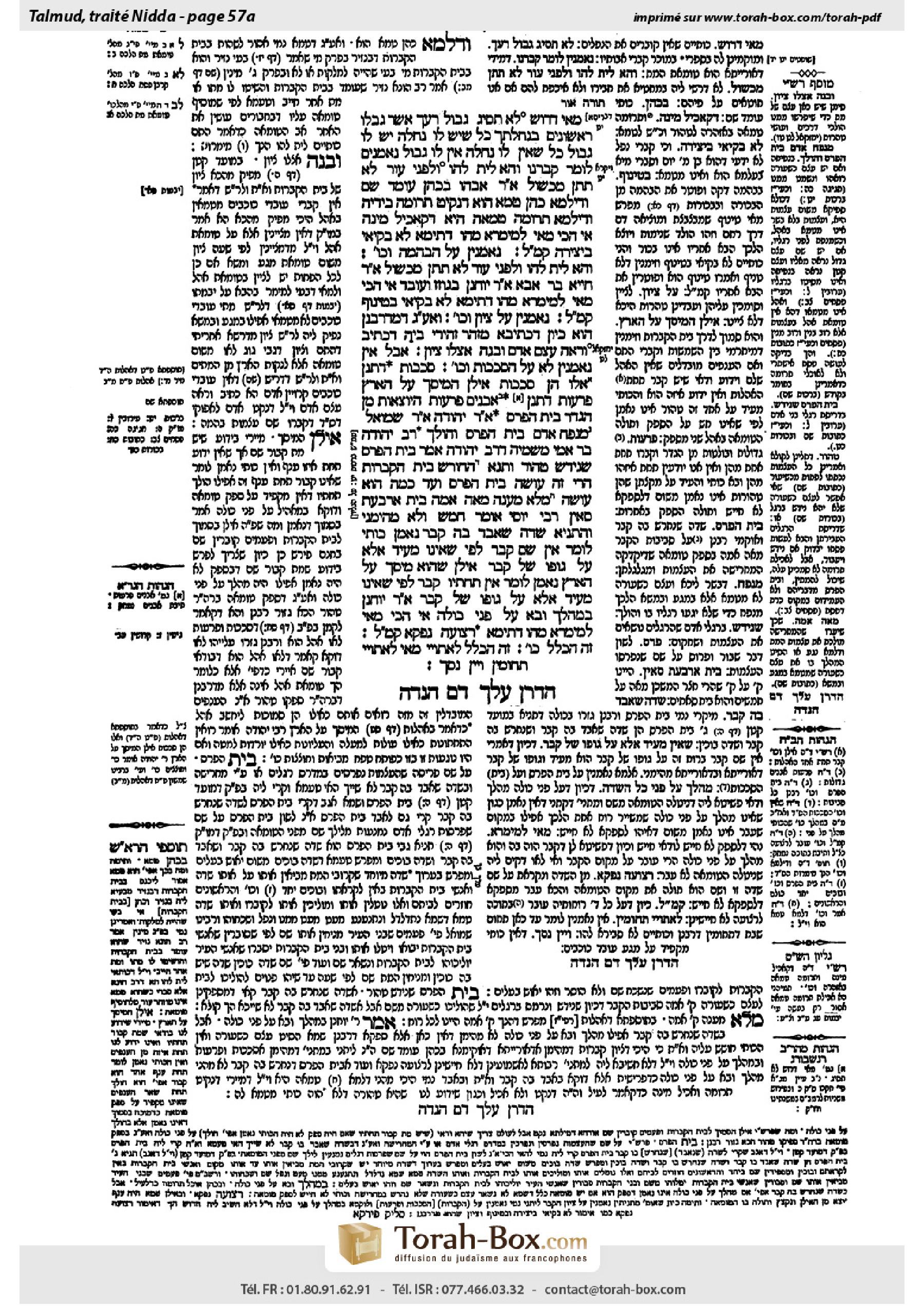
Niddah 57a: Talmud study for Daf Yomi
Daf Yomi is the daily study of one Talmud folio. Explore 37 tractates with scans, Hebrew text, Sefaria English and AI-generated French translations where annotated.
Passage selection and English or AI-generated French translation are available where the scan has annotations. Daf Study is independent of Torah-Box and Sefaria.
Browse Niddah · נידה · All tractatesNiddah 57a text and translations
This page of Niddah includes the Aramaic text, an English translation and an AI-generated French translation, alongside the scan above.
נידה נ״ז א · Aramaic and Hebrew text
גְּמָ' מַאי דְּרוּשׁ? ״לֹא תַסִּיג גְּבוּל רֵעֲךָ אֲשֶׁר גָּבְלוּ רִאשֹׁנִים בְּנַחֲלָתְךָ״.
כֹּל שֶׁיֵּשׁ לוֹ נַחֲלָה — יֵשׁ לוֹ גְּבוּל, כֹּל שֶׁאֵין לוֹ נַחֲלָה — אֵין לוֹ גְּבוּל.
נֶאֱמָנִים לוֹמַר קָבַרְנוּ. וְהָא לֵית לְהוּ ״וְלִפְנֵי עִוֵּר לֹא תִתֵּן מִכְשֹׁל״! אָמַר רַבִּי אֲבָהוּ: בְּכֹהֵן עוֹמֵד שָׁם.
וְדִילְמָא כֹּהֵן טָמֵא הוּא? דְּנָקֵיט תְּרוּמָה בִּידֵיהּ, וְדִילְמָא תְּרוּמָה טְמֵאָה הִיא? דְּקָאָכֵיל מִינַּהּ.
אִי הָכִי, מַאי לְמֵימְרָא? מַהוּ דְּתֵימָא: לָא בְּקִיאִי בִּיצִירָה, קָא מַשְׁמַע לַן.
נֶאֱמָנִין עַל הַבְּהֵמָה וְכוּ׳. וְהָא לֵית לְהוּ ״וְלִפְנֵי עִוֵּר לֹא תִתֵּן מִכְשֹׁל״! אָמַר רַבִּי חִיָּיא בַּר אַבָּא אָמַר רַבִּי יוֹחָנָן: בְּגוֹזֵז וְעוֹבֵד.
אִי הָכִי, מַאי לְמֵימְרָא? מַהוּ דְּתֵימָא: לָא בְּקִיאִי בְּטִינּוּף, קָא מַשְׁמַע לַן.
נֶאֱמָנִין עַל צִיּוּן וְכוּ׳. וְאַף עַל גַּב דְּמִדְּרַבָּנַן הוּא, כֵּיוָן דִּכְתִיבָא — מִזְהָר זְהִירִי בֵּיהּ, דִּכְתִיב: ״וְרָאָה עֶצֶם אָדָם וּבָנָה אֶצְלוֹ צִיּוּן״.
אֲבָל אֵין נֶאֱמָנִין לֹא עַל הַסְּכָכוֹת וְכוּ׳. סְכָכוֹת — דִּתְנַן: ״אֵלּוּ הֵן סְכָכוֹת — אִילָן הַמֵּיסֵךְ עַל הָאָרֶץ״. פְּרָעוֹת — דִּתְנַן: ״אֲבָנִים פְּרוּעוֹת הַיּוֹצְאוֹת מִן הַגָּדֵר״.
בֵּית הַפְּרָס. אָמַר רַב יְהוּדָה אָמַר רַב שְׁמוּאֵל: מְנַפֵּחַ אָדָם בֵּית הַפְּרָס, וְהוֹלֵךְ.
רַב יְהוּדָה בַּר אַמֵּי מִשְּׁמֵיהּ דְּרַב יְהוּדָה אָמַר: בֵּית הַפְּרָס שֶׁנִּידַּשׁ טָהוֹר. וְתָנָא: הַחוֹרֵשׁ בֵּית הַקְּבָרוֹת — הֲרֵי זֶה עוֹשֶׂה בֵּית הַפְּרָס, וְעַד כַּמָּה הוּא עוֹשֶׂה? מְלֹא מַעֲנָה, מֵאָה אַמָּה, בֵּית אַרְבַּעַת סְאִין. רַבִּי יוֹסֵי אוֹמֵר: חָמֵשׁ.
וְלָא מְהֵימְנִי? וְהָתַנְיָא: שָׂדֶה שֶׁאָבַד בָּהּ קֶבֶר, נֶאֱמָן כּוּתִי לוֹמַר ״אֵין שָׁם קֶבֶר״.
לְפִי שֶׁאֵינוֹ מֵעִיד אֶלָּא עַל גּוּפוֹ שֶׁל קֶבֶר. אִילָן שֶׁהוּא מֵיסֵךְ עַל הָאָרֶץ — נֶאֱמָן לוֹמַר ״אֵין תַּחְתָּיו קֶבֶר״, לְפִי שֶׁאֵינוֹ מֵעִיד אֶלָּא עַל גּוּפוֹ שֶׁל קֶבֶר.
אָמַר רַבִּי יוֹחָנָן: בִּמְהַלֵּךְ וּבָא עַל פְּנֵי כּוּלָּהּ.
אִי הָכִי, מַאי לְמֵימְרָא? מַהוּ דְּתֵימָא: רְצוּעָה נָפְקָא, קָא מַשְׁמַע לַן.
זֶה הַכְּלָל כּוּ׳. זֶה הַכְּלָל לְאֵתוֹיֵי מַאי? לְאֵתוֹיֵי תְּחוּמִין וְיֵין נֶסֶךְ.
הֲדַרַן עֲלָךְ דַּם הַנִּדָּה.
Niddah 57a · English translation
GEMARA: The mishna teaches that the Samaritans do not observe burial customs for stillborn children. The Gemara asks: What verse did they interpret as a source for this practice? The Gemara replies that they interpreted the verse: “You shall not remove your fellow’s boundary marker, which was bounded by the first ones, in your inheritance that you shall inherit, in the land that the Lord your God gives you to possess it” (Deuteronomy 19:14).
The Gemara explains: The Sages derived from this verse that it is prohibited to sell one’s ancestral burial ground. In accordance with this interpretation of the verse, the Samaritans derived that any individual who has an inheritance, i.e., who stands to inherit land, has a boundary, i.e., a burial place, whereas any individual who does not have an inheritance in the land, e.g., a stillborn child, does not have a boundary, i.e., a burial place. The Samaritans therefore concluded that the mitzva of burial does not apply to stillborn children.
The mishna teaches that Samaritans are deemed credible to state: We buried the stillborn children in a certain place, or to state that they did not bury the stillborn children there, and that place does not transmit ritual impurity. The Gemara objects: But the Samaritans do not accept the Sages’ interpretation of the verse: “And you shall not put a stumbling block before the blind” (Leviticus 19:14), that one may not cause another to sin. Since they are not concerned about misleading others, why is their testimony accepted? Rabbi Abbahu says: The mishna is referring to a case where a Samaritan priest is standing there, on that spot, which indicates that he genuinely maintains it is not impure with the impurity of a corpse.
The Gemara objects: But perhaps he is an impure priest and therefore he does not refrain from standing in an impure place. The Gemara explains: The mishna is referring to a situation where the priest is holding teruma in his hand, which indicates he is ritually pure. The Gemara further objects: But perhaps it is impure teruma. The Gemara explains: The mishna is referring to a case where the priest is partaking of the teruma, which indicates that it is not impure, as it is prohibited to consume impure teruma.
The Gemara asks: If so, i.e., if this is the circumstance, it is obvious that the Samaritan priest’s testimony can be accepted. Then what is the purpose of stating this halakha? The Gemara answers: The ruling of the mishna is necessary, lest you say that the Samaritans are not knowledgeable with regard to the stages of the formation of an embryo, and they might bury a fetus believing that it is an unformed fetus that does not transmit impurity, when it is actually a forty-day-old fetus, which is impure. Therefore, the mishna teaches us that they are sufficiently knowledgeable, and their testimony is accepted.
The mishna teaches that the Samaritans are deemed credible to state with regard to an animal that it previously gave birth, and its subsequent offspring does not have the sacred status of a firstborn animal. The Gemara objects: But the Samaritans do not accept the Sages’ interpretation of the verse: “And you shall not put a stumbling block before the blind,” that one may not cause another to sin. Why, then, is their testimony accepted? Rabbi Ḥiyya bar Abba says that Rabbi Yoḥanan says: The mishna is referring to a case where the Samaritan is shearing and working the offspring of the animal. Since the Samaritans are meticulous with regard to Torah law, it is evident that it is not a firstborn.
The Gemara asks: If so, i.e., if this is the circumstance, what is the purpose of stating this halakha? The Gemara answers: The ruling of the mishna is necessary, lest you say that the Samaritans are not knowledgeable with regard to a murky discharge emitted from the uterus, which is indicative of a fetus and exempts subsequent births from the mitzva of the firstborn (see Bekhorot 21a). It is possible that the Samaritan mistakenly believes the animal previously emitted a murky discharge and therefore its offspring is not a firstborn. Therefore, the mishna teaches us that they are sufficiently knowledgeable, and their testimony is accepted.
The mishna further teaches that the Samaritans are deemed credible to testify with regard to the marking of graves, as the Samaritans mark their graves, and we rely on their marking as an indication that a corpse is buried there. Therefore, any place where there is no marking is considered ritually pure. The Gemara explains: Even though the marking of graves is required only by rabbinic law, and Samaritans generally do not observe rabbinic law, since it is written in the Bible, the Samaritans are meticulous with regard to it, as it is written: “And those that pass through shall pass through the land, and when one sees a human bone he shall set up a marking by it, until the buriers have buried it in the valley of Hamon-gog” (Ezekiel 39:15).
The mishna teaches: But with regard to the following cases in which the exact location of a grave is unknown, the Samaritans are not deemed credible to testify: They are not deemed credible to testify about overhanging boughs, nor about the protrusions that jut out of stone fences. The Gemara explains these terms: The term overhanging boughs should be understood as we learned in a mishna (Oholot 8:2): These are overhanging boughs: A tree that hangs over the ground. The term protrusions should be understood as we learned in the Tosefta (Oholot 9:4): Protruding stones that jut out of a fence.
§ The mishna teaches that the Samaritans are not deemed credible to testify about a beit haperas. With regard to a beit haperas, Rav Yehuda says that Rav Shmuel says: The reason the Sages deemed a beit haperas impure is due to the concern that the bones, but not the flesh of the corpse, were dispersed by the plow throughout the field. The halakha is that a bone transmits impurity by carrying or by contact, if it is at least the size of a barley grain, but it does not transmit impurity by means of a tent. Therefore, if a person is carrying ritually pure items, or if he wishes to remain ritually pure so that he may consume consecrated items, and yet he must pass through a beit haperas, he may blow on the earth of the beit haperas before each step, so that if there is a bone beneath the dust he will expose it and avoid it. And in this manner he may walk across the area while remaining ritually pure, even though he might step over a bone.
Rav Yehuda bar Ami says in the name of Rav Yehuda: A beit haperas that has been trodden underfoot by many people is pure, as it may be assumed that any bone fragments at least as large as a barley grain that were on the surface were either broken or removed. And it was taught in a baraita: In the case of one who plows a graveyard, this individual thereby renders it a beit haperas. And to what extent does he render it a beit haperas, i.e., how far does the concern apply that bones might have been dispersed? The field is rendered a beit haperas to the extent of a full furrow [ma’ana], one hundred cubits by one hundred cubits, which is the area required for sowing four se’a of seed. Rabbi Yosei says: The area rendered a beit haperas is the area required for sowing five se’a of seed.
With regard to the ruling of the mishna that the Samaritans are not deemed credible to testify about a beit haperas, the Gemara asks: And aren’t they deemed credible? But isn’t it taught in a baraita: With regard to a field in which a grave was lost, which has the status of a beit haperas, a Samaritan is deemed credible to say: There is no grave there?
The baraita explains: This is due to the fact that he is not considered to be testifying about a case of uncertain impurity; rather, he is testifying about the location of the grave itself, which is a matter of Torah law, and the Samaritans are deemed credible with regard to a matter of Torah law. Likewise, in the case of a tree that is hanging over the ground, a Samaritan is deemed credible to say: There is no grave beneath it, as he is testifying only about the location of the grave itself. This indicates that the Samaritans are deemed credible with regard to overhanging boughs and protrusions.
Rabbi Yoḥanan says in explanation: The baraita is referring to a case where the Samaritan is walking to and fro over the entire area, and therefore if there was a grave there he would certainly have become impure. Consequently, one may rely on his statement with regard to the purity of the place. By contrast, the mishna is speaking of a case where the Samaritan did not traverse the entire area, and therefore his testimony is not accepted, as they are not meticulous with regard to cases of uncertainty.
The Gemara asks: If so, it is obvious that his testimony is credible, and what is the purpose of stating this halakha? The Gemara answers: The ruling of the baraita is necessary, lest you say that perhaps a narrow strip of land, which is called by the same name as this field, extends into a nearby field, and the Samaritan presumes the grave is located in that strip of land. If so, even if the Samaritan traversed the entire field his testimony cannot be accepted, as he traversed the field because he considered it merely a case of uncertain impurity. The baraita therefore teaches us that if the Samaritan traverses the entire field his testimony is accepted, as this concern is not an issue.
The mishna teaches: This is the principle governing the credibility of Samaritans: In the case of any matter of halakha that they are suspected of not fulfilling, they are not deemed credible to testify about it. The Gemara asks: What is added by the term: This is the principle? The Gemara answers: It serves to add that Samaritans are not deemed credible with regard to Shabbat boundaries, i.e., to say that a Shabbat boundary extends until a certain point, as the halakha of Shabbat boundaries applies by rabbinic law. And likewise, the Samaritans are not deemed credible with regard to the status of wine used for a libation in idol worship, as the Samaritans do not refrain from drinking wine touched by a gentile.
Niddah 57a · Traduction française (IA)
GUEMARA : La Michna enseigne que les Samaritains n’observent pas les rites funéraires pour les enfants mort-nés. La Guemara demande : Quel verset ont-ils interprété comme fondement de cette pratique ? La Guemara répond qu’ils ont interprété le verset suivant : « Tu ne déplaceras pas la borne de ton prochain, que les premiers ont fixée, dans l’héritage dont tu hériteras dans le pays que le Seigneur ton Dieu te donne pour en prendre possession » (Deutéronome 19,14).
La Guemara explique : Les Sages ont déduit de ce verset qu’il est interdit de vendre le terrain funéraire de ses ancêtres. Selon cette interprétation du verset, les Samaritains ont déduit que tout individu qui a un héritage, c’est-à-dire qui est appelé à hériter d’une terre, a une borne, c’est-à-dire un lieu de sépulture, tandis que tout individu qui n’a pas d’héritage dans le pays, par exemple un enfant mort-né, n’a pas de borne, c’est-à-dire pas de lieu de sépulture. Les Samaritains ont donc conclu que la mitsva d’inhumation ne s’applique pas aux enfants mort-nés.
La Michna enseigne que les Samaritains sont jugés crédibles lorsqu’ils déclarent : « Nous avons enterré les enfants mort-nés à tel endroit », ou qu’ils ne les y ont pas enterrés ; cet endroit ne transmet alors pas l’impureté rituelle. La Guemara objecte : Mais les Samaritains n’acceptent pas l’interprétation des Sages du verset : « Tu ne mettras pas d’obstacle devant l’aveugle » (Lévitique 19,14), selon laquelle il est interdit d’inciter autrui à pécher. Puisqu’ils ne se soucient pas d’induire autrui en erreur, pourquoi leur témoignage est-il accepté ? Rabbi Abbahou dit : La Michna parle d’un cas où un prêtre samaritain se tient là, à cet endroit, ce qui indique qu’il est réellement convaincu que le lieu n’est pas impur de l’impureté d’un cadavre.
La Guemara objecte : Mais peut-être est-il un prêtre impur et ne s’abstient-il donc pas de se tenir dans un lieu impur. La Guemara explique : La Michna parle d’une situation où le prêtre tient de la terouma dans sa main, ce qui indique qu’il est rituellement pur. La Guemara objecte encore : Mais peut-être s’agit-il de terouma impure. La Guemara explique : La Michna parle d’un cas où le prêtre consomme la terouma, ce qui indique qu’elle n’est pas impure, car il est interdit de consommer de la terouma impure.
La Guemara demande : Dans ce cas, c’est-à-dire dans ces circonstances, il est évident que le témoignage du prêtre samaritain peut être accepté. À quoi sert donc cette halakha ? La Guemara répond : La décision de la Michna est nécessaire, de peur que tu ne dises que les Samaritains ne connaissent pas les étapes de la formation de l’embryon et qu’ils aient enterré un fœtus en croyant qu’il s’agissait d’un fœtus non formé, qui ne transmet pas l’impureté, alors qu’il s’agissait en réalité d’un fœtus de quarante jours, qui est impur. La Michna nous enseigne donc qu’ils ont des connaissances suffisantes et que leur témoignage est accepté.
La Michna enseigne que les Samaritains sont jugés crédibles lorsqu’ils déclarent, au sujet d’un animal, qu’il a déjà mis bas et que sa progéniture ultérieure n’a pas le statut sacré de premier-né. La Guemara objecte : Mais les Samaritains n’acceptent pas l’interprétation des Sages du verset : « Tu ne mettras pas d’obstacle devant l’aveugle », selon laquelle il est interdit d’inciter autrui à pécher. Pourquoi, alors, leur témoignage est-il accepté ? Rabbi Ḥiyya bar Abba dit au nom de Rabbi Yoḥanan : La Michna parle d’un cas où le Samaritain tond la progéniture de l’animal et la fait travailler. Puisque les Samaritains sont scrupuleux en matière de loi de la Torah, il est évident qu’il ne s’agit pas d’un premier-né.
La Guemara demande : Dans ce cas, c’est-à-dire dans ces circonstances, à quoi sert cette halakha ? La Guemara répond : La décision de la Michna est nécessaire, de peur que tu ne dises que les Samaritains ne connaissent pas l’émission d’un écoulement trouble provenant de l’utérus, qui indique la présence d’un fœtus et dispense les naissances suivantes de la mitsva du premier-né (voir Bekhorot 21a). Il est possible que le Samaritain croie à tort que l’animal a auparavant émis un écoulement trouble et que, par conséquent, son petit n’est pas un premier-né. La Michna nous enseigne donc qu’ils ont des connaissances suffisantes et que leur témoignage est accepté.
La Michna enseigne en outre que les Samaritains sont jugés crédibles pour témoigner au sujet du marquage des tombes, car ils marquent leurs tombes et l’on se fie à leurs marques pour savoir qu’un cadavre est enterré à cet endroit. Par conséquent, tout endroit dépourvu de marque est considéré comme rituellement pur. La Guemara explique : Bien que le marquage des tombes ne soit requis que par décret rabbinique et que les Samaritains n’observent généralement pas les lois rabbiniques, ils sont scrupuleux à cet égard puisque cela est écrit dans la Bible, comme il est écrit : « Ceux qui traverseront le pays le traverseront ; lorsqu’on apercevra un ossement humain, on dressera une marque à côté de lui, jusqu’à ce que les ensevelisseurs l’enterrent dans la vallée de Hamon-Gog » (Ézéchiel 39,15).
La Michna enseigne : Cependant, dans les cas suivants, où l’emplacement exact d’une tombe est inconnu, les Samaritains ne sont pas jugés crédibles pour témoigner : ils ne sont pas jugés crédibles au sujet des branches surplombantes, ni au sujet des saillies qui dépassent des clôtures de pierre. La Guemara explique ces termes : L’expression « branches surplombantes » doit être comprise comme dans une Michna (Oholot 8,2) : « Voici ce que sont les branches surplombantes : un arbre qui surplombe le sol. » Le terme « saillies » doit être compris comme dans une Tosefta (Oholot 9,4) : « Des pierres qui dépassent d’une clôture. »
§ La Michna enseigne que les Samaritains ne sont pas jugés crédibles pour témoigner au sujet d’un beit haperas. À propos d’un beit haperas, Rav Yehouda dit au nom de Rav Shmuel : Les Sages ont déclaré un beit haperas impur par crainte que les os, mais non la chair du cadavre, aient été dispersés dans le champ par la charrue. La halakha est qu’un os transmet l’impureté par portage ou par contact s’il a au moins la taille d’un grain d’orge, mais qu’il ne transmet pas l’impureté par le biais d’une tente. Par conséquent, si une personne porte des objets rituellement purs, ou si elle souhaite demeurer rituellement pure afin de pouvoir consommer des objets consacrés, mais qu’elle doit néanmoins traverser un beit haperas, elle peut souffler sur la terre du beit haperas avant chaque pas, de sorte que, s’il y a un os sous la poussière, elle le découvrira et l’évitera. Elle peut ainsi traverser le lieu tout en demeurant rituellement pure, même si elle risque de passer au-dessus d’un os.
Rav Yehouda bar Ami dit au nom de Rav Yehouda : Un beit haperas que de nombreuses personnes ont foulé est pur, car on peut supposer que les fragments d’os d’au moins la taille d’un grain d’orge qui se trouvaient à la surface ont été brisés ou enlevés. Et il a été enseigné dans une baraïta : Lorsqu’un homme laboure un cimetière, il le transforme ainsi en beit haperas. Dans quelle mesure le transforme-t-il en beit haperas, c’est-à-dire jusqu’où s’étend la crainte que des os aient été dispersés ? Le champ est considéré comme un beit haperas sur une surface correspondant à un sillon complet [ma’ana], soit cent coudées sur cent coudées, superficie nécessaire pour semer quatre séa de semence. Rabbi Yossé dit : La superficie considérée comme un beit haperas est celle nécessaire pour semer cinq séa de semence.
À propos de la décision de la Michna selon laquelle les Samaritains ne sont pas jugés crédibles pour témoigner au sujet d’un beit haperas, la Guemara demande : Mais ne sont-ils pas jugés crédibles ? N’est-il pas enseigné dans une baraïta : À propos d’un champ où l’emplacement d’une tombe a été perdu, et qui a le statut de beit haperas, un Samaritain est jugé crédible lorsqu’il déclare : « Il n’y a pas de tombe là-bas » ?
La baraïta explique : C’est parce qu’il n’est pas considéré comme témoignant dans un cas d’impureté incertaine ; il témoigne plutôt au sujet de l’emplacement même de la tombe, question relevant de la loi de la Torah, et les Samaritains sont jugés crédibles en matière de loi de la Torah. De même, dans le cas d’un arbre qui surplombe le sol, un Samaritain est jugé crédible lorsqu’il déclare : « Il n’y a pas de tombe en dessous », car il témoigne uniquement au sujet de l’emplacement même de la tombe. Cela indique que les Samaritains sont jugés crédibles au sujet des branches surplombantes et des saillies.
Rabbi Yoḥanan explique : La baraïta parle d’un cas où le Samaritain va et vient sur toute la superficie ; s’il y avait eu une tombe, il serait donc certainement devenu impur. On peut par conséquent se fier à sa déclaration quant à la pureté du lieu. En revanche, la Michna parle d’un cas où le Samaritain n’a pas parcouru toute la superficie ; son témoignage n’est donc pas accepté, car ils ne sont pas scrupuleux en matière de cas d’incertitude.
La Guemara demande : Dans ce cas, il est évident que son témoignage est crédible ; à quoi sert donc de mentionner cette halakha ? La Guemara répond : La décision de la baraïta est nécessaire, de peur que tu ne dises qu’une étroite bande de terre, portant le même nom que ce champ, s’étend jusque dans un champ voisin et que le Samaritain suppose que la tombe se trouve dans cette bande. Si tel était le cas, même si le Samaritain avait parcouru tout le champ, son témoignage ne pourrait pas être accepté, puisqu’il aurait parcouru le champ en considérant qu’il s’agissait simplement d’un cas d’impureté incertaine. La baraïta nous enseigne donc que si le Samaritain parcourt tout le champ, son témoignage est accepté, car cette crainte ne se pose pas.
La Michna enseigne : Tel est le principe régissant la crédibilité des Samaritains : pour toute question de halakha qu’ils sont soupçonnés de ne pas respecter, ils ne sont pas jugés crédibles pour témoigner. La Guemara demande : Qu’ajoutent les mots « tel est le principe » ? La Guemara répond : Ils servent à inclure les limites du Chabbat : les Samaritains ne sont pas jugés crédibles pour déclarer qu’une limite du Chabbat s’étend jusqu’à un point donné, car la halakha des limites du Chabbat relève du droit rabbinique. De même, les Samaritains ne sont pas jugés crédibles quant au statut du vin utilisé pour une libation dans le culte idolâtre, car ils ne s’abstiennent pas de boire du vin touché par un non-Juif.
Traduction française générée par IA à partir de l’édition anglaise de Sefaria. Vérifie toujours un passage avec le texte source.
Text from Sefaria: William Davidson Edition - Vocalized Aramaic (CC BY NC); William Davidson Edition - English (CC BY NC).