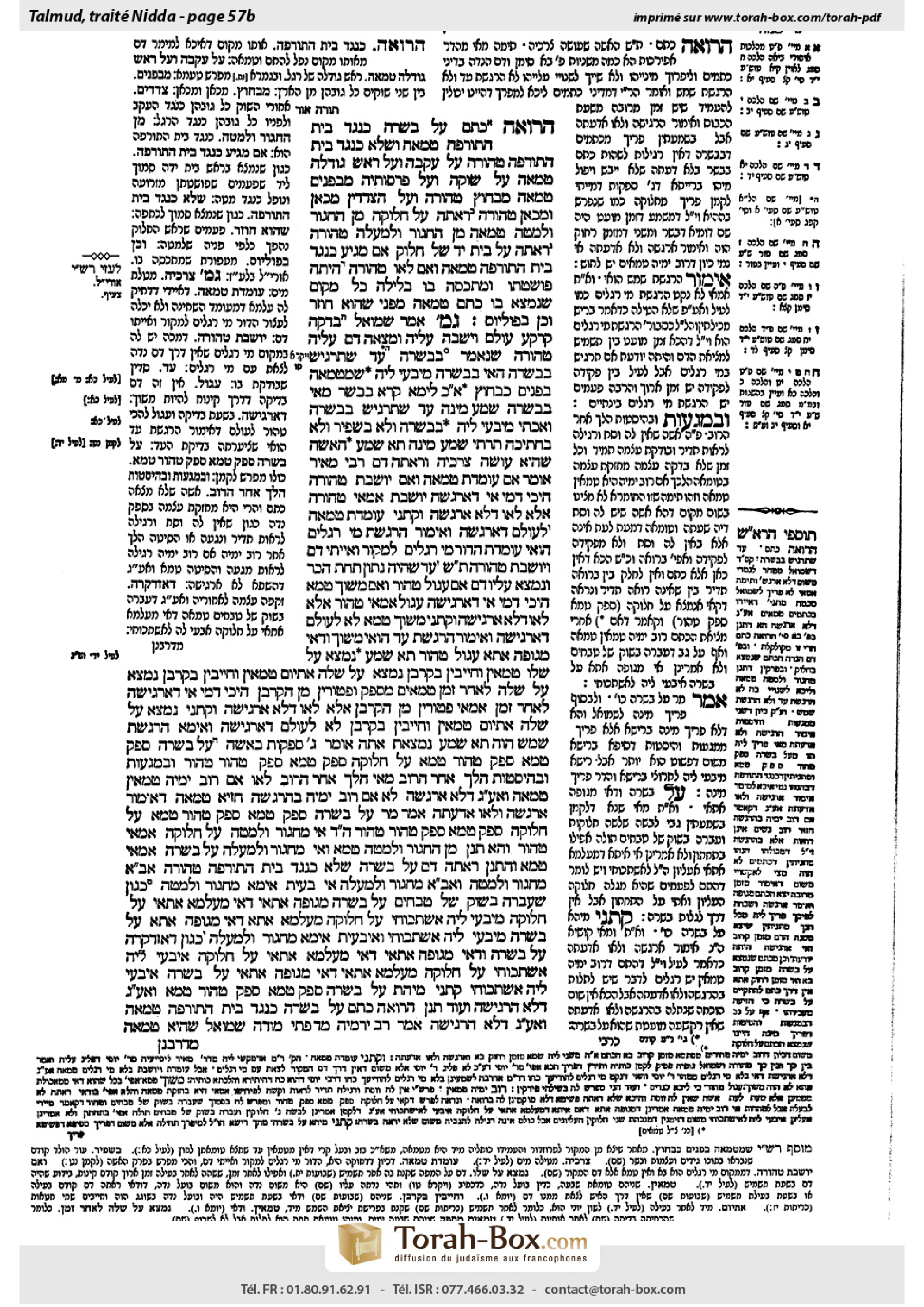
Niddah 57b: Talmud study for Daf Yomi
Daf Yomi is the daily study of one Talmud folio. Explore 37 tractates with scans, Hebrew text, Sefaria English and AI-generated French translations where annotated.
Passage selection and English or AI-generated French translation are available where the scan has annotations. Daf Study is independent of Torah-Box and Sefaria.
Browse Niddah · נידה · All tractatesNiddah 57b text and translations
This page of Niddah includes the Aramaic text, an English translation and an AI-generated French translation, alongside the scan above.
נידה נ״ז ב · Aramaic and Hebrew text
מַתְנִי' הָרוֹאָה כֶּתֶם עַל בְּשָׂרָה כְּנֶגֶד בֵּית הַתּוּרְפָּה — טְמֵאָה, וְשֶׁלֹּא כְּנֶגֶד בֵּית הַתּוּרְפָּה — טְהוֹרָה. עַל עֲקֵבָהּ וְעַל רֹאשׁ גּוּדָלָהּ — טְמֵאָה.
עַל שׁוֹקָהּ וְעַל פַּרְסוֹתֶיהָ — מִבִּפְנִים טְמֵאָה, מִבַּחוּץ טְהוֹרָה, וְעַל הַצְּדָדִין מִכָּאן וּמִכָּאן טְהוֹרָה.
רָאֲתָה עַל חֲלוּקָהּ מִן הֶחָגוּר וּלְמַטָּה — טְמֵאָה, מִן הֶחָגוּר וּלְמַעְלָה — טְהוֹרָה. רָאֲתָה עַל בֵּית יָד שֶׁל חָלוּק, אִם מַגִּיעַ כְּנֶגֶד בֵּית הַתּוּרְפָּה — טְמֵאָה, וְאִם לָאו — טְהוֹרָה.
הָיְתָה פּוֹשַׁטְתּוֹ וּמִתְכַּסָּה בּוֹ בַּלַּיְלָה, כָּל מָקוֹם שֶׁנִּמְצָא בּוֹ כֶּתֶם — טְמֵאָה, מִפְּנֵי שֶׁהוּא חוֹזֵר, וְכֵן בַּפּוּלְיוֹס.
גְּמָ' אָמַר שְׁמוּאֵל: בָּדְקָה קַרְקַע עוֹלָם, וְיָשְׁבָה עָלֶיהָ, וּמָצְאָה דָּם עָלֶיהָ — טְהוֹרָה, שֶׁנֶּאֱמַר ״בִּבְשָׂרָהּ״ — עַד שֶׁתַּרְגִּישׁ בִּבְשָׂרָהּ.
הַאי ״בִּבְשָׂרָהּ״ מִיבְּעֵי לֵיהּ, שֶׁמְּטַמְּאָה בִּפְנִים כְּבַחוּץ! אִם כֵּן, לֵימָא קְרָא ״בְּבָשָׂר״, מַאי ״בִּבְשָׂרָהּ״? שְׁמַע מִינַּהּ: עַד שֶׁתַּרְגִּישׁ בִּבְשָׂרָהּ.
וְאַכַּתִּי מִיבְּעֵי לֵיהּ ״בִּבְשָׂרָהּ״, וְלֹא בְּשָׁפִיר וְלֹא בַּחֲתִיכָה! תַּרְתֵּי שְׁמַע מִינַּהּ.
תָּא שְׁמַע: הָאִשָּׁה שֶׁהִיא עוֹשָׂה צְרָכֶיהָ, וְרָאֲתָה דָּם. רַבִּי מֵאִיר אוֹמֵר: אִם עוֹמֶדֶת — טְמֵאָה, וְאִם יוֹשֶׁבֶת — טְהוֹרָה.
הֵיכִי דָּמֵי? אִי דְּאַרְגִּשָׁה — יוֹשֶׁבֶת אַמַּאי טְהוֹרָה? אֶלָּא לָאו דְּלָא אַרְגִּשָׁה, וְקָתָנֵי: עוֹמֶדֶת טְמֵאָה!
לְעוֹלָם דְּאַרְגִּשָׁה, וְאֵימוֹר ״הַרְגָּשַׁת מֵי רַגְלַיִם הֲוַאי״. עוֹמֶדֶת — הֲדוּר מֵי רַגְלַיִם לְמָקוֹר (וְאַיְיתִי) [וְאַיְיתוֹ] דָּם, וְיוֹשֶׁבֶת — טְהוֹרָה.
תָּא שְׁמַע: עֵד שֶׁהָיָה נָתוּן תַּחַת הַכַּר, וְנִמְצָא עָלָיו דָּם — אִם עָגוֹל טָהוֹר, וְאִם מָשׁוּךְ טָמֵא.
הֵיכִי דָּמֵי? אִי דְּאַרְגִּישָׁה — עָגוֹל אַמַּאי טָהוֹר? אֶלָּא לָאו דְּלָא אַרְגִּישָׁה, וְקָתָנֵי: מָשׁוּךְ טָמֵא.
לָא, לְעוֹלָם דְּאַרְגִּישָׁה, וְאֵימוֹר ״הַרְגָּשַׁת עֵד הֲוַאי״, מָשׁוּךְ — וַדַּאי מִגּוּפַהּ אֲתָא, עָגוֹל — טָהוֹר.
תָּא שְׁמַע: נִמְצָא עַל שֶׁלּוֹ — טְמֵאִין, וְחַיָּיבִין בְּקׇרְבָּן. נִמְצָא עַל שֶׁלָּהּ אֹתְיוֹם — טְמֵאִין, וְחַיָּיבִין בְּקׇרְבָּן. נִמְצָא עַל שֶׁלָּהּ לְאַחַר זְמַן — טְמֵאִים מִסָּפֵק, וּפְטוּרִין מִן הַקׇּרְבָּן.
הֵיכִי דָּמֵי? אִי דְּאַרְגִּישָׁה, לְאַחַר זְמַן אַמַּאי פְּטוּרִין מִן הַקׇּרְבָּן? אֶלָּא לָאו דְּלָא אַרְגִּישָׁה, וְקָתָנֵי נִמְצָא עַל שֶׁלָּהּ אֹתְיוֹם טְמֵאִין וְחַיָּיבִין בְּקׇרְבָּן! לָא, לְעוֹלָם דְּאַרְגִּישָׁה, וְאֵימָא הַרְגָּשַׁת שַׁמָּשׁ הֲוָה.
תָּא שְׁמַע: נִמְצֵאתָ אַתָּה אוֹמֵר שְׁלֹשָׁה סְפֵקוֹת בָּאִשָּׁה — עַל בְּשָׂרָה, סָפֵק טָמֵא סָפֵק טָהוֹר — טָמֵא. עַל חֲלוּקָהּ, סָפֵק טָמֵא סָפֵק טָהוֹר — טָהוֹר. וּבְמַגָּעוֹת וּבְהֶיסֵּטוֹת, הַלֵּךְ אַחַר הָרוֹב.
מַאי ״הַלֵּךְ אַחַר הָרוֹב״? לָאו אִם רוֹב יָמֶיהָ טְמֵאִין — טְמֵאָה, וְאַף עַל גַּב דְּלָא אַרְגִשָׁה.
לָא, אִם רוֹב יָמֶיהָ בְּהַרְגָּשָׁה חָזְיָא — טְמֵאָה, דְּאֵימוֹר אַרְגִשָׁה וְלָאו אַדַּעְתַּהּ.
אָמַר מָר: עַל בְּשָׂרָה סָפֵק טָמֵא סָפֵק טָהוֹר — טָמֵא, עַל חֲלוּקָהּ סָפֵק טָמֵא סָפֵק טָהוֹר — טָהוֹר.
הֵיכִי דָמֵי? אִי מֵחֲגוֹר וּלְמַטָּה, עַל חֲלוּקָהּ אַמַּאי טָהוֹר? וְהָא תְנַן: מִן הֶחָגוּר וּלְמַטָּה טָמֵא! וְאִי מֵחֲגוֹר וּלְמַעְלָה, עַל בְּשָׂרָהּ אַמַּאי טָמֵא? וְהָתְנַן: רָאֲתָה דָּם עַל בְּשָׂרָה שֶׁלֹּא כְּנֶגֶד בֵּית הַתּוּרְפָּה טְהוֹרָה!
אִיבָּעֵית אֵימָא מֵחֲגוֹר וּלְמַטָּה, וְאִיבָּעֵית אֵימָא מֵחֲגוֹר וּלְמַעְלָה. אִי בָּעֵית אֵימָא מֵחֲגוֹר וּלְמַטָּה, כְּגוֹן שֶׁעָבְרָה בְּשׁוּק שֶׁל טַבָּחִים. עַל בְּשָׂרָה — מִגּוּפַהּ אֲתָאי, דְּאִי מֵעָלְמָא אֲתָאי — עַל חֲלוּקָהּ מִיבְּעֵי לֵיהּ אִשְׁתְּכוֹחֵי. עַל חֲלוּקָהּ — מֵעָלְמָא אֲתָא, דְּאִי מִגּוּפַהּ אֲתָא — עַל בְּשָׂרָה מִיבְּעֵי לֵיהּ אִשְׁתְּכוֹחֵי.
וְאִיבָּעֵית אֵימָא, מֵחֲגוֹר וּלְמַעְלָה, כְּגוֹן דְּאִזְדְּקַרָה עַל בְּשָׂרָהּ — וַדַּאי מִגּוּפַהּ אֲתָאי, דְּאִי מֵעָלְמָא אֲתָאי — עַל חֲלוּקָהּ אִיבְּעִי לֵיהּ אִשְׁתְּכוֹחֵי. עַל חֲלוּקָהּ — מֵעָלְמָא אֲתָאי, דְּאִי מִגּוּפַהּ אֲתָאי — עַל בְּשָׂרָה אִיבְּעִי לֵיהּ אִשְׁתְּכוֹחֵי.
קָתָנֵי מִיהַת: עַל בְּשָׂרָהּ סָפֵק טָמֵא סָפֵק טָהוֹר טָמֵא, וְאַף עַל גַּב דְּלֹא הִרְגִּישָׁה. וְעוֹד תְּנַן: הָרוֹאָה כֶּתֶם עַל בְּשָׂרָה כְּנֶגֶד בֵּית הַתּוּרְפָּה טְמֵאָה, וְאַף עַל גַּב דְּלֹא הִרְגִּישָׁה. אָמַר רַב יִרְמְיָה מִדִּפְתִּי: מוֹדֶה שְׁמוּאֵל שֶׁהִיא טְמֵאָה
Niddah 57b · English translation
MISHNA: A woman who sees a blood stain on her flesh adjacent to her vagina [beit haturpa], i.e., a place where blood that originated in her vagina could be found, becomes ritually impure, as there is a concern that it originated in the uterus and is menstrual blood. And if it was discovered on her flesh in an area not adjacent to her vagina she remains ritually pure, as it certainly did not originate in the uterus. If the stain was discovered on her heel or on the tip of her large toe, although it is not adjacent to her vagina she is ritually impure, as blood from the uterus could have reached there.
In a case where the stain was discovered on her leg or on her feet, if it was on the inner side she is ritually impure, as blood from the uterus could have reached there. If it was on the outer side she is ritually pure, and if it was on the sides, either from here, i.e., on the front of her leg or foot, or from there, i.e., on the back of her leg or foot, she is also ritually pure, as blood from the uterus could not have reached there.
In a case where the woman saw a blood stain on her robe, if it was from the belt and below she is ritually impure, as blood from the uterus could have reached there; if it was from the belt and above she is ritually pure. In a case where she saw the stain on the end of the sleeve of the robe, if the sleeve can reach adjacent to her vagina she is ritually impure; and if not, i.e., if the stain is in a place on the sleeve that does not reach adjacent to the vagina, she is ritually pure.
If it was a robe which she would remove and with which she would cover herself at night, wherever on the robe that the stain is found, the stain renders her ritually impure, due to the fact that the robe moves while the woman is asleep and therefore the blood could have originated in the uterus. And likewise with regard to a kerchief [bapoleyos], no matter where the blood is found on the kerchief, the woman is impure.
GEMARA: With regard to the cases discussed in the mishna concerning a blood stain found on a woman, Shmuel says: If a woman examined the ground beneath her to see if it was clean from blood and other substances, and she found nothing, and subsequently she sat upon it and then found blood on it, although it might be assumed that this blood came from her, she is ritually pure. The reason is as it is stated: “And her issue in her flesh shall be blood, she shall be in her menstrual state seven days” (Leviticus 15:19). This verse teaches that a woman does not become impure unless she senses, i.e., experiences some type of sensation, in her flesh that she emitted blood from her uterus. Since this woman did not sense an emission of blood, she is pure.
The Gemara asks: How can Shmuel interpret the verse in this manner? After all, he requires this term: “In her flesh,” to teach a different halakha, that a woman becomes impure by finding blood inside her body just as by seeing blood outside her body, i.e., provided that the blood is uterine blood, even if it is currently situated inside her vaginal canal, she is impure. The Gemara answers: If so, if it serves to teach only that blood inside is like blood outside, let the verse say: In the flesh. What is the reason that the verse states: “In her flesh”? Conclude from this term that a woman does not become impure unless she senses in her flesh.
The Gemara asks: And still, Shmuel requires the term “in her flesh” to teach that she is impure only if the blood touches her flesh, and not through blood found in a gestational sac, nor through blood found in an amorphous piece of tissue that she emitted. The Gemara answers: Conclude two conclusions from this verse, as the plain meaning of the term teaches all these halakhot.
With regard to the opinion of Shmuel, the Gemara suggests: Come and hear a mishna at the beginning of the next chapter (59b): In the case of a woman who is urinating and sees blood intermingled with the urine, Rabbi Meir says: If she urinates while she is standing she is ritually impure, as the blood could have originated in the uterus. And if she is sitting she is ritually pure, as it is clear that the blood is from a wound.
The Gemara analyzes this mishna: What are the circumstances? If she sensed while urinating, then in the case where she is sitting, why is she ritually pure, according to Shmuel? Rather, is it not referring to a case where she did not sense while urinating? And yet the mishna teaches that if she urinates while she is standing she is ritually impure. This indicates that her status does not depend on her sensing, which contradicts the statement of Shmuel.
The Gemara answers: This affords no proof, as the mishna is actually referring to a case where she sensed while urinating, and yet since this feeling accompanied urination, one might say it was the sensation of urine. Consequently, if she urinated while standing, the urine would return to her uterus and bring blood with it. But if she urinated while sitting the urine cannot return to the uterus and therefore she is pure, as the sensation is attributed to her urine.
The Gemara further suggests: Come and hear the mishna below (58b): With regard to an examination cloth that was placed beneath the pillow and blood was later found on the cloth, and it is unclear whether it is the blood of an examination or the blood of a louse that was crushed beneath it, if the stain is round it is ritually pure. There is no concern that this blood might have come from her examination, as a woman examines through an act of wiping and a stain produced in this manner would not be round. And if the stain is elongated it is ritually impure, as this shape can be formed by an examination.
The Gemara analyzes the mishna: What are the circumstances? If she sensed, then in the case where the stain is round why is it pure? Rather, is it not referring to a case where she did not sense? And yet the mishna teaches that an elongated stain is impure. This contradicts the opinion of Shmuel that a woman is rendered impure only if she sensed.
The Gemara answers: No, the mishna is actually referring to a case where she sensed, but since she also performed an examination one might say this was the sensation of the examination cloth. Consequently, if the stain was elongated, as appropriate for a stain produced by an examination, the blood certainly came from her body, whereas if the stain was round it is pure, as this is not the usual appearance of a stain from an examination.
The Gemara suggests: Come and hear another mishna (14a): If blood was found on his, i.e., the husband’s, examination cloth following intercourse, the woman and her husband are both ritually impure for seven days, in accordance with the halakha of a menstruating woman and one who engages in intercourse with her, and they are each liable to bring a sin offering for unwittingly performing an action punishable with excision from the World-to-Come [karet]. If blood was found on her cloth immediately after intercourse, the woman and her husband are likewise ritually impure for seven days and are each liable to bring a sin offering. If blood was found on her swatch after time passed, they are both ritually impure due to uncertainty, as it is possible that the blood appeared only after intercourse, and they are exempt from bringing the sin offering.
The Gemara analyzes this mishna: What are the circumstances? If it is referring to a situation where she sensed, then in the case where blood was found on her cloth after time passed, why are they exempt from bringing the sin offering? Rather, is it not referring to a case where she did not sense? And yet the mishna teaches that if blood was found on her cloth immediately after intercourse, they are ritually impure for seven days and are each liable to bring a sin offering. Once again, this contradicts the opinion of Shmuel. The Gemara answers: No, the mishna is actually referring to a case where she sensed, but since she was engaging in intercourse at the time, one might say this was the sensation of the male organ.
The Gemara suggests: Come and hear from a baraita: You are found to say that there are three uncertainties involving cases where blood is found on a woman or her garments. If a stain is discovered on her flesh and there is uncertainty whether it is impure or pure, the halakha is that it is impure. If it is found on her robe and there is uncertainty whether it is impure or pure, the halakha is that it is pure. And in the case of a woman whose status as a menstruating woman is uncertain, with regard to her touching items and with regard to her moving items, one should follow the majority.
The Gemara analyzes the baraita: What is the meaning of the phrase: Follow the majority, with regard to this woman of uncertain status? Does this not mean that if for the majority of her days she is in a state of ritual impurity, as she emits impure blood on many days, then she is considered impure even when her status is uncertain? And since this baraita does not differentiate between cases where she did and did not sense, the ruling that one follows the majority, and that she is impure, evidently applies even though she did not sense, which contradicts the opinion of Shmuel.
The Gemara answers: No proof may be brought from here, as this is what the baraita means: If on the majority of her days this woman sees blood accompanied by a sensation, she is impure, despite the fact that she is uncertain whether she had a sensation, as one can say she sensed on this occasion as well, but it was not on her mind, i.e., she did not pay attention to it at the time.
Before returning to the opinion of Shmuel, the Gemara analyzes the other clauses of this baraita. The Master said above: If a stain is discovered on her flesh and there is uncertainty whether it is impure or pure, it is impure; if it is found on her robe and there is uncertainty whether it is impure or pure, it is pure. The juxtaposition of these two cases indicates that the blood is found in the same area in both instances.
The Gemara asks: What are the circumstances? If the blood was discovered from the belt and below, then when it was found on her robe why is she pure? But didn’t we learn in the mishna: In a case where the woman saw a blood stain on her robe, if it was from the belt and below she is ritually impure? And if the blood was from the belt and above, then if it was discovered on her flesh why is she impure? But didn’t we learn in the mishna that if she saw blood on her flesh in an area not adjacent to her vagina she remains ritually pure?
The Gemara answers: If you wish, say that the blood was discovered from the belt and below, and if you wish, say instead that it was found from the belt and above. The Gemara elaborates: If you wish, say that the blood was found from the belt and below, as the baraita is referring to a situation where the blood can be attributed to an external factor, e.g., a case where she passed through a marketplace of butchers [tabbaḥim]. Consequently, if the blood is found on her flesh it is assumed that it came from her body, as, if it came from the outside world, it should have been found on her robe as well. If it is discovered on her robe it is assumed that it came from the outside world, as, if it came from her body, it should have been found on her flesh as well.
And if you wish, say instead that the blood was found from the belt and above, and the baraita is referring to a situation where it is possible the blood came from her body, e.g., a case where she jumped backward. Therefore, if the blood is found on her flesh it certainly came from her body, as, if it came from the outside world, it should have been found on her robe as well. And if it is discovered on her robe the assumption is that it came from the outside world, as, if it came from her body, it should have been found on her flesh as well.
The Gemara raises an objection from the baraita to the opinion of Shmuel: In any event, the baraita teaches that if a stain is discovered on her flesh and there is uncertainty whether it is impure or pure, it is impure, and this is the halakha even though she did not sense, which contradicts the opinion of Shmuel. And furthermore, we learned in the mishna that a woman who sees a blood stain on her flesh adjacent to her vagina becomes ritually impure, and this is apparently the halakha even though she did not sense. Rav Yirmeya of Difti says: The ruling of Shmuel that a woman must sense in order to be rendered impure applies only by Torah law. But Shmuel concedes that in all the cases cited above, where it is indicated that a woman is impure despite the fact that she did not sense, she is impure
Niddah 57b · Traduction française (IA)
MICHNA : Une femme qui découvre une tache de sang sur sa chair, près de son vagin [beit haturpa], c’est-à-dire dans un endroit où pourrait se trouver du sang provenant de son vagin, devient rituellement impure, car on peut craindre que le sang provienne de l’utérus et soit du sang menstruel. Si elle découvre la tache sur une partie de sa chair qui n’est pas proche de son vagin, elle reste rituellement pure, car le sang ne peut certainement pas provenir de l’utérus. Si la tache est découverte sur son talon ou à l’extrémité de son gros orteil, elle est rituellement impure, bien que ces endroits ne soient pas proches de son vagin, car le sang de l’utérus a pu parvenir jusque-là.
Si la tache est découverte sur sa jambe ou sur ses pieds, elle est rituellement impure lorsqu’elle se trouve sur la face intérieure, car le sang de l’utérus a pu parvenir jusque-là. Si elle se trouve sur la face extérieure, elle est rituellement pure. Si elle se trouve sur les côtés, que ce soit de ce côté-ci, c’est-à-dire à l’avant de sa jambe ou de son pied, ou de ce côté-là, c’est-à-dire à l’arrière de sa jambe ou de son pied, elle est également rituellement pure, car le sang de l’utérus n’a pas pu parvenir jusque-là.
Si la femme découvre une tache de sang sur sa robe, elle est rituellement impure si la tache se trouve à la ceinture ou en dessous, car le sang de l’utérus a pu parvenir jusque-là ; si elle se trouve au-dessus de la ceinture, elle est rituellement pure. Si elle découvre la tache à l’extrémité de la manche de sa robe, elle est rituellement impure si la manche peut atteindre un endroit proche de son vagin ; sinon, c’est-à-dire si la tache se trouve à un endroit de la manche qui ne peut atteindre un tel endroit, elle est rituellement pure.
S’il s’agit d’une robe qu’elle enlève et dont elle se couvre la nuit, toute tache découverte, où qu’elle se trouve sur la robe, la rend rituellement impure, car la robe bouge pendant son sommeil et le sang a donc pu provenir de l’utérus. Il en va de même pour un fichu [bapoleyos] : quel que soit l’endroit où le sang est découvert sur le fichu, la femme est impure.
GUEMARA : À propos des cas évoqués dans la Michna, où une tache de sang est découverte sur une femme, Chmouel dit : Si une femme a examiné le sol sous elle pour vérifier qu’il était exempt de sang et d’autres substances, et qu’elle n’y a rien trouvé, puis s’est assise dessus et y a ensuite découvert du sang, elle est rituellement pure, même si l’on pourrait supposer que ce sang provient d’elle. En effet, il est dit : « Son écoulement dans sa chair sera du sang ; elle sera dans son état menstruel pendant sept jours » (Lévitique 15,19). Ce verset enseigne qu’une femme ne devient impure que si elle ressent dans sa chair, c’est-à-dire si elle éprouve une certaine sensation au moment où elle expulse du sang de son utérus. Puisque cette femme n’a pas ressenti l’émission de sang, elle est pure.
La Guemara demande : Comment Chmouel peut-il interpréter le verset de cette manière ? Après tout, il a besoin de l’expression « dans sa chair » pour enseigner une autre halakha : une femme devient impure si elle trouve du sang à l’intérieur de son corps, tout comme lorsqu’elle voit du sang à l’extérieur de son corps. Autrement dit, si le sang provient de l’utérus, elle est impure même s’il se trouve alors dans son canal vaginal. La Guemara répond : Si cette expression ne servait qu’à enseigner que le sang à l’intérieur équivaut au sang à l’extérieur, que le verset dise : « dans la chair ». Pourquoi dit-il : « dans sa chair » ? Déduis de cette expression qu’une femme ne devient impure que si elle ressent quelque chose dans sa chair.
La Guemara demande : Pourtant, Chmouel a également besoin de l’expression « dans sa chair » pour enseigner qu’elle n’est impure que si le sang touche sa chair, et non si le sang se trouve dans un sac gestationnel, ni s’il se trouve dans un morceau amorphe de tissu qu’elle a expulsé. La Guemara répond : Déduis deux enseignements de ce verset, car le sens simple de cette expression enseigne toutes ces halakhot.
À propos de l’opinion de Chmouel, la Guemara propose : Viens et entends une Michna au début du chapitre suivant (59b) : dans le cas d’une femme qui urine et voit du sang mêlé à son urine, Rabbi Meïr dit : si elle urine debout, elle est rituellement impure, car le sang a pu provenir de l’utérus. Si elle urine assise, elle est rituellement pure, car il est évident que le sang provient d’une blessure.
La Guemara analyse cette Michna : Dans quelles circonstances ? Si elle a ressenti une sensation en urinant, alors, lorsqu’elle est assise, pourquoi est-elle rituellement pure selon Chmouel ? Ne s’agit-il pas plutôt d’un cas où elle n’a rien ressenti en urinant ? Pourtant, la Michna enseigne que si elle urine debout, elle est rituellement impure. Cela indique que son statut ne dépend pas du fait qu’elle ait ressenti quelque chose, ce qui contredit les propos de Chmouel.
La Guemara répond : On ne peut en tirer aucune preuve, car la Michna traite en réalité d’un cas où elle a ressenti quelque chose en urinant. Toutefois, comme cette sensation a accompagné la miction, on pourrait dire qu’il s’agissait de la sensation de l’urine. Par conséquent, si elle a uriné debout, l’urine serait remontée vers son utérus et aurait entraîné du sang avec elle. Mais si elle a uriné assise, l’urine ne peut remonter vers l’utérus ; elle est donc pure, car la sensation est attribuée à son urine.
La Guemara propose encore : Viens et entends la Michna ci-dessous (58b) : à propos d’un linge d’examen placé sous un oreiller, sur lequel on découvre ensuite du sang, s’il est impossible de savoir s’il s’agit du sang provenant d’un examen ou du sang d’un pou écrasé dessous, une tache ronde rend la femme rituellement pure. On ne craint pas que ce sang provienne de son examen, car une femme s’examine en essuyant, et une tache produite de cette manière ne serait pas ronde. Si la tache est allongée, elle est rituellement impure, car un examen peut produire une tache de cette forme.
La Guemara analyse la Michna : De quelles circonstances s’agit-il ? Si elle a ressenti une sensation, alors, dans le cas où la tache est ronde, pourquoi est-elle pure ? Ne s’agit-il pas plutôt d’un cas où elle n’a rien ressenti ? Pourtant, la Michna enseigne qu’une tache allongée est impure. Cela contredit l’opinion de Chmouel, selon laquelle une femme n’est rendue impure que si elle a ressenti une sensation.
La Guemara répond : Non, la Michna traite en réalité d’un cas où elle a ressenti une sensation, mais comme elle a aussi procédé à un examen, on pourrait dire que la sensation provenait du linge d’examen. Par conséquent, si la tache est allongée, conformément à la forme d’une tache produite par un examen, le sang provient certainement de son corps ; tandis que si la tache est ronde, elle est pure, car ce n’est pas l’aspect habituel d’une tache provenant d’un examen.
La Guemara propose : Viens et entends une autre Michna (14a) : si du sang est découvert sur le linge d’examen de l’homme, c’est-à-dire du mari, après les rapports sexuels, la femme et son mari sont tous deux rituellement impurs pendant sept jours, conformément à la halakha d’une femme menstruée et de celui qui a des rapports avec elle, et chacun est tenu d’apporter un sacrifice expiatoire pour avoir accompli par inadvertance un acte passible de retranchement du Monde à venir [karet]. Si du sang est découvert sur le linge d’examen de la femme immédiatement après les rapports sexuels, la femme et son mari sont pareillement rituellement impurs pendant sept jours et chacun est tenu d’apporter un sacrifice expiatoire. Si du sang est découvert sur son linge après un certain temps, ils sont tous deux rituellement impurs par doute, car il est possible que le sang ne soit apparu qu’après les rapports sexuels, et ils sont dispensés d’apporter le sacrifice expiatoire.
La Guemara analyse cette Michna : De quelles circonstances s’agit-il ? Si elle traite d’un cas où elle a ressenti une sensation, alors, lorsque du sang est découvert sur son linge après un certain temps, pourquoi sont-ils dispensés d’apporter le sacrifice expiatoire ? Ne s’agit-il pas plutôt d’un cas où elle n’a rien ressenti ? Pourtant, la Michna enseigne que si du sang est découvert sur son linge immédiatement après les rapports sexuels, ils sont rituellement impurs pendant sept jours et chacun est tenu d’apporter un sacrifice expiatoire. Cela contredit une nouvelle fois l’opinion de Chmouel. La Guemara répond : Non, la Michna traite en réalité d’un cas où elle a ressenti une sensation, mais comme elle avait des rapports sexuels à ce moment-là, on pourrait dire qu’il s’agissait de la sensation du pénis.
La Guemara propose : Viens et entends une baraïta : on en vient à dire qu’il existe trois cas de doute concernant la découverte de sang sur une femme ou sur ses vêtements. Si une tache est découverte sur son corps et qu’il y a un doute quant à savoir si elle est impure ou pure, la halakha est qu’elle est impure. Si elle est découverte sur sa robe et qu’il y a un doute quant à savoir si elle est impure ou pure, la halakha est qu’elle est pure. Et, dans le cas d’une femme dont le statut de femme menstruée est incertain, pour ce qui est de toucher des objets et de les déplacer, on suit la majorité.
La Guemara analyse la baraïta : Que signifie l’expression « on suit la majorité » à propos de cette femme au statut incertain ? Cela ne veut-il pas dire que si, pendant la majorité de ses jours, elle se trouve en état d’impureté rituelle, car elle émet du sang impur de nombreux jours, elle est considérée comme impure même lorsque son statut est incertain ? Et puisque cette baraïta ne distingue pas les cas où elle a ressenti une sensation de ceux où elle n’en a pas ressenti, la règle selon laquelle on suit la majorité — et selon laquelle elle est impure — s’applique manifestement même si elle n’a rien ressenti, ce qui contredit l’opinion de Chmouel.
La Guemara répond : Non, on ne peut pas en tirer de preuve, car voici ce que signifie la baraïta : si, la plupart du temps, cette femme voit du sang accompagné d’une sensation, elle est impure, malgré le doute quant à savoir si elle a ressenti une sensation ; car on peut dire qu’elle a également ressenti quelque chose cette fois-ci, mais qu’elle n’en avait pas conscience, c’est-à-dire qu’elle n’y a pas prêté attention sur le moment.
Avant de revenir à l’opinion de Chmouel, la Guemara analyse les autres clauses de cette baraïta. Le Maître a dit plus haut : si une tache est découverte sur son corps et qu’il y a un doute quant à savoir si elle est impure ou pure, elle est impure ; si elle est découverte sur sa robe et qu’il y a un doute quant à savoir si elle est impure ou pure, elle est pure. La juxtaposition de ces deux cas indique que le sang est découvert dans la même zone dans les deux cas.
La Guemara demande : De quelles circonstances s’agit-il ? Si le sang a été découvert à partir de la ceinture vers le bas, alors, lorsqu’il est trouvé sur sa robe, pourquoi est-elle pure ? N’avons-nous pas appris dans la Michna que si la femme découvre une tache de sang sur sa robe à partir de la ceinture vers le bas, elle est rituellement impure ? Et si le sang a été découvert à partir de la ceinture vers le haut, alors, lorsqu’il est trouvé sur son corps, pourquoi est-elle impure ? N’avons-nous pas appris dans la Michna que si elle découvre du sang sur son corps, dans une zone qui n’est pas adjacente à son vagin, elle reste rituellement pure ?
La Guemara répond : Si tu veux, dis que le sang a été découvert à partir de la ceinture vers le bas ; ou bien, dis qu’il a été trouvé à partir de la ceinture vers le haut. La Guemara précise : si tu veux, dis qu’il a été trouvé à partir de la ceinture vers le bas, car la baraïta traite d’un cas où le sang peut être attribué à une cause extérieure, par exemple celui d’une femme qui est passée par un marché de bouchers [tabbaḥim]. Par conséquent, si le sang est découvert sur son corps, on suppose qu’il provient de son corps, car s’il provenait de l’extérieur, il aurait également dû se trouver sur sa robe. S’il est découvert sur sa robe, on suppose qu’il provient de l’extérieur, car s’il provenait de son corps, il aurait également dû se trouver sur son corps.
Ou bien, dis que le sang a été trouvé à partir de la ceinture vers le haut, et que la baraïta traite d’un cas où il est possible que le sang provienne de son corps, par exemple celui d’une femme qui a sauté en arrière. Par conséquent, si le sang est découvert sur son corps, il provient certainement de son corps, car s’il provenait de l’extérieur, il aurait également dû se trouver sur sa robe. Et s’il est découvert sur sa robe, on suppose qu’il provient de l’extérieur, car s’il provenait de son corps, il aurait également dû se trouver sur son corps.
La Guemara soulève une objection contre l’opinion de Chmouel à partir de la baraïta : quoi qu’il en soit, la baraïta enseigne que si une tache est découverte sur son corps et qu’il y a un doute quant à savoir si elle est impure ou pure, elle est impure ; cette halakha s’applique même si elle n’a rien ressenti, ce qui contredit l’opinion de Chmouel. En outre, nous avons appris dans la Michna qu’une femme qui découvre une tache de sang sur son corps, dans une zone adjacente à son vagin, devient rituellement impure ; apparemment, cette halakha s’applique même si elle n’a rien ressenti. Rav Yirmeya de Difti dit : La règle de Chmouel, selon laquelle une femme doit ressentir une sensation pour être rendue impure, ne s’applique qu’en vertu de la Torah. Mais Chmouel reconnaît que, dans tous les cas cités ci-dessus, où il est indiqué qu’une femme est impure bien qu’elle n’ait rien ressenti, elle est impure
Traduction française générée par IA à partir de l’édition anglaise de Sefaria. Vérifie toujours un passage avec le texte source.
Text from Sefaria: William Davidson Edition - Vocalized Aramaic (CC BY NC); William Davidson Edition - English (CC BY NC).