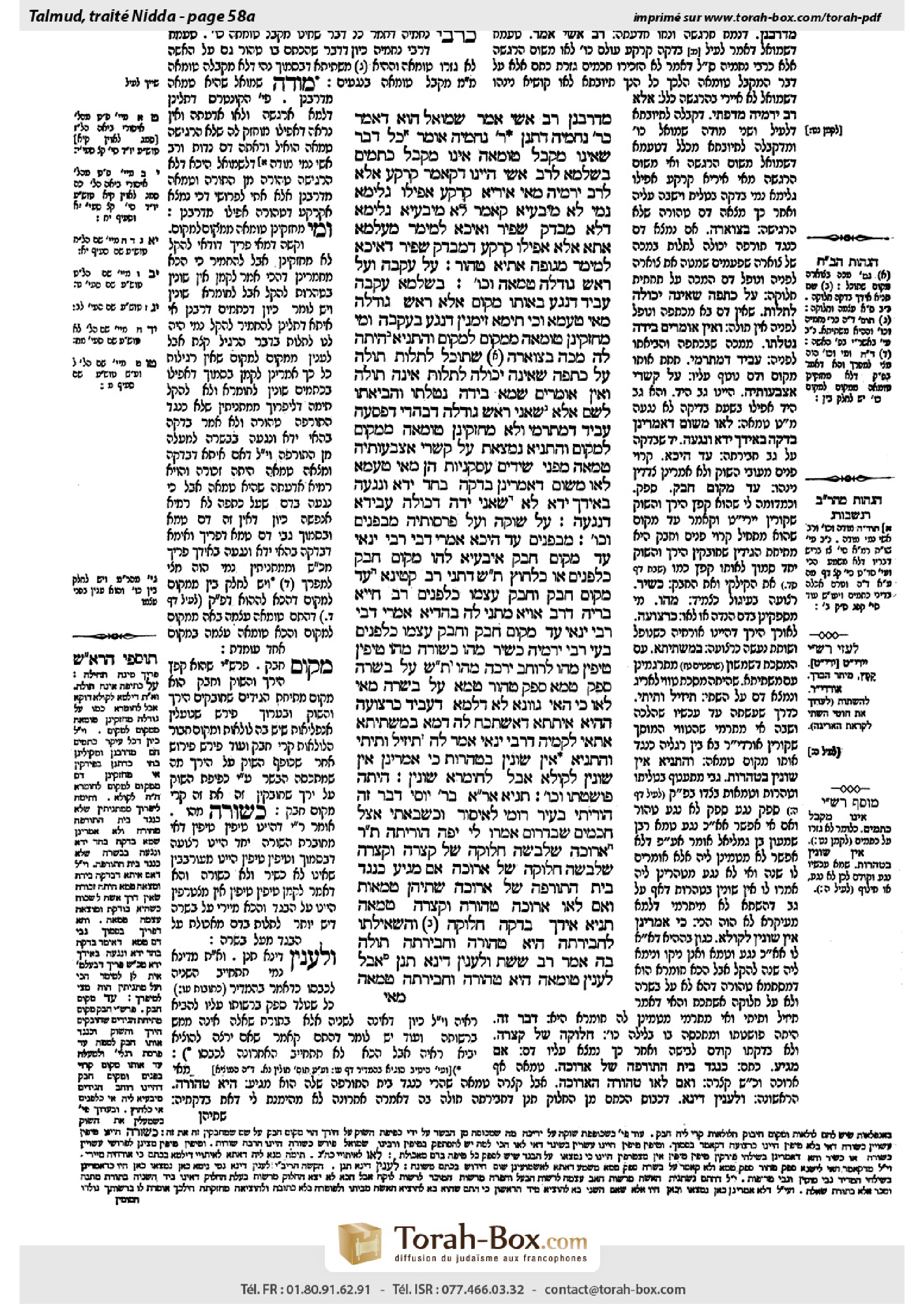
Niddah 58a: Talmud study for Daf Yomi
Daf Yomi is the daily study of one Talmud folio. Explore 37 tractates with scans, Hebrew text, Sefaria English and AI-generated French translations where annotated.
Passage selection and English or AI-generated French translation are available where the scan has annotations. Daf Study is independent of Torah-Box and Sefaria.
Browse Niddah · נידה · All tractatesNiddah 58a text and translations
This page of Niddah includes the Aramaic text, an English translation and an AI-generated French translation, alongside the scan above.
נידה נ״ח א · Aramaic and Hebrew text
מִדְּרַבָּנַן.
רַב אָשֵׁי אָמַר: שְׁמוּאֵל הוּא דְּאָמַר כְּרַבִּי נְחֶמְיָה, דִּתְנַן: רַבִּי נְחֶמְיָה אוֹמֵר: כׇּל דָּבָר שֶׁאֵינוֹ מְקַבֵּל טוּמְאָה — אֵינוֹ מְקַבֵּל כְּתָמִים.
בִּשְׁלָמָא לְרַב אָשֵׁי — הַיְינוּ דְּקָאָמַר ״קַרְקַע״, אֶלָּא לְרַב יִרְמְיָה — מַאי אִירְיָא קַרְקַע? אֲפִילּוּ גְּלִימָא נָמֵי! לָא מִיבַּעְיָא קָאָמַר.
לָא מִיבַּעְיָא גְּלִימָא, דְּלָא מִבְּדַק שַׁפִּיר, וְאִיכָּא לְמֵימַר מֵעָלְמָא אֲתָא, אֶלָּא אֲפִילּוּ קַרְקַע דְּמִבְּדַק שַׁפִּיר, דְּאִיכָּא לְמֵימַר מִגּוּפַהּ אָתְיָא — טָהוֹר.
עַל עֲקֵבָהּ וְעַל רֹאשׁ גּוּדָלָהּ טְמֵאָה וְכוּ׳. בִּשְׁלָמָא עֲקֵבָהּ, עֲבִיד דְּנָגַע בְּאוֹתוֹ מָקוֹם, אֶלָּא רֹאשׁ גּוּדָלָהּ מַאי טַעְמָא? וְכִי תֵּימָא זִימְנִין דְּנָגַע בַּעֲקֵבָהּ, וּמִי מְחַזְּקִינַן טוּמְאָה מִמָּקוֹם לְמָקוֹם?
וְהָתַנְיָא: הָיְתָה לָהּ מַכָּה בְּצַוָּארָהּ, שֶׁתּוּכַל לִתְלוֹת — תּוֹלָה, עַל כְּתֵפָהּ, שֶׁאֵינָהּ יְכוֹלָה לִתְלוֹת — אֵינָהּ תּוֹלָה.
וְאֵין אוֹמְרִים ״שֶׁמָּא בְּיָדָהּ נְטָלַתּוּ וֶהֱבִיאַתּוּ לְשָׁם״! אֶלָּא שָׁאנֵי רֹאשׁ גּוּדָלָהּ, דְּבַהֲדֵי דְּפָסְעָה עֲבִיד דְּמִתְרְמֵי.
וְלָא מְחַזְּקִינַן טוּמְאָה מִמָּקוֹם לְמָקוֹם? וְהָתַנְיָא: נִמְצֵאת עַל קִשְׁרֵי אֶצְבְּעוֹתֶיהָ — טְמֵאָה, מִפְּנֵי שֶׁיָּדַיִם עַסְקָנִיּוֹת הֵן.
מַאי טַעְמָא? לָאו מִשּׁוּם דְּאָמְרִינַן: בָּדְקָה בְּחַד יְדָא, וְנָגְעָה בְּאִידַּךְ יְדָא? לָא, שָׁאנֵי יְדַהּ, דְּכוּלַּהּ עֲבִידָא דְּנָגְעָה.
עַל שׁוֹקָהּ וְעַל פַּרְסוֹתֶיהָ, מִבִּפְנִים וְכוּ׳. מִבִּפְנִים — עַד הֵיכָא? אָמְרִי דְּבֵי רַבִּי יַנַּאי: עַד מָקוֹם חֲבָק.
אִיבַּעְיָא לְהוּ: מְקוֹם חֲבָק כְּלִפְנִים אוֹ כְּלַחוּץ? תָּא שְׁמַע, דְּתָנֵי רַב קַטִּינָא: עַד מְקוֹם חֲבָק, וַחֲבָק עַצְמוֹ כְּלִפְנִים. רַב חִיָּיא בְּרֵיהּ דְּרַב אַוְיָא מַתְנֵי לַהּ בְּהֶדְיָא, אָמְרִי דְּבֵי רַבִּי יַנַּאי: עַד מָקוֹם חֲבָק, וַחֲבָק עַצְמוֹ כְּלִפְנִים.
בָּעֵי רַבִּי יִרְמְיָה: ״כְּשֵׁיר״ מַהוּ? ״כְּשׁוּרָה״ מַהוּ? ״טִיפִּין טִיפִּין״ מַהוּ? ״לְרוֹחַב יְרֵכָהּ״ מַהוּ?
תָּא שְׁמַע: עַל בְּשָׂרָהּ, סָפֵק טָמֵא סָפֵק טָהוֹר — טָמֵא. עַל בְּשָׂרָהּ — מַאי לַָאו כִּי הַאי גַוְונָא? לָא, דִּלְמָא דַּעֲבִיד כִּרְצוּעָה.
הַהִיא אִיתְּתָא דְּאִשְׁתְּכַח לַהּ דְּמָא בְּמַשְׁתִּיתָא, אֲתַאי לְקַמֵּיהּ דְּרַבִּי יַנַּאי, אֲמַר לַהּ: תֵּיזִיל וְתֵיתֵי.
וְהָתַנְיָא: אֵין שׁוֹנִין בִּטְהָרוֹת! כִּי אָמְרִינַן אֵין שׁוֹנִין — לְקוּלָּא, אֲבָל לְחוּמְרָא — שׁוֹנִין.
הָיְתָה פּוֹשַׁטְתּוֹ וְכוּ׳. תַּנְיָא, אָמַר רַבִּי אֱלִיעֶזֶר בְּרַבִּי יוֹסֵי: דָּבָר זֶה הוֹרֵיתִי בָּעִיר רוֹמִי לְאִיסּוּר, וּכְשֶׁבָּאתִי אֵצֶל חֲכָמִים שֶׁבַּדָּרוֹם אָמְרוּ לִי: יָפֶה הוֹרֵיתָהּ.
תָּנוּ רַבָּנַן: אֲרוּכָּה שֶׁלָּבְשָׁה חֲלוּקָהּ שֶׁל קְצָרָה, וּקְצָרָה שֶׁלָּבְשָׁה חֲלוּקָהּ שֶׁל אֲרוּכָּה — אִם מַגִּיעַ כְּנֶגֶד בֵּית הַתּוּרְפָּה שֶׁל אֲרוּכָּה, שְׁתֵּיהֶן טְמֵאוֹת. וְאִם לָאו, אֲרוּכָּה טְהוֹרָה וּקְצָרָה טְמֵאָה.
תַּנְיָא אִידַּךְ: בָּדְקָה חֲלוּקָהּ וְהִשְׁאִילַתּוּ לַחֲבֶירְתָּהּ, הִיא טְהוֹרָה וַחֲבֶירְתָּהּ תּוֹלָה בָּהּ. אָמַר רַב שֵׁשֶׁת: וּלְעִנְיַן דִּינָא תְּנַן, אֲבָל לְעִנְיַן טוּמְאָה — הִיא טְהוֹרָה וַחֲבֶירְתָּהּ טְמֵאָה.
Niddah 58a · English translation
by rabbinic law. Accordingly, Shmuel agrees that if she examined the ground, found it clean, sat upon it, and later found blood, even if she did not sense that she emitted blood she is impure by rabbinic law.
Rav Ashi said: Shmuel said this woman is pure even by rabbinic law, in accordance with the opinion of Rabbi Neḥemya, as we learned in a mishna (59b) that Rabbi Neḥemya says: Any item that is not susceptible to ritual impurity, e.g., the ground, is not susceptible to ritual impurity due to blood stains. This is because the decree of impurity of blood stains was limited to items susceptible to ritual impurity. According to Rav Ashi, all the sources cited above that indicate she is impure even if she did not sense an emission are referring to cases where the stain was found on an item that is susceptible to ritual impurity.
The Gemara asks: Granted, according to the opinion of Rav Ashi with regard to Shmuel’s opinion, that is why Shmuel says the woman examined the ground beneath her, as the ground is not susceptible to ritual impurity. But according to the opinion of Rav Yirmeya, why does Shmuel refer specifically to the ground? The same halakha should apply even if she sat on a cloak and did not sense an emission of blood. The Gemara answers that Shmuel is speaking utilizing the style of: It is not necessary.
The Gemara elaborates: It is not necessary to state that if a woman examined a cloak, found it pure, sat upon it, and then saw a blood stain on it, she is pure. The reason is that it is not easy to examine a cloak well, due to its creases, and therefore there is room to say the stain on the cloak came from the outside world, i.e., from some external factor. Rather, even in the case of the ground, which one can examine well and therefore there is room to say the stain on the ground must have come from her body when she sat upon it, Shmuel teaches that the blood is nevertheless ritually pure.
§ The mishna teaches: If a stain was discovered on her heel or on the tip of her large toe, although it is not adjacent to her vagina she is ritually impure, as blood from the uterus could have reached there. The Gemara comments: Granted, when blood is found on her heel she is impure, as it is wont to touch that place, her vagina, when she kneels. But if the blood is discovered on the tip of her large toe, what is the reason she is thereby rendered impure? And if you would say the reason is that sometimes the tip of one large toe might touch her heel, i.e., the heel of the other foot, do we presume that ritual impurity travels from place to place? Since that is not presumed, the stain on the large toe of one foot cannot be presumed to come from the heel of the other foot.
The Gemara cites the source of this principle. But isn’t it taught in a baraita: If a woman had a wound on her neck in an area where she can attribute the blood she found adjacent to her vagina to that wound, she may attribute the blood to the wound and she is pure. But if the wound was on her shoulder, which is a place where she cannot attribute the blood she found adjacent to her vagina to that wound, she may not attribute it to the wound, and she is ritually impure.
The Gemara explains the proof from the baraita: And it is clear from this baraita that we do not say that perhaps she took blood from her wounded shoulder in her hand and brought it there, near her vagina. Rather, this is the reason for the ruling of the mishna: The tip of her large toe is different, as when she walks it might happen that the tip of this toe is positioned under her vagina and blood drips onto it from there. For this reason she is rendered impure by a stain on that toe.
The Gemara asks: And do we not presume that ritual impurity travels from place to place? But isn’t it taught in a baraita: If blood was found on the joints of her fingers on the back of her hand she is impure, despite the fact that blood from her source is not usually found on that part of her hand because hands are active?
The Gemara analyzes the baraita: What is the reason for this halakha? Is it not due to the fact that we say she examined with one hand and then touched the back of the other hand? If so, this indicates that ritual impurity is presumed to travel from place to place. The Gemara answers: No, the reason she is impure when blood is found on the back of her hand is that her hand is different, as with regard to the entire hand, including the back, it might happen that it touched the vagina,as one’s hands are active.
§ The mishna teaches: In a case where the stain was discovered on her leg or on her feet, if it was on the inner side she is ritually impure, as blood from the uterus could have reached there. If it was on the outer side of the leg or foot she is ritually pure. The Gemara asks: With regard to the term: On the inner side, until where does it extend? The students of the school of Rabbi Yannai said: Until the place of the joint [mekom ḥavak] of the thigh and shin, the ligaments on the inside of the kneecap.
In this regard, a dilemma was raised before the Sages: Is the place of the joint itself considered as part of the inner side or as part of the outer side? Come and hear, as Rav Ketina explicitly teaches: The inner side extends until the place of the joint, and the joint itself is considered as part of the inner side. The Gemara adds that Rav Ḥiyya, son of Rav Avya, teaches it explicitly that the students of the school of Rabbi Yannai themselves said: The inner side extends until the place of the joint, and the joint itself is considered as part of the inner side.
Rabbi Yirmeya raises a dilemma: If the stain on a woman’s body was in the shape of a bracelet, what is the halakha? Likewise, if it was in the shape of a straight line, what is the halakha? If it was not in a single defined shape but was a series of drops, what is the halakha? Furthermore, if the stain extended along the width of her thigh, what is the halakha? Is there a concern in these cases that the blood might have come from her uterus?
The Gemara suggests: Come and hear a baraita: If a stain is discovered on her flesh and there is uncertainty whether it is impure or pure, it is impure. What, is it not that the case of blood found on her flesh is referring to a case like this, i.e., those cases mentioned by Rabbi Yirmeya, and therefore she is impure? The Gemara answers: There is no proof from here, as perhaps the baraita is referring to a stain shaped like a strip along the length of her thigh, as this is the usual form of a stain from the vagina.
The Gemara relates that there was a certain woman who discovered blood in the warp on the loom where she was weaving. She was concerned that while she was weaving, the threads of the warp might have come between her legs and been stained. She came before Rabbi Yannai to inquire about the status of this blood. Rabbi Yannai said to her: Let her go and come, i.e., she should go and weave in her usual manner. Since this involves a repetitive action, it will soon become clear whether the threads stretch between her legs.
The Gemara asks: But isn’t it taught in a baraita that one does not rely on repeated actions with regard to ritually pure items? Since the second action might not precisely mimic the first it cannot be relied upon to determine ritual-purity status. The Gemara answers that when we say one does not rely on repeated actions it is only in cases where it would lead to a leniency. But if it leads to a stringency, as in this case where the woman is currently pure, since the blood was not found on her body or her garments one does rely on repeated actions. If the repeated action indicates that the threads of the warp come between her legs while weaving, she is impure.
§ The mishna teaches: If it was a robe that she would remove and cover herself with at night, no matter where on the robe the stain is found, she is ritually impure because the robe moves while the woman is asleep, and therefore the blood could have originated in the uterus. The Gemara comments: It is taught in a baraita that Rabbi Eliezer, son of Rabbi Yosei, said: With regard to this matter of blood found on a robe worn at night, I issued a prohibitive ruling in the city of Rome. And when I came to the Sages in the south of Eretz Yisrael they said to me: You issued a proper ruling.
With regard to blood discovered on a robe, the Sages taught in a baraita: In the case of a tall woman who wore the robe of a short woman without first examining it to see if it was clean of stains, and likewise a short woman who wore the robe of a tall woman, if a stain was subsequently found on the robe and it is unknown from which woman it came, the halakha is as follows: If the location of the stain reaches adjacent to the vagina of the tall woman they are both ritually impure. The reason is that in this case it certainly reached that area of the short woman. And if it does not reach adjacent to the vagina of the tall woman, the tall woman is pure, as the stain is definitely not from her, and the short woman is impure.
It is taught in another baraita: If a woman examined her robe and did not find a stain, and then lent it to another woman, after which a stain was discovered on the robe, what is the halakha? She, the woman who lent the robe, is pure, and the other woman, the one who borrowed the robe, may attribute the stain to the woman who lent the robe to her, i.e., she may say that she does not rely on the lender’s examination. Rav Sheshet said in explanation of this baraita: And we learn this ruling that the borrower can say she does not rely on the lender only with regard to the matter of a monetary judgment as to which of the women must pay for the laundering of the robe. But with regard to the matter of ritual impurity, she, the lender, is pure, and the other woman, the borrower, is impure.
Niddah 58a · Traduction française (IA)
Par conséquent, Chmouel convient que si elle a examiné le sol, l’a trouvé propre, s’y est assise, puis a trouvé du sang, elle est impure selon le droit rabbinique, même si elle n’a pas senti qu’elle avait émis du sang.
Rav Achi dit : Chmouel a déclaré que cette femme est pure même selon le droit rabbinique, conformément à l’opinion de Rabbi Neḥemya. En effet, nous avons appris dans une Michna (59b) que Rabbi Neḥemya dit : Tout objet qui n’est pas susceptible de contracter l’impureté rituelle, par exemple le sol, n’est pas susceptible de contracter l’impureté rituelle à cause de taches de sang. Cela s’explique par le fait que le décret d’impureté concernant les taches de sang ne s’applique qu’aux objets susceptibles de contracter l’impureté rituelle. Selon Rav Achi, toutes les sources citées plus haut, qui indiquent qu’elle est impure même si elle n’a pas senti d’écoulement, concernent des cas où la tache a été trouvée sur un objet susceptible de contracter l’impureté rituelle.
La Guemara demande : Certes, selon l’opinion de Rav Achi concernant celle de Chmouel, on comprend pourquoi Chmouel dit que la femme a examiné le sol sous elle : le sol n’est pas susceptible de contracter l’impureté rituelle. Mais selon l’opinion de Rav Yirmeya, pourquoi Chmouel mentionne-t-il précisément le sol ? La même halakha devrait s’appliquer même si elle s’est assise sur un manteau et n’a pas senti d’écoulement de sang. La Guemara répond que Chmouel s’exprime selon la formule : « Il n’est pas nécessaire de dire… ».
La Guemara développe : Il n’est pas nécessaire de préciser que si une femme a examiné un manteau, l’a trouvé propre, s’est assise dessus, puis y a vu une tache de sang, elle est pure. En effet, il n’est pas facile d’examiner soigneusement un manteau à cause de ses plis ; on peut donc dire que la tache vient de l’extérieur, c’est-à-dire d’une cause extérieure. En revanche, même dans le cas du sol, que l’on peut examiner soigneusement et où l’on pourrait donc dire que la tache doit provenir de son corps lorsqu’elle s’y est assise, Chmouel enseigne que le sang est néanmoins rituellement pur.
§ La Michna enseigne : Si une tache est découverte sur son talon ou à l’extrémité de son gros orteil, elle est rituellement impure, bien que la tache ne soit pas proche de son vagin, car du sang provenant de l’utérus a pu parvenir jusque-là. La Guemara commente : Certes, elle est impure lorsque le sang est trouvé sur son talon, puisqu’il arrive que cette partie touche son vagin lorsqu’elle s’agenouille. Mais si le sang est découvert à l’extrémité de son gros orteil, pour quelle raison est-elle rendue impure ? Et si l’on disait que c’est parce qu’il arrive que l’extrémité d’un gros orteil touche son talon, c’est-à-dire le talon de l’autre pied, présumons-nous que l’impureté rituelle se déplace d’un endroit à un autre ? Puisque ce n’est pas présumé, on ne peut pas présumer que la tache sur le gros orteil d’un pied provient du talon de l’autre pied.
La Guemara cite la source de ce principe. Mais n’est-il pas enseigné dans une baraïta : Si une femme a une plaie au cou, à un endroit tel qu’elle peut attribuer à cette plaie le sang qu’elle a trouvé près de son vagin, elle peut le lui attribuer et elle est pure. Mais si la plaie se trouve sur son épaule, endroit où elle ne peut pas attribuer à cette plaie le sang trouvé près de son vagin, elle ne peut pas le lui attribuer et elle est rituellement impure.
La Guemara explique la preuve tirée de la baraïta : Il ressort clairement de cette baraïta que nous ne disons pas qu’elle a peut-être pris de sa main du sang provenant de la plaie de son épaule et l’a transporté jusque-là, près de son vagin. La raison de la décision de la Michna est plutôt que le bout de son gros orteil constitue un cas différent : lorsqu’elle marche, il peut arriver que le bout de cet orteil se trouve sous son vagin et que du sang y goutte. C’est pourquoi une tache sur cet orteil la rend impure.
La Guemara demande : Ne présumons-nous donc pas que l’impureté rituelle se déplace d’un endroit à un autre ? Pourtant, n’est-il pas enseigné dans une baraïta : Si du sang est trouvé sur les articulations des doigts, sur le dos de sa main, elle est impure, bien que le sang provenant de sa source ne se trouve généralement pas sur cette partie de sa main, car ses mains sont en mouvement.
La Guemara analyse la baraïta : Quelle est la raison de cette halakha ? N’est-ce pas parce que nous disons qu’elle a examiné avec une main, puis a touché le dos de l’autre main ? Si c’est le cas, cela indique que l’impureté rituelle est présumée se déplacer d’un endroit à un autre. La Guemara répond : Non ; si elle est impure lorsque du sang est trouvé sur le dos de sa main, c’est parce que sa main constitue un cas différent : toute sa main, y compris le dos, a pu toucher son vagin, puisque ses mains sont en mouvement.
§ La Michna enseigne : Si la tache est découverte sur sa jambe ou sur ses pieds, elle est rituellement impure si elle se trouve sur le côté intérieur, car du sang provenant de l’utérus a pu y parvenir. Si elle se trouve sur le côté extérieur de la jambe ou du pied, elle est rituellement pure. La Guemara demande : Jusqu’où s’étend le côté intérieur ? Les élèves de l’école de Rabbi Yannai ont dit : jusqu’à l’endroit de l’articulation [mekom ḥavak] de la cuisse et du tibia, c’est-à-dire les ligaments situés à l’intérieur de la rotule.
À ce sujet, les Sages ont soulevé une question : l’endroit même de l’articulation est-il considéré comme faisant partie du côté intérieur ou du côté extérieur ? Écoutons : Rav Ketina enseigne explicitement que le côté intérieur s’étend jusqu’à l’endroit de l’articulation et que l’articulation elle-même est considérée comme faisant partie du côté intérieur. La Guemara ajoute que Rav Ḥiyya, fils de Rav Avya, enseigne explicitement que les élèves de l’école de Rabbi Yannai eux-mêmes ont dit : le côté intérieur s’étend jusqu’à l’endroit de l’articulation et l’articulation elle-même est considérée comme faisant partie du côté intérieur.
Rabbi Yirmeya soulève une question : si la tache sur le corps d’une femme a la forme d’un bracelet, quelle est la halakha ? De même, si elle a la forme d’une ligne droite, quelle est la halakha ? Si elle n’a pas une forme unique et bien définie, mais consiste en une série de gouttes, quelle est la halakha ? En outre, si la tache s’étend sur la largeur de sa cuisse, quelle est la halakha ? Dans ces cas, faut-il craindre que le sang provienne de son utérus ?
La Guemara propose : Écoutons une baraïta : Si une tache est découverte sur sa chair et que l’on ne sait pas si elle entraîne l’impureté ou la pureté, elle entraîne l’impureté. N’est-ce pas que le cas du sang trouvé sur sa chair fait référence à un cas comme ceux que Rabbi Yirmeya vient de mentionner, et qu’elle est donc impure ? La Guemara répond : On ne peut pas en tirer de preuve, car la baraïta fait peut-être référence à une tache en forme de bande le long de sa cuisse, puisque c’est la forme habituelle d’une tache provenant du vagin.
La Guemara rapporte qu’une certaine femme avait découvert du sang dans les fils de chaîne de son métier à tisser. Elle craignait que, pendant qu’elle tissait, les fils de chaîne soient passés entre ses jambes et aient été tachés. Elle se présenta devant Rabbi Yannai pour s’enquérir du statut de ce sang. Rabbi Yannai lui dit : « Qu’elle aille et vienne », c’est-à-dire qu’elle reprenne son tissage comme à l’accoutumée. Comme il s’agit d’une action répétitive, on saura bientôt si les fils passent entre ses jambes.
La Guemara demande : Pourtant, n’est-il pas enseigné dans une baraïta qu’on ne se fie pas à la répétition d’une action lorsqu’il s’agit d’objets rituellement purs ? Comme la seconde action risque de ne pas reproduire exactement la première, on ne peut pas s’y fier pour déterminer leur statut de pureté rituelle. La Guemara répond que lorsqu’on dit qu’on ne se fie pas à la répétition d’une action, cela ne concerne que les cas où elle entraînerait une indulgence. Mais si elle entraîne une rigueur, comme dans ce cas où la femme est actuellement pure puisque le sang n’a été trouvé ni sur son corps ni sur ses vêtements, on se fie à la répétition de l’action. Si celle-ci indique que les fils de chaîne passent entre ses jambes lorsqu’elle tisse, elle est impure.
§ La Michna enseigne : S’il s’agissait d’une robe qu’elle ôtait pour s’en couvrir la nuit, quel que soit l’endroit de la robe où la tache est trouvée, elle est rituellement impure, car la robe bouge pendant le sommeil de la femme ; le sang a donc pu provenir de l’utérus. La Guemara commente : Une baraïta enseigne que Rabbi Eliezer, fils de Rabbi Yosei, a dit : « À propos du sang trouvé sur une robe portée la nuit, j’ai rendu une décision rigoureuse dans la ville de Rome. » Et lorsque je suis arrivé auprès des Sages du sud d’Eretz Israël, ils m’ont dit : « Tu as rendu une décision correcte. »
À propos du sang découvert sur une robe, les Sages ont enseigné dans une baraïta : Si une femme de grande taille a porté la robe d’une femme de petite taille sans l’examiner au préalable pour vérifier qu’elle était exempte de taches, et qu’une femme de petite taille a également porté la robe d’une femme de grande taille, si une tache est ensuite trouvée sur la robe et que l’on ne sait pas de laquelle des deux femmes elle provient, la halakha est la suivante : si la tache atteint une zone proche du vagin de la femme de grande taille, elles sont toutes deux rituellement impures. En effet, dans ce cas, elle a nécessairement atteint cette zone chez la femme de petite taille. Et si elle n’atteint pas une zone proche du vagin de la femme de grande taille, celle-ci est pure, car la tache ne peut certainement pas provenir d’elle, tandis que la femme de petite taille est impure.
Une autre baraïta enseigne : Si une femme a examiné sa robe sans y trouver de tache, puis l’a prêtée à une autre femme, et qu’une tache est ensuite découverte sur la robe, quelle est la halakha ? La première, celle qui a prêté la robe, est pure, et l’autre femme, celle qui l’a empruntée, peut attribuer la tache à celle qui lui a prêté la robe, c’est-à-dire qu’elle peut dire qu’elle ne se fie pas à l’examen de la prêteuse. Rav Sheshet explique cette baraïta ainsi : Cette règle, selon laquelle l’emprunteuse peut dire qu’elle ne se fie pas à la prêteuse, ne s’applique qu’à la question d’un jugement pécuniaire visant à déterminer laquelle des deux femmes doit payer le nettoyage de la robe. Mais en matière d’impureté rituelle, la première, celle qui a prêté la robe, est pure, tandis que l’autre femme, celle qui l’a empruntée, est impure.
Traduction française générée par IA à partir de l’édition anglaise de Sefaria. Vérifie toujours un passage avec le texte source.
Text from Sefaria: William Davidson Edition - Vocalized Aramaic (CC BY NC); William Davidson Edition - English (CC BY NC).