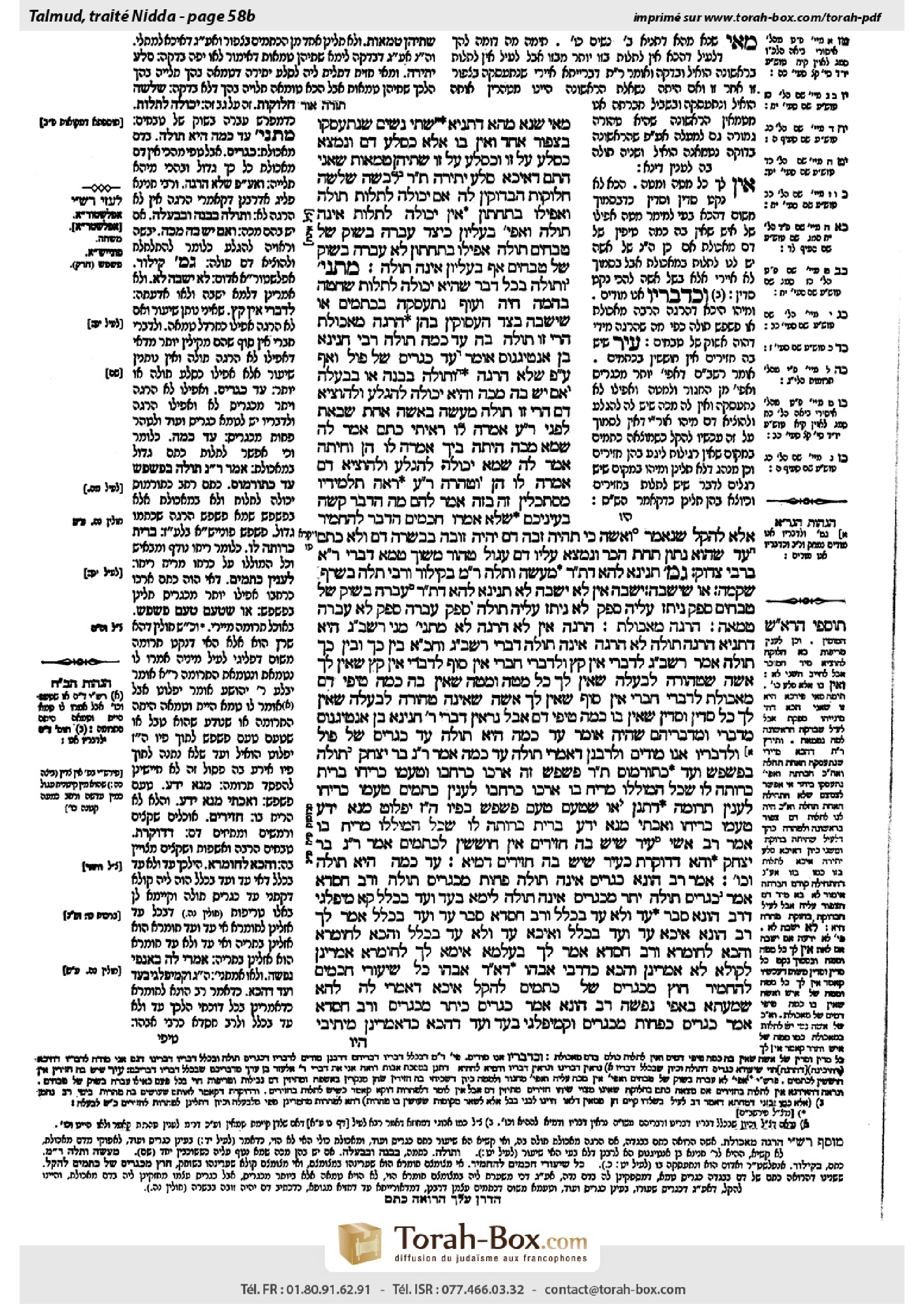
Niddah 58b: Talmud study for Daf Yomi
Daf Yomi is the daily study of one Talmud folio. Explore 37 tractates with scans, Hebrew text, Sefaria English and AI-generated French translations where annotated.
Passage selection and English or AI-generated French translation are available where the scan has annotations. Daf Study is independent of Torah-Box and Sefaria.
Browse Niddah · נידה · All tractatesNiddah 58b text and translations
This page of Niddah includes the Aramaic text, an English translation and an AI-generated French translation, alongside the scan above.
נידה נ״ח ב · Aramaic and Hebrew text
מַאי שְׁנָא מֵהָא דְּתַנְיָא: שְׁתֵּי נָשִׁים שֶׁנִּתְעַסְּקוּ בְּצִפּוֹר אֶחָד, וְאֵין בּוֹ אֶלָּא כְּסֶלַע דָּם, וְנִמְצָא כְּסֶלַע עַל זוֹ וּכְסֶלַע עַל זוֹ — שְׁתֵּיהֶן טְמֵאוֹת? שָׁאנֵי הָתָם דְּאִיכָּא סֶלַע יַתִּירָא.
תָּנוּ רַבָּנַן: לָבְשָׁה שְׁלֹשָׁה חֲלוּקוֹת הַבְּדוּקִין לָהּ, אִם יְכוֹלָה לִתְלוֹת — תּוֹלָה, וַאֲפִילּוּ בַּתַּחְתּוֹן. אֵין יְכוֹלָה לִתְלוֹת — אֵינָהּ תּוֹלָה, וַאֲפִילּוּ בָּעֶלְיוֹן.
כֵּיצַד? עָבְרָה בְּשׁוּק שֶׁל טַבָּחִים — תּוֹלָה אֲפִילּוּ בַּתַּחְתּוֹן; לֹא עָבְרָה בְּשׁוּק שֶׁל טַבָּחִים — אַף בָּעֶלְיוֹן אֵינָהּ תּוֹלָה.
מַתְנִי' וְתוֹלָה בְּכׇל דָּבָר שֶׁהִיא יְכוֹלָה לִתְלוֹת. שָׁחֲטָה בְּהֵמָה, חַיָּה וָעוֹף, נִתְעַסְּקָה בִּכְתָמִים, אוֹ שֶׁיָּשְׁבָה בְּצַד הָעֲסוּקִין בָּהֶן, הָרְגָה מַאֲכוֹלֶת — הֲרֵי זוֹ תּוֹלָה בָּהּ.
עַד כַּמָּה תּוֹלָה? רַבִּי חֲנִינָא בֶּן אַנְטִיגְנוֹס אוֹמֵר: עַד כִּגְרִיס שֶׁל פּוֹל, וְאַף עַל פִּי שֶׁלֹּא הָרְגָה. וְתוֹלָה בִּבְנָהּ אוֹ בְּבַעְלָהּ אִם יֵשׁ בָּהּ מַכָּה, וְהִיא יְכוֹלָה לְהִגָּלֵעַ וּלְהוֹצִיא דָּם — הֲרֵי זוֹ תּוֹלָה.
מַעֲשֶׂה בְּאִשָּׁה אַחַת שֶׁבָּאת לִפְנֵי רַבִּי עֲקִיבָא, אָמְרָה לוֹ: רָאִיתִי כֶּתֶם. אָמַר לָהּ: שֶׁמָּא מַכָּה הָיְתָה בִּיךְ? אָמְרָה לוֹ: הֵן. וְחָיְתָה, אָמַר לָהּ: שֶׁמָּא יְכוֹלָה לְהִגָּלֵעַ וּלְהוֹצִיא דָּם? אָמְרָה לוֹ: הֵן. וְטִהֲרָהּ רַבִּי עֲקִיבָא.
רָאָה תַּלְמִידָיו מִסְתַּכְּלִין זֶה בָּזֶה, אָמַר לָהֶם: מָה הַדָּבָר קָשֶׁה בְּעֵינֵיכֶם? שֶׁלֹּא אָמְרוּ חֲכָמִים הַדָּבָר לְהַחְמִיר אֶלָּא לְהָקֵל, שֶׁנֶּאֱמַר: ״וְאִשָּׁה כִּי תִהְיֶה זָבָה דָּם יִהְיֶה זֹבָהּ בִּבְשָׂרָהּ״ — ״דָּם״ וְלֹא כֶּתֶם.
עֵד שֶׁהוּא נָתוּן תַּחַת הַכַּר, וְנִמְצָא עָלָיו דָּם — עָגוֹל טָהוֹר, מָשׁוּךְ טָמֵא; דִּבְרֵי רַבִּי אֱלִיעֶזֶר בְּרַבִּי צָדוֹק.
גְּמָ' תְּנֵינָא לְהָא דְּתָנוּ רַבָּנַן: מַעֲשֶׂה וְתָלָה רַבִּי מֵאִיר בְּקִילוֹר, וְרַבִּי תָּלָה בִּשְׂרַף שִׁקְמָה.
אוֹ שֶׁיָּשְׁבָה. יָשְׁבָה — אִין, לֹא יָשְׁבָה — לָא.
תְּנֵינָא לְהָא דְּתָנוּ רַבָּנַן: עָבְרָה בְּשׁוּק שֶׁל טַבָּחִים, סָפֵק נִיתַּז עָלֶיהָ סָפֵק לֹא נִיתַּז עָלֶיהָ — תּוֹלָה, סָפֵק עָבְרָה סָפֵק לֹא עָבְרָה — טְמֵאָה.
הָרְגָה מַאֲכוֹלֶת. הָרְגָה — אִין, לֹא הָרְגָה — לָא. מַתְנִיתִין מַנִּי? רַבָּן שִׁמְעוֹן בֶּן גַּמְלִיאֵל הִיא, דְּתַנְיָא: הָרְגָה — תּוֹלָה, לֹא הָרְגָה — אֵינָהּ תּוֹלָה, דִּבְרֵי רַבָּן שִׁמְעוֹן בֶּן גַּמְלִיאֵל. וַחֲכָמִים אוֹמְרִים: בֵּין כָּךְ וּבֵין כָּךְ תּוֹלָה.
אָמַר רַבָּן שִׁמְעוֹן בֶּן גַּמְלִיאֵל: לִדְבָרַי — אֵין קֵץ, וּלְדִבְרֵי חֲבֵרַי — אֵין סוֹף.
לִדְבָרַי אֵין קֵץ — שֶׁאֵין לְךָ אִשָּׁה שֶׁטְּהוֹרָה לְבַעְלָהּ, שֶׁאֵין לְךָ כׇּל מִטָּה וּמִטָּה שֶׁאֵין בָּהּ כַּמָּה טִיפֵּי דַּם מַאֲכוֹלֶת.
לְדִבְרֵי חֲבֵרַי אֵין סוֹף — שֶׁאֵין לְךָ אִשָּׁה שֶׁאֵינָהּ טְהוֹרָה לְבַעְלָהּ, שֶׁאֵין לְךָ כׇּל סָדִין וְסָדִין שֶׁאֵין בּוֹ כַּמָּה טִיפֵּי דָּם.
אֲבָל נִרְאִין דִּבְרֵי רַבִּי חֲנִינָא בֶּן אַנְטִיגְנוֹס מִדְּבָרַי וּמִדִּבְרֵיהֶם, שֶׁהָיָה אוֹמֵר: עַד כַּמָּה הִיא תּוֹלָה? עַד כִּגְרִיס שֶׁל פּוֹל. וְלִדְבָרָיו אָנוּ מוֹדִים. וּלְרַבָּנַן דְּאָמְרִי תּוֹלָה, עַד כַּמָּה? אָמַר רַב נַחְמָן בַּר יִצְחָק: תּוֹלָה בְּפִשְׁפֵּשׁ, וְעַד כְּתוֹרְמוֹס.
תָּנוּ רַבָּנַן: פִּשְׁפֵּשׁ זֶה, אׇרְכּוֹ כְּרׇחְבּוֹ, וְטַעְמוֹ כְּרֵיחוֹ. בְּרִית כְּרוּתָה לוֹ, שֶׁכׇּל הַמּוֹלְלוֹ מֵרִיחַ בּוֹ. אׇרְכּוֹ כְּרׇחְבּוֹ — לְעִנְיַן כְּתָמִים;
טַעְמוֹ כְּרֵיחוֹ — לְעִנְיַן תְּרוּמָה. דִּתְנַן: אוֹ שֶׁטָּעַם טַעַם פִּשְׁפֵּשׁ בְּפִיו, הֲרֵי זֶה יִפְלוֹט. מְנָא יָדַע? טַעְמוֹ כְּרֵיחוֹ. וְאַכַּתִּי מְנָא יָדַע? בְּרִית כְּרוּתָה לוֹ, שֶׁכׇּל הַמּוֹלְלוֹ מֵרִיחַ בּוֹ.
אָמַר רַב אָשֵׁי: עִיר שֶׁיֵּשׁ בָּהּ חֲזִירִים, אֵין חוֹשְׁשִׁין לִכְתָמִים. אָמַר רַב נַחְמָן בַּר יִצְחָק: וְהָא דְּרוֹקֶרֶת כְּעִיר שֶׁיֵּשׁ בָּהּ חֲזִירִים דָּמְיָא.
עַד כַּמָּה הִיא תּוֹלָה וְכוּ׳. אָמַר רַב הוּנָא: כִּגְרִיס — אֵינָהּ תּוֹלָה, פָּחוֹת מִכִּגְרִיס — תּוֹלָה, וְרַב חִסְדָּא אָמַר: כִּגְרִיס — תּוֹלָה, יָתֵר מִכִּגְרִיס — אֵינָהּ תּוֹלָה.
לֵימָא, בְּעַד וְעַד בִּכְלָל קָא מִיפַּלְגִי, דְּרַב הוּנָא סָבַר: עַד וְלֹא עַד בִּכְלָל, וְרַב חִסְדָּא סָבַר: עַד וְעַד בִּכְלָל?
אָמַר לְךָ רַב הוּנָא: אִיכָּא עַד וְעַד בִּכְלָל, וְאִיכָּא עַד וְלֹא עַד בִּכְלָל, וְהָכָא לְחוּמְרָא, וְהָכָא לְחוּמְרָא.
וְרַב חִסְדָּא אָמַר לָךְ: בְּעָלְמָא אֵימָא לָךְ לְחוּמְרָא אָמְרִינַן, לְקוּלָּא לָא אָמְרִינַן. וְהָכָא כִּדְרַבִּי אֲבָהוּ, דְּאָמַר רַבִּי אֲבָהוּ: כׇּל שִׁעוּרֵי חֲכָמִים לְהַחְמִיר, חוּץ מִכִּגְרִיס שֶׁל כְּתָמִים לְהָקֵל.
אִיכָּא דְאָמְרִי לַהּ לְהָא שְׁמַעְתָּא בְּאַפֵּי נַפְשַׁהּ: רַב הוּנָא אָמַר — כִּגְרִיס כְּיָתֵר מִכִּגְרִיס, וְרַב חִסְדָּא אָמַר — כִּגְרִיס כְּפָחוֹת מִכִּגְרִיס, וְקָמִיפַּלְגִי בְּ״עַד וְעַד״ דְּהָכָא, כִּדְאָמְרִינַן. מֵיתִיבִי:
Niddah 58b · English translation
The Gemara asks: In what way is this case different from that which is taught in a baraita: With regard to two women who were occupied with one slaughtered bird, and the bird contained only an amount of blood capable of producing a stain as big as a sela coin, and blood the size of a sela was found on this woman and blood the size of a sela was found on that woman, they are both impure, despite the fact that the blood of one of them can be attributed to the bird. Likewise, in the case of Rav Sheshet the lender should be impure as well, as she might not have examined the robe properly. The Gemara answers: There it is different, as there is an additional sela.
The Sages taught in a baraita: In the case of a woman who wore three robes, one on top of the other, that had been examined by her for blood stains, and she subsequently found a stain on one of the robes, if she can attribute the blood on the robe to an external source, she may attribute it to that source, and she is pure. And this is the halakha even if the stain was on the lower robe, closest to her skin. But if she cannot reasonably attribute the blood to an external factor she may not attribute it to an external factor, and she is impure, and this is the halakha even if the stain was on the upper robe.
The baraita elaborates: How so? If she passed through a marketplace of butchers, where blood could have sprayed on her clothes, she may attribute a stain on her garment to the butchers and she is pure, even if the stain was on the lower robe. If she did not pass through a marketplace of butchers or anywhere else with a lot of blood, then even if the stain was on the upper robe she may not attribute the blood to an external source and she is impure.
MISHNA: And a woman who discovers a blood stain on her body or her garment may attribute its existence to any matter to which she can attribute it: If she slaughtered a domesticated animal, an undomesticated animal, or a bird; or if she was occupied with the removal of blood stains from the garments of other women or from her own garment, from any source, such as blood that originated from a wound elsewhere on her body or even her own menstrual blood from a prior menstrual cycle; or if she sat alongside others who were occupied with removing blood stains; or if she killed a louse; in all of these cases, that woman may attribute the blood stain to it.
How large a stain may a woman attribute to a louse? Rabbi Ḥanina ben Antigonus says: It can be up to the area of a split bean. And she may attribute the stain to a louse even if she does not remember that she killed it. And she may attribute the blood stain to her son or to her husband in a case where one of them is near her and has a wound. Furthermore, if the woman herself has a wound, even if the wound scabbed over and is no longer bleeding, but it can reopen and bleed, that woman may attribute the blood stain to that wound.
There was an incident involving one woman who came before Rabbi Akiva. She said to him: I saw a blood stain. Rabbi Akiva said to her: Perhaps there was a wound on your body? She said to him: Yes, there was a wound and it healed. He said to her: Was it perhaps a wound that could reopen and bleed? She said to him: Yes it was. And Rabbi Akiva deemed her ritually pure.
Rabbi Akiva saw his students looking at each other, wondering why he ruled leniently in this case. Rabbi Akiva said to them: What in this matter is difficult in your eyes? The reason I ruled this way is that the Sages did not state the matter of the impurity of blood stains in order to be stringent; rather, they instituted this impurity in order to be lenient, as it is stated: “And if a woman has an issue, and her issue in her flesh shall be blood” (Leviticus 15:19), from which it is derived that by Torah law, “blood” deems her impure, but not a stain. Impurity from a blood stain was instituted by the Sages, and they rule leniently in any case where the stain can be attributed to another source.
With regard to an examination cloth that was placed beneath the pillow and blood was found on the cloth, and it is unclear whether it is the blood of an examination or the blood of a louse that was crushed beneath it, if the stain is round the woman is ritually pure, as an examination to determine whether a woman is menstruating would not leave a round stain. If the stain is elongated the woman is ritually impure; this is the statement of Rabbi Eliezer, son of Rabbi Tzadok.
GEMARA: The mishna teaches that a woman who discovers a blood stain on her body or her garment may attribute its existence to any matter to which she can attribute it. The Gemara notes: We learn in the mishna that which the Sages taught explicitly in a baraita: An incident occurred involving a blood stain found on a woman’s garment, and Rabbi Meir attributed it to an eye salve [bekilor] that the woman had previously handled, and likewise, Rabbi Yehuda HaNasi attributed a stain to the sap of a sycamore tree the woman had touched.
§ The mishna teaches: Or if she was occupied with the removal of blood stains from the garments of other women or from her own garment, from any source, such as blood that originated from a wound elsewhere on her body or even her own menstrual blood from a prior menstrual cycle; or if she sat alongside others who were occupied with removing blood stains. The Gemara infers: If she knows for certain that she sat alongside those occupied with removing blood stains, yes, she may attribute blood to this source. But if she does not know for certain that she sat alongside those who were removing blood stains, but knows only that she was in the same area as they were, she may not attribute blood to this source.
Again the Gemara comments: We learn in the mishna that which the Sages taught explicitly in a baraita: If a woman passed through a marketplace of butchers and it is uncertain whether blood from the marketplace sprayed on her or whether it did not spray on her, she may attribute a stain to the butchers. But if she is uncertain whether she passed by the marketplace or whether she did not pass by, she is deemed impure and may not attribute it to that source. In this case as well, only if she is certain that she was in a circumstance to which she can attribute the blood may she attribute it to that cause.
§ The mishna teaches that if she killed a louse she may attribute the blood stain to it. The Gemara infers: If she killed a louse, yes, she may attribute blood to it, but if she did not kill a louse she may not attribute blood to it. The Gemara asks: Whose opinion is expressed in the mishna? The Gemara answers that it is the opinion of Rabban Shimon ben Gamliel, as it is taught in a baraita: If a woman killed a louse before finding blood, she may attribute blood to it. If she did not kill a louse she may not attribute blood to it; this is the statement of Rabban Shimon ben Gamliel. And the Rabbis say: Both in this case and in that case she may attribute blood to a louse.
Rabban Shimon ben Gamliel said there is a difficulty with regard to both his opinion and that of the Rabbis: According to my statement, that a woman may attribute a stain only to a creature she actually killed, there is no limit; and according to the statement of my colleagues, who rule that she may attribute a stain to a louse even if she had not killed one, there is no end.
Rabban Shimon ben Gamliel explains: According to my statement, there is no limit to the size of the stain she found, as she is impure even if it is as small as a mustard seed. Consequently, you have no woman who is pure to her husband, as you have no bed of any sort on which there are not several drops of blood of a louse. Since I rule that a woman may attribute blood to a louse only if she previously killed one, all women will be in a state of impurity to their husbands.
By contrast, according to the statement of my colleagues there is no end to the advantage their ruling provides to women, because if their ruling is accepted you have no woman who is not pure to her husband, as you have no sheet of any sort on which there are not several blood drops, and every woman can attribute all these drops to a louse, even if she had not killed one.
Rabban Shimon ben Gamliel continues: But the statement of Rabbi Ḥanina ben Antigonus appears to be more correct than my statement and their statement, as Rabbi Ḥanina ben Antigonus would say: How large a stain may a woman attribute to a louse? It can be up to the area of a split bean. And therefore we concede to his opinion and accept his statement. The Gemara asks: And according to the opinion of the Rabbis, who say that a woman may attribute blood to a louse whether or not she killed one, how large can the stain be? After all, some stains are far bigger than those produced by a louse. Rav Naḥman bar Yitzḥak says: She may attribute a stain to a bedbug, which has more blood than a louse, and this applies to any stain whose size is up to the width of a lupine seed.
The Gemara continues to discuss the matter of the bedbug. The Sages taught in a baraita: This bedbug, its length is equal to its width, and its taste is like its foul smell. A covenant is made with it, i.e., it is a law of nature, that anyone who squeezes it will smell its foul odor. The Gemara explains with regard to which halakhot these characteristics of the bedbug were mentioned. The fact that its length is equal to its width was stated with regard to the matter of stains, i.e., if a stain is found whose length is the same as its width, one may attribute it to the blood of a bedbug even if the stain is larger than the area of a split bean.
The statement that its taste is like its foul smell is applicable with regard to the matter of the partaking of teruma, the portion of the produce designated for the priest, as we learned in a mishna (Terumot 8:2): Or if he tasted the taste of a bedbug in his mouth, which is prohibited for consumption, this person must spit out the contents of his mouth, despite the fact that it is generally prohibited to waste teruma. How does he know that there is a bedbug in his mouth? He knows because its taste is like its foul smell. And still, how does he know the smell of a bedbug? In answer to this question the baraita explains that one does not err with regard to the smell of the bedbug, as a covenant is made with it that anyone who squeezes it will smell its foul odor, and therefore it is a well-known smell.
The mishna teaches that a woman may attribute a blood stain as having come from another entity and remain pure. In this regard Rav Ashi says: In the case of a town in which there are pigs, one need not be concerned for stains found on the body or clothes of a woman living there. Since pigs wander the streets and often have stains of blood on them, and their living areas attract bugs of all kinds, any blood stain found on a woman can be attributed to the pigs. Rav Naḥman bar Yitzḥak said: And this town of Dukeret, where there are many slaughterhouses, garbage heaps, and bugs, is considered like a town in which there are pigs.
§ The mishna teaches: How large a stain may a woman attribute to a louse? Rabbi Ḥanina ben Antigonus says: It can be up to the area of a split bean. The Gemara notes that the meaning of the statement of Rabbi Ḥanina ben Antigonus is a matter of dispute among the Sages. Rav Huna says: If the stain was the size of a split bean she may not attribute it to the blood of a louse; if it was less than the size of a split bean she may attribute it to the blood of a louse. And Rav Ḥisda says: Even if it was the size of a split bean she may still attribute it to the blood of a louse; but if the stain was more than the size of a split bean she may not attribute it to the blood of a louse.
The Gemara suggests: Let us say that these Sages disagree with regard to the matter of: Up to and including. As Rav Huna maintains that the term: Up to, means: Up to the measure but not including the measure, and since Rabbi Ḥanina ben Antigonus said that a stain can be up to the area of a split bean, this does not include the size of a bean itself. And Rav Ḥisda maintains that the term means: Up to and including the measure.
The Gemara responds: Rav Huna could say to you that there are instances where the term means up to and including the measure, and there are instances where it means up to and not including the measure. And both here, where it means up to and not including the measure, it is intended as a stringency, as in the statement of Rabbi Ḥanina ben Antigonus; and there, where it means up to and including the measure, it is likewise intended as a stringency.
And Rav Ḥisda could say to you that in general I will say to you that when it leads to a stringency, we say that the term: Up to, means up to and including the measure, whereas if it leads to a leniency we do not say so. And here, with regard to stains, I interpret the term in this manner despite the fact that it entails a leniency, in accordance with the opinion of Rabbi Abbahu. As Rabbi Abbahu says: All measures of the Sages must be interpreted stringently, except for the measure of a split bean as a standard for stains of blood found on a woman’s clothing, which is interpreted leniently. Therefore, even if the stain is exactly the size of a bean the woman remains pure.
Some say this halakha as a distinct matter, not specifically as an explanation of the mishna: Rav Huna says the area of a split bean is considered the same as the area of greater than a split bean. And Rav Ḥisda says the area of a split bean is considered the same as the area of less than a split bean. And these two amora’im disagree with regard to the matter of up to, whether it means including or not including the measure itself, as discussed in this case here, with regard to stains. The Gemara raises an objection:
Niddah 58b · Traduction française (IA)
La Guemara demande : En quoi ce cas diffère-t-il de celui enseigné dans une baraïta ? Deux femmes s’occupaient d’un même oiseau abattu, qui ne contenait qu’une quantité de sang suffisante pour produire une tache de la taille d’un sela. Or, on a trouvé sur cette femme du sang de la taille d’un sela, et sur l’autre femme également du sang de la taille d’un sela. Elles sont toutes deux impures, bien que le sang de l’une d’elles puisse être attribué à l’oiseau. De même, dans le cas de Rav Sheshet, la prêteuse devrait elle aussi être impure, car il se peut qu’elle n’ait pas correctement examiné le vêtement. La Guemara répond : Le cas est différent, car il y a un sela supplémentaire.
Les Sages ont enseigné dans une baraïta : Dans le cas d’une femme qui portait trois vêtements l’un sur l’autre, qu’elle avait examinés pour vérifier qu’ils ne portaient pas de taches de sang, puis qui a trouvé une tache sur l’un d’eux, si elle peut raisonnablement attribuer le sang sur le vêtement à une source extérieure, elle peut le lui attribuer et elle est pure. Cette halakha s’applique même si la tache se trouve sur le vêtement inférieur, le plus proche de sa peau. Mais si elle ne peut raisonnablement attribuer le sang à une cause extérieure, elle ne peut pas le lui attribuer et elle est impure. Cette halakha s’applique même si la tache se trouve sur le vêtement supérieur.
La baraïta précise : Comment cela ? Si elle est passée par un marché de bouchers, où du sang a pu éclabousser ses vêtements, elle peut attribuer aux bouchers une tache sur son vêtement et elle est pure, même si la tache se trouve sur le vêtement inférieur. Si elle n’est pas passée par un marché de bouchers ni par aucun autre endroit où il y avait beaucoup de sang, alors, même si la tache se trouve sur le vêtement supérieur, elle ne peut pas attribuer le sang à une source extérieure et elle est impure.
MICHNA : Une femme qui découvre une tache de sang sur son corps ou son vêtement peut en attribuer la présence à toute cause à laquelle elle peut raisonnablement l’attribuer : si elle a abattu un animal domestique, un animal sauvage ou un oiseau ; si elle s’occupait d’enlever des taches de sang sur les vêtements d’autres femmes ou sur son propre vêtement, quelle qu’en soit la source, par exemple du sang provenant d’une blessure ailleurs sur son corps ou même de son propre sang menstruel d’un cycle précédent ; si elle était assise à côté d’autres personnes qui s’occupaient d’enlever des taches de sang ; ou si elle a tué un pou. Dans tous ces cas, cette femme peut attribuer la tache de sang à cette cause.
Quelle est la taille maximale d’une tache qu’une femme peut attribuer à un pou ? Rabbi Ḥanina ben Antigonus dit : Elle peut aller jusqu’à la surface d’un haricot fendu. Elle peut attribuer la tache à un pou même si elle ne se souvient pas en avoir tué un. Elle peut aussi attribuer la tache de sang à son fils ou à son mari si l’un d’eux se trouve près d’elle et a une blessure. En outre, si la femme elle-même a une blessure, même si celle-ci s’est recouverte d’une croûte et ne saigne plus, mais peut se rouvrir et saigner, elle peut attribuer la tache de sang à cette blessure.
Un jour, une femme se présenta devant Rabbi Akiva et lui dit : « J’ai vu une tache de sang. » Rabbi Akiva lui demanda : « Se peut-il que tu aies une blessure sur le corps ? » Elle lui répondit : « Oui, j’avais une blessure, mais elle a guéri. » Il lui demanda : « Se peut-il que ce soit une blessure qui puisse se rouvrir et saigner ? » Elle lui répondit : « Oui. » Rabbi Akiva la déclara alors rituellement pure.
Rabbi Akiva vit ses élèves se regarder les uns les autres, se demandant pourquoi il avait tranché avec indulgence dans ce cas. Il leur dit : « Qu’est-ce qui vous semble difficile dans cette affaire ? La raison pour laquelle j’ai tranché ainsi, c’est que les Sages n’ont pas institué l’impureté des taches de sang pour se montrer rigoureux ; ils l’ont plutôt instituée afin de se montrer indulgents. En effet, il est dit : “Si une femme a un écoulement et que son écoulement dans sa chair soit du sang” (Lévitique 15:19). On en déduit que, selon la Torah écrite, c’est le “sang” qui la rend impure, mais non une tache. L’impureté due à une tache de sang a été instituée par les Sages, qui se montrent indulgents dans tout cas où la tache peut être attribuée à une autre source. »
Concernant un linge d’examen placé sous l’oreiller, sur lequel on a trouvé du sang sans savoir s’il s’agit du sang d’un examen ou de celui d’un pou écrasé dessous : si la tache est ronde, la femme est rituellement pure, car un examen visant à déterminer si une femme a ses règles ne laisserait pas de tache ronde. Si la tache est allongée, la femme est rituellement impure. Telle est l’opinion de Rabbi Eliezer, fils de Rabbi Tzadok.
GUEMARA : La Michna enseigne qu’une femme qui découvre une tache de sang sur son corps ou son vêtement peut en attribuer la présence à toute cause à laquelle elle peut raisonnablement l’attribuer. La Guemara relève : Nous apprenons dans la Michna ce que les Sages ont explicitement enseigné dans une baraïta : Un incident s’est produit lorsqu’on a trouvé une tache de sang sur le vêtement d’une femme. Rabbi Meir l’a attribuée à un collyre [bekilor] que la femme avait auparavant manipulé ; de même, Rabbi Yehuda HaNasi a attribué une tache à la sève d’un sycomore que la femme avait touché.
§ La Michna enseigne : si elle s’occupait d’enlever des taches de sang sur les vêtements d’autres femmes ou sur son propre vêtement, quelle qu’en soit la source, par exemple du sang provenant d’une blessure ailleurs sur son corps ou même de son propre sang menstruel d’un cycle précédent ; ou si elle était assise à côté d’autres personnes qui s’occupaient d’enlever des taches de sang. La Guemara en déduit : Si elle sait avec certitude qu’elle était assise à côté de personnes qui s’occupaient d’enlever des taches de sang, alors oui, elle peut attribuer le sang à cette source. Mais si elle ne sait pas avec certitude qu’elle était assise à côté de personnes qui enlevaient des taches de sang et sait seulement qu’elle se trouvait dans la même zone qu’elles, elle ne peut pas attribuer le sang à cette source.
La Guemara fait encore remarquer : Nous apprenons dans la Michna ce que les Sages ont explicitement enseigné dans une baraïta : Si une femme est passée par un marché de bouchers et qu’on ne sait pas si du sang provenant du marché a éclaboussé ses vêtements ou non, elle peut attribuer une tache aux bouchers. Mais si elle ne sait pas si elle est passée devant le marché ou non, elle est déclarée impure et ne peut pas attribuer la tache à cette source. Dans ce cas également, elle ne peut attribuer le sang à cette cause que si elle est certaine de s’être trouvée dans une situation à laquelle elle peut l’attribuer.
§ La Michna enseigne que si elle a tué un pou, elle peut lui attribuer la tache de sang. La Guemara en déduit : Si elle a tué un pou, alors oui, elle peut lui attribuer le sang ; mais si elle n’en a pas tué, elle ne peut pas le lui attribuer. La Guemara demande : De qui est l’opinion exprimée dans la Michna ? La Guemara répond qu’il s’agit de l’opinion de Rabban Shimon ben Gamliel, comme il est enseigné dans une baraïta : Si une femme a tué un pou avant de trouver du sang, elle peut lui attribuer le sang. Si elle n’a pas tué de pou, elle ne peut pas lui attribuer le sang. Telle est l’opinion de Rabban Shimon ben Gamliel. Et les Sages disent : Dans les deux cas, elle peut attribuer le sang à un pou.
Rabban Shimon ben Gamliel dit qu’il y a une difficulté aussi bien dans son opinion que dans celle des Sages : Selon mon enseignement, d’après lequel une femme ne peut attribuer une tache qu’à une créature qu’elle a effectivement tuée, il n’y a pas de limite ; et selon l’enseignement de mes collègues, qui statuent qu’elle peut attribuer une tache à un pou même si elle n’en a pas tué, il n’y a pas de fin.
Rabban Shimon ben Gamliel explique : Selon mon enseignement, la taille de la tache trouvée n’a aucune limite, puisqu’elle est impure même si la tache est aussi petite qu’une graine de moutarde. En conséquence, il n’y aurait aucune femme pure vis-à-vis de son mari, car il n’existe aucun lit sur lequel il n’y aurait pas plusieurs gouttes de sang de pou. Puisque je statue qu’une femme ne peut attribuer le sang à un pou que si elle en a tué un auparavant, toutes les femmes seraient en état d’impureté vis-à-vis de leur mari.
À l’inverse, selon l’enseignement de mes collègues, l’avantage que leur décision procure aux femmes n’aurait pas de fin, car, si leur décision était acceptée, il n’y aurait aucune femme qui ne soit pure vis-à-vis de son mari : il n’existe aucun drap sur lequel il n’y aurait pas plusieurs gouttes de sang, et chaque femme pourrait attribuer toutes ces gouttes à un pou, même si elle n’en avait pas tué.
Rabban Shimon ben Gamliel poursuit : Mais l’enseignement de Rabbi Ḥanina ben Antigonus paraît plus juste que le mien et que celui de mes collègues, car Rabbi Ḥanina ben Antigonus disait : « Quelle est la taille maximale d’une tache qu’une femme peut attribuer à un pou ? Elle peut aller jusqu’à la surface d’un haricot fendu. » Nous reconnaissons donc la justesse de son opinion et acceptons son enseignement. La Guemara demande : Et selon l’opinion des Sages, qui disent qu’une femme peut attribuer le sang à un pou qu’elle en ait tué un ou non, quelle peut être la taille de la tache ? Après tout, certaines taches sont bien plus grandes que celles que produit un pou. Rav Naḥman bar Yitzḥak dit : Elle peut attribuer une tache à une punaise, qui contient plus de sang qu’un pou ; cela s’applique à toute tache dont la taille ne dépasse pas la largeur d’une graine de lupin.
La Guemara poursuit son examen de la punaise. Les Sages ont enseigné dans une baraïta : La longueur de cette punaise est égale à sa largeur, et son goût ressemble à sa mauvaise odeur. Un pacte a été conclu avec elle — c’est-à-dire qu’il s’agit d’une loi de la nature — selon lequel quiconque l’écrase sentira sa mauvaise odeur. La Guemara explique à quelles halakhot se rapportent ces caractéristiques de la punaise. Le fait que sa longueur soit égale à sa largeur a été mentionné à propos des taches : si l’on trouve une tache dont la longueur est égale à la largeur, on peut l’attribuer au sang d’une punaise, même si la tache dépasse la surface d’un haricot fendu.
La déclaration selon laquelle son goût ressemble à sa mauvaise odeur s’applique à la consommation de terouma, la part des produits agricoles réservée au prêtre, comme nous l’avons appris dans une Michna (Terumot 8:2) : si quelqu’un a le goût d’une punaise dans la bouche, dont la consommation est interdite, il doit recracher le contenu de sa bouche, bien qu’en règle générale il soit interdit de gaspiller la terouma. Comment sait-il qu’il y a une punaise dans sa bouche ? Il le sait parce que son goût ressemble à sa mauvaise odeur. Mais comment connaît-il l’odeur d’une punaise ? La baraïta répond en expliquant que l’on ne se trompe pas sur l’odeur de la punaise, car un pacte a été conclu avec elle selon lequel quiconque l’écrase sentira sa mauvaise odeur ; son odeur est donc bien connue.
La Michna enseigne qu’une femme peut attribuer une tache de sang à une autre source et rester pure. À ce sujet, Rav Ashi dit : Dans une ville où il y a des porcs, il n’est pas nécessaire de s’inquiéter des taches trouvées sur le corps ou les vêtements d’une femme qui y habite. Comme les porcs errent dans les rues et portent souvent des taches de sang, et que les endroits où ils vivent attirent toutes sortes d’insectes, toute tache de sang trouvée sur une femme peut être attribuée aux porcs. Rav Naḥman bar Yitzḥak dit : La ville de Dukeret, où se trouvent de nombreux abattoirs, tas d’ordures et insectes, est elle aussi considérée comme une ville où il y a des porcs.
§ La Michna enseigne : « Quelle est la taille maximale d’une tache qu’une femme peut attribuer à un pou ? Rabbi Ḥanina ben Antigonus dit : Elle peut aller jusqu’à la surface d’un haricot fendu. » La Guemara relève que la signification de l’enseignement de Rabbi Ḥanina ben Antigonus fait l’objet d’un désaccord entre les Sages. Rav Huna dit : Si la tache a la taille d’un haricot fendu, elle ne peut pas l’attribuer au sang d’un pou ; si elle est plus petite, elle peut l’attribuer au sang d’un pou. Rav Ḥisda dit : Même si elle a la taille d’un haricot fendu, elle peut encore l’attribuer au sang d’un pou ; mais si la tache dépasse cette taille, elle ne peut pas l’attribuer au sang d’un pou.
La Guemara propose : Peut-on dire que ces Sages sont en désaccord sur la question de savoir si « jusqu’à » inclut la mesure elle-même ? Rav Huna soutient que « jusqu’à » signifie : jusqu’à cette mesure, mais sans l’inclure. Ainsi, puisque Rabbi Ḥanina ben Antigonus a dit qu’une tache peut aller jusqu’à la surface d’un haricot fendu, cela n’inclut pas la taille exacte d’un haricot fendu. Rav Ḥisda, quant à lui, soutient que le terme signifie : jusqu’à cette mesure, mesure incluse.
La Guemara répond : Rav Huna pourrait te dire que, dans certains cas, le terme signifie « jusqu’à cette mesure, mesure incluse », et que dans d’autres, il signifie « jusqu’à cette mesure, sans l’inclure ». Ici, où il signifie « jusqu’à cette mesure, sans l’inclure », cela vise à être rigoureux, comme dans l’enseignement de Rabbi Ḥanina ben Antigonus ; et là, où il signifie « jusqu’à cette mesure, mesure incluse », cela vise également à être rigoureux.
Et Rav Ḥisda pourrait te dire qu’en règle générale, lorsque cela entraîne une rigueur, nous disons que « jusqu’à » signifie « jusqu’à cette mesure, mesure incluse », tandis que si cela entraîne une indulgence, nous ne le disons pas. Ici, à propos des taches, j’interprète le terme de cette façon, bien que cela entraîne une indulgence, conformément à l’opinion de Rabbi Abbahu. Rabbi Abbahu dit en effet : Toutes les mesures établies par les Sages doivent être interprétées avec rigueur, à l’exception de la mesure d’un haricot fendu comme critère pour les taches de sang trouvées sur les vêtements d’une femme, qui s’interprète avec indulgence. Par conséquent, même si la tache a exactement la taille d’un haricot fendu, la femme reste pure.
Certains rapportent cette halakha comme un enseignement distinct, et non spécifiquement comme une explication de la Michna : Rav Huna dit que la surface d’un haricot fendu est considérée comme équivalente à une surface supérieure à celle d’un haricot fendu. Rav Ḥisda dit que la surface d’un haricot fendu est considérée comme équivalente à une surface inférieure à celle d’un haricot fendu. Ces deux amoraïm sont en désaccord sur la question de savoir si « jusqu’à » inclut ou non la mesure elle-même, comme dans le cas examiné ici, celui des taches. La Guemara soulève une objection :
Traduction française générée par IA à partir de l’édition anglaise de Sefaria. Vérifie toujours un passage avec le texte source.
Text from Sefaria: William Davidson Edition - Vocalized Aramaic (CC BY NC); William Davidson Edition - English (CC BY NC).