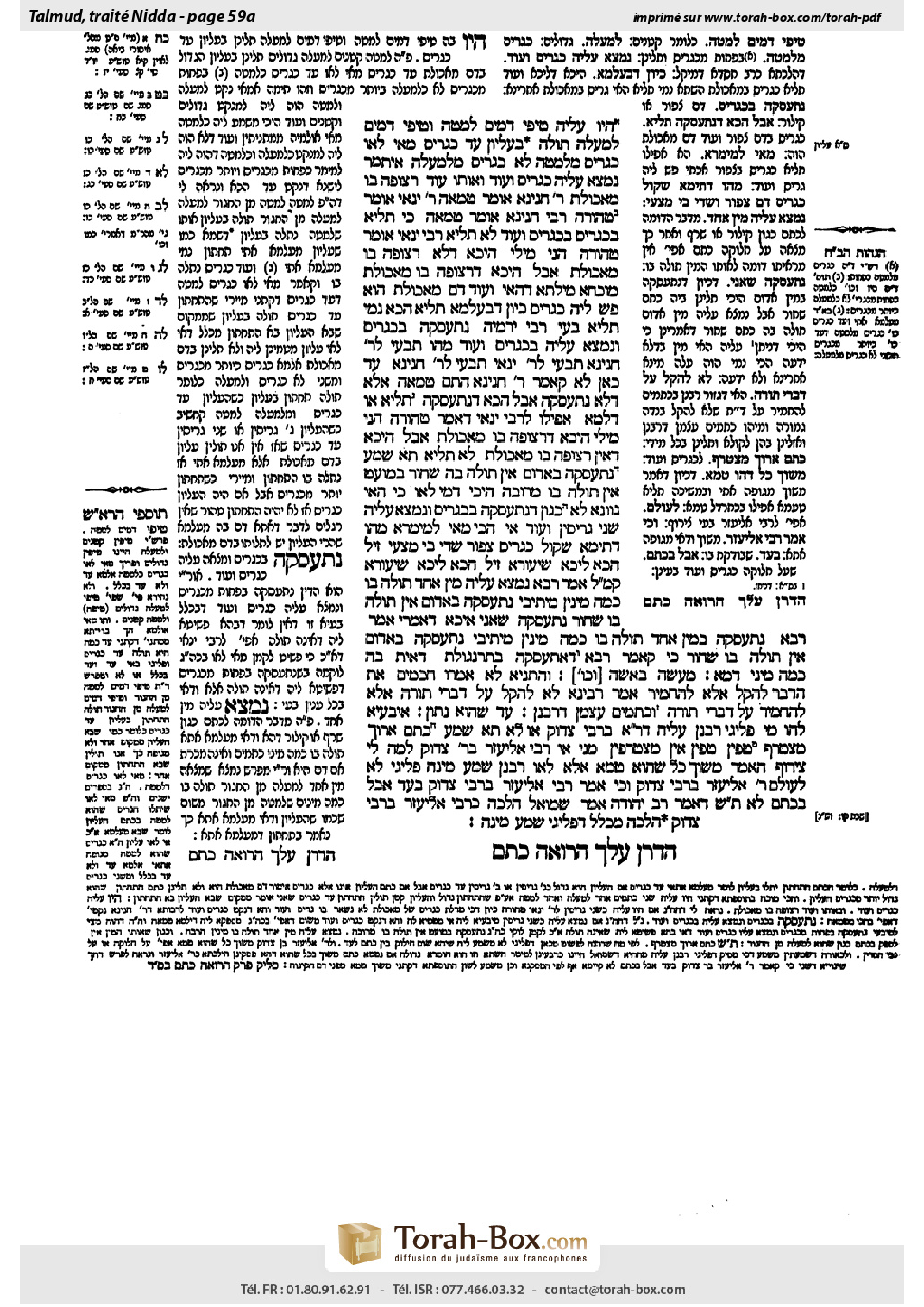
Niddah 59a: Talmud study for Daf Yomi
Daf Yomi is the daily study of one Talmud folio. Explore 37 tractates with scans, Hebrew text, Sefaria English and AI-generated French translations where annotated.
Passage selection and English or AI-generated French translation are available where the scan has annotations. Daf Study is independent of Torah-Box and Sefaria.
Browse Niddah · נידה · All tractatesNiddah 59a text and translations
This page of Niddah includes the Aramaic text, an English translation and an AI-generated French translation, alongside the scan above.
נידה נ״ט א · Aramaic and Hebrew text
הָיוּ עָלֶיהָ טִיפֵּי דָמִים לְמַטָּה וְטִיפֵּי דָמִים לְמַעְלָה — תּוֹלָה בְּעֶלְיוֹן עַד כִּגְרִיס. מַאי לַָאו כִּגְרִיס מִלְּמַטָּה? לָא, כִּגְרִיס מִלְּמַעְלָה.
אִיתְּמַר: נִמְצָא עָלֶיהָ כִּגְרִיס וָעוֹד, וְאוֹתוֹ עוֹד רְצוּפָה בּוֹ מַאֲכוֹלֶת. רַבִּי חֲנִינָא אוֹמֵר: טְמֵאָה, רַבִּי יַנַּאי אוֹמֵר: טְהוֹרָה. רַבִּי חֲנִינָא אוֹמֵר טְמֵאָה — כִּי תָּלְיָא בְּכִגְרִיס, בְּכִגְרִיס וָעוֹד לָא תָּלְיָא.
רַבִּי יַנַּאי אוֹמֵר: טְהוֹרָה, הָנֵי מִילֵּי — הֵיכָא דְּלֹא רְצוּפָה בּוֹ מַאֲכוֹלֶת, אֲבָל הֵיכָא דִּרְצוּפָה בּוֹ מַאֲכוֹלֶת — מוֹכְחָא מִילְּתָא דְּהַאי וָעוֹד דַּם מַאֲכוֹלֶת הוּא, פָּשׁ לֵיהּ כִּגְרִיס, כֵּיוָן דִּבְעָלְמָא תָּלְיָא — הָכָא נָמֵי תָּלְיָא.
בָּעֵי רַבִּי יִרְמְיָה: נִתְעַסְּקָה בְּכִגְרִיס, וְנִמְצָא עָלֶיהָ בְּכִגְרִיס וָעוֹד, מַהוּ? תִּבְעֵי לְרַבִּי חֲנִינָא, תִּבְעֵי לְרַבִּי יַנַּאי.
תִּבְּעֵי לְרַבִּי חֲנִינָא: עַד כָּאן לָא קָאָמַר רַבִּי חֲנִינָא הָתָם ״טְמֵאָה״ אֶלָּא דְּלֹא נִתְעַסְּקָה, אֲבָל הָכָא דְּנִתְעַסְּקָה — תָּלְיָא? אוֹ דִלְמָא, אֲפִילּוּ לְרַבִּי יַנַּאי דְּאָמַר ״טְהוֹרָה״ — הָנֵי מִילֵּי הֵיכָא דִּרְצוּפָה בּוֹ מַאֲכוֹלֶת, אֲבָל הֵיכָא דְּאֵין רְצוּפָה בּוֹ מַאֲכוֹלֶת — לֹא תָּלְיָא?
תָּא שְׁמַע: נִתְעַסְּקָה בֶּאֱדוֹם — אֵין תּוֹלָה בָּהּ שָׁחוֹר, בְּמוּעָט — אֵין תּוֹלָה בּוֹ מְרוּבָּה. הֵיכִי דָּמֵי? לָאו כִּי הַאי גַוְונָא?!
לָא, כְּגוֹן דְּנִתְעַסְּקָה בְּכִגְרִיס, וְנִמְצָא עָלֶיהָ שְׁנֵי גְּרִיסִין וָעוֹד. אִי הָכִי, מַאי לְמֵימְרָא?
מַהוּ דְּתֵימָא: שְׁקוֹל כִּגְרִיס (צִפּוֹר), שְׁדִי בֵּי מִצְעֵי; זִיל הָכָא — לֵיכָּא שִׁיעוּרָא, זִיל הָכָא — לֵיכָּא שִׁיעוּרָא, קָא מַשְׁמַע לַן.
אָמַר רָבָא: נִמְצָא עָלֶיהָ מִין אֶחָד — תּוֹלָה בּוֹ כַּמָּה מִינִין. מֵיתִיבִי: נִתְעַסְּקָה בְּאָדוֹם — אֵין תּוֹלָה בּוֹ שָׁחוֹר! נִתְעַסְּקָה שָׁאנֵי.
אִיכָּא דְאָמְרִי, אָמַר רָבָא: נִתְעַסְּקָה בְּמִין אֶחָד — תּוֹלָה בּוֹ כַּמָּה מִינִין. מֵיתִיבִי: נִתְעַסְּקָה בְּאָדוֹם — אֵין תּוֹלָה בּוֹ שָׁחוֹר! כִּי קָאָמַר רָבָא, דְּאִתְעַסַּקָה בְּתַרְנְגוֹלֶת דְּאִית בַּהּ כַּמָּה מִינֵי דְּמָא.
מַעֲשֶׂה בְּאִשָּׁה [וְכוּ׳]. וְהָתַנְיָא: לֹא אָמְרוּ חֲכָמִים אֶת הַדָּבָר לְהָקֵל אֶלָּא לְהַחְמִיר!
אָמַר רָבִינָא: לֹא לְהָקֵל עַל דִבְרֵי תוֹרָה, אֶלָּא לְהַחְמִיר עַל דִבְרֵי תוֹרָה, וּכְתָמִים עַצְמָן דְּרַבָּנַן.
עֵד שֶׁהוּא נָתוּן, אִיבַּעְיָא לְהוּ: מִי פְּלִיגִי רַבָּנַן עֲלֵיהּ דְּרַבִּי אֱלִיעֶזֶר בְּרַבִּי צָדוֹק, אוֹ לָא?
תָּא שְׁמַע: כֶּתֶם אָרוֹךְ — מִצְטָרֵף, טִפִּין טִפִּין — אֵין מִצְטָרְפִין. מַנִּי? אִי רַבִּי אֱלִיעֶזֶר בְּרַבִּי צָדוֹק — לְמָה לִי צֵירוּף? הָאָמַר ״מָשׁוּךְ כֹּל שֶׁהוּא טָמֵא״!
אֶלָּא לָאו רַבָּנַן, שְׁמַע מִינַּהּ פְּלִיגִי? לָא, לְעוֹלָם רַבִּי אֱלִיעֶזֶר בְּרַבִּי צָדוֹק, וְכִי אָמַר רַבִּי אֱלִיעֶזֶר בְּרַבִּי צָדוֹק — בְּעֵד, אֲבָל בְּכֶתֶם — לָא.
תָּא שְׁמַע, דְּאָמַר רַב יְהוּדָה אָמַר שְׁמוּאֵל: הֲלָכָה כְּרַבִּי אֱלִיעֶזֶר בְּרַבִּי צָדוֹק. הֲלָכָה — מִכְּלָל דִּפְלִיגִי, שְׁמַע מִינַּהּ.
הֲדַרַן עֲלָךְ הָרוֹאָה כֶּתֶם.
Niddah 59a · English translation
If there were on a woman’s body small drops of blood and large drops of blood, she may attribute these drops to an external source, even with regard to the largest drop, provided that it is up to the size of a split bean. What, is it not that a drop the size of a split bean itself is considered small, like a drop that is less than the size of a bean, which contradicts the opinion of Rav Huna? The Gemara responds: No, it means that a drop exactly the size of a split bean is like a large drop, i.e., a drop greater than a bean.
It was stated: If a stain was found on a woman and it was the size of a split bean and slightly more, which is too large to be attributed to a louse, and in that area that was slightly more than a bean there was a squashed louse, what is the status of that woman? Rabbi Ḥanina says she is ritually impure, as the stain is not attributed to a louse; Rabbi Yannai says she is pure. The Gemara explains their opinions: Rabbi Ḥanina says she is impure, in accordance with the halakha that a woman may attribute a stain to a louse only with regard to a stain whose area is up to the area of a split bean, whereas with regard to a stain the size of a split bean and slightly more, she may not attribute it to a louse.
By contrast, Rabbi Yannai says she is pure, as he maintains that this statement that one may not attribute a stain larger than a bean to a louse applies only where there is no louse squashed on the stain. But in a case where there is a louse squashed on the stain it is apparent that this blood that causes the stain to be slightly more than the size of a bean is the blood of a louse. Since it is visibly squashed there, there is no uncertainty in this regard. When that area is subtracted one is left with a stain that is the size of a split bean, and one may say that since in general a woman attributes a stain the size of a bean to a louse, here too, she may attribute the stain to another, second louse.
With regard to the dispute between Rabbi Ḥanina and Rabbi Yannai, Rabbi Yirmeya raises a dilemma: If a woman was occupied with an item the size of a split bean, e.g., the blood of a slaughtered bird, or eye salve, and then a stain was found on her the size of a split bean and slightly more, what is the halakha? Rabbi Yirmeya elaborates: The dilemma can be raised according to the opinion of Rabbi Ḥanina, who maintained in the previous case that she is impure, and the dilemma can be raised according to the opinion of Rabbi Yannai, who ruled that she is pure.
The dilemma can be raised according to the opinion of Rabbi Ḥanina, as perhaps Rabbi Ḥanina states there that she is impure only where she was not occupied with a louse, and there is no reason to attribute the stain to that cause. But here, where she was occupied with an item that can stain her, it can be claimed that she may attribute the stain to that source. Or perhaps, even according to the opinion of Rabbi Yannai, who said in the previous case that she is pure, that statement applies only where a louse was found squashed on the stain; but in a case where there is no louse squashed on the stain and there is no certainty that part of the stain came from another source, she may not attribute part of the stain to the item she was occupied with and part of the stain to a louse. In this situation everyone agrees she is impure.
The Gemara suggests: Come and hear a resolution from a baraita: If a woman was occupied with a red item she may not attribute a black stain to it. Likewise, if she was dealing with a small item she may not attribute a large stain to it. What are the circumstances of the second clause of this baraita? Is it not referring to a case like this dilemma raised by Rabbi Yirmeya where she was occupied with an item the size of a bean and a stain was found on her that was the size of a bean and slightly more? If so, the baraita teaches that in such a situation she may not attribute the stain to the item.
The Gemara responds: No, the baraita is referring to a case where she was occupied with an item the size of a split bean, and subsequently a stain was found on her the size of two split beans and slightly more. In this situation she may not attribute the stain to the item she was occupied with. The Gemara asks: If that is so, what is the purpose of stating this case? Even if as much of the stain as possible is attributed to the item, a stain larger than a bean remains, and that part cannot be attributed to that source.
The Gemara answers that the ruling of the baraita is necessary lest you say that one should take the blood stain the size of a split bean that came from the blood of the bird she was previously occupied with and cast it into the middle of the stain. In other words, assume the blood from the bird is in the middle of the large stain, joining together two smaller stains. Consequently, one could say: Go here and measure the stain on this side, and there is no measure that transmits impurity, as it is less than the size of a bean, and likewise, go there, to the other side, and there is no measure that transmits impurity. Therefore, the baraita teaches us that this is not so, and in such a case she is impure.
Rava says: If one type of a stain was found on a woman, e.g., a stain from the sap of a sycamore tree or an eye salve, she may attribute other stains to that source, even if the stains are of several types, i.e., if they differ in color from the first stain. The Gemara raises an objection to the opinion of Rava from the aforementioned baraita: If a woman was occupied with a red item she may not attribute a black stain to it. The Gemara answers: A situation where she was occupied is different from Rava’s case. Since she was occupied with a red item, there is no reason to attribute a black stain to that source. In Rava’s case, by contrast, she was not occupied with any item, and therefore one can say that just as a stain of one type was sprayed upon her without her knowledge, the same occurred with regard to the other types of stains.
Some say a different version of the above discussion. Rava says: If a woman was occupied with an item of one type, she may attribute stains of several types to it. The Gemara raises an objection to the opinion of Rava: If a woman was occupied with a red item she may not attribute a black stain to it. The Gemara answers: When Rava said his ruling he was referring to a situation where she was occupied with a slaughtered chicken, which has several types of blood, and therefore she may attribute stains of different types to that cause.
§ The mishna teaches that there was an incident involving one woman who came before Rabbi Akiva and he deemed her pure, to the surprise of his students. He explained to them that the Sages did not state the matter of the impurity of blood stains in order to be stringent; rather, they instituted this impurity in order to be lenient. The Gemara asks: But isn’t it taught in a baraita that the Sages did not state the matter of the impurity of blood stains to be lenient, but rather to be stringent?
Ravina says that there is no contradiction between these two statements: The very institution of the impurity of blood stains was enacted so as not to be more lenient than Torah law, but rather to be stringent beyond Torah law. But since the impurity of blood stains themselves is by rabbinic law, the Sages were lenient in specific cases.
§ The mishna teaches with regard to an examination cloth that was placed beneath the pillow and blood was later found on the cloth, that Rabbi Eliezer, son of Rabbi Tzadok, maintains that if the stain is round it is ritually pure and if it is elongated it is ritually impure. Concerning this a dilemma was raised before the Sages: Do the Rabbis disagree with Rabbi Eliezer, son of Rabbi Tzadok, or not?
The Gemara suggests: Come and hear a resolution from a baraita: An elongated stain combines with other elongated stains, so that if together they form the area of slightly more than a bean the woman is impure. But a series of drops do not combine to constitute a stain that renders her impure. Whose opinion is stated in this baraita? If it is the opinion of Rabbi Eliezer, son of Rabbi Tzadok, why do I need a combination in the case of an elongated stain? Didn’t he say that an elongated stain of any size renders her impure?
Rather, is it not the opinion of the Rabbis, and should one not conclude from it that the Rabbis disagree with Rabbi Eliezer, son of Rabbi Tzadok? The Gemara responds: No, actually the baraita is in accordance with the opinion of Rabbi Eliezer, son of Rabbi Tzadok, and when Rabbi Eliezer, son of Rabbi Tzadok, said an elongated stain is ritually impure he was referring to a stain found on an examination cloth; but with regard to a regular stain of an elongated shape, he does not hold it is impure regardless of its size.
The Gemara suggests: Come and hear, as Rav Yehuda said that Shmuel said: The halakha is in accordance with the opinion of Rabbi Eliezer, son of Rabbi Tzadok. Since Shmuel rules that the halakha is in accordance with his opinion, it may be derived by inference that the Rabbis disagree with his opinion, as otherwise there would be no need for a ruling of halakha. The Gemara affirms: Indeed, conclude from it that this is correct.
Niddah 59a · Traduction française (IA)
Si de petites et de grandes gouttes de sang se trouvaient sur le corps d’une femme, elle peut attribuer ces gouttes à une source extérieure, même la plus grande, à condition qu’elle ne dépasse pas la taille d’un haricot fendu. Cela signifie-t-il qu’une goutte de la taille exacte d’un haricot fendu est considérée comme petite, au même titre qu’une goutte plus petite qu’un haricot, ce qui contredirait l’avis de Rav Houna ? La Guemara répond : Non, cela signifie qu’une goutte de la taille exacte d’un haricot fendu est considérée comme une grande goutte, c’est-à-dire une goutte plus grande qu’un haricot.
Il a été enseigné : si une tache a été trouvée sur une femme et qu’elle avait la taille d’un haricot fendu et un peu plus, taille trop importante pour être attribuée à un pou, et qu’un pou écrasé se trouvait dans cette partie qui dépassait légèrement la taille d’un haricot, quel est le statut de cette femme ? Rabbi Ḥanina dit qu’elle est rituellement impure, car la tache ne peut pas être attribuée à un pou ; Rabbi Yannai dit qu’elle est pure. La Guemara explique leurs avis : Rabbi Ḥanina dit qu’elle est impure, conformément à la halakha selon laquelle une femme ne peut attribuer une tache à un pou que si sa superficie ne dépasse pas celle d’un haricot fendu ; pour une tache de la taille d’un haricot fendu et un peu plus, elle ne peut pas l’attribuer à un pou.
En revanche, Rabbi Yannai dit qu’elle est pure, car selon lui, cette règle interdisant d’attribuer à un pou une tache plus grande qu’un haricot ne s’applique que lorsqu’aucun pou écrasé ne se trouve sur la tache. Mais lorsqu’un pou est écrasé sur la tache, il est manifeste que le sang qui fait dépasser à la tache la taille d’un haricot provient d’un pou. Puisqu’on le voit écrasé à cet endroit, il n’y a aucun doute à ce sujet. Une fois cette partie retranchée, il reste une tache de la taille d’un haricot fendu ; on peut alors dire que, puisqu’en général une femme attribue une tache de la taille d’un haricot à un pou, elle peut également, dans ce cas, attribuer la tache à un autre pou, un second.
Au sujet du désaccord entre Rabbi Ḥanina et Rabbi Yannai, Rabbi Yirmeya soulève une question : si une femme s’était occupée d’un élément de la taille d’un haricot fendu, par exemple du sang d’un oiseau abattu ou d’un collyre, puis qu’on avait trouvé sur elle une tache de la taille d’un haricot fendu et un peu plus, quelle est la halakha ? Rabbi Yirmeya précise : la question peut être posée selon l’avis de Rabbi Ḥanina, qui a estimé dans le cas précédent qu’elle était impure, comme selon celui de Rabbi Yannai, qui a statué qu’elle était pure.
La question peut être posée selon l’avis de Rabbi Ḥanina : peut-être Rabbi Ḥanina estime-t-il dans ce cas qu’elle est impure uniquement parce qu’elle ne s’était pas occupée d’un pou, et qu’il n’y a donc aucune raison d’attribuer la tache à cette cause. Mais ici, puisqu’elle s’était occupée d’un élément susceptible de la tacher, on peut soutenir qu’elle peut attribuer la tache à cette source. Ou peut-être, même selon l’avis de Rabbi Yannai, qui a dit dans le cas précédent qu’elle était pure, cette décision ne s’applique-t-elle que lorsqu’un pou a été trouvé écrasé sur la tache ; mais s’il n’y a aucun pou écrasé sur la tache et qu’on n’a pas la certitude qu’une partie de la tache provient d’une autre source, elle ne peut pas attribuer une partie de la tache à l’élément dont elle s’était occupée et une autre partie à un pou. Dans cette situation, tous conviennent qu’elle est impure.
La Guemara propose : Viens et écoute une résolution tirée d’une baraïta : si une femme s’est occupée d’un élément rouge, elle ne peut pas lui attribuer une tache noire. De même, si elle s’est occupée d’un petit élément, elle ne peut pas lui attribuer une grande tache. Dans quelles circonstances s’applique la seconde clause de cette baraïta ? Ne vise-t-elle pas un cas semblable à la question soulevée par Rabbi Yirmeya, où elle s’était occupée d’un élément de la taille d’un haricot et où l’on a trouvé sur elle une tache de la taille d’un haricot et un peu plus ? Si tel est le cas, la baraïta enseigne que, dans une telle situation, elle ne peut pas attribuer la tache à cet élément.
La Guemara répond : Non, la baraïta parle d’un cas où elle s’était occupée d’un élément de la taille d’un haricot fendu, puis où l’on a trouvé sur elle une tache de la taille de deux haricots fendus et un peu plus. Dans cette situation, elle ne peut pas attribuer la tache à l’élément dont elle s’était occupée. La Guemara demande : Si tel est le cas, pourquoi énoncer ce cas ? Même si l’on attribue à cet élément la plus grande partie possible de la tache, il reste une tache plus grande qu’un haricot, et cette partie ne peut pas être attribuée à cette source.
La Guemara répond que la décision de la baraïta est nécessaire, car on pourrait penser qu’il faut prendre la tache de sang de la taille d’un haricot fendu provenant du sang de l’oiseau dont elle s’était auparavant occupée et la placer au milieu de la tache. Autrement dit, on supposerait que le sang de l’oiseau se trouve au milieu de la grande tache, réunissant deux taches plus petites. On pourrait alors dire : mesure la tache de ce côté-ci ; elle n’atteint pas la mesure qui transmet l’impureté, puisqu’elle est inférieure à la taille d’un haricot ; et de même, mesure la tache de l’autre côté : elle n’atteint pas non plus la mesure qui transmet l’impureté. La baraïta nous enseigne donc qu’il n’en est pas ainsi et que, dans un tel cas, elle est impure.
Rava dit : si une tache d’un certain type a été trouvée sur une femme, par exemple une tache provenant de la sève d’un sycomore ou d’un collyre, elle peut attribuer à cette source d’autres taches, même si celles-ci sont de plusieurs types, c’est-à-dire si leur couleur diffère de celle de la première tache. La Guemara soulève une objection à l’avis de Rava à partir de la baraïta mentionnée précédemment : si une femme s’est occupée d’un élément rouge, elle ne peut pas lui attribuer une tache noire. La Guemara répond : le cas d’une femme qui s’en est occupée est différent de celui de Rava. Puisqu’elle s’est occupée d’un élément rouge, il n’y a aucune raison d’attribuer à cette source une tache noire. En revanche, dans le cas de Rava, elle ne s’était occupée d’aucun élément ; on peut donc dire que, de même qu’une tache d’un type donné s’est répandue sur elle à son insu, il en va de même des taches des autres types.
Certains rapportent une version différente de la discussion précédente. Rava dit : si une femme s’est occupée d’un élément d’un certain type, elle peut lui attribuer des taches de plusieurs types. La Guemara soulève une objection à l’avis de Rava : si une femme s’est occupée d’un élément rouge, elle ne peut pas lui attribuer une tache noire. La Guemara répond : lorsque Rava a énoncé sa décision, il parlait d’une situation où elle s’était occupée d’un poulet abattu, dont le sang présente plusieurs types ; elle peut donc attribuer à cette cause des taches de types différents.
§ La Michna enseigne qu’un jour, une femme se présenta devant Rabbi Akiva, qui la déclara pure, au grand étonnement de ses élèves. Il leur expliqua que les Sages n’avaient pas institué l’impureté des taches de sang pour se montrer stricts ; ils avaient au contraire institué cette impureté afin de se montrer indulgents. La Guemara demande : Mais n’est-il pas enseigné dans une baraïta que les Sages n’ont pas institué l’impureté des taches de sang pour se montrer indulgents, mais au contraire pour se montrer stricts ?
Ravina dit qu’il n’y a pas de contradiction entre ces deux déclarations : l’institution même de l’impureté des taches de sang a été édictée afin de ne pas être plus indulgent que la loi de la Torah, mais au contraire d’être plus strict qu’elle. Toutefois, puisque l’impureté des taches de sang relève elle-même du droit rabbinique, les Sages se sont montrés indulgents dans des cas particuliers.
§ La Michna enseigne, au sujet d’un linge d’examen placé sous l’oreiller, sur lequel du sang a ensuite été trouvé, que Rabbi Eliezer, fils de Rabbi Tzadok, estime que si la tache est ronde, elle est rituellement pure, et si elle est allongée, elle est rituellement impure. À ce sujet, une question fut posée aux Sages : les Rabbins sont-ils en désaccord avec Rabbi Eliezer, fils de Rabbi Tzadok, ou non ?
La Guemara propose : Viens et écoute une résolution tirée d’une baraïta : une tache allongée se combine avec d’autres taches allongées, de sorte que si leur superficie combinée dépasse légèrement la taille d’un haricot, la femme est impure. Mais une série de gouttes ne se combine pas pour constituer une tache qui la rend impure. Quel avis est exprimé dans cette baraïta ? S’il s’agit de l’avis de Rabbi Eliezer, fils de Rabbi Tzadok, pourquoi faut-il combiner les taches dans le cas d’une tache allongée ? N’a-t-il pas dit qu’une tache allongée, quelle que soit sa taille, la rend impure ?
N’est-ce pas plutôt l’avis des Rabbins, et ne faut-il pas en conclure que les Rabbins sont en désaccord avec Rabbi Eliezer, fils de Rabbi Tzadok ? La Guemara répond : Non, en réalité, la baraïta est conforme à l’avis de Rabbi Eliezer, fils de Rabbi Tzadok. Lorsqu’il a dit qu’une tache allongée est rituellement impure, Rabbi Eliezer, fils de Rabbi Tzadok, parlait d’une tache trouvée sur un linge d’examen ; mais, pour une tache ordinaire de forme allongée, il ne considère pas qu’elle soit impure quelle que soit sa taille.
La Guemara propose : Viens et écoute, car Rav Yehouda a dit au nom de Shmuel : la halakha est conforme à l’avis de Rabbi Eliezer, fils de Rabbi Tzadok. Puisque Shmuel statue que la halakha est conforme à son avis, on peut en déduire que les Rabbins sont en désaccord avec lui, car autrement il n’y aurait pas besoin d’énoncer une décision de halakha. La Guemara confirme : En effet, conclus-en que c’est exact.
Traduction française générée par IA à partir de l’édition anglaise de Sefaria. Vérifie toujours un passage avec le texte source.
Text from Sefaria: William Davidson Edition - Vocalized Aramaic (CC BY NC); William Davidson Edition - English (CC BY NC).