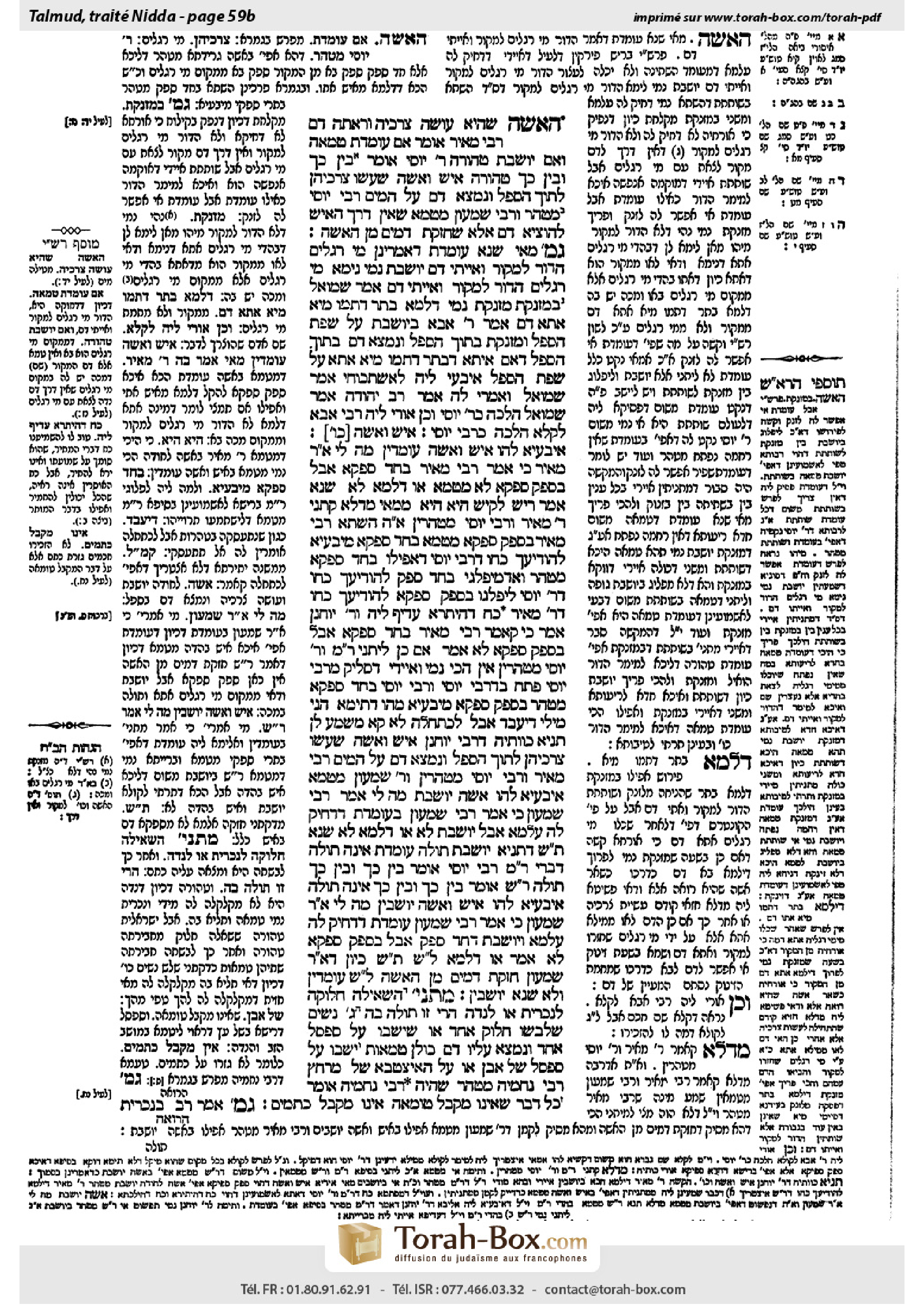
Niddah 59b: Talmud study for Daf Yomi
Daf Yomi is the daily study of one Talmud folio. Explore 37 tractates with scans, Hebrew text, Sefaria English and AI-generated French translations where annotated.
Passage selection and English or AI-generated French translation are available where the scan has annotations. Daf Study is independent of Torah-Box and Sefaria.
Browse Niddah · נידה · All tractatesNiddah 59b text and translations
This page of Niddah includes the Aramaic text, an English translation and an AI-generated French translation, alongside the scan above.
נידה נ״ט ב · Aramaic and Hebrew text
מַתְנִי' הָאִשָּׁה שֶׁהִיא עוֹשָׂה צְרָכֶיהָ וְרָאֲתָה דָּם, רַבִּי מֵאִיר אוֹמֵר: אִם עוֹמֶדֶת — טְמֵאָה, וְאִם יוֹשֶׁבֶת — טְהוֹרָה. רַבִּי יוֹסֵי אוֹמֵר: בֵּין כָּךְ וּבֵין כָּךְ טְהוֹרָה.
אִישׁ וְאִשָּׁה שֶׁעָשׂוּ צׇרְכֵיהֶן לְתוֹךְ הַסֵּפֶל, וְנִמְצָא דָּם עַל הַמַּיִם — רַבִּי יוֹסֵי מְטַהֵר, וְרַבִּי שִׁמְעוֹן מְטַמֵּא, שֶׁאֵין דֶּרֶךְ הָאִישׁ לְהוֹצִיא דָּם, אֶלָּא שֶׁחֶזְקַת דָמִים מִן הָאִשָּׁה.
גְּמָ' מַאי שְׁנָא עוֹמֶדֶת, דְּאָמְרִינַן: מֵי רַגְלַיִם הֲדוּר לְמָקוֹר וְאַיְיתִי דָּם? יוֹשֶׁבֶת נָמֵי נֵימָא: מֵי רַגְלַיִם הֲדוּר לְמָקוֹר וְאַיְיתִי דָּם!
אָמַר שְׁמוּאֵל: בִּמְזַנֶּקֶת. מְזַנֶּקֶת נָמֵי, דִּלְמָא בָּתַר דְּתַמּוּ מַיָּא אֲתָא דָּם?
אָמַר רַבִּי אַבָּא: בְּיוֹשֶׁבֶת עַל שְׂפַת הַסֵּפֶל, וּמְזַנֶּקֶת בְּתוֹךְ הַסֵּפֶל, וְנִמְצָא דָּם בְּתוֹךְ הַסֵּפֶל, דְּאִם אִיתָא דְּבָתַר דְּתַמּוּ מַיָּא אֲתָא — עַל שְׂפַת הַסֵּפֶל אִיבְּעִי לֵיהּ לְאִשְׁתְּכוֹחֵי.
אָמַר שְׁמוּאֵל, וְאָמְרִי לַהּ אָמַר רַב יְהוּדָה אָמַר שְׁמוּאֵל: הֲלָכָה כְּרַבִּי יוֹסֵי, וְכֵן אוֹרִי לֵיהּ רַבִּי אַבָּא לְקָלָא הֲלָכָה כְּרַבִּי יוֹסֵי.
אִישׁ וְאִשָּׁה [וְכוּ׳]. אִיבַּעְיָא לְהוּ: אִישׁ וְאִשָּׁה עוֹמְדִין, מָה לִי אָמַר רַבִּי מֵאִיר?
כִּי אָמַר רַבִּי מֵאִיר בְּחַד סְפֵקָא, אֲבָל בִּסְפֵק סְפֵקָא לָא מְטַמֵּא, אוֹ דִלְמָא לָא שְׁנָא?
אָמַר רֵישׁ לָקִישׁ: הִיא הִיא. מִמַּאי? מִדְּלָא קָתָנֵי ״רַבִּי מֵאִיר וְרַבִּי יוֹסֵי מְטַהֲרִין״.
אִי הָכִי, הַשְׁתָּא רַבִּי מֵאִיר בִּסְפֵק סְפֵקָא מְטַמֵּא, בְּחַד סְפֵקָא מִיבַּעְיָא? לְהוֹדִיעֲךָ כֹּחוֹ דְּרַבִּי יוֹסֵי, דַּאֲפִילּוּ בְּחַד סְפֵקָא מְטַהֵר.
וְאַדְּמִיפַּלְגִי בְּחַד סָפֵק, לְהוֹדִיעֲךָ כֹּחוֹ דְּרַבִּי יוֹסֵי, לִיפְלְגוּ בִּסְפֵק סְפֵקָא, לְהוֹדִיעֲךָ כֹּחוֹ דְּרַבִּי מֵאִיר! כֹּחַ דְּהֶיתֵּרָא עֲדִיף לֵיהּ.
וְרַבִּי יוֹחָנָן אָמַר: כִּי קָאָמַר רַבִּי מֵאִיר בְּחַד סְפֵקָא, אֲבָל בִּסְפֵק סְפֵקָא לָא אָמַר. אִם כֵּן, לִיתְנֵי ״רַבִּי מֵאִיר וְרַבִּי יוֹסֵי מְטַהֲרִין״! אִין הָכִי נָמֵי, וְאַיְּידֵי דְּסָלֵיק מֵרַבִּי יוֹסֵי — פָּתַח בִּדְרַבִּי יוֹסֵי.
וְרַבִּי יוֹסֵי בְּחַד סְפֵקָא מְטַהֵר, בִּסְפֵק סְפֵקָא מִיבַּעְיָא? מַהוּ דְּתֵימָא: הָנֵי מִילֵּי דִּיעֲבַד, אֲבָל לְכַתְּחִלָּה לָא, קָא מַשְׁמַע לַן.
תַּנְיָא כְּוָותֵיהּ דְּרַבִּי יוֹחָנָן: אִישׁ וְאִשָּׁה שֶׁעָשׂוּ צׇרְכֵיהֶן לְתוֹךְ הַסֵּפֶל, וְנִמְצָא דָּם עַל הַמַּיִם — רַבִּי מֵאִיר וְרַבִּי יוֹסֵי מְטַהֲרִין, וְרַבִּי שִׁמְעוֹן מְטַמֵּא.
אִיבַּעְיָא לְהוּ: אִשָּׁה יוֹשֶׁבֶת, מָה לִי אָמַר רַבִּי שִׁמְעוֹן? כִּי אָמַר רַבִּי שִׁמְעוֹן בְּעוֹמֶדֶת, דִּדְחִיק לַהּ עָלְמָא, אֲבָל יוֹשֶׁבֶת — לָא, אוֹ דִּלְמָא לָא שְׁנָא?
תָּא שְׁמַע, דְּתַנְיָא: יוֹשֶׁבֶת — תּוֹלָה, עוֹמֶדֶת — אֵינָהּ תּוֹלָה, דִּבְרֵי רַבִּי מֵאִיר. רַבִּי יוֹסֵי אוֹמֵר: בֵּין כָּךְ וּבֵין כָּךְ — תּוֹלָה. רַבִּי שִׁמְעוֹן אוֹמֵר: בֵּין כָּךְ וּבֵין כָּךְ — אֵינָהּ תּוֹלָה.
אִיבַּעְיָא לְהוּ: אִישׁ וְאִשָּׁה יוֹשְׁבִין, מָה לִי אָמַר רַבִּי שִׁמְעוֹן? כִּי אָמַר רַבִּי שִׁמְעוֹן — עוֹמֶדֶת דִּדְחִיק לַהּ עָלְמָא, וְיוֹשֶׁבֶת דְּחַד סָפֵק, אֲבָל בִּסְפֵק סְפֵקָא — לָא אָמַר, אוֹ דִלְמָא לָא שְׁנָא?
תָּא שְׁמַע: כֵּיוָן דְּאָמַר רַבִּי שִׁמְעוֹן ״חֶזְקַת דָּמִים מִן הָאִשָּׁה״ — לָא שְׁנָא עוֹמְדִין וְלָא שְׁנָא יוֹשְׁבִין.
מַתְנִי' הִשְׁאִילָה חֲלוּקָהּ לְנׇכְרִית אוֹ לְנִדָּה — הֲרֵי זוֹ תּוֹלָה בָּהּ.
שָׁלֹשׁ נָשִׁים שֶׁלָּבְשׁוּ חָלוּק אֶחָד, אוֹ שֶׁיָּשְׁבוּ עַל סַפְסָל אֶחָד, וְנִמְצָא עָלָיו דָּם — כּוּלָּן טְמֵאוֹת.
יָשְׁבוּ עַל סַפְסָל שֶׁל אֶבֶן אוֹ עַל הָאִיצְטְבָא שֶׁל מֶרְחָץ — רַבִּי נְחֶמְיָה מְטַהֵר. שֶׁהָיָה רַבִּי נְחֶמְיָה אוֹמֵר: כׇּל דָּבָר שֶׁאֵינוֹ מְקַבֵּל טוּמְאָה — אֵינוֹ מְקַבֵּל כְּתָמִים.
גְּמָ' אָמַר רַב: בְּנׇכְרִית
Niddah 59b · English translation
MISHNA: In the case of a woman who is urinating and saw blood intermingled with the urine, Rabbi Meir says: If she urinated while standing she is ritually impure, as the blood could have originated in the uterus. And if she is sitting, she is ritually pure, as it is clear that the blood is from a wound. Rabbi Yosei says: Whether she urinates in this manner, i.e., standing, or whether she urinates in that manner, i.e., sitting, she is ritually pure.
In the case of a man and a woman who urinated into a basin [hasefel], and blood is found on the water in the basin, Rabbi Yosei deems her ritually pure. Even when it is clear that it is the blood of a woman who urinated, and there is only one uncertainty, Rabbi Yosei deems her ritually pure. In this case, there is a compound uncertainty: Did the blood originate with the man or with the woman, and did the blood come from the uterus or from a wound? And Rabbi Shimon deems her ritually impure, because there is only one uncertainty, as it is not the typical manner of the man to discharge blood with his urine; rather, the presumptive status of the blood is that it was discharged from the woman.
GEMARA: The mishna teaches that in a case where a woman finds blood in her urine Rabbi Meir distinguishes between a case where she is standing and a case where she is sitting. The Gemara asks: What is different about a situation where she is standing? The difference is that we say that while she was urinating the urine returned to the uterus and brought blood from there, which renders her impure. But if so, when she is sitting as well, let us say that the urine returns to the uterus and brings blood. Why does Rabbi Meir deem her ritually pure in that case?
Shmuel says, in answer to this question: This mishna is referring specifically to a case where the urine flows in a steady stream, without the woman straining. In such a situation, when she is sitting and the urine flows in a steady stream, the stream of urine does not return to the uterus and bring blood. By contrast, if she is standing the urine does not flow in a steady stream, and she must strain to urinate. When she strains to urinate, the urine can bring blood from the uterus with it, whether she is standing or sitting. The Gemara objects: But in a case where she is sitting as well, when the urine flows in a steady stream, perhaps after the urine has finished, blood will come naturally from the uterus, and the flow of blood will mix with the urine?
Rabbi Abba says: This is no concern, as the mishna is referring to a case where she is sitting on the edge of the basin and urinates in a steady flow into the basin, and the blood is found only inside the basin. As, if it is so that after the stream of urine finished the blood came naturally from her uterus, the blood should have been found on the edge of the basin. Since the blood is found only inside the basin it is clear that it came with the urine, not separately.
Shmuel said, and some say that Rav Yehuda said that Shmuel said: The halakha is in accordance with the opinion of Rabbi Yosei. And similarly, Rabbi Abba ruled for a Sage called Kala, who inquired into this matter, that the halakha is in accordance with the opinion of Rabbi Yosei.
§ The mishna teaches: In the case of a man and a woman who urinated into a basin, and blood is found on the water in the basin, Rabbi Yosei deems her ritually pure. A dilemma was raised before the Sages: In a case where a man and a woman were standing and they urinated into the same basin, and blood was found in the basin, what would Rabbi Meir, who distinguishes between a woman who was sitting and a woman who was standing, say the halakha is?
The Gemara clarifies the dilemma: When Rabbi Meir said that a woman who sees blood in her urine while standing is impure, does this apply when there is only one uncertainty, i.e., whether the blood came from a wound or from the uterus? Whereas in a case of a compound uncertainty, i.e., whether the blood came from the man or from the woman, and even if it came from the woman, whether it came from a wound or from her uterus, perhaps Rabbi Meir does not deem her impure? Or perhaps there is no difference between the two cases according to Rabbi Meir.
Reish Lakish said: Rabbi Meir would rule in this case of a compound uncertainty exactly as he rules in that case of a single uncertainty, i.e., there is no difference between the two cases. Reish Lakish clarifies: From where do I know that this is Rabbi Meir’s opinion? From the fact that the latter clause of the mishna does not teach: Rabbi Meir and Rabbi Yosei deem her pure. Instead, the mishna states merely that Rabbi Yosei deems her pure. This indicates that Rabbi Meir deems her impure even if a man and a woman both urinated into the same basin where the blood was found.
The Gemara raises a difficulty with regard to Reish Lakish’s opinion: If so, i.e., if according to Rabbi Meir a woman is impure even when a man also urinates into the same basin, now that Rabbi Meir deems her impure in a case of compound uncertainty, is it necessary for the mishna to teach his opinion in a case of one uncertainty? The Gemara answers: The mishna formulated the halakha in that manner to convey the far-reaching nature of the opinion of Rabbi Yosei, i.e., that he deems her pure even in a case of one uncertainty.
The Gemara asks: But if so, rather than stating the dispute in a case of one uncertainty, which serves to convey the far-reaching nature of the opinion of Rabbi Yosei, let the tanna teach the dispute in a case of compound uncertainty, in order to convey the far-reaching nature of the opinion of Rabbi Meir. The Gemara answers: It is preferable for the tanna to teach the strength of a lenient ruling. If a tanna can formulate a dispute in a manner that emphasizes the extent of the more lenient opinion, he will do so.
And Rabbi Yoḥanan disagreed with Reish Lakish, and said: When Rabbi Meir says that the woman is impure, that applies only to a case of one uncertainty, but in a case of compound uncertainty Rabbi Meir did not say that she is impure. The Gemara raises a difficulty with regard to Rabbi Yoḥanan’s opinion: If so, i.e., if Rabbi Meir deems her pure when both a man and a woman urinate into the same basin, let the mishna teach: Rabbi Meir and Rabbi Yosei deem her pure. Why does the tanna mention only Rabbi Yosei? The Gemara answers: Yes, it is indeed so, that Rabbi Meir agrees with this ruling, but since the mishna left off with the opinion of Rabbi Yosei at the end of the first clause of the mishna, the tanna opened the latter clause with the opinion of Rabbi Yosei as well.
The Gemara asks: But as Rabbi Yosei deems her pure in a case of one uncertainty, is it necessary for the mishna to teach his opinion a case of a compound uncertainty? The Gemara answers: It is necessary for the tanna to state that Rabbi Yosei deems her pure in a case of compound uncertainty, lest you say that this statement, that Rabbi Yosei deems her pure, applies only after the fact, if the woman has already touched pure items, but he does not deem her pure ab initio. Therefore, the tanna teaches us that Rabbi Yosei deems her pure even ab initio.
It is taught in a baraita in accordance with the opinion of Rabbi Yoḥanan: In the case of a man and a woman who urinated into a basin, and blood is found on the water in the basin, Rabbi Meir and Rabbi Yosei deem her ritually pure, and Rabbi Shimon deems her ritually impure, as there is only one uncertainty.
§ The mishna teaches that Rabbi Shimon deems her ritually impure because there is only one uncertainty, as it is not the typical manner of the man to discharge blood with his urine. A dilemma was raised before the Sages: In a case where a woman was sitting and she urinated into a basin, and blood was found in the basin, what would Rabbi Shimon say? The Gemara explains the dilemma: When Rabbi Shimon stated his opinion, was he referring specifically to a woman who is standing, who in general must strain to urinate in such a position, and perhaps as a result the blood came from the uterus? Whereas if she is sitting without straining, in which case Rabbi Meir deems her pure, perhaps Rabbi Shimon agrees that she is not impure. Or perhaps there is no difference between the two cases according to the opinion of Rabbi Shimon.
The Gemara answers: Come and hear, as it is taught in a baraita: If a woman urinates while sitting and blood is found in the basin, she can attribute the blood to a wound and she is pure, but if she is standing she cannot attribute the blood to a wound, and therefore she is impure; this is the statement of Rabbi Meir. Rabbi Yosei said: Both in this case and in that case she can attribute the blood to a wound and she is pure. Rabbi Shimon said: Both in this case and in that case she cannot attribute the blood to a wound, and she is impure.
Another dilemma was raised before the Sages with regard to the opinion of Rabbi Shimon: In a case where a man and a woman were sitting and urinated into the same basin, and blood was found in the basin, what would Rabbi Shimon say? The Gemara clarifies the dilemma: When Rabbi Shimon stated his opinion, was he referring to a woman who is standing, who in general must strain to urinate in such a position and perhaps as a result the blood came from the uterus, or to a case where she alone is sitting, which are cases of only one uncertainty? Whereas in a case of compound uncertainty, i.e., uncertainty whether the blood came from the man or from the woman, and even if it did come from the woman, whether it was from a wound or from her uterus, perhaps he does not say that she is impure. Or perhaps there is no difference between the cases, as it is entirely atypical for a man to discharge blood.
The Gemara answers: Come and hear the mishna: Since Rabbi Shimon said that the presumptive status of the blood is that it was discharged from the woman, evidently there is no difference in his opinion whether she was standing or whether she was sitting.
MISHNA: In a case where a woman lent her garment to a gentile woman or to a menstruating Jewish woman, and after the borrower returned the garment the owner wore it and then discovered a blood stain, she attributes the blood stain to the gentile or the menstruating woman.
In a case of three women who wore one garment or who sat on one bench [safsal], one after the other, and the garment, or bench, was examined before the first of them donned it, or sat on it, and it was clean, and after the third one removed the garment, or stood up, a blood stain was discovered on the garment or on the bench, all the women are ritually impure.
If they sat on a stone bench or on the bench [ha’itzteva] of a bathhouse, neither of which can become ritually impure, the first because it is stone and the second because it is attached to the floor of the bathhouse, and a blood stain was found on one of those benches, Rabbi Neḥemya deems all three women ritually pure, as Rabbi Neḥemya would say: Any item that is not susceptible to ritual impurity is not susceptible to ritual impurity due to blood stains. The decree of impurity due to blood stains was limited to items susceptible to ritual impurity.
GEMARA: Rav says: The ruling of the mishna is stated with regard to a gentile woman
Niddah 59b · Traduction française (IA)
MICHNA : Dans le cas d’une femme qui urine et voit du sang mêlé à son urine, Rabbi Meïr dit : Si elle a uriné debout, elle est rituellement impure, car le sang a pu provenir de l’utérus. Si elle était assise, elle est rituellement pure, car il est clair que le sang provient d’une blessure. Rabbi Yossi dit : Qu’elle urine de cette manière, c’est-à-dire debout, ou de cette autre manière, c’est-à-dire assise, elle est rituellement pure.
Dans le cas d’un homme et d’une femme qui ont uriné dans un bassin [hasefel], et où l’on trouve du sang à la surface de l’eau, Rabbi Yossi la considère comme rituellement pure. Même lorsqu’il est certain qu’il s’agit du sang d’une femme qui a uriné, et qu’il n’y a donc qu’une seule incertitude, Rabbi Yossi la considère comme rituellement pure. Dans ce cas, il y a une incertitude composée : le sang provient-il de l’homme ou de la femme, et provient-il de l’utérus ou d’une blessure ? Rabbi Shimon la considère comme rituellement impure, car il n’y a qu’une seule incertitude : il n’est pas habituel qu’un homme évacue du sang avec son urine ; le sang est donc présumé provenir de la femme.
GUEMARA : La Michna enseigne que, lorsqu’une femme trouve du sang dans son urine, Rabbi Meïr distingue le cas où elle est debout de celui où elle est assise. La Guemara demande : Qu’est-ce qui distingue le cas où elle est debout ? On dit que, pendant qu’elle urinait, l’urine est remontée dans l’utérus et en a entraîné du sang, ce qui la rend impure. Mais alors, lorsqu’elle est assise aussi, ne devrait-on pas dire que l’urine remonte dans l’utérus et entraîne du sang ? Pourquoi Rabbi Meïr la considère-t-il comme rituellement pure dans ce cas ?
Shmuel répond à cette question : Cette Michna concerne précisément le cas où l’urine s’écoule en un jet régulier, sans que la femme ait à pousser. Dans une telle situation, lorsqu’elle est assise et que l’urine s’écoule en un jet régulier, le jet d’urine ne remonte pas dans l’utérus pour en entraîner du sang. En revanche, si elle est debout, l’urine ne s’écoule pas en un jet régulier et elle doit pousser pour uriner. Lorsqu’elle pousse, l’urine peut entraîner avec elle du sang provenant de l’utérus, qu’elle soit debout ou assise. La Guemara objecte : Mais lorsqu’elle est assise aussi et que l’urine s’écoule en un jet régulier, peut-être qu’après l’écoulement de l’urine, du sang sort naturellement de l’utérus et que ce sang se mêle à l’urine ?
Rabbi Abba dit : Il n’y a pas lieu de s’en inquiéter, car la Michna parle d’un cas où elle est assise sur le bord du bassin et urine en un jet régulier dans le bassin, et où le sang n’est trouvé qu’à l’intérieur du bassin. En effet, si le sang était sorti naturellement de son utérus après la fin du jet d’urine, il aurait dû être trouvé sur le bord du bassin. Puisque le sang n’est trouvé qu’à l’intérieur du bassin, il est clair qu’il est sorti avec l’urine et non séparément.
Shmuel a dit — et certains disent que Rav Yehouda a dit au nom de Shmuel — : La halakha est conforme à l’opinion de Rabbi Yossi. De même, Rabbi Abba a statué ainsi pour un Sage appelé Kala, qui l’avait interrogé sur cette question : la halakha est conforme à l’opinion de Rabbi Yossi.
§ La Michna enseigne : Dans le cas d’un homme et d’une femme qui ont uriné dans un bassin, et où l’on trouve du sang à la surface de l’eau, Rabbi Yossi la considère comme rituellement pure. Les Sages ont soulevé un dilemme : Dans le cas où un homme et une femme étaient debout et ont uriné dans le même bassin, et où l’on a trouvé du sang dans le bassin, quelle halakha Rabbi Meïr, qui distingue entre une femme assise et une femme debout, établirait-il ?
La Guemara précise le dilemme : Lorsque Rabbi Meïr dit qu’une femme qui voit du sang dans son urine alors qu’elle est debout est impure, cela s’applique-t-il lorsqu’il n’y a qu’une seule incertitude, à savoir si le sang provient d’une blessure ou de l’utérus ? Mais, dans un cas d’incertitude composée — à savoir si le sang provient de l’homme ou de la femme et, s’il provient de la femme, s’il vient d’une blessure ou de son utérus — peut-être Rabbi Meïr ne la considère-t-il pas comme impure ? Ou peut-être, selon Rabbi Meïr, n’y a-t-il aucune différence entre les deux cas ?
Reish Lakish dit : Dans ce cas d’incertitude composée, Rabbi Meïr statuerait exactement comme dans le cas d’incertitude simple, c’est-à-dire qu’il n’y a aucune différence entre les deux cas. Reish Lakish précise : D’où sais-je que telle est l’opinion de Rabbi Meïr ? Du fait que la dernière partie de la Michna n’enseigne pas : « Rabbi Meïr et Rabbi Yossi la considèrent comme pure. » Au lieu de cela, la Michna indique seulement que Rabbi Yossi la considère comme pure. Cela montre que Rabbi Meïr la considère comme impure même si un homme et une femme ont tous deux uriné dans le même bassin où l’on a trouvé le sang.
La Guemara soulève une difficulté concernant l’opinion de Reish Lakish : Si c’est ainsi, c’est-à-dire si, selon Rabbi Meïr, une femme est impure même lorsqu’un homme urine aussi dans le même bassin, puisque Rabbi Meïr la considère comme impure dans un cas d’incertitude composée, était-il nécessaire que la Michna enseigne son opinion dans un cas d’incertitude simple ? La Guemara répond : La Michna a formulé la halakha de cette manière afin de faire ressortir l’étendue de l’opinion de Rabbi Yossi, à savoir qu’il la considère comme pure même dans un cas d’incertitude simple.
La Guemara demande : Mais dans ce cas, au lieu d’énoncer le désaccord dans un cas d’incertitude simple, ce qui fait ressortir l’étendue de l’opinion de Rabbi Yossi, que le tanna l’enseigne dans un cas d’incertitude composée, afin de faire ressortir l’étendue de l’opinion de Rabbi Meïr. La Guemara répond : Il est préférable que le tanna enseigne la portée d’une décision indulgente. Si un tanna peut formuler un désaccord de manière à souligner l’étendue de l’opinion la plus indulgente, il le fera.
Rabbi Yoḥanan n’était pas d’accord avec Reish Lakish et dit : Lorsque Rabbi Meïr affirme que la femme est impure, cela ne s’applique qu’à un cas d’incertitude simple ; dans un cas d’incertitude composée, Rabbi Meïr n’a pas dit qu’elle était impure. La Guemara soulève une difficulté concernant l’opinion de Rabbi Yoḥanan : Si c’est ainsi, c’est-à-dire si Rabbi Meïr la considère comme pure lorsqu’un homme et une femme urinent dans le même bassin, que la Michna enseigne : « Rabbi Meïr et Rabbi Yossi la considèrent comme pure. » Pourquoi le tanna ne mentionne-t-il que Rabbi Yossi ? La Guemara répond : Oui, c’est bien ainsi, Rabbi Meïr est d’accord avec cette décision ; mais comme la première partie de la Michna se terminait par l’opinion de Rabbi Yossi, le tanna a également commencé la dernière partie par l’opinion de Rabbi Yossi.
La Guemara demande : Mais puisque Rabbi Yossi la considère comme pure dans un cas d’incertitude simple, est-il nécessaire que la Michna enseigne son opinion dans un cas d’incertitude composée ? La Guemara répond : Il est nécessaire que le tanna précise que Rabbi Yossi la considère comme pure dans un cas d’incertitude composée, de peur que tu ne dises que cette affirmation — Rabbi Yossi la considère comme pure — ne s’applique qu’après coup, si la femme a déjà touché des objets purs, mais qu’il ne la considère pas comme pure a priori. Le tanna nous enseigne donc que Rabbi Yossi la considère comme pure même a priori.
Il est enseigné dans une baraïta conformément à l’opinion de Rabbi Yoḥanan : Dans le cas d’un homme et d’une femme qui ont uriné dans un bassin, et où l’on trouve du sang à la surface de l’eau, Rabbi Meïr et Rabbi Yossi la considèrent comme rituellement pure, tandis que Rabbi Shimon la considère comme rituellement impure, car il n’y a qu’une seule incertitude.
§ La Michna enseigne que Rabbi Shimon la considère comme rituellement impure, car il n’y a qu’une seule incertitude : il n’est pas habituel qu’un homme évacue du sang avec son urine. Les Sages ont soulevé un dilemme : Dans le cas où une femme était assise et a uriné dans un bassin, et où l’on a trouvé du sang dans le bassin, que dirait Rabbi Shimon ? La Guemara explique le dilemme : Lorsque Rabbi Shimon a exprimé son opinion, parlait-il précisément d’une femme debout, qui doit généralement pousser pour uriner dans cette position, et peut-être le sang provenait-il par conséquent de l’utérus ? Mais si elle est assise sans pousser — cas où Rabbi Meïr la considère comme pure — peut-être Rabbi Shimon convient-il qu’elle n’est pas impure. Ou peut-être, selon l’opinion de Rabbi Shimon, n’y a-t-il aucune différence entre les deux cas ?
La Guemara répond : Viens et écoute, car il est enseigné dans une baraïta : Si une femme urine assise et que l’on trouve du sang dans le bassin, elle peut attribuer le sang à une blessure et elle est pure ; mais si elle est debout, elle ne peut pas attribuer le sang à une blessure et elle est donc impure. Telle est l’opinion de Rabbi Meïr. Rabbi Yossi dit : Dans ce cas comme dans l’autre, elle peut attribuer le sang à une blessure et elle est pure. Rabbi Shimon dit : Dans ce cas comme dans l’autre, elle ne peut pas attribuer le sang à une blessure et elle est impure.
Les Sages ont soulevé un autre dilemme concernant l’opinion de Rabbi Shimon : Dans le cas où un homme et une femme étaient assis et ont uriné dans le même bassin, et où l’on a trouvé du sang dans le bassin, que dirait Rabbi Shimon ? La Guemara précise le dilemme : Lorsque Rabbi Shimon a exprimé son opinion, parlait-il d’une femme debout, qui doit généralement pousser pour uriner dans cette position et dont le sang provenait peut-être par conséquent de l’utérus, ou d’un cas où elle seule est assise, cas où il n’y a qu’une seule incertitude ? Mais, dans un cas d’incertitude composée — à savoir si le sang provient de l’homme ou de la femme et, s’il provient de la femme, s’il vient d’une blessure ou de son utérus — peut-être ne dit-il pas qu’elle est impure. Ou peut-être n’y a-t-il aucune différence entre les cas, puisqu’il est tout à fait inhabituel qu’un homme évacue du sang ?
La Guemara répond : Viens et écoute la Michna : Puisque Rabbi Shimon a dit que le sang est présumé avoir été évacué par la femme, il est évident que, selon son opinion, il n’y a aucune différence entre le fait qu’elle ait été debout ou assise.
MICHNA : Dans le cas où une femme a prêté son vêtement à une femme non juive ou à une femme juive en période de menstruation, et où, après que l’emprunteuse le lui a rendu, la propriétaire l’a porté puis y a découvert une tache de sang, elle attribue cette tache à la femme non juive ou à la femme en période de menstruation.
Dans le cas de trois femmes qui ont porté le même vêtement ou se sont assises sur le même banc [safsal], l’une après l’autre, et où le vêtement ou le banc a été examiné avant que la première le porte ou s’y assoie et a été trouvé propre, puis où une tache de sang a été découverte sur le vêtement ou le banc après que la troisième l’a enlevé ou s’est levée, toutes les femmes sont rituellement impures.
Si elles se sont assises sur un banc de pierre ou sur le banc [ha’itzteva] d’un bain public — ni l’un ni l’autre ne pouvant devenir rituellement impur, le premier parce qu’il est en pierre et le second parce qu’il est fixé au sol du bain public — et qu’une tache de sang a été trouvée sur l’un de ces bancs, Rabbi Neḥemya considère les trois femmes comme rituellement pures. En effet, Rabbi Neḥemya disait : Tout objet qui n’est pas susceptible de contracter l’impureté rituelle ne l’est pas non plus du fait de taches de sang. Le décret d’impureté due aux taches de sang était limité aux objets susceptibles de contracter l’impureté rituelle.
GUEMARA : Rav dit : La décision de la Michna concerne une femme non juive.
Traduction française générée par IA à partir de l’édition anglaise de Sefaria. Vérifie toujours un passage avec le texte source.
Text from Sefaria: William Davidson Edition - Vocalized Aramaic (CC BY NC); William Davidson Edition - English (CC BY NC).