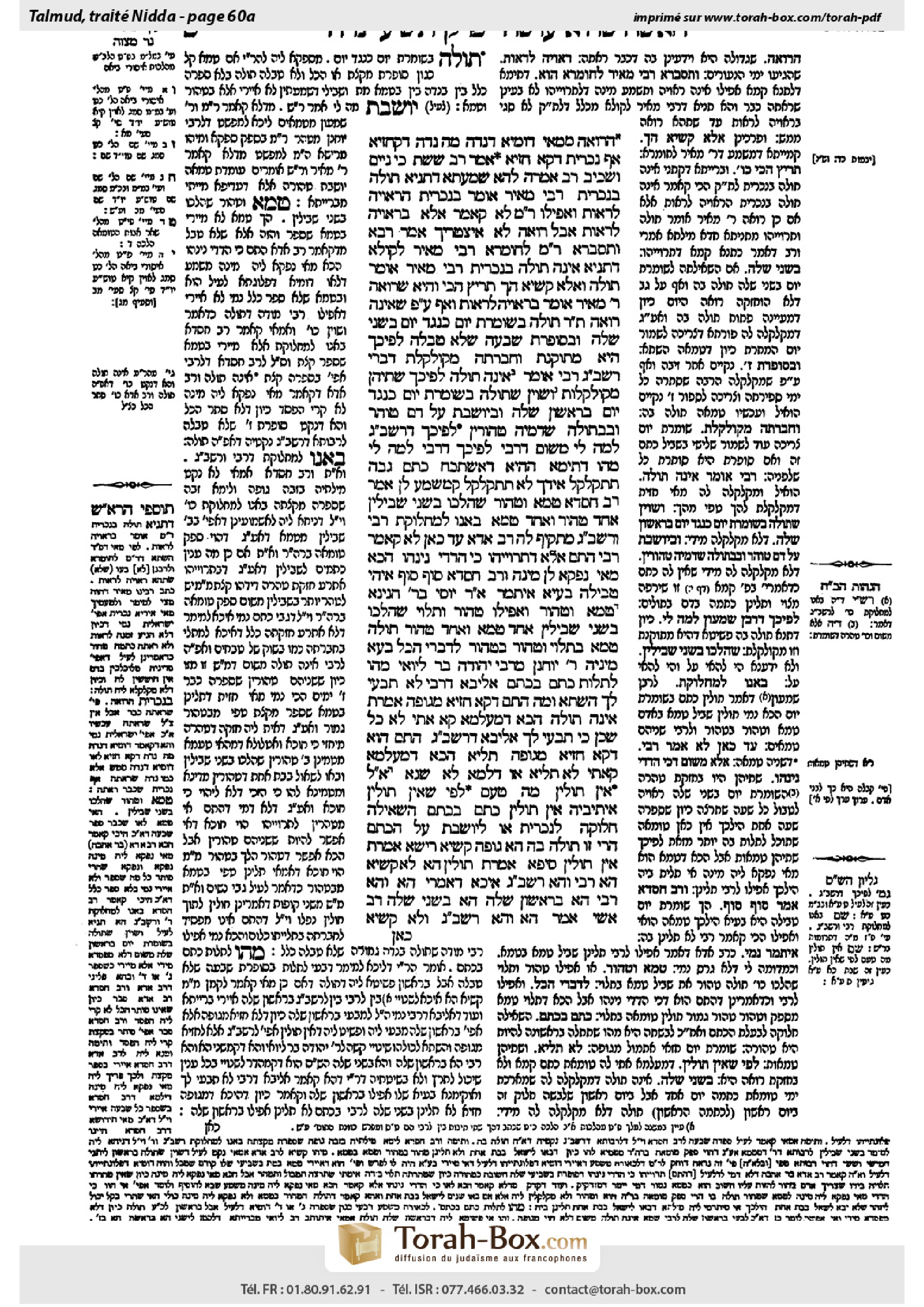
Niddah 60a: Talmud study for Daf Yomi
Daf Yomi is the daily study of one Talmud folio. Explore 37 tractates with scans, Hebrew text, Sefaria English and AI-generated French translations where annotated.
Passage selection and English or AI-generated French translation are available where the scan has annotations. Daf Study is independent of Torah-Box and Sefaria.
Browse Niddah · נידה · All tractatesNiddah 60a text and translations
This page of Niddah includes the Aramaic text, an English translation and an AI-generated French translation, alongside the scan above.
נידה ס׳ א · Aramaic and Hebrew text
הָרוֹאָה.
מִמַּאי? דּוּמְיָא דְּנִדָּה: מָה נִדָּה דְּקָחָזְיָא, אַף נׇכְרִית דְּקָא חָזְיָא.
אָמַר רַב שֵׁשֶׁת: כִּי נָיֵים וְשָׁכֵיב רַב אַמְרַהּ לְהָא שְׁמַעְתָּא. דְּתַנְיָא: תּוֹלָה בְּנׇכְרִית. רַבִּי מֵאִיר אוֹמֵר: בְּנׇכְרִית הָרְאוּיָה לִרְאוֹת. וַאֲפִילּוּ רַבִּי מֵאִיר לָא קָאָמַר אֶלָּא בִּרְאוּיָה לִרְאוֹת, אֲבָל רוֹאָה — לָא אִיצְטְרִיךְ.
אָמַר רָבָא: וְתִסְבְּרַאּ רַבִּי מֵאִיר לְחוּמְרָא? רַבִּי מֵאִיר לְקוּלָּא!
דְּתַנְיָא: אֵינָהּ תּוֹלָה בְּנׇכְרִית, רַבִּי מֵאִיר אוֹמֵר: תּוֹלָה. וְאֶלָּא קַשְׁיָא הָךְ! תָּרֵיץ הָכִי: וְהִיא שֶׁרוֹאָה. רַבִּי מֵאִיר אוֹמֵר: בִּרְאוּיָה לִרְאוֹת, וְאַף עַל פִּי שֶׁאֵינָהּ רוֹאָה.
תָּנוּ רַבָּנַן: תּוֹלָה בְּשׁוֹמֶרֶת יוֹם כְּנֶגֶד יוֹם, בַּשֵּׁנִי שֶׁלָּהּ.
וּבְסוֹפֶרֶת שִׁבְעָה שֶׁלֹּא טָבְלָה, לְפִיכָךְ הִיא מְתוּקֶּנֶת וַחֲבֶרְתָּהּ מְקוּלְקֶלֶת, דִּבְרֵי רַבָּן שִׁמְעוֹן בֶּן גַּמְלִיאֵל. רַבִּי אוֹמֵר: אֵינָהּ תּוֹלָה, לְפִיכָךְ שְׁתֵּיהֶן מְקוּלְקָלוֹת.
וְשָׁוִין, שֶׁתּוֹלָה בְּשׁוֹמֶרֶת יוֹם כְּנֶגֶד יוֹם, בָּרִאשׁוֹן שֶׁלָּהּ.
וּבְיוֹשֶׁבֶת עַל דַּם טוֹהַר, וּבִבְתוּלָה שֶׁדָּמֶיהָ טְהוֹרִין.
״לְפִיכָךְ״ דְּרַבָּן שִׁמְעוֹן בֶּן גַּמְלִיאֵל — לְמָה לִי? מִשּׁוּם דְּרַבִּי.
״לְפִיכָךְ״ דְּרַבִּי — לְמָה לִי? מַהוּ דְּתֵימָא: הָהִיא דְּאִשְׁתְּכַח כֶּתֶם גַּבַּהּ — תִּתְקַלְקַל, אִידַּךְ — לֹא תִּתְקַלְקַל; קָמַשְׁמַע לַן.
אָמַר רַב חִסְדָּא: טָמֵא וְטָהוֹר שֶׁהָלְכוּ בִּשְׁנֵי שְׁבִילִין, אֶחָד טָהוֹר וְאֶחָד טָמֵא — בָּאנוּ לְמַחְלוֹקֶת רַבִּי וְרַבָּן שִׁמְעוֹן בֶּן גַּמְלִיאֵל.
מַתְקֵיף לַהּ רַב אַדָּא: עַד כָּאן לָא קָאָמַר רַבִּי הָתָם, אֶלָּא דְּתַרְוַיְיהוּ כִּי הֲדָדֵי נִינְהוּ, הָכָא מַאי נָפְקָא לַן מִינַּהּ?
וְרַב חִסְדָּא, סוֹף סוֹף אִיהִי טְבִילָה בָּעֲיָא.
אִיתְּמַר, אָמַר רַבִּי יוֹסֵי בְּרַבִּי חֲנִינָא: טָמֵא וְטָהוֹר, וַאֲפִילּוּ טָהוֹר וְתָלוּי, שֶׁהָלְכוּ בִּשְׁנֵי שְׁבִילִין, אֶחָד טָמֵא וְאֶחָד טָהוֹר — תּוֹלֶה טָמֵא בְּתָלוּי וְטָהוֹר בְּטָהוֹר, לְדִבְרֵי הַכֹּל.
בְּעָא מִינֵּיהּ רַבִּי יוֹחָנָן מֵרַבִּי יְהוּדָה בַּר לֵיוַאי: מַהוּ לִתְלוֹת כֶּתֶם בְּכֶתֶם? אַלִּיבָּא דְּרַבִּי — לָא תִּבְּעֵי לָךְ.
הַשְׁתָּא, וּמָה הָתָם דְּקָא חָזְיָא מִגּוּפַהּ, אָמְרַתְּ אֵינָהּ תּוֹלָה, הָכָא דְּמֵעָלְמָא קָא אָתֵי — לֹא כׇּל שֶׁכֵּן?
כִּי תִּבְּעֵי לָךְ אַלִּיבָּא דְּרַבָּן שִׁמְעוֹן בֶּן גַּמְלִיאֵל, הָתָם הוּא דְּקָא חָזְיָא מִגּוּפַהּ — תָּלְיָא, הָכָא דְּמֵעָלְמָא קָאָתֵי — לָא תָּלְיָא, אוֹ דִלְמָא לָא שְׁנָא.
אֲמַר לֵיהּ: אֵין תּוֹלִין. מָה טַעַם? לְפִי שֶׁאֵין תּוֹלִין.
אֵיתִיבֵיהּ: אֵין תּוֹלִין כֶּתֶם בְּכֶתֶם, הִשְׁאִילָה חֲלוּקָהּ לְנׇכְרִית אוֹ לְיוֹשֶׁבֶת עַל הַכֶּתֶם — הֲרֵי זוֹ תּוֹלָה בָּהּ.
הָא גּוּפַהּ קַשְׁיָא: רֵישָׁא אָמְרַתְּ אֵין תּוֹלִין, סֵיפָא אָמְרַתְּ תּוֹלִין! הָא לָא קַשְׁיָא — הָא רַבִּי, וְהָא רַבָּן שִׁמְעוֹן בֶּן גַּמְלִיאֵל.
אִיכָּא דְאָמְרִי: הָא וְהָא רַבִּי — הָא בָּרִאשׁוֹן שֶׁלָּהּ, הָא בַּשֵּׁנִי שֶׁלָּהּ.
רַב אָשֵׁי אָמַר: הָא וְהָא רַבָּן שִׁמְעוֹן בֶּן גַּמְלִיאֵל — וְלָא קַשְׁיָא,
Niddah 60a · English translation
who is of age and already seeing a flow of menstrual blood, i.e., she has had a flow of menstrual blood.
The Gemara explains: From where does Rav know that this is referring to a gentile woman who once experienced a flow of blood? He infers from the mishna that the gentile woman it mentions is similar to a menstruating woman: Just as a menstruating woman is one who sees, i.e., who has already experienced bleeding, so too, the mishna is referring to an adult gentile woman who already sees menstrual blood.
Rav Sheshet says: I say that when Rav was dozing or sleeping he said that halakha, i.e., it is an error. As it is taught in a baraita: If a woman loaned her garment to a gentile and subsequently found a blood stain on it, she attributes the stain to the gentile woman. This tanna deems it permitted for her to attribute the blood to any gentile woman, regardless of her age or her likelihood of bleeding. Rabbi Meir disagrees and says: This applies specifically to a gentile woman who is fit to see menstrual blood. And the Gemara adds that even Rabbi Meir says only that the gentile woman must be fit to see menstrual blood, but he too agrees that it is not necessary for her to be seeing blood at that time. She does not have to have actually experienced bleeding at some point.
Rava said in response to Rav Sheshet’s challenge: And how can you understand that Rabbi Meir is coming to be stringent? Rav Sheshet maintains that according to the first tanna of the baraita she can attribute the blood stain to any gentile, whereas Rabbi Meir rules stringently that she may attribute it only to a gentile who is fit to experience bleeding. This is incorrect, as Rabbi Meir is actually coming to be lenient. In other words, the first tanna is more stringent, as he deems it permitted for her to attribute the blood stain only to a gentile woman who had experienced a menstrual flow at least once. By contrast, Rabbi Meir rules that she may attribute the stain to a gentile woman who is old enough to experience bleeding, even if she has never experienced a menstrual flow.
The Gemara provides the reason for Rava’s opinion. As it is taught in a baraita: A woman who loaned her garment to a gentile woman and subsequently finds a blood stain on it may not attribute the stain to the gentile woman. Rabbi Meir says that she may attribute the blood stain to the gentile woman. But if so, the first baraita, which states that according to the first tanna she may attribute the blood stain to any gentile woman, is difficult. You must answer like this: According to the first tanna she may attribute the blood to any gentile woman provided that she sees, i.e., that she once experienced bleeding. By contrast, Rabbi Meir says a more lenient opinion, that she may attribute it to the gentile woman provided that she is fit to see menstrual blood, and this is the halakha even though she has not actually seen menstrual blood yet.
§ The Sages taught a baraita with regard to a woman who loaned her garment to another woman who was a lesser zava: The lender may attribute the blood stain on the loaned garment to a woman who observes a clean day for each day she experiences a discharge, if the blood is found on her second day, i.e., the day after she had a discharge, despite the fact that she does not have a presumptive status of seeing blood. It is nevertheless considered that her uterus is open and the likelihood is that she will experience bleeding.
And likewise, she may also attribute the blood stain if she loaned her garment to a woman counting seven clean days who did not immerse in a ritual bath, and who will now have to count another seven clean days. Therefore, the status of the one who loaned the garment is fixed, and the status of the other woman is ruined and she must begin her counting again; this is the statement of Rabban Shimon ben Gamliel. Rabbi Yehuda HaNasi says: She may not attribute the blood flow to either of these women. Therefore, the statuses of both the woman who loaned the garment and the one who borrowed it are ruined, in that both women are deemed impure.
The baraita continues: And both Rabban Shimon ben Gamliel and Rabbi Yehuda HaNasi agree that a woman who lends her garment may attribute any blood stain found on it to a woman who observes a day for a day if it is on her first day of the discharge. In this case the status of the woman who borrowed the garment is no more ruined than it was already, as either way she can become pure on the following day.
And they also agree in a case where the woman who borrowed the garment was a woman after childbirth who is observing the period of the blood of purity. During these days, attributing the blood to her does not ruin her status, as any blood she emits is pure and does not affect her status. And similarly, the lender may attribute the blood stain to a virgin who engages in intercourse for the first time, as her blood is pure, as there is an assumption that it is hymenal bleeding rather than menstrual blood.
The Gemara asks: Why do I need the clause starting with: Therefore, mentioned by Rabban Shimon ben Gamliel? It is obvious that the status of only one woman is ruined, so what information does this observation add? The Gemara answers that this clause does not add any new information; rather, the baraita taught it because of the use of the similar clause beginning with: Therefore, stated by Rabbi Yehuda HaNasi in the latter part of the baraita.
The Gemara persists: But why do I need the clause starting with: Therefore, in the statement of Rabbi Yehuda HaNasi? That too is apparently superfluous. The Gemara explains: It is necessary, lest you say that the status of the woman who has the blood stain found with her when she is wearing the garment, should be ruined, whereas the status of the other woman should not be ruined, as the garment was not with her when the blood stain was discovered. Therefore, the baraita teaches us the clause beginning with: Therefore, to stress that both women are impure.
§ With regard to the dispute between Rabban Shimon ben Gamliel and Rabbi Yehuda HaNasi, Rav Ḥisda says: In a case of two individuals, one of whom was ritually impure and the other of whom was pure, who walked on two paths, one of which was pure and the other one impure due to a corpse buried there, and neither remembers which path he took, and afterward they handled items of ritual purity, e.g., the portion of produce designated for the priest [teruma] or consecrated items, we have arrived at the dispute between Rabbi Yehuda HaNasi and Rabban Shimon ben Gamliel. According to Rabban Shimon ben Gamliel, if one of the two individuals was already impure it can be assumed that he was the one who walked along the ritually impure path, and the other individual remains pure. Rabbi Yehuda HaNasi claims that there is no assumption that the one who was pure retains that state, as it is equally possible that he walked along the ritually impure path.
Rav Adda objects to this suggestion of Rav Ḥisda, claiming that one cannot compare the two cases. It is possible that Rabbi Yehuda HaNasi states his halakha only there, with regard to a woman who observes a day for a day, as she can immerse in a ritual bath at any time, and therefore both women are like each other, i.e., both have a presumption of ritual purity. But here, in the case of the two individuals walking on two paths, what practical difference does it make to the one who was previously impure if he remains ritually impure? Since there is no change of status, Rabbi Yehuda HaNasi would agree in that case that it can be assumed that the individual who was previously impure was the one who walked on the impure path.
And the Gemara asks: How would Rav Ḥisda respond to this claim? Rav Ḥisda would answer that a woman who observes a day for a day is also not fully pure, as ultimately she requires immersion in a ritual bath to complete her purification, and yet Rabbi Yehuda HaNasi still rejects the attribution of the blood flow to her. Accordingly, the two cases are comparable and Rabbi Yehuda HaNasi would not assume that the individual who was already impure was the one who walked along the path that was impure.
It was stated that Rabbi Yosei, son of Rabbi Ḥanina, says: In a case of two individuals, one of whom was ritually impure and the other of whom was pure, or even where one was pure and the other was impure due to uncertainty, who walked on two different paths, one of which was impure and the other one pure, and neither remembers which path he took, one may attribute by assuming that the impure path was the one traversed by the individual who was impure due to uncertainty, and the pure path was traversed by the one who was ritually pure. And everyone agrees with this ruling, i.e., Rabbi Yehuda HaNasi agrees with Rabban Shimon ben Gamliel in this case. This statement is in accordance with Rav Adda’s objection, not in accordance with the suggestion of Rav Ḥisda.
§ Rabbi Yoḥanan raised a dilemma before Rabbi Yehuda bar Livai: What is the halakha with regard to attributing a blood stain to a woman who is already impure due to having seen a blood stain? Rabbi Yoḥanan clarifies his question: I am not raising this dilemma to you according to the opinion of Rabbi Yehuda HaNasi.
Rabbi Yoḥanan explains why his dilemma does not apply according to the opinion of Rabbi Yehuda HaNasi: Now, and if there, where one loaned her garment to a woman who observes a clean day for a day, which is a case where she sees a discharge from her body, and yet you said that according to Rabbi Yehuda HaNasi the other woman may not attribute the blood stain to her, then here, in the case of a woman who is impure merely due to having seen a blood stain, where her impurity came from a source external to her, is it not all the more so that Rabbi Yehuda HaNasi would not permit one to attribute the blood stain to her?
Rather, when I raise this dilemma to you, it is in accordance with the opinion of Rabban Shimon ben Gamliel. Rabbi Yoḥanan clarifies the dilemma: Perhaps it is only there, in the case where she loaned her garment to a woman who observes a day for a day, where she sees the discharge from her body, that the lender may attribute the blood stain to her, whereas here, where it is possible that the stain came from a source external to her, Rabban Shimon ben Gamliel would not permit the lender to attribute this new blood stain to her. Or perhaps it is no different, and Rabban Shimon ben Gamliel would rule leniently in both cases.
Rabbi Yehuda bar Livai said to Rabbi Yoḥanan: She may not attribute this blood stain to a woman who was already impure due to having seen a blood stain, and both women are ritually impure. Rabbi Yoḥanan asked Rabbi Yehuda bar Livai: What is the reason that she may not attribute the blood stain to her? Rabbi Yehuda bar Livai answered: It is because in this case one may not attribute the new blood stain to that other woman, as her previous stain might have come from an external cause.
Rabbi Yoḥanan raised an objection to Rabbi Yehuda bar Livai from the following baraita: A woman who loans her garment to another and subsequently finds a blood stain on it may not attribute the blood stain to a woman who was impure due to having previously seen a blood stain. But if she loaned her garment to a gentile woman or to a woman who was observing days of impurity due to having seen a blood stain, she may attribute the blood stain found on the garment to that other woman.
Before explaining the objection, the Gemara first analyzes the baraita. This baraita itself is difficult. In the first clause you said that a woman who loans her garment to another and subsequently finds a blood stain on it may not attribute the blood stain to a woman who was impure due to having previously seen a blood stain, whereas in the latter clause you said that she may attribute the blood stain to such a woman. Rabbi Yoḥanan explains this contradiction: This is not difficult. This first clause of the baraita is in accordance with the opinion of Rabbi Yehuda HaNasi, and that latter clause is in accordance with the opinion of Rabban Shimon ben Gamliel.
There are those who say an alternative resolution of the contradiction: Both this clause and that clause are in accordance with the opinion of Rabbi Yehuda HaNasi. The difference is that this latter clause, where she may attribute the blood stain to the other woman, is referring to a case where the blood stain was found on that woman’s first day, when she had just found the blood stain and is impure for that day. Since she is in any case impure for that day, she is not adversely affected by having the new stain attributed to her. The case where the blood stain may not be attributed to the other woman is a case where the blood stain in question was found on her second day, i.e., the day after she found the blood stain, when she is not impure but merely requires immersion. The lender may not attribute the new blood stain to her, as that would render her ritually impure for an extra day.
Rav Ashi said yet another resolution of the baraita: Both this first clause and that latter clause are in accordance with the opinion of Rabban Shimon ben Gamliel, and it is not difficult.
Niddah 60a · Traduction française (IA)
qui a atteint l’âge adulte et a déjà eu un écoulement de sang menstruel, c’est-à-dire qu’elle a déjà saigné.
La Guemara explique : D’où Rav sait-il qu’il s’agit d’une femme non juive qui a déjà eu un écoulement de sang ? Il le déduit de la Michna, qui assimile la femme non juive qu’elle mentionne à une femme menstruée : de même qu’une femme menstruée est une femme qui voit, c’est-à-dire qui a déjà saigné, de même la Michna parle d’une femme non juive adulte qui voit déjà du sang menstruel.
Rav Sheshet dit : Je dis que Rav a énoncé cette halakha alors qu’il somnolait ou dormait ; autrement dit, il s’agit d’une erreur. En effet, il est enseigné dans une baraïta : Si une femme a prêté son vêtement à une femme non juive et qu’elle y trouve ensuite une tache de sang, elle attribue la tache à la femme non juive. Selon ce tanna, il est permis d’attribuer le sang à n’importe quelle femme non juive, quel que soit son âge ou la probabilité qu’elle saigne. Rabbi Meïr n’est pas d’accord et dit : Cela s’applique spécifiquement à une femme non juive qui est en âge d’avoir des saignements menstruels. La Guemara ajoute que même Rabbi Meïr dit seulement que la femme non juive doit être en âge d’avoir des saignements menstruels, mais il convient lui aussi qu’il n’est pas nécessaire qu’elle saigne à ce moment-là. Elle n’a pas besoin d’avoir réellement saigné auparavant.
Rava répondit à l’objection de Rav Sheshet : Comment peux-tu comprendre que Rabbi Meïr vient rendre la règle plus stricte ? Rav Sheshet soutient que, selon le premier tanna de la baraïta, elle peut attribuer la tache de sang à n’importe quelle femme non juive, tandis que Rabbi Meïr statue avec rigueur qu’elle ne peut l’attribuer qu’à une femme non juive en âge d’avoir des saignements. C’est incorrect, car Rabbi Meïr vient en réalité assouplir la règle. Autrement dit, le premier tanna est plus strict, car il estime qu’elle ne peut attribuer la tache de sang qu’à une femme non juive qui a déjà eu au moins une fois un écoulement menstruel. En revanche, Rabbi Meïr statue qu’elle peut attribuer la tache à une femme non juive en âge d’avoir des saignements, même si elle n’a jamais eu d’écoulement menstruel.
La Guemara donne la raison de l’opinion de Rava. En effet, il est enseigné dans une baraïta : Une femme qui a prêté son vêtement à une femme non juive et y trouve ensuite une tache de sang ne peut pas attribuer la tache à cette femme non juive. Rabbi Meïr dit qu’elle peut lui attribuer la tache de sang. Mais, dans ce cas, la première baraïta, qui dit que selon le premier tanna elle peut attribuer la tache de sang à n’importe quelle femme non juive, pose difficulté. Il faut répondre ainsi : Selon le premier tanna, elle peut attribuer le sang à n’importe quelle femme non juive, à condition que celle-ci voie, c’est-à-dire qu’elle ait déjà saigné. Rabbi Meïr, en revanche, donne une opinion plus indulgente : elle peut lui attribuer le sang à condition qu’elle soit en âge d’avoir des saignements menstruels, même si elle n’a pas encore réellement saigné.
§ Les Sages ont enseigné une baraïta au sujet d’une femme qui a prêté son vêtement à une autre femme qui était une zava mineure : celle qui a prêté le vêtement peut attribuer la tache de sang qui s’y trouve à une femme qui observe un jour de pureté pour chaque jour où elle a un écoulement, si le sang est trouvé le deuxième jour, c’est-à-dire le jour suivant un écoulement, bien que cette femme n’ait pas de présomption de saignement. On considère néanmoins que son utérus est ouvert et qu’il est probable qu’elle saigne.
De même, elle peut aussi attribuer la tache de sang si elle a prêté son vêtement à une femme qui compte sept jours de pureté mais ne s’est pas immergée au mikvé et qui devra donc à présent compter à nouveau sept jours de pureté. Par conséquent, le statut de celle qui a prêté le vêtement est établi, tandis que celui de l’autre femme est compromis et qu’elle doit recommencer son compte ; telle est la déclaration de Rabban Shimon ben Gamliel. Rabbi Yehouda HaNassi dit : Elle ne peut attribuer l’écoulement de sang à aucune de ces deux femmes. Par conséquent, les statuts de celle qui a prêté le vêtement et de celle qui l’a emprunté sont tous deux compromis, puisque les deux femmes sont considérées comme impures.
La baraïta poursuit : Rabban Shimon ben Gamliel et Rabbi Yehouda HaNassi conviennent tous deux qu’une femme qui prête son vêtement peut attribuer toute tache de sang qui s’y trouve à une femme qui observe un jour pour un jour, si la tache est trouvée le premier jour de son écoulement. Dans ce cas, le statut de la femme qui a emprunté le vêtement n’est pas davantage compromis qu’il ne l’était déjà, car elle peut de toute façon devenir pure le lendemain.
Ils conviennent également dans le cas où la femme qui a emprunté le vêtement a accouché et observe la période du sang de pureté. Durant ces jours, lui attribuer le sang ne compromet pas son statut, car tout sang qu’elle émet est pur et n’a aucune incidence sur son statut. De même, celle qui a prêté le vêtement peut attribuer la tache de sang à une vierge qui a des relations sexuelles pour la première fois, car son sang est pur : on présume qu’il s’agit d’un saignement hyménal plutôt que de sang menstruel.
La Guemara demande : Pourquoi ai-je besoin de la clause qui commence par « Par conséquent », dans la déclaration de Rabban Shimon ben Gamliel ? Il est évident que le statut d’une seule femme est compromis ; quelle information cette remarque ajoute-t-elle donc ? La Guemara répond que cette clause n’apporte aucune information nouvelle. La baraïta l’a plutôt enseignée en raison de l’emploi d’une clause similaire commençant par « Par conséquent », dans la déclaration de Rabbi Yehouda HaNassi, dans la dernière partie de la baraïta.
La Guemara insiste : Mais pourquoi ai-je besoin de la clause commençant par « Par conséquent » dans la déclaration de Rabbi Yehouda HaNassi ? Elle aussi semble superflue. La Guemara explique : Elle est nécessaire, de peur que tu ne dises que le statut de la femme sur laquelle la tache de sang a été trouvée alors qu’elle portait le vêtement doit être compromis, tandis que celui de l’autre femme ne doit pas l’être, puisque le vêtement ne se trouvait pas avec elle lorsque la tache de sang a été découverte. La baraïta nous enseigne donc, par la clause commençant par « Par conséquent », que les deux femmes sont impures.
§ Au sujet du différend entre Rabban Shimon ben Gamliel et Rabbi Yehouda HaNassi, Rav Ḥisda dit : Dans le cas de deux personnes, dont l’une était rituellement impure et l’autre pure, qui ont emprunté deux chemins, l’un pur et l’autre impur en raison d’un cadavre qui y était enterré, sans que l’une ou l’autre se souvienne du chemin qu’elle a pris, puis ont manipulé des éléments soumis aux règles de pureté rituelle, par exemple des produits agricoles réservés au prêtre [terouma] ou des objets consacrés, nous retrouvons le différend entre Rabbi Yehouda HaNassi et Rabban Shimon ben Gamliel. Selon Rabban Shimon ben Gamliel, si l’une des deux personnes était déjà impure, on peut présumer que c’est elle qui a emprunté le chemin rituellement impur, et l’autre personne reste pure. Rabbi Yehouda HaNassi soutient qu’on ne peut pas présumer que celle qui était pure conserve cet état, puisqu’il est tout aussi possible qu’elle ait emprunté le chemin rituellement impur.
Rav Adda objecte à cette suggestion de Rav Ḥisda, affirmant qu’on ne peut pas comparer les deux cas. Il est possible que Rabbi Yehouda HaNassi n’énonce sa halakha que dans ce cas, à propos d’une femme qui observe un jour pour un jour, puisqu’elle peut s’immerger au mikvé à tout moment ; les deux femmes sont donc semblables, c’est-à-dire qu’elles bénéficient toutes deux d’une présomption de pureté rituelle. Mais ici, dans le cas des deux personnes qui ont emprunté deux chemins, quelle conséquence pratique cela a-t-il pour celle qui était auparavant impure qu’elle reste rituellement impure ? Puisqu’il n’y a pas de changement de statut, Rabbi Yehouda HaNassi conviendrait dans ce cas qu’on peut présumer que la personne qui était auparavant impure a emprunté le chemin impur.
La Guemara demande : Que répondrait Rav Ḥisda à cette objection ? Rav Ḥisda répondrait qu’une femme qui observe un jour pour un jour n’est pas non plus entièrement pure, puisqu’elle doit finalement s’immerger au mikvé pour achever sa purification. Pourtant, Rabbi Yehouda HaNassi refuse malgré tout de lui attribuer l’écoulement de sang. Les deux cas sont donc comparables, et Rabbi Yehouda HaNassi ne présumerait pas que la personne qui était déjà impure a emprunté le chemin impur.
Il a été enseigné que Rabbi Yosei, fils de Rabbi Ḥanina, dit : Dans le cas de deux personnes, dont l’une était rituellement impure et l’autre pure, ou même dans celui où l’une était pure et l’autre impure par doute, qui ont emprunté deux chemins différents, l’un impur et l’autre pur, sans que l’une ou l’autre se souvienne du chemin qu’elle a pris, on peut attribuer les chemins en présumant que la personne impure par doute a emprunté le chemin impur et que celle qui était rituellement pure a emprunté le chemin pur. Tout le monde est d’accord avec cette décision, c’est-à-dire que Rabbi Yehouda HaNassi est d’accord avec Rabban Shimon ben Gamliel dans ce cas. Cette déclaration va dans le sens de l’objection de Rav Adda, et non de la suggestion de Rav Ḥisda.
§ Rabbi Yoḥanan posa une question à Rabbi Yehouda bar Livai : Quelle est la halakha concernant le fait d’attribuer une tache de sang à une femme qui est déjà impure pour avoir vu une tache de sang ? Rabbi Yoḥanan précise sa question : Je ne te pose pas cette question selon l’opinion de Rabbi Yehouda HaNassi.
Rabbi Yoḥanan explique pourquoi sa question ne s’applique pas selon l’opinion de Rabbi Yehouda HaNassi : À plus forte raison, si dans le cas où une femme a prêté son vêtement à une femme qui observe un jour de pureté pour un jour, situation où cette femme a un écoulement provenant de son corps, tu as dit que, selon Rabbi Yehouda HaNassi, l’autre femme ne peut pas lui attribuer la tache de sang, alors ici, dans le cas d’une femme qui est impure uniquement parce qu’elle a vu une tache de sang, son impureté provenant d’une source extérieure à elle, Rabbi Yehouda HaNassi ne permettrait-il pas encore moins de lui attribuer la tache de sang ?
Je te pose plutôt cette question selon l’opinion de Rabban Shimon ben Gamliel. Rabbi Yoḥanan précise la question : Peut-être que ce n’est que dans le cas où elle a prêté son vêtement à une femme qui observe un jour pour un jour, où celle-ci a un écoulement provenant de son corps, que celle qui a prêté le vêtement peut lui attribuer la tache de sang ; mais ici, où il est possible que la tache provienne d’une source extérieure à elle, Rabban Shimon ben Gamliel ne permettrait pas à celle qui a prêté le vêtement de lui attribuer cette nouvelle tache de sang. Ou peut-être n’y a-t-il aucune différence, et Rabban Shimon ben Gamliel statuerait avec indulgence dans les deux cas.
Rabbi Yehouda bar Livai dit à Rabbi Yoḥanan : Elle ne peut pas attribuer cette tache de sang à une femme qui était déjà impure pour avoir vu une tache de sang, et les deux femmes sont rituellement impures. Rabbi Yoḥanan demanda à Rabbi Yehouda bar Livai : Pour quelle raison ne peut-elle pas lui attribuer la tache de sang ? Rabbi Yehouda bar Livai répondit : Parce que, dans ce cas, on ne peut pas attribuer la nouvelle tache de sang à cette autre femme, puisque sa tache précédente pourrait provenir d’une cause extérieure.
Rabbi Yoḥanan objecta à Rabbi Yehouda bar Livai à partir de la baraïta suivante : Une femme qui prête son vêtement à une autre et y trouve ensuite une tache de sang ne peut pas attribuer cette tache à une femme qui était impure pour avoir précédemment vu une tache de sang. Mais si elle a prêté son vêtement à une femme non juive ou à une femme qui observait des jours d’impureté après avoir vu une tache de sang, elle peut attribuer à cette autre femme la tache de sang trouvée sur le vêtement.
Avant d’exposer l’objection, la Guemara analyse d’abord la baraïta. Cette baraïta elle-même pose difficulté. Dans la première clause, tu as dit qu’une femme qui prête son vêtement à une autre et y trouve ensuite une tache de sang ne peut pas attribuer cette tache à une femme qui était impure pour avoir précédemment vu une tache de sang, alors que dans la dernière clause, tu as dit qu’elle peut attribuer la tache à une telle femme. Rabbi Yoḥanan explique cette contradiction : Il n’y a pas de difficulté. La première clause de la baraïta est conforme à l’opinion de Rabbi Yehouda HaNassi, et la dernière clause est conforme à l’opinion de Rabban Shimon ben Gamliel.
Certains donnent une autre résolution de la contradiction : les deux clauses, celle-ci et celle-là, sont conformes à l’opinion de Rabbi Yehouda HaNassi. La différence est que la dernière clause, selon laquelle elle peut attribuer la tache de sang à l’autre femme, se rapporte au cas où la tache de sang a été trouvée le premier jour de cette femme, alors qu’elle vient de voir la tache et qu’elle est impure ce jour-là. Puisqu’elle est de toute façon impure ce jour-là, l’attribution de la nouvelle tache ne lui porte pas préjudice. Le cas où la tache de sang ne peut pas être attribuée à l’autre femme est celui où la tache en question a été trouvée le deuxième jour, c’est-à-dire le lendemain du jour où elle a vu la tache, alors qu’elle n’est pas impure, mais doit seulement s’immerger. Celle qui a prêté le vêtement ne peut pas lui attribuer la nouvelle tache de sang, car cela la rendrait rituellement impure un jour de plus.
Rav Ashi proposa une autre résolution de la baraïta : la première clause comme la dernière sont conformes à l’opinion de Rabban Shimon ben Gamliel, et il n’y a pas de difficulté.
Traduction française générée par IA à partir de l’édition anglaise de Sefaria. Vérifie toujours un passage avec le texte source.
Text from Sefaria: William Davidson Edition - Vocalized Aramaic (CC BY NC); William Davidson Edition - English (CC BY NC).