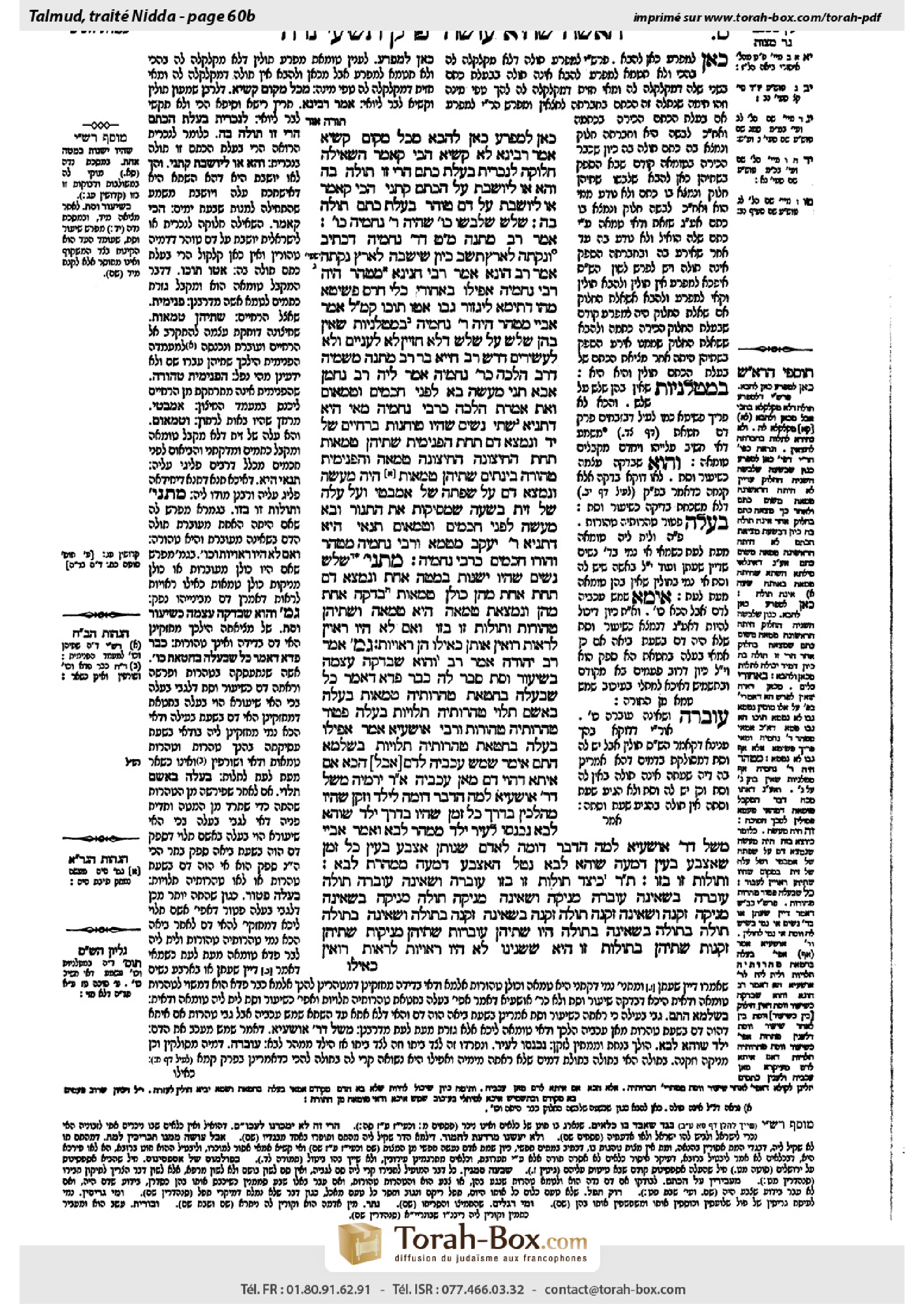
Niddah 60b: Talmud study for Daf Yomi
Daf Yomi is the daily study of one Talmud folio. Explore 37 tractates with scans, Hebrew text, Sefaria English and AI-generated French translations where annotated.
Passage selection and English or AI-generated French translation are available where the scan has annotations. Daf Study is independent of Torah-Box and Sefaria.
Browse Niddah · נידה · All tractatesNiddah 60b text and translations
This page of Niddah includes the Aramaic text, an English translation and an AI-generated French translation, alongside the scan above.
נידה ס׳ ב · Aramaic and Hebrew text
כָּאן לְמַפְרֵעַ, כָּאן לְהַבָּא.
מִכׇּל מָקוֹם קַשְׁיָא! אָמַר רָבִינָא: לָא קַשְׁיָא, הָכִי קָאָמַר: הִשְׁאִילָה חֲלוּקָהּ לְנׇכְרִית — בַּעֲלַת כֶּתֶם הֲרֵי זוֹ תּוֹלָה בָּהּ.
וְהָא ״אוֹ לְיוֹשֶׁבֶת עַל הַכֶּתֶם״ קָתָנֵי! הָכִי קָאָמַר: אוֹ לְיוֹשֶׁבֶת עַל דַּם טוֹהַר — בַּעֲלַת כֶּתֶם תּוֹלָה בָּהּ.
שָׁלֹשׁ שֶׁלָּבְשׁוּ כּוּ׳. שֶׁהָיָה רַבִּי נְחֶמְיָה כּוּ׳. אָמַר רַב מַתְנָה: מַאי טַעְמָא דְּרַבִּי נְחֶמְיָה? דִּכְתִיב ״וְנִקָּתָה לָאָרֶץ תֵּשֵׁב״ — כֵּיוָן שֶׁיָּשְׁבָה לָאָרֶץ — נִקָּתָה.
אָמַר רַב הוּנָא, אָמַר רַבִּי חֲנִינָא: מְטַהֵר הָיָה רַבִּי נְחֶמְיָה אֲפִילּוּ בַּאֲחוֹרֵי כְּלִי חֶרֶס. פְּשִׁיטָא!
מַהוּ דְּתֵימָא: לִיגְזוֹר גַּבּוֹ אַטּוּ תּוֹכוֹ, קָא מַשְׁמַע לַן.
אָמַר אַבָּיֵי: מְטַהֵר הָיָה רַבִּי נְחֶמְיָה בְּמַטְלָנִיּוֹת שֶׁאֵין בָּהֶן שָׁלֹשׁ עַל שָׁלֹשׁ, דְּלָא חַזְיָין לָא לַעֲנִיִּים וְלֹא לַעֲשִׁירִים.
דָּרַשׁ רַב חִיָּיא בַּר רַב מַתְנָה מִשְּׁמֵיהּ דְּרַב: הֲלָכָה כְּרַבִּי נְחֶמְיָה. אֲמַר לֵיהּ רַב נַחְמָן: אַבָּא תָּנֵי מַעֲשֶׂה בָּא לִפְנֵי חֲכָמִים וְטִמְּאוּם, וְאַתְּ אָמְרַתְּ הֲלָכָה כְּרַבִּי נְחֶמְיָה?
מַאי הִיא? דְּתַנְיָא: שְׁתֵּי נָשִׁים שֶׁהָיוּ טוֹחֲנוֹת בְּרֵחַיִים שֶׁל יָד, וְנִמְצָא דָּם תַּחַת הַפְּנִימִית — שְׁתֵּיהֶן טְמֵאוֹת, תַּחַת הַחִיצוֹנָה — הַחִיצוֹנָה טְמֵאָה וְהַפְּנִימִית טְהוֹרָה, בֵּינָתַיִם — שְׁתֵּיהֶן טְמֵאוֹת.
הָיָה מַעֲשֶׂה וְנִמְצָא דָּם עַל שְׂפָתָהּ שֶׁל אַמְבָּטִי, וְעַל עָלֶה שֶׁל זַיִת בְּשָׁעָה שֶׁמַּסִּיקוֹת אֶת הַתַּנּוּר, וּבָא מַעֲשֶׂה לִפְנֵי חֲכָמִים וְטִמְּאוּם.
תַּנָּאֵי הִיא, דְּתַנְיָא: רַבִּי יַעֲקֹב מְטַמֵּא, וְרַבִּי נְחֶמְיָה מְטַהֵר, וְהוֹרוּ חֲכָמִים כְּרַבִּי נְחֶמְיָה.
מַתְנִי' שָׁלֹשׁ נָשִׁים שֶׁהָיוּ יְשֵׁנוֹת בְּמִטָּה אַחַת, וְנִמְצָא דָּם תַּחַת אַחַת מֵהֶן — כּוּלָּן טְמֵאוֹת. בָּדְקָה אַחַת מֵהֶן וְנִמְצֵאת טְמֵאָה — הִיא טְמֵאָה, וּשְׁתֵּיהֶן טְהוֹרוֹת. וְתוֹלוֹת זוֹ בָּזוֹ, וְאִם לֹא הָיוּ רְאוּיוֹת לִרְאוֹת — רוֹאִין אוֹתָן כְּאִילּוּ הֵן רְאוּיוֹת.
גְּמָ' אָמַר רַב יְהוּדָה, אָמַר רַב: וְהוּא שֶׁבָּדְקָה עַצְמָהּ בְּ״שִׁיעוּר וֶסֶת״.
סָבַר לַהּ כְּבַר פְּדָא, דְּאָמַר: כֹּל שֶׁבַּעְלָהּ בְּחַטָּאת — טׇהֳרוֹתֶיהָ טְמֵאוֹת.
בַּעְלָהּ בְּאָשָׁם תָּלוּי — טׇהֳרוֹתֶיהָ תְּלוּיוֹת, בַּעְלָהּ פָּטוּר — טׇהֳרוֹתֶיהָ טְהוֹרוֹת.
וְרַבִּי אוֹשַׁעְיָא אָמַר: אֲפִילּוּ בַּעְלָהּ בְּחַטָּאת — טׇהֳרוֹתֶיהָ תְּלוּיוֹת.
בִּשְׁלָמָא הָתָם, אֵימַר שַׁמָּשׁ עַכְּבֵיהּ לְדָם, [אֲבָל] הָכָא, אִם אִיתַהּ (דְּהָוֵי) [דַּהֲוָה] דָּם, מַאן עַכְּבֵיהּ?
אָמַר רַבִּי יִרְמְיָה: מָשָׁל דְּרַבִּי אוֹשַׁעְיָא, לְמָה הַדָּבָר דוֹמֶה? לְיֶלֶד וְזָקֵן שֶׁהָיוּ מְהַלְּכִין בַּדֶּרֶךְ, כׇּל זְמַן שֶׁהָיוּ בַּדֶּרֶךְ — יֶלֶד שׁוֹהֶא לָבֹא, נִכְנְסוּ לָעִיר — יֶלֶד מְמַהֵר לָבֹא. וְאָמַר אַבָּיֵי: מָשָׁל דְּרַבִּי אוֹשַׁעְיָא, לְמָה הַדָּבָר דוֹמֶה? לְאָדָם שֶׁנּוֹתֵן אֶצְבַּע בָּעַיִן, כׇּל זְמַן שֶׁאֶצְבַּע בָּעַיִן — דִּמְעָה שׁוֹהָא לָבֹא, נָטַל הָאֶצְבַּע — דִּמְעָה מְמַהֶרֶת לָבֹא.
וְתוֹלוֹת זוֹ בָּזוֹ. תָּנוּ רַבָּנַן: כֵּיצַד תּוֹלוֹת זוֹ בָּזוֹ? עוּבָּרָה וְשֶׁאֵינָהּ עוּבָּרָה — תּוֹלָה עוּבָּרָה בְּשֶׁאֵינָהּ עוּבָּרָה.
מְנִיקָה וְשֶׁאֵינָהּ מְנִיקָה — תּוֹלָה מְנִיקָה בְּשֶׁאֵינָהּ מְנִיקָה. זְקֵנָה וְשֶׁאֵינָהּ זְקֵנָה — תּוֹלָה זְקֵנָה בְּשֶׁאֵינָהּ זְקֵנָה. בְּתוּלָה וְשֶׁאֵינָהּ בְּתוּלָה — תּוֹלָה בְּתוּלָה בְּשֶׁאֵינָהּ בְּתוּלָה.
הָיוּ שְׁתֵּיהֶן עוּבָּרוֹת, שְׁתֵּיהֶן מְנִיקוֹת, שְׁתֵּיהֶן זְקֵנוֹת, שְׁתֵּיהֶן בְּתוּלוֹת — זוֹ הִיא שֶׁשָּׁנִינוּ: לֹא הָיוּ רְאוּיוֹת לִרְאוֹת — רוֹאִין
Niddah 60b · English translation
Here, in the latter clause of the baraita, when she may attribute the stain to a woman who had seen a blood stain, it is referring to rendering that woman impure retroactively with regard to the status of pure items that she had already touched before the stain was found on the garment she borrowed. This attribution of the blood stain to the woman who was already impure due to seeing a blood stain does not harm her impure status in any way, as items she had previously touched were already considered impure. There, in the beginning of the baraita, where the ruling is that the lender may not attribute the blood stain to a woman who was already impure, it is referring to her own status with regard to the future. With regard to the future, one may not attribute the stain to woman who had already seen a blood stain, as this attribution would ruin that woman’s counting of pure days.
The Gemara returns to the objection: The baraita has been resolved, but in any case everyone agrees that according to Rabban Shimon ben Gamliel she may attribute the stain to a woman who had previously seen a blood stain. This presents a difficulty to the answer of Rabbi Yehuda bar Livai, i.e., that according to Rabban Shimon ben Gamliel one may not attribute the blood stain in such a case. Ravina said: It is not difficult, as this is what the baraita is saying in its latter clause: If she loaned her garment to a gentile woman, then with regard to defining the lender as one who had seen a blood stain, the lender may attribute the stain to the gentile woman. If so, it cannot be inferred from the baraita that according to Rabban Shimon ben Gamliel one may attribute a blood stain to another woman who was already impure due to a blood stain.
The Gemara raises an objection: But the tanna of the baraita teaches: Or to a woman who was observing days of impurity due to having seen a blood stain, i.e., it mentions another woman who was already impure due to having seen a blood stain. Ravina explains that this is what the tanna is saying: If she loaned the garment to a gentile woman or to a woman after childbirth who is observing the period of the blood of purity, then with regard to defining the lender as a woman who saw a blood stain, she may attribute the stain to the gentile or to the woman observing the days of ritually pure blood, and the lender remains pure.
§ The mishna teaches: In a case of three women who wore one garment, etc. If they sat on a stone bench or on the bench of a bathhouse, Rabbi Neḥemya deems all three women ritually pure, as Rabbi Neḥemya would say: Any item that is not susceptible to ritual impurity is not susceptible to ritual impurity due to blood stains. The Gemara clarifies the opinion of Rabbi Neḥemya. Rav Mattana says: What is the reason for the opinion of Rabbi Neḥemya? As it is written: “And her gates shall lament and mourn; and clean she shall sit upon the ground” (Isaiah 3:26). This teaches that once she sits on the ground, which is not susceptible to ritual impurity, she shall be clean, i.e., pure.
Rav Huna says that Rabbi Ḥanina says: Rabbi Neḥemya would deem her ritually pure even if she sat on the exterior of an inverted earthenware vessel. Since an earthenware vessel becomes impure only if an impure item enters its airspace, its exterior is not susceptible to ritual impurity and therefore it does not render a woman who sees a blood stain on it ritually impure. The Gemara asks: Isn’t that obvious? Rabbi Neḥemya himself said that she does not become impure if a blood stain is found on an item that is not susceptible to ritual impurity. What does Rabbi Ḥanina add to that statement?
The Gemara answers: This observation is necessary, lest you say: Let the Sages decree that she becomes impure from a blood stain found on the exterior of an earthenware vessel, due to its similarity to a blood stain found on the interior, which would render her impure. Therefore, Rabbi Ḥanina teaches us that there is no such decree.
Abaye says: Rabbi Neḥemya would deem her ritually pure if she saw blood stains on small rags that do not have an area of three fingerbreadths by three fingerbreadths, as these rags are suitable for use neither for the poor nor for the wealthy.
Rav Ḥiyya bar Rav Mattana taught in the name of Rav: The halakha is in accordance with the opinion of Rabbi Neḥemya. Rav Naḥman said to Rav Ḥiyya bar Rav Mattana: Father teaches the following baraita: An incident of this kind came before the Sages, involving two women who found a blood stain on an item that was not susceptible to ritual impurity, and the Sages deemed both women ritually impure, in accordance with the opinion of the Rabbis, who disagree with Rabbi Neḥemya. And yet you say that the halakha is in accordance with the opinion of Rabbi Neḥemya?
The Gemara inquires: What is that incident in question? As it is taught in a baraita: With regard to two women who were grinding with a hand mill and were standing next to each other, and blood was found beneath the woman on the inside, i.e., the woman standing closest to the mill, they are both ritually impure. The reason is that the woman standing further away pushes in to get closer to the mill, and therefore the blood stain could be from either of them. But if blood was found beneath the woman on the outside, i.e., the woman standing further from the mill, the woman on the outside is impure and the woman on the inside is pure. If the blood was found between them, they are both impure.
The baraita continues: There was an incident and blood was found on the edge of a bathtub, and in another case a blood stain was found on an olive leaf at the time that the women were kindling the oven. And the incident came before the Sages and they deemed both women ritually impure. Since an olive leaf is not susceptible to ritual impurity, this baraita is not in accordance with the opinion of Rabbi Neḥemya.
Rabbi Ḥiyya bar Rav Mattana answered: It is a dispute between tanna’im whether or not the halakha is in accordance with the opinion of Rabbi Neḥemya. As it is taught in a baraita: If a blood stain is found on an item that is not susceptible to ritual impurity, Rabbi Ya’akov deems her impure, but Rabbi Neḥemya deems her pure. And the Sages ruled that the halakha is in accordance with the opinion of Rabbi Neḥemya.
MISHNA: In a case of three women who were sleeping in one bed and blood was discovered beneath one of them, all of them are ritually impure. If when the blood was discovered one of them examined herself and discovered that she was impure due to menstruation, she is impure and the other two are pure. And if none of them examined themselves, or if all of them examined themselves and were pure, they attribute the blood to each other, i.e., if one of them is unfit to menstruate, e.g., she is pregnant, she may attribute the blood to the other women who are fit to menstruate. And if all three women were not fit to see the flow of blood, e.g., they each belonged to one of the categories listed in the mishna on 7a, one considers them as though they were fit, and all three are impure, because the blood must have originated from one of them.
GEMARA: The mishna teaches that if one of the women examined herself when the blood was discovered and found that she was impure due to menstruation, she is impure and the other two are pure. In this regard, Rav Yehuda says that Rav says: The other two women may attribute the blood to the one who examined herself only when she examined herself within the brief period of time needed for the onset of menstruation. But if she checked herself after this time, although she is impure, the other women are also impure, due to uncertainty.
The Gemara explains: Rav holds in accordance with the opinion of bar Padda, who said: There are three time periods with regard to defining a woman’s ritual-purity status if she sees blood after engaging in intercourse. The shortest is the period of time required for the onset of menstruation, i.e., for menstrual bleeding to begin. The next shortest is the time it would take the woman to get out of bed after intercourse and wash her private parts. The longest period is any time longer than that. If a woman finds blood after intercourse within the period of time needed for the onset of menstruation, she must have been impure during intercourse. With regard to any woman whose husband would be liable to bring a sin offering if he had engaged in intercourse with her, because she found the blood within that short period, if she had not been engaging in intercourse, but rather had been preparing food in a state of ritual purity, and then she found blood within that short period, all the pure items that she touched are ritually impure.
By contrast, with regard to any woman whose husband would be liable to bring a provisional guilt offering if he had engaged in intercourse with her, as it is uncertain whether he violated a transgression for which he would be liable to bring a sin offering, if she had not been engaging in intercourse, but rather had been preparing food in a state of ritual purity and then found blood within that same time period, the status of all the pure items she touched is suspended, as their status is uncertain. They are not burned but they may not be eaten either. Finally, with regard to any woman whose husband would be exempt from bringing any offering, i.e., where she finds blood after a longer time period, if she had not been engaging in intercourse, but rather had been preparing food in a state of ritual purity, and then found the blood after a longer time period, all the pure items she touched remain pure.
And Rabbi Oshaya says: There is no connection between her husband’s obligation to bring an offering and the ritual-purity status of the items she handled. Even if her husband is liable to bring a sin offering, i.e., when she discovered the blood within the period of time needed for the onset of menstruation, the status of all the pure items she touched before she discovered the blood is suspended, as their status is uncertain.
Rabbi Oshaya explains his reasoning. Granted, there, in the case of intercourse, where the husband must bring an offering, one can say that the male organ prevented the blood from emerging from her body, and therefore it is clear that she was impure beforehand. But here, in the case of preparing food in a state of ritual purity, if it is so that there was blood coming out of her while she was preparing the food, what prevented the blood from emerging from her body?
Rabbi Yirmeya says a parable in explanation of the opinion of Rabbi Oshaya: To what is this matter comparable? To a child and an old man who are walking along the road. As long as they are on the road, the child delays his arrival, i.e., he walks at the pace of the old man. But once they enter the city, the child hastens his arrival, and runs on ahead. Similarly, as soon as the couple has finished engaging in intercourse, the blood comes quickly, but the blood is hindered from coming out during intercourse. And Abaye also says a parable in explanation of the opinion of Rabbi Oshaya: To what is this matter comparable? To a man who puts his finger in his eye. As long as his finger is in his eye, the tears delay their arrival and remain in the eye. But as soon as he has removed his finger the tears hasten their arrival.
§ The mishna teaches: And with regard to three women who were sleeping in one bed and blood was discovered beneath one of them, that if one of them is unfit to menstruate they attribute the blood to each other, i.e., to the women who are fit to menstruate. In this regard, the Sages taught in a baraita: How do they attribute the blood to one another? If one of the women is pregnant and one is not pregnant, the pregnant woman may attribute the blood to the woman who is not pregnant.
If one of the women is nursing and the other is not nursing, the nursing woman may attribute the blood to the woman who is not nursing. If one of the women is old and no longer experiences bleeding regularly, and the other one is not old, the old woman may attribute the blood to the woman who is not old. Likewise, if one of the women is a virgin, in this context, one who has not yet experienced bleeding due to her youth, and the other woman is not a virgin, in this context, one who has experienced bleeding, the virgin may attribute the blood to the woman who is not a virgin.
The baraita continues: If both women are pregnant, or both women are nursing, or both women are old, or both women are virgins, in this case the halakha is as we learned in the mishna: If both women were not fit to see menstrual blood, and yet blood is found beneath them on the bed, one considers them
Niddah 60b · Traduction française (IA)
Ici, dans la dernière partie de la baraïta, lorsqu’elle peut attribuer la tache à une femme qui avait déjà vu une tache de sang, il s’agit de rendre cette femme impure rétroactivement quant au statut des objets purs qu’elle avait touchés avant que la tache ne soit découverte sur le vêtement qu’elle avait emprunté. Attribuer cette tache de sang à la femme qui était déjà impure parce qu’elle avait vu une tache de sang ne porte aucunement atteinte à son statut d’impure, car les objets qu’elle avait touchés auparavant étaient déjà considérés comme impurs. Là, au début de la baraïta, où il est enseigné que celle qui a prêté le vêtement ne peut pas attribuer la tache de sang à une femme déjà impure, il s’agit du statut futur de cette dernière. Pour l’avenir, on ne peut pas attribuer la tache à une femme qui avait déjà vu une tache de sang, car cela compromettrait le décompte de ses jours de pureté.
La Guemara revient à l’objection : la baraïta a été expliquée, mais, quoi qu’il en soit, tous s’accordent à dire que, selon Rabban Shimon ben Gamliel, elle peut attribuer la tache à une femme qui avait déjà vu une tache de sang. Cela pose une difficulté à la réponse de Rabbi Yehuda bar Livai, selon laquelle, d’après Rabban Shimon ben Gamliel, on ne peut pas attribuer la tache de sang dans un tel cas. Ravina dit : il n’y a pas de difficulté, car voici ce que dit la baraïta dans sa dernière partie : si elle a prêté son vêtement à une non-Juive, alors, pour déterminer si celle qui a prêté le vêtement est considérée comme ayant vu une tache de sang, elle peut attribuer la tache à la non-Juive. On ne peut donc pas déduire de la baraïta que, selon Rabban Shimon ben Gamliel, on peut attribuer une tache de sang à une autre femme déjà impure à cause d’une tache de sang.
La Guemara soulève une objection : mais le tanna de la baraïta enseigne : « ou à une femme qui observait des jours d’impureté parce qu’elle avait vu une tache de sang », c’est-à-dire qu’il mentionne une autre femme déjà impure parce qu’elle avait vu une tache de sang. Ravina explique que voici ce que dit le tanna : si elle a prêté le vêtement à une non-Juive ou à une femme après un accouchement qui observe la période du sang de pureté, alors, pour déterminer si celle qui a prêté le vêtement est considérée comme une femme ayant vu une tache de sang, elle peut attribuer la tache à la non-Juive ou à la femme qui observe les jours de sang rituellement pur, et celle qui a prêté le vêtement reste pure.
§ La Michna enseigne : dans le cas de trois femmes qui ont porté un même vêtement, etc. Si elles se sont assises sur un banc de pierre ou sur le banc d’un bain public, Rabbi Neḥemya les déclare toutes trois rituellement pures, car Rabbi Neḥemya disait : tout objet qui n’est pas susceptible de contracter l’impureté rituelle n’est pas non plus susceptible de la contracter à cause de taches de sang. La Guemara précise l’opinion de Rabbi Neḥemya. Rav Mattana dit : quelle est la raison de l’opinion de Rabbi Neḥemya ? Car il est écrit : « Ses portes gémissent et sont dans le deuil ; et, dépouillée, elle s’assied à terre » (Isaïe 3,26). Cela enseigne qu’une fois assise à terre, qui n’est pas susceptible de contracter l’impureté rituelle, elle est pure.
Rav Huna dit au nom de Rabbi Ḥanina : Rabbi Neḥemya la déclarerait rituellement pure même si elle s’était assise sur la face extérieure d’un récipient en terre cuite retourné. Puisqu’un récipient en terre cuite ne devient impur que si un objet impur pénètre dans son espace intérieur, sa face extérieure n’est pas susceptible de contracter l’impureté rituelle ; elle ne rend donc pas rituellement impure une femme qui y voit une tache de sang. La Guemara demande : cela n’est-il pas évident ? Rabbi Neḥemya lui-même a dit qu’elle ne devient pas impure si une tache de sang est trouvée sur un objet qui n’est pas susceptible de contracter l’impureté rituelle. Qu’ajoute Rabbi Ḥanina à cette déclaration ?
La Guemara répond : cette précision est nécessaire, de peur que tu ne dises : que les Sages décrètent qu’elle devient impure à cause d’une tache de sang trouvée sur la face extérieure d’un récipient en terre cuite, en raison de sa ressemblance avec une tache de sang trouvée sur la face intérieure, laquelle la rendrait impure. Rabbi Ḥanina nous enseigne donc qu’un tel décret n’existe pas.
Abaye dit : Rabbi Neḥemya la déclarerait rituellement pure si elle avait vu des taches de sang sur de petits chiffons dont la superficie est inférieure à trois largeurs de doigt sur trois, car ces chiffons ne conviennent ni aux pauvres ni aux riches.
Rav Ḥiyya bar Rav Mattana enseigna au nom de Rav : la halakha suit l’opinion de Rabbi Neḥemya. Rav Naḥman dit à Rav Ḥiyya bar Rav Mattana : mon père enseigne la baraïta suivante : un cas de ce genre s’est présenté devant les Sages, celui de deux femmes qui avaient trouvé une tache de sang sur un objet qui n’était pas susceptible de contracter l’impureté rituelle, et les Sages les déclarèrent toutes deux rituellement impures, conformément à l’opinion des Rabbins, qui s’opposent à Rabbi Neḥemya. Et pourtant, tu dis que la halakha suit l’opinion de Rabbi Neḥemya ?
La Guemara demande : quel est le cas en question ? Comme il est enseigné dans une baraïta : à propos de deux femmes qui moulinaient avec un moulin à bras et se tenaient l’une à côté de l’autre, si du sang était trouvé sous la femme qui se tenait à l’intérieur, c’est-à-dire celle qui était la plus proche du moulin, elles sont toutes deux rituellement impures. En effet, la femme qui se tient plus loin se rapproche en avançant vers le moulin ; la tache de sang peut donc provenir de l’une ou de l’autre. Mais si le sang était trouvé sous la femme qui se tenait à l’extérieur, c’est-à-dire celle qui était la plus éloignée du moulin, la femme de l’extérieur est impure et celle de l’intérieur est pure. Si le sang était trouvé entre elles, elles sont toutes deux impures.
La baraïta poursuit : un cas s’est produit où du sang a été trouvé sur le bord d’une baignoire, et un autre où une tache de sang a été trouvée sur une feuille d’olivier au moment où les femmes allumaient le four. Le cas fut soumis aux Sages, qui déclarèrent les deux femmes rituellement impures. Puisqu’une feuille d’olivier n’est pas susceptible de contracter l’impureté rituelle, cette baraïta ne suit pas l’opinion de Rabbi Neḥemya.
Rabbi Ḥiyya bar Rav Mattana répondit : il existe une controverse entre des tannaïm sur la question de savoir si la halakha suit ou non l’opinion de Rabbi Neḥemya. Car il est enseigné dans une baraïta : si une tache de sang est trouvée sur un objet qui n’est pas susceptible de contracter l’impureté rituelle, Rabbi Ya’akov la déclare impure, tandis que Rabbi Neḥemya la déclare pure. Et les Sages ont statué que la halakha suit l’opinion de Rabbi Neḥemya.
MICHNA : Dans le cas de trois femmes qui dormaient dans un même lit et où du sang a été découvert sous l’une d’elles, elles sont toutes rituellement impures. Si, au moment où le sang a été découvert, l’une d’elles s’est examinée et a constaté qu’elle était impure en raison de ses règles, elle est impure et les deux autres sont pures. Si aucune ne s’est examinée, ou si elles se sont toutes examinées et étaient pures, elles attribuent le sang les unes aux autres, c’est-à-dire que si l’une d’elles est inapte à avoir ses règles — par exemple, si elle est enceinte —, elle peut attribuer le sang aux autres femmes, qui sont aptes à avoir leurs règles. Et si les trois femmes étaient inaptes à voir un écoulement de sang, par exemple si chacune appartenait à l’une des catégories énumérées dans la Michna en 7a, on les considère comme si elles étaient aptes, et toutes trois sont impures, car le sang doit provenir de l’une d’elles.
GUEMARA : La Michna enseigne que si l’une des femmes s’est examinée au moment où le sang a été découvert et a constaté qu’elle était impure en raison de ses règles, elle est impure et les deux autres sont pures. À ce propos, Rav Yehuda dit au nom de Rav : les deux autres femmes ne peuvent attribuer le sang à celle qui s’est examinée que si elle l’a fait pendant le bref laps de temps nécessaire au déclenchement des règles. Mais si elle s’est examinée après ce délai, bien qu’elle soit impure, les autres femmes sont elles aussi impures, par incertitude.
La Guemara explique : Rav suit l’opinion de bar Padda, qui a dit qu’il existe trois délais pour déterminer le statut de pureté rituelle d’une femme qui voit du sang après avoir eu des rapports sexuels. Le plus court est le temps nécessaire au déclenchement des règles, c’est-à-dire au début du saignement menstruel. Le délai suivant est le temps qu’il faudrait à la femme pour se lever après les rapports et se laver les parties intimes. Le délai le plus long correspond à tout temps supérieur à cela. Si une femme trouve du sang après un rapport dans le délai nécessaire au déclenchement des règles, elle devait être impure pendant le rapport. Pour toute femme avec laquelle son mari serait tenu d’apporter un sacrifice expiatoire s’il avait eu des rapports, parce qu’elle a trouvé du sang pendant ce bref délai, si, au lieu d’avoir des rapports, elle préparait de la nourriture en état de pureté rituelle et trouvait ensuite du sang pendant ce bref délai, tous les objets purs qu’elle a touchés sont rituellement impurs.
En revanche, pour toute femme avec laquelle son mari serait tenu d’apporter un sacrifice de culpabilité provisoire s’il avait eu des rapports, car il est incertain qu’il ait commis une transgression passible d’un sacrifice expiatoire, si, au lieu d’avoir des rapports, elle préparait de la nourriture en état de pureté rituelle et trouvait ensuite du sang pendant ce même délai, le statut de tous les objets purs qu’elle a touchés est suspendu, car leur statut est incertain. On ne les brûle pas, mais on ne peut pas non plus les manger. Enfin, pour toute femme avec laquelle son mari serait dispensé d’apporter une quelconque offrande — c’est-à-dire lorsqu’elle trouve du sang après un délai plus long —, si, au lieu d’avoir des rapports, elle préparait de la nourriture en état de pureté rituelle et trouvait ensuite le sang après ce délai plus long, tous les objets purs qu’elle a touchés restent purs.
Et Rabbi Oshaya dit : il n’y a aucun lien entre l’obligation de son mari d’apporter une offrande et le statut de pureté rituelle des objets qu’elle a manipulés. Même si son mari est tenu d’apporter un sacrifice expiatoire, c’est-à-dire lorsqu’elle a découvert le sang dans le délai nécessaire au déclenchement des règles, le statut de tous les objets purs qu’elle a touchés avant de découvrir le sang est suspendu, car leur statut est incertain.
Rabbi Oshaya explique son raisonnement. Certes, là, dans le cas des rapports sexuels où le mari doit apporter une offrande, on peut dire que le membre masculin a empêché le sang de sortir de son corps ; il est donc clair qu’elle était déjà impure auparavant. Mais ici, dans le cas où elle préparait de la nourriture en état de pureté rituelle, si du sang sortait d’elle pendant qu’elle préparait la nourriture, qu’est-ce qui l’aurait empêché de sortir de son corps ?
Rabbi Yirmeya propose une parabole pour expliquer l’opinion de Rabbi Oshaya : à quoi cela ressemble-t-il ? À un enfant et à un vieillard qui cheminent sur la route. Tant qu’ils sont sur la route, l’enfant retarde son arrivée, c’est-à-dire qu’il marche au rythme du vieillard. Mais une fois entrés dans la ville, l’enfant se dépêche d’arriver et court devant lui. De même, dès que le couple a fini d’avoir des rapports, le sang vient rapidement, mais il est empêché de sortir pendant les rapports. Abaye propose lui aussi une parabole pour expliquer l’opinion de Rabbi Oshaya : à quoi cela ressemble-t-il ? À un homme qui met son doigt dans son œil. Tant que son doigt est dans son œil, les larmes tardent à venir et restent dans l’œil. Mais dès qu’il retire son doigt, les larmes arrivent rapidement.
§ La Michna enseigne que, dans le cas de trois femmes qui dormaient dans un même lit et où du sang a été découvert sous l’une d’elles, si l’une d’elles est inapte à avoir ses règles, elles attribuent le sang les unes aux autres, c’est-à-dire aux femmes qui sont aptes à avoir leurs règles. À ce propos, les Sages ont enseigné dans une baraïta : comment attribuent-elles le sang les unes aux autres ? Si l’une des femmes est enceinte et l’autre ne l’est pas, la femme enceinte peut attribuer le sang à celle qui ne l’est pas.
Si l’une des femmes allaite et que l’autre n’allaite pas, celle qui allaite peut attribuer le sang à celle qui n’allaite pas. Si l’une des femmes est âgée et n’a plus de saignements réguliers, tandis que l’autre n’est pas âgée, la femme âgée peut attribuer le sang à celle qui n’est pas âgée. De même, si l’une des femmes est vierge — en l’occurrence, une femme qui, en raison de son jeune âge, n’a pas encore eu de saignement — et que l’autre n’est pas vierge — en l’occurrence, une femme qui a déjà eu des saignements —, la vierge peut attribuer le sang à celle qui n’est pas vierge.
La baraïta poursuit : si les deux femmes sont enceintes, ou si elles allaitent toutes les deux, ou si elles sont toutes deux âgées, ou si elles sont toutes deux vierges, la halakha est dans ce cas telle que nous l’avons apprise dans la Michna : si les deux femmes étaient inaptes à voir du sang menstruel et que, pourtant, du sang a été trouvé sous elles, sur le lit, on les considère
Traduction française générée par IA à partir de l’édition anglaise de Sefaria. Vérifie toujours un passage avec le texte source.
Text from Sefaria: William Davidson Edition - Vocalized Aramaic (CC BY NC); William Davidson Edition - English (CC BY NC).