Niddah 61a: Talmud study for Daf Yomi
Daf Yomi is the daily study of one Talmud folio. Explore 37 tractates with scans, Hebrew text, Sefaria English and AI-generated French translations where annotated.
Passage selection and English or AI-generated French translation are available where the scan has annotations. Daf Study is independent of Torah-Box and Sefaria.
Browse Niddah · נידה · All tractatesNiddah 61a text and translations
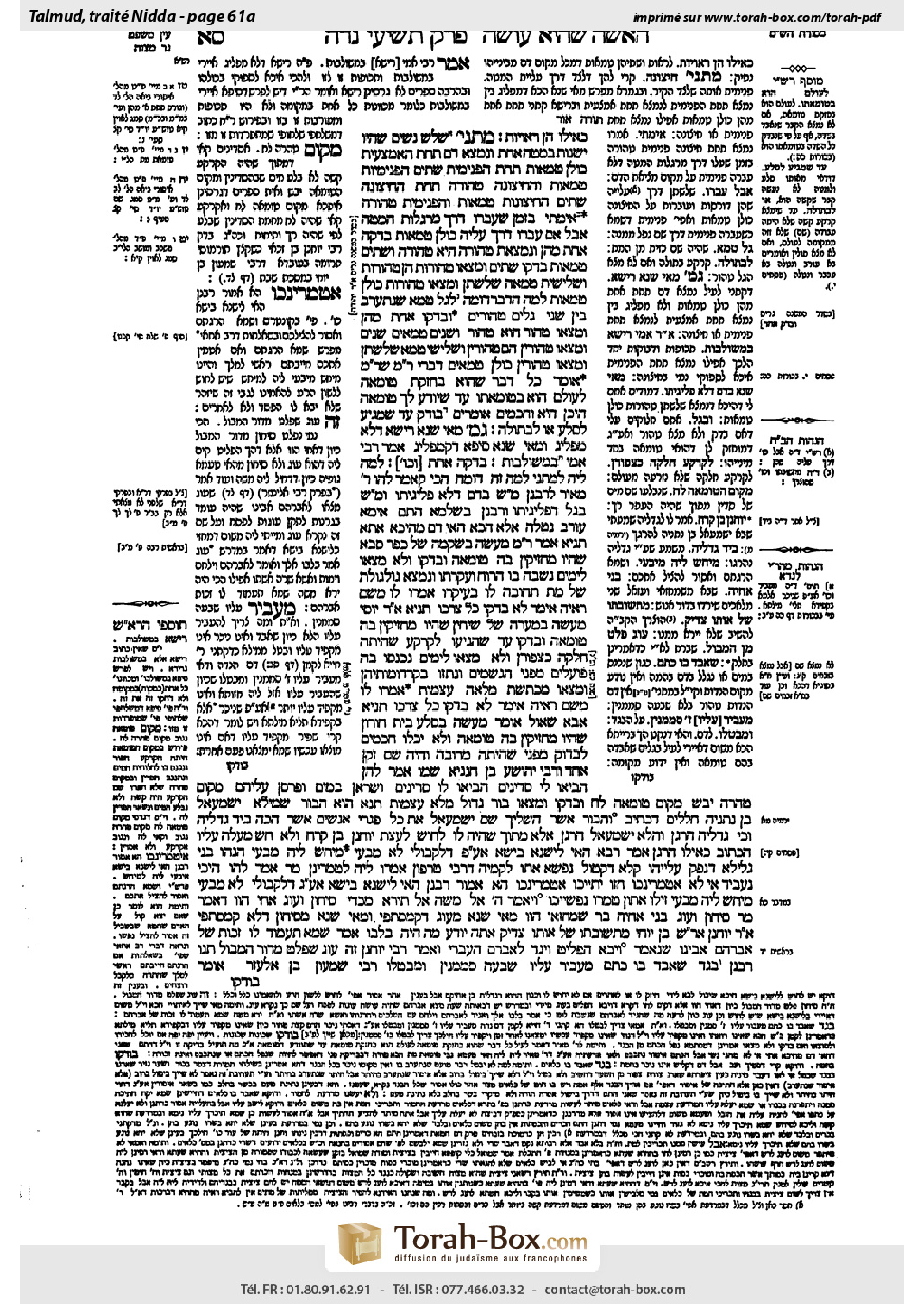
This page of Niddah includes the Aramaic text, an English translation and an AI-generated French translation, alongside the scan above.
נידה ס״א א · Aramaic and Hebrew text
כְּאִילּוּ הֵן רְאוּיוֹת.
מַתְנִי' שָׁלֹשׁ נָשִׁים שֶׁהָיוּ יְשֵׁנוֹת בְּמִטָּה אַחַת, וְנִמְצָא דָּם תַּחַת הָאֶמְצָעִית — כּוּלָּן טְמֵאוֹת. תַּחַת הַפְּנִימִית — שְׁתַּיִם הַפְּנִימִיּוֹת טְמֵאוֹת, וְהַחִיצוֹנָה טְהוֹרָה. תַּחַת הַחִיצוֹנָה — שְׁתַּיִם הַחִיצוֹנוֹת טְמֵאוֹת, וְהַפְּנִימִית טְהוֹרָה.
אֵימָתַי? בִּזְמַן שֶׁעָבְרוּ דֶּרֶךְ מַרְגְּלוֹת הַמִּטָּה, אֲבָל אִם עָבְרוּ דֶּרֶךְ עָלֶיהָ — כּוּלָּן טְמֵאוֹת. בָּדְקָה אַחַת מֵהֶן וְנִמְצֵאת טְהוֹרָה — הִיא טְהוֹרָה, וּשְׁתַּיִם טְמֵאוֹת. בָּדְקוּ שְׁתַּיִם וּמָצְאוּ טְהוֹרוֹת — הֵן טְהוֹרוֹת, וּשְׁלִישִׁית טְמֵאָה. שְׁלָשְׁתָּן וּמָצְאוּ טְהוֹרוֹת — כּוּלָּן טְמֵאוֹת.
לְמָה הַדָּבָר דוֹמֶה? לְגַל טָמֵא שֶׁנִּתְעָרֵב בֵּין שְׁנֵי גַּלִּים טְהוֹרִים, וּבָדְקוּ אֶחָד מֵהֶן וּמָצְאוּ טָהוֹר — הוּא טָהוֹר, וּשְׁנַיִם טְמֵאִים. שְׁנַיִם וּמָצְאוּ טְהוֹרִין — הֵם טְהוֹרִין, וּשְׁלִישִׁי טָמֵא.
שְׁלָשְׁתָּן, וּמָצְאוּ טְהוֹרִין — כּוּלָּן טְמֵאִים, דִּבְרֵי רַבִּי מֵאִיר. שֶׁרַבִּי מֵאִיר אוֹמֵר: כׇּל דָּבָר שֶׁהוּא בְּחֶזְקַת טוּמְאָה — לְעוֹלָם הוּא בְּטוּמְאָתוֹ, עַד שֶׁיִּוָּדַע לְךָ טוּמְאָה הֵיכָן הִיא.
וַחֲכָמִים אוֹמְרִים: בּוֹדֵק עַד שֶׁמַּגִּיעַ לְסֶלַע אוֹ לִבְתוּלָה.
גְּמָ' מַאי שְׁנָא רֵישָׁא דְּלָא מְפַלֵּיג, וּמַאי שְׁנָא סֵיפָא דְּקָמְפַלֵּיג? אָמַר רַבִּי אַמֵּי: בִּמְשׁוּלָּבוֹת.
בָּדְקָה אַחַת [וְכוּ׳]. לְמָה לֵיהּ לְמִתְנֵי ״לְמָה זֶה דּוֹמֶה״?
הָכִי קָאָמַר לְהוּ רַבִּי מֵאִיר לְרַבָּנַן: מַאי שְׁנָא בְּדָם דְּלָא פְּלִיגִיתוּ, וּמַאי שְׁנָא בְּגַל דִּפְלִיגִיתוּ?
וְרַבָּנַן, בִּשְׁלָמָא הָתָם — אֵימָא עוֹרֵב נְטָלָהּ, אֶלָּא הָכָא — הַאי דָּם מֵהֵיכָא אֲתָא?
תַּנְיָא, אָמַר רַבִּי מֵאִיר: מַעֲשֶׂה בְּשִׁקְמָה שֶׁל כְּפַר סָבָא, שֶׁהָיוּ מַחֲזִיקִין בָּהּ טוּמְאָה, וּבָדְקוּ וְלֹא מָצְאוּ. לְיָמִים נָשְׁבָה בּוֹ הָרוּחַ וַעֲקָרַתּוּ, וְנִמְצָא גּוּלְגּוֹלֶת שֶׁל מֵת תְּחוּבָה לוֹ בְּעִיקָּרוֹ. אָמְרוּ לוֹ: מִשָּׁם רְאָיָה? אֵימַר לֹא בָּדְקוּ כׇּל צָרְכּוֹ.
תַּנְיָא, אָמַר רַבִּי יוֹסֵי: מַעֲשֶׂה בִּמְעָרָה שֶׁל שִׁיחִין, שֶׁהָיוּ מַחְזִיקִין בָּהּ טוּמְאָה, וּבָדְקוּ עַד שֶׁהִגִּיעוּ לְקַרְקַע שֶׁהָיְתָה חֲלָקָה כְּצִפּוֹרֶן, וְלֹא מָצְאוּ. לְיָמִים נִכְנְסוּ בָּהּ פּוֹעֲלִים מִפְּנֵי הַגְּשָׁמִים, וְנִתְּזוּ בְּקַרְדּוּמּוֹתֵיהֶן, וּמָצְאוּ מַכְתֶּשֶׁת מְלֵאָה עֲצָמוֹת. אָמְרוּ לוֹ: מִשָּׁם רְאָיָה? אֵימַר לֹא בָּדְקוּ כָּל צָרְכּוֹ.
תַּנְיָא, אַבָּא שָׁאוּל אוֹמֵר: מַעֲשֶׂה בְּסֶלַע בֵּית חוֹרוֹן, שֶׁהָיוּ מַחֲזִיקִין בָּהּ טוּמְאָה, וְלֹא יָכְלוּ חֲכָמִים לִבְדּוֹק מִפְּנֵי שֶׁהָיְתָה מְרוּבָּה. וְהָיָה שָׁם זָקֵן אֶחָד, וְרַבִּי יְהוֹשֻׁעַ בֶּן חֲנַנְיָא שְׁמוֹ. אָמַר לָהֶן: הָבִיאוּ לִי סְדִינִים! הֵבִיאוּ לוֹ סְדִינִים, וּשְׁרָאָן בְּמַיִם, וּפְרָסָן עֲלֵיהֶם. מְקוֹם טׇהֳרָה — יָבֵשׁ, מְקוֹם טוּמְאָה — לַח, וּבָדְקוּ וּמָצְאוּ בּוֹר גָּדוֹל מָלֵא עֲצָמוֹת.
תָּנָא: הוּא הַבּוֹר שֶׁמִּילֵּא יִשְׁמָעֵאל בֶּן נְתַנְיָה חֲלָלִים, דִּכְתִיב: ״וְהַבּוֹר אֲשֶׁר הִשְׁלִיךְ שָׁם יִשְׁמָעֵאל אֵת כׇּל פִּגְרֵי אֲנָשִׁים אֲשֶׁר הִכָּה בְּיַד גְּדַלְיָה״.
וְכִי גְדַלְיָה הֲרָגָן? וַהֲלֹא יִשְׁמָעֵאל הֲרָגָן! אֶלָּא מִתּוֹךְ שֶׁהָיָה לוֹ לָחוֹשׁ לַעֲצַת יוֹחָנָן בֶּן קָרֵחַ, וְלֹא חַשׁ — מַעֲלֶה עָלָיו הַכָּתוּב כְּאִילּוּ הֲרָגָן.
אָמַר רָבָא: הַאי לִישָּׁנָא בִּישָׁא, אַף עַל פִּי דִּלְקַבּוֹלֵי לָא מִבְּעֵי — מֵיחָשׁ לֵיהּ מִבְּעֵי.
הָנְהוּ בְּנֵי גָּלִילָא דִּנְפַק עֲלַיְיהוּ קָלָא דִּקְטוּל נַפְשָׁא, אֲתוֹ לְקַמֵּיהּ דְּרַבִּי טַרְפוֹן, אֲמַרוּ לֵיהּ: לַטְמְרִינַן מָר! אֲמַר לְהוּ: הֵיכִי נַעֲבֵיד? אִי לָא אַטְמְרִינְכוּ — חָזוּ יָתַיְיכוּ, אַטְמְרִינְכוּ — הָא אֲמוּר רַבָּנַן: הַאי לִישָּׁנָא בִּישָׁא, אַף עַל גַּב דִּלְקַבּוֹלֵי לָא מִבְּעֵי — מֵיחָשׁ לֵיהּ מִבְּעֵי. זִילוּ אַתּוּן, טַמַּרוּ נַפְשַׁיְיכוּ.
״וַיֹּאמֶר ה׳ אֶל מֹשֶׁה אַל תִּירָא״ — מִכְּדֵי סִיחוֹן וְעוֹג אַחֵי הֲווֹ, דְּאָמַר מָר: סִיחוֹן וְעוֹג בְּנֵי אֲחִיָּה בַּר שַׁמְחֲזַאי הֲווֹ, מַאי שְׁנָא מֵעוֹג דְּקָמִסְתְּפֵי, וּמַאי שְׁנָא מִסִּיחוֹן דְּלָא קָמִסְתְּפֵי?
אָמַר רַבִּי יוֹחָנָן, אָמַר רַבִּי שִׁמְעוֹן בֶּן יוֹחַי: מִתְּשׁוּבָתוֹ שֶׁל אוֹתוֹ צַדִּיק אַתָּה יוֹדֵעַ מָה הָיָה בְּלִבּוֹ, אָמַר: שֶׁמָּא תַּעֲמוֹד לוֹ זְכוּת שֶׁל אַבְרָהָם אָבִינוּ.
שֶׁנֶּאֱמַר: ״וַיָּבֹא הַפָּלִיט וַיַּגֵּד לְאַבְרָם הָעִבְרִי״, וְאָמַר רַבִּי יוֹחָנָן: זֶה עוֹג, שֶׁפָּלַט מִדּוֹר הַמַּבּוּל.
תָּנוּ רַבָּנַן: בֶּגֶד שֶׁאָבַד בּוֹ כֶּתֶם, מַעֲבִיר עָלָיו שִׁבְעָה סַמְמָנִין וּמְבַטְּלוֹ. רַבִּי שִׁמְעוֹן בֶּן אֶלְעָזָר אוֹמֵר:
Niddah 61a · English translation
as though they were fit, and all three are impure, because the blood must have originated from one of them.
MISHNA: In a case of three women who were sleeping in one bed that was located adjacent to a wall, and blood was discovered beneath the middle woman, all of them are ritually impure. If the blood was discovered beneath the woman on the inside, closest to the wall, the two innermost women are ritually impure and the woman on the outside is ritually pure. If the blood was discovered beneath the woman on the outside, farthest from the wall, the two outermost women are ritually impure and the woman on the inside is ritually pure.
When is that the ruling? It is when they passed into their positions on the bed via the foot of the bed; but if they passed into their positions on the bed via the side of the bed, over the place where the blood was discovered, all of them are ritually impure. If immediately after the blood was discovered, one of them examined herself and she was found to be ritually pure, she is pure and the other two are impure. If two of them examined themselves and found that they were ritually pure, they are pure and the third is impure. If all three of them examined themselves and found that they were ritually pure, all of them are ritually impure, as the blood must have originated from one of them.
To what case is this matter comparable? It is similar to the case of a ritually impure pile of stones with an olive-bulk of a corpse beneath it, where this pile was intermingled with two ritually pure piles, and they examined one of them and found it pure. That pile is pure and the other two are impure. If they examined two of them and found them ritually pure, they are ritually pure and the third is impure.
If they examined all three of them and found them ritually pure, all of them are impure; this is the statement of Rabbi Meir, as Rabbi Meir would say: With regard to any item that has the presumptive status of ritual impurity, it forever remains in its state of ritual impurity, even if one examined the relevant area or item and the source of impurity was not found, until it becomes known to you where the ritual impurity is. The assumption is that the impurity was not found because the examination was not conducted properly.
And the Rabbis say: One continues searching the relevant area until he reaches bedrock or virgin soil, beneath which there is certainly no ritual impurity. If no ritual impurity is found at that stage, presumably an animal dragged the olive-bulk of the corpse from beneath the pile, and the pile of rocks is pure.
GEMARA: The previous mishna taught that if blood is found beneath one of three women lying together on a bed, they are all ritually impure. By contrast, the mishna here distinguishes based on the precise location where the blood was found. The Gemara asks: What is different in the first clause, i.e., the previous mishna, which did not distinguish on the basis of where the blood was found, and what is different in the latter clause, i.e., this mishna, which does distinguish in that manner? Rabbi Ami said that the previous mishna is referring to a case where the women were lying intertwined, and therefore it is impossible to distinguish between the woman on the inside and the woman on the outside.
§ The mishna teaches: If immediately after the blood was discovered, one of them examined herself and she was found to be ritually pure, she is pure and the other two are impure. If two of them examined themselves and found that they were ritually pure, they are pure and the third is impure. If all three of them examined themselves and found that they were ritually pure, all of them are ritually impure. The mishna proceeds to compare this case to that of a pile of stones beneath which there is an olive-bulk of a corpse. The Gemara asks: Why does the tanna need to teach: To what case is this matter comparable? The ruling of the mishna is clear enough without this analogy.
The Gemara explains that this is what Rabbi Meir is saying to the Rabbis: What is different with regard to the case of blood, where you do not disagree with me, as you concede that all three women are impure, and what is different with regard to the case of the pile of stones, where you disagree with me and maintain that all three piles of stones can be ritually pure if they are examined?
And the Rabbis would counter that the two cases are different. Granted, there, with regard to the piles of stones, one could say that a raven or some other animal took away the olive-bulk of the corpse, so there is a reason to deem all the piles pure. But here, in the case of the three women and the blood, from where did this blood come? It must have come from one of them. Therefore, at least one of the women must be ritually impure, and one cannot say that all three are pure.
The Gemara discusses other cases involving possible mistakes in examinations. It is taught in a baraita: Rabbi Meir said that there was an incident involving a sycamore tree in Kefar Sava, with regard to which they had a presumption of ritual impurity, i.e., a presumption that there was a corpse buried beneath it. And they examined by digging in that place and did not find any corpse. Some days later, the wind blew at it and uprooted the sycamore tree, and they found a skull from a corpse stuck in its roots. This apparently indicates that in general one cannot rely upon an examination. The Sages said to Rabbi Meir: Do you seek to bring a proof from there? One can say that they did not examine as much as was necessary.
The Gemara cites another case. It is taught in a baraita: Rabbi Yosei said that there was an incident involving a cave in Shiḥin with regard to which they had a presumption of ritual impurity of a corpse. And they examined by digging inside the cave until they reached ground that was as smooth as a fingernail, and they did not find any corpse. Some days later workers entered the cave because they sought shelter from the rain. And they dug with their shovels and found a mortar full of bones. Once again, this indicates that one cannot rely upon an examination. The Sages said to Rabbi Yosei: Do you bring a proof from there? One can say they did not examine as much as was necessary.
The Gemara cites yet another relevant case. It is taught in a baraita: Abba Shaul says that there was an incident involving bedrock in Beit Ḥoron, with regard to which they had a presumption of ritual impurity of a corpse. And the Sages were unable to examine it because the area of the bedrock was too large. And there was one old man there, and his name was Rabbi Yehoshua ben Ḥananya. He said to them: Bring me sheets. They brought him sheets and he soaked them in water and spread them over the bedrock. In every place of ritual purity the ground remained dry, and in every place of ritual impurity the ground became moist. They understood that it was not entirely bedrock, as the area where the ground was wet was actually soft earth. And they examined there by digging and found a large pit filled with bones.
It is taught: That pit that they found is the pit that Ishmael, son of Nethaniah, filled with corpses, as it is written: “Now the pit where Ishmael cast all the dead bodies of the men whom he had slain by the side of Gedaliah was that which Asa the king had made for fear of Baasa king of Israel; the same Ishmael, son of Nethaniah, filled with them that were slain” (Jeremiah 41:9).
The Gemara analyzes that verse: And did Gedaliah kill them? But didn’t Ishmael kill them? Gedaliah was one of those killed by Ishmael and his men (see Jeremiah 41:2). The Gemara answers: Rather, since Gedaliah should have been concerned and cautious based on the advice of Johanan, son of Kareah, who warned him that Ishmael was conspiring to kill him and even offered to go and kill Ishmael in a preemptive strike (see Jeremiah 40:13–16), but Gedaliah was not concerned and he refused to listen to Johanan’s advice, saying that he did not want to listen to malicious speech, the verse ascribes him blame as though he himself killed them.
§ In relation to the above comment that Gedaliah was killed after not heeding the warning of Johanan, the Gemara clarifies what is permitted when receiving such a warning. Rava said: With regard to this prohibition against listening to malicious speech, even though one should not accept the malicious speech as true, one is nevertheless required to be concerned about the harm that might result from ignoring it.
The Gemara cites examples of people who were concerned about malicious speech. There were these people of the Galilee about whom a rumor emerged that they had killed someone. They came before Rabbi Tarfon and said to him: Will the Master hide us? Rabbi Tarfon said to them: What should we do? If I do not hide you, your pursuers will see you and kill you. If I do hide you, this too is problematic, as didn’t the Rabbis say: With regard to this prohibition against listening to malicious speech, even though one should not accept the malicious speech as true, one is required to be concerned about the harm that might result from ignoring it? Therefore, you must go and hide yourselves.
The Gemara cites another case of a report that caused concern. Before the battle against Og, king of Bashan, it is stated: “And the Lord said to Moses: Do not fear him; for I have delivered him into your hand, and all his people, and his land; and you shall do to him as you did to Sihon king of the Amorites, who dwelt at Heshbon” (Numbers 21:34). The Gemara asks: Now, Sihon and Og were brothers, as the Master said: Sihon and Og were sons of Ahijah, son of Shamhazai. In what way is Sihon different from Og, that God found it necessary to warn Moses not to be afraid of Og, and in what way is Og different from Sihon, that there was no need for a warning not to be afraid of Sihon?
Rabbi Yoḥanan says that Rabbi Shimon ben Yoḥai says: From the answer that God gave to that righteous one, Moses, you know what was in his heart, i.e., what gave Moses cause to fear. Moses said to himself: Perhaps the merit of our forefather Abraham will stand for Og and save him. Og was the one who told Abraham that Lot had been taken captive by the four kings, enabling Abraham to rescue Lot.
The Gemara cites the source of this claim. As it is stated: “And there came one that was saved, and told Abram the Hebrew, now he dwelt by the terebinths of Mamre the Amorite, brother of Eshkol, and brother of Aner; and these were confederate with Abram. And when Abram heard that his brother was taken captive, he led forth his trained men, born in his house, three hundred and eighteen, and pursued as far as Dan” (Genesis 14:13–14). And Rabbi Yoḥanan said that the term “one that was saved” is referring to Og, who was saved from the punishment of the generation of the flood. For this reason, Moses was more afraid of Og.
§ The Gemara cites another instance in which an impure item was lost, similar to the case discussed above involving the pile of stones. The Sages taught in a baraita: Menstrual blood is itself a source of impurity. With regard to a garment in which a blood stain was lost, i.e., it is difficult to determine if the blood is still on the garment, one applies to it, i.e., scrubs it with, seven abrasive substances that are known to remove blood stains, and thereby nullifies the blood stain, so that the garment is pure. Rabbi Shimon ben Elazar says:
Niddah 61a · Traduction française (IA)
comme s’ils étaient aptes, et tous trois sont impurs, car le sang doit provenir de l’un d’entre eux.
MICHNA : Dans le cas de trois femmes qui dormaient dans un même lit placé contre un mur, si du sang est découvert sous la femme du milieu, elles sont toutes impures. Si le sang est découvert sous la femme située à l’intérieur, la plus proche du mur, les deux femmes situées à l’intérieur sont impures et celle qui se trouve à l’extérieur est pure. Si le sang est découvert sous la femme située à l’extérieur, la plus éloignée du mur, les deux femmes situées à l’extérieur sont impures et celle qui se trouve à l’intérieur est pure.
Dans quel cas cette règle s’applique-t-elle ? Lorsqu’elles ont rejoint leurs places dans le lit en passant par le pied du lit ; mais si elles ont rejoint leurs places en passant par le côté du lit, au-dessus de l’endroit où le sang a été découvert, elles sont toutes impures. Si, immédiatement après la découverte du sang, l’une d’elles s’est examinée et s’est révélée pure, elle est pure et les deux autres sont impures. Si deux d’entre elles se sont examinées et se sont révélées pures, elles sont pures et la troisième est impure. Si toutes les trois se sont examinées et se sont révélées pures, elles sont toutes impures, car le sang doit provenir de l’une d’entre elles.
À quel cas cette situation est-elle comparable ? À celui d’un tas de pierres impur sous lequel se trouve un olive-volume de cadavre, mêlé à deux tas purs ; si l’on en examine un et qu’on le trouve pur, ce tas est pur et les deux autres sont impurs. Si l’on en examine deux et qu’on les trouve purs, ils sont purs et le troisième est impur.
Si l’on examine les trois tas et qu’on les trouve purs, ils sont tous impurs ; telle est la déclaration de Rabbi Meïr. En effet, Rabbi Meïr disait : Tout élément qui a un statut présumé d’impureté rituelle demeure toujours dans cet état, même si l’on examine la zone ou l’élément concerné sans trouver la source d’impureté, jusqu’à ce que l’on sache où se trouve l’impureté rituelle. On suppose que l’impureté n’a pas été trouvée parce que l’examen n’a pas été effectué correctement.
Les Sages disent : On poursuit les recherches dans la zone concernée jusqu’à atteindre le substrat rocheux ou un sol vierge, sous lequel il n’y a certainement aucune impureté rituelle. Si, à ce stade, aucune impureté rituelle n’est trouvée, on peut supposer qu’un animal a traîné l’olive-volume de cadavre hors de dessous le tas, et le tas de pierres est pur.
GUEMARA : La Michna précédente enseignait que, si du sang est trouvé sous l’une des trois femmes couchées ensemble dans un lit, elles sont toutes impures. En revanche, la Michna présente distingue les cas selon l’endroit précis où le sang a été trouvé. La Guemara demande : En quoi le début, c’est-à-dire la Michna précédente, diffère-t-il pour ne pas distinguer selon l’endroit où le sang a été trouvé, et en quoi la fin, c’est-à-dire cette Michna, diffère-t-elle pour établir une telle distinction ? Rabbi Ami dit que la Michna précédente parle d’un cas où les femmes étaient entrelacées, de sorte qu’il est impossible de distinguer la femme située à l’intérieur de celle située à l’extérieur.
§ La Michna enseigne : Si, immédiatement après la découverte du sang, l’une d’elles s’est examinée et s’est révélée pure, elle est pure et les deux autres sont impures. Si deux d’entre elles se sont examinées et se sont révélées pures, elles sont pures et la troisième est impure. Si toutes les trois se sont examinées et se sont révélées pures, elles sont toutes impures. La Michna compare ensuite ce cas à celui d’un tas de pierres sous lequel se trouve un olive-volume de cadavre. La Guemara demande : Pourquoi le tanna doit-il enseigner : « À quel cas cette situation est-elle comparable ? » La règle de la Michna est suffisamment claire sans cette analogie.
La Guemara explique que Rabbi Meïr dit ceci aux Sages : En quoi le cas du sang diffère-t-il, puisque vous n’êtes pas en désaccord avec moi et reconnaissez que les trois femmes sont impures ? Et en quoi le cas des tas de pierres diffère-t-il, puisque vous êtes en désaccord avec moi et soutenez que les trois tas de pierres peuvent être purs s’ils sont examinés ?
Les Sages répondraient que les deux cas sont différents. Certes, dans le cas des tas de pierres, on peut dire qu’un corbeau ou un autre animal a emporté l’olive-volume de cadavre ; il y a donc une raison de déclarer tous les tas purs. Mais ici, dans le cas des trois femmes et du sang, d’où ce sang viendrait-il ? Il doit provenir de l’une d’elles. Par conséquent, au moins une des femmes est nécessairement impure, et on ne peut pas dire qu’elles sont toutes les trois pures.
La Guemara examine d’autres cas où des erreurs ont pu se produire lors d’examens. Il est enseigné dans une baraïta : Rabbi Meïr dit qu’un incident s’est produit au sujet d’un sycomore à Kefar Sava, dont le statut présumé était celui d’impureté rituelle, c’est-à-dire qu’on présumait qu’un cadavre était enterré dessous. On creusa à cet endroit pour l’examiner, mais on ne trouva aucun cadavre. Quelques jours plus tard, le vent souffla sur le sycomore et le déracina ; on trouva alors un crâne de cadavre pris dans ses racines. Cela semble indiquer qu’en général, on ne peut pas se fier à un examen. Les Sages dirent à Rabbi Meïr : Veux-tu apporter une preuve de là ? On peut dire qu’ils n’ont pas examiné autant qu’il le fallait.
La Guemara cite un autre cas. Il est enseigné dans une baraïta : Rabbi Yossei dit qu’un incident s’est produit au sujet d’une grotte à Shiḥin, dont le statut présumé était celui d’impureté rituelle due à un cadavre. On creusa dans la grotte pour l’examiner jusqu’à atteindre un sol lisse comme un ongle, mais on ne trouva aucun cadavre. Quelques jours plus tard, des ouvriers entrèrent dans la grotte pour s’abriter de la pluie. Ils creusèrent avec leurs pelles et trouvèrent un mortier rempli d’ossements. Là encore, cela indique qu’on ne peut pas se fier à un examen. Les Sages dirent à Rabbi Yossei : Apportes-tu une preuve de là ? On peut dire qu’ils n’ont pas examiné autant qu’il le fallait.
La Guemara cite un autre cas pertinent. Il est enseigné dans une baraïta : Abba Shaoul dit qu’un incident s’est produit au sujet d’un substrat rocheux à Beit Ḥoron, dont le statut présumé était celui d’impureté rituelle due à un cadavre. Les Sages ne purent pas l’examiner, car la zone de substrat rocheux était trop vaste. Il y avait là un vieil homme, nommé Rabbi Yehoshua ben Ḥananya. Il leur dit : « Apportez-moi des draps. » Ils lui apportèrent des draps ; il les trempa dans l’eau et les étendit sur le substrat rocheux. En tout endroit rituellement pur, le sol resta sec, et en tout endroit rituellement impur, le sol devint humide. Ils comprirent que la zone n’était pas entièrement rocheuse, car l’endroit où le sol était humide était en réalité constitué de terre meuble. Ils y creusèrent et trouvèrent une grande fosse remplie d’ossements.
Il est enseigné : La fosse qu’ils trouvèrent est celle qu’Ishmael, fils de Nethaniah, remplit de cadavres, comme il est écrit : « Or la fosse dans laquelle Ishmael avait jeté tous les cadavres des hommes qu’il avait tués auprès de Guedalia était celle que le roi Asa avait creusée par crainte de Baasa, roi d’Israël ; c’est Ishmael, fils de Nethaniah, qui la remplit de ceux qui avaient été tués » (Jérémie 41:9).
La Guemara analyse ce verset : Guedalia les a-t-il tués ? N’est-ce pas Ishmael qui les a tués ? Guedalia était l’un de ceux qu’Ishmael et ses hommes tuèrent (voir Jérémie 41:2). La Guemara répond : En réalité, Guedalia aurait dû tenir compte de l’avertissement de Johanan, fils de Kareah, et se montrer prudent. Johanan l’avait averti qu’Ishmael complotait pour le tuer et lui avait même proposé d’aller tuer Ishmael par anticipation (voir Jérémie 40:13–16). Mais Guedalia ne s’en inquiéta pas et refusa d’écouter le conseil de Johanan, disant qu’il ne voulait pas prêter l’oreille à des propos malveillants. Le verset lui impute donc la faute comme s’il les avait lui-même tués.
§ À propos du commentaire précédent, selon lequel Guedalia fut tué après n’avoir pas tenu compte de l’avertissement de Johanan, la Guemara précise ce qu’il convient de faire lorsqu’on reçoit un tel avertissement. Rava dit : Concernant l’interdiction de prêter foi à des propos malveillants, bien qu’on ne doive pas les tenir pour vrais, on est néanmoins tenu de se soucier du préjudice qui pourrait résulter du fait de les ignorer.
La Guemara cite des exemples de personnes qui ont tenu compte de propos malveillants. Il y avait des habitants de Galilée au sujet desquels une rumeur courut : ils avaient tué quelqu’un. Ils se présentèrent devant Rabbi Tarfon et lui dirent : « Maître, nous cacheras-tu ? » Rabbi Tarfon leur répondit : « Que dois-je faire ? Si je ne vous cache pas, vos poursuivants vous verront et vous tueront. Mais si je vous cache, cela pose également problème, car les Sages n’ont-ils pas dit : “Concernant l’interdiction de prêter foi à des propos malveillants, bien qu’on ne doive pas les tenir pour vrais, on est tenu de se soucier du préjudice qui pourrait résulter du fait de les ignorer” ? Vous devez donc aller vous cacher vous-mêmes. »
La Guemara cite un autre cas où un rapport suscita de l’inquiétude. Avant la bataille contre Og, roi du Bashan, il est dit : « Et le Seigneur dit à Moïse : “Ne le crains pas, car je l’ai livré entre tes mains, lui, tout son peuple et son pays ; tu lui feras comme tu as fait à Sihon, roi des Amoréens, qui habitait à Heshbon” » (Nombres 21:34). La Guemara demande : Or Sihon et Og étaient frères, comme le Maître l’a dit : Sihon et Og étaient les fils d’Ahijah, fils de Shamhazai. En quoi Sihon diffère-t-il d’Og, pour que Dieu ait jugé nécessaire d’avertir Moïse de ne pas craindre Og ? Et en quoi Og diffère-t-il de Sihon, pour qu’il n’ait pas été nécessaire de l’avertir de ne pas craindre Sihon ?
Rabbi Yoḥanan dit au nom de Rabbi Shimon ben Yoḥai : La réponse que Dieu donna à ce juste, Moïse, vous révèle ce qu’il avait à l’esprit, c’est-à-dire ce qui lui donnait matière à craindre. Moïse se disait : Peut-être le mérite de notre ancêtre Abraham protégera-t-il Og et le sauvera-t-il. C’est Og qui avait informé Abraham que Lot avait été capturé par les quatre rois, permettant ainsi à Abraham de sauver Lot.
La Guemara cite la source de cette affirmation. En effet, il est dit : « Un rescapé vint l’annoncer à Abram l’Hébreu, qui demeurait aux chênes de Mamré l’Amoréen, frère d’Eshkol et frère d’Aner ; ceux-ci étaient alliés à Abram. Abram apprit que son frère avait été fait captif ; il mobilisa ses hommes entraînés, nés dans sa maison, au nombre de trois cent dix-huit, et les poursuivit jusqu’à Dan » (Genèse 14:13–14). Rabbi Yoḥanan dit que l’expression « un rescapé » désigne Og, qui avait échappé au châtiment de la génération du Déluge. Voilà pourquoi Moïse craignait davantage Og.
§ La Guemara cite un autre cas où un élément impur a disparu, semblable au cas du tas de pierres évoqué précédemment. Les Sages ont enseigné dans une baraïta : Le sang menstruel est lui-même une source d’impureté. Lorsqu’une tache de sang a disparu sur un vêtement, c’est-à-dire qu’il est difficile de déterminer si le sang s’y trouve encore, on le frotte avec sept substances abrasives connues pour éliminer les taches de sang, ce qui fait disparaître la tache et rend le vêtement pur. Rabbi Shimon ben Elazar dit :
Traduction française générée par IA à partir de l’édition anglaise de Sefaria. Vérifie toujours un passage avec le texte source.
Text from Sefaria: William Davidson Edition - Vocalized Aramaic (CC BY NC); William Davidson Edition - English (CC BY NC).