Niddah 61b: Talmud study for Daf Yomi
Daf Yomi is the daily study of one Talmud folio. Explore 37 tractates with scans, Hebrew text, Sefaria English and AI-generated French translations where annotated.
Passage selection and English or AI-generated French translation are available where the scan has annotations. Daf Study is independent of Torah-Box and Sefaria.
Browse Niddah · נידה · All tractatesNiddah 61b text and translations
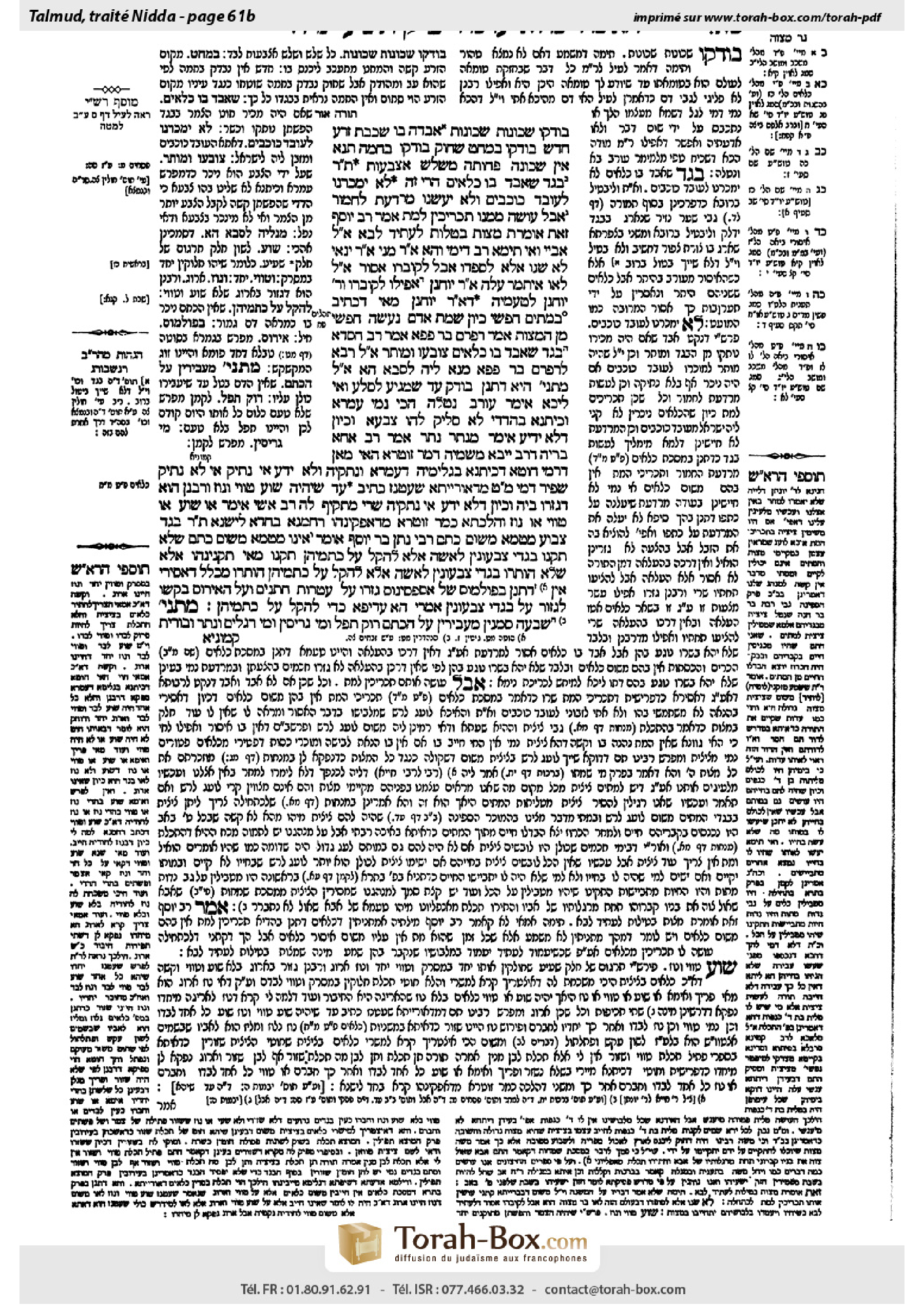
This page of Niddah includes the Aramaic text, an English translation and an AI-generated French translation, alongside the scan above.
נידה ס״א ב · Aramaic and Hebrew text
בּוֹדְקוֹ שְׁכוּנוֹת שְׁכוּנוֹת.
אָבְדָה בּוֹ שִׁכְבַת זֶרַע, חָדָשׁ — בּוֹדְקוֹ בְּמַחַט, שָׁחוּק — בּוֹדְקוֹ בַּחַמָּה. תָּנָא: אֵין ״שְׁכוּנָה״ פְּחוּתָה מִשְּׁלֹשׁ אֶצְבָּעוֹת.
תָּנוּ רַבָּנַן: בֶּגֶד שֶׁאָבַד בּוֹ כִּלְאַיִם — הֲרֵי זֶה לֹא יִמְכְּרֶנּוּ לְגוֹי, וְלֹא יַעֲשֶׂנּוּ מַרְדַּעַת לַחֲמוֹר, אֲבָל עוֹשֶׂה מִמֶּנּוּ תַּכְרִיכִין לְמֵת. אָמַר רַב יוֹסֵף: זֹאת אוֹמֶרֶת — מִצְוֹת בְּטֵלוֹת לֶעָתִיד לָבֹא.
אֲמַר לֵיהּ אַבָּיֵי, וְאִי תֵימָא רַב דִּימִי: וְהָא אָמַר רַבִּי מָנִי אֲמַר רַבִּי יַנַּאי, לֹא שָׁנוּ אֶלָּא לְסׇפְדוֹ, אֲבָל לְקוֹבְרוֹ אָסוּר. אֲמַר לֵיהּ: לָאו אִיתְּמַר עֲלַהּ, אָמַר רַבִּי יוֹחָנָן: אֲפִילּוּ לְקוֹבְרוֹ.
וְרַבִּי יוֹחָנָן לְטַעְמֵיהּ, דְּאָמַר רַבִּי יוֹחָנָן: מַאי דִכְתִיב ״בַּמֵּתִים חׇפְשִׁי״? כֵּיוָן שֶׁמֵּת אָדָם נַעֲשָׂה חׇפְשִׁי מִן הַמִּצְוֹת.
אָמַר רַפְרָם בַּר פָּפָּא, אָמַר רַב חִסְדָּא: בֶּגֶד שֶׁאָבַד בּוֹ כִּלְאַיִם — צוֹבְעוֹ, וּמוּתָּר. אֲמַר לֵיהּ רָבָא לְרַפְרָם בַּר פָּפָּא: מְנָא לֵיהּ לְסָבָא הָא?
אֲמַר לֵיהּ: מַתְנִיתִין הִיא, דִּתְנַן: בּוֹדֵק עַד שֶׁמַּגִּיעַ לְסֶלַע, וְאִי לֵיכָּא — אֵימַר עוֹרֵב נְטָלָהּ. הָכִי נָמֵי: עַמְרָא וְכִיתָּנָא בַּהֲדָדֵי לָא סָלֵיק לְהוּ צִבְעָא, וְכֵיוָן דְּלָא יְדִיעַ — אֵימַר מִנְתָּר נְתַר.
אָמַר רַב אַחָא בְּרֵיהּ דְּרַב יֵיבָא מִשְּׁמֵיהּ דְּמָר זוּטְרָא: הַאי מַאן דִּרְמֵי חוּטָא דְּכִיתָּנָא בִּגְלִימָיה דְּעַמְרָא וְנַתְּקֵיהּ, וְלָא יָדַע אִי נְתִיק אִי לָא נְתִיק — שַׁפִּיר דָּמֵי.
מַאי טַעְמָא? מִדְּאוֹרָיְיתָא ״שַׁעַטְנֵז״ כְּתִיב — עַד שֶׁיִּהְיֶה שׁוּעַ, טְוִוי, וְנוּז. וְרַבָּנַן הוּא דִּגְזַרוּ בֵּיהּ, וְכֵיוָן דְּלָא יָדַע אִי נַתְּקֵיהּ — שְׁרֵי.
מַתְקֵיף לַהּ רַב אָשֵׁי: אֵימַר אוֹ שׁוּעַ אוֹ טְוִוי אוֹ נוּז! וְהִלְכְתָא כְּמָר זוּטְרָא, מִדְּאַפְּקִינְהוּ רַחֲמָנָא בַּחֲדָא לִישָּׁנָא.
תָּנוּ רַבָּנַן: בֶּגֶד צָבוּעַ מְטַמֵּא מִשּׁוּם כֶּתֶם. רַבִּי נָתָן בַּר יוֹסֵף אוֹמֵר: אֵינוֹ מְטַמֵּא מִשּׁוּם כֶּתֶם, שֶׁלֹּא תִּקְּנוּ בִּגְדֵי צִבְעוֹנִין לְאִשָּׁה אֶלָּא לְהָקֵל עַל כִּתְמֵיהֶן.
תִּקְּנוּ? מַאי תַּקְּנִינְהוּ? אֶלָּא, שֶׁלֹּא הוּתְּרוּ בִּגְדֵי צִבְעוֹנִין לְאִשָּׁה אֶלָּא לְהָקֵל עַל כִּתְמֵיהֶן. ״הוּתְּרוּ״ — מִכְּלָל דַּאֲסִירִי!
אִין, דִּתְנַן: בַּפּוּלְמוּס שֶׁל אַסְפַּסְיָנוּס גָּזְרוּ עַל עַטְרוֹת חֲתָנִים וְעַל הָאִירוּס, בִּקְּשׁוּ לִגְזוֹר עַל בִּגְדֵי צִבְעוֹנִין. אָמְרִי: הָא עֲדִיפָא, כְּדֵי לְהָקֵל עַל כִּתְמֵיהֶן.
מַתְנִי' שִׁבְעָה סַמָּנִין מַעֲבִירִין עַל הַכֶּתֶם: רוֹק תָּפֵל, וּמֵי גְרִיסִין, וּמֵי רַגְלַיִם, וְנֶתֶר, וּבוֹרִית,
Niddah 61b · English translation
He examines it section by section, as by examining each part of the garment separately he will discover any remaining blood stain.
In the case of a garment in which a seminal emission, which is also ritually impure, was lost, i.e., it is not known where on the garment the semen is, if the garment is new, one examines it by sticking a needle into every part of it. In this manner he will feel if the semen is in the garment. If the garment is worn out, one examines it by holding it up to the sun, as the sun’s rays will not pass through the stained part of the garment. It was taught in a baraita: The section mentioned need not be less than three fingerbreadths by three fingerbreadths in area.
The Gemara cites another case of a garment in which something was lost. The Sages taught in a baraita: With regard to a garment in which diverse kinds, a prohibited mixture of wool and linen, was lost, i.e., it is a wool garment into which a linen thread was sewn or vice versa and it is not known where on the garment the thread is located, one may not sell it to a gentile and one may not even fashion it into a saddlecloth for a donkey. This is prohibited lest one remove a piece of the garment and sew it onto his own clothing. But one may fashion it into a shroud for a corpse, as there is no concern that one might remove it from the dead. Rav Yosef said: That is to say that the mitzvot will be nullified in the future. If this were not the case, then when the dead are resurrected they will be deriving benefit from the garment of diverse kinds in which they were buried.
Abaye said to Rav Yosef, and some say that Rav Dimi said to Rav Yosef: But didn’t Rabbi Mani say that Rabbi Yannai said: They taught that it is permitted to place a corpse in a shroud of diverse kinds only in order to eulogize him, but it is prohibited to bury him in a shroud of diverse kinds? Rav Yosef said to him: Wasn’t it stated with regard to that matter that Rabbi Yoḥanan says: It is even permitted to bury him in a shroud of diverse kinds?
And Rabbi Yoḥanan conforms to his standard line of reasoning in this regard, as Rabbi Yoḥanan said: What is the meaning of that which is written: “Set apart [ḥofshi] among the dead, like the slain that lie in the grave, whom You remember no more” (Psalms 88:6)? Once a person dies, he becomes free [ḥofshi] from the mitzvot.
§ Rafram bar Pappa says that Rav Ḥisda says: With regard to a garment in which diverse kinds was lost, one may dye it, and it is permitted to wear the garment, as wool and linen absorb dye differently, and therefore it will be easy to notice the location of the other kind of thread and remove it. Rava said to Rafram bar Pappa: From where does the Elder, i.e., Rav Ḥisda, derive this halakha?
Rafram bar Pappa said to him: It is derived from the mishna, as we learned: With regard to a pile of stones that was known to have an item of ritual impurity buried beneath it, one continues searching beneath each of these piles until he reaches bedrock. And if the impure item is not there, i.e., if he found nothing, one can say that a raven or some other animal took it. So too here, wool and flax, i.e., linen, do not absorb the dye in the same manner. And since he dyed the garment and he does not know of any mixture of linen and wool within it, as the entire garment absorbed the dye in the same way, one must say that that thread has fallen out, and therefore it is permitted to wear the garment.
Rav Aḥa, son of Rav Yeiva, said in the name of Mar Zutra: In a case of one who put a thread of flax in a cloak of wool and it fell out, but he does not know whether it all fell out or whether it did not all fall out, it is permitted to wear the cloak.
The Gemara asks: What is the reason that the halakha is lenient in this case of uncertainty? By Torah law, it is written: “Diverse kinds [sha’atnez]” (Deuteronomy 22:11), and this is interpreted as an acronym indicating that the halakha of diverse kinds does not apply unless the item is combed smooth [shua], spun [tavui] as a thread, and woven [nuz]. Without these characteristics, the combination is not considered diverse kinds by Torah law. And it is the Sages who decreed that diverse kinds that are merely attached to each other are prohibited, despite the fact that they are not combed and spun together. And in this case, since he does not know if it all fell out it is permitted, as the halakha is lenient with regard to uncertainties involving prohibitions that are by rabbinic law.
Rav Ashi objects to this leniency. One can say that by Torah law it is prohibited if the linen and wool are either combed, or spun, or woven. Perhaps the word sha’atnez does not limit the prohibition to a combination of all three activities, but to any one of them. The Gemara concludes: And the halakha is in accordance with the opinion of Mar Zutra, from the fact that the Merciful One expresses the prohibition in the Torah in one word, sha’atnez. Therefore, the term means all three characteristics together.
§ The Sages taught in a baraita: A colored garment renders a woman impure due to blood stains if she sees a blood stain on it. Rabbi Natan bar Yosef says: If she sees a blood stain on the colored garment she is not impure due to a blood stain, as the Sages enacted that women wear colored garments, and this decree was made only in order to be lenient with regard to their blood stains, i.e., so that they do not become impure.
The Gemara questions Rabbi Natan bar Yosef’s use of the word: Enacted. The Sages enacted? What was their enactment? Rather, Rabbi Natan bar Yosef said the reason that the Sages permitted colored garments to women was only in order to be lenient with regard to her blood stains. The Gemara raises an objection: From the statement that the Sages permitted colored garments one can conclude by inference they were previously prohibited. But was there a time when it was not permitted for women to wear colored garments?
The Gemara answers: Yes, as we learned in a mishna (Sota 49a): In the war [bapulmus] of Vespasian they decreed upon the crowns of bridegrooms, i.e., that bridegrooms may no longer wear crowns, and upon the drum [ha’irus], i.e., they also banned the playing of drums. They also sought to decree with regard to colored garments, i.e., that women may not wear such garments, but they said: This is preferable, that women should wear colored garments, in order to be lenient with regard to their blood stains, as a blood stain found on a colored garment does not render a woman ritually impure.
MISHNA: There are seven substances that one applies to the stain on a garment to ascertain whether it is a blood stain or a dye, as these seven substances remove the blood. They are: Tasteless saliva, and liquid from split beans, and urine, and natron, and borit,
Niddah 61b · Traduction française (IA)
Il l’examine section par section, car en examinant séparément chaque partie du vêtement, il découvrira toute tache de sang qui subsiste.
Dans le cas d’un vêtement où une émission séminale, qui est également rituellement impure, s’est perdue, c’est-à-dire qu’on ignore où se trouve le sperme sur le vêtement, si celui-ci est neuf, on l’examine en enfonçant une aiguille dans chacune de ses parties. De cette manière, on sentira si le sperme se trouve dans le vêtement. Si le vêtement est usé, on l’examine en le tenant face au soleil, car les rayons du soleil ne traverseront pas la partie tachée du vêtement. Il a été enseigné dans une baraïta : La section mentionnée ne doit pas mesurer moins de trois largeurs de doigt sur trois largeurs de doigt.
La Guemara cite un autre cas de vêtement où quelque chose s’est perdu. Les Sages ont enseigné dans une baraïta : Dans le cas d’un vêtement où un mélange de matières interdit, composé de laine et de lin, s’est perdu, c’est-à-dire un vêtement de laine dans lequel un fil de lin a été cousu, ou inversement, sans qu’on sache où se trouve le fil sur le vêtement, on ne peut pas le vendre à un non-Juif et on ne peut même pas en faire une housse de selle pour un âne. Cela est interdit, de crainte qu’il n’en détache un morceau et le couse sur son propre vêtement. Mais on peut en faire un linceul pour un mort, car on ne craint pas qu’on le retire du défunt. Rav Yossef dit : Cela signifie que les mitsvot seront abolies à l’avenir. Si ce n’était pas le cas, lorsque les morts ressusciteraient, ils tireraient profit du vêtement contenant un mélange de laine et de lin dans lequel ils auraient été ensevelis.
Abayé dit à Rav Yossef — certains disent que Rav Dimi dit à Rav Yossef : Mais Rabbi Mani n’a-t-il pas dit que Rabbi Yannai a dit : Ils ont enseigné qu’il est permis de placer un mort dans un linceul contenant un mélange de laine et de lin uniquement pour lui rendre les derniers honneurs, mais qu’il est interdit de l’ensevelir dans un tel linceul ? Rav Yossef lui dit : N’a-t-on pas déclaré à ce sujet que Rabbi Yoḥanan dit qu’il est même permis de l’ensevelir dans un linceul contenant un mélange de laine et de lin ?
Et Rabbi Yoḥanan suit ici son raisonnement habituel, car Rabbi Yoḥanan dit : Que signifie ce qui est écrit : « Mis à part [ḥofshi] parmi les morts, semblable aux victimes qui reposent dans le tombeau, dont Tu ne te souviens plus » (Psaumes 88:6) ? Lorsqu’un homme meurt, il est libéré [ḥofshi] des mitsvot.
§ Rafram bar Pappa dit au nom de Rav Ḥisda : Dans le cas d’un vêtement où un mélange de laine et de lin s’est perdu, on peut le teindre, et il est permis de le porter, car la laine et le lin absorbent la teinture différemment ; il sera donc facile de repérer l’emplacement du fil de l’autre matière et de le retirer. Rava dit à Rafram bar Pappa : D’où l’Ancien, c’est-à-dire Rav Ḥisda, tire-t-il cette halakha ?
Rafram bar Pappa lui dit : Cela se déduit de la Michna, car nous avons appris : À propos d’un tas de pierres sous lequel on sait qu’un objet rituellement impur a été enfoui, on poursuit les recherches sous chacun des tas jusqu’à atteindre la roche en place. Et si l’objet impur ne s’y trouve pas, c’est-à-dire si l’on n’a rien trouvé, on peut dire qu’un corbeau ou un autre animal l’a emporté. De même ici, la laine et le lin n’absorbent pas la teinture de la même manière. Et puisqu’il a teint le vêtement sans savoir qu’il contenait un mélange de lin et de laine, car tout le vêtement a absorbé la teinture de la même manière, on doit dire que ce fil est tombé ; il est donc permis de porter le vêtement.
Rav Aḥa, fils de Rav Yeiva, dit au nom de Mar Zutra : Dans le cas de quelqu’un qui a mis un fil de lin dans un manteau de laine et que celui-ci est tombé, mais qui ignore s’il est tombé entièrement ou s’il en reste une partie, il est permis de porter le manteau.
La Guemara demande : Pourquoi la halakha est-elle indulgente dans ce cas d’incertitude ? Selon la Torah écrite, il est écrit : « Mélange interdit [sha’atnez] » (Deutéronome 22:11), et ce terme est interprété comme un acronyme indiquant que l’interdiction du mélange ne s’applique que si les matières ont été peignées et lissées [shua], filées [tavui] en fil, et tissées [nuz]. Sans ces caractéristiques, l’association n’est pas considérée comme un mélange interdit selon la Torah. Ce sont les Sages qui ont décrété que des matières de laine et de lin simplement attachées l’une à l’autre sont interdites, bien qu’elles n’aient pas été peignées et filées ensemble. Dans ce cas, puisqu’il ignore si le fil est tombé entièrement, le vêtement est permis, car la halakha est indulgente face aux incertitudes concernant les interdits d’origine rabbinique.
Rav Ashi objecte à cette indulgence. On peut dire que, selon la Torah, le mélange de lin et de laine est interdit s’ils ont été peignés, ou filés, ou tissés. Peut-être le mot sha’atnez ne limite-t-il pas l’interdiction à l’association des trois opérations, mais signifie-t-il qu’une seule d’entre elles suffit. La Guemara conclut : La halakha est conforme à l’opinion de Mar Zutra, puisque le Miséricordieux exprime l’interdiction dans la Torah par un seul mot, sha’atnez. Le terme désigne donc les trois caractéristiques réunies.
§ Les Sages ont enseigné dans une baraïta : Une femme devient impure à cause d’une tache de sang si elle en voit une sur un vêtement coloré. Rabbi Natan bar Yossef dit : Si elle voit une tache de sang sur un vêtement coloré, elle ne devient pas impure à cause de cette tache, car les Sages ont décrété que les femmes portent des vêtements colorés, et ce décret avait uniquement pour but d’être indulgent à l’égard des taches de sang, c’est-à-dire d’éviter qu’elles ne deviennent impures.
La Guemara met en question l’emploi par Rabbi Natan bar Yossef du mot « décrété ». Les Sages ont décrété cela ? Quel était ce décret ? Rabbi Natan bar Yossef a plutôt dit que les Sages ont permis aux femmes de porter des vêtements colorés uniquement pour être indulgents à l’égard de leurs taches de sang. La Guemara objecte : De l’affirmation selon laquelle les Sages ont permis les vêtements colorés, on peut déduire qu’ils étaient auparavant interdits. Mais y a-t-il eu une époque où les femmes n’avaient pas le droit de porter des vêtements colorés ?
La Guemara répond : Oui, car nous avons appris dans une Michna (Sota 49a) : Pendant la guerre [bapulmus] de Vespasien, ils ont décrété l’interdiction des couronnes des mariés, c’est-à-dire que les mariés ne pouvaient plus porter de couronnes, ainsi que celle du tambour [ha’irus], c’est-à-dire qu’ils ont également interdit de jouer du tambour. Ils ont aussi voulu décréter l’interdiction des vêtements colorés, c’est-à-dire que les femmes ne pourraient plus porter de tels vêtements, mais ils ont dit : Il vaut mieux que les femmes portent des vêtements colorés, afin d’être indulgents à l’égard de leurs taches de sang, car une tache de sang trouvée sur un vêtement coloré ne rend pas une femme rituellement impure.
MICHNA : Il existe sept substances que l’on applique sur la tache d’un vêtement pour déterminer s’il s’agit d’une tache de sang ou de teinture, car ces sept substances éliminent le sang. Ce sont : la salive insipide, le liquide de fèves écrasées, l’urine, le natron et le borit,
Traduction française générée par IA à partir de l’édition anglaise de Sefaria. Vérifie toujours un passage avec le texte source.
Text from Sefaria: William Davidson Edition - Vocalized Aramaic (CC BY NC); William Davidson Edition - English (CC BY NC).