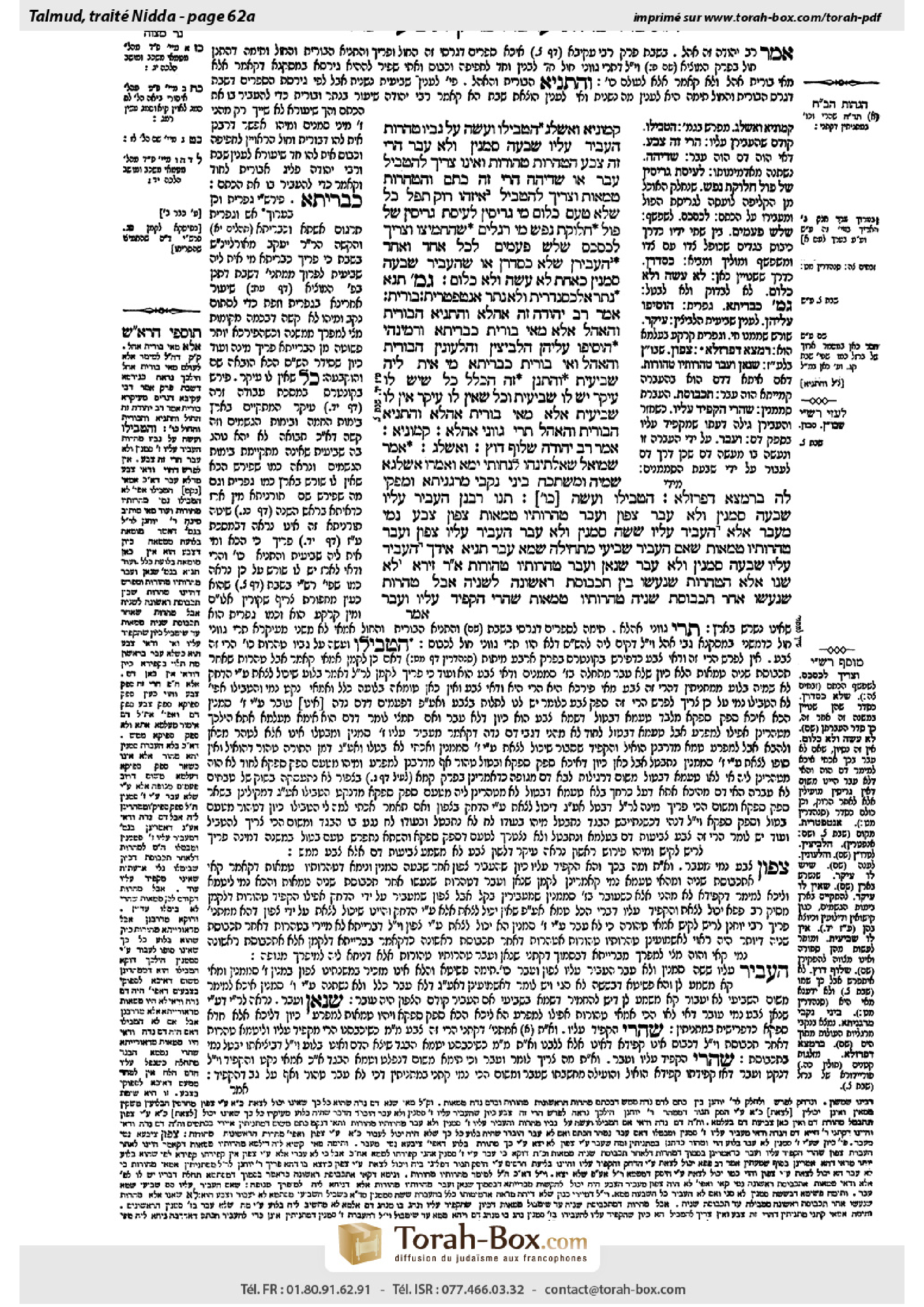
Niddah 62a: Talmud study for Daf Yomi
Daf Yomi is the daily study of one Talmud folio. Explore 37 tractates with scans, Hebrew text, Sefaria English and AI-generated French translations where annotated.
Passage selection and English or AI-generated French translation are available where the scan has annotations. Daf Study is independent of Torah-Box and Sefaria.
Browse Niddah · נידה · All tractatesNiddah 62a text and translations
This page of Niddah includes the Aramaic text, an English translation and an AI-generated French translation, alongside the scan above.
נידה ס״ב א · Aramaic and Hebrew text
קִמוֹנְיָא, וְאַשְׁלָג.
הִטְבִּילוֹ וְעָשָׂה עַל גַּבָּיו טְהָרוֹת, הֶעֱבִיר עָלָיו שִׁבְעָה סַמָּנִין וְלֹא עָבַר — הֲרֵי זֶה צֶבַע, הַטְּהָרוֹת טְהוֹרוֹת וְאֵינוֹ צָרִיךְ לְהַטְבִּיל. עָבַר אוֹ שֶׁדֵּהָה — הֲרֵי זֶה כֶּתֶם, וְהַטְּהָרוֹת טְמֵאוֹת וְצָרִיךְ לְהַטְבִּיל.
אֵיזֶהוּ רוֹק תָּפֵל? כֹּל שֶׁלֹּא טָעַם כְּלוּם. מֵי גְרִיסִין — לְעִיסַּת גְּרִיסִין שֶׁל פּוֹל חֲלוּקַת נֶפֶשׁ. מֵי רַגְלַיִם — שֶׁהֶחְמִיצוּ.
וְצָרִיךְ לְכַסְכֵּס שָׁלֹשׁ פְּעָמִים לְכׇל אֶחָד וְאֶחָד, הֶעֱבִירָן שֶׁלֹּא כְּסִדְרָן, אוֹ שֶׁהֶעֱבִיר שִׁבְעָה סַמָּנִין כְּאַחַת — לֹא עָשָׂה וְלֹא כְלוּם.
גְּמָ' תָּנָא: נֶתֶר אֲלֶכְּסַנְדְּרִית, וְלֹא נֶתֶר אַנְטִפַּטְרִית.
בּוֹרִית. אָמַר רַב יְהוּדָה: זֶה אַהֲלָא. וְהָתַנְיָא: הַבּוֹרִית וְהָאָהָל! אֶלָּא מַאי בּוֹרִית? כַּבְרִיתָא.
וּרְמִינְהִי: הוֹסִיפוּ עֲלֵיהֶן הַלְבֵּיצִין, וְהַלְּעוֹנִין, הַבּוֹרִית, וְהָאָהָל. וְאִי בּוֹרִית כַּבְרִיתָא, מִי אִית לֵיהּ שְׁבִיעִית? וְהָתְנַן: זֶה הַכְּלָל: כֹּל שֶׁיֵּשׁ לוֹ עִיקָּר — יֵשׁ לוֹ שְׁבִיעִית, וְכֹל שֶׁאֵין לוֹ עִיקָּר — אֵין לוֹ שְׁבִיעִית! אֶלָּא מַאי בּוֹרִית? אַהֲלָא. וְהָתַנְיָא: הַבּוֹרִית וְהָאָהָל! תְּרֵי גַּוְונֵי אַהֲלָא.
קִמוֹנְיָא. אָמַר רַב יְהוּדָה: שְׁלוֹף דּוֹץ. וְאַשְׁלָג, אָמַר שְׁמוּאֵל: שְׁאֵלְתִּינְהוּ לְנָחוֹתֵי יַמָּא, וַאֲמַרוּ: אַשְׁלָגָא שְׁמֵיהּ, וּמִשְׁתְּכַח בֵּינֵי נִקְבֵי מַרְגָּנִיתָא, וּמַפְּקִי לֵהּ בְּרַמְצָא דְּפַרְזְלָא.
הִטְבִּילוֹ וְעָשָׂה [כּוּ׳]. תָּנוּ רַבָּנַן: הֶעֱבִיר עָלָיו שִׁבְעָה סַמָּנִין וְלֹא עָבַר, צַפּוֹן וְעָבַר — טׇהֳרוֹתָיו טְמֵאוֹת.
צַפּוֹן צֶבַע נָמֵי מְעַבַּר! אֶלָּא, הֶעֱבִיר עָלָיו שִׁשָּׁה סַמָּנִין וְלֹא עָבַר, הֶעֱבִיר עָלָיו צַפּוֹן וְעָבַר — טׇהֳרוֹתָיו טְמֵאוֹת, שֶׁאִם הֶעֱבִיר שְׁבִיעִי מִתְּחִילָּה, שֶׁמָּא עָבַר.
תַּנְיָא אִידַּךְ: הֶעֱבִיר עָלָיו שִׁבְעָה סַמָּנִין וְלֹא עָבַר, שְׁנָאָן וְעָבַר — טׇהֳרוֹתָיו טְהוֹרוֹת.
אָמַר רַבִּי זֵירָא: לֹא שָׁנוּ אֶלָּא הַטְּהָרוֹת שֶׁנַּעֲשׂוּ בֵּין תִּכְבּוֹסֶת רִאשׁוֹנָה לַשְּׁנִיָּה, אֲבָל טְהָרוֹת שֶׁנַּעֲשׂוּ אַחַר תִּכְבּוֹסֶת שְׁנִיָּה — טׇהֳרוֹתָיו טְמֵאוֹת, שֶׁהֲרֵי הִקְפִּיד עָלָיו וְעָבַר.
Niddah 62a · English translation
Cimolian earth [kamonya], and potash [eshlag].
If one immersed the garment with the stain whose nature is unknown and then handled ritually pure items with the garment, and then applied these seven substances to the stain and it did not disappear, that stain is presumably from a dye, and therefore the ritually pure items are pure, and he need not immerse the garment again, as there is no impurity. If the stain disappeared or if it faded, that is a blood stain, and the ritually pure items that he handled are impure, and he must immerse the garment again.
What is tasteless saliva? It is saliva that emerges from the mouth of any person who tasted nothing all night, when he first awakens in the morning. Liquid from split beans is created through the chewing of split beans that divided naturally, not by human hand, which is then applied to the stain. The urine that is an effective detergent is specifically urine that fermented for three days.
And one must rub each and every one of the substances three times over the stain, and one must apply them separately, and one must apply them in the order they are listed in the mishna. If one applied them in a manner that is not in their prescribed order, or if one applied all seven substances simultaneously, he has done nothing. One cannot determine by means of that examination whether it is blood or a dye.
GEMARA: The Gemara clarifies the identities of the seven substances that remove blood stains. With regard to natron, a Sage taught in a baraita: This is referring to Alexandrian natron, i.e., from the city in Egypt, and not natron from Anpantrin, which is of a different quality.
The mishna lists borit as one of the seven substances. Rav Yehuda says: This is referring to ice plant. The Gemara raises an objection: But isn’t it taught in a baraita: Borit and ice plant, which indicates that they are two different substances? Rather, what is borit? Sulfur.
And the Gemara raises a contradiction from the baraita discussing the halakha of plants whose use is prohibited during the Sabbatical Year: They added to the list of such plants: Bulbs of ornithogalum, and wormwood, and borit, and ice plant. And if it would enter your mind to say that borit is sulfur, is there sulfur that is subject to the halakhot of the Sabbatical Year? But didn’t we learn in a baraita that this is the principle: Anything that has a root and grows is subject to the halakhot of the Sabbatical Year, and anything that does not have a root is not subject to the halakhot of the Sabbatical Year? Rather, what is borit? It is ice plant. But isn’t it taught in the baraita: And borit and ice plant? The Gemara explains that there are two types of ice plant, one of which is called borit.
With regard to the Cimolian earth mentioned in the mishna, Rav Yehuda said: This is the earth referred to as: Pull out, stick in. And with regard to the eshlag mentioned in the mishna, Shmuel said: I asked all of the seafarers about the identity of eshlag, and they told me it is called ashlega, in Aramaic, and can be found in the shell of the pearl, and is removed with an iron skewer.
§ The mishna teaches: If one immersed the garment with the stain whose nature is unknown and then handled ritually pure items with the garment, and then applied these seven substances to the stain and it did not disappear, that stain is a dye, and therefore the ritually pure items are pure, and he need not immerse the garment again, as there is no impurity. The Sages taught in a baraita: If one applied these seven substances to the stain and it did not disappear, but he then applied soap [tzafon] and it disappeared, any ritually pure items that he handled with the garment are impure.
The Gemara raises an objection with regard to this ruling: But soap causes dye to disappear as well; why then should one assume that the stain was blood? Rather, the baraita means that if one applied only six of the seven substances to it and the stain did not disappear, and he then applied soap to the stain and it disappeared, any ritually pure items that he handled with the garment are impure. The reason is that if he had applied all seven substances initially, perhaps the stain would have disappeared, proving that it was blood. Consequently, the garment is rendered impure due to uncertainty.
It is taught in another baraita: If one applied the seven substances to the stain and it did not disappear, indicating that it is a dye, and he then repeated and applied the seven substances a second time and the stain disappeared, any ritually pure items that he handled with the garment remain ritually pure.
In explanation of this baraita, Rabbi Zeira says: They taught that the pure items remain pure only with regard to the ritually pure items that were handled between the first washing with the seven substances and the second washing. But with regard to any pure items that were handled with the garment after the second washing, these pure items become impure, as he was particular about it, i.e., by repeating the washing procedure he showed he was concerned that it might be blood, and the stain disappeared, demonstrating that it was in fact blood.
Niddah 62a · Traduction française (IA)
Terre cimolienne [kamonya] et potasse [eshlag].
Si quelqu’un a immergé le vêtement portant la tache de nature inconnue, puis a manipulé avec ce vêtement des objets rituellement purs, avant d’appliquer les sept substances sur la tache, et que celle-ci n’a pas disparu, on présume qu’il s’agit d’une tache de teinture. Les objets rituellement purs sont donc purs, et il n’est pas nécessaire d’immerger de nouveau le vêtement, puisqu’il n’y a pas d’impureté. Si la tache a disparu ou s’est atténuée, il s’agit d’une tache de sang ; les objets rituellement purs qu’il a manipulés sont impurs et il doit immerger de nouveau le vêtement.
Qu’est-ce que la salive insipide ? C’est la salive qui sort de la bouche de toute personne qui n’a rien goûté de toute la nuit, au moment où elle se réveille pour la première fois le matin. Le liquide de fèves fendues est obtenu en mâchant des fèves qui se sont fendues naturellement, et non sous l’action de la main de l’homme ; on l’applique ensuite sur la tache. L’urine qui est un détergent efficace est précisément celle qui a fermenté pendant trois jours.
Il faut frotter chacune de ces substances sur la tache trois fois, les appliquer séparément et respecter l’ordre dans lequel elles sont énumérées dans la Michna. Si on les applique dans un ordre différent ou si on applique les sept substances simultanément, l’opération est sans effet. Cet examen ne permet pas de déterminer s’il s’agit de sang ou d’une teinture.
GUEMARA : La Guemara précise l’identité des sept substances qui font disparaître les taches de sang. Au sujet du natron, un Sage enseigne dans une baraïta : il s’agit du natron alexandrin, c’est-à-dire celui de la ville d’Égypte, et non du natron d’Anpantrin, qui est d’une autre qualité.
La Michna énumère la borit parmi les sept substances. Rav Yehouda dit : il s’agit de la plante à glace. La Guemara objecte : mais n’est-il pas enseigné dans une baraïta : « borit et plante à glace », ce qui indique qu’il s’agit de deux substances différentes ? Que désigne donc la borit ? Le soufre.
La Guemara soulève une contradiction à partir de la baraïta qui traite de la halakha concernant les plantes dont l’usage est interdit durant l’année de la Chemita : on a ajouté à la liste de ces plantes les bulbes d’ornithogale, l’absinthe, la borit et la plante à glace. Or, si tu pensais que la borit désigne le soufre, le soufre serait-il soumis aux lois de la Chemita ? Pourtant, n’avons-nous pas appris dans une baraïta le principe suivant : tout ce qui possède une racine et pousse est soumis aux lois de la Chemita, tandis que tout ce qui ne possède pas de racine ne l’est pas ? Que désigne donc la borit ? La plante à glace. Mais n’est-il pas enseigné dans la baraïta : « la borit et la plante à glace » ? La Guemara explique qu’il existe deux sortes de plantes à glace, dont l’une est appelée borit.
Au sujet de la terre cimolienne mentionnée dans la Michna, Rav Yehouda a dit : c’est la terre appelée « tire, plante ». Et au sujet de l’eshlag mentionné dans la Michna, Chmouel a dit : j’ai interrogé tous les marins sur l’identité de l’eshlag, et ils m’ont dit qu’on l’appelle ashlega en araméen, qu’on le trouve dans la coquille de la perle et qu’on l’en retire avec une broche de fer.
§ La Michna enseigne : si quelqu’un a immergé le vêtement portant la tache de nature inconnue, puis a manipulé avec ce vêtement des objets rituellement purs, avant d’appliquer les sept substances sur la tache, et que celle-ci n’a pas disparu, il s’agit d’une tache de teinture. Les objets rituellement purs sont donc purs, et il n’est pas nécessaire d’immerger de nouveau le vêtement, puisqu’il n’y a pas d’impureté. Les Sages ont enseigné dans une baraïta : si quelqu’un a appliqué les sept substances sur la tache et que celle-ci n’a pas disparu, puis a appliqué du savon [tzafon] et que la tache a disparu, tous les objets rituellement purs qu’il a manipulés avec le vêtement sont impurs.
La Guemara objecte à cette décision : le savon fait également disparaître les teintures ; pourquoi présumer alors qu’il s’agissait de sang ? La baraïta veut plutôt dire que si quelqu’un n’a appliqué que six des sept substances et que la tache n’a pas disparu, puis a appliqué du savon sur la tache et que celle-ci a disparu, tous les objets rituellement purs qu’il a manipulés avec le vêtement sont impurs. En effet, s’il avait appliqué d’emblée les sept substances, la tache aurait peut-être disparu, ce qui aurait prouvé qu’il s’agissait de sang. Par conséquent, le vêtement est impur en raison du doute.
Il est enseigné dans une autre baraïta : si quelqu’un a appliqué les sept substances sur la tache et qu’elle n’a pas disparu, indiquant qu’il s’agit d’une teinture, puis a répété l’opération et appliqué une seconde fois les sept substances, et que la tache a disparu, tous les objets rituellement purs qu’il a manipulés avec le vêtement restent purs.
Pour expliquer cette baraïta, Rabbi Zeira dit : ils ont enseigné que les objets purs restent purs uniquement dans le cas des objets rituellement purs manipulés entre le premier lavage avec les sept substances et le second. En revanche, les objets purs manipulés avec le vêtement après le second lavage deviennent impurs, car il s’en était préoccupé : en répétant le lavage, il a montré qu’il craignait qu’il puisse s’agir de sang, et la disparition de la tache a démontré qu’il s’agissait bien de sang.
Traduction française générée par IA à partir de l’édition anglaise de Sefaria. Vérifie toujours un passage avec le texte source.
Text from Sefaria: William Davidson Edition - Vocalized Aramaic (CC BY NC); William Davidson Edition - English (CC BY NC).