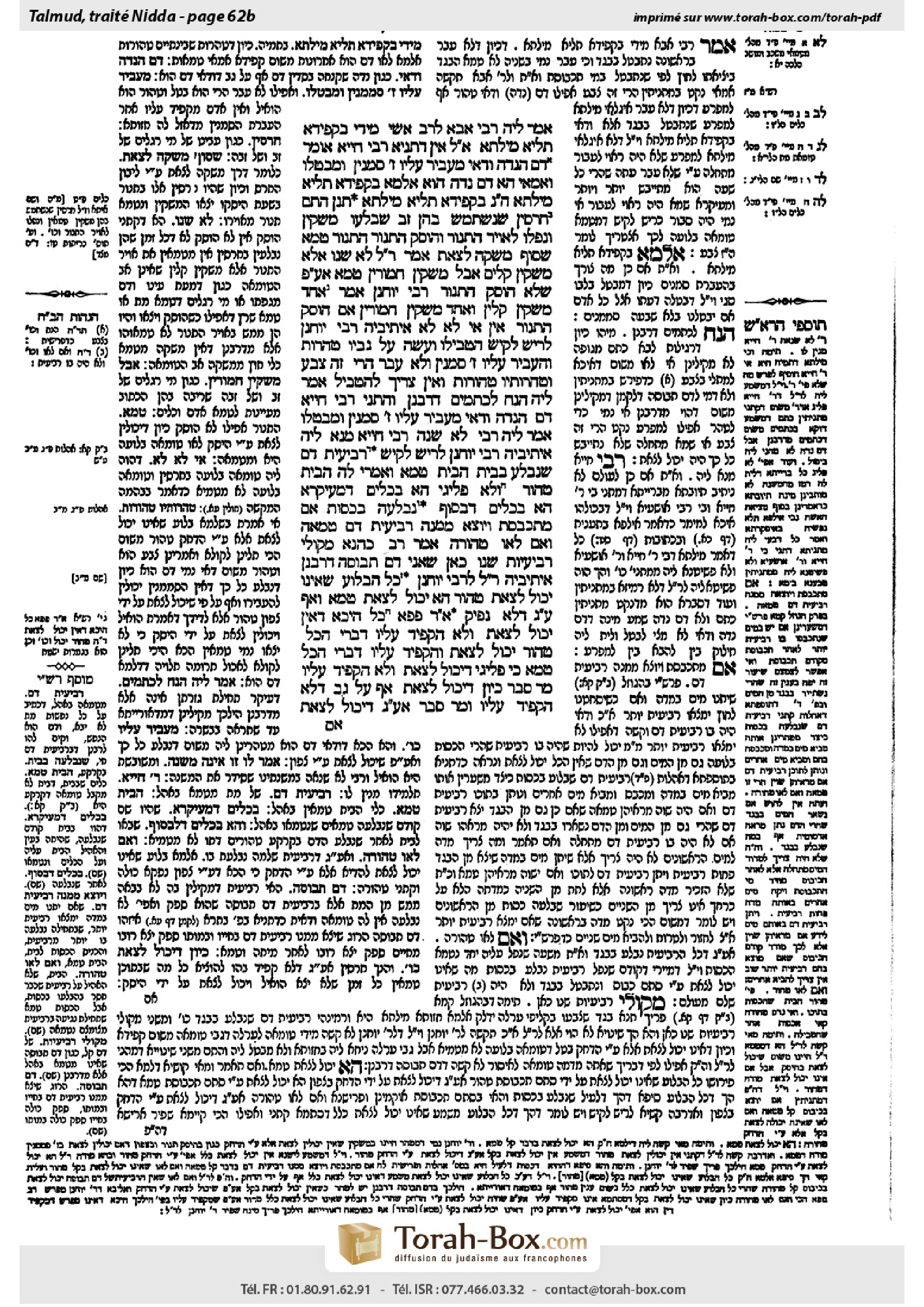
Niddah 62b: Talmud study for Daf Yomi
Daf Yomi is the daily study of one Talmud folio. Explore 37 tractates with scans, Hebrew text, Sefaria English and AI-generated French translations where annotated.
Passage selection and English or AI-generated French translation are available where the scan has annotations. Daf Study is independent of Torah-Box and Sefaria.
Browse Niddah · נידה · All tractatesNiddah 62b text and translations
This page of Niddah includes the Aramaic text, an English translation and an AI-generated French translation, alongside the scan above.
נידה ס״ב ב · Aramaic and Hebrew text
אֲמַר לֵיהּ רַבִּי אַבָּא לְרַב אָשֵׁי: מִידֵּי בִּקְפִידָא תַּלְיָא מִילְּתָא?
אֲמַר לֵיהּ: אִין, דְּתַנְיָא: רַבִּי חִיָּיא אוֹמֵר: דַּם הַנִּדָּה וַדַּאי — מַעֲבִיר עָלָיו שִׁבְעָה סַמָּנִין, וּמְבַטְּלוֹ.
וְאַמַּאי? הָא דַּם נִדָּה הוּא! אַלְמָא בִּקְפֵידָא תַּלְיָא מִילְּתָא, הָכִי נָמֵי בִּקְפֵידָא תַּלְיָא מִילְּתָא.
תְּנַן הָתָם: חֲרָסִין שֶׁנִּשְׁתַּמֵּשׁ בָּהֶן זָב, שֶׁבָּלְעוּ מַשְׁקִין, וְנָפְלוּ לַאֲוִיר הַתַּנּוּר, וְהוּסַּק הַתַּנּוּר — הַתַּנּוּר טָמֵא, שֶׁסּוֹף מַשְׁקֶה לָצֵאת.
אָמַר רֵישׁ לָקִישׁ: לֹא שָׁנוּ אֶלָּא מַשְׁקִין קַלִּים, אֲבָל מַשְׁקִין חֲמוּרִין — טָמֵא, אַף עַל פִּי שֶׁלֹּא הוּסַּק הַתַּנּוּר. רַבִּי יוֹחָנָן אָמַר: אֶחָד מַשְׁקִין קַלִּין וְאֶחָד מַשְׁקִין חֲמוּרִין, אִם הוּסַּק הַתַּנּוּר — אִין, אִי לָא — לָא.
אֵיתִיבֵיהּ רַבִּי יוֹחָנָן לְרֵישׁ לָקִישׁ: הִטְבִּילוֹ, וְעָשָׂה עַל גַּבָּיו טְהָרוֹת, וְהֶעֱבִיר עָלָיו שִׁבְעָה סַמָּנִין וְלֹא עָבַר — הֲרֵי זֶה צֶבַע, וְטׇהֳרוֹתָיו טְהוֹרוֹת, וְאֵין צָרִיךְ לְהַטְבִּיל!
אֲמַר לֵיהּ: הַנַּח לִכְתָמִים דְּרַבָּנַן.
וְהָתָנֵי רַבִּי חִיָּיא: דַּם הַנִּדָּה וַדַּאי — מַעֲבִיר עָלָיו שִׁבְעָה סַמָּנִין וּמְבַטְּלוֹ!
אֲמַר לֵיהּ: רַבִּי לֹא שָׁנָה, רַבִּי חִיָּיא מְנָא לֵיהּ?
אֵיתִיבֵיהּ רַבִּי יוֹחָנָן לְרֵישׁ לָקִישׁ: רְבִיעִית דָּם שֶׁנִּבְלַע בַּבַּיִת — הַבַּיִת טָמֵא, וְאָמְרִי לַהּ: הַבַּיִת טָהוֹר. וְלָא פְּלִיגִי — הָא בְּכֵלִים דְּמֵעִיקָּרָא, הָא בְּכֵלִים דְּבַסּוֹף.
נִבְלְעָה בִּכְסוּת, אִם מִתְכַּבֶּסֶת וְיוֹצֵא מִמֶּנָּה רְבִיעִית דָּם — טְמֵאָה, וְאִם לָאו — טְהוֹרָה!
אָמַר רַב כָּהֲנָא: מִקּוּלֵּי רְבִיעִיּוֹת שָׁנוּ כָּאן, שָׁאנֵי דַּם תְּבוּסָה דְּרַבָּנַן.
אֵיתִיבֵיהּ רֵישׁ לָקִישׁ לְרַבִּי יוֹחָנָן: כׇּל הַבָּלוּעַ שֶׁאֵינוֹ יָכוֹל לָצֵאת — טָהוֹר. הָא יָכוֹל לָצֵאת — טָמֵא, וְאַף עַל גַּב דְּלָא נָפֵיק!
אָמַר רַב פָּפָּא: כֹּל הֵיכָא דְּאֵין יָכוֹל לָצֵאת, וְלֹא הִקְפִּיד עָלָיו — דִּבְרֵי הַכֹּל טָהוֹר; יָכוֹל לָצֵאת וְהִקְפִּיד עָלָיו — דִּבְרֵי הַכֹּל טָמֵא.
כִּי פְּלִיגִי דְּיָכוֹל לָצֵאת וְלֹא הִקְפִּיד עָלָיו, מָר סָבַר: כֵּיוָן דְּיָכוֹל לָצֵאת, אַף עַל גַּב דְּלֹא הִקְפִּיד עָלָיו, וּמָר סָבַר: אַף עַל גַּב דְּיָכוֹל לָצֵאת
Niddah 62b · English translation
Rabbi Abba said to Rav Ashi, with regard to his statement: Does the matter of purity or impurity depend on whether or not one is particular about the blood stain? If the items he handled on the garment between the first and second washings are ritually pure, then any items he handled after the second washing should likewise be pure.
Rav Ashi said to him: Yes, the status of purity depends upon whether or not the owner of the garment is particular about the stain. As it is taught in a baraita that Rabbi Ḥiyya says: If one finds blood on a garment that is certainly from a menstruating woman and therefore renders the garment impure, one may apply the seven substances listed in the mishna to it and thereby nullify it from being considered a blood stain at all, even if the stain is not completely removed. And he may then immerse the garment in a ritual bath and it is ritually pure.
Rav Ashi analyzes this ruling: But why is the garment pure? After all, it has blood from a menstruating woman on it. Evidently, the matter of whether or not it is ritually pure depends upon whether or not the owner of the garment is particular about the blood stain. So too here, the matter of whether or not it is ritually pure depends upon whether or not the owner of the garment is particular about the blood stain.
§ We learned in a mishna there (see Kelim 9:5): In a case of pottery, i.e., a chamber pot, that a man who experiences a gonorrhea-like discharge [zav] has used and that has absorbed impure liquids from the zav, and it then fell into the air of an oven, and the oven was subsequently heated, the oven is impure, as the impure liquid will eventually emerge from the chamber pot due to the heat of the oven.
The amora’im disagree with regard to the correct interpretation of this mishna. Reish Lakish says: They taught that the oven is impure once it is heated only with regard to liquids of lesser ritual impurity, i.e., that are not primary sources of impurity, such as the tears or urine of one who was rendered impure by contact with a corpse. But with regard to liquids of greater ritual impurity, e.g., urine of a zav or zava, the oven is impure even though the oven was not heated. Rabbi Yoḥanan says: With regard to both liquids of lesser ritual impurity and liquids of greater ritual impurity that fell into an oven, if the oven was heated, then yes, the oven is impure, but if the oven was not heated, it is not impure.
Rabbi Yoḥanan raised an objection to Reish Lakish from the mishna: If one immersed the garment with the stain whose nature is unknown, and then handled ritually pure items with the garment, and then applied these seven substances to the stain and it did not disappear, that stain is presumably from a dye, and therefore the ritually pure items are ritually pure, and he need not immerse the garment again, as there is no impurity. Rabbi Yoḥanan understands that the stain is not definitely from a dye; even if it is from blood, such blood that is absorbed into the garment to the degree that it does not come out after this process is performed, does not impart ritual impurity. The same should apply in the case of the oven, i.e., the liquids should impart impurity only when the oven is heated and they actually emerge.
Reish Lakish said to Rabbi Yoḥanan in response: Leave aside blood stains, i.e., one cannot cite a proof from them, as they impart impurity by rabbinic law, and for this reason the Sages were lenient and ruled that they do not impart impurity until they actually emerge. But with regard to liquids that are impure by Torah law, the halakha is different.
Rabbi Yoḥanan raises another objection to Reish Lakish: But didn’t Rabbi Ḥiyya teach: If one finds blood on a garment that is certainly from a menstruating woman and therefore renders the garment impure, one may apply the seven substances listed in the mishna to it and nullify the stain from being considered a blood stain at all, even if the stain is not entirely removed; and he may then immerse the garment in a ritual bath and it is ritually pure?
Reish Lakish said to Rabbi Yoḥanan in response: You cannot raise an objection to me from the baraita of Rabbi Ḥiyya, since if Rabbi Yehuda HaNasi did not teach this halakha in the Mishna, from where did Rabbi Ḥiyya learn it? Rabbi Ḥiyya was a student of Rabbi Yehuda HaNasi, and therefore he could not have included a halakha that contradicts the Mishna. Consequently, this statement in his name must be erroneous.
Rabbi Yoḥanan raised an objection to Reish Lakish from a mishna (Oholot 3:2): With regard to a quarter-log of blood from a corpse that was absorbed in the floor of a house, every vessel in the house is ritually impure by virtue of being under the same roof as the blood. The Gemara parenthetically notes: And some say that the mishna states that every vessel in the house is ritually pure. And these two statements do not disagree, as this first statement was issued in reference to vessels that were in the house at the outset, before the blood became absorbed; and this second statement was issued in reference to vessels that came into the house at the end, after the blood had already been absorbed.
The mishna continues: In a case where the blood was absorbed in a garment, it is examined. If the garment is washed and a quarter-log of blood emerges from it, it is ritually impure and it imparts impurity to the vessels in the house as well. But if not, then it is pure, and it does not impart impurity. Apparently, only blood that can be removed from a garment is considered blood, whereas blood absorbed in the garment is insignificant. This is in accordance with the opinion that an absorbed substance does not impart ritual impurity, even if it can be removed in some manner.
Rav Kahana said in response: They taught here a halakha from among the leniencies that apply to the measurement of a quarter-log. That is, this case is different, as the mishna is referring to the blood of submission discharged from a body at the time of death, and such blood is ritually impure by rabbinic law. But in general, a ritually impure liquid that is absorbed into an item does impart impurity.
Reish Lakish raised an objection to Rabbi Yoḥanan from a mishna (Oholot 3:2): Any liquid that is absorbed but that is unable to emerge is pure. Reish Lakish infers from this mishna that if it is able to emerge it is impure, and that this is the halakha even though it has not yet emerged.
Rav Pappa said in defense of Rabbi Yoḥanan’s opinion: Anywhere that the liquid is unable to emerge and the owner of the garment is not particular about it, i.e., he is not bothered that this liquid is absorbed within the garment, everyone, i.e., both Rabbi Yoḥanan and Reish Lakish, agrees that the garment is pure. If the liquid is able to emerge and the owner of the garment is particular about it and does not want it in his garment, everyone agrees that the garment is impure.
They disagree when the liquid is able to emerge and the owner is not particular about it. One Sage, Reish Lakish, holds that since the liquid is able to emerge, even though the owner is not particular about it, the garment is impure. And one Sage, Rabbi Yoḥanan, holds that even though the liquid is able to emerge,
Niddah 62b · Traduction française (IA)
Rabbi Abba dit à Rav Ashi, au sujet de sa déclaration : Le statut de pureté ou d’impureté dépend-il du fait que l’on se soucie ou non de la tache de sang ? Si les objets qu’il a manipulés avec le vêtement entre le premier et le deuxième lavage sont rituellement purs, alors les objets qu’il a manipulés après le deuxième lavage devraient eux aussi être purs.
Rav Ashi lui dit : Oui, le statut de pureté dépend du fait que le propriétaire du vêtement se soucie ou non de la tache. En effet, il est enseigné dans une baraïta que Rabbi Ḥiyya dit : Si l’on trouve sur un vêtement du sang provenant certainement d’une femme menstruée et qui rend donc le vêtement impur, on peut lui appliquer les sept substances énumérées dans la Michna et ainsi faire en sorte qu’il ne soit plus considéré du tout comme une tache de sang, même si la tache n’est pas entièrement éliminée. On peut ensuite immerger le vêtement dans un bain rituel, et il est rituellement pur.
Rav Ashi analyse cette décision : Mais pourquoi le vêtement est-il pur ? Après tout, il porte du sang provenant d’une femme menstruée. Il apparaît donc que le fait qu’il soit rituellement pur ou non dépend du fait que le propriétaire du vêtement se soucie ou non de la tache de sang. De même ici, le fait qu’il soit rituellement pur ou non dépend du fait que le propriétaire du vêtement se soucie ou non de la tache de sang.
§ Nous avons appris dans une Michna, là-bas (voir Kelim 9:5) : Dans le cas d’un récipient en terre cuite, c’est-à-dire un pot de chambre, utilisé par un homme atteint d’un écoulement de type gonorrhéique [zav], qui a absorbé des liquides impurs provenant du zav, puis tombé dans l’espace intérieur d’un four, si le four est ensuite chauffé, celui-ci est impur, car le liquide impur finira par ressortir du pot de chambre sous l’effet de la chaleur du four.
Les amoraïm sont en désaccord sur l’interprétation exacte de cette Michna. Reish Lakish dit : Ils ont enseigné que le four devient impur lorsqu’il est chauffé uniquement à propos de liquides de moindre degré d’impureté rituelle, c’est-à-dire qui ne sont pas des sources primaires d’impureté, comme les larmes ou l’urine d’une personne rendue impure par contact avec un cadavre. Mais, s’il s’agit de liquides d’un degré supérieur d’impureté rituelle, par exemple l’urine d’un zav ou d’une zava, le four est impur même s’il n’a pas été chauffé. Rabbi Yoḥanan dit : Pour les liquides de moindre degré d’impureté rituelle comme pour ceux de degré supérieur, lorsqu’ils tombent dans un four, si le four est chauffé, alors oui, il est impur ; mais s’il n’est pas chauffé, il n’est pas impur.
Rabbi Yoḥanan soulève une objection contre Reish Lakish à partir de la Michna : Si l’on a immergé le vêtement portant la tache dont la nature est inconnue, puis manipulé avec ce vêtement des objets rituellement purs, et qu’on a ensuite appliqué ces sept substances sur la tache sans qu’elle disparaisse, celle-ci provient vraisemblablement d’une teinture ; les objets rituellement purs sont donc purs, et il n’est pas nécessaire d’immerger de nouveau le vêtement, puisqu’il n’y a pas d’impureté. Rabbi Yoḥanan comprend que la tache ne provient pas certainement d’une teinture ; même s’il s’agit de sang, un sang absorbé dans le vêtement au point de ne pas en sortir après cette procédure ne transmet pas l’impureté rituelle. Il devrait en être de même dans le cas du four : les liquides ne devraient transmettre l’impureté que lorsque le four est chauffé et qu’ils en ressortent effectivement.
Reish Lakish répondit à Rabbi Yoḥanan : Écarte les taches de sang ; on ne peut pas en tirer de preuve, car elles transmettent l’impureté selon le droit rabbinique. C’est pourquoi les Sages ont été indulgents et ont statué qu’elles ne transmettent pas l’impureté avant de ressortir effectivement. Mais, pour les liquides impurs selon la Torah, la halakha est différente.
Rabbi Yoḥanan soulève une autre objection contre Reish Lakish : Rabbi Ḥiyya n’a-t-il pas enseigné que si l’on trouve sur un vêtement du sang provenant certainement d’une femme menstruée et qui rend donc le vêtement impur, on peut lui appliquer les sept substances énumérées dans la Michna et faire en sorte que la tache ne soit plus considérée du tout comme une tache de sang, même si elle n’est pas entièrement éliminée ; on peut ensuite immerger le vêtement dans un bain rituel, et il est rituellement pur ?
Reish Lakish répondit à Rabbi Yoḥanan : Tu ne peux pas soulever d’objection contre moi à partir de la baraïta de Rabbi Ḥiyya, car si Rabbi Yehuda HaNasi n’a pas enseigné cette halakha dans la Michna, d’où Rabbi Ḥiyya l’aurait-il apprise ? Rabbi Ḥiyya était un disciple de Rabbi Yehuda HaNasi ; il n’aurait donc pas pu inclure une halakha qui contredit la Michna. Par conséquent, cette déclaration qui lui est attribuée doit être erronée.
Rabbi Yoḥanan soulève une objection contre Reish Lakish à partir d’une Michna (Oholot 3:2) : À propos d’un quart de log de sang provenant d’un cadavre, absorbé dans le sol d’une maison, tout ustensile se trouvant dans la maison est rituellement impur, parce qu’il se trouve sous le même toit que le sang. La Guemara note incidemment : Certains disent que la Michna enseigne que tout ustensile se trouvant dans la maison est rituellement pur. Ces deux énoncés ne sont pas contradictoires : le premier concerne les ustensiles qui se trouvaient dans la maison dès le début, avant que le sang ne soit absorbé ; le second concerne les ustensiles qui sont entrés dans la maison par la suite, une fois le sang déjà absorbé.
La Michna poursuit : Si le sang a été absorbé dans un vêtement, on examine celui-ci. Si le vêtement est lavé et qu’un quart de log de sang en ressort, il est rituellement impur et transmet aussi l’impureté aux ustensiles de la maison. Mais si ce n’est pas le cas, il est pur et ne transmet pas l’impureté. Il apparaît donc que seul le sang qui peut être retiré d’un vêtement est considéré comme du sang, tandis que le sang absorbé dans le vêtement est insignifiant. Cela correspond à l’opinion selon laquelle une substance absorbée ne transmet pas l’impureté rituelle, même si elle peut être retirée d’une manière ou d’une autre.
Rav Kahana répondit : Ils ont enseigné ici une halakha parmi les indulgences qui s’appliquent à la mesure d’un quart de log. Autrement dit, ce cas est différent, car la Michna parle du sang de l’agonie qui s’écoule d’un corps au moment de la mort, et un tel sang est impur selon le droit rabbinique. Mais, en règle générale, un liquide rituellement impur absorbé dans un objet transmet bien l’impureté.
Reish Lakish soulève une objection contre Rabbi Yoḥanan à partir d’une Michna (Oholot 3:2) : Tout liquide qui est absorbé et ne peut pas ressortir est pur. Reish Lakish déduit de cette Michna que s’il peut ressortir, il est impur, et que telle est la halakha même s’il n’est pas encore ressorti.
Rav Pappa défend l’opinion de Rabbi Yoḥanan : Dans tous les cas où le liquide ne peut pas ressortir et où le propriétaire du vêtement ne s’en soucie pas, c’est-à-dire que cela ne le dérange pas que ce liquide soit absorbé dans le vêtement, tous deux — Rabbi Yoḥanan et Reish Lakish — conviennent que le vêtement est pur. Si le liquide peut ressortir et que le propriétaire du vêtement s’en soucie, ne voulant pas qu’il se trouve dans son vêtement, tous deux conviennent que le vêtement est impur.
Ils sont en désaccord lorsque le liquide peut ressortir et que le propriétaire ne s’en soucie pas. L’un des Sages, Reish Lakish, estime que, puisque le liquide peut ressortir, le vêtement est impur même si le propriétaire ne s’en soucie pas. L’autre Sage, Rabbi Yoḥanan, estime que même si le liquide peut ressortir,
Traduction française générée par IA à partir de l’édition anglaise de Sefaria. Vérifie toujours un passage avec le texte source.
Text from Sefaria: William Davidson Edition - Vocalized Aramaic (CC BY NC); William Davidson Edition - English (CC BY NC).