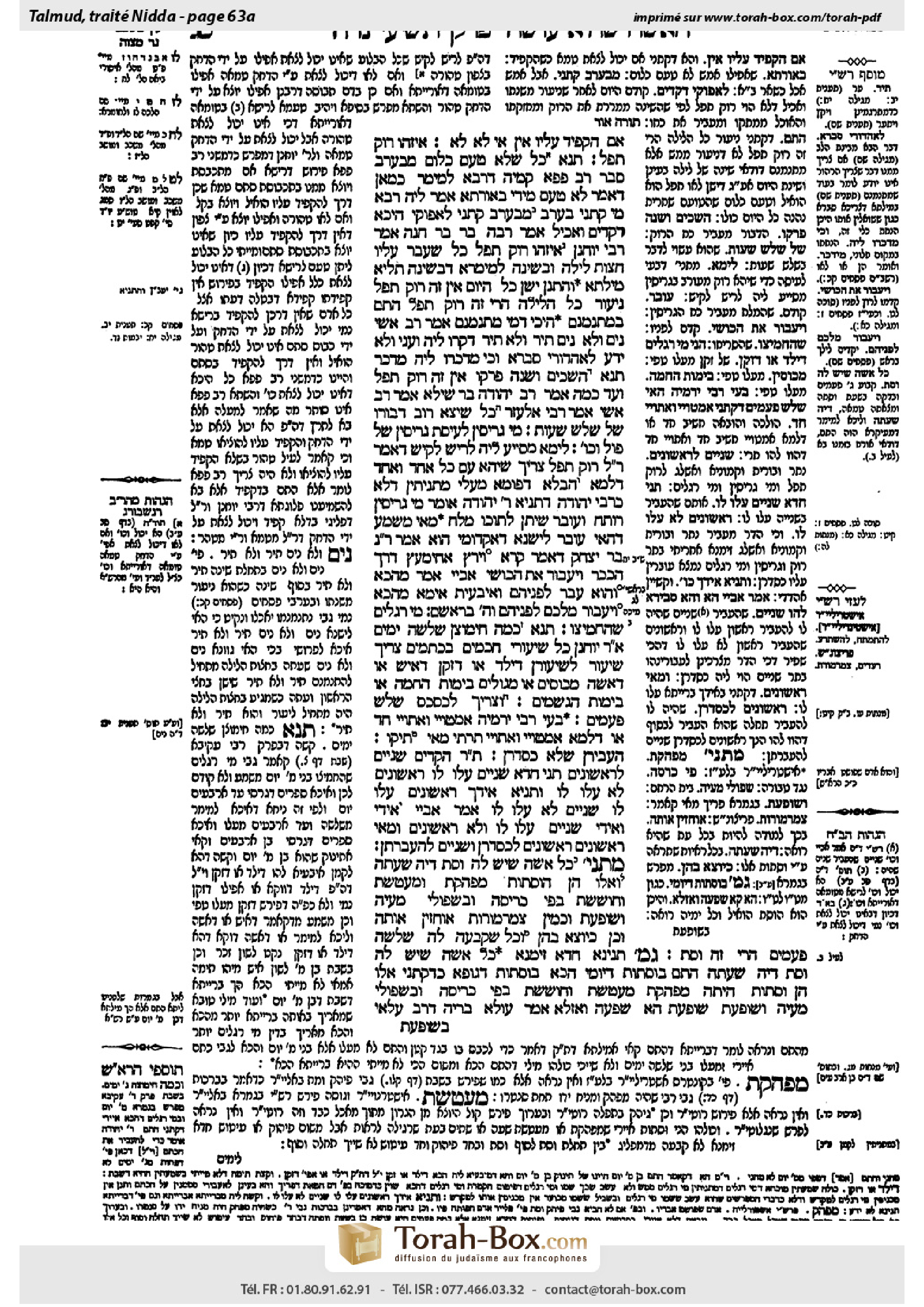
Niddah 63a: Talmud study for Daf Yomi
Daf Yomi is the daily study of one Talmud folio. Explore 37 tractates with scans, Hebrew text, Sefaria English and AI-generated French translations where annotated.
Passage selection and English or AI-generated French translation are available where the scan has annotations. Daf Study is independent of Torah-Box and Sefaria.
Browse Niddah · נידה · All tractatesNiddah 63a text and translations
This page of Niddah includes the Aramaic text, an English translation and an AI-generated French translation, alongside the scan above.
נידה ס״ג א · Aramaic and Hebrew text
אִם הִקְפִּיד עָלָיו — אִין, אִי לָא — לָא.
אֵיזֶהוּ רוֹק תָּפֵל. תָּנָא: כָּל שֶׁלֹּא טָעַם כְּלוּם מִבָּעֶרֶב. סְבַר רַב פָּפָּא קַמֵּיהּ דְּרָבָא לְמֵימַר, כְּמַאן דְּאָמַר לָא טְעַם מִידֵּי בְּאוּרְתָּא. אֲמַר לֵיהּ רָבָא: מִי קָתָנֵי ״בָּעֶרֶב״? ״מִבָּעֶרֶב״ קָתָנֵי, לְאַפּוֹקֵי הֵיכָא דְּקָדֵים וְאָכֵיל.
אָמַר רַבָּה בַּר בַּר חַנָּה, אָמַר רַבִּי יוֹחָנָן: אֵיזֶהוּ רוֹק תָּפֵל? כֹּל שֶׁעָבַר עָלָיו חֲצוֹת לַיְלָה וּבְשֵׁינָה. לְמֵימְרָא דִּבְשֵׁינָה תַּלְיָא מִילְּתָא? וְהָתְנַן: יָשַׁן כׇּל הַיּוֹם — אֵין זֶה רוֹק תָּפֵל, נֵיעוֹר כׇּל הַלַּיְלָה — הֲרֵי זֶה רוֹק תָּפֵל! הָתָם בְּמִתְנַמְנֵם.
הֵיכִי דָּמֵי מִתְנַמְנֵם? אָמַר רַב אָשֵׁי: נִים וְלָא נִים, תִּיר וְלָא תִּיר, דְּקָרוּ לֵיהּ — וְעָנֵי, וְלָא יָדַע לְאַהְדּוֹרֵי סְבָרָא, וְכִי מַדְכְּרוּ לֵיהּ — מִדְּכַר.
תָּנָא: הִשְׁכִּים וְשָׁנָה פִּרְקוֹ — אֵין זֶה רוֹק תָּפֵל. וְעַד כַּמָּה? אָמַר רַב יְהוּדָה בַּר שֵׁילָא, אָמַר רַב אָשֵׁי, אָמַר רַבִּי אֶלְעָזָר: כֹּל שֶׁיָּצָא רוֹב דִּבּוּרוֹ שֶׁל שָׁלֹשׁ שָׁעוֹת.
מֵי גְרִיסִין — לְעִיסַּת גְּרִיסִין שֶׁל פּוֹל וְכוּ׳. לֵימָא מְסַיַּיע לֵיהּ לְרֵישׁ לָקִישׁ, דְּאָמַר רֵישׁ לָקִישׁ: רוֹק תָּפֵל צָרִיךְ שֶׁיְּהֵא עִם כׇּל אֶחָד וְאֶחָד? דִּלְמָא הַבְלָא דְפוּמָּא מְעַלֵּי.
מַתְנִיתִין דְּלָא כְּרַבִּי יְהוּדָה, דְּתַנְיָא: רַבִּי יְהוּדָה אוֹמֵר: מֵי גְרִיסִין רוֹתֵחַ, וְעוֹבֵר שֶׁיִּתֵּן לְתוֹכוֹ מֶלַח.
מַאי מַשְׁמַע דְּהַאי ״עוֹבֵר״ לִישָּׁנָא דְּאַקְדּוֹמֵי הוּא? אָמַר רַב נַחְמָן בַּר יִצְחָק: דְּאָמַר קְרָא ״וַיָּרׇץ אֲחִימַעַץ דֶּרֶךְ הַכִּכָּר וַיַּעֲבוֹר אֶת הַכּוּשִׁי״. אַבָּיֵי אָמַר: מֵהָכָא ״וְהוּא עָבַר לִפְנֵיהֶם״, וְאִיבָּעֵית אֵימָא מֵהָכָא: ״וַיַּעֲבוֹר מַלְכָּם לִפְנֵיהֶם וַה׳ בְּרֹאשָׁם״.
מֵי רַגְלַיִם שֶׁהֶחְמִיצוּ. תָּנָא: כַּמָּה חִימּוּצָן? — שְׁלֹשָׁה יָמִים.
אָמַר רַבִּי יוֹחָנָן: כׇּל שִׁיעוּרֵי חֲכָמִים בִּכְתָמִים — צָרִיךְ שִׁיעוּר לְשִׁיעוּרָן. דְּיֶלֶד אוֹ דְזָקֵן, דְּאִישׁ אוֹ דְאִשָּׁה, מְכוּסִּים אוֹ מְגוּלִּים, בִּימוֹת הַחַמָּה אוֹ בִּימוֹת הַגְּשָׁמִים.
וְצָרִיךְ לְכַסְכֵּס שָׁלֹשׁ פְּעָמִים. בָּעֵי רַבִּי יִרְמְיָה: אַמְטוֹיֵי וְאֵתוֹיֵי חַד, אוֹ דִלְמָא אַמְטוֹיֵי וְאֵתוֹיֵי תַּרְתֵּי? מַאי? תֵּיקוּ.
הֶעֱבִירָן שֶׁלֹּא כְּסִדְרָן. תָּנוּ רַבָּנַן: הִקְדִּים שְׁנִיִּים לָרִאשׁוֹנִים, תָּנֵי חֲדָא: שְׁנִיִּים עָלוּ לוֹ, רִאשׁוֹנִים לֹא עָלוּ לוֹ. וְתַנְיָא אִידַּךְ: רִאשׁוֹנִים עָלוּ לוֹ, שְׁנִיִּים לֹא עָלוּ לוֹ.
אָמַר אַבָּיֵי: אִידִי וְאִידִי שְׁנִיִּים עָלוּ לוֹ, וְלֹא רִאשׁוֹנִים, וּמַאי ״רִאשׁוֹנִים״? רִאשׁוֹנִים לִכְסִדְרָן, וּשְׁנִיִּים לְהַעֲבָרָתָן.
מַתְנִי' כׇּל אִשָּׁה שֶׁיֵּשׁ לָהּ וֶסֶת — דַּיָּהּ שְׁעָתָהּ. וְאֵלּוּ הֵן הַוְּסָתוֹת: מְפַהֶקֶת, וּמְעַטֶּשֶׁת, וְחוֹשֶׁשֶׁת בְּפִי כְרֵיסָהּ, וּבְשִׁפּוּלֵי מֵעֶיהָ, וְשׁוֹפַעַת, וּכְמִין צְמַרְמוֹרוֹת אוֹחֲזִין אוֹתָהּ, וְכֵן כַּיּוֹצֵא בָּהֶן. וְכֹל שֶׁקָּבְעָה לָהּ שָׁלֹשׁ פְּעָמִים — הֲרֵי זֶה וֶסֶת.
גְּמָ' תְּנֵינָא חֲדָא זִימְנָא: כׇּל אִשָּׁה שֶׁיֵּשׁ לָהּ וֶסֶת דַּיָּהּ שְׁעָתָהּ! הָתָם — בִּוְסָתוֹת דְּיוֹמֵי, הָכָא — בִּוְסָתוֹת דְּגוּפָא.
כִּדְקָתָנֵי: אֵלּוּ הֵן וְסָתוֹת — הָיְתָה מְפַהֶקֶת, מְעַטֶּשֶׁת, וְחוֹשֶׁשֶׁת בְּפִי כְרֵיסָהּ, וּבְשִׁפּוּלֵי מֵעֶיהָ, וְשׁוֹפַעַת.
שׁוֹפַעַת? הָא שָׁפְעָה וְאָזְלָא! אָמַר עוּלָּא בְּרֵיהּ דְּרַב עִלַּאי:
Niddah 63a · English translation
if he is particular that he does not want the liquid there, then yes, it renders the garment impure, but if not, then the liquid does not render the garment impure.
§ The mishna teaches: What is tasteless saliva? A tanna taught in a baraita: What is the definition of tasteless saliva? Any saliva where the person had not tasted anything since the evening. Rav Pappa, who was sitting before Rava, thought to say: This is in accordance with the opinion of the one who said that he did not eat anything all night long. Rava said to him: Is it taught: One who had not tasted anything in the evening, which would indicate that it is referring only to one who did not eat since nightfall? No, the baraita teaches: Where the person had not tasted anything since the evening, which means even if he ate after nightfall, but did not eat for the rest of the night. This serves to exclude a case where he arose early in the morning and ate, as in such a case it is no longer tasteless saliva.
Rabba bar bar Ḥana says that Rabbi Yoḥanan says: What is tasteless saliva? Any saliva where the person did not eat any food and he passed the middle of the night and he was in a state of sleep. The Gemara asks: Is that to say that the matter depends on whether or not he had sleep? But didn’t we learn in a baraita: Even if he slept the entire day, that is not tasteless saliva; but if he was awake the entire night, that is tasteless saliva? This indicates that sleep is not a critical factor in producing tasteless saliva. The Gemara resolves this apparent contradiction by explaining that there, in the latter clause of the baraita, it is referring to a case where he was awake all night and did not sleep properly, but was dozing off and on.
The Gemara asks: What are the circumstances of dozing? Rav Ashi said: It is referring to a situation in which one is asleep and yet not fully asleep, and awake and yet not fully awake. If someone calls him he answers, and he is in a mental state in which he does not know how to provide an answer that requires logical reasoning, but when people remind him about something when he is in that state that has happened previously he remembers it.
A tanna taught in a baraita: If one rose early in the morning and learned aloud his chapter of the Torah, that saliva in his mouth is not tasteless saliva, as speech weakens the strength of the saliva. And how much learning and talk removes the strength of the saliva? Rav Yehuda bar Sheila says that Rav Ashi says that Rabbi Elazar says: Any case where he uttered most of his normal amount of speech that he usually says in three hours.
§ The mishna teaches: Liquid from split beans is created through the chewing of split beans that divided naturally, not by human hand, which are then applied to the stain. The Gemara suggests: Let us say that this ruling supports the opinion of Reish Lakish, as Reish Lakish said: Tasteless saliva must be mixed with each and every one of the other six substances in order to remove the blood stain. The Gemara answers that this is no proof, as perhaps it is not due to the saliva, but rather the heat of his mouth is what helps the split beans remove the stain.
The Gemara notes that the mishna is not in accordance with the opinion of Rabbi Yehuda. As it is taught in a baraita that Rabbi Yehuda says: The liquid from split beans is effective in removing blood stains only when it is boiling, and before [over] one puts salt into the pot.
The Gemara asks: From where may it be inferred that the word over is a formulation of priority? Rav Naḥman bar Yitzḥak said that the verse states: “And Ahimaaz ran by the way of the plain, and overran [vayya’avor] the Cushite” (II Samuel 18:23), i.e., Ahimaaz overtook the Cushite. Abaye said: It is derived from here: “And he passed [avar] before them” (Genesis 33:3). And if you wish, say instead that the proof is from here: “And their king passed [vayya’avor] before them and the Lord at their head” (Micah 2:13).
§ The mishna teaches: The urine that is an effective detergent is specifically urine that fermented. A tanna taught in a baraita: For how long must it be fermented? For three days.
On the topic of the urine used to remove a blood stain, Rabbi Yoḥanan says: All the measures of the Sages with regard to blood stains require a measure for their measure. There are many types of urine, each of which has different properties, and it is unclear which is to be used. Is it urine of a young person or of an old person? Is it urine of a man or of a woman? Is it urine that has been kept covered or uncovered? Is it urine from the summer or from the rainy season?
§ The mishna teaches: And one must rub each and every one of the substances three times. Rabbi Yirmeya raises a dilemma with regard to this rubbing: Is the going and coming of the hand over the surface of the rubbed item considered one rubbing, or perhaps the going and coming are considered two actions and two distinct rubbings? What is the correct count? The Gemara states: The dilemma shall stand unresolved.
§ The mishna further teaches: If one applied them in a manner that is not in their prescribed order, or if one applied all seven substances simultaneously, he has done nothing. The Sages taught two baraitot with regard to this matter. If one applied the substances from the second half of the list, i.e., natron, borit, Cimolian earth, and potash, before the substances from the first half of the list, i.e., tasteless saliva, liquid from split beans, and urine, it is taught in one baraita: The second set count for him, but the first do not count for him. And it is taught in another baraita: The first count for him, but the second do not count for him.
Abaye said that there is no dispute between these two baraitot: Both this baraita and that baraita agree that the substances that he applied second count for him, and not the substances that he applied first. And what does the second baraita mean when it uses the term: First? It means the first according to the order of the mishna, which were the second in their application.
MISHNA: For any woman who has a fixed menstrual cycle that is not time dependent, but is dependent on a physical sensation, her time is sufficient, i.e., she does not transmit ritual impurity retroactively, for twenty-four hours or until the last time she examined herself (see 2a). And these are the fixed menstrual cycles based on sensation: When a woman menstruates after she yawns [mefaheket], or after she sneezes, or after she senses pain near her stomach or in her lower abdomen, or after she secretes a discharge, or after a type of feverish shuddering [tzemarmorot] overtakes her. And likewise the same applies with regard to any sensation of the like. And in the case of any woman who establishes a pattern for herself by experiencing such a sensation three times before the onset of menstruation, that is a fixed menstrual cycle.
GEMARA: The mishna teaches that for any woman who has a fixed menstrual cycle, her time is sufficient. The Gemara objects: We already learned that her time is sufficient on another occasion (2a): For any woman who has a fixed menstrual cycle, and she examined herself at that time and discovered blood, her time is sufficient, and it is only from that moment that she transmits ritual impurity. The Gemara answers: There, it is referring to a fixed menstrual cycle of a certain number of days; here, it is referring to a fixed menstrual cycle based on a physical sensation.
As it teaches in the continuation of the mishna: These are the fixed menstrual cycles based on sensation: When a woman menstruates after she yawns, or after she sneezes, or after she senses pain near her stomach or in her lower abdomen, or after she secretes a discharge. All of these are physical sensations.
The mishna includes the case where she secretes a discharge as one of the physical sensations. The Gemara understands this as referring to a continuous discharge of blood, and therefore asks: But during menstruation she is continuously discharging blood; how can this be a signal of the onset of menstruation? Ulla, son of Rav Ilai, said:
Niddah 63a · Traduction française (IA)
Si la personne tient à ce que le liquide ne soit pas là, alors oui, il rend le vêtement impur ; sinon, le liquide ne rend pas le vêtement impur.
§ La Michna enseigne : Qu’est-ce qu’une salive sans goût ? Un tanna a enseigné dans une baraïta : Quelle est la définition d’une salive sans goût ? Toute salive d’une personne qui n’a rien goûté depuis le soir. Rav Pappa, qui était assis devant Rava, pensa dire que cela correspond à l’opinion de celui qui dit qu’elle n’a rien mangé de toute la nuit. Rava lui dit : Est-il enseigné « une personne qui n’a rien goûté le soir », ce qui indiquerait qu’il s’agit uniquement de quelqu’un qui n’a rien mangé depuis la tombée de la nuit ? Non, la baraïta enseigne : « une personne qui n’a rien goûté depuis le soir », ce qui signifie que même si elle a mangé après la tombée de la nuit, elle n’a rien mangé pendant le reste de la nuit. Cela exclut le cas où elle s’est levée tôt le matin et a mangé, car alors sa salive n’est plus sans goût.
Rabba bar bar Ḥana dit au nom de Rabbi Yoḥanan : Qu’est-ce qu’une salive sans goût ? Toute salive d’une personne qui n’a mangé aucun aliment, qui a veillé au-delà du milieu de la nuit et qui a dormi. La Guemara demande : Cela signifie-t-il que la question dépend du fait qu’elle ait dormi ou non ? Mais n’avons-nous pas appris dans une baraïta : Même si elle a dormi toute la journée, ce n’est pas une salive sans goût ; mais si elle est restée éveillée toute la nuit, c’est une salive sans goût ? Cela indique que le sommeil n’est pas un facteur déterminant pour produire une salive sans goût. La Guemara résout cette contradiction apparente en expliquant que, dans la dernière clause de la baraïta, il s’agit d’un cas où la personne est restée éveillée toute la nuit sans dormir véritablement, mais s’assoupissait par intermittence.
La Guemara demande : Dans quelles circonstances parle-t-on d’assoupissement ? Rav Ashi dit : Il s’agit d’un état où l’on dort sans être tout à fait endormi et où l’on est éveillé sans être tout à fait éveillé. Si quelqu’un l’appelle, il répond ; mais il n’est pas en mesure de donner une réponse qui exige un raisonnement logique. En revanche, si, dans cet état, on lui rappelle quelque chose qui s’est produit auparavant, il s’en souvient.
Un tanna a enseigné dans une baraïta : Si une personne s’est levée tôt le matin et a récité à voix haute le chapitre de Torah qu’elle étudiait, la salive dans sa bouche n’est pas une salive sans goût, car la parole affaiblit la puissance de la salive. Quelle quantité d’étude et de parole affaiblit la salive ? Rav Yehuda bar Sheila dit au nom de Rav Ashi, qui le dit au nom de Rabbi Elazar : c’est le cas où la personne a prononcé la majeure partie de la quantité habituelle de paroles qu’elle dit en trois heures.
§ La Michna enseigne : Le liquide provenant des fèves fendues s’obtient en mâchant des fèves qui se sont fendues naturellement, et non par la main d’un homme ; ce liquide est ensuite appliqué sur la tache. La Guemara suggère : Disons que cette règle appuie l’opinion de Reish Lakish, car Reish Lakish a dit que la salive sans goût doit être mélangée à chacune des six autres substances afin d’enlever la tache de sang. La Guemara répond que cela ne prouve rien : ce n’est peut-être pas la salive qui agit, mais plutôt la chaleur de la bouche qui aide les fèves fendues à enlever la tache.
La Guemara relève que la Michna n’est pas conforme à l’opinion de Rabbi Yehuda. En effet, il est enseigné dans une baraïta que Rabbi Yehuda dit : Le liquide provenant des fèves fendues n’est efficace pour enlever les taches de sang que lorsqu’il est bouillant et avant [par-dessus] qu’on mette du sel dans la marmite.
La Guemara demande : D’où peut-on déduire que le mot « par-dessus » exprime une antériorité ? Rav Naḥman bar Yitzḥak dit que le verset énonce : « Et Ahimaaz courut par le chemin de la plaine et devança [vayya’avor] le Koushite » (II Samuel 18:23), c’est-à-dire qu’Ahimaaz dépassa le Koushite. Abaye dit que cela se déduit d’ici : « Et il passa [avar] devant eux » (Genèse 33:3). Et, si tu veux, dis plutôt que la preuve vient d’ici : « Leur roi passa [vayya’avor] devant eux, et l’Éternel était à leur tête » (Michée 2:13).
§ La Michna enseigne : L’urine qui constitue un détergent efficace est précisément une urine qui a fermenté. Un tanna a enseigné dans une baraïta : Combien de temps doit-elle avoir fermenté ? Trois jours.
À propos de l’urine utilisée pour enlever une tache de sang, Rabbi Yoḥanan dit : Toutes les mesures établies par les Sages au sujet des taches de sang exigent une mesure précise pour chacune d’elles. Il existe de nombreux types d’urine, chacun ayant des propriétés différentes, et l’on ne sait pas laquelle utiliser. Est-ce l’urine d’une personne jeune ou âgée ? Est-ce l’urine d’un homme ou d’une femme ? Est-ce une urine qui a été conservée couverte ou découverte ? Est-ce l’urine de l’été ou de la saison des pluies ?
§ La Michna enseigne : Il faut frotter chacune des substances trois fois. Rabbi Yirmeya soulève une question au sujet de ce frottement : Le mouvement de la main qui va et vient sur la surface de l’objet frotté compte-t-il comme un seul frottement, ou l’aller et le retour comptent-ils comme deux gestes et deux frottements distincts ? Quel est le décompte correct ? La Guemara laisse la question sans réponse.
§ La Michna enseigne également : Si quelqu’un les a appliquées dans un ordre autre que celui qui leur est prescrit, ou s’il a appliqué les sept substances simultanément, il n’a rien fait. Les Sages ont enseigné deux baraïtot à ce sujet. Si quelqu’un a appliqué les substances de la seconde moitié de la liste — le natron, le borit, la terre de Cimolie et la potasse — avant celles de la première moitié — la salive sans goût, le liquide provenant des fèves fendues et l’urine —, une baraïta enseigne : Le second groupe compte pour lui, mais pas le premier. Une autre baraïta enseigne : Le premier groupe compte pour lui, mais pas le second.
Abaye dit qu’il n’y a pas de désaccord entre ces deux baraïtot : toutes deux conviennent que ce sont les substances appliquées en second qui comptent pour lui, et non celles qu’il a appliquées en premier. Que signifie donc le terme « premier » dans la seconde baraïta ? Il désigne les substances qui viennent en premier selon l’ordre de la Michna, mais qui ont été appliquées en second.
MICHNA : Pour toute femme dont le cycle menstruel fixe dépend non pas d’un moment précis, mais d’une sensation physique, le moment où elle constate le sang fait foi : elle ne transmet pas l’impureté rituelle rétroactivement, ni pendant les vingt-quatre heures précédentes ni jusqu’au dernier moment où elle s’est examinée (voir 2a). Voici les cycles menstruels fixes fondés sur une sensation : lorsqu’une femme a ses règles après avoir bâillé [mefaheket], après avoir éternué, après avoir ressenti une douleur près de l’estomac ou dans le bas-ventre, après avoir sécrété un écoulement ou après avoir été saisie par une sorte de frisson fébrile [tzemarmorot]. Il en va de même pour toute sensation du même genre. Toute femme qui établit pour elle-même un schéma en éprouvant une telle sensation trois fois avant le début des règles a un cycle menstruel fixe.
GUEMARA : La Michna enseigne que, pour toute femme qui a un cycle menstruel fixe, le moment où elle constate le sang fait foi. La Guemara objecte : Nous avons déjà appris ailleurs que le moment où elle constate le sang fait foi (2a) : toute femme qui a un cycle menstruel fixe et qui s’examine à ce moment-là et découvre du sang ne transmet l’impureté rituelle qu’à partir de cet instant. La Guemara répond : Là, il s’agit d’un cycle menstruel fixe défini par un certain nombre de jours ; ici, il s’agit d’un cycle menstruel fixe fondé sur une sensation physique.
Comme l’enseigne la suite de la Michna : Voici les cycles menstruels fixes fondés sur une sensation : lorsqu’une femme a ses règles après avoir bâillé, après avoir éternué, après avoir ressenti une douleur près de l’estomac ou dans le bas-ventre, ou après avoir sécrété un écoulement. Il s’agit là de sensations physiques.
La Michna inclut le cas où elle sécrète un écoulement parmi les sensations physiques. La Guemara comprend qu’il s’agit d’un écoulement continu de sang et demande donc : Mais pendant les règles, elle perd continuellement du sang ; comment cela peut-il signaler le début des règles ? Ulla, fils de Rav Ilai, dit :
Traduction française générée par IA à partir de l’édition anglaise de Sefaria. Vérifie toujours un passage avec le texte source.
Text from Sefaria: William Davidson Edition - Vocalized Aramaic (CC BY NC); William Davidson Edition - English (CC BY NC).