Niddah 63b: Talmud study for Daf Yomi
Daf Yomi is the daily study of one Talmud folio. Explore 37 tractates with scans, Hebrew text, Sefaria English and AI-generated French translations where annotated.
Passage selection and English or AI-generated French translation are available where the scan has annotations. Daf Study is independent of Torah-Box and Sefaria.
Browse Niddah · נידה · All tractatesNiddah 63b text and translations
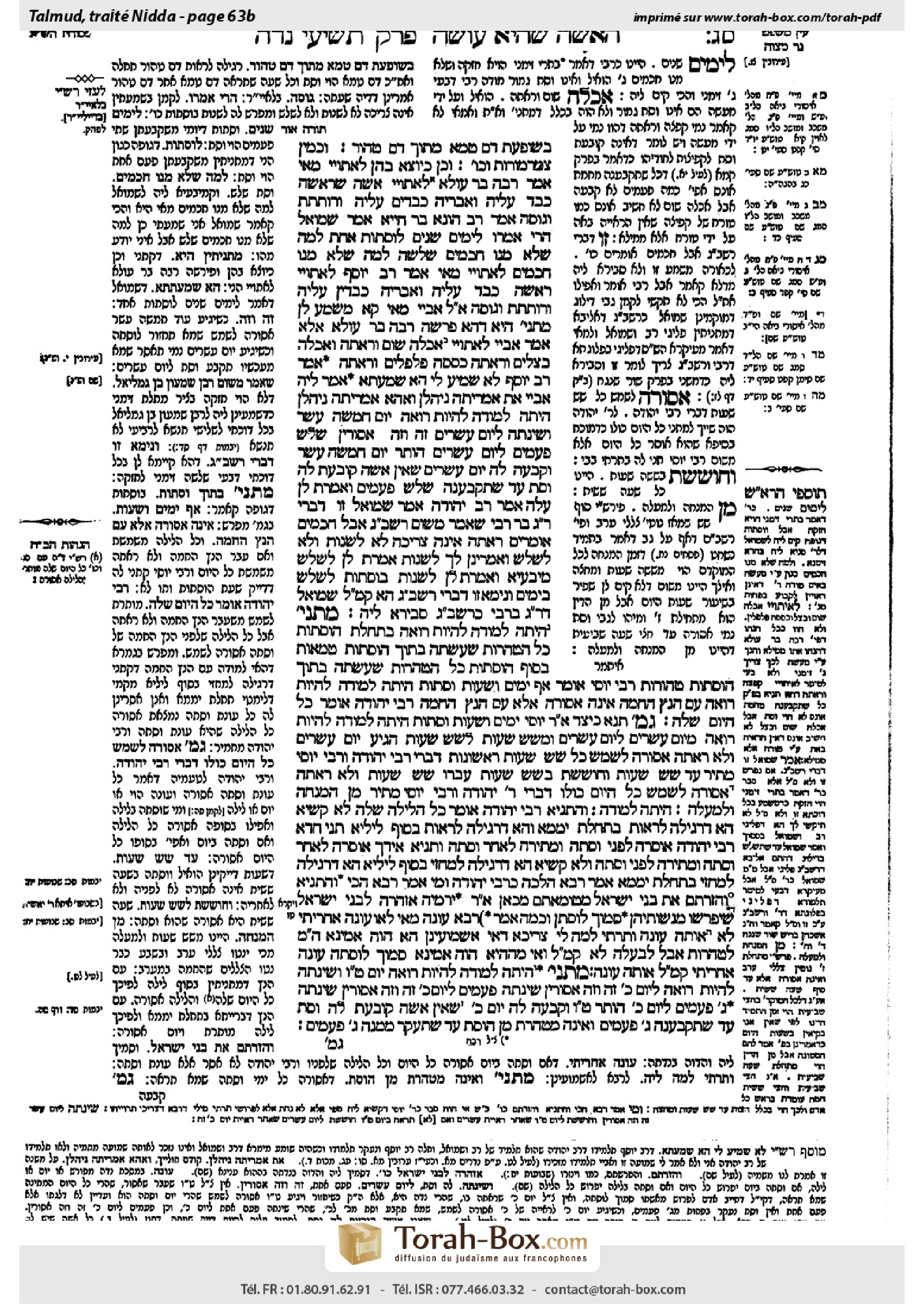
This page of Niddah includes the Aramaic text, an English translation and an AI-generated French translation, alongside the scan above.
נידה ס״ג ב · Aramaic and Hebrew text
בְּשׁוֹפַעַת דָּם טָמֵא מִתּוֹךְ דָּם טָהוֹר.
וּכְמִין צְמַרְמוֹרוֹת וְכוּ׳. ״וְכֵן כַּיּוֹצֵא בָּהֶן״ — לְאֵתוֹיֵי מַאי? אָמַר רַבָּה בַּר עוּלָּא: לְאֵתוֹיֵי אִשָּׁה שֶׁרֹאשָׁהּ כָּבֵד עָלֶיהָ, וְאֵבָרֶיהָ כְּבֵדִים עָלֶיהָ, וְרוֹתֶתֶת, וְגוֹסָה.
אָמַר רַב הוּנָא בַּר חִיָּיא, אָמַר שְׁמוּאֵל: הֲרֵי אָמְרוּ לְיָמִים — שְׁנַיִם, לִוְסָתוֹת — אַחַת, לְמַה שֶּׁלֹּא מָנוּ חֲכָמִים — שְׁלֹשָׁה.
לְמַה שֶּׁלֹּא מָנוּ חֲכָמִים. לְאֵתוֹיֵי מַאי? אָמַר רַב יוֹסֵף: לְאֵתוֹיֵי רֹאשָׁהּ כָּבֵד עָלֶיהָ, וְאֵבָרֶיהָ כְּבֵדִין עָלֶיהָ, וְרוֹתֶתֶת, וְגוֹסָה. אֲמַר לֵיהּ אַבָּיֵי: מַאי קָא מַשְׁמַע לַן? מַתְנִיתִין הִיא! דְּהָא פָּרְשַׁהּ רַבָּה בַּר עוּלָּא. אֶלָּא אָמַר אַבָּיֵי: לְאֵתוֹיֵי אָכְלָה שׁוּם וְרָאֲתָה, וְאָכְלָה בְּצָלִים וְרָאֲתָה, כָּסְסָה פִּלְפְּלִים וְרָאֲתָה.
אָמַר רַב יוֹסֵף: לָא שְׁמִיעַ לִי הָא שְׁמַעְתָּא.
אֲמַר לֵיהּ אַבָּיֵי: אַתְּ אַמְרִיתַהּ נִיהֲלַן, וְאַהָא אַמְרִיתַהּ נִיהֲלַן — הָיְתָה לְמוּדָה לִהְיוֹת רוֹאָה יוֹם חֲמִשָּׁה עָשָׂר, וְשִׁינְּתָה לְיוֹם עֶשְׂרִים — זֶה וְזֶה אֲסוּרִין. שָׁלֹשׁ פְּעָמִים לְיוֹם עֶשְׂרִים — הוּתַּר יוֹם חֲמִשָּׁה עָשָׂר, וְקָבְעָה לָהּ יוֹם עֶשְׂרִים, שֶׁאֵין אִשָּׁה קוֹבַעַת לָהּ וֶסֶת עַד שֶׁתִּקְבָּעֶנָּה שָׁלֹשׁ פְּעָמִים.
וַאֲמַרְתְּ לַן עֲלַהּ, אָמַר רַב יְהוּדָה אָמַר שְׁמוּאֵל: זוֹ דִּבְרֵי רַבָּן גַּמְלִיאֵל בַּר רַבִּי, שֶׁאָמַר מִשּׁוּם רַבָּן שִׁמְעוֹן בֶּן גַּמְלִיאֵל, אֲבָל חֲכָמִים אוֹמְרִים: רָאֲתָה — אֵינָהּ צְרִיכָה לֹא לִשְׁנוֹת וְלֹא לְשַׁלֵּשׁ.
וְאָמְרִינַן לָךְ: לִשְׁנוֹת אָמְרַתְּ לַן, לְשַׁלֵּשׁ מִיבַּעְיָא? וַאֲמַרְתְּ לַן: לִשְׁנוֹת — בִּוְסָתוֹת, לְשַׁלֵּשׁ — בְּיָמִים.
וְנֵימָא: זוֹ דִּבְרֵי רַבָּן שִׁמְעוֹן בֶּן גַּמְלִיאֵל! הָא קָא מַשְׁמַע לַן שְׁמוּאֵל, דְּרַבָּן גַּמְלִיאֵל בְּרַבִּי כְּרַבָּן שִׁמְעוֹן בֶּן גַּמְלִיאֵל סְבִירָא לֵיהּ.
מַתְנִי' הָיְתָה לְמוּדָה לִהְיוֹת רוֹאָה בִּתְחִלַּת הַוְּסָתוֹת — כׇּל הַטְּהָרוֹת שֶׁעָשְׂתָה בְּתוֹךְ הַוְּסָתוֹת טְמֵאוֹת. בְּסוֹף הַוְּסָתוֹת — כׇּל הַטְּהָרוֹת שֶׁעָשְׂתָה בְּתוֹךְ הַוְּסָתוֹת טְהוֹרוֹת.
רַבִּי יוֹסֵי אוֹמֵר: אַף יָמִים וְשָׁעוֹת וְסָתוֹת. הָיְתָה לְמוּדָה לִהְיוֹת רוֹאָה עִם הָנֵץ הַחַמָּה — אֵינָהּ אֲסוּרָה אֶלָּא עִם הָנֵץ הַחַמָּה. רַבִּי יְהוּדָה אוֹמֵר: כׇּל הַיּוֹם שֶׁלָּהּ.
גְּמָ' תָּנָא: כֵּיצַד אָמַר רַבִּי יוֹסֵי יָמִים וְשָׁעוֹת וְסָתוֹת? הָיְתָה לְמוּדָה לִהְיוֹת רוֹאָה מִיּוֹם עֶשְׂרִים לְיוֹם עֶשְׂרִים, וּמִשֵּׁשׁ שָׁעוֹת לְשֵׁשׁ שָׁעוֹת. הִגִּיעַ יוֹם עֶשְׂרִים וְלֹא רָאֲתָה — אֲסוּרָה לְשַׁמֵּשׁ כׇּל שֵׁשׁ שָׁעוֹת רִאשׁוֹנוֹת, דִּבְרֵי רַבִּי יְהוּדָה. וְרַבִּי יוֹסֵי מַתִּיר עַד שֵׁשׁ שָׁעוֹת, וְחוֹשֶׁשֶׁת בְּשֵׁשׁ שָׁעוֹת.
עָבְרוּ שֵׁשׁ שָׁעוֹת, וְלֹא רָאֲתָה — אֲסוּרָה לְשַׁמֵּשׁ כׇּל הַיּוֹם כּוּלּוֹ, דִּבְרֵי רַבִּי יְהוּדָה. וְרַבִּי יוֹסֵי מַתִּיר מִן הַמִּנְחָה וּלְמַעְלָה.
הָיְתָה לְמוּדָה. וְהָתַנְיָא: רַבִּי יְהוּדָה אוֹמֵר: כׇּל הַלַּיְלָה שֶׁלָּהּ!
לָא קַשְׁיָא — הָא דִּרְגִילָה לִרְאוֹת בִּתְחִלַּת יְמָמָא, וְהָא דִּרְגִילָה לִרְאוֹת בְּסוֹף לֵילְיָא.
תָּנֵי חֲדָא: רַבִּי יְהוּדָה אוֹסְרָהּ לִפְנֵי וִסְתָּהּ, וּמַתִּירָהּ לְאַחַר וִסְתָּהּ. וְתַנְיָא אִידַּךְ: אוֹסְרָהּ לְאַחַר וִסְתָּהּ, וּמַתִּירָהּ לִפְנֵי וִסְתָּהּ.
וְלָא קַשְׁיָא — הָא דִּרְגִילָה לְמִחְזֵי בְּסוֹף לֵילְיָא, הָא דִּרְגִילָה לְמִחְזֵי בִּתְחִלַּת יְמָמָא.
אָמַר רָבָא: הֲלָכָה כְּרַבִּי יְהוּדָה, וּמִי אָמַר רָבָא הָכִי? וְהָתַנְיָא: ״וְהִזַּרְתֶּם אֶת בְּנֵי יִשְׂרָאֵל מִטּוּמְאָתָם״ — מִכָּאן אָמַר רַבִּי יִרְמְיָה: אַזְהָרָה לִבְנֵי יִשְׂרָאֵל שֶׁיִּפְרְשׁוּ מִנְּשׁוֹתֵיהֶן סָמוּךְ לְוִסְתָּן.
וְכַמָּה? אָמַר רָבָא: עוֹנָה. מַאי לַָאו עוֹנָה אַחֲרִיתִי? לָא, אוֹתָהּ עוֹנָה.
וְתַרְתֵּי לְמָה לִי? צְרִיכָא, דְּאִי אַשְׁמוֹעִינַן הָא — הֲוָה אָמֵינָא הָנֵי מִילֵּי לִטְהָרוֹת, אֲבָל לְבַעְלָהּ — לָא. קָא מַשְׁמַע לַן.
וְאִי מֵהַהִיא — הֲוָה אָמֵינָא ״סָמוּךְ לְוִסְתָּהּ״ עוֹנָה אַחֲרִיתִי. קָא מַשְׁמַע לַן אוֹתָהּ עוֹנָה.
מַתְנִי' הָיְתָה לְמוּדָה לִהְיוֹת רוֹאָה יוֹם חֲמִשָּׁה עָשָׂר, וְשִׁינְּתָה לִהְיוֹת רוֹאָה לְיוֹם עֶשְׂרִים — זֶה וָזֶה אֲסוּרִין. שִׁינְּתָה פַּעֲמַיִם לְיוֹם עֶשְׂרִים — זֶה וָזֶה אֲסוּרִין.
שִׁינְּתָה שָׁלֹשׁ פְּעָמִים לְיוֹם עֶשְׂרִים — הוּתַּר חֲמִשָּׁה עָשָׂר, וְקָבְעָה לָהּ יוֹם עֶשְׂרִים, שֶׁאֵין אִשָּׁה קוֹבַעַת לָהּ וֶסֶת עַד שֶׁתִּקְבָּעֶנָּה שָׁלֹשׁ פְּעָמִים, וְאֵינָהּ מִטַּהֶרֶת מִן הַוֶּסֶת עַד שֶׁתֵּעָקֵר מִמֶּנָּה שָׁלֹשׁ פְּעָמִים.
Niddah 63b · English translation
The mishna is referring to a case where she discharges ritually impure blood in the midst of discharging ritually pure blood. For example, if she normally first discharges blood that is not red, and it therefore does not render her impure, and then she experiences a discharge of red blood.
The mishna teaches: Or a type of feverish shuddering overtakes her, and likewise the same applies with regard to any sensation of the like. The Gemara asks: What is added by this last phrase? Rabba bar Ulla said: It serves to include a woman whose head is heavy upon her or her limbs are heavy upon her, or she trembles or belches constantly.
Rav Huna bar Ḥiyya says that Shmuel says: The Sages said, with regard to establishing a set period of days, that two days are sufficient, i.e., if a woman experiences bleeding twice on the same date of the month or after the same interval, she has a fixed menstrual cycle. By contrast, with regard to a fixed menstrual cycle based on a physical sensation, it is sufficient if she experiences bleeding even once. But for those sensations which the Sages did not include in the mishna, she has a fixed cycle only if she experiences bleeding three times accompanied by one of those symptoms.
The Gemara asks: When Shmuel said: For those which the Sages did not include, what did he intend to add? Rav Yosef says: This serves to add the case mentioned above, i.e., her head is heavy upon her, or her limbs are heavy upon her, or she trembles or belches constantly. Abaye said to Rav Yosef: What is that addition teaching us? In effect, it is already taught in the mishna, as Rabba bar Ulla explained above that the additional phrase: The same applies with regard to any sensation of the like, serves to include those sensations. Rather, Abaye said: Shmuel’s phrase serves to add a case where she ate garlic and saw menstrual blood, or ate onions and saw menstrual blood, or chewed pepper and saw menstrual blood, i.e., these triggers can give rise to a fixed cycle, but only after three occurrences.
Rav Yosef said: I did not hear this tradition concerning the opinion of Shmuel, that with regard to days a cycle is fixed if she experiences bleeding twice, whereas for physical sensations a cycle is fixed after one occurrence. Rav Yosef had fallen ill and forgotten his studies and was therefore unable to remember that such a ruling had been issued.
His student, Abaye, said to him: You yourself told us this halakha, and it was with regard to this following matter that you told this halakha to us, taught in the mishna below: If a woman was accustomed to see the flow of blood on the fifteenth day and she deviated from the norm to see the flow of blood on the twentieth day, then on both this day, the fifteenth, and that day, the twentieth, it is prohibited for her to engage in intercourse. If she deviated from the norm to see the flow of blood on the twentieth day three times, it becomes permitted for her to engage in intercourse on the fifteenth day, and she has established the twentieth day for herself as the day of her fixed menstrual cycle, as a woman establishes a fixed menstrual cycle only after she establishes it three times.
Abaye continues: And you, Rav Yosef, said to us with regard to this mishna that Rav Yehuda said that Shmuel said: This is the statement of Rabban Gamliel bar Rabbi Yehuda HaNasi, who said it in the name of Rabban Shimon ben Gamliel. But the Rabbis say: If she saw a discharge of blood even once, she has a fixed cycle and does not need to repeat and experience bleeding a second time or to repeat a third time.
And we said to you: Since you said to us that she does not need to repeat a second time, is it necessary for you to mention that she does not need to repeat a third time? And you said to us that when you said that she does not need to repeat a second time, this is referring to a fixed menstrual cycle based on a physical sensation, whereas when you said she does not need to repeat a third time, that is referring to a fixed cycle of days.
The Gemara asks: But why did Shmuel have to explain that the mishna is the statement of Rabban Gamliel bar Rabbi Yehuda HaNasi? Let him say simply that this mishna is the statement of Rabban Shimon ben Gamliel, who always requires repetition three times to establish a presumptive status. The Gemara answers that this is what Shmuel teaches us: That Rabban Gamliel, son of Rabbi Yehuda HaNasi, holds in accordance with the opinion of Rabban Shimon ben Gamliel.
MISHNA: If a woman was accustomed to see the flow of blood at the beginning of the sensation that accompanies her fixed cycle, even if on one occasion she happened to experience bleeding only at the end of the sensation, all the ritually pure items that she handled within the duration of that sensation that accompanies her fixed cycle are ritually impure. If the woman was accustomed to experience bleeding at the end of the sensation that accompanies her fixed cycle, all the ritually pure items that she handled within the duration of that sensation that accompanies her fixed cycle are pure.
Rabbi Yosei says: Even specific days and specific hours determine a fixed menstrual cycle: If a woman was accustomed to see the flow of blood on a certain day of the month at sunrise, it is prohibited for her to engage in intercourse with her husband only at sunrise; but during the night before and the following day, it is permitted for her to engage in intercourse. Rabbi Yehuda says: Once sunrise passed and she did not menstruate, the entire day is hers and she may engage in intercourse, in accordance with the opinion of Rabbi Yosei; but contrary to the opinion of Rabbi Yosei, intercourse the night before is prohibited.
GEMARA: A tanna taught in a baraita: In what case did Rabbi Yosei say that specific days and hours determine a fixed menstrual cycle? For example, if a woman was accustomed to see the flow of blood on the twentieth day and again on the twentieth day, and in the sixth hour of the day and again in the sixth hour of the day the next time; if the twentieth day arrives a third time and she does not see a flow of blood, it is prohibited for her to engage in intercourse for the entirety of the first six hours of the day; this is the statement of Rabbi Yehuda. Rabbi Yosei deems it permitted for her to engage in intercourse until the sixth hour of the day, and says that she must be concerned only during the sixth hour.
The baraita continues: If the sixth hour passed and she did not see a flow of blood, it is prohibited for her to engage in intercourse for the entirety of the day; this is the statement of Rabbi Yehuda. And Rabbi Yosei deems it permitted for her to engage in intercourse from minḥa time onward, i.e., from the beginning of the seventh hour.
§ The mishna teaches with regard to a woman who was accustomed to see the flow of blood on a certain day of the month at sunrise, that Rabbi Yehuda says: Once sunrise passed and she did not menstruate, the entire day is hers and she may engage in intercourse, but intercourse is prohibited the night before. The Gemara objects: But isn’t it taught in a baraita that Rabbi Yehuda says: The entire night is hers? This indicates that she may engage in intercourse during the night.
The Gemara explains that it is not difficult. Here, when it is permitted for her to engage in intercourse the entire night, it is referring to a case where she is accustomed to see a flow of blood at the beginning of the day, i.e., immediately after sunrise. And there, in the mishna, which deems it prohibited for her to engage in intercourse all night, it is referring to a case where she is accustomed to see a flow of blood at the end of the night, i.e., just before sunrise.
The Gemara cites further baraitot that deal with Rabbi Yehuda’s opinion. It is taught in one baraita: Rabbi Yehuda deems it prohibited for her to engage in intercourse before the time of her fixed cycle, but deems it permitted for her to do so after the time of her fixed cycle if she did not experience bleeding then. And it is taught in another baraita: Rabbi Yehuda deems it prohibited for her to engage in intercourse after the time of her fixed cycle but deems it permitted for her to do so before the time of her fixed cycle.
The Gemara resolves this apparent contradiction: And this is not difficult; here, the baraita that rules that it is prohibited for her to engage in intercourse before the time of her fixed cycle is referring to a case where she is accustomed to see a flow of blood at the end of the night. By contrast, there, the baraita that states that it is prohibited for her to do so after the time of her fixed cycle is referring to a case where she is accustomed to see a flow of blood at the beginning of the day.
Rava said: The halakha is in accordance with the opinion of Rabbi Yehuda. The Gemara asks: And did Rava actually say this? But isn’t it taught in a baraita: The verse states with regard to a menstruating woman: “You shall separate the children of Israel from their impurity” (Leviticus 15:31). From here, Rabbi Yirmeya said that there is a warning to the children of Israel that they should separate from their wives close to the time of their menstrual cycles.
And how close? Rava says: One twelve-hour period, i.e., either from sunrise to sunset, or from sunset to sunrise. The Gemara explains the difficulty: What, is it not referring to an additional twelve-hour period, i.e., the prohibition applies to the time of her expected period itself, either day or night, as well as the previous twelve hours? This is not in accordance with the opinion of Rabbi Yehuda, who deems it prohibited for her to engage in intercourse only for the twelve hours of the expected time of her period. The Gemara answers: No, it is referring to that same twelve-hour period.
The Gemara asks: And why do I need two statements of Rava, i.e., both that the halakha is in accordance with the opinion of Rabbi Yehuda and that a woman must separate for only one twelve-hour period? The Gemara answers that both are necessary, because if Rava had taught us only this, that the halakha is in accordance with the opinion of Rabbi Yehuda in the mishna, I would say that this statement applies only to the handling of pure items, but with regard to engaging in intercourse with her husband, it does not apply, and with regard to intercourse, the halakha is in accordance with the opinion of Rabbi Yosei. Therefore, Rava teaches us that even with regard to intercourse, the halakha is in accordance with the opinion of Rabbi Yehuda.
And by contrast, if Rava had taught us only that statement, that she must wait a twelve-hour period, I would say that she must separate close to the fixed time of her cycle for an additional twelve-hour period, as suggested above. Therefore, Rava teaches us that the halakha is in accordance with the opinion of Rabbi Yehuda, which indicates that she separates for only that single twelve-hour period.
MISHNA: If the woman was accustomed to see the flow of blood on the fifteenth day and she deviated from the norm to see the flow of blood on the twentieth day, then on both this day, the fifteenth, and that day, the twentieth, it is prohibited for her to engage in intercourse. If she deviated from the norm twice, then on both this day, the fifteenth, and that day, the twentieth, it is likewise prohibited for her to engage in intercourse.
If she deviated from the norm to see the flow of blood on the twentieth day three times, it becomes permitted for her to engage in intercourse on the fifteenth, and she has established the twentieth day for herself as the day of her fixed menstrual cycle, as a woman establishes a fixed menstrual cycle only after she establishes it three times. And a woman is purified from the existing fixed menstrual cycle, in the sense that intercourse is permitted on that day, only when she has been displaced from that day three times.
Niddah 63b · Traduction française (IA)
La Michna parle d’un cas où elle évacue du sang rituellement impur au milieu d’un écoulement de sang rituellement pur. Par exemple, si elle a l’habitude d’évacuer d’abord du sang qui n’est pas rouge et qui, par conséquent, ne la rend pas impure, puis qu’elle a un écoulement de sang rouge.
La Michna enseigne : « Ou bien elle est saisie d’un frisson fébrile » ; il en va de même pour toute sensation semblable. La Guemara demande : Qu’ajoute cette dernière expression ? Rabba bar Oulla dit : Elle inclut le cas d’une femme qui a la tête lourde ou les membres lourds, ou qui tremble ou éructe constamment.
Rav Houna bar Ḥiyya dit au nom de Shmouel : Les Sages ont dit que, pour établir un cycle fixe selon les jours, deux occurrences suffisent : si une femme a un saignement deux fois à la même date du mois ou après le même intervalle, elle a un cycle menstruel fixe. En revanche, pour établir un cycle fixe fondé sur une sensation physique, il suffit qu’elle ait un saignement une seule fois. Mais, pour les sensations que les Sages n’ont pas incluses dans la Michna, elle n’a un cycle fixe que si elle a trois saignements accompagnés de l’un de ces symptômes.
La Guemara demande : Lorsque Shmouel a parlé des sensations que les Sages n’ont pas incluses, qu’entendait-il ajouter ? Rav Yossef dit : Cela ajoute le cas mentionné précédemment, celui d’une femme qui a la tête lourde ou les membres lourds, ou qui tremble ou éructe constamment. Abayé dit à Rav Yossef : Quel est l’intérêt de cet ajout ? En réalité, la Michna l’enseigne déjà, puisque, comme Rabba bar Oulla l’a expliqué plus haut, l’expression supplémentaire « il en va de même pour toute sensation semblable » inclut ces sensations. Abayé dit plutôt : La formule de Shmouel ajoute le cas où elle a mangé de l’ail et a vu du sang menstruel, ou mangé des oignons et a vu du sang menstruel, ou mâché du poivre et a vu du sang menstruel. Ces facteurs peuvent donc entraîner un cycle fixe, mais seulement après trois occurrences.
Rav Yossef dit : Je n’avais pas entendu cette tradition concernant l’opinion de Shmouel, selon laquelle un cycle est fixé après deux saignements lorsqu’il s’agit de jours, tandis qu’il l’est après une seule occurrence lorsqu’il s’agit de sensations physiques. Rav Yossef était tombé malade et avait oublié ses études ; il était donc incapable de se rappeler qu’une telle décision avait été rendue.
Son élève Abayé lui dit : C’est toi-même qui nous as enseigné cette halakha, à propos de l’enseignement suivant de la Michna : Si une femme avait l’habitude d’avoir un écoulement de sang le quinzième jour et qu’elle s’écarte de son habitude en ayant un écoulement le vingtième jour, les rapports sexuels lui sont interdits aussi bien ce jour-ci, le quinzième, que ce jour-là, le vingtième. Si elle s’écarte de son habitude et a un écoulement le vingtième jour à trois reprises, les rapports sexuels lui sont permis le quinzième jour et elle a établi le vingtième jour comme jour de son cycle menstruel fixe, car une femme n’établit un cycle menstruel fixe qu’après l’avoir établi trois fois.
Abayé poursuit : Et toi, Rav Yossef, tu nous as dit au sujet de cette Michna que Rav Yehouda a dit au nom de Shmouel : C’est l’opinion de Rabban Gamliel, fils de Rabbi Yehouda HaNassi, qui l’a énoncée au nom de Rabban Shimon ben Gamliel. Mais les Sages disent : Si elle a eu un écoulement de sang ne serait-ce qu’une fois, elle a un cycle fixe et n’a pas besoin de répéter l’expérience pour avoir un deuxième saignement, ni de la répéter une troisième fois.
Et nous t’avons dit : Puisque tu nous as dit qu’elle n’a pas besoin de répéter l’expérience une deuxième fois, est-il nécessaire de préciser qu’elle n’a pas besoin de la répéter une troisième fois ? Tu nous as répondu que, lorsque tu as dit qu’elle n’avait pas besoin de répéter l’expérience une deuxième fois, tu parlais d’un cycle menstruel fixe fondé sur une sensation physique, tandis que, lorsque tu as dit qu’elle n’avait pas besoin de la répéter une troisième fois, tu parlais d’un cycle fixe selon les jours.
La Guemara demande : Mais pourquoi Shmouel a-t-il dû préciser que la Michna exprime l’opinion de Rabban Gamliel, fils de Rabbi Yehouda HaNassi ? Qu’il dise simplement que cette Michna exprime l’opinion de Rabban Shimon ben Gamliel, qui exige toujours trois répétitions pour établir une présomption. La Guemara répond que c’est là l’enseignement de Shmouel : Rabban Gamliel, fils de Rabbi Yehouda HaNassi, est du même avis que Rabban Shimon ben Gamliel.
MICHNA : Si une femme avait l’habitude d’avoir un écoulement de sang au début de la sensation qui accompagne son cycle fixe, même si, une fois, elle a par hasard eu un saignement seulement à la fin de cette sensation, tous les objets rituellement purs qu’elle a touchés pendant la durée de la sensation qui accompagne son cycle fixe sont rituellement impurs. Si la femme avait l’habitude d’avoir un saignement à la fin de la sensation qui accompagne son cycle fixe, tous les objets rituellement purs qu’elle a touchés pendant la durée de cette sensation sont purs.
Rabbi Yossi dit : Les jours et les heures déterminés fixent eux aussi un cycle menstruel. Si une femme avait l’habitude d’avoir un écoulement de sang, un certain jour du mois, au lever du soleil, les rapports sexuels avec son mari ne lui sont interdits qu’au lever du soleil ; durant la nuit précédente et le jour qui suit, ils lui sont permis. Rabbi Yehouda dit : Une fois le soleil levé, si elle n’a pas eu ses règles, toute la journée lui est permise et elle peut avoir des rapports sexuels, conformément à l’opinion de Rabbi Yossi ; mais, contrairement à l’opinion de Rabbi Yossi, les rapports sexuels sont interdits la nuit précédente.
GUEMARA : Un tanna enseigne dans une baraïta : Dans quel cas Rabbi Yossi a-t-il dit que les jours et les heures déterminés fixent un cycle menstruel ? Par exemple, si une femme avait l’habitude d’avoir un écoulement de sang le vingtième jour, puis encore le vingtième jour, à la sixième heure du jour, puis à nouveau à la sixième heure du jour lors de l’occurrence suivante ; si le vingtième jour arrive une troisième fois sans qu’elle ait d’écoulement de sang, les rapports sexuels lui sont interdits pendant les six premières heures de la journée ; telle est l’opinion de Rabbi Yehouda. Rabbi Yossi lui permet d’avoir des rapports sexuels jusqu’à la sixième heure du jour et dit qu’elle doit seulement craindre un saignement pendant la sixième heure.
La baraïta poursuit : Si la sixième heure est passée sans qu’elle ait eu d’écoulement de sang, les rapports sexuels lui sont interdits pendant toute la journée ; telle est l’opinion de Rabbi Yehouda. Rabbi Yossi lui permet d’avoir des rapports sexuels à partir de l’heure de la minha, c’est-à-dire au début de la septième heure.
§ La Michna enseigne, au sujet d’une femme qui avait l’habitude d’avoir un écoulement de sang un certain jour du mois au lever du soleil, que Rabbi Yehouda dit : Une fois le soleil levé, si elle n’a pas eu ses règles, toute la journée lui est permise et elle peut avoir des rapports sexuels, mais ceux-ci sont interdits la nuit précédente. La Guemara objecte : Pourtant, n’est-il pas enseigné dans une baraïta que Rabbi Yehouda dit : Toute la nuit lui est permise ? Cela indique qu’elle peut avoir des rapports sexuels pendant la nuit.
La Guemara explique que ce n’est pas difficile. Ici, lorsqu’il lui est permis d’avoir des rapports sexuels pendant toute la nuit, il s’agit d’un cas où elle a l’habitude d’avoir un écoulement de sang au début du jour, c’est-à-dire immédiatement après le lever du soleil. Là, dans la Michna, qui lui interdit les rapports sexuels toute la nuit, il s’agit d’un cas où elle a l’habitude d’avoir un écoulement de sang à la fin de la nuit, c’est-à-dire juste avant le lever du soleil.
La Guemara cite d’autres baraïtot qui portent sur l’opinion de Rabbi Yehouda. Une baraïta enseigne : Rabbi Yehouda lui interdit les rapports sexuels avant le moment de son cycle fixe, mais les lui permet après ce moment si elle n’a pas eu de saignement alors. Une autre baraïta enseigne : Rabbi Yehouda lui interdit les rapports sexuels après le moment de son cycle fixe, mais les lui permet avant ce moment.
La Guemara résout cette contradiction apparente : ce n’est pas difficile ; ici, la baraïta qui lui interdit les rapports sexuels avant le moment de son cycle fixe concerne un cas où elle a l’habitude d’avoir un écoulement de sang à la fin de la nuit. En revanche, là, la baraïta qui lui interdit les rapports sexuels après le moment de son cycle fixe concerne un cas où elle a l’habitude d’avoir un écoulement de sang au début du jour.
Rava dit : La halakha suit l’opinion de Rabbi Yehouda. La Guemara demande : Rava a-t-il vraiment dit cela ? Pourtant, une baraïta enseigne : Le verset dit, au sujet d’une femme menstruée : « Vous séparerez les enfants d’Israël de leur impureté » (Lévitique 15, 31). De là, Rabbi Yirmeya a dit qu’il y a un avertissement adressé aux enfants d’Israël : ils doivent s’éloigner de leurs femmes à l’approche de la période de leurs règles.
Et de combien de temps doivent-ils s’éloigner ? Rava dit : Une période de douze heures, c’est-à-dire du lever au coucher du soleil, ou du coucher au lever du soleil. La Guemara explique la difficulté : N’est-il pas question d’une période supplémentaire de douze heures, c’est-à-dire que l’interdiction s’applique au moment même où ses règles sont attendues, de jour ou de nuit, ainsi qu’aux douze heures précédentes ? Cela ne serait pas conforme à l’opinion de Rabbi Yehouda, qui lui interdit les rapports sexuels uniquement pendant les douze heures correspondant au moment attendu de ses règles. La Guemara répond : Non, il s’agit de cette même période de douze heures.
La Guemara demande : Pourquoi faut-il deux enseignements de Rava, à savoir que la halakha suit l’opinion de Rabbi Yehouda et qu’une femme ne doit s’éloigner que pendant une période de douze heures ? La Guemara répond que les deux sont nécessaires, car si Rava nous avait seulement enseigné que la halakha suit l’opinion de Rabbi Yehouda dans la Michna, j’aurais dit que cet enseignement ne concerne que la manipulation d’objets purs, mais pas les rapports sexuels avec son mari, et que, pour les rapports sexuels, la halakha suit l’opinion de Rabbi Yossi. Rava nous enseigne donc que même pour les rapports sexuels, la halakha suit l’opinion de Rabbi Yehouda.
À l’inverse, si Rava nous avait seulement enseigné qu’elle doit attendre une période de douze heures, j’aurais dit qu’elle doit s’éloigner de son mari pendant une période supplémentaire de douze heures à l’approche du moment fixe de son cycle, comme suggéré plus haut. Rava nous enseigne donc que la halakha suit l’opinion de Rabbi Yehouda, ce qui indique qu’elle ne doit s’éloigner que pendant cette seule période de douze heures.
MICHNA : Si la femme avait l’habitude d’avoir un écoulement de sang le quinzième jour et qu’elle s’écarte de son habitude en ayant un écoulement le vingtième jour, les rapports sexuels lui sont interdits aussi bien ce jour-ci, le quinzième, que ce jour-là, le vingtième. Si elle s’est écartée de son habitude à deux reprises, les rapports sexuels lui sont également interdits aussi bien ce jour-ci, le quinzième, que ce jour-là, le vingtième.
Si elle s’est écartée de son habitude et a eu un écoulement de sang le vingtième jour à trois reprises, les rapports sexuels lui sont permis le quinzième jour et elle a établi le vingtième jour comme jour de son cycle menstruel fixe, car une femme n’établit un cycle menstruel fixe qu’après l’avoir établi trois fois. Une femme n’est délivrée de son cycle fixe existant, en ce sens que les rapports sexuels lui sont permis ce jour-là, que lorsqu’elle s’en est écartée à trois reprises.
Traduction française générée par IA à partir de l’édition anglaise de Sefaria. Vérifie toujours un passage avec le texte source.
Text from Sefaria: William Davidson Edition - Vocalized Aramaic (CC BY NC); William Davidson Edition - English (CC BY NC).