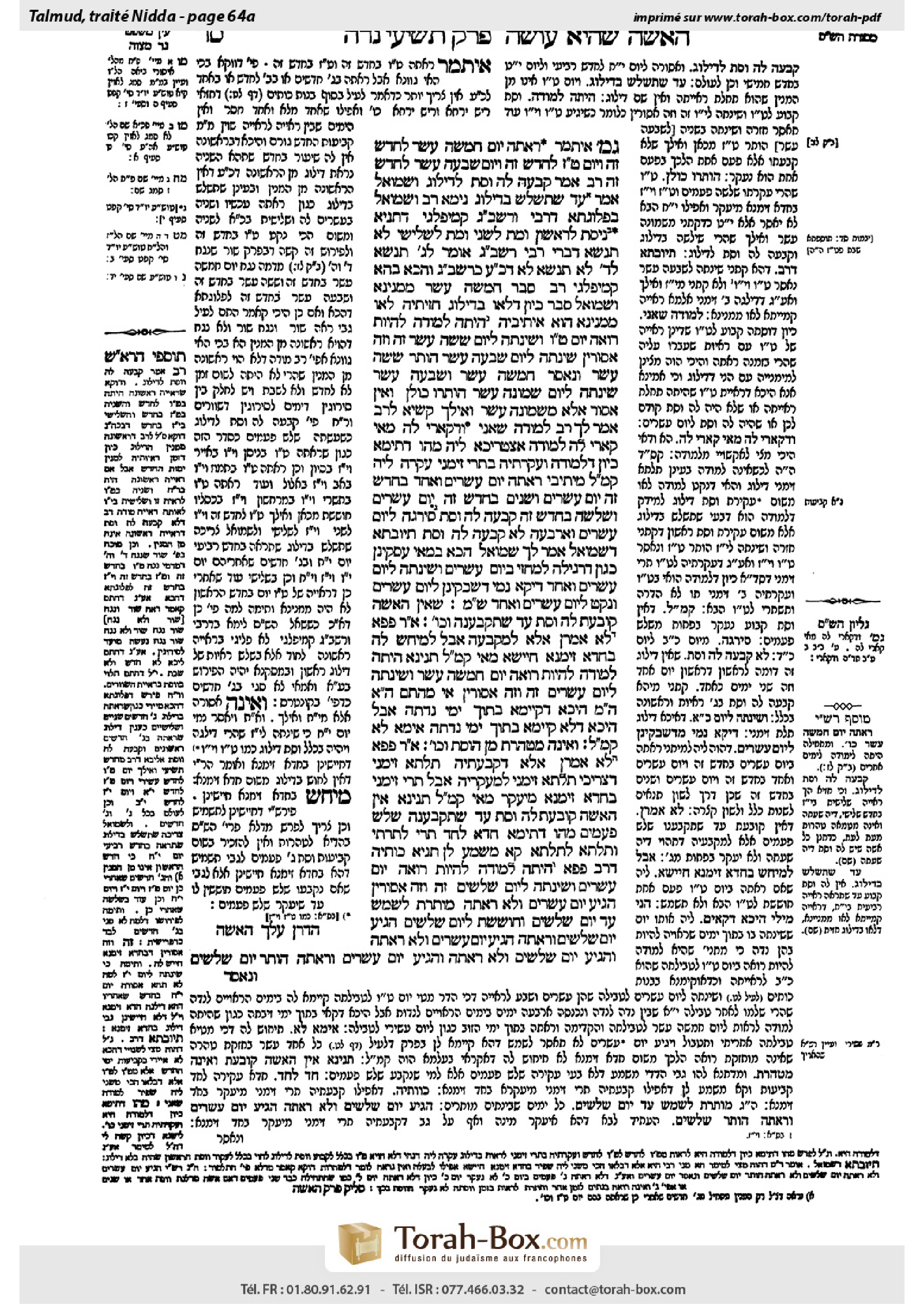
Niddah 64a: Talmud study for Daf Yomi
Daf Yomi is the daily study of one Talmud folio. Explore 37 tractates with scans, Hebrew text, Sefaria English and AI-generated French translations where annotated.
Passage selection and English or AI-generated French translation are available where the scan has annotations. Daf Study is independent of Torah-Box and Sefaria.
Browse Niddah · נידה · All tractatesNiddah 64a text and translations
This page of Niddah includes the Aramaic text, an English translation and an AI-generated French translation, alongside the scan above.
נידה ס״ד א · Aramaic and Hebrew text
גְּמָ' אִיתְּמַר, רָאֲתָה יוֹם חֲמִשָּׁה עָשָׂר לְחֹדֶשׁ זֶה, וְיוֹם שִׁשָּׁה עָשָׂר לְחֹדֶשׁ זֶה, וְיוֹם שִׁבְעָה עָשָׂר לְחֹדֶשׁ זֶה — רַב אָמַר: קָבְעָה לָהּ וֶסֶת לְדִילּוּג, וּשְׁמוּאֵל אָמַר: עַד שֶׁתְּשַׁלֵּשׁ בְּדִילּוּג.
נֵימָא רַב וּשְׁמוּאֵל בִּפְלוּגְתָּא דְּרַבִּי וְרַבָּן שִׁמְעוֹן בֶּן גַּמְלִיאֵל קָמִיפַּלְגִי, דְּתַנְיָא: נִיסֵּת לָרִאשׁוֹן וָמֵת, לַשֵּׁנִי וָמֵת — לַשְּׁלִישִׁי לֹא תִּנָּשֵׂא, דִּבְרֵי רַבִּי. רַבָּן שִׁמְעוֹן בֶּן גַּמְלִיאֵל אוֹמֵר: לַשְּׁלִישִׁי תִּנָּשֵׂא, לָרְבִיעִי לֹא תִּנָּשֵׂא.
לָא, דְּכוּלֵּי עָלְמָא כְּרַבָּן שִׁמְעוֹן בֶּן גַּמְלִיאֵל, וְהָכָא בְּהָא קָמִיפַּלְגִי: רַב סָבַר חֲמִשָּׁה עָשָׂר מִמִּנְיָנָא, וּשְׁמוּאֵל סָבַר כֵּיוָן דְּלָאו בְּדִילּוּג חֲזֵיתֵיהּ — לָאו מִמִּנְיָנָא הוּא.
אֵיתִיבֵיהּ: הָיְתָה לְמוּדָה לִהְיוֹת רוֹאָה יוֹם חֲמִשָּׁה עָשָׂר, וְשִׁינְּתָה לְיוֹם שִׁשָּׁה עָשָׂר — זֶה וָזֶה אֲסוּרִין. שִׁינְּתָה לְיוֹם שִׁבְעָה עָשָׂר — הוּתַּר שִׁשָּׁה עָשָׂר, וְנֶאֱסַר חֲמִשָּׁה עָשָׂר וְשִׁבְעָה עָשָׂר.
שִׁינְּתָה לְיוֹם שְׁמוֹנָה עָשָׂר — הוּתְּרוּ כּוּלָּן, וְאֵין אָסוּר אֶלָּא מִשְּׁמוֹנָה עָשָׂר וְאֵילָךְ. קַשְׁיָא לְרַב! אָמַר לְךָ רַב: לְמוּדָה שָׁאנֵי.
וּדְקָאָרֵי לַהּ, מַאי קָאָרֵי לַהּ? לְמוּדָה אִצְטְרִיכָא לֵיהּ, מַהוּ דְּתֵימָא: כֵּיוָן דִּלְמוּדָה וַעֲקַרְתֵּיהּ — בִּתְרֵי זִימְנֵי עָקְרָה לֵיהּ, קָא מַשְׁמַע לַן.
מֵיתִיבִי: רָאֲתָה יוֹם עֶשְׂרִים וְאֶחָד בְּחֹדֶשׁ זֶה, יוֹם עֶשְׂרִים וּשְׁנַיִם בְּחֹדֶשׁ זֶה, יוֹם עֶשְׂרִים וּשְׁלֹשָׁה בְּחֹדֶשׁ זֶה — קָבְעָה לָהּ וֶסֶת. סֵירְגָה לְיוֹם עֶשְׂרִים וְאַרְבָּעָה — לֹא קָבְעָה לָהּ וֶסֶת. תְּיוּבְתָּא דִּשְׁמוּאֵל!
אָמַר לָךְ שְׁמוּאֵל: הָכָא בְמַאי עָסְקִינַן? כְּגוֹן דִּרְגִילָה לְמִחְזֵי בְּיוֹם עֶשְׂרִים, וְשִׁינְּתָה לְיוֹם עֶשְׂרִים וְאֶחָד. דַּיְקָא נָמֵי, דְּשַׁבְקֵיהּ לְיוֹם עֶשְׂרִים וְנַקְטֵיהּ לְיוֹם עֶשְׂרִים וְאֶחָד — שְׁמַע מִינַּהּ.
שֶׁאֵין הָאִשָּׁה קוֹבַעַת לָהּ וֶסֶת עַד שֶׁתִּקְבָּעֶנָּה וְכוּ׳. אָמַר רַב פָּפָּא: לָא אֲמַרַן אֶלָּא לְמִקְבְּעַהּ, אֲבָל לְמֵיחַשׁ לַהּ בַּחֲדָא זִימְנָא חָיְישָׁא.
מַאי קָא מַשְׁמַע לַן? תְּנֵינָא: הָיְתָה לְמוּדָה לִהְיוֹת רוֹאָה יוֹם חֲמִשָּׁה עָשָׂר, וְשִׁינְּתָה לְיוֹם עֶשְׂרִים — זֶה וְזֶה אֲסוּרִין!
אִי מֵהָתָם, הֲוָה אָמֵינָא: הָנֵי מִילֵּי — הֵיכָא דְּקָיְימָא בְּתוֹךְ יְמֵי נִדָּתָהּ, אֲבָל הֵיכָא דְּלָא קָיְימָא בְּתוֹךְ יְמֵי נִדָּתָהּ — אֵימָא לָא. קָא מַשְׁמַע לַן.
וְאֵינָהּ מִטַּהֶרֶת מִן הַוֶּסֶת וְכוּ׳. אָמַר רַב פָּפָּא: לָא אֲמַרַן אֶלָּא דִּקְבַעְתֵּיהּ תְּלָתָא זִימְנֵי, דִּצְרִיכִי תְּלָתָא זִימְנֵי לְמִעְקְרֵיהּ, אֲבָל תְּרֵי זִימְנֵי — בַּחֲדָא זִימְנָא מִיעֲקַר.
מַאי קָא מַשְׁמַע לַן? תְּנֵינָא: אֵין הָאִשָּׁה קוֹבַעַת לָהּ וֶסֶת עַד שֶׁתִּקְבָּעֶנָּה שָׁלֹשׁ פְּעָמִים! מַהוּ דְּתֵימָא: חֲדָא — לְחַד, תְּרֵי — לְתַרְתֵּי, וּתְלָתָא — לִתְלָתָא, קָא מַשְׁמַע לַן.
תַּנְיָא כְּוָתֵיהּ דְּרַב פָּפָּא: הָיְתָה לְמוּדָה לִהְיוֹת רוֹאָה יוֹם עֶשְׂרִים, וְשִׁינְּתָה לַיּוֹם שְׁלֹשִׁים — זֶה וָזֶה אֲסוּרִין. הִגִּיעַ יוֹם עֶשְׂרִים וְלֹא רָאֲתָה — מוּתֶּרֶת לְשַׁמֵּשׁ עַד יוֹם שְׁלֹשִׁים, וְחוֹשֶׁשֶׁת לְיוֹם שְׁלֹשִׁים.
הִגִּיעַ יוֹם שְׁלֹשִׁים וְרָאֲתָה, הִגִּיעַ יוֹם עֶשְׂרִים וְלֹא רָאֲתָה, וְהִגִּיעַ יוֹם שְׁלֹשִׁים וְלֹא רָאֲתָה, וְהִגִּיעַ יוֹם עֶשְׂרִים וְרָאֲתָה — הוּתַּר יוֹם שְׁלֹשִׁים,
Niddah 64a · English translation
GEMARA: It was stated: If a woman saw menstrual blood on the fifteenth of this month, and on the sixteenth of the month after that, and on the seventeenth of the month after that, Rav says: She has thereby determined her menstrual cycle by skipping, i.e., as a month and a day. And Shmuel says: Her menstrual cycle is not determined until she skips a day three times. According to Shmuel, as the cycle is established in this case not by the date itself but by the pattern of one additional day every month, the pattern is established only when this occurs three consecutive times, i.e., when she menstruates on the fourth occasion.
The Gemara suggests: Shall we say that Rav and Shmuel disagree with regard to the issue that is the subject of the dispute between Rabbi Yehuda HaNasi and Rabban Shimon ben Gamliel? As it is taught in a baraita: If a woman was married to her first husband and he died, and was then married to a second one and he too died, she may not marry a third husband; this is the statement of Rabbi Yehuda HaNasi. Rabban Shimon ben Gamliel says: She may marry a third husband, but if he also dies she may not marry a fourth husband. The suggestion is that Rav and Rabbi Yehuda HaNasi hold that after two instances she has established a presumption and a pattern, whereas Shmuel and Rabban Shimon ben Gamliel maintain that the presumption is established only after three occurrences.
The Gemara rejects this suggestion: No, everyone agrees that the halakha is in accordance with the opinion of Rabban Shimon ben Gamliel, that a presumption is established only after three times, and here they disagree with regard to this matter: Rav holds that when she experienced bleeding on the fifteenth of the month, that occasion is also one of the number, i.e., it counts as the first of the pattern, which therefore has three elements. And Shmuel holds that since she did not see the first time after skipping, i.e., after having experienced bleeding on the fourteenth of the previous month, it is not part of the number, which means that she has experienced bleeding only twice in accordance with that pattern.
Shmuel raised an objection to the opinion of Rav from a baraita: If a woman was accustomed to see a flow of blood on the fifteenth day of the month, and deviated and instead experienced bleeding on the sixteenth day of the month, on both this day, the fifteenth, and that day, the sixteenth, it is prohibited for her to engage in intercourse with her husband. If she then deviated and experienced bleeding on the seventeenth day of the following month, the sixteenth day becomes permitted, and the fifteenth and seventeenth days of the following month are prohibited.
If she subsequently deviated and experienced bleeding on the eighteenth day of the following month, all the days are permitted. The fifteenth is permitted because she has now experienced bleeding three times on a different day, while the other days are permitted because she experienced bleeding only once on each day. And it is prohibited for her to engage in intercourse in the following month only from the eighteenth day and onward, i.e., on the nineteenth day, since she has now established a pattern of bleeding after one month and one day. This is difficult for Rav, as he maintains that twice is sufficient to establish a pattern, whereas this baraita requires three instances. Rav could have said to you in response: Since she was accustomed to experience bleeding on the fifteenth it is different. In that particular case the fifteenth does not count as the beginning of a new pattern because it was already her regular established time.
The Gemara expresses surprise at Shmuel’s question: And he who asked [udeka’arei] it, why did he ask it? The baraita clearly stresses the fact that the woman began with an established fixed menstrual cycle that was not part of the pattern. Shmuel could answer: It was necessary for the baraita to teach the case where she was accustomed to experience bleeding on a specific day, lest you say that since she was accustomed to experience bleeding on a specific day and displaced that pattern by bleeding on a different day, it should be sufficient that with two times she displaces it. For this reason, the baraita teaches us that an established pattern is displaced only after three occasions where she experiences bleeding on a different day. If it is not established, one displacement is enough.
The Gemara raises an objection from a baraita: If a woman saw a flow of blood on the twenty-first day of this month, the twenty-second day of that month, i.e., of the next month, and the twenty-third day of that month, i.e., of the third month, she established a fixed pattern of bleeding after one month and one day. If in the third month she instead varied and experienced bleeding on the twenty-fourth day of the month, she has not established a fixed pattern, as this last interval was one month and two days long. This is apparently a conclusive refutation of the opinion of Shmuel, as according to the baraita the pattern is established after only two equidistant intervals, whereas Shmuel requires three.
The Gemara answers that Shmuel could have said to you: Here, we are dealing with a case where the woman was accustomed to see a flow of blood on the twentieth day of the month, and she deviated and experienced bleeding on the twenty-first day of the month. Consequently, there were in fact a total of three equidistant intervals of one month and one day. The Gemara adds that the language of the baraita is also precise, as for what other reason would the baraita leave aside the twentieth day of the month and not use that date as the example, and instead take for its example the twenty-first day of the month? Learn from this that she had an established pattern of bleeding on the twentieth of every month before the events described in the baraita.
§ The mishna teaches: As a woman establishes a fixed menstrual cycle only after she establishes it three times. Rav Pappa says, in explanation: We said that she must experience bleeding three times only with regard to establishing a fixed menstrual cycle, but with regard to being concerned for a pattern, even after one time she must be concerned that this might be the beginning of a fixed pattern.
The Gemara asks: What is Rav Pappa teaching us? We learn this in the mishna: If the woman was accustomed to see the flow of blood on the fifteenth day and she deviated from the norm to see the flow of blood on the twentieth day, on both this day, the fifteenth, and that day, the twentieth, it is prohibited for her to engage in intercourse. This clearly demonstrates that even after bleeding only once on a certain day she must be concerned that this could be the start of a new fixed menstrual cycle.
The Gemara answers: If this halakha was derived only from there, I would say that this statement applies in a case where she experiences bleeding on the twentieth day while she is standing in her days suitable for menstruation, i.e., the days following the eleven days after her last period, when she is most likely to menstruate. But in a case where she is not standing in her days suitable for menstruation, but rather during the eleven days when uterine bleeding would render her a zava, I would say that she does not need to be concerned that she might experience bleeding again at that time. Therefore, Rav Pappa teaches us that even during these eleven days she must be concerned.
§ The mishna teaches: And a woman is purified from the existing fixed menstrual cycle, in the sense that intercourse is permitted on that day, only when she has been displaced from that day three times. Rav Pappa says, in explanation: We said this only in the case of a set cycle that she established by three times. With regard to such a cycle, we said that a different three times are necessary to displace that cycle. But with regard to a cycle that is established with only two times, it is displaced by one time of bleeding on a different day.
The Gemara asks: What is Rav Pappa teaching us? We learn this in the mishna: A woman establishes a fixed menstrual cycle only after she establishes it three times. The Gemara answers that it was necessary for Rav Pappa to teach his halakha, lest you say that a cycle is displaced by bleeding one time on a different day for a cycle that was set one time, but by bleeding on two different days for a cycle that was established with two times, and likewise by bleeding on three different days for a cycle that was established with three times. Therefore, Rav Pappa teaches us that whether she experiences bleeding once or twice, she displaces it by bleeding once on a different day.
It is taught in a baraita in accordance with the opinion of Rav Pappa: If a woman was accustomed to see the flow of blood on the twentieth day after her previous flow, and she deviated from the norm to experience bleeding on the thirtieth day, on both this day, the twentieth, and that day, the thirtieth, it is prohibited for her to engage in intercourse. If the twentieth day arrived, counting from the previous flow, which had occurred on day thirty, and she did not see a flow of blood, it is permitted for her to engage in intercourse until the thirtieth day after the previous flow, and she must be concerned on the thirtieth day.
If the thirtieth day arrived and she saw a flow of blood, and then the twentieth day after that arrived and she did not see a flow of blood, and the thirtieth day from her previous flow arrived and she did not see blood on that day but saw on a later day, and then the twentieth day after her previous flow arrived and she saw a flow of blood, the thirtieth day becomes permitted, as she experienced bleeding after an interval of thirty days only twice. This is in accordance with the opinion of Rav Pappa that a cycle of bleeding that has occurred twice is displaced by a single time of not bleeding on that day.
Niddah 64a · Traduction française (IA)
GUEMARA : Il a été enseigné : Si une femme a vu du sang menstruel le quinze de ce mois, puis le seize du mois suivant, puis le dix-sept du mois d’après, Rav dit qu’elle a ainsi établi son cycle menstruel par décalage, c’est-à-dire à un intervalle d’un mois et un jour. Shmuel dit que son cycle menstruel n’est établi qu’après qu’elle a décalé d’un jour à trois reprises. Selon Shmuel, puisque le cycle est établi ici non par la date elle-même, mais par le schéma d’un jour supplémentaire chaque mois, ce schéma n’est établi que lorsque cela se produit trois fois de suite, c’est-à-dire lorsqu’elle a ses règles une quatrième fois.
La Guemara suggère : Dirait-on que Rav et Shmuel sont en désaccord sur la question qui oppose Rabbi Yehouda HaNassi à Rabban Shimon ben Gamliel ? En effet, il est enseigné dans une baraïta : Si une femme a été mariée à son premier mari et qu’il est mort, puis qu’elle a été mariée à un deuxième mari et que celui-ci est également mort, elle ne peut pas épouser un troisième mari ; telle est l’opinion de Rabbi Yehouda HaNassi. Rabban Shimon ben Gamliel dit : Elle peut épouser un troisième mari, mais si celui-ci meurt également, elle ne peut pas épouser un quatrième mari. L’hypothèse est que Rav et Rabbi Yehouda HaNassi considèrent qu’après deux occurrences, une présomption et un schéma sont établis, tandis que Shmuel et Rabban Shimon ben Gamliel estiment que la présomption n’est établie qu’après trois occurrences.
La Guemara rejette cette hypothèse : Non, tous conviennent que la halakha suit l’opinion de Rabban Shimon ben Gamliel, selon laquelle une présomption n’est établie qu’après trois fois. Leur désaccord porte ici sur la question suivante : Rav considère que, lorsqu’elle a eu un saignement le quinze du mois, cette occurrence compte également dans le décompte, c’est-à-dire qu’elle constitue le premier élément du schéma, lequel comporte donc trois éléments. Shmuel, lui, considère que, puisqu’elle n’a pas eu de saignement la première fois après un décalage — c’est-à-dire après avoir eu un saignement le quatorze du mois précédent —, cette occurrence ne compte pas ; elle n’a donc eu un saignement selon ce schéma que deux fois.
Shmuel soulève une objection contre l’opinion de Rav à partir d’une baraïta : Si une femme avait l’habitude d’avoir un écoulement de sang le quinze du mois, mais qu’elle s’en est écartée et a eu un saignement le seize du mois, il lui est interdit d’avoir des rapports avec son mari aussi bien ce jour-ci, le quinze, que cet autre jour, le seize. Si elle s’écarte ensuite de nouveau de son habitude et a un saignement le dix-sept du mois suivant, les rapports le seize deviennent permis, tandis qu’ils sont interdits le quinze et le dix-sept du mois suivant.
Si, par la suite, elle s’écarte encore de son habitude et a un saignement le dix-huit du mois suivant, les rapports sont permis tous ces jours-là. Le quinze est permis parce qu’elle a désormais eu trois fois un saignement un autre jour, tandis que les autres jours sont permis parce qu’elle n’a eu un saignement qu’une seule fois à chacun de ces jours. Le mois suivant, les rapports ne lui sont interdits qu’à partir du dix-huit, c’est-à-dire le dix-neuf, puisqu’elle a désormais établi un schéma de saignements à un intervalle d’un mois et un jour. Cela pose une difficulté à Rav, qui soutient que deux fois suffisent pour établir un schéma, alors que cette baraïta exige trois occurrences. Rav aurait pu te répondre : le cas d’une femme qui avait l’habitude d’avoir un saignement le quinze est différent. Dans ce cas particulier, le quinze ne compte pas comme le début d’un nouveau schéma, car il s’agissait déjà de sa date régulière établie.
La Guemara s’étonne de la question de Shmuel : Et celui qui l’a posée [udeka’arei], pourquoi l’a-t-il posée ? La baraïta souligne clairement que la femme avait d’abord un cycle menstruel fixe et établi, qui ne faisait pas partie du schéma. Shmuel pourrait répondre : Il était nécessaire que la baraïta enseigne le cas où elle avait l’habitude d’avoir un saignement un jour précis, de peur que tu ne dises que, puisqu’elle avait l’habitude d’avoir un saignement un jour précis et qu’elle s’est écartée de cette habitude en ayant un saignement un autre jour, il suffise qu’elle s’en écarte deux fois. C’est pourquoi la baraïta nous enseigne qu’un schéma établi n’est déplacé qu’après trois occasions où elle a un saignement un autre jour. S’il n’est pas établi, un seul écart suffit.
La Guemara soulève une objection à partir d’une baraïta : Si une femme a vu un écoulement de sang le vingt et un de ce mois, le vingt-deux du mois suivant, puis le vingt-trois du troisième mois, elle a établi un cycle fixe de saignements à un intervalle d’un mois et un jour. Si, au troisième mois, elle s’écarte de nouveau et a un saignement le vingt-quatre du mois, elle n’a pas établi de cycle fixe, car ce dernier intervalle a duré un mois et deux jours. Cela réfute apparemment de façon concluante l’opinion de Shmuel, puisque, selon la baraïta, le schéma est établi après seulement deux intervalles égaux, alors que Shmuel en exige trois.
La Guemara répond que Shmuel aurait pu te dire : Ici, il s’agit d’une femme qui avait l’habitude d’avoir un écoulement de sang le vingt du mois, puis s’en est écartée et a eu un saignement le vingt et un. Il y a donc en réalité eu au total trois intervalles égaux d’un mois et un jour. La Guemara ajoute que la formulation de la baraïta est également précise : pour quelle autre raison la baraïta aurait-elle laissé de côté le vingt du mois et n’aurait-elle pas pris cette date comme exemple, choisissant plutôt le vingt et un ? Apprends-en qu’avant les événements décrits dans la baraïta, elle avait établi un schéma de saignements le vingt de chaque mois.
§ La Michna enseigne : Une femme n’établit un cycle menstruel fixe qu’après l’avoir établi trois fois. Rav Pappa explique : Nous avons dit qu’elle doit avoir des saignements trois fois uniquement pour établir un cycle menstruel fixe ; mais, lorsqu’il s’agit de tenir compte d’un schéma, même après une seule occurrence, elle doit craindre qu’il ne s’agisse du début d’un cycle fixe.
La Guemara demande : Que nous enseigne Rav Pappa ? Nous l’apprenons dans la Michna : Si la femme avait l’habitude d’avoir un écoulement de sang le quinze et qu’elle s’écarte de la norme en ayant un écoulement de sang le vingt, il lui est interdit d’avoir des rapports aussi bien ce jour-ci, le quinze, que cet autre jour, le vingt. Cela montre clairement que, même après avoir eu un saignement une seule fois un jour donné, elle doit craindre qu’il ne s’agisse du début d’un nouveau cycle menstruel fixe.
La Guemara répond : Si cette halakha était déduite de ce passage seulement, je dirais que cette affirmation s’applique au cas où elle a un saignement le vingt alors qu’elle se trouve dans ses jours propices aux menstruations, c’est-à-dire les jours qui suivent les onze jours suivant ses dernières règles, période où elle est le plus susceptible d’avoir ses règles. Mais si elle ne se trouve pas dans ses jours propices aux menstruations et qu’elle est plutôt dans les onze jours où un saignement utérin la rendrait zava, je dirais qu’elle n’a pas à craindre d’avoir de nouveau un saignement à ce moment-là. Rav Pappa nous enseigne donc que, même pendant ces onze jours, elle doit le craindre.
§ La Michna enseigne : Une femme est libérée du cycle menstruel fixe existant — en ce sens que les rapports sont permis ce jour-là — uniquement lorsque ce jour a été déplacé à trois reprises. Rav Pappa explique : Nous avons dit cela uniquement dans le cas d’un cycle fixe qu’elle a établi trois fois ; pour un tel cycle, il faut trois occurrences où elle a ses règles un autre jour pour le déplacer. Mais un cycle établi deux fois seulement est déplacé par un seul saignement un autre jour.
La Guemara demande : Que nous enseigne Rav Pappa ? Nous l’apprenons dans la Michna : Une femme n’établit un cycle menstruel fixe qu’après l’avoir établi trois fois. La Guemara répond qu’il était nécessaire que Rav Pappa enseigne sa halakha, de peur que tu ne dises qu’un cycle établi une fois est déplacé par un saignement survenu un autre jour, mais qu’un cycle établi deux fois n’est déplacé que par des saignements survenus deux jours différents, et de même qu’un cycle établi trois fois n’est déplacé que par des saignements survenus trois jours différents. Rav Pappa nous enseigne donc que, qu’elle ait eu des saignements une ou deux fois, elle déplace le cycle en ayant un seul saignement un autre jour.
Il est enseigné dans une baraïta, conformément à l’opinion de Rav Pappa : Si une femme avait l’habitude d’avoir un écoulement de sang le vingtième jour après l’écoulement précédent et qu’elle s’écarte de la norme en ayant un saignement le trentième jour, il lui est interdit d’avoir des rapports aussi bien ce jour-ci, le vingtième, que cet autre jour, le trentième. Si le vingtième jour arrive, en comptant à partir de l’écoulement précédent, survenu le trentième jour, et qu’elle n’a pas d’écoulement de sang, elle peut avoir des rapports jusqu’au trentième jour après l’écoulement précédent, et elle doit craindre le trentième jour.
Si le trentième jour arrive et qu’elle a un écoulement de sang, puis que le vingtième jour suivant arrive et qu’elle n’a pas d’écoulement de sang, puis que le trentième jour à compter de son écoulement précédent arrive et qu’elle n’a pas de saignement ce jour-là, mais en a un un jour plus tard, et qu’ensuite le vingtième jour après son écoulement précédent arrive et qu’elle a un écoulement de sang, les rapports le trentième jour deviennent permis, car elle n’a eu un saignement après un intervalle de trente jours que deux fois. Cela est conforme à l’opinion de Rav Pappa, selon laquelle un cycle de saignements survenu deux fois est déplacé par une seule absence de saignement ce jour-là.
Traduction française générée par IA à partir de l’édition anglaise de Sefaria. Vérifie toujours un passage avec le texte source.
Text from Sefaria: William Davidson Edition - Vocalized Aramaic (CC BY NC); William Davidson Edition - English (CC BY NC).