Niddah 64b: Talmud study for Daf Yomi
Daf Yomi is the daily study of one Talmud folio. Explore 37 tractates with scans, Hebrew text, Sefaria English and AI-generated French translations where annotated.
Passage selection and English or AI-generated French translation are available where the scan has annotations. Daf Study is independent of Torah-Box and Sefaria.
Browse Niddah · נידה · All tractatesNiddah 64b text and translations
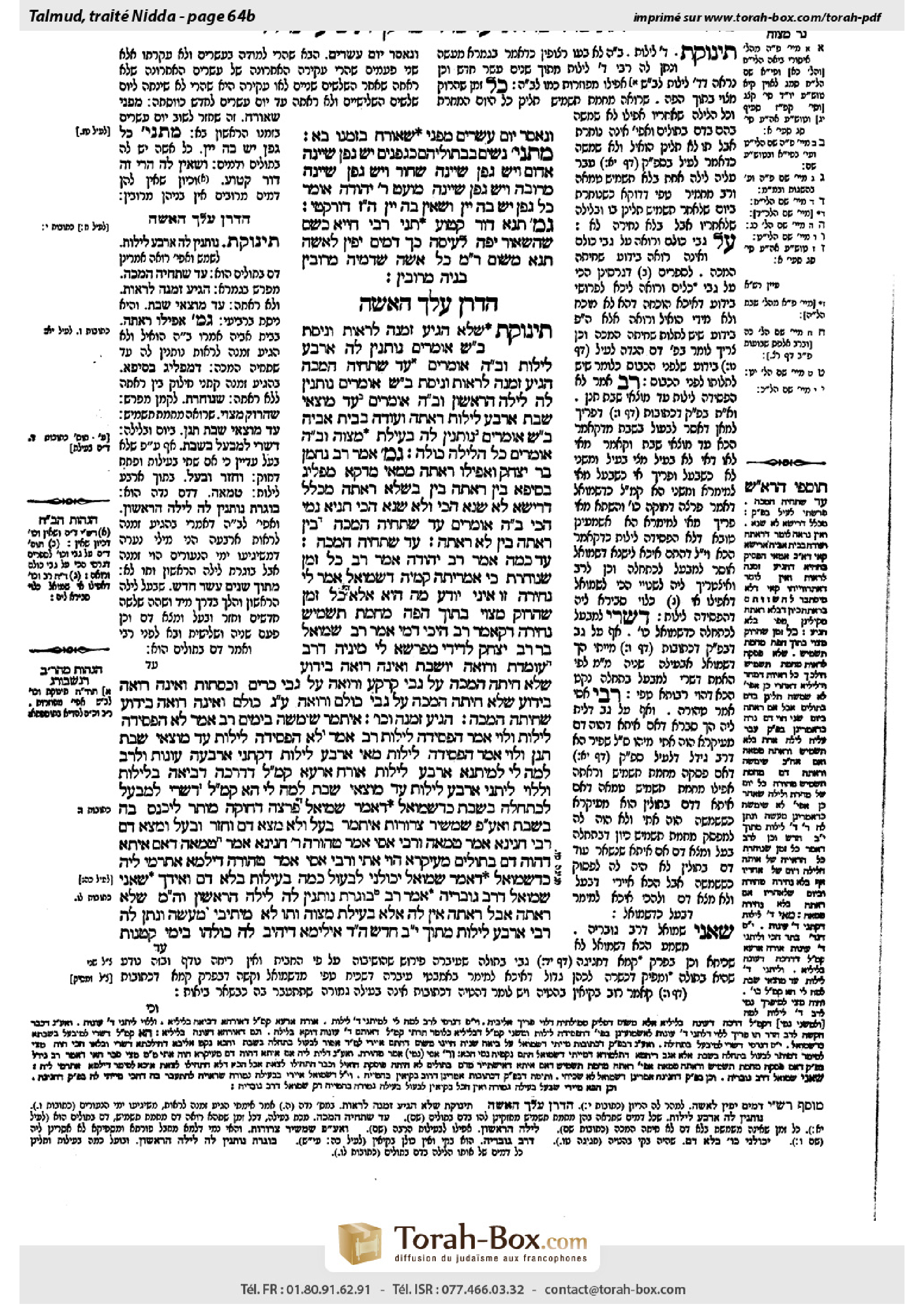
This page of Niddah includes the Aramaic text, an English translation and an AI-generated French translation, alongside the scan above.
נידה ס״ד ב · Aramaic and Hebrew text
וְנֶאֱסַר יוֹם עֶשְׂרִים, מִפְּנֵי שֶׁאוֹרַח בִּזְמַנּוֹ בָּא.
מַתְנִי' נָשִׁים בִּבְתוּלֵיהֶם כִּגְפָנִים, יֵשׁ גֶּפֶן שֶׁיֵּינָהּ אָדוֹם, וְיֵשׁ גֶּפֶן שֶׁיֵּינָהּ שָׁחוֹר, וְיֵשׁ גֶּפֶן שֶׁיֵּינָהּ מְרוּבֶּה, וְיֵשׁ גֶּפֶן שֶׁיֵּינָהּ מוּעָט. רַבִּי יְהוּדָה אוֹמֵר: כׇּל גֶּפֶן יֵשׁ בָּהּ יַיִן, וְשֶׁאֵין בָּהּ יַיִן — הֲרֵי זֶה דּוֹרְקְטִי.
גְּמָ' תָּנָא: דּוֹר קָטוּעַ. תָּנֵי רַבִּי חִיָּיא: כְּשֵׁם שֶׁהַשְּׂאוֹר יָפֶה לָעִיסָּה, כָּךְ דָּמִים יָפִין לָאִשָּׁה. תָּנָא מִשּׁוּם רַבִּי מֵאִיר: כׇּל אִשָּׁה שֶׁדָּמֶיהָ מְרוּבִּין — בָּנֶיהָ מְרוּבִּין.
הֲדַרַן עֲלָךְ הָאִשָּׁה.
מַתְנִי' תִּינוֹקֶת שֶׁלֹּא הִגִּיעַ זְמַנָּהּ לִרְאוֹת וְנִיסֵּת — בֵּית שַׁמַּאי אוֹמְרִים: נוֹתְנִין לָהּ אַרְבַּע לֵילוֹת, וּבֵית הִלֵּל אוֹמְרִים: עַד שֶׁתִּחְיֶה הַמַּכָּה.
הִגִּיעַ זְמַנָּהּ לִרְאוֹת וְנִיסֵּת, בֵּית שַׁמַּאי אוֹמְרִים: נוֹתְנִין לָהּ לַיְלָה הָרִאשׁוֹן, וּבֵית הִלֵּל אוֹמְרִים: עַד מוֹצָאֵי שַׁבָּת (ארבע) [אַרְבָּעָה] לֵילוֹת.
רָאֲתָה וְעוֹדָהּ בְּבֵית אָבִיהָ, בֵּית שַׁמַּאי אוֹמְרִים: נוֹתְנִין לָהּ בְּעִילַת מִצְוָה, וּבֵית הִלֵּל אוֹמְרִים: כׇּל הַלַּיְלָה (כּוּלָּהּ) [שֶׁלָּהּ].
גְּמָ' אָמַר רַב נַחְמָן בַּר יִצְחָק: וַאֲפִילּוּ רָאֲתָה. מִמַּאי? מִדְּקָא מְפַלֵּיג בְּסֵיפָא בֵּין רָאֲתָה בֵּין בְּשֶׁלֹּא רָאֲתָה, מִכְּלָל דְּרֵישָׁא — לָא שְׁנָא הָכִי וְלָא שְׁנָא הָכִי.
תַּנְיָא נָמֵי הָכִי: בֵּית הִלֵּל אוֹמְרִים: עַד שֶׁתִּחְיֶה הַמַּכָּה, בֵּין רָאֲתָה בֵּין לֹא רָאֲתָה.
עַד שֶׁתִּחְיֶה הַמַּכָּה. עַד כַּמָּה? אָמַר רַב יְהוּדָה אָמַר רַב: כׇּל זְמַן שֶׁנּוֹחֶרֶת. כִּי אַמְרִיתַהּ קַמֵּיהּ דִּשְׁמוּאֵל, אֲמַר לִי: נְחִירָה זוֹ אֵינִי יוֹדֵעַ מָה הִיא, אֶלָּא כׇּל זְמַן שֶׁהָרוֹק מָצוּי בְּתוֹךְ הַפֶּה מֵחֲמַת תַּשְׁמִישׁ.
נְחִירָה דְּקָאָמַר רַב, הֵיכִי דָמֵי? אָמַר רַב שְׁמוּאֵל בַּר רַב יִצְחָק: לְדִידִי מִפָּרְשָׁא לִי מִינֵּיהּ דְּרַב — עוֹמֶדֶת וְרוֹאָה, יוֹשֶׁבֶת וְאֵינָהּ רוֹאָה — בְּיָדוּעַ שֶׁלֹּא חָיְתָה הַמַּכָּה. עַל גַּבֵּי קַרְקַע וְרוֹאָה, עַל גַּבֵּי כָּרִים וּכְסָתוֹת וְאֵינָהּ רוֹאָה — בְּיָדוּעַ שֶׁלֹּא חָיְתָה הַמַּכָּה. עַל גַּבֵּי כּוּלָּם וְרוֹאָה, עַל גַּבֵּי כּוּלָּם וְאֵינָהּ רוֹאָה — בְּיָדוּעַ שֶׁחָיְתָה הַמַּכָּה.
הִגִּיעַ זְמַנָּהּ וְכוּ׳. אִיתְּמַר: שִׁימְּשָׁה בַּיָּמִים — רַב אָמַר: לֹא הִפְסִידָה לֵילוֹת, וְלֵוִי אָמַר: הִפְסִידָה לֵילוֹת.
רַב אָמַר: לֹא הִפְסִידָה לֵילוֹת, עַד ״מוֹצָאֵי שַׁבָּת״ תְּנַן. וְלֵוִי אָמַר: הִפְסִידָה לֵילוֹת. מַאי ״אַרְבַּע לֵילוֹת״ דְּקָתָנֵי? אַרְבָּעָה עוֹנוֹת.
וּלְרַב, לְמָה לִי לְמִיתְנֵא ״אַרְבָּעָה לֵילוֹת״? אוֹרַח אַרְעָא קָא מַשְׁמַע לַן, דְּדַרְכָּהּ דְּבִיאָה בַּלֵּילוֹת. וּלְלֵוִי, לִיתְנֵי ״אַרְבָּעָה לֵילוֹת״, ״עַד מוֹצָאֵי שַׁבָּת״ לְמָה לִי? הָא קָא מַשְׁמַע לַן דִּשְׁרֵי לְמִבְעַל לְכַתְּחִלָּה בְּשַׁבָּת.
כְּדִשְׁמוּאֵל, דְּאָמַר שְׁמוּאֵל: פִּרְצָה דְּחוּקָה מוּתָּר לִיכָּנֵס בָּהּ בְּשַׁבָּת, וְאַף עַל פִּי שֶׁמַּשִּׁיר צְרוֹרוֹת.
אִיתְּמַר: בָּעַל וְלֹא מָצָא דָּם, וְחָזַר וּבָעַל וּמָצָא דָּם, רַבִּי חֲנִינָא אָמַר: טְמֵאָה, וְרַבִּי אַסִּי אָמַר: טְהוֹרָה.
רַבִּי חֲנִינָא אָמַר: טְמֵאָה, דְּאִם אִיתַהּ דַּהֲוָה דַּם בְּתוּלִים — מֵעִיקָּרָא הֲוָה אָתֵי. וְרַבִּי אַסִּי אָמַר: טְהוֹרָה, דִּילְמָא אִתְרְמִי לֵיהּ כְּדִשְׁמוּאֵל, דְּאָמַר שְׁמוּאֵל: ״יָכוֹלְנִי לִבְעוֹל כַּמָּה בְּעִילוֹת בְּלֹא דָּם״. וְאִידָּךְ — שָׁאנֵי שְׁמוּאֵל דְּרַב גּוּבְרֵיהּ.
אָמַר רַב: בּוֹגֶרֶת נוֹתְנִין לָהּ לַיְלָה הָרִאשׁוֹן, וְהָנֵי מִילֵּי שֶׁלֹּא רָאֲתָה, אֲבָל רָאֲתָה — אֵין לָהּ אֶלָּא בְּעִילַת מִצְוָה וְתוּ לָא.
מֵיתִיבִי: מַעֲשֶׂה וְנָתַן לָהּ רַבִּי (ארבע) [אַרְבָּעָה] לֵילוֹת מִתּוֹךְ שְׁנֵים עָשָׂר חֹדֶשׁ. הֵיכִי דָּמֵי? אִילֵּימָא דְּיָהֵיב לַהּ כּוּלְּהוּ בִּימֵי קַטְנוּת,
Niddah 64b · English translation
And she is prohibited on the twentieth day, because it is the manner of women that their blood flow comes at its usual time.
MISHNA: Women, with regard to the blood that flows when their hymens are ruptured, are like grapevines: There is a vine that produces wine that is red, and there is a vine that produces wine that is black; and there is a vine that produces wine in abundance, and there is a vine that produces only a meager amount of wine. Rabbi Yehuda says: In every vine, there are grapes fit to produce wine, but any vine in which there are no grapes fit to produce wine, this is a dry vine [durkati]. Likewise, any woman who experiences bleeding is capable of giving birth, whereas one who does not experience bleeding is like a dry vine, unable to give birth.
GEMARA: With regard to the term durkati, the Gemara explains that this means truncated generation [dor katua]. As Rabbi Ḥiyya teaches: Just as leaven is good for dough, so too, blood is good for a woman. It was likewise taught in the name of Rabbi Meir: Any woman whose blood is plentiful, her children are plentiful.
MISHNA: In the case of a young girl whose time to see a menstrual flow, i.e., the age of puberty, has not yet arrived, and she married and engaged in intercourse and her hymen was torn, Beit Shammai say: The Sages give her four nights after intercourse during which the blood is attributed to the torn hymen and she remains ritually pure. Thereafter, any blood is assumed to be menstrual blood and renders her impure. And Beit Hillel say: The blood is attributed to the torn hymen until the wound heals.
In the case of a young woman whose time to see a menstrual flow has arrived but she has not yet begun to menstruate, and she married and engaged in intercourse and her hymen was torn, Beit Shammai say: The Sages give her the first night during which the blood is attributed to the torn hymen. Thereafter, any blood is assumed to be menstrual blood. And Beit Hillel say: The blood is attributed to the torn hymen until the conclusion of Shabbat, and she may engage in intercourse with her husband for four nights, as it was customary for a virgin to marry on Wednesday.
In the case of a young woman who saw menstrual blood before marriage while she was still in her father’s house, Beit Shammai say: The Sages give her permission to engage only in relations that consummate a marriage, which are a mitzva, after which she is ritually impure due to the blood. And Beit Hillel say: The husband and wife may engage even in several acts of intercourse, as any blood seen throughout the entire night is attributed to the torn hymen.
GEMARA: The mishna first addresses the case of a young girl who has not yet reached puberty. Rav Naḥman bar Yitzḥak says: And this halakha applies to her even if she has seen menstrual blood. He explains his reasoning: From where do I derive this? I derive it from the fact that the tanna distinguishes in the latter clause of the mishna between a young girl who has seen menstrual blood and a young girl who has not seen menstrual blood. By inference, in the first clause of the mishna the halakha is no different in this case, where the young girl has experienced menstrual bleeding, and it is no different in that case, where she has not yet experienced menstrual bleeding.
This explanation of Rav Naḥman bar Yitzḥak is also taught in a baraita: Beit Hillel say: With regard to a young girl who has not yet reached puberty, the blood she emits is attributed to the torn hymen until the wound heals, regardless of whether she has seen menstrual blood beforehand or whether she has not yet seen menstrual blood.
§ The mishna teaches that Beit Hillel say: The blood is attributed to the torn hymen until the wound heals. The Gemara clarifies: Until when can the blood be attributed to the torn hymen? Rav Yehuda says that Rav says: All the time that she is noḥeret. Rav Yehuda continues: When I subsequently said this halakha before Shmuel, he said to me: This noḥeret, I do not know what it is, nor do I know what Rav means by it. Rather, all the time that the saliva is in her mouth due to sexual intercourse, she may attribute the blood to the torn hymen. Shmuel is using a euphemism, i.e., as long as there is blood in her vagina resulting from sexual intercourse.
The Gemara clarifies: This noḥeret that Rav says; what is it like? What did he mean? Rav Shmuel bar Rav Yitzḥak said: It was explained to me by Rav as follows: If the young girl stands up and sees blood, but she sits and does not see blood, it is known that the wound has not yet healed, and the blood is still attributed to the torn hymen. Similarly, if she sits on the ground and sees blood, but she sits on cushions and blankets and does not see blood, it is known that the wound has not yet healed and she may attribute the blood to the torn hymen, as the blood flows due to the strain of sitting on the ground. But if she sometimes sits on all of them, i.e., the ground, cushions, and blankets, and sees blood, and on other occasions she sits on all of them and does not see blood, it is known that the wound has healed, and this blood must now be menstrual blood.
§ The mishna teaches: In the case of a young woman whose time to see a menstrual flow has arrived, Beit Hillel say: The blood is attributed to the torn hymen until the conclusion of Shabbat and she may engage in intercourse with her husband for four nights. It was stated that there is a dispute between amora’im with regard to the following case: If she engaged in intercourse with her husband during the daytime, in addition to engaging in intercourse at night, Rav says: She has not lost her nights, and the blood is still attributed to the torn hymen for four nights. Levi says: She has lost her nights, since she has engaged in intercourse twice during the daytime and twice at night, and therefore she has already used up the equivalent of four nights.
The Gemara explains: Rav says that she has not lost her nights, as we learned in the mishna that the blood is attributed to the torn hymen until the conclusion of Shabbat, and it does not limit the number of times she may engage in intercourse during that time. And Levi says: She has lost her nights, as what is the meaning of the term: Four nights, that is taught in the mishna? It means four twelve-hour periods, either days or nights.
The Gemara asks: And according to the opinion of Rav, why do I need the mishna to teach: Four nights? The mishna should have stated four days, which would include both days and nights. Rav would respond that the mishna teaches us proper conduct, as it is proper that intercourse should be performed only at night. The Gemara suggests: And according to the opinion of Levi, let the mishna teach only: Four nights. Why do I need the mishna to specify: Until the conclusion of Shabbat? Levi would answer that this teaches us that it is permitted to engage in intercourse for the first time on Shabbat. Since the custom was for a virgin to marry on Wednesday, which means that one of the four first nights is Shabbat, it is permitted to engage in intercourse on that night, despite the fact that it may cause her to bleed.
The Gemara notes that Levi’s ruling is in accordance with the opinion of Shmuel, as Shmuel said: It is permitted to enter into a narrow opening in a wall on Shabbat, and this is the halakha even though doing so causes pebbles to fall from the wall. Similarly, although engaging in intercourse might cause a wound and bleeding, it is permitted on Shabbat.
It was stated that the amora’im engaged in a dispute: If a husband engaged in intercourse with a virgin and did not find blood, and he went back within the first four nights and again engaged in intercourse with her and this time he found blood, Rabbi Ḥanina says: The wife is ritually impure, as this is menstruation blood. And Rabbi Asi says: She is ritually pure, as it is blood from the wound resulting from the act of intercourse.
Rabbi Ḥanina says: She is ritually impure, as if it is so that it is blood from her hymen, i.e., the blood of her virginity, it would have come at the outset, after the first time they engaged in intercourse. And Rabbi Asi said: She is ritually pure, as perhaps it happened for him that he engaged in intercourse like Shmuel described. As Shmuel said: I can engage in intercourse several times without the appearance of blood. In other words, I can engage in intercourse with a virgin while leaving her hymen intact. And the other Sage, Rabbi Ḥanina, does not allow for that possibility, since he maintains that Shmuel is different, as his strength was great. Shmuel was particularly skilled at this, while others cannot accomplish this.
§ The mishna teaches the halakha of a young girl. The Gemara discusses the case of a girl who is older than twelve and a half. Rav says: The Sages give a grown woman, who engaged in intercourse on her wedding night, the entire first night, during which she may engage in intercourse with her husband several times. And this statement applies only if she did not see any blood. But if she saw blood, she has only the relations that consummate a marriage, which are a mitzva, and nothing more.
The Gemara raises an objection to Rav’s statement from a baraita: There was an incident involving a virgin who married, and Rabbi Yehuda HaNasi gave her four nights in which to engage in intercourse within twelve months of her wedding when the blood is considered to be like blood resulting from the torn hymen. The Gemara asks: What are the circumstances of this case? If we say that Rabbi Yehuda HaNasi gave her all of those nights of purity in her days as a minor,
Niddah 64b · Traduction française (IA)
Et elle est interdite le vingtième jour, car les femmes ont généralement un écoulement de sang à son échéance habituelle.
MICHNA : En ce qui concerne le sang qui s’écoule lors de la rupture de leur hymen, les femmes sont comparables à des vignes : certaines produisent un vin rouge, d’autres un vin noir ; certaines produisent du vin en abondance, d’autres n’en produisent qu’une faible quantité. Rabbi Yehouda dit : Toute vigne porte des raisins propres à produire du vin ; mais une vigne qui ne porte aucun raisin propre à produire du vin est une vigne sèche [durkati]. De même, toute femme qui saigne est capable d’enfanter, tandis que celle qui ne saigne pas est comme une vigne sèche, incapable d’enfanter.
GUEMARA : À propos du terme durkati, la Guemara explique qu’il signifie « génération tronquée » [dor katua]. Rabbi Ḥiyya enseigne en effet : De même que le levain est bénéfique pour la pâte, le sang est bénéfique pour une femme. On a également enseigné au nom de Rabbi Meïr : Toute femme dont le sang est abondant a de nombreux enfants.
MICHNA : Dans le cas d’une jeune fille qui n’a pas encore atteint l’âge où elle commence à avoir ses règles, c’est-à-dire la puberté, et qui s’est mariée, a eu des rapports et s’est déchiré l’hymen, Beit Chammaï disent : Les Sages lui accordent quatre nuits après les rapports, pendant lesquelles le sang est attribué à la rupture de l’hymen et elle reste rituellement pure. Ensuite, tout saignement est présumé être du sang menstruel et la rend impure. Beit Hillel disent : Le sang est attribué à la rupture de l’hymen jusqu’à ce que la plaie guérisse.
Dans le cas d’une jeune femme qui a atteint l’âge où elle commence à avoir ses règles, mais qui n’a pas encore commencé à être réglée, et qui s’est mariée, a eu des rapports et s’est déchiré l’hymen, Beit Chammaï disent : Les Sages lui accordent la première nuit, pendant laquelle le sang est attribué à la rupture de l’hymen. Ensuite, tout saignement est présumé être du sang menstruel. Beit Hillel disent : Le sang est attribué à la rupture de l’hymen jusqu’à la fin du Chabbat, et elle peut avoir des rapports avec son mari pendant quatre nuits, car il était d’usage qu’une vierge se marie le mercredi.
Dans le cas d’une jeune femme qui a vu du sang menstruel avant son mariage, alors qu’elle était encore chez son père, Beit Chammaï disent : Les Sages ne lui permettent que les rapports qui consomment le mariage, lesquels constituent une mitsva ; ensuite, elle est rituellement impure à cause du sang. Beit Hillel disent : Le mari et la femme peuvent avoir plusieurs rapports, car tout sang observé pendant toute la nuit est attribué à la rupture de l’hymen.
GUEMARA : La Michna traite d’abord du cas d’une jeune fille qui n’a pas encore atteint la puberté. Rav Naḥman bar Yitzḥak dit : Cette halakha s’applique à elle même si elle a déjà vu du sang menstruel. Il explique son raisonnement : D’où est-ce que je le déduis ? Du fait que, dans la dernière partie de la Michna, le tanna distingue entre une jeune fille qui a vu du sang menstruel et une jeune fille qui n’en a pas vu. On en déduit que, dans la première partie de la Michna, la halakha est identique dans les deux cas : que la jeune fille ait déjà eu des saignements menstruels ou qu’elle n’en ait pas encore eu.
Cette explication de Rav Naḥman bar Yitzḥak est également enseignée dans une baraïta : Beit Hillel disent : Pour une jeune fille qui n’a pas encore atteint la puberté, le sang qu’elle perd est attribué à la rupture de l’hymen jusqu’à la guérison de la plaie, qu’elle ait déjà vu du sang menstruel auparavant ou qu’elle n’en ait pas encore vu.
§ La Michna enseigne que Beit Hillel disent : Le sang est attribué à la rupture de l’hymen jusqu’à la guérison de la plaie. La Guemara précise : Jusqu’à quand le sang peut-il être attribué à la rupture de l’hymen ? Rav Yehouda dit au nom de Rav : Aussi longtemps qu’elle est noḥeret. Rav Yehouda poursuit : Lorsque j’ai ensuite rapporté cette halakha devant Chmouel, il m’a dit : « Cette noḥeret, je ne sais pas ce que c’est, et je ne sais pas non plus ce que Rav entend par là. » Il faut plutôt dire : Aussi longtemps que de la salive reste dans sa bouche à la suite des rapports, elle peut attribuer le sang à la rupture de l’hymen. Chmouel emploie ici un euphémisme : tant qu’il y a du sang dans son vagin à la suite des rapports, elle peut l’attribuer à la rupture de l’hymen.
La Guemara précise : Que signifie cette noḥeret dont parle Rav ? À quoi faisait-il allusion ? Rav Chmouel bar Rav Yitzḥak dit : Rav me l’a expliqué ainsi : si la jeune fille se lève et voit du sang, mais qu’elle s’assied et n’en voit pas, on sait que la plaie n’a pas encore guéri et que le sang est toujours attribué à la rupture de l’hymen. De même, si elle s’assied par terre et voit du sang, mais qu’elle s’assied sur des coussins et des couvertures et n’en voit pas, on sait que la plaie n’a pas encore guéri et elle peut attribuer le sang à la rupture de l’hymen, car le sang s’écoule sous l’effet de l’effort provoqué par la position assise à même le sol. Mais si, à certaines occasions, elle s’assied sur chacun de ces supports — le sol, des coussins et des couvertures — et voit du sang, tandis qu’à d’autres occasions elle s’assied sur chacun d’eux et n’en voit pas, on sait que la plaie a guéri et que ce sang doit désormais être considéré comme du sang menstruel.
§ La Michna enseigne : Dans le cas d’une jeune femme qui a atteint l’âge où elle commence à avoir ses règles, Beit Hillel disent : Le sang est attribué à la rupture de l’hymen jusqu’à la fin du Chabbat, et elle peut avoir des rapports avec son mari pendant quatre nuits. Il a été rapporté que les amoraïm sont en désaccord au sujet du cas suivant : si elle a eu des rapports avec son mari pendant la journée, en plus des rapports nocturnes, Rav dit : Elle n’a pas perdu ses nuits, et le sang est toujours attribué à la rupture de l’hymen pendant quatre nuits. Levi dit : Elle a perdu ses nuits, puisqu’elle a eu des rapports deux fois pendant la journée et deux fois la nuit ; elle a donc déjà utilisé l’équivalent de quatre nuits.
La Guemara explique : Rav dit qu’elle n’a pas perdu ses nuits, car nous avons appris dans la Michna que le sang est attribué à la rupture de l’hymen jusqu’à la fin du Chabbat, sans limiter le nombre de rapports qu’elle peut avoir pendant cette période. Levi dit qu’elle a perdu ses nuits : que signifie l’expression « quatre nuits » enseignée dans la Michna ? Elle désigne quatre périodes de douze heures, de jour comme de nuit.
La Guemara demande : Selon Rav, pourquoi la Michna devait-elle enseigner « quatre nuits » ? Elle aurait dû dire « quatre jours », ce qui aurait inclus les jours et les nuits. Rav répondrait que la Michna nous enseigne la conduite convenable : il convient de n’avoir des rapports que la nuit. La Guemara propose : Et selon Levi, que la Michna enseigne seulement « quatre nuits » ! Pourquoi devait-elle préciser « jusqu’à la fin du Chabbat » ? Levi répondrait que cela nous enseigne qu’il est permis d’avoir des rapports pour la première fois le Chabbat. Puisqu’il était d’usage qu’une vierge se marie le mercredi, l’une de ces quatre premières nuits tombe un Chabbat ; il est donc permis d’avoir des rapports cette nuit-là, même s’ils peuvent provoquer un saignement.
La Guemara relève que la décision de Levi est conforme à l’opinion de Chmouel, car Chmouel a dit : Il est permis de pénétrer dans une ouverture étroite d’un mur pendant le Chabbat, même si cela fait tomber des cailloux du mur. De même, bien que les rapports puissent provoquer une plaie et un saignement, ils sont permis le Chabbat.
Il a été rapporté que les amoraïm sont en désaccord : si un mari a eu des rapports avec une vierge sans trouver de sang, puis a de nouveau eu des rapports avec elle au cours des quatre premières nuits et a cette fois trouvé du sang, Rabbi Ḥanina dit : L’épouse est rituellement impure, car il s’agit de sang menstruel. Rabbi Asi dit : Elle est rituellement pure, car il s’agit du sang de la plaie provoquée par les rapports.
Rabbi Ḥanina dit : Elle est rituellement impure, car si le sang provenait de son hymen, c’est-à-dire du sang de sa virginité, il serait apparu dès le début, après leur premier rapport. Rabbi Asi dit : Elle est rituellement pure, car il se peut qu’il lui soit arrivé d’avoir des rapports de la manière décrite par Chmouel. Chmouel a en effet dit : « Je peux avoir des rapports plusieurs fois sans qu’apparaisse de sang. » Autrement dit, je peux avoir des rapports avec une vierge sans que son hymen se déchire. L’autre Sage, Rabbi Ḥanina, n’admet pas cette possibilité, car il estime que Chmouel était différent, sa force étant exceptionnelle. Chmouel avait une maîtrise particulière en la matière, tandis que les autres ne peuvent pas y parvenir.
§ La Michna enseigne la halakha relative à une jeune fille. La Guemara examine le cas d’une jeune fille âgée de plus de douze ans et demi. Rav dit : Les Sages accordent à une femme adulte qui a eu des rapports lors de sa nuit de noces toute la première nuit, durant laquelle elle peut avoir plusieurs rapports avec son mari. Cette règle ne s’applique que si elle n’a vu aucun sang. Mais si elle a vu du sang, elle ne peut avoir que les rapports qui consomment le mariage, lesquels constituent une mitsva, et rien de plus.
La Guemara soulève une objection à l’affirmation de Rav à partir d’une baraïta : Il arriva qu’une vierge se maria, et Rabbi Yehouda HaNassi lui accorda quatre nuits pendant lesquelles elle pouvait avoir des rapports, au cours des douze mois suivant son mariage, le sang étant alors considéré comme celui qui résulte de la rupture de l’hymen. La Guemara demande : Dans quelles circonstances cela s’est-il produit ? Si nous disons que Rabbi Yehouda HaNassi lui accorda toutes ces nuits de pureté alors qu’elle était mineure,
Traduction française générée par IA à partir de l’édition anglaise de Sefaria. Vérifie toujours un passage avec le texte source.
Text from Sefaria: William Davidson Edition - Vocalized Aramaic (CC BY NC); William Davidson Edition - English (CC BY NC).