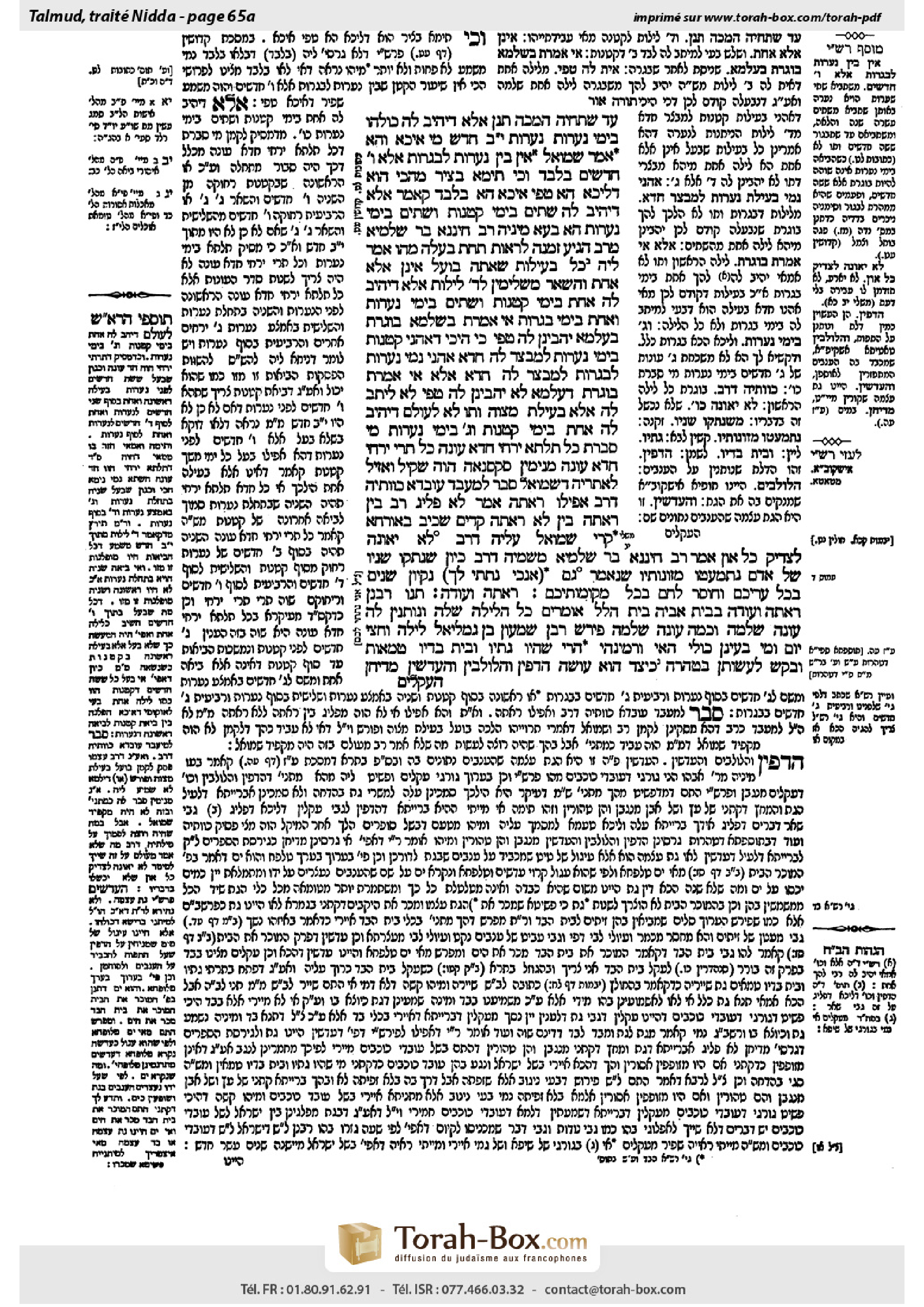
Niddah 65a: Talmud study for Daf Yomi
Daf Yomi is the daily study of one Talmud folio. Explore 37 tractates with scans, Hebrew text, Sefaria English and AI-generated French translations where annotated.
Passage selection and English or AI-generated French translation are available where the scan has annotations. Daf Study is independent of Torah-Box and Sefaria.
Browse Niddah · נידה · All tractatesNiddah 65a text and translations
This page of Niddah includes the Aramaic text, an English translation and an AI-generated French translation, alongside the scan above.
נידה ס״ה א · Aramaic and Hebrew text
״עַד שֶׁתִּחְיֶה הַמַּכָּה״ תְּנַן!
אֶלָּא דְּיָהֵיב לַהּ כּוּלְּהוּ בִּימֵי נַעֲרוּת — נַעֲרוּת שְׁנֵים עָשָׂר חֹדֶשׁ מִי אִיכָּא? וְהָא אָמַר שְׁמוּאֵל: אֵין בֵּין נַעֲרוּת לְבַגְרוּת אֶלָּא שִׁשָּׁה חֳדָשִׁים בִּלְבָד! וְכִי תֵימָא בְּצִיר מֵהָכִי הוּא דְּלֵיכָּא, הָא טְפֵי אִיכָּא — הָא ״בִּלְבָד״ קָאָמַר.
אֶלָּא, דְּיָהֵיב לַהּ שְׁתַּיִם בִּימֵי קַטְנוּת וּשְׁתַּיִם בִּימֵי נַעֲרוּת, הָא בְּעָא מִינֵּיהּ רַב חִינָּנָא בַּר שֶׁלֶמְיָא מֵרַב: הִגִּיעַ זְמַנָּהּ לִרְאוֹת תַּחַת בַּעְלָהּ, מַהוּ?
אֲמַר לֵיהּ: כׇּל בְּעִילוֹת שֶׁאַתָּה בּוֹעֵל — אֵינָן אֶלָּא אַחַת, וְהַשְּׁאָר מַשְׁלִימִין לְאַרְבָּעָה לֵילוֹת.
אֶלָּא, דְּיָהֵיב לַהּ אַחַת בִּימֵי קַטְנוּת, וּשְׁתַּיִם בִּימֵי נַעֲרוּת, וְאַחַת בִּימֵי בַּגְרוּת. אִי אָמְרַתְּ בִּשְׁלָמָא בּוֹגֶרֶת בְּעָלְמָא יָהֲבִינַן לַהּ טְפֵי, כִּי הֵיכִי דְּאַהֲנַי קַטְנוּת בִּימֵי נַעֲרוּת לְמִבְצַר לַהּ חֲדָא, אַהֲנַי נָמֵי נַעֲרוּת לְבַגְרוּת לְמִבְצַר לַהּ חֲדָא.
אֶלָּא אִי אָמְרַתְּ בּוֹגֶרֶת דְּעָלְמָא לָא יָהֲבִינַן לַהּ טְפֵי — לָא לִיתֵּב לַהּ אֶלָּא בְּעִילַת מִצְוָה, וְתוּ לָא!
לְעוֹלָם, דְּיָהֵיב לַהּ אַחַת בִּימֵי קַטְנוּת וְשָׁלֹשׁ בִּימֵי נַעֲרוּת. מִי סָבְרַתְּ כֹּל תְּלָתָא יַרְחֵי — חֲדָא עוֹנָה? כֹּל תְּרֵי יַרְחֵי — חֲדָא עוֹנָה.
מִנְיָמִין סַקְסְנָאָה הֲוָה שָׁקֵיל וְאָזֵיל לְאַתְרֵיהּ דִּשְׁמוּאֵל, סְבַר לְמֶעְבַּד עוֹבָדָא כְּוָותֵיהּ דְּרַב, אֲפִילּוּ רָאֲתָה. אֲמַר: לָא פָּלֵיג רַב בֵּין רָאֲתָה בֵּין לֹא רָאֲתָה.
קְדֵים שְׁכֵיב בְּאוֹרְחָא, קָרֵי שְׁמוּאֵל עֲלֵיהּ דְּרַב ״לֹא יְאֻנֶּה לַצַּדִּיק כׇּל אָוֶן״.
אָמַר רַב חִינָּנָא בַּר שֶׁלֶמְיָא מִשְּׁמֵיהּ דְּרַב: כֵּיוָן שֶׁנִּתְּקוּ שִׁנָּיו שֶׁל אָדָם, נִתְמַעֲטוּ מְזוֹנוֹתָיו, שֶׁנֶּאֱמַר: ״גַּם אָנֹכִי נָתַתִּי לָךְ נִקְיוֹן שִׁנַּיִם בְּכׇל עָרֵיכֶם וְחוֹסֶר לֶחֶם בְּכֹל מְקוֹמוֹתֵיכֶם״.
רָאֲתָה וְעוֹדָהּ. תָּנוּ רַבָּנַן: רָאֲתָה וְעוֹדָהּ בְּבֵית אָבִיהָ, בֵּית הִלֵּל אוֹמְרִים: כׇּל הַלַּיְלָה שֶׁלָּהּ, וְנוֹתְנִין לָהּ עוֹנָה שְׁלֵמָה. וְכַמָּה עוֹנָה שְׁלֵמָה? פֵּירֵשׁ רַבָּן שִׁמְעוֹן בֶּן גַּמְלִיאֵל: לַיְלָה וַחֲצִי יוֹם.
וּמִי בָּעֵינַן כּוּלֵּי הַאי? וּרְמִינְהִי: הֲרֵי שֶׁהָיוּ גִּתָּיו וּבֵית בַּדָּיו טְמֵאוֹת, וּבִקֵּשׁ לַעֲשׂוֹתָן בְּטָהֳרָה, כֵּיצַד הוּא עוֹשֶׂה? הַדַּפִּין וְהַלּוּלָבִין וְהָעֲדָשִׁין — מְדִיחָן,
Niddah 65a · English translation
in accordance with the ruling of the mishna: The Sages give her four nights, then he should have given her longer, as we learned in the mishna that according to Beit Hillel the blood may be attributed to the torn hymen until the wound heals.
Rather, you will say that he gave her these four nights all during her days as a young woman. Are there twelve months when one has the status of a young woman? But didn’t Shmuel say: The difference in time between becoming a young woman and becoming a grown woman is only six months? And if you would say that Shmuel is saying that it is in less than six months that there is no transition from young woman to grown woman status, but there is such a transition in more than six months, as women develop differently, that is not so, as Shmuel said: Only, which indicates that the period is neither less nor more than six months.
Rather, you will suggest that Rabbi Yehuda HaNasi gave her two days during her days as a minor, and he gave her two days during her days as a young woman. This too is difficult, as Rav Ḥinnana bar Shelamya asked Rav: With regard to a young girl who married before she reached puberty, and then her time to see menstrual blood arrived while she was under the authority of her husband, what is the halakha? Does she have the four nights when the blood is considered to be from her torn hymen?
And Rav said to him: All the acts of intercourse that you engage in while she is still too young are considered as only one act of intercourse, and the remainder, i.e., three more acts of intercourse, complete the total number of four nights. If so, Rabbi Yehuda HaNasi could not have given her two nights as a minor, since at most those acts of intercourse count as one.
Rather, you will suggest that he gave her one night during her days as a minor, and two nights during her days as a young woman, and one night during her days as a grown woman. But this is also difficult: Granted, if you say that we generally give a grown woman more than one night, then one can understand why Rabbi Yehuda HaNasi gave her one night in this case: Just as all the acts of intercourse she engaged in as a minor have the effect to deduct one night for her days as a young woman, similarly all the acts of intercourse she engaged in while a young woman have the effect to deduct one night for her days as a grown woman, leaving her with one.
But if you say that we generally do not give a grown woman more than one night, then in this case Rabbi Yehuda HaNasi should have given her as a grown woman only the one act of relations that consummate a marriage, which are a mitzva, i.e., merely a single act of intercourse, and nothing more, as otherwise the acts of intercourse before she became a grown woman would not have affected her status.
The Gemara answers: Actually, the correct explanation is that Rabbi Yehuda HaNasi gave her one night during her days as a minor and three nights during her days as a young woman. And as for the fact that she has the status of a young woman for only exactly six months, do you maintain that every three months was counted as one period of the husband’s absence, such that she had only two nights in six months? This is not the case. Rather, every two months was counted as one period, and therefore she had three nights during these six months when she could attribute the blood to her torn hymen.
The Gemara relates that the Sage Minyamin Saksana was coming and walking to the place of Shmuel. He thought that he would perform an action in accordance with the opinion of Rav, in that he would permit a grown woman to attribute blood to her torn hymen for the entire first night, even though she had already seen menstrual blood before she was married. Minyamin mistakenly said to himself: Rav does not distinguish between a woman who has seen menstrual blood and a woman who has not seen menstrual blood.
Before Minyamin reached Shmuel’s place, he passed away on the road, and he never completed the journey. Upon hearing this, Shmuel recited this verse about Rav: “No mishap shall befall the righteous” (Proverbs 12:21), i.e., God does not allow prohibited acts to come from the statements of the righteous. In this case, Minyamin ruled incorrectly, based on a misunderstanding of Rav’s statement.
Since the Gemara cited Rav Ḥinnana bar Shelamya, it cites another of his statements: Rav Ḥinnana bar Shelamya said in the name of Rav: Once a person’s teeth fall out and he has difficulty eating, his food diminshes accordingly, as it is stated: “And I also have given you cleanness of teeth in all your cities, and lack of bread in all your places” (Amos 4:6). The term “cleanness of teeth” is here a euphemism for having no teeth at all, which leads to a lack of bread.
§ The mishna teaches: In the case of a young woman who saw menstrual blood before marriage, while she was still in her father’s house, Beit Hillel say: They may engage in several acts of intercourse, as any bleeding throughout the entire night is attributed to the torn hymen. The Sages taught in a baraita: In the case of a young woman who saw menstrual blood while she was still in her father’s house, Beit Hillel say: All the night is hers, and the Sages give her one complete period of time during which she may attribute all bleeding to her torn hymen. And how long is a complete period of time in this context? Rabban Shimon ben Gamliel explained that it is one night and half of the next day.
The Gemara asks: But do we require all this time of one night and half of a day for a complete period? And the Gemara raises a contradiction from a baraita: In the case of one whose winepresses or olive presses were impure and he wished to prepare his grapes and olives in a state of ritual purity, how does he act? He should rinse the planks used to press the grapes in the winepress, and the palm branches used as brooms, and the troughs,
Niddah 65a · Traduction française (IA)
Conformément à la décision de la Michna : les Sages lui accordent quatre nuits. Il aurait donc dû lui en accorder davantage, puisque nous avons appris dans la Michna que, selon Beit Hillel, le sang peut être attribué à la déchirure de l’hymen jusqu’à la guérison de la plaie.
Mais tu diras plutôt qu’il lui a accordé ces quatre nuits pendant toute la période où elle avait le statut de jeune fille. Y a-t-il douze mois pendant lesquels on a le statut de jeune fille ? Pourtant, Shmuel n’a-t-il pas dit que la durée entre le moment où l’on devient jeune fille et celui où l’on devient adulte n’est que de six mois ? Et si tu dis que Shmuel veut dire qu’il n’y a pas de passage du statut de jeune fille à celui d’adulte en moins de six mois, mais qu’un tel passage peut avoir lieu après plus de six mois, car les femmes se développent différemment, ce n’est pas le cas : Shmuel a dit « seulement », ce qui indique que cette période n’est ni plus courte ni plus longue que six mois.
Mais tu suggéreras plutôt que Rabbi Yehuda HaNassi lui a accordé deux jours pendant qu’elle avait le statut de mineure et deux jours pendant qu’elle avait le statut de jeune fille. Cela aussi est difficile, car Rav Ḥinnana bar Shelamya demanda à Rav : « Quel est le statut d’une jeune fille qui s’est mariée avant d’avoir atteint la puberté, puis dont le moment de voir du sang menstruel est arrivé alors qu’elle était sous l’autorité de son mari ? A-t-elle droit aux quatre nuits pendant lesquelles le sang est considéré comme provenant de la déchirure de son hymen ? »
Rav lui répondit : « Tous les rapports que tu as avec elle alors qu’elle est encore trop jeune ne comptent que comme un seul rapport ; le reste, c’est-à-dire trois rapports supplémentaires, complète le total de quatre nuits. » Si tel est le cas, Rabbi Yehuda HaNassi n’aurait pas pu lui accorder deux nuits en tant que mineure, puisque ces rapports comptent tout au plus pour un.
Mais tu suggéreras plutôt qu’il lui a accordé une nuit pendant qu’elle avait le statut de mineure, deux nuits pendant qu’elle avait le statut de jeune fille et une nuit pendant qu’elle avait le statut d’adulte. Cela aussi est difficile. Certes, si tu dis qu’en règle générale nous accordons à une femme adulte plus d’une nuit, on comprend pourquoi Rabbi Yehuda HaNassi ne lui a accordé qu’une nuit dans ce cas : de même que tous les rapports qu’elle a eus en tant que mineure ont pour effet de déduire une nuit du nombre de nuits auxquelles elle a droit en tant que jeune fille, de même tous les rapports qu’elle a eus en tant que jeune fille ont pour effet de déduire une nuit du nombre de nuits auxquelles elle a droit en tant qu’adulte, de sorte qu’il ne lui en reste qu’une.
Mais si tu dis qu’en règle générale nous n’accordons pas à une femme adulte plus d’une nuit, alors Rabbi Yehuda HaNassi aurait dû ne lui accorder, en tant qu’adulte, que l’unique rapport qui consomme le mariage, puisqu’il s’agit d’une mitsva, c’est-à-dire un seul rapport, et rien de plus ; sinon, les rapports qu’elle a eus avant de devenir adulte n’auraient eu aucun effet sur son statut.
La Guemara répond : en réalité, l’explication correcte est que Rabbi Yehuda HaNassi lui a accordé une nuit pendant qu’elle avait le statut de mineure et trois nuits pendant qu’elle avait le statut de jeune fille. Quant au fait qu’elle n’a le statut de jeune fille que pendant exactement six mois, penses-tu que chaque période de trois mois était comptée comme une période d’absence du mari, de sorte qu’elle n’aurait eu que deux nuits en six mois ? Ce n’est pas le cas. Au contraire, chaque période de deux mois était comptée comme une période d’absence ; elle avait donc trois nuits au cours de ces six mois pendant lesquelles elle pouvait attribuer le sang à la déchirure de son hymen.
La Guemara rapporte que le Sage Minyamin Saksana se rendait à pied chez Shmuel. Il pensait agir conformément à l’opinion de Rav en permettant à une femme adulte d’attribuer le sang à la déchirure de son hymen pendant toute la première nuit, même si elle avait déjà vu du sang menstruel avant son mariage. Minyamin se dit à tort : « Rav ne fait pas de distinction entre une femme qui a déjà vu du sang menstruel et une femme qui n’en a pas vu. »
Avant que Minyamin n’arrive chez Shmuel, il mourut en chemin et n’acheva jamais son voyage. En l’apprenant, Shmuel cita à propos de Rav le verset : « Aucun malheur n’atteindra le juste » (Proverbes 12, 21), c’est-à-dire que Dieu ne laisse pas les propos des justes conduire à des actes interdits. Dans ce cas, Minyamin avait rendu une décision erronée, fondée sur une mauvaise compréhension des propos de Rav.
Puisque la Guemara a mentionné Rav Ḥinnana bar Shelamya, elle cite une autre de ses déclarations : Rav Ḥinnana bar Shelamya dit au nom de Rav : dès qu’une personne perd ses dents et a du mal à manger, sa nourriture diminue en conséquence, comme il est dit : « Je vous ai aussi donné des dents propres dans toutes vos villes et le manque de pain dans tous vos lieux » (Amos 4, 6). L’expression « dents propres » est ici un euphémisme désignant l’absence totale de dents, qui entraîne le manque de pain.
§ La Michna enseigne : dans le cas d’une jeune fille qui a vu du sang menstruel avant son mariage, alors qu’elle se trouvait encore dans la maison de son père, Beit Hillel disent : ils peuvent avoir plusieurs rapports, car tout saignement survenant durant toute la nuit est attribué à la déchirure de l’hymen. Les Sages enseignèrent dans une baraïta : dans le cas d’une jeune fille qui a vu du sang menstruel alors qu’elle se trouvait encore dans la maison de son père, Beit Hillel disent : toute la nuit lui appartient, et les Sages lui accordent une période complète pendant laquelle elle peut attribuer tout saignement à la déchirure de son hymen. Quelle est la durée d’une période complète dans ce contexte ? Rabban Shimon ben Gamliel expliqua qu’il s’agit d’une nuit et de la moitié du jour suivant.
La Guemara demande : Faut-il vraiment une nuit et la moitié d’un jour pour constituer une période complète ? La Guemara soulève une contradiction à partir d’une baraïta : dans le cas d’une personne dont les pressoirs à vin ou à olives étaient impurs et qui souhaitait préparer ses raisins et ses olives en état de pureté rituelle, que doit-elle faire ? Elle doit rincer les planches utilisées pour presser les raisins dans le pressoir à vin, les branches de palmier utilisées comme balais et les auges,
Traduction française générée par IA à partir de l’édition anglaise de Sefaria. Vérifie toujours un passage avec le texte source.
Text from Sefaria: William Davidson Edition - Vocalized Aramaic (CC BY NC); William Davidson Edition - English (CC BY NC).