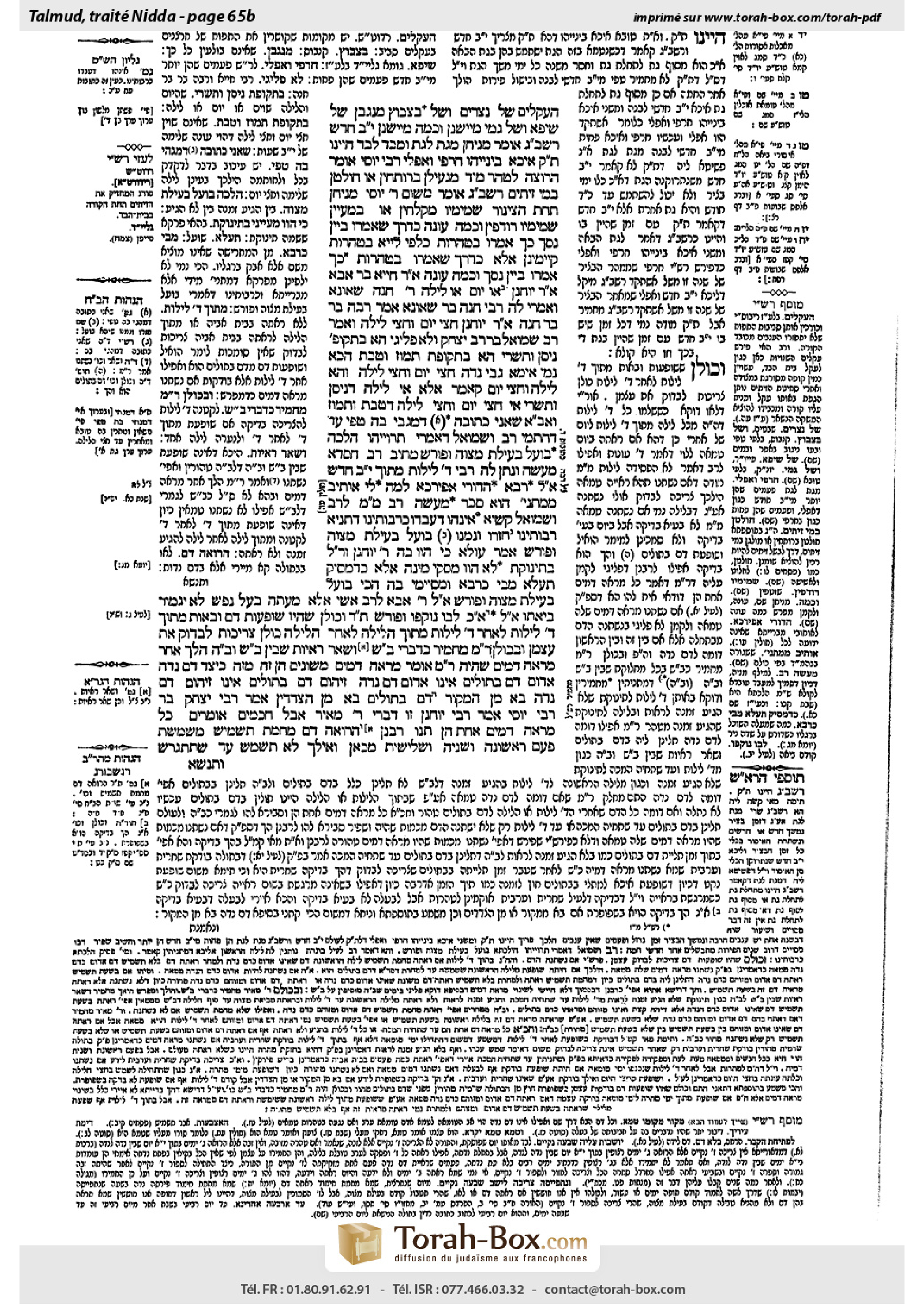
Niddah 65b: Talmud study for Daf Yomi
Daf Yomi is the daily study of one Talmud folio. Explore 37 tractates with scans, Hebrew text, Sefaria English and AI-generated French translations where annotated.
Passage selection and English or AI-generated French translation are available where the scan has annotations. Daf Study is independent of Torah-Box and Sefaria.
Browse Niddah · נידה · All tractatesNiddah 65b text and translations
This page of Niddah includes the Aramaic text, an English translation and an AI-generated French translation, alongside the scan above.
נידה ס״ה ב · Aramaic and Hebrew text
הָעֲקָלִים שֶׁל נְצָרִים וְשֶׁל בִּצְבּוּץ — מְנַגְּבָן, שֶׁל שִׁיפָא וְשֶׁל גֶּמִי — מְיַישְּׁנָן. וְכַמָּה מְיַישְּׁנָן? שְׁנֵים עָשָׂר חֹדֶשׁ. רַבָּן שִׁמְעוֹן בֶּן גַּמְלִיאֵל אוֹמֵר: מַנִּיחָן מִגַּת לַגַּת וּמִבַּד לְבַד.
הַיְינוּ תַּנָּא קַמָּא! אִיכָּא בֵּינַיְיהוּ חָרְפֵי וְאַפְלֵי.
רַבִּי יוֹסֵי אוֹמֵר: הָרוֹצֶה לְטַהֵר מִיָּד, מַגְעִילָן בְּרוֹתְחִין אוֹ חוֹלְטָן בְּמֵי זֵיתִים. רַבָּן שִׁמְעוֹן בֶּן גַּמְלִיאֵל אוֹמֵר מִשּׁוּם רַבִּי יוֹסֵי: מַנִּיחָן תַּחַת הַצִּינּוֹר שֶׁמֵּימָיו מְקַלְּחִין, אוֹ בְּמַעְיָין שֶׁמֵּימָיו רוֹדְפִין. וְכַמָּה עוֹנָה? כְּדֶרֶךְ שֶׁאָמְרוּ בְּיֵין נֶסֶךְ, כָּךְ אָמְרוּ בִּטְהָרוֹת.
כְּלַפֵּי לְיָיא! בִּטְהָרוֹת קָיְימִינַן! אֶלָּא, כְּדֶרֶךְ שֶׁאָמְרוּ בִּטְהָרוֹת, כָּךְ אָמְרוּ בְּיֵין נֶסֶךְ.
וְכַמָּה עוֹנָה? אָמַר רַבִּי חִיָּיא בַּר אַבָּא אָמַר רַבִּי יוֹחָנָן: אוֹ יוֹם אוֹ לַיְלָה. רַבִּי חָנָה שְׁאוּנָא, וְאָמְרִי לַהּ רַבִּי חָנָה בַּר שְׁאוּנָא, אָמַר רַבָּה בַּר בַּר חַנָּה אָמַר רַבִּי יוֹחָנָן: חֲצִי יוֹם וַחֲצִי לַיְלָה.
וְאָמַר רַב שְׁמוּאֵל בַּר רַב יִצְחָק: וְלָא פְּלִיגִי — הָא בִּתְקוּפַת נִיסָן וְתִשְׁרִי, הָא בִּתְקוּפַת תַּמּוּז וְטֵבֵת.
הָכָא נָמֵי, אֵימָא גַּבֵּי נִדָּה חֲצִי יוֹם וַחֲצִי לַיְלָה! וְהָא ״לַיְלָה וַחֲצִי יוֹם״ קָאָמַר! אֶלָּא: אִי לַיְלָה דְּנִיסָן וְתִשְׁרִי, אִי חֲצִי יוֹם וַחֲצִי לַיְלָה דְּטֵבֵת וְתַמּוּז.
וְאִיבָּעֵית אֵימָא: שָׁאנֵי כְּתוּבָּה — דְּמַגְּהִי בַּהּ טְפֵי, עַד דְּחָתְמִי.
רָב וּשְׁמוּאֵל דְּאָמְרִי תַּרְוַיְיהוּ: הֲלָכָה — בּוֹעֵל בְּעִילַת מִצְוָה, וּפוֹרֵשׁ.
מֵתִיב רַב חִסְדָּא: מַעֲשֶׂה וְנָתַן לָהּ רַבִּי אַרְבָּעָה לֵילוֹת מִתּוֹךְ שְׁנֵים עָשָׂר חֹדֶשׁ!
אֲמַר לֵיהּ רָבָא: הַדּוֹרֵי אַפִּירְכָא לְמָה לִי? אוֹתֵיב מִמַּתְנִיתִין! הוּא סָבַר: מַעֲשֶׂה רַב.
מִכׇּל מָקוֹם, לְרַב וּשְׁמוּאֵל קַשְׁיָא! אִינְהוּ דַּעֲבַדוּ כְּרַבּוֹתֵינוּ, דְּתַנְיָא: רַבּוֹתֵינוּ חָזְרוּ וְנִמְנוּ — בּוֹעֵל בְּעִילַת מִצְוָה וּפוֹרֵשׁ.
אָמַר עוּלָּא: כִּי הָווּ בַּהּ רַבִּי יוֹחָנָן וְרֵישׁ לָקִישׁ בְּתִינוֹקֶת, לָא הֲווֹ מַסְּקִי מִינַּהּ אֶלָּא כִּדְמַסֵּיק תַּעֲלָא מִבֵּי כְרָבָא, וּמְסַיְּימִי בַּהּ הָכִי: בּוֹעֵל בְּעִילַת מִצְוָה וּפוֹרֵשׁ.
אָמַר לוֹ רַבִּי אַבָּא לְרַב אָשֵׁי: אֶלָּא מֵעַתָּה, בַּעַל נֶפֶשׁ לֹא יִגְמוֹר בִּיאָתוֹ! אָמַר לוֹ: אִם כֵּן, לִבּוֹ נוֹקְפוֹ וּפוֹרֵשׁ.
תָּנוּ רַבָּנַן: וְכוּלָּן שֶׁהָיוּ שׁוֹפְעוֹת דָּם וּבָאוֹת, מִתּוֹךְ אַרְבָּעָה לֵילוֹת לְאַחַר אַרְבָּעָה לֵילוֹת, מִתּוֹךְ הַלַּיְלָה לְאַחַר הַלַּיְלָה — כּוּלָּן צְרִיכוֹת לִבְדּוֹק אֶת עַצְמָן.
וּבְכוּלָּן, רַבִּי מֵאִיר מַחְמִיר כְּדִבְרֵי בֵּית שַׁמַּאי.
וּשְׁאָר רְאִיּוֹת שֶׁבֵּין בֵּית שַׁמַּאי וּבֵית הִלֵּל — הַלֵּךְ אַחַר מַרְאֵה דָמִים.
שֶׁהָיָה רַבִּי מֵאִיר אוֹמֵר: מַרְאֵה דָמִים מְשׁוּנִּים הֵן זֶה מִזֶּה. כֵּיצַד? דַּם נִדָּה — אָדוֹם, דַּם בְּתוּלִים — אֵינוֹ אָדוֹם. דַּם נִדָּה — זִיהוּם, דַּם בְּתוּלִים — אֵינוֹ זִיהוּם. דַּם נִדָּה — בָּא מִן הַמָּקוֹר, דַּם בְּתוּלִים — בָּא מִן הַצְּדָדִין.
אָמַר רַבִּי יִצְחָק בַּר רַבִּי יוֹסֵי, אָמַר רַבִּי יוֹחָנָן: זוֹ דִּבְרֵי רַבִּי מֵאִיר, אֲבָל חֲכָמִים אוֹמְרִים כׇּל מַרְאֵה דָמִים אַחַת הֵן.
תָּנוּ רַבָּנַן: הָרוֹאָה דָּם מֵחֲמַת תַּשְׁמִישׁ — מְשַׁמֶּשֶׁת פַּעַם רִאשׁוֹנָה, וּשְׁנִיָּה, וּשְׁלִישִׁית, מִכָּאן וְאֵילָךְ — לֹא תְּשַׁמֵּשׁ עַד שֶׁתִּתְגָּרֵשׁ
Niddah 65b · English translation
and he should clean the pressing baskets with ashes and water if they were made of palm leaves or of hemp [bitzbutz], or leave them dormant if they were made of bast [shifa] or of reeds, because these absorb more of the wine. And how long must one leave them dormant? He must leave them for twelve months. Rabban Shimon ben Gamliel says: He can lay them aside from one wine-pressing season to the next wine-pressing season, or from one olive-pressing season to the next olive-pressing season.
The Gemara interrupts its citation to analyze the baraita: Rabban Shimon ben Gamliel’s statement is the same as that of the first tanna, as there are twelve months between one wine-pressing season and the next. The Gemara responds: The difference between them is the matter of the early and late ripening season for grapes. Rabban Shimon ben Gamliel does not require a precise measure of twelve months, as the difference in time between ripening seasons can be slightly more or less than that.
The Gemara continues its citation of the baraita. Rabbi Yosei says: One who wishes to purify the baskets immediately, without waiting a year, purges them in boiling water or scalds them in olive water. Rabban Shimon ben Gamliel says in the name of Rabbi Yosei: One sets them under a pipe whose water flows constantly or in a spring with rapid waters. And how much time should he leave them there? He should leave them for a period of time. In the same way that the Sages stated this time frame with regard to wine used for a libation in idol worship, so too the Sages stated this time frame with regard to matters of ritual purity.
The Gemara expresses surprise at this last clause: Isn’t it the opposite [kelapei layya]? We are dealing with matters of purity in this baraita. Rather, the baraita means: In the same way that the Sages stated this time frame with regard to matters of ritual purity, so too the Sages stated this time frame in the case of wine used for a libation in idol worship.
The Gemara asks: And how long is the period of time referred to in the baraita? Rabbi Ḥiyya bar Abba says that Rabbi Yoḥanan says: Either the day or the night. Rabbi Ḥana She’ona, and some say Rabbi Ḥana bar She’ona, say that Rabba bar bar Ḥana says that Rabbi Yoḥanan says: Half a day and half a night.
And Rav Shmuel bar Rav Yitzḥak said: And the Sages do not disagree. The ruling of this one, who says either a day or a night, is stated with regard to the equinox of the season of Nisan or Tishrei, when the days and night are equal; whereas the ruling of that one, who says half a day and half a night, is stated with regard to the solstice of the season of Tammuz, i.e., summer, or Tevet, i.e., winter, which have the longest day or night respectively, so that half the day and half the night together amount to twelve hours. This baraita apparently contradicts the statement of Rabban Shimon ben Gamliel, who says that the woman may attribute the blood to her hymen for a night and half the day.
The Gemara answers: Here too, one can say with regard to a menstruating woman that he meant half a day and half a night. The Gemara raises a difficulty. But Rabban Shimon ben Gamliel said a night and half a day. The Gemara clarifies: Rather, this is what Rabban Shimon ben Gamliel meant: Either a night during Nisan or Tishrei, which is twelve hours, or half a day and half a night during Tevet or Tammuz, which also equals twelve hours.
And if you wish, say instead: With regard to the purity of wine, a period is twelve hours. But in the case of marriage the time frame is different, due to the marriage contract, which is signed before the marriage is consummated, as there are those who delay for a lengthy period until they complete and sign it. Consequently, the Sages extended the period in this case to a night and half a day.
§ Although the mishna provides a certain period of time for both a minor and a young woman during which they may attribute any blood to the torn hymen, nevertheless Rav and Shmuel both say that the halakha is that the groom engages in relations that consummate a marriage, which are a mitzva, and then he separates from his wife.
Rav Ḥisda raises an objection from the baraita: There was an incident involving a virgin who married, and Rabbi Yehuda HaNasi gave her four nights to engage in intercourse within twelve months of her wedding. This indicates that the husband does not have to separate from his wife immediately after the first act of intercourse is completed.
Rava said to Rav Ḥisda: Why do I need to search for a refutation from a baraita, which is not necessarily known by all? One can raise a difficulty from an explicit statement of the mishna, which states that the first blood a woman sees on her wedding night is attributed to her torn hymen. The Gemara explains that Rav Ḥisda raises his objection from the baraita, as he holds that a practical incident ruled upon by a Sage is a preferable source.
The Gemara returns to the objection: In any case, this baraita is difficult for Rav and Shmuel. The Gemara answers that they acted in accordance with the opinion attributed to our Sages, as it is taught in a baraita: Our Sages returned and were counted again, i.e., they voted and decided, that the groom engages in relations that consummate a marriage, which are a mitzva, and subsequently he separates from his wife.
The Gemara proves that this ruling of Rav and Shmuel, based on the baraita, is also the opinion of Rabbi Yoḥanan and Reish Lakish. Ulla said: When we were learning the topic of a young girl who saw blood on her wedding night with Rabbi Yoḥanan and Reish Lakish, they brought up from it only the amount of earth that the fox brings up from a plowed field, i.e., they did not establish the halakha as stated in the mishna. And they concluded the discussion in this manner: The groom engages in relations that consummate a marriage, which are a mitzva, and then he separates from his wife.
Rabbi Abba said to Rav Ashi, in light of this ruling that the groom must separate from his bride after completing the act of intercourse: If that is so, a pious person should not complete his act of intercourse, lest he unintentionally continue longer than is permitted. Rav Ashi said to him in reply: The Sages did not issue such a decree, because if so, his heart will strike him with fear that perhaps his wife will begin to bleed while he is engaged in the act of intercourse, and he will separate from his wife completely and will not consummate the marriage.
§ The mishna teaches that a young girl is given four nights during which any bleeding is attributed to her torn hymen. The Sages taught in a baraita: And with regard to all of them, i.e., all the women who are given four nights, if they were discharging blood continually, from four nights until after those four nights, or in the case of those women who are given only one night, if they discharge blood from that one night until after that night, they may not attribute the blood to the torn hymen. Rather, all of them must examine themselves, in the manner that will be explained.
And with regard to all of these women, Rabbi Meir is stringent in accordance with the statement of Beit Shammai, and therefore a minor girl who bleeds for more than four nights must examine herself, despite the fact that Beit Hillel say she remains ritually pure until the wound has healed. Similarly, Rabbi Meir holds that with regard to a young girl who has reached puberty, if she continues to bleed after the first night she must examine herself.
The baraita continues: But with regard to the other cases of seeing blood, when she does not discharge blood continuously but bleeds again the following day, concerning which there is a dispute between Beit Shammai and Beit Hillel, Rabbi Meir holds that one follows the appearance of the blood. In other words, he does not maintain entirely in accordance with the opinion of Beit Shammai. Beit Hillel rule that the woman is ritually pure even if the color of the blood has changed, whereas Beit Shammai hold that she is ritually impure even if the color of the blood has not changed.
As Rabbi Meir would say: The appearances of impure and pure blood differ from one another. How so? The blood of a menstruating woman is red, whereas blood that comes from a torn hymen, indicating that she was a virgin, is not red. The blood of a menstruating woman is cloudy; blood that indicates that she was a virgin is not cloudy. Finally, the blood of a menstruating woman comes from the uterus; blood that indicates that she was a virgin comes from the sides of the vaginal wall.
Rabbi Yitzḥak bar Rabbi Yosei says that Rabbi Yoḥanan says: This is the statement of Rabbi Meir. According to Rabbi Meir, it is possible to examine the color of blood to determine whether it is menstrual blood or hymenal blood. But the Rabbis say that all appearances of blood are one, i.e., there is no distinction between the appearance of menstrual blood and blood indicating one’s loss of virginity.
§ The Sages taught in a baraita: A woman who sees blood due to sexual intercourse may engage in intercourse before the first time this occurs, before the second time this occurs, and before the third time this occurs. From this point forward, i.e., after three consecutive occurrences of bleeding due to intercourse, she may not engage in intercourse until she is divorced from her husband
Niddah 65b · Traduction française (IA)
et il doit nettoyer les paniers du pressoir avec des cendres et de l’eau s’ils sont faits de feuilles de palmier ou de chanvre [bitzbutz], ou les laisser inutilisés s’ils sont faits de liber [shifa] ou de roseaux, car ceux-ci absorbent davantage le vin. Combien de temps faut-il les laisser inutilisés ? Il faut les laisser ainsi pendant douze mois. Rabban Shimon ben Gamliel dit : Il peut les mettre de côté d’une saison de pressurage du vin à la suivante, ou d’une saison de pressurage des olives à la suivante.
La Guemara interrompt sa citation pour analyser la baraïta : la déclaration de Rabban Shimon ben Gamliel revient au même que celle du premier tanna, puisqu’il s’écoule douze mois entre deux saisons de pressurage du vin. La Guemara répond : La différence entre eux concerne les saisons de maturation précoce et tardive du raisin. Rabban Shimon ben Gamliel n’exige pas une durée précise de douze mois, car l’intervalle entre les saisons de maturation peut être légèrement supérieur ou inférieur.
La Guemara poursuit sa citation de la baraïta. Rabbi Yosei dit : Celui qui souhaite purifier immédiatement les paniers, sans attendre un an, les traite à l’eau bouillante ou les échaude avec de l’eau d’olives. Rabban Shimon ben Gamliel dit au nom de Rabbi Yosei : On les place sous un tuyau dont l’eau coule en permanence, ou dans une source aux eaux rapides. Combien de temps faut-il les y laisser ? Il faut les y laisser un certain temps. De même que les Sages ont indiqué cette durée à propos du vin utilisé pour une libation idolâtre, ils l’ont également indiquée en matière de pureté rituelle.
La Guemara s’étonne de cette dernière clause : N’est-ce pas l’inverse [kelapei layya] ? Dans cette baraïta, il est question de pureté. Il faut plutôt comprendre que, de même que les Sages ont indiqué cette durée en matière de pureté rituelle, ils l’ont également indiquée dans le cas du vin utilisé pour une libation idolâtre.
La Guemara demande : Quelle est la durée dont parle la baraïta ? Rabbi Ḥiyya bar Abba dit au nom de Rabbi Yoḥanan : soit un jour, soit une nuit. Rabbi Ḥana She’ona — et certains disent Rabbi Ḥana bar She’ona — rapporte au nom de Rabba bar bar Ḥana, qui le dit au nom de Rabbi Yoḥanan : une demi-journée et une demi-nuit.
Rav Shmuel bar Rav Yitzḥak dit : Les Sages ne sont pas en désaccord. L’avis de celui qui dit « soit un jour, soit une nuit » s’applique à l’équinoxe de Nisan ou de Tishrei, lorsque le jour et la nuit sont de même durée ; tandis que l’avis de celui qui dit « une demi-journée et une demi-nuit » s’applique au solstice de Tammuz, c’est-à-dire l’été, ou de Tevet, c’est-à-dire l’hiver, où le jour ou la nuit est respectivement le plus long, de sorte qu’une demi-journée et une demi-nuit réunies représentent douze heures. Cette baraïta semble contredire la déclaration de Rabban Shimon ben Gamliel, selon laquelle la femme peut attribuer le sang à son hymen pendant une nuit et une demi-journée.
La Guemara répond : Ici aussi, à propos d’une femme menstruée, on peut dire qu’il voulait parler d’une demi-journée et d’une demi-nuit. La Guemara soulève une difficulté : Mais Rabban Shimon ben Gamliel a dit « une nuit et une demi-journée ». La Guemara précise : Voici plutôt ce que Rabban Shimon ben Gamliel voulait dire : soit une nuit pendant Nisan ou Tishrei, ce qui représente douze heures, soit une demi-journée et une demi-nuit pendant Tevet ou Tammuz, ce qui représente également douze heures.
Et si tu le souhaites, dis plutôt : en matière de pureté du vin, la durée est de douze heures. Mais, dans le cas du mariage, le délai est différent en raison du contrat de mariage, qui est signé avant la consommation du mariage, car certains tardent longtemps avant de l’établir et de le signer. Par conséquent, les Sages ont prolongé le délai dans ce cas jusqu’à une nuit et une demi-journée.
§ Bien que la Michna fixe, pour une mineure comme pour une jeune femme, une certaine période durant laquelle elles peuvent attribuer tout saignement à la déchirure de leur hymen, Rav et Shmuel disent tous deux que la halakha est la suivante : le marié a des relations conjugales pour consommer le mariage, ce qui constitue une mitsva, puis se sépare de son épouse.
Rav Ḥisda soulève une objection à partir de la baraïta : Il est arrivé qu’une vierge se marie, et Rabbi Yehuda HaNasi lui accorda quatre nuits pour avoir des relations, dans les douze mois suivant son mariage. Cela indique que le mari n’a pas à se séparer de son épouse immédiatement après le premier rapport.
Rava dit à Rav Ḥisda : Pourquoi chercher une réfutation dans une baraïta, qui n’est pas nécessairement connue de tous ? On peut soulever une difficulté à partir d’un énoncé explicite de la Michna, qui dit que le premier sang qu’une femme voit pendant sa nuit de noces est attribué à la déchirure de son hymen. La Guemara explique que Rav Ḥisda soulève son objection à partir de la baraïta, car il estime qu’un cas concret tranché par un Sage constitue une source préférable.
La Guemara revient à l’objection : Quoi qu’il en soit, cette baraïta pose une difficulté à Rav et Shmuel. La Guemara répond qu’ils ont agi conformément à l’avis attribué à nos Sages, car il est enseigné dans une baraïta : Nos Sages se sont réunis de nouveau et ont procédé à un nouveau vote, c’est-à-dire qu’ils ont voté et décidé que le marié a des relations conjugales pour consommer le mariage, ce qui constitue une mitsva, puis se sépare de son épouse.
La Guemara prouve que cette décision de Rav et Shmuel, fondée sur la baraïta, est également l’avis de Rabbi Yoḥanan et Reish Lakish. Ulla dit : Lorsque nous étudiions avec Rabbi Yoḥanan et Reish Lakish le cas d’une jeune fille qui avait vu du sang pendant sa nuit de noces, ils n’en tirèrent que la quantité de terre qu’un renard soulève d’un champ labouré, c’est-à-dire qu’ils n’établirent pas la halakha telle qu’elle est énoncée dans la Michna. Ils conclurent la discussion ainsi : le marié a des relations conjugales pour consommer le mariage, ce qui constitue une mitsva, puis se sépare de son épouse.
À la lumière de cette décision selon laquelle le marié doit se séparer de son épouse après avoir achevé le rapport, Rabbi Abba dit à Rav Ashi : Si tel est le cas, un homme pieux ne devrait pas achever son rapport, de peur de le prolonger involontairement au-delà de ce qui est permis. Rav Ashi lui répondit : Les Sages n’ont pas promulgué un tel décret, car alors la peur lui étreindrait le cœur : il redouterait que son épouse ne commence à saigner pendant le rapport, et il se séparerait complètement d’elle sans consommer le mariage.
§ La Michna enseigne qu’une jeune fille bénéficie de quatre nuits durant lesquelles tout saignement est attribué à la déchirure de son hymen. Les Sages ont enseigné dans une baraïta : Pour toutes ces femmes, c’est-à-dire celles auxquelles sont accordées quatre nuits, si elles perdent du sang continuellement pendant ces quatre nuits et au-delà, ou, dans le cas de celles auxquelles une seule nuit est accordée, si elles perdent du sang pendant cette nuit et au-delà, elles ne peuvent pas attribuer le sang à la déchirure de leur hymen. Elles doivent plutôt toutes procéder à un examen d’elles-mêmes, selon les modalités qui seront expliquées.
Pour toutes ces femmes, Rabbi Meir se montre rigoureux conformément à l’avis de Beit Shammai. Ainsi, une jeune fille mineure qui saigne pendant plus de quatre nuits doit procéder à un examen d’elle-même, bien que Beit Hillel dise qu’elle reste rituellement pure jusqu’à la guérison de la blessure. De même, selon Rabbi Meir, une jeune fille qui a atteint la puberté doit procéder à un examen d’elle-même si elle continue à saigner après la première nuit.
La baraïta poursuit : Mais dans les autres cas de saignement, lorsqu’elle ne perd pas du sang continuellement, mais saigne de nouveau le lendemain — cas sur lequel Beit Shammai et Beit Hillel sont en désaccord —, Rabbi Meir estime qu’il faut se fonder sur l’aspect du sang. Autrement dit, il ne suit pas entièrement l’avis de Beit Shammai. Beit Hillel statue que la femme est rituellement pure même si la couleur du sang a changé, tandis que Beit Shammai estime qu’elle est rituellement impure même si la couleur du sang n’a pas changé.
Car Rabbi Meir disait : L’aspect du sang impur et celui du sang pur diffèrent. En quoi ? Le sang d’une femme menstruée est rouge, tandis que le sang provenant d’un hymen déchiré, qui indique qu’elle était vierge, n’est pas rouge. Le sang d’une femme menstruée est trouble, tandis que le sang indiquant qu’elle était vierge ne l’est pas. Enfin, le sang d’une femme menstruée provient de l’utérus, tandis que le sang indiquant qu’elle était vierge provient des côtés de la paroi vaginale.
Rabbi Yitzḥak bar Rabbi Yosei dit au nom de Rabbi Yoḥanan : Tel est l’avis de Rabbi Meir. Selon Rabbi Meir, il est possible d’examiner la couleur du sang afin de déterminer s’il s’agit de sang menstruel ou de sang provenant de l’hymen. Mais les Sages disent que tous les aspects du sang sont identiques, c’est-à-dire qu’il n’y a pas de différence entre l’aspect du sang menstruel et celui du sang indiquant la perte de la virginité.
§ Les Sages ont enseigné dans une baraïta : Une femme qui voit du sang à la suite de rapports sexuels peut avoir des rapports avant la première occurrence, avant la deuxième et avant la troisième. À partir de là, c’est-à-dire après trois occurrences consécutives de saignement à la suite de rapports sexuels, elle ne peut plus avoir de rapports jusqu’à ce qu’elle soit divorcée de son mari.
Traduction française générée par IA à partir de l’édition anglaise de Sefaria. Vérifie toujours un passage avec le texte source.
Text from Sefaria: William Davidson Edition - Vocalized Aramaic (CC BY NC); William Davidson Edition - English (CC BY NC).