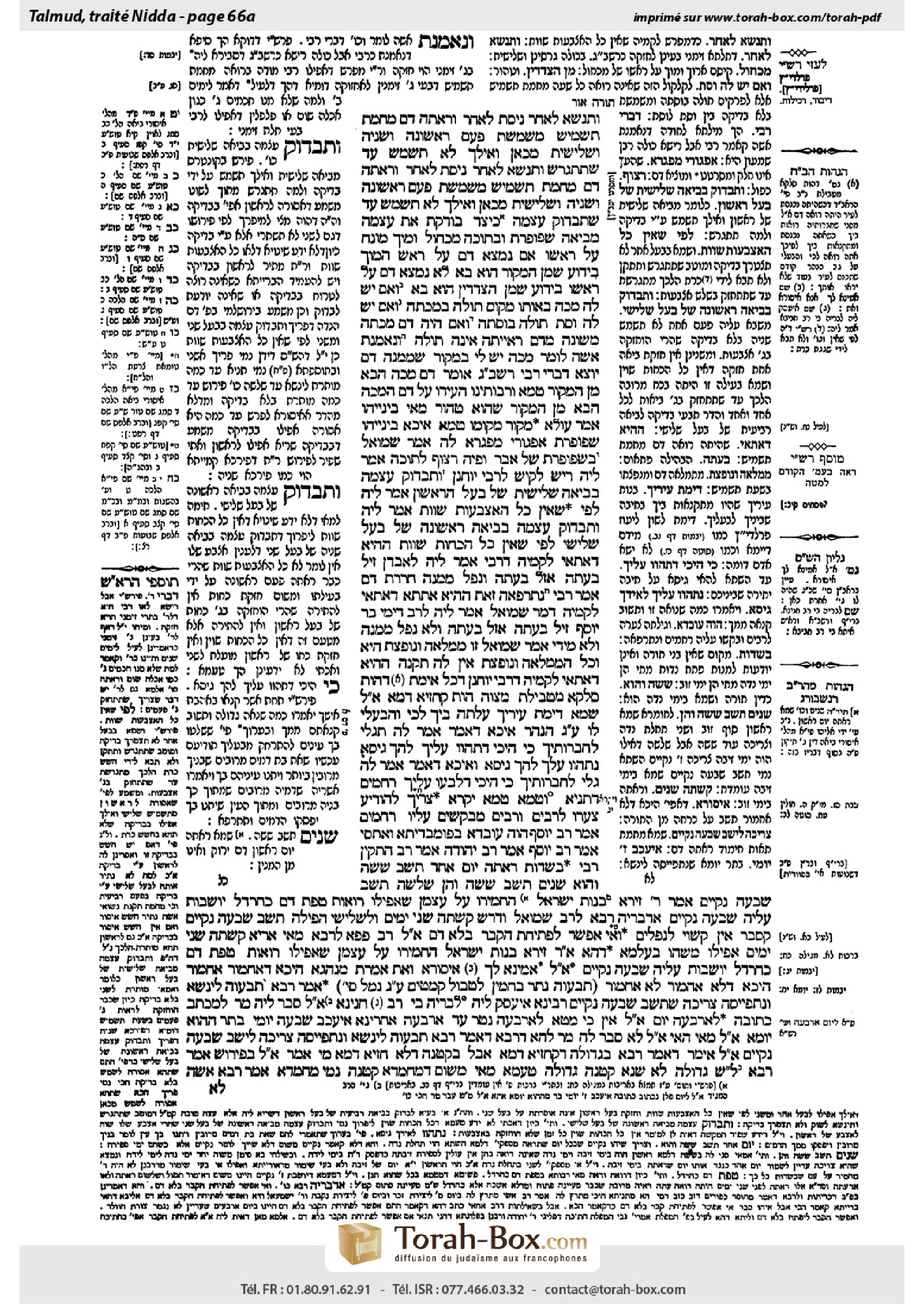
Niddah 66a: Talmud study for Daf Yomi
Daf Yomi is the daily study of one Talmud folio. Explore 37 tractates with scans, Hebrew text, Sefaria English and AI-generated French translations where annotated.
Passage selection and English or AI-generated French translation are available where the scan has annotations. Daf Study is independent of Torah-Box and Sefaria.
Browse Niddah · נידה · All tractatesNiddah 66a text and translations
This page of Niddah includes the Aramaic text, an English translation and an AI-generated French translation, alongside the scan above.
נידה ס״ו א · Aramaic and Hebrew text
וְתִנָּשֵׂא לְאַחֵר.
נִיסֵּת לְאַחֵר, וְרָאֲתָה דָּם מֵחֲמַת תַּשְׁמִישׁ — מְשַׁמֶּשֶׁת פַּעַם רִאשׁוֹנָה וּשְׁנִיָּה וּשְׁלִישִׁית, מִכָּאן וְאֵילָךְ לֹא תְּשַׁמֵּשׁ עַד שֶׁתִּתְגָּרֵשׁ וְתִנָּשֵׂא לְאַחֵר. נִיסֵּת לְאַחֵר, וְרָאֲתָה דָּם מֵחֲמַת תַּשְׁמִישׁ — מְשַׁמֶּשֶׁת פַּעַם רִאשׁוֹנָה וּשְׁנִיָּה וּשְׁלִישִׁית, מִכָּאן וְאֵילָךְ לֹא תְּשַׁמֵּשׁ עַד שֶׁתִּבְדּוֹק עַצְמָהּ.
כֵּיצַד בּוֹדֶקֶת אֶת עַצְמָהּ? מְבִיאָה שְׁפוֹפֶרֶת, וּבְתוֹכָהּ מִכְחוֹל, וּמוֹךְ מוּנָּח עַל רֹאשׁוֹ. אִם נִמְצָא דָּם עַל רֹאשׁ הַמּוֹךְ — בְּיָדוּעַ שֶׁמִּן הַמָּקוֹר הוּא בָּא. לֹא נִמְצָא דָּם עַל רֹאשׁוֹ — בְּיָדוּעַ שֶׁמִּן הַצְּדָדִין הוּא בָּא.
וְאִם יֵשׁ לָהּ מַכָּה בְּאוֹתוֹ מָקוֹם — תּוֹלָה בְּמַכָּתָהּ, וְאִם יֵשׁ לָהּ וֶסֶת — תּוֹלָה בְּוִסְתָּהּ.
וְאִם הָיָה דַּם מַכָּתָהּ מְשׁוּנֶּה מִדַּם רְאִיָּיתָהּ — אֵינָהּ תּוֹלָה, וְנֶאֱמֶנֶת אִשָּׁה לוֹמַר ״מַכָּה יֵשׁ לִי בַּמָּקוֹר שֶׁמִּמֶּנָּה דָּם יוֹצֵא״, דִּבְרֵי רַבִּי.
רַבָּן שִׁמְעוֹן בֶּן גַּמְלִיאֵל אוֹמֵר: דַּם מַכָּה הַבָּא מִן הַמָּקוֹר — טָמֵא, וְרַבּוֹתֵינוּ הֵעִידוּ עַל דַּם הַמַּכָּה הַבָּא מִן הַמָּקוֹר שֶׁהוּא טָהוֹר.
מַאי בֵּינַיְיהוּ? אָמַר עוּלָּא: מָקוֹר מְקוֹמוֹ טָמֵא אִיכָּא בֵּינַיְיהוּ.
שְׁפוֹפֶרֶת — (אַפְגּוֹרֵי מַפְגְּרָא) [אַפְסוֹדֵי מַפְסְדָא] לַהּ! אָמַר שְׁמוּאֵל: בִּשְׁפוֹפֶרֶת שֶׁל אֲבָר, וּפִיהָ רָצוּף לְתוֹכָהּ.
אֲמַר לֵיהּ רֵישׁ לָקִישׁ לְרַבִּי יוֹחָנָן: וְתִבְדּוֹק עַצְמָהּ בְּבִיאָה שְׁלִישִׁית שֶׁל בַּעַל הָרִאשׁוֹן? אֲמַר לֵיהּ: לְפִי שֶׁאֵין כׇּל הָאֶצְבָּעוֹת שָׁווֹת.
אֲמַר לֵיהּ: וְתִבְדּוֹק עַצְמָהּ בְּבִיאָה רִאשׁוֹנָה שֶׁל בַּעַל שְׁלִישִׁי? לְפִי שֶׁאֵין כׇּל הַכֹּחוֹת שָׁווֹת.
הָהִיא דַּאֲתַאי לְקַמֵּיהּ דְּרַבִּי, אֲמַר לֵיהּ לְאַבָּדָן: זִיל בַּעֲתַהּ. אֲזַל בַּעֲתַהּ, וְנָפַל מִמֶּנָּה חֲרָרַת דָּם. אָמַר רַבִּי: נִתְרַפְּאָה זֹאת.
הַהִיא אִתְּתָא דַּאֲתַאי לְקַמֵּיהּ דְּמָר שְׁמוּאֵל, אֲמַר לֵיהּ לְרַב דִּימִי בַּר יוֹסֵף: זִיל בַּעֲתַהּ! אֲזַל בַּעֲתַהּ, וְלָא נְפַל (מִמֶּנָּה) [מִינַּהּ] וְלָא מִידֵּי. אָמַר שְׁמוּאֵל: זוֹ מְמַלְּאָה וְנוֹפֶצֶת הִיא, וְכׇל הַמְמַלְּאָה וְנוֹפֶצֶת — אֵין לָהּ תַּקָּנָה.
הָהִיא דַּאֲתַאי לְקַמֵּיהּ דְּרַבִּי יוֹחָנָן, דְּכֹל אֵימַת דַּהֲוָת סָלְקָא מִטְּבִילַת מִצְוָה, הֲוָת קָחָזְיָא דְּמָא. אֲמַר לַהּ: שֶׁמָּא דִּימַת עִירִיךְ עָלְתָה בִּיךְ, לְכִי וְהִבָּעֲלִי לוֹ עַל גַּבֵּי הַנָּהָר.
אִיכָּא דְּאָמַר, אֲמַר לַהּ: תְּגַלִּי לְחַבְרוֹתִיךְ. כִּי הֵיכִי (דתהוו) [דְּתָוְוהָן] עֲלַיךְ לְהָךְ גִּיסָא, נִתְוְוהוּ עֲלַךְ לְהָךְ גִּיסָא. וְאִיכָּא דְּאָמַר, אֲמַר לָהּ: גַּלִּי לְחַבְרוֹתִיךְ, כִּי הֵיכִי דְּלִבְעוֹ עֲלַיךְ רַחֲמִים, דְּתַנְיָא: ״וְטָמֵא טָמֵא יִקְרָא״ — צָרִיךְ לְהוֹדִיעַ צַעֲרוֹ לָרַבִּים, וְרַבִּים מְבַקְּשִׁים עָלָיו רַחֲמִים.
אָמַר רַב יוֹסֵף: הֲוָה עוֹבָדָא בְּפוּמְבְּדִיתָא, וְאִתַּסִּי.
אָמַר רַב יוֹסֵף, אָמַר רַב יְהוּדָה, אָמַר רַב: הִתְקִין רַבִּי בְּשָׂדוֹת, רָאֲתָה יוֹם אֶחָד — תֵּשֵׁב שִׁשָּׁה וְהוּא,
שְׁנַיִם — תֵּשֵׁב שִׁשָּׁה, וְהֵן שְׁלֹשָׁה — תֵּשֵׁב שִׁבְעָה נְקִיִּים.
אָמַר רַבִּי זֵירָא: בְּנוֹת יִשְׂרָאֵל הֶחֱמִירוּ עַל עַצְמָן, שֶׁאֲפִילּוּ רוֹאוֹת טִפַּת דָּם כְּחַרְדָּל — יוֹשְׁבוֹת עָלֶיהָ שִׁבְעָה נְקִיִּים.
אַדְבְּרֵיהּ רָבָא לְרַב שְׁמוּאֵל, וְדָרֵשׁ: קִשְּׁתָה שְׁנֵי יָמִים, וְלַשְּׁלִישִׁי הִפִּילָה — תֵּשֵׁב שִׁבְעָה נְקִיִּים. קָסָבַר: אֵין קָשָׁוֵי לִנְפָלִים, וְאִי אֶפְשָׁר לִפְתִיחַת הַקֶּבֶר בְּלֹא דָּם.
אֲמַר לֵיהּ רַב פָּפָּא לְרָבָא: מַאי אִרְיָא קִשְּׁתָה שְׁנֵי יָמִים? אֲפִילּוּ מַשֶּׁהוּ בְּעָלְמָא! דְּהָא אָמַר רַבִּי זֵירָא: בְּנוֹת יִשְׂרָאֵל הֶחֱמִירוּ עַל עַצְמָן, שֶׁאֲפִילּוּ רוֹאוֹת טִפַּת דָּם כְּחַרְדָּל — יוֹשְׁבוֹת עָלֶיהָ שִׁבְעָה נְקִיִּים!
אֲמַר לֵיהּ רבא: אָמֵינָא לָךְ אִיסּוּרָא, וְאַתְּ אָמְרַתְּ מִנְהָגָא?! הֵיכָא דְּאַחְמוּר — אַחְמוּר, הֵיכָא דְּלָא אַחְמוּר — לָא אַחְמוּר.
(תְּבָעוּהָ, נֶתֶר, בְּחַמִּין, לִטְבוּל, קְמָטִים, עַל גַּבֵּי, נָמָל — סִימָן). אָמַר רָבָא: תְּבָעוּהָ לִינָּשֵׂא וְנִתְפַּיְּיסָה — צְרִיכָה שֶׁתֵּשֵׁב שִׁבְעָה נְקִיִּים.
רָבִינָא אֶיעְסֹק לֵיהּ לִבְרֵיהּ בֵּי רַב חֲנִינָא, אֲמַר לֵיהּ: סָבַר לֵיהּ מָר לְמִכְתַּב כְּתוּבָה לְאַרְבָּעָה יוֹם? אֲמַר לֵיהּ: אִין. כִּי מְטָא לְאַרְבָּעָה, נְטַר עַד אַרְבְּעָה אַחֲרִינָא, אִיעַכַּב שִׁבְעָה יוֹמֵי בָּתַר הָהוּא יוֹמָא.
אֲמַר לֵיהּ: מַאי הַאי? אֲמַר לֵיהּ: לָא סָבַר לַהּ מָר לְהָא דְּרָבָא, דְּאָמַר רָבָא: תְּבָעוּהָ לִינָּשֵׂא וְנִתְפַּיְּיסָה צְרִיכָה לֵישֵׁב שִׁבְעָה נְקִיִּים? אֲמַר לֵיהּ: אֵימַר דְּאָמַר רָבָא בִּגְדוֹלָה דְּקָחָזְיָא דְּמָא, אֲבָל בִּקְטַנָּה דְּלָא חַזְיָא דְּמָא — מִי אָמַר?
אֲמַר לֵיהּ: בְּפֵירוּשׁ אָמַר רָבָא: לָא שְׁנָא גְּדוֹלָה, לָא שְׁנָא קְטַנָּה. גְּדוֹלָה טַעְמָא מַאי? מִשּׁוּם דְּמֵחֲמָדָא, קְטַנָּה נָמֵי מֵחֲמָדָא.
אָמַר רָבָא: אִשָּׁה
Niddah 66a · English translation
and is married to another man. She is permitted to engage in intercourse with her second husband because it is possible that the bleeding was caused by engaging in intercourse with her first husband, and the issue will not reoccur when she engages in intercourse with a different man.
If she married another man and again saw blood due to sexual intercourse, she may engage in intercourse before the first time this occurs, before the second time this occurs, and before the third time this occurs. From this point forward she may not engage in intercourse until she is divorced from her second husband and is married to yet another man. If she married another man and again saw blood due to sexual intercourse, she may engage in intercourse the first time this occurs, the second time this occurs, and the third time this occurs. From this point forward there is a presumption that she always bleeds due to engaging in intercourse, and therefore she may not engage in intercourse or marry someone else until she examines herself.
How does she examine herself? She brings a tube, inside of which she places a cosmetic brush so that it is long enough to reach deeply into her vagina, and an absorbent cloth is placed on the tip of the brush. She inserts the tube with the brush and cloth within herself and then removes it. If blood is found on the top of the absorbent cloth, it is known that the blood comes from the uterus and she is ritually impure. If blood is not found on the top of the cloth, it is known that the blood comes from the sides of the vaginal walls and she is ritually pure, and she may resume engaging in intercourse with her husband.
And if she has a wound in that place, i.e., her vagina, she attributes the blood to her wound, and she is ritually pure, as it is assumed to not be uterine blood. And if she has a fixed menstrual cycle, i.e., she does not bleed every time she engages in intercourse with her husband, but only at fixed times, she attributes the blood to her fixed menstrual cycle, and she is permitted to engage in intercourse at other times.
And if the blood of her wound differed from the blood that she sees due to sexual intercourse, she may not attribute the blood to her wound. And a woman is deemed credible to say: I have a wound in my uterus, from where the blood is emerging. This is the statement of Rabbi Yehuda HaNasi.
Rabban Shimon ben Gamliel says: Blood of a wound that comes from the uterus is ritually impure as a primary category of impurity. Although this blood does not render it prohibited for her to engage in intercourse with her husband, it does render her impure with regard to eating ritually pure food. But our Sages testified that they had a tradition with regard to the blood of a wound that comes from the uterus, that it is ritually pure.
The Gemara asks: What is the difference between the opinion of those Sages and the opinion of Rabban Shimon ben Gamliel? Ulla said: The difference between them is whether the place of a woman’s uterus is impure, which means that any blood that passes through there is impure, even if it is blood from a wound. According to Rabban Shimon ben Gamliel, even the blood of a wound becomes impure if it passes through the uterus, whereas those Sages hold that only blood that originates in the uterus is impure.
With regard to the baraita that states that the test for a woman who experiences bleeding due to sexual intercourse is to insert a tube, the Gemara asks: But won’t a tube scratch her and cause her to bleed regardless? Shmuel said: The baraita is referring to a tube of lead, and the mouth, i.e., the end that is inserted, is folded inward so that it will not scratch her.
The baraita says that if a woman experiences bleeding on three occasions due to intercourse with her husband he must divorce her. Reish Lakish said to Rabbi Yoḥanan: But let her examine herself after the third act of intercourse with her first husband, so that he need not divorce her. Rabbi Yoḥanan said to him: It is preferable for her not to test herself and risk becoming forbidden to all men and instead to be divorced and remarry another, because not all fingers, i.e., penises, are equal. Since it is possible that sexual intercourse with her second husband might not cause her to bleed, she should not risk becoming forbidden to all men by performing the examination.
Reish Lakish further said to Rabbi Yoḥanan: Why does she examine herself only after the third time she experiences bleeding due to sexual intercourse with her third husband? But let her examine herself after the first act of intercourse with her third husband. After the first occurrence this woman already has a presumptive status that all acts of intercourse cause her to bleed. Rabbi Yoḥanan answered: She does not perform the examination then, because not all forces are equal. It is possible that the manner in which the couple has intercourse causes her to bleed, and therefore it is only after three times that she has a presumptive status of bleeding after every act of intercourse.
The Gemara relates: There was a certain woman who experienced bleeding due to sexual intercourse who came before Rabbi Yehuda HaNasi and asked him what she should do. Rabbi Yehuda HaNasi said to the Sage Abdon, who was present at the time: Go and suddenly frighten this woman. Abdon went and frightened her, and a mass of congealed blood fell from her vagina. Rabbi Yehuda HaNasi said: This woman is now cured. She will no longer experience bleeding due to sexual intercourse, as this mass of blood was the source of the blood.
The Gemara relates a similar incident: There was a certain woman who experienced bleeding due to sexual intercourse who came before Shmuel. Shmuel said to Rav Dimi bar Yosef: Go and frighten this woman. Rav Dimi went and frightened her, but nothing fell from her at all. Shmuel said: This woman is filled with blood, which falls out of her during intercourse. And any woman who is filled with blood that falls out during intercourse has no cure.
The Gemara relates another incident: There was a certain woman who came before Rabbi Yoḥanan and told him that every time she emerged from immersion in a ritual bath, after completing the mitzva of purifying herself for her husband, she would see blood before she engaged in intercourse with him. Rabbi Yoḥanan said to her: Perhaps the gossip of the women in your city, who are jealous of the love between you and your husband, has reached you, and this evil eye causes you to bleed before you engage in intercourse. Go and immerse in the river and engage in intercourse with your husband on the bank of the river, so that the other women will not see you leaving the ritual bath and gossip about you.
Some say that Rabbi Yoḥanan said to her: Reveal this fact to your friends, so that those women who were against you on this side, and gossiped about you, will be with you on that side, and be kind to you. And some say that Rabbi Yoḥanan said to her: Reveal this fact to your friends, in order that they will pray for mercy for you, as it is taught in a baraita discussing the verse: “And the leper in whom the mark is, his clothes shall be ripped and the hair of his head shall grow long and he will put a covering upon his upper lip and will cry: Impure, impure” (Leviticus 13:45). The leper publicizes the fact that he is ritually impure, as he must announce his pain to the masses, and then the masses will pray for mercy on his behalf.
Rav Yosef said: There was a similar incident in Pumbedita of a woman who experienced bleeding immediately after immersing in a ritual bath, and she followed the advice given by Rabbi Yoḥanan and she was cured.
§ Rav Yosef says that Rav Yehuda says that Rav says: Rabbi Yehuda HaNasi decreed that in the fields, i.e., in those distant places where there were no Torah scholars and whose residents were not well versed in the halakhot of menstruating women and did not know how to distinguish between the days of menstruation and the days of ziva, if she saw blood on one day, she must sit and count six days and that first day. She must observe six clean days without a discharge despite the possibility that she might have experienced bleeding only in her period of ziva, in which case she would be impure for only one day.
If she experiences bleeding for two days, she must sit and count six days and both of those first two days, for a total of eight days, in case the first day on which she bled was the last day of ziva, while the next day was the first day of her menstruation period. If she experiences bleeding for three days she must sit and count seven clean days, as she might be a greater zava, who must count seven clean days.
The Gemara cites a related statement. Rabbi Zeira says: Jewish women were stringent with themselves to the extent that even if they see a drop of blood the size of a mustard seed, they sit seven clean days for it. By Torah law, a woman who experiences menstrual bleeding waits seven days in total before immersing, regardless of whether she experienced bleeding on those days. If she experiences bleeding during the eleven days when she is not expected to experience menstrual bleeding, she is a lesser zava and waits one day without bleeding and then immerses. The Jewish women accepted upon themselves the stringency that if they experience any bleeding whatsoever, they treat it as the blood of a greater zava, which obligates one to count seven clean days before immersing (see Leviticus 15:25).
Rava authorized Rav Shmuel, and he taught: If a pregnant woman experienced labor pains for two days, and on the third day she miscarried, she must sit and count seven clean days. The Gemara explains that Rava holds that the principle that blood that emerges while the woman experiences labor pains is not ritually impure does not apply to miscarriages. And Rava further maintains that it is impossible for the womb to open without blood emerging. Therefore, when she miscarried she must have experienced a flow of blood, even if she did not notice it.
Rav Pappa said to Rava: For what reason did you teach this halakha specifically with regard to a woman who experiences labor pains for two days? Even if she merely discharges any amount of blood she should be impure, as Rabbi Zeira says: The Jewish women were stringent with themselves to the extent that even if they see a drop of blood of the size of a mustard seed, that woman sits seven clean days for it. Since it is impossible for the womb to open without the emergence of blood, when this woman miscarried there must have been blood, and therefore she must count seven clean days.
Rava said to Rav Pappa: I speak to you of a prohibition, i.e., that by Torah law a woman who experiences difficulty in childbirth for two days and on the third miscarries must count seven clean days as a greater zava, and you speak to me of a custom, a mere stringency. The stringency you mention does not apply in this case. Where the Jewish women were stringent, they were stringent, i.e., if they saw a drop of blood the size of a mustard seed. Where they were not stringent, i.e., in a case of blood due to labor, they were not stringent. By contrast, in the case I described the woman is obligated to count seven clean days by Torah law.
The Gemara provides a mnemonic for the following discussions: One who proposed to her; natron; with hot water; to immerse; folds; on top of; a port. Rava says: With regard to one who proposed marriage to a woman and she accepted it, the emotional excitement might have caused her to have a flow of menstrual blood, which would render her ritually impure and prohibit her from engaging in intercourse. Even if she was unaware of any flow, she must consider the possibility that it occurred. Therefore, to purify herself she must wait seven consecutive days that are clean from any flow of menstrual blood and then immerse in a ritual bath. Only after that process may she marry.
The Gemara cites a related incident: Ravina arranged for his son to marry into the family of Rav Ḥanina, i.e., to marry Rav Ḥanina’s daughter. Rav Ḥanina said to Ravina: Does the Master hold that it is appropriate to write the marriage contract as stating that the wedding will take place in four days, i.e., on Wednesday? Ravina said: Yes. When the fourth day, i.e., Wednesday arrived, he waited until another fourth day before marrying her, until the following Wednesday, i.e., he delayed seven days after that day when he had planned to marry her.
Rav Ḥanina said to Ravina: What is this? Why did you delay the wedding by an extra week? Ravina said to Rav Ḥanina: Doesn’t the Master hold in accordance with this statement of Rava, as Rava said: With regard to one who proposed marriage to a woman and she accepted it, she must wait seven consecutive days that are clean from any flow of menstrual blood and then immerse in a ritual bath? Rav Ḥanina said to Ravina: One can say that Rava said this statement with regard to an adult woman, who has seen menstrual blood. But did Rava actually say this with regard to a minor girl, who has not yet seen menstrual blood?
Ravina said to Rav Ḥanina: Rava said explicitly that there is no difference whether she is an adult woman and no difference whether she is a minor girl. What is the reason that an adult woman must wait for seven days? She must wait because she desires to marry her husband, and this might cause her to have a flow of blood. A minor girl also desires to marry her husband, which could cause a flow of blood.
§ Rava says: A woman who is about to immerse herself in a ritual bath for purification
Niddah 66a · Traduction française (IA)
et épouse un autre homme. Elle peut avoir des relations avec son second mari, car il est possible que le saignement ait été causé par les relations avec son premier mari et que le problème ne se reproduise pas avec un autre homme.
Si elle épouse un autre homme et constate de nouveau un saignement à la suite de relations sexuelles, elle peut avoir des relations avant la première occurrence, avant la deuxième occurrence et avant la troisième occurrence. À partir de là, elle ne peut plus avoir de relations jusqu’à ce qu’elle divorce de son second mari et épouse encore un autre homme. Si elle épouse un autre homme et constate de nouveau un saignement à la suite de relations sexuelles, elle peut avoir des relations la première fois, la deuxième fois et la troisième fois. À partir de là, on présume qu’elle saigne toujours à la suite de relations sexuelles ; elle ne peut donc ni avoir de relations ni épouser quelqu’un d’autre avant de s’être examinée.
Comment s’examine-t-elle ? Elle prend un tube dans lequel elle place un pinceau cosmétique suffisamment long pour atteindre profondément son vagin, et fixe un linge absorbant à l’extrémité du pinceau. Elle introduit en elle le tube contenant le pinceau et le linge, puis le retire. Si du sang se trouve à l’extrémité du linge absorbant, on sait que le sang provient de l’utérus et qu’elle est rituellement impure. Si l’extrémité du linge ne porte pas de sang, on sait que le sang provient des parois vaginales et qu’elle est rituellement pure ; elle peut alors reprendre les relations avec son mari.
Et si elle a une plaie à cet endroit, c’est-à-dire dans son vagin, elle attribue le sang à cette plaie et elle est rituellement pure, car on suppose qu’il ne s’agit pas de sang utérin. Et si elle a un cycle menstruel régulier, c’est-à-dire qu’elle ne saigne pas chaque fois qu’elle a des relations avec son mari, mais seulement à des moments fixes, elle attribue le sang à son cycle menstruel régulier et peut avoir des relations à d’autres moments.
Et si le sang de sa plaie diffère du sang qu’elle constate à la suite de relations sexuelles, elle ne peut pas attribuer le sang à sa plaie. Une femme est considérée comme digne de foi lorsqu’elle dit : « J’ai une plaie dans l’utérus, d’où provient le sang. » Telle est la déclaration de Rabbi Yehouda HaNassi.
Rabban Shimon ben Gamliel dit : « Le sang d’une plaie provenant de l’utérus est rituellement impur au premier degré d’impureté. » Bien que ce sang ne lui interdise pas d’avoir des relations avec son mari, il la rend impure en ce qui concerne la consommation d’aliments rituellement purs. Mais nos Sages ont témoigné avoir reçu une tradition au sujet du sang d’une plaie provenant de l’utérus : il est rituellement pur.
La Guemara demande : Quelle est la différence entre l’opinion de ces Sages et celle de Rabban Shimon ben Gamliel ? Oulla a dit : La différence porte sur la question de savoir si l’endroit où se trouve l’utérus d’une femme est impur, ce qui signifie que tout sang qui passe par là est impur, même s’il provient d’une plaie. Selon Rabban Shimon ben Gamliel, même le sang d’une plaie devient impur s’il passe par l’utérus, tandis que ces Sages soutiennent que seul le sang qui prend naissance dans l’utérus est impur.
Au sujet de la baraïta qui enseigne que le test d’une femme qui saigne à la suite de relations sexuelles consiste à introduire un tube, la Guemara demande : Mais le tube ne risque-t-il pas de la griffer et de provoquer un saignement ? Shmouel a dit : La baraïta parle d’un tube de plomb dont l’ouverture, c’est-à-dire l’extrémité que l’on introduit, est repliée vers l’intérieur, afin qu’il ne la griffe pas.
La baraïta dit que si une femme saigne à trois reprises à la suite de relations avec son mari, celui-ci doit divorcer d’elle. Reish Lakish dit à Rabbi Yoḥanan : « Mais qu’elle s’examine après le troisième rapport avec son premier mari, afin qu’il ne soit pas obligé de divorcer d’elle. » Rabbi Yoḥanan lui répond : « Il vaut mieux qu’elle ne se soumette pas à l’examen et ne risque pas de devenir interdite à tous les hommes ; qu’elle soit plutôt répudiée et se remarie avec un autre, car tous les doigts, c’est-à-dire tous les pénis, ne se ressemblent pas. » Puisqu’il est possible que les relations avec son second mari ne la fassent pas saigner, elle ne doit pas risquer de devenir interdite à tous les hommes en se soumettant à l’examen.
Reish Lakish dit encore à Rabbi Yoḥanan : « Pourquoi ne s’examine-t-elle qu’après la troisième fois qu’elle saigne à la suite de relations avec son troisième mari ? Qu’elle s’examine après le premier rapport avec son troisième mari. Dès la première occurrence, cette femme est déjà présumée saigner à la suite de tous ses rapports. » Rabbi Yoḥanan répond : « Elle ne procède pas alors à l’examen, car toutes les forces ne sont pas égales. Il est possible que la manière dont le couple a des relations la fasse saigner ; ce n’est donc qu’après trois occurrences qu’elle acquiert le statut présumé de saigner après chaque rapport. »
La Guemara rapporte : Une certaine femme qui saignait à la suite de relations sexuelles se présenta devant Rabbi Yehouda HaNassi et lui demanda ce qu’elle devait faire. Rabbi Yehouda HaNassi dit au sage Abdon, qui était présent : « Va effrayer cette femme par surprise. » Abdon alla l’effrayer, et une masse de sang coagulé tomba de son vagin. Rabbi Yehouda HaNassi dit : « Cette femme est maintenant guérie. Elle ne saignera plus à la suite de relations sexuelles, car cette masse de sang était à l’origine du saignement. »
La Guemara rapporte un incident semblable : Une certaine femme qui saignait à la suite de relations sexuelles se présenta devant Shmouel. Shmouel dit à Rav Dimi bar Yosef : « Va effrayer cette femme. » Rav Dimi alla l’effrayer, mais rien ne tomba. Shmouel dit : « Cette femme est remplie de sang, qui s’écoule pendant les relations. Toute femme remplie de sang qui s’écoule pendant les relations est incurable. »
La Guemara rapporte un autre incident : Une certaine femme se présenta devant Rabbi Yoḥanan et lui dit que chaque fois qu’elle sortait de son immersion dans un mikvé, après avoir accompli la mitsva de se purifier pour son mari, elle constatait du sang avant d’avoir des relations avec lui. Rabbi Yoḥanan lui dit : « Peut-être les commérages des femmes de ta ville, jalouses de l’amour qui t’unit à ton mari, sont-ils parvenus jusqu’à toi, et ce mauvais œil te fait saigner avant que tu aies des relations. Va t’immerger dans le fleuve et aie des relations avec ton mari sur la berge, afin que les autres femmes ne te voient pas sortir du mikvé et ne jasent pas à ton sujet. »
Certains disent que Rabbi Yoḥanan lui a dit : « Révèle cela à tes amies, afin que ces femmes qui étaient contre toi de ce côté-ci et médisent de toi soient avec toi de l’autre côté et te témoignent de la bienveillance. » D’autres disent que Rabbi Yoḥanan lui a dit : « Révèle cela à tes amies, afin qu’elles prient pour obtenir la miséricorde en ta faveur », comme l’enseigne une baraïta à propos du verset : « Le lépreux atteint de la plaie déchirera ses vêtements, laissera pousser les cheveux de sa tête, se couvrira la lèvre supérieure et criera : Impur, impur » (Lévitique 13, 45). Le lépreux fait connaître son impureté rituelle, car il doit annoncer sa souffrance aux foules ; celles-ci prieront alors pour obtenir la miséricorde en sa faveur.
Rav Yosef a dit : Un incident semblable s’est produit à Poumbedita : une femme qui saignait immédiatement après s’être immergée dans un mikvé a suivi le conseil donné par Rabbi Yoḥanan et a été guérie.
§ Rav Yosef dit au nom de Rav Yehouda, qui le dit au nom de Rav : Rabbi Yehouda HaNassi a décrété que, dans les régions rurales, c’est-à-dire dans les endroits éloignés où il n’y avait pas de sages de la Torah et dont les habitants ne connaissaient pas bien les halakhot relatives aux femmes menstruées ni la distinction entre les jours de menstruation et les jours de ziva, si une femme voyait du sang un jour, elle devait s’asseoir et compter six jours en plus de ce premier jour. Elle devait observer six jours purs, sans écoulement, malgré la possibilité qu’elle n’ait saigné que durant sa période de ziva, auquel cas elle n’aurait été impure qu’un seul jour.
Si elle saigne pendant deux jours, elle doit s’asseoir et compter six jours en plus de ces deux premiers jours, soit huit jours au total, au cas où le premier jour où elle a saigné aurait été le dernier jour de ziva, tandis que le lendemain aurait été le premier jour de sa période menstruelle. Si elle saigne pendant trois jours, elle doit s’asseoir et compter sept jours purs, car elle pourrait être une grande zava, qui doit compter sept jours purs.
La Guemara cite une déclaration liée à ce sujet. Rabbi Zeira dit : « Les femmes juives se sont imposé une rigueur telle que, même si elles voient une goutte de sang de la taille d’une graine de moutarde, elles observent sept jours purs à cause de celle-ci. » Selon la Torah, une femme qui a des saignements menstruels attend sept jours au total avant de s’immerger, qu’elle ait ou non saigné pendant ces jours. Si elle saigne durant les onze jours où elle n’est pas censée avoir de saignements menstruels, elle est une petite zava et attend un jour sans saigner avant de s’immerger. Les femmes juives se sont imposé la rigueur de traiter tout saignement, quel qu’il soit, comme le sang d’une grande zava, ce qui oblige à compter sept jours purs avant de s’immerger (voir Lévitique 15, 25).
Rava a autorisé Rav Shmuel, qui a enseigné : « Si une femme enceinte a ressenti les douleurs de l’accouchement pendant deux jours et a fait une fausse couche le troisième jour, elle doit s’asseoir et compter sept jours purs. » La Guemara explique que Rava considère que le principe selon lequel le sang qui s’écoule pendant que la femme ressent les douleurs de l’accouchement n’est pas rituellement impur ne s’applique pas aux fausses couches. Rava soutient en outre qu’il est impossible que l’utérus s’ouvre sans que du sang s’écoule. Par conséquent, lorsqu’elle a fait une fausse couche, elle a nécessairement eu un écoulement de sang, même si elle ne l’a pas remarqué.
Rav Pappa dit à Rava : « Pourquoi as-tu enseigné cette halakha précisément au sujet d’une femme qui ressent les douleurs de l’accouchement pendant deux jours ? Même si elle ne perdait qu’une quantité quelconque de sang, elle devrait être impure, car Rabbi Zeira dit : “Les femmes juives se sont imposé une rigueur telle que, même si elles voient une goutte de sang de la taille d’une graine de moutarde, cette femme observe sept jours purs à cause de celle-ci.” Puisqu’il est impossible que l’utérus s’ouvre sans que du sang s’écoule, il a nécessairement coulé du sang lorsque cette femme a fait une fausse couche ; elle doit donc compter sept jours purs. »
Rava dit à Rav Pappa : « Je te parle d’une interdiction, c’est-à-dire du fait que, selon la Torah, une femme qui éprouve des difficultés d’accouchement pendant deux jours et fait une fausse couche le troisième jour doit compter sept jours purs en tant que grande zava, et toi, tu me parles d’une coutume, d’une simple rigueur. La rigueur que tu mentionnes ne s’applique pas dans ce cas. Là où les femmes juives se sont imposé une rigueur, elles l’ont fait, c’est-à-dire lorsqu’elles voyaient une goutte de sang de la taille d’une graine de moutarde. Là où elles ne se sont pas imposé de rigueur, c’est-à-dire dans le cas d’un saignement dû au travail de l’accouchement, elles ne l’ont pas fait. En revanche, dans le cas que j’ai décrit, la femme est tenue de compter sept jours purs en vertu de la Torah. »
La Guemara fournit un moyen mnémotechnique pour les discussions qui suivent : celui qui a demandé sa main ; natron ; avec de l’eau chaude ; s’immerger ; plis ; au-dessus de ; un port. Rava dit : Lorsqu’un homme a demandé une femme en mariage et qu’elle a accepté, l’émotion peut avoir provoqué un écoulement de sang menstruel, ce qui la rendrait rituellement impure et lui interdirait d’avoir des relations. Même si elle n’a remarqué aucun écoulement, elle doit tenir compte de la possibilité qu’il ait eu lieu. Pour se purifier, elle doit donc attendre sept jours consécutifs sans aucun écoulement de sang menstruel, puis s’immerger dans un mikvé. Ce n’est qu’après cette procédure qu’elle peut se marier.
La Guemara cite un incident lié à ce sujet : Ravina arrangea le mariage de son fils dans la famille de Rav Ḥanina, c’est-à-dire avec la fille de Rav Ḥanina. Rav Ḥanina dit à Ravina : « Maître, penses-tu qu’il convient de rédiger le contrat de mariage en indiquant que le mariage aura lieu dans quatre jours, c’est-à-dire le mercredi ? » Ravina répondit : « Oui. » Lorsque arriva le quatrième jour, c’est-à-dire le mercredi, il attendit jusqu’à un autre quatrième jour avant de l’épouser, soit jusqu’au mercredi suivant ; autrement dit, il retarda le mariage de sept jours par rapport à la date prévue.
Rav Ḥanina dit à Ravina : « Qu’est-ce que cela signifie ? Pourquoi as-tu retardé le mariage d’une semaine supplémentaire ? » Ravina dit à Rav Ḥanina : « Maître, ne suis-tu pas cet enseignement de Rava ? Rava a dit en effet : Lorsqu’un homme a demandé une femme en mariage et qu’elle a accepté, elle doit attendre sept jours consécutifs sans aucun écoulement de sang menstruel, puis s’immerger dans un mikvé. » Rav Ḥanina dit à Ravina : « On peut dire que Rava a enseigné cela au sujet d’une femme adulte, qui a déjà vu du sang menstruel. Mais Rava a-t-il vraiment dit cela au sujet d’une jeune fille mineure, qui n’a pas encore vu de sang menstruel ? »
Ravina dit à Rav Ḥanina : « Rava a dit explicitement qu’il n’y a pas de différence entre une femme adulte et une jeune fille mineure. Pourquoi une femme adulte doit-elle attendre sept jours ? Elle doit attendre parce qu’elle désire épouser son mari, ce qui peut provoquer un écoulement de sang. Une jeune fille mineure désire elle aussi épouser son mari, ce qui pourrait provoquer un écoulement de sang. »
§ Rava dit : Une femme qui s’apprête à s’immerger dans un mikvé afin de se purifier
Traduction française générée par IA à partir de l’édition anglaise de Sefaria. Vérifie toujours un passage avec le texte source.
Text from Sefaria: William Davidson Edition - Vocalized Aramaic (CC BY NC); William Davidson Edition - English (CC BY NC).