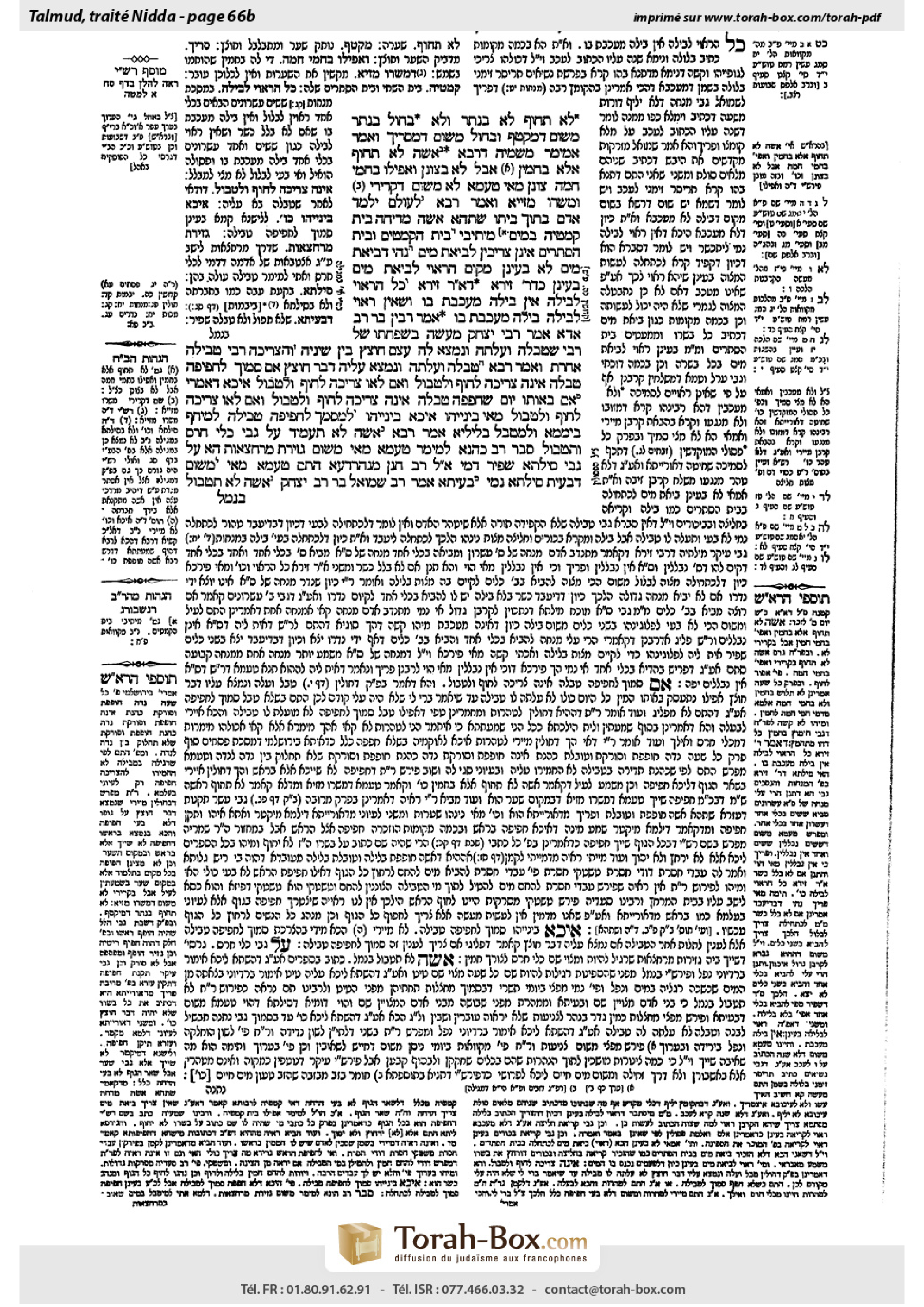
Niddah 66b: Talmud study for Daf Yomi
Daf Yomi is the daily study of one Talmud folio. Explore 37 tractates with scans, Hebrew text, Sefaria English and AI-generated French translations where annotated.
Passage selection and English or AI-generated French translation are available where the scan has annotations. Daf Study is independent of Torah-Box and Sefaria.
Browse Niddah · נידה · All tractatesNiddah 66b text and translations
This page of Niddah includes the Aramaic text, an English translation and an AI-generated French translation, alongside the scan above.
נידה ס״ו ב · Aramaic and Hebrew text
לָא תִּחוֹף לֹא בְּנֶתֶר וְלֹא בַּחוֹל; בְּנֶתֶר מִשּׁוּם דְּמִקְּטָף, וּבַחוֹל מִשּׁוּם דִּמְסָרֵיךְ.
וְאָמַר אַמֵּימָר מִשְּׁמֵיהּ דְּרָבָא: אִשָּׁה לֹא תִּחוֹף אֶלָּא בְּחַמִּין, אֲבָל לֹא בְּצוֹנֵן, וַאֲפִילּוּ בְּחַמֵּי חַמָּה. צוֹנֵן מַאי טַעְמָא לָא? מִשּׁוּם דְּקָרִירֵי וּמְשָׁרוּ מַזְּיָיא.
וְאָמַר רָבָא: לְעוֹלָם יִלְמַד אָדָם בְּתוֹךְ בֵּיתוֹ שֶׁתְּהֵא אִשָּׁה מְדִיחָה בֵּית קַמְטֵיהּ בְּמַיִם. מֵיתִיבִי: בֵּית הַקְּמָטִים וּבֵית הַסְּתָרִים אֵינָן צְרִיכִין לְבִיאַת מַיִם!
נְהִי דְּבִיאַת מַיִם לָא בָּעֵינַן, מְקוֹם הָרָאוּי לְבִיאַת מַיִם בָּעֵינַן, כִּדְרַבִּי זֵירָא, דְּאָמַר רַבִּי זֵירָא: כׇּל הָרָאוּי לְבִילָּה — אֵין בִּילָּה מְעַכֶּבֶת בּוֹ, וְשֶׁאֵין רָאוּי לְבִילָּה — בִּילָּה מְעַכֶּבֶת בּוֹ.
אָמַר רָבִין בַּר רַב אַדָּא, אָמַר רַבִּי יִצְחָק: מַעֲשֶׂה בְּשִׁפְחָתוֹ שֶׁל רַבִּי שֶׁטָּבְלָה, וְעָלְתָה, וְנִמְצָא לָהּ עֶצֶם חוֹצֵץ בֵּין שִׁינֶּיהָ, וְהִצְרִיכָהּ רַבִּי טְבִילָה אַחֶרֶת.
וְאָמַר רָבָא: טָבְלָה וְעָלְתָה, וְנִמְצָא עָלֶיהָ דָּבָר חוֹצֵץ — אִם סָמוּךְ לַחֲפִיפָה טָבְלָה, אֵינָהּ צְרִיכָה לְחוֹף וְלִטְבּוֹל, וְאִם לָאו — צְרִיכָה לְחוֹף וְלִטְבּוֹל.
אִיכָּא דְאָמְרִי, אִם בְּאוֹתוֹ יוֹם שֶׁחָפְפָה טָבְלָה — אֵינָהּ צְרִיכָה לְחוֹף וְלִטְבּוֹל, וְאִם לָאו — צְרִיכָה לְחוֹף וְלִטְבּוֹל.
מַאי בֵּינַיְיהוּ? אִיכָּא בֵּינַיְיהוּ לְמִסְמַךְ לַחֲפִיפָה טְבִילָה, לְמִיחַף בִּימָמָא וּלְמִטְבָּל בְּלֵילְיָא.
אָמַר רָבָא: אִשָּׁה לֹא תַּעֲמוֹד עַל גַּבֵּי כְּלִי חֶרֶס וְתִטְבּוֹל. סָבַר רַב כָּהֲנָא לְמֵימַר: טַעְמָא מַאי? מִשּׁוּם גְּזֵירַת מֶרְחֲצָאוֹת, הָא עַל גַּבֵּי סִילְתָּא — שַׁפִּיר דָּמֵי.
אֲמַר לֵיהּ רַב חָנָן מִנְּהַרְדְּעָא: הָתָם טַעְמָא מַאי — מִשּׁוּם דְּבָעֵית, סִילְתָּא נָמֵי בְּעֵיתָא.
אָמַר רַב שְׁמוּאֵל בַּר רַב יִצְחָק: אִשָּׁה לֹא תִּטְבּוֹל
Niddah 66b · English translation
may not wash her hair with natron or with sand. The reason she may not wash her hair with natron is because natron pulls out hair, and that hair may remain sitting on her head and serve as an interposition between her and the water of the ritual bath. And similarly, she may not wash her hair with sand, because it sticks to her hair and it also serves as an interposition.
And Ameimar said in the name of Rava: A woman washes her hair only with hot water, but not with cold water. But she may wash her hair even with hot water that was heated in the sun. What is the reason that she may not wash her hair with cold water? Because it is cold and causes the hair to harden, and the dirt will remain in the hair.
And Rava says: A man should always teach in his house that a woman should rinse any place with creases, e.g., her armpits, in water before she immerses in a ritual bath, to ensure that they are clean. The Gemara raises an objection from a baraita: Places with creases and any concealed part of the body do not require immersion in water. In other words, the immersion is valid even if the water does not touch those parts of the body. If so, why must she rinse them before immersing?
The Gemara answers: Granted that they do not require immersion in water, but we require that they must be a place that is suitable for immersion in water. This is in accordance with the opinion of Rabbi Zeira, as Rabbi Zeira says: For any amount of flour suitable for mingling with oil in a meal offering, mingling is not indispensable for it, i.e., it is valid even if it is not mixed. But for any amount of flour not suitable for mingling, e.g., if the quantity of flour is so great that the ingredients cannot be properly mixed, mingling is indispensable for it, and such a meal offering is invalid. This teaches a halakhic principle: There are certain actions that prevent the fulfillment of a mitzva if they are impossible, even if the actual performance of those actions are not indispensable to the mitzva.
Ravin bar Rav Adda says that Rabbi Yitzḥak says: There was an incident involving a maidservant of Rabbi Yehuda HaNasi who immersed herself, and she ascended from her immersion and a bone was found interposed between her teeth, and Rabbi Yehuda HaNasi required her to perform another immersion. This demonstrates that according to Rabbi Yehuda HaNasi one may not have a foreign object even inside one’s mouth.
And Rava says: If a woman immersed in a ritual bath and ascended from the water, and she then found on her hair an item that interposes between her and the water, what is the halakha? If she immersed soon after washing her hair, she does not need to wash her hair and immerse in the ritual bath a second time, as it can be assumed that this item was not there when she immersed, since her hair had been cleaned. But if she did not wash her hair immediately before immersing, she must wash her hair and immerse in the ritual bath a second time.
There are those who state a slightly different version of Rava’s statement: If she immersed on the same day that she washed her hair, she does not need to wash her hair and to immerse in a ritual bath a second time. But if she did not wash her hair on the same day that she immersed, she must wash her hair and immerse in the ritual bath a second time.
The Gemara asks: What is the practical difference between these two versions of Rava’s statement? The Gemara answers: The practical difference between them is with regard to washing her hair close to immersion. According to the first version of Rava’s statement, she must wash her hair immediately before immersing, whereas according to the second version she has more time. Another difference between the two versions is with regard to washing her hair during the day and immersing at night immediately afterward. According to the first version of Rava’s statement, provided that she washed her hair immediately before immersing, it makes no difference whether or not she washed and immersed on the same day. Conversely, according to the second version she must wash her hair on the same day or night as her immersion.
§ Rava says: A woman may not stand on top of earthenware utensils that are submerged in the ritual bath and immerse. Rav Kahana thought to say: What is the reason for this? It is because the Sages issued a decree against immersing in this manner, as it appears like immersing in bathhouses, i.e., the purpose of the decree is to prevent women from thinking that it is permitted to immerse in a bathhouse, which contains drawn water and is not valid as a ritual bath. It can be inferred from this reasoning that it is permitted for a woman to stand on top of a plank of wood that is in the ritual bath.
Rav Ḥanan from Neharde’a said to Rav Kahana that this is not the reason for Rava’s statement. Rather, there, in the case of submerged earthenware utensils, what is the reason that she may not immerse? She may not immerse because she will be afraid that she might fall off, and consequently she will not immerse herself properly. By the same logic, she will also be afraid when she is standing on top of a plank of wood, and therefore this is also prohibited.
Rav Shmuel bar Rav Yitzḥak says: A woman may not immerse herself
Niddah 66b · Traduction française (IA)
ne peut pas se laver les cheveux avec du natron ni avec du sable. Elle ne peut pas utiliser de natron, car celui-ci arrache des cheveux, qui peuvent rester sur sa tête et faire obstacle entre elle et l’eau du bain rituel. De même, elle ne peut pas se laver les cheveux avec du sable, car celui-ci s’y accroche et fait également obstacle.
Et Ameimar dit au nom de Rava : Une femme ne se lave les cheveux qu’à l’eau chaude, et non à l’eau froide. Elle peut toutefois se les laver même avec de l’eau chaude chauffée au soleil. Pourquoi ne peut-elle pas se laver les cheveux à l’eau froide ? Parce que l’eau froide fait durcir les cheveux, de sorte que la saleté y reste.
Et Rava dit : Un homme doit toujours enseigner dans sa maison qu’une femme doit rincer à l’eau toute partie de son corps présentant des plis, par exemple ses aisselles, avant de s’immerger dans un bain rituel, afin de s’assurer qu’elle est propre. La Guemara soulève une objection à partir d’une baraïta : Les parties du corps présentant des plis et toute partie cachée du corps n’ont pas besoin d’être immergées dans l’eau. Autrement dit, l’immersion est valable même si l’eau ne touche pas ces parties du corps. Dès lors, pourquoi doit-elle les rincer avant de s’immerger ?
La Guemara répond : Certes, elles n’ont pas besoin d’être immergées dans l’eau, mais il faut qu’elles soient des parties du corps susceptibles d’être immergées dans l’eau. Cela correspond à l’opinion de Rabbi Zeira, car Rabbi Zeira dit : Pour toute quantité de farine qu’il est possible de mélanger à l’huile dans une offrande végétale, le mélange n’est pas indispensable, c’est-à-dire que l’offrande est valable même si les ingrédients ne sont pas mélangés. Mais pour toute quantité de farine qu’il est impossible de mélanger, par exemple si la quantité de farine est si grande que les ingrédients ne peuvent pas être mélangés correctement, le mélange est indispensable, et une telle offrande végétale est invalide. Cela enseigne un principe halakhique : certaines opérations empêchent l’accomplissement d’une mitsva si elles sont impossibles, même si leur exécution effective n’est pas indispensable à la mitsva.
Ravin bar Rav Adda dit au nom de Rabbi Yitzḥak : Un incident impliqua une servante de Rabbi Yehuda HaNasi. Elle s’immergea, puis, en sortant de l’eau, on trouva un os coincé entre ses dents. Rabbi Yehuda HaNasi lui ordonna alors de s’immerger une seconde fois. Cela montre que, selon Rabbi Yehuda HaNasi, aucun corps étranger ne doit se trouver, même à l’intérieur de la bouche.
Et Rava dit : Si une femme s’est immergée dans un bain rituel, en est sortie, puis a trouvé dans ses cheveux un objet qui fait obstacle entre elle et l’eau, quelle est la halakha ? Si elle s’est immergée peu après s’être lavé les cheveux, elle n’a pas besoin de se laver les cheveux et de s’immerger une seconde fois dans le bain rituel, car on peut supposer que cet objet ne s’y trouvait pas au moment de son immersion, puisque ses cheveux avaient été nettoyés. Mais si elle ne s’est pas lavé les cheveux juste avant l’immersion, elle doit se les laver et s’immerger une seconde fois dans le bain rituel.
Certains rapportent une version légèrement différente de la déclaration de Rava : Si elle s’est immergée le jour même où elle s’est lavé les cheveux, elle n’a pas besoin de se les laver et de s’immerger une seconde fois dans un bain rituel. Mais si elle ne s’est pas lavé les cheveux le jour même où elle s’est immergée, elle doit se les laver et s’immerger une seconde fois dans un bain rituel.
La Guemara demande : Quelle est la différence pratique entre ces deux versions de la déclaration de Rava ? La Guemara répond : La différence pratique concerne le délai entre le lavage des cheveux et l’immersion. Selon la première version de la déclaration de Rava, elle doit se laver les cheveux juste avant de s’immerger, tandis que, selon la seconde version, elle dispose de plus de temps. Une autre différence entre les deux versions concerne le cas où elle se lave les cheveux pendant la journée et s’immerge la nuit, juste après. Selon la première version de la déclaration de Rava, dès lors qu’elle s’est lavé les cheveux juste avant l’immersion, peu importe qu’elle se soit lavée et immergée le même jour ou non. En revanche, selon la seconde version, elle doit se laver les cheveux le même jour que son immersion, de jour ou de nuit.
§ Rava dit : Une femme ne doit pas se tenir sur des récipients en terre cuite immergés dans le bain rituel pour s’y immerger. Rav Kahana pensa que la raison était la suivante : les Sages ont décrété qu’il est interdit de s’immerger de cette manière, car cela ressemble à une immersion dans des bains publics. Autrement dit, ce décret vise à empêcher les femmes de penser qu’il est permis de s’immerger dans un bain public, qui contient de l’eau puisée et ne peut servir de bain rituel valable. On peut déduire de ce raisonnement qu’une femme peut se tenir sur une planche de bois placée dans le bain rituel.
Rav Ḥanan de Neharde’a dit à Rav Kahana que telle n’est pas la raison de la déclaration de Rava. Dans le cas des récipients en terre cuite immergés, pourquoi ne peut-elle pas s’immerger ? Parce qu’elle craindra de tomber et, par conséquent, ne s’immergera pas correctement. Selon le même raisonnement, elle craindra également de tomber si elle se tient sur une planche de bois ; cela est donc également interdit.
Rav Shmuel bar Rav Yitzḥak dit : Une femme ne peut pas s’immerger
Traduction française générée par IA à partir de l’édition anglaise de Sefaria. Vérifie toujours un passage avec le texte source.
Text from Sefaria: William Davidson Edition - Vocalized Aramaic (CC BY NC); William Davidson Edition - English (CC BY NC).