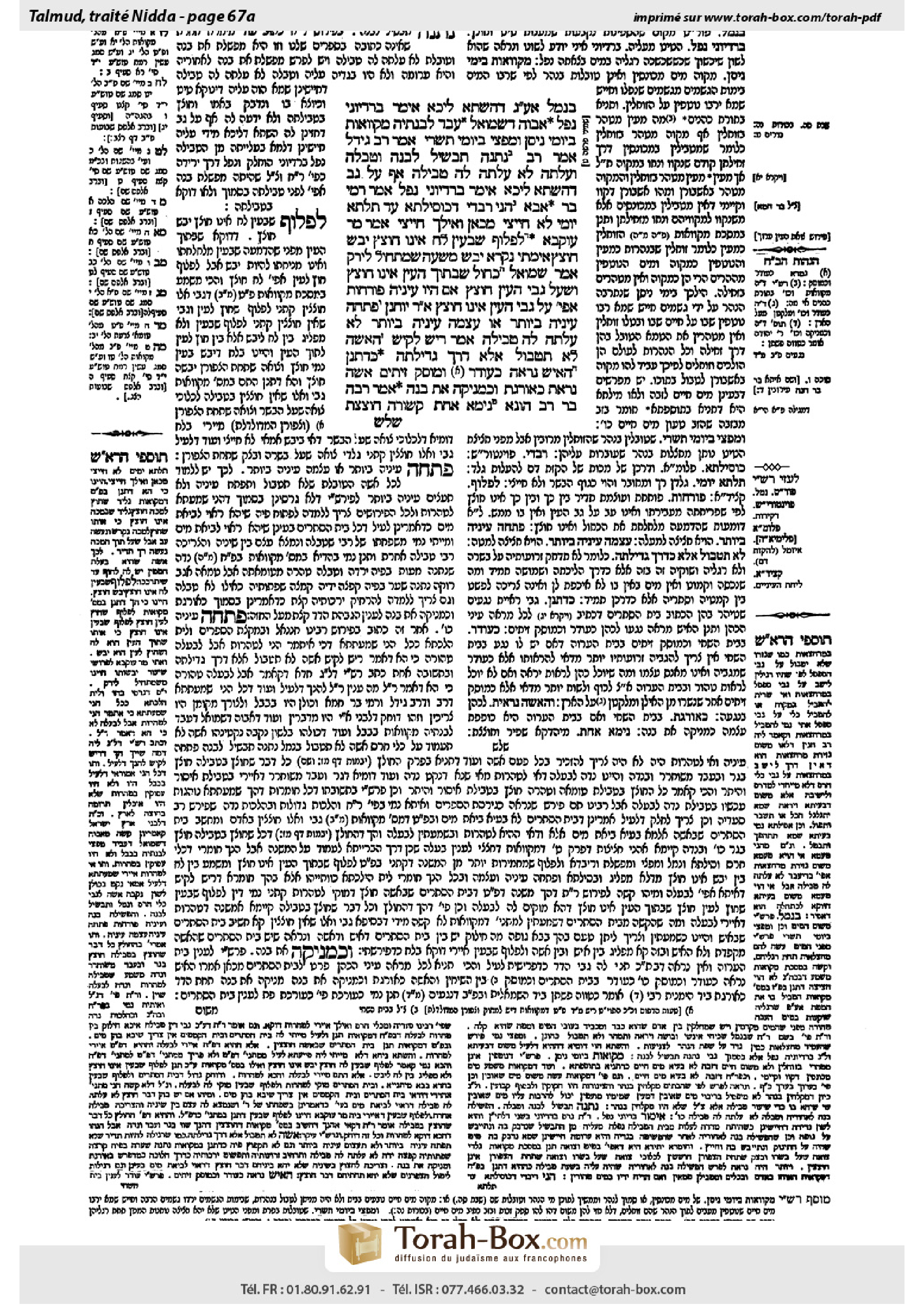
Niddah 67a: Talmud study for Daf Yomi
Daf Yomi is the daily study of one Talmud folio. Explore 37 tractates with scans, Hebrew text, Sefaria English and AI-generated French translations where annotated.
Passage selection and English or AI-generated French translation are available where the scan has annotations. Daf Study is independent of Torah-Box and Sefaria.
Browse Niddah · נידה · All tractatesNiddah 67a text and translations
This page of Niddah includes the Aramaic text, an English translation and an AI-generated French translation, alongside the scan above.
נידה ס״ז א · Aramaic and Hebrew text
בְּנָמֵל, אַף עַל גַּב דְּהַשְׁתָּא לֵיכָּא — אֵימַר בְּרִדְיוֹנֵי נְפַל.
אֲבוּהּ דִּשְׁמוּאֵל עֲבַד לִבְנָתֵיהּ מִקְוָואוֹת בְּיוֹמֵי נִיסָן, וּמַפָּצֵי בְּיוֹמֵי תִּשְׁרֵי.
אָמַר רַב גִּידֵּל, אָמַר רַב: נָתְנָה תַּבְשִׁיל לִבְנָהּ, וְטָבְלָה וְעָלְתָה — לֹא עָלְתָה לָהּ טְבִילָה, אַף עַל גַּב דְּהַשְׁתָּא לֵיכָּא, אֵימַר בְּרִדְיוֹנֵי נְפַל.
אָמַר רָמֵי בַּר אַבָּא: הָנֵי רִבְדֵי דְּכוּסִילְתָּא, עַד תְּלָתָא יוֹמֵי — לָא חָיְיצִי, מִכָּאן וְאֵילָךְ — חָיְיצִי.
אָמַר מָר עוּקְבָא: לִפְלוּף שֶׁבָּעַיִן, לַח — אֵינוֹ חוֹצֵץ, יָבֵשׁ — חוֹצֵץ. אֵימָתַי נִקְרָא יָבֵשׁ? מִשָּׁעָה שֶׁמַּתְחִיל לִירַק.
אָמַר שְׁמוּאֵל: כְּחוֹל שֶׁבְּתוֹךְ הָעַיִן — אֵינוֹ חוֹצֵץ, וְשֶׁעַל גַּבֵּי הָעַיִן — חוֹצֵץ. אִם הָיוּ עֵינֶיהָ פּוֹרְחוֹת — אֲפִילּוּ עַל גַּבֵּי הָעַיִן אֵינוֹ חוֹצֵץ.
אָמַר רַבִּי יוֹחָנָן: פָּתְחָה עֵינֶיהָ בְּיוֹתֵר, אוֹ עַצְמָהּ עֵינֶיהָ בְּיוֹתֵר — לֹא עָלְתָה לָהּ טְבִילָה.
אָמַר רֵישׁ לָקִישׁ: הָאִשָּׁה לֹא תִּטְבּוֹל אֶלָּא דֶּרֶךְ גְּדִילָתָהּ, כְּדִתְנַן: הָאִישׁ נִרְאָה כְּעוֹדֵר וּמוֹסֵק זֵיתִים, אִשָּׁה נִרְאֵת כְּאוֹרֶגֶת וְכִמְנִיקָה אֶת בְּנָהּ.
אָמַר רַבָּה בַּר רַב הוּנָא: נִימָא אַחַת קְשׁוּרָה חוֹצֶצֶת,
Niddah 67a · English translation
in a port [banamal], where the boats are drawn up onto shore, as there is a lot of mud there, which can stick to her and interpose between her and the water. Even though now, after the immersion, there is no mud stuck to her feet or body, one can say that perhaps while she walked back after immersing the mud fell off. Since one cannot be certain that there was no mud stuck to her body while she immersed, she may not immerse in a port.
The Gemara relates that Shmuel’s father prepared ritual baths for his daughters in the days of Nisan, by digging holes and letting them fill with natural rainwater, and he placed mats in the Euphrates River in the days of Tishrei. Since the water was shallow and the riverbed was muddy, he placed mats on the riverbed so that they could immerse without getting dirty.
The Gemara cites a similar halakha involving the interposition of an item during immersion. Rav Giddel says that Rav says: If a woman gave a cooked dish to her son, and afterward she immersed in a ritual bath and ascended from the ritual bath, the immersion is ineffective for her. The reason is that even though now, after the immersion, there is no food stuck to her body, one can say that perhaps as she walked back after immersing the food fell off. Since one cannot be certain that there was no food stuck to her body while she immersed, she should not handle food immediately before immersing.
Rami bar Abba said: With regard to these bloodletting incisions [ravdei dekhusilta], until three days have passed since the bloodletting, when they have not yet formed a hard scab, they do not interpose and invalidate an immersion. From this point forward they interpose, as the scab is too hard for the water to penetrate.
Mar Ukva said: With regard to mucus that is in the eye, if it is moist, it does not interpose and invalidate an immersion. But if the mucus is dry and hard it interposes. When is it called dry? It is called dry from the time that it begins to turn yellow.
Shmuel says: Eye shadow that is in the eye does not interpose and invalidate an immersion. But eye shadow that is on or around the eye interposes. And if the woman’s eyes were constantly blinking, then even eye shadow that is on or around the eye does not interpose, as the constant blinking removes the eye shadow.
Rabbi Yoḥanan says: If a woman opened her eyes very wide or closed her eyes very tightly while immersing, this immersion is ineffective for her. Such open or closed eyelids prevent the water from reaching the creases around the eyes.
Reish Lakish says: A woman may immerse herself in a ritual bath only in the manner that she grows, i.e., she may not force her arms to her sides or close her legs tightly. She is not obligated to spread her limbs widely, but simply stand in her normal manner. As we learned in a mishna (Nega’im 2:4): When a man has a leprous mark between his legs and stands before a priest for inspection, he should appear like one who is hoeing, i.e., with his legs slightly apart, and if it is under his arm, he should appear like one who is harvesting olives, with his arms slightly raised. If the mark is not visible when he is standing in that manner, it is not impure. By contrast, a woman with a leprous mark between her legs should appear like one who is weaving, and if the mark is beneath her breast she should appear like a woman who is nursing her son.
Rabba bar Rav Huna says: A single hair tied in a knot interposes and invalidates an immersion.
Niddah 67a · Traduction française (IA)
Dans un port [banamal], où les bateaux sont tirés jusque sur la rive, il y a beaucoup de boue, qui peut adhérer à son corps et faire écran entre elle et l’eau. Même si, après l’immersion, il n’y a plus de boue collée à ses pieds ou à son corps, on peut supposer que la boue est peut-être tombée pendant qu’elle revenait après s’être immergée. Comme on ne peut pas être certain qu’aucune boue ne collait à son corps pendant l’immersion, elle ne peut pas s’immerger dans un port.
La Guemara rapporte que le père de Shmuel préparait des bains rituels pour ses filles au mois de Nisan, en creusant des trous qu’il laissait se remplir d’eau de pluie naturelle, et qu’il disposait des nattes dans l’Euphrate au mois de Tishrei. Comme l’eau était peu profonde et le lit du fleuve boueux, il y plaçait des nattes pour qu’elles puissent s’immerger sans se salir.
La Guemara cite une halakha similaire concernant l’interposition d’un élément pendant l’immersion. Rav Giddel rapporte au nom de Rav : si une femme a servi un plat cuisiné à son fils, puis s’est immergée dans un bain rituel et en est sortie, son immersion n’est pas valable. En effet, même si, après l’immersion, il n’y a plus de nourriture collée à son corps, on peut supposer que la nourriture est peut-être tombée pendant qu’elle revenait après s’être immergée. Comme on ne peut pas être certain qu’aucune nourriture ne collait à son corps pendant l’immersion, elle ne doit pas manipuler de nourriture juste avant de s’immerger.
Rami bar Abba a dit : concernant les incisions de saignée [ravdei dekhusilta], tant que trois jours ne se sont pas écoulés depuis la saignée et qu’elles ne sont pas encore recouvertes d’une croûte dure, elles ne font pas écran et n’invalident pas l’immersion. À partir de là, elles font écran, car la croûte est trop dure pour que l’eau la pénètre.
Mar Ukva a dit : le mucus qui se trouve dans l’œil ne fait pas écran et n’invalide pas l’immersion s’il est humide. Mais s’il est sec et dur, il fait écran. À partir de quand le considère-t-on comme sec ? Dès qu’il commence à jaunir.
Shmuel dit : le khôl qui se trouve dans l’œil ne fait pas écran et n’invalide pas l’immersion. En revanche, le khôl qui se trouve sur l’œil ou autour de lui fait écran. Si la femme cligne constamment des yeux, même le khôl qui se trouve sur l’œil ou autour de lui ne fait pas écran, car les clignements répétés l’enlèvent.
Rabbi Yoḥanan dit : si une femme ouvre les yeux tout grands ou les ferme très fort pendant qu’elle s’immerge, son immersion n’est pas valable. Des paupières ainsi ouvertes ou fermées empêchent l’eau d’atteindre les plis autour des yeux.
Reish Lakish dit : une femme ne peut s’immerger dans un bain rituel que dans la posture naturelle de son corps, c’est-à-dire qu’elle ne doit pas plaquer les bras contre ses côtés ni serrer fortement les jambes. Elle n’est pas tenue d’écarter largement les membres, mais doit simplement se tenir dans sa posture habituelle. Comme nous l’avons appris dans une Michna (Nega’im 2:4) : lorsqu’un homme présente une lésion lépreuse entre les jambes et se tient devant un prêtre pour être examiné, il doit se tenir comme quelqu’un qui bine, c’est-à-dire les jambes légèrement écartées ; si la lésion est sous son bras, il doit se tenir comme quelqu’un qui récolte des olives, les bras légèrement levés. Si la lésion n’est pas visible lorsqu’il se tient ainsi, elle n’est pas impure. En revanche, une femme présentant une lésion lépreuse entre les jambes doit se tenir comme quelqu’un qui tisse ; si la lésion se trouve sous son sein, elle doit se tenir comme une femme qui allaite son fils.
Rabba bar Rav Huna dit : un seul cheveu noué fait écran et invalide l’immersion.
Traduction française générée par IA à partir de l’édition anglaise de Sefaria. Vérifie toujours un passage avec le texte source.
Text from Sefaria: William Davidson Edition - Vocalized Aramaic (CC BY NC); William Davidson Edition - English (CC BY NC).