Niddah 67b: Talmud study for Daf Yomi
Daf Yomi is the daily study of one Talmud folio. Explore 37 tractates with scans, Hebrew text, Sefaria English and AI-generated French translations where annotated.
Passage selection and English or AI-generated French translation are available where the scan has annotations. Daf Study is independent of Torah-Box and Sefaria.
Browse Niddah · נידה · All tractatesNiddah 67b text and translations
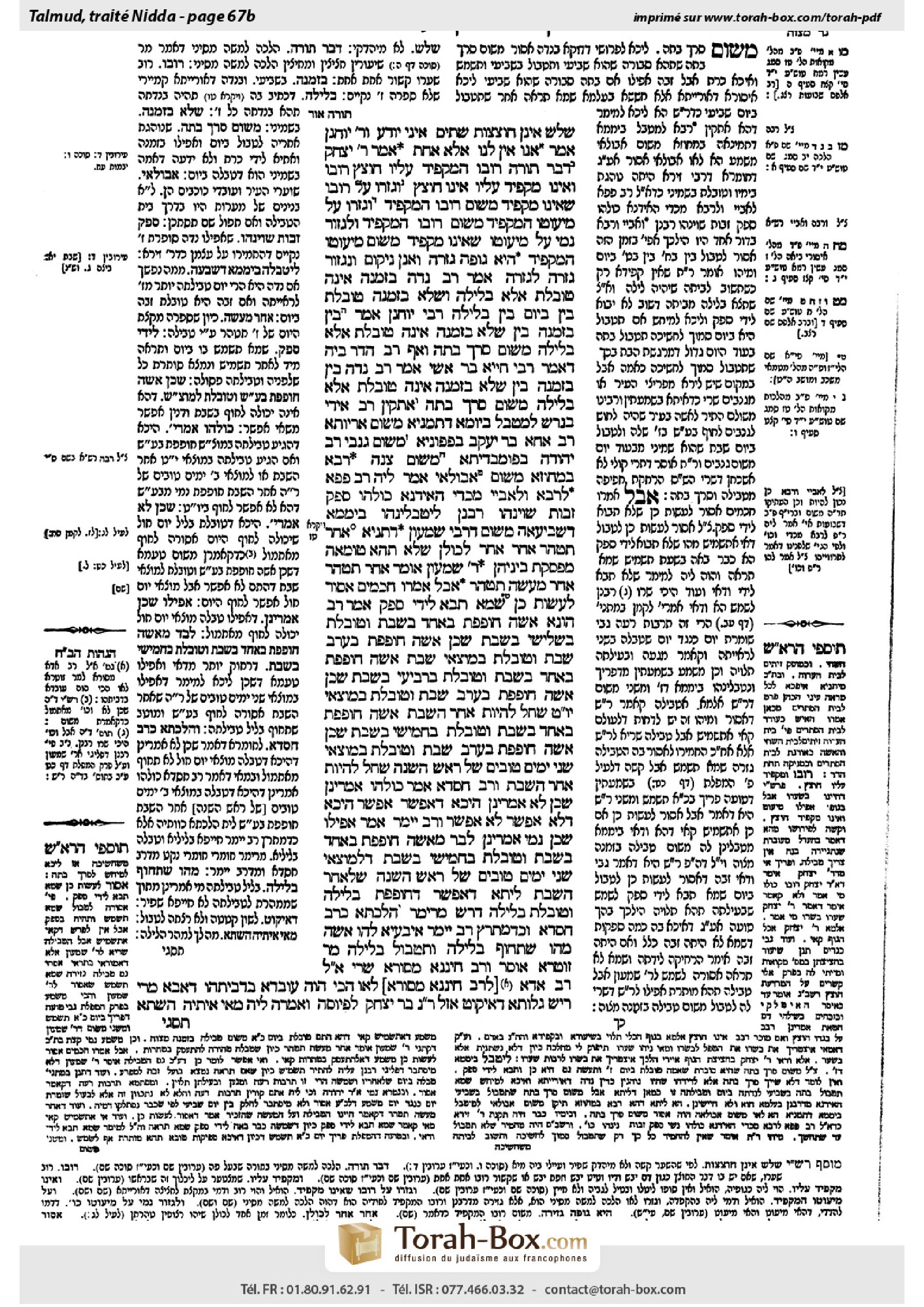
This page of Niddah includes the Aramaic text, an English translation and an AI-generated French translation, alongside the scan above.
נידה ס״ז ב · Aramaic and Hebrew text
שָׁלֹשׁ אֵינָן חוֹצְצוֹת, שְׁתַּיִם אֵינִי יוֹדֵעַ. וְרַבִּי יוֹחָנָן אָמַר: אָנוּ אֵין לָנוּ אֶלָּא אַחַת.
אָמַר רַבִּי יִצְחָק: דְּבַר תּוֹרָה, רוּבּוֹ הַמַּקְפִּיד עָלָיו — חוֹצֵץ, רוּבּוֹ וְאֵינוֹ מַקְפִּיד עָלָיו — אֵינוֹ חוֹצֵץ, וְגָזְרוּ עַל רוּבּוֹ שֶׁאֵינוֹ מַקְפִּיד מִשּׁוּם רוּבּוֹ הַמַּקְפִּיד, וְגָזְרוּ עַל מִיעוּטוֹ הַמַּקְפִּיד מִשּׁוּם רוּבּוֹ הַמַּקְפִּיד.
וְלִגְזוֹר נָמֵי עַל מִיעוּטוֹ שֶׁאֵינוֹ מַקְפִּיד, מִשּׁוּם מִיעוּטוֹ הַמַּקְפִּיד! הִיא גּוּפַהּ גְּזֵרָה, וַאֲנַן נֵיקוּם וְנִגְזוֹר גְּזֵרָה לִגְזֵרָה?!
אָמַר רַב: נִדָּה בִּזְמַנָּהּ אֵינָהּ טוֹבֶלֶת אֶלָּא בַּלַּיְלָה, וְשֶׁלֹּא בִּזְמַנָּהּ טוֹבֶלֶת בֵּין בַּיּוֹם בֵּין בַּלַּיְלָה. רַבִּי יוֹחָנָן אָמַר: בֵּין בִּזְמַנָּהּ בֵּין שֶׁלֹּא בִּזְמַנָּהּ אֵינָהּ טוֹבֶלֶת אֶלָּא בַּלַּיְלָה, מִשּׁוּם סֶרֶךְ בִּתָּהּ.
וְאַף רַב הֲדַר בֵּיהּ, דְּאָמַר רַבִּי חִיָּיא בַּר אָשֵׁי אָמַר רַב: נִדָּה, בֵּין בִּזְמַנָּהּ בֵּין שֶׁלֹּא בִּזְמַנָּהּ, אֵינָהּ טוֹבֶלֶת אֶלָּא בַּלַּיְלָה, מִשּׁוּם סֶרֶךְ בִּתָּהּ.
אַתְקֵין רַב אִידִי בְּנַרֶשׁ לְמִטְבָּל בְּיוֹמָא דִּתְמָנְיָא, מִשּׁוּם אַרְיָוָתָא; רַב אַחָא בַּר יַעֲקֹב בְּפַפּוֹנְיָא, מִשּׁוּם גַּנָּבֵי;
רַב יְהוּדָה בְּפוּמְבְּדִיתָא, מִשּׁוּם צִנָּה; רָבָא בְּמָחוֹזָא, מִשּׁוּם אֲבוּלָּאֵי.
אֲמַר לֵיהּ רַב פָּפָּא לְרָבָא וּלְאַבָּיֵי: מִכְּדֵי הָאִידָּנָא כּוּלְּהוּ סָפֵק זָבוֹת שַׁוִּינְהוּ רַבָּנַן, לַיטְבְּלִינְהוּ בִּימָמָא דְּשִׁבְיעָאה?
מִשּׁוּם דְּרַבִּי שִׁמְעוֹן, דְּתַנְיָא: ״אַחַר תִּטְהָר״ — אַחַר, אַחַר לְכוּלָּן, שֶׁלֹּא תְּהֵא טוּמְאָה מַפְסֶקֶת בֵּינֵיהֶן. רַבִּי שִׁמְעוֹן אוֹמֵר: ״אַחַר תִּטְהָר״ — אַחַר מַעֲשֶׂה תִּטְהָר.
אֲבָל אָמְרוּ חֲכָמִים: אָסוּר לַעֲשׂוֹת כֵּן, שֶׁמָּא תָּבֹא לִידֵי סָפֵק.
אָמַר רַב הוּנָא: אִשָּׁה חוֹפֶפֶת בְּאֶחָד בַּשַּׁבָּת, וְטוֹבֶלֶת בִּשְׁלִישִׁי בַּשַּׁבָּת, שֶׁכֵּן אִשָּׁה חוֹפֶפֶת בְּעֶרֶב שַׁבָּת, וְטוֹבֶלֶת בְּמוֹצָאֵי שַׁבָּת.
אִשָּׁה חוֹפֶפֶת בְּאֶחָד בַּשַּׁבָּת, וְטוֹבֶלֶת בִּרְבִיעִי בַּשַּׁבָּת — שֶׁכֵּן אִשָּׁה חוֹפֶפֶת בְּעֶרֶב שַׁבָּת, וְטוֹבֶלֶת בְּמוֹצָאֵי יוֹם טוֹב שֶׁחָל לִהְיוֹת אַחַר הַשַּׁבָּת.
אִשָּׁה חוֹפֶפֶת בְּאֶחָד בַּשַּׁבָּת, וְטוֹבֶלֶת בַּחֲמִישִׁי בַּשַּׁבָּת — שֶׁכֵּן אִשָּׁה חוֹפֶפֶת בְּעֶרֶב שַׁבָּת, וְטוֹבֶלֶת בְּמוֹצָאֵי שְׁנֵי יָמִים טוֹבִים שֶׁל רֹאשׁ הַשָּׁנָה שֶׁחָל לִהְיוֹת אַחַר הַשַּׁבָּת.
וְרַב חִסְדָּא אָמַר: כּוּלְּהוּ אָמְרִינַן, ״שֶׁכֵּן״ לָא אָמְרִינַן. הֵיכָא דְּאֶפְשָׁר — אֶפְשָׁר, הֵיכָא דְּלָא אֶפְשָׁר — לָא אֶפְשָׁר.
וְרַב יֵימַר אָמַר: אֲפִילּוּ ״שֶׁכֵּן״ נָמֵי אָמְרִינַן, לְבַר מֵאִשָּׁה חוֹפֶפֶת בְּאֶחָד בַּשַּׁבָּת וְטוֹבֶלֶת בַּחֲמִישִׁי בַּשַּׁבָּת, דִּלְמוֹצָאֵי שְׁנֵי יָמִים טוֹבִים שֶׁל רֹאשׁ הַשָּׁנָה שֶׁלְּאַחַר הַשַּׁבָּת לֵיתַהּ, דְּאֶפְשָׁר דְּחוֹפֶפֶת בַּלַּיְלָה וְטוֹבֶלֶת בַּלַּיְלָה.
דְּרַשׁ מָרִימָר: הִלְכְתָא כְּרַב חִסְדָּא, וּכְדִמְתָרֵץ רַב יֵימַר.
אִיבַּעְיָא לְהוּ: אִשָּׁה מַהוּ שֶׁתָּחוֹף בַּלַּיְלָה וְתִטְבּוֹל בַּלַּיְלָה? מָר זוּטְרָא אוֹסַר, וְרַב חִינָּנָא מִסּוּרָא שָׁרֵי.
אֲמַר לֵיהּ רַב אַדָּא לְרַב חִינָּנָא מִסּוּרָא: לָאו הָכִי הֲוָה עוֹבָדָא בִּדְבֵיתְהוּ דְּאַבָּא מָרִי רֵישׁ גָּלוּתָא, דְּאִיקּוּט, אֲזַל רַב נַחְמָן בַּר יִצְחָק לְפַיּוֹסַהּ, וַאֲמַרָה לֵיהּ: מַאי אִיתֵיהּ הַשְׁתָּא?
Niddah 67b · English translation
Three hairs tied together in a knot do not interpose, as three hairs cannot be tied so tightly that water cannot penetrate them. With regard to two hairs tied together in a knot, I do not know the halakha. And Rabbi Yoḥanan says: We have a tradition that only one hair interposes, but two or more do not prevent the water from reaching the body.
§ Rabbi Yitzḥak says: By Torah law, if there is an interposition between a person and the water, and it covers the majority of his body, and he is particular and wants the interposing substance removed, it interposes and invalidates an immersion in a ritual bath. But if it covers the majority of his body but he is not particular about that substance, it does not interpose. But the Sages issued a decree prohibiting substances covering the majority of his body with regard to which he is not particular, due to substances covering the majority of his body about which he is particular. And likewise, they issued a decree against substances covering the minority of his body with regard to which he is particular, due to substances covering the majority of his body about which he is particular.
The Gemara raises a difficulty: But let them also issue a decree prohibiting substances covering the minority of his body with regard to which he is not particular, due to substances covering the minority of his body about which he is particular. The Gemara answers: The Sages did not issue such a decree, as that prohibition is itself a rabbinic decree, and will we arise and issue a decree to prevent the violation of another decree?
§ The Gemara returns to discuss the issue of the correct time for immersion. Rav says: A menstruating woman who wishes to immerse to complete her purification process at her time, i.e., at the end of seven days, may immerse only at night, i.e., on the night after the seventh day, the night of the eighth day. But a woman who wishes to immerse not at her time, i.e., on the eighth day or afterward, may immerse either during the day or at night. Rabbi Yoḥanan says: Whether she is immersing at her time or not at her time, she may immerse only at night. This is because her daughter might follow her example when she is old enough, and also immerse in the daytime, but she may do so on the seventh day, when immersion is not valid.
And even Rav retracted his opinion and ruled that a woman who is immersing after menstruation may never do so during the day. As Rabbi Ḥiyya bar Ashi said that Rav said: A menstruating woman who wishes to immerse to complete her purification process, whether at her time or whether not at her time, may immerse only at night, because her daughter might follow her example and immerse during the daytime of the seventh day.
The Gemara cites examples of Sages who permitted immersion on the eighth day due to exceptional circumstances. Rav Idi decreed in Neresh that the women may immerse during the daytime on the eighth day due to the lions that roamed the area at night and posed a threat to women who immersed at that time. Rav Aḥa bar Yaakov decreed in Pappunya that the women should immerse during the daytime on the eighth day due to thieves who posed a threat to women who immersed at that night.
Similarly, Rav Yehuda decreed in Pumbedita that the women should immerse in the daytime on the eighth day due to the cold of the night. Rava decreed in Meḥoza that the women should immerse in the daytime on the eighth day due to the gatekeepers [abula’ei], who were untrustworthy and might hurt the women on their way to and from immersion.
§ Rav Pappa said to Rava and to Abaye: Since nowadays the Sages have given all women who menstruate the status of an uncertain greater zava, may they immerse on the seventh day during the daytime? A greater zava, after counting seven clean days, may immerse on the seventh day. Since all women who menstruate now count seven clean days after the bleeding ceases, more than seven days from the onset of her menstruating have passed by the seventh clean day.
Rava and Abaye replied that they may nevertheless not immerse on the seventh day, due to the statement of Rabbi Shimon. As it is taught in a baraita: The verse states: “But if she be purified of her ziva, then she shall count to herself seven days, and after that she shall be pure” (Leviticus 15:28). The purification of a zava must be after the seven days, i.e., after all of the days, which must be consecutive so that there are no days of impurity separating between the seven clean days. Rabbi Shimon says that the phrase “And after that she shall be pure” teaches that after the action of counting seven clean days she shall be pure. In other words, once she has examined herself at the beginning of the seventh day she may immerse on that day.
Rabbi Shimon continues: But the Sages said: It is prohibited to do so, i.e., to immerse on the seventh day, lest she come to a case of uncertainty. If she were to engage in intercourse with her husband on that seventh day after immersion, and afterward on the same day she experiences bleeding, it would retroactively nullify her entire seven clean days, which would mean that she engaged in intercourse with her husband while she was impure, rendering them both liable to receive the punishment of karet.
§ Rav Huna says: A woman may wash her hair on the first day of the week, Sunday, and immerse on the third day of the week, i.e., Monday night. The proof of this is that sometimes a woman washes her hair on the eve of Shabbat, but she does not immerse until the conclusion of Shabbat, which is the same interval as from Sunday to Monday night.
Similarly, a woman may wash her hair on the first day of the week, Sunday, and immerse on the fourth day of the week, Tuesday night. The proof of this is that sometimes a woman washes her hair on the eve of Shabbat, but she does not immerse until the conclusion of the Festival that occurs after Shabbat, which is the same interval as from Sunday to Tuesday night.
Furthermore, a woman may wash her hair on the first day of the week, Sunday, and immerse on the fifth day of the week, Wednesday night. The proof of this is that sometimes a woman washes her hair on the eve of Shabbat, but she does not immerse until the conclusion of two days of Rosh HaShana that occurs after Shabbat, which is the same interval as from Sunday to Wednesday night.
But Rav Ḥisda said: We say that all of these long gaps between a woman washing her hair and immersing are permitted. But we do not say as proof that since a woman washes her hair before Shabbat and immerses only several days later, she may do so during a regular week as well. One cannot learn this halakha from those situations involving Shabbat, as one cannot derive cases where alternatives are possible from those cases where alternatives are not possible. Where it is possible for a woman to wash her hair and immerse immediately, it is possible, and she is not allowed to do so any earlier. But where it is not possible for a woman to wash her hair immediately before immersion, e.g., when she must immerse after the conclusion of Shabbat or a festival, it is impossible, and for this reason she is permitted to wash her hair in advance.
And Rav Yeimar said: We even say the proof that since a woman washes her hair before Shabbat and immerses only several days later, she may do so during a regular week as well. Rav Yeimar agrees with Rav Huna in all cases apart from that of a woman who washes her hair on the first day of the week, Sunday, and immerses on the fifth day of the week, Wednesday night. He maintains that Rav Huna’s proof from the conclusion of two days of Rosh HaShana that is after Shabbat is not a sufficient proof, as even in such a case a woman may not wait so long. Rather, it is possible for her to wash her hair at night after the conclusion of Rosh HaShana and immerse on that same night, so that she should not have such a long gap between washing her hair and immersing.
Mareimar taught: The halakha is in accordance with the opinion of Rav Ḥisda, that a woman should not wash her hair many days before immersing except when there is no other possibility. And the halakha is also in accordance with the manner in which Rav Yeimar explains that if Rosh HaShana occurs after Shabbat a woman should wash her hair on the night of her immersion.
§ A dilemma was raised before the Sages: What is the halakha with regard to whether a woman may wash her hair at night and immerse on that same night? Mar Zutra deems it prohibited for her to do so. Since she will be in a hurry to immerse and return to her husband, there is a concern that she will not wash and examine her hair thoroughly. And Rav Ḥinnana from Sura deems it permitted for a woman to wash her hair on the night of her immersion.
Rav Adda said to Rav Ḥinnana from Sura: Was there not an incident like this involving the wife of Abba Mari, the Exilarch, who quarreled with her husband, and as a result she did not want to immerse in a ritual bath to become permitted to him; and Rav Naḥman bar Yitzḥak went to appease her and to persuade her to immerse, and she said to him: What is there that can be done now? There is no reason for me to hurry and immerse now.
Niddah 67b · Traduction française (IA)
Trois cheveux noués ensemble ne font pas écran, car il est impossible de nouer trois cheveux assez serrés pour empêcher l’eau de les pénétrer. Quant à deux cheveux noués ensemble, je ne connais pas la halakha. Rabbi Yoḥanan dit : « Nous avons reçu la tradition qu’un seul cheveu fait écran, mais que deux cheveux ou davantage n’empêchent pas l’eau d’atteindre le corps. »
§ Rabbi Yitzḥak dit : Selon la Torah, si une substance fait écran entre une personne et l’eau, qu’elle couvre la majeure partie de son corps et que cette personne souhaite que la substance soit retirée, elle fait écran et invalide l’immersion au mikvé. Mais si elle couvre la majeure partie de son corps sans que la personne souhaite son retrait, elle ne fait pas écran. Les Sages ont toutefois décrété que les substances couvrant la majeure partie du corps et dont la personne ne souhaite pas le retrait sont interdites, par crainte des substances couvrant la majeure partie du corps dont la personne souhaite le retrait. De même, ils ont décrété que les substances couvrant une partie minoritaire du corps et dont la personne souhaite le retrait sont interdites, par crainte des substances couvrant la majeure partie du corps dont la personne souhaite le retrait.
La Guemara soulève une difficulté : Mais pourquoi ne pas décréter également que les substances couvrant une partie minoritaire du corps et dont la personne ne souhaite pas le retrait sont interdites, par crainte des substances couvrant une partie minoritaire du corps dont la personne souhaite le retrait ? La Guemara répond : Les Sages n’ont pas prononcé un tel décret, car cette interdiction est elle-même un décret rabbinique. Allons-nous donc prononcer un décret pour empêcher la transgression d’un autre décret ?
§ La Guemara revient à la question du moment approprié pour l’immersion. Rav dit : Une femme nidda qui souhaite s’immerger pour achever son processus de purification au moment prévu, c’est-à-dire au terme des sept jours, ne peut s’immerger que la nuit, celle qui suit le septième jour, autrement dit la nuit du huitième jour. Mais une femme qui souhaite s’immerger hors du moment prévu, c’est-à-dire le huitième jour ou plus tard, peut s’immerger de jour ou de nuit. Rabbi Yoḥanan dit : Qu’elle s’immerge au moment prévu ou non, elle ne peut s’immerger que la nuit. En effet, sa fille pourrait suivre son exemple lorsqu’elle serait en âge de le faire et s’immerger elle aussi de jour, éventuellement le septième jour, alors que l’immersion n’y est pas valable.
Même Rav est revenu sur son opinion et a statué qu’une femme qui s’immerge après ses règles ne peut jamais le faire de jour. Car Rabbi Ḥiyya bar Ashi a dit au nom de Rav : Une femme nidda qui souhaite s’immerger pour achever son processus de purification, au moment prévu ou non, ne peut s’immerger que la nuit, car sa fille pourrait suivre son exemple et s’immerger de jour le septième jour.
La Guemara cite des exemples de Sages qui ont autorisé l’immersion le huitième jour en raison de circonstances exceptionnelles. Rav Idi décréta à Neresh que les femmes pourraient s’immerger de jour le huitième jour, à cause des lions qui rôdaient dans les environs la nuit et menaçaient celles qui s’immergeaient alors. Rav Aḥa bar Yaakov décréta à Pappunya que les femmes devraient s’immerger de jour le huitième jour, à cause des voleurs qui menaçaient celles qui s’immergeaient la nuit.
De même, Rav Yehuda décréta à Pumbedita que les femmes devraient s’immerger de jour le huitième jour, à cause du froid nocturne. Rava décréta à Meḥoza que les femmes devraient s’immerger de jour le huitième jour, à cause des portiers [abula’ei], qui n’étaient pas dignes de confiance et risquaient de leur faire du mal sur le chemin de l’immersion ou au retour.
§ Rav Pappa dit à Rava et à Abaye : Puisque, de nos jours, les Sages ont attribué à toutes les femmes qui ont leurs règles le statut d’une zavva majeure incertaine, peuvent-elles s’immerger de jour le septième jour ? Une zavva majeure peut s’immerger le septième jour après avoir compté sept jours purs. Puisque, désormais, toutes les femmes qui ont leurs règles comptent sept jours purs après la fin du saignement, au septième jour pur, plus de sept jours se sont écoulés depuis le début des règles.
Rava et Abaye répondirent qu’elles ne peuvent néanmoins pas s’immerger le septième jour, en raison de l’enseignement de Rabbi Shimon. Car il est enseigné dans une baraïta : Le verset dit : « Mais si elle est purifiée de son flux, elle comptera pour elle-même sept jours, et ensuite elle sera pure » (Lévitique 15, 28). La purification d’une zavva doit avoir lieu après les sept jours, c’est-à-dire après l’ensemble de ces jours, qui doivent se suivre sans qu’aucun jour d’impureté s’intercale entre les sept jours purs. Rabbi Shimon dit que l’expression « et ensuite elle sera pure » enseigne qu’elle sera pure après avoir compté sept jours purs. Autrement dit, une fois qu’elle s’est examinée au début du septième jour, elle peut s’immerger ce jour-là.
Rabbi Shimon poursuit : Mais les Sages ont dit qu’il est interdit de le faire, c’est-à-dire de s’immerger le septième jour, de peur qu’elle ne se trouve dans une situation d’incertitude. Si elle avait des relations avec son mari après son immersion ce septième jour, puis qu’elle se mette à saigner plus tard dans la journée, cela annulerait rétroactivement l’ensemble de ses sept jours purs. Elle aurait donc eu des relations avec son mari alors qu’elle était impure, et tous deux seraient passibles de karet.
§ Rav Huna dit : Une femme peut se laver les cheveux le premier jour de la semaine, le dimanche, et s’immerger le troisième jour de la semaine, c’est-à-dire dans la nuit du lundi. La preuve en est qu’il arrive qu’une femme se lave les cheveux la veille de Chabbat, mais ne s’immerge qu’à la sortie de Chabbat : l’intervalle est le même que du dimanche à la nuit du lundi.
De même, une femme peut se laver les cheveux le premier jour de la semaine, le dimanche, et s’immerger le quatrième jour de la semaine, dans la nuit du mardi. La preuve en est qu’il arrive qu’une femme se lave les cheveux la veille de Chabbat, mais ne s’immerge qu’à la fin de la fête qui suit Chabbat : l’intervalle est le même que du dimanche à la nuit du mardi.
En outre, une femme peut se laver les cheveux le premier jour de la semaine, le dimanche, et s’immerger le cinquième jour de la semaine, dans la nuit du mercredi. La preuve en est qu’il arrive qu’une femme se lave les cheveux la veille de Chabbat, mais ne s’immerge qu’à la fin des deux jours de Roch Hachana qui suivent Chabbat : l’intervalle est le même que du dimanche à la nuit du mercredi.
Mais Rav Ḥisda dit : Nous affirmons que tous ces longs intervalles entre le lavage des cheveux et l’immersion d’une femme sont permis. Toutefois, nous ne pouvons pas en déduire que, puisqu’une femme se lave les cheveux avant Chabbat et ne s’immerge que plusieurs jours plus tard, elle peut agir ainsi pendant une semaine ordinaire également. On ne peut pas déduire cette halakha des cas liés à Chabbat, car on ne peut pas déduire les cas où d’autres possibilités existent de ceux où elles n’existent pas. Lorsqu’une femme peut se laver les cheveux et s’immerger immédiatement, elle peut le faire, et elle n’est pas autorisée à se laver les cheveux plus tôt. Mais lorsqu’elle ne peut pas se laver les cheveux juste avant l’immersion, par exemple lorsqu’elle doit s’immerger après la sortie de Chabbat ou d’une fête, elle n’a pas cette possibilité ; c’est pourquoi elle est autorisée à se laver les cheveux à l’avance.
Et Rav Yeimar dit : Nous pouvons même invoquer comme preuve que, puisqu’une femme se lave les cheveux avant Chabbat et ne s’immerge que plusieurs jours plus tard, elle peut agir ainsi pendant une semaine ordinaire également. Rav Yeimar est d’accord avec Rav Huna dans tous les cas, sauf celui d’une femme qui se lave les cheveux le premier jour de la semaine, le dimanche, et s’immerge le cinquième jour de la semaine, dans la nuit du mercredi. Il estime que la preuve de Rav Huna tirée de la fin des deux jours de Roch Hachana qui suivent Chabbat n’est pas suffisante, car même dans ce cas, une femme ne peut pas attendre aussi longtemps. Elle peut plutôt se laver les cheveux la nuit, après la fin de Roch Hachana, et s’immerger cette même nuit, afin d’éviter un intervalle aussi long entre le lavage des cheveux et l’immersion.
Mareimar enseignait : La halakha suit l’opinion de Rav Ḥisda, selon laquelle une femme ne doit pas se laver les cheveux plusieurs jours avant l’immersion, sauf si aucune autre possibilité ne s’offre à elle. La halakha suit également l’explication de Rav Yeimar : si Roch Hachana tombe après Chabbat, une femme doit se laver les cheveux la nuit de son immersion.
§ Une question fut posée aux Sages : Quelle est la halakha concernant une femme qui se lave les cheveux la nuit et s’immerge cette même nuit ? Mar Zutra estime qu’il lui est interdit d’agir ainsi. Comme elle sera pressée de s’immerger et de retourner auprès de son mari, on craint qu’elle ne se lave pas et n’examine pas soigneusement ses cheveux. Rav Ḥinnana de Sura estime qu’une femme peut se laver les cheveux la nuit de son immersion.
Rav Adda dit à Rav Ḥinnana de Sura : N’y a-t-il pas eu un cas semblable concernant la femme d’Abba Mari, l’exilarque, qui s’était disputée avec son mari et ne voulait donc pas s’immerger au mikvé afin de lui être permise ? Rav Naḥman bar Yitzḥak alla l’apaiser et la convaincre de s’immerger, mais elle lui dit : « Que peut-on faire maintenant ? Je n’ai aucune raison de me dépêcher de m’immerger maintenant. »
Traduction française générée par IA à partir de l’édition anglaise de Sefaria. Vérifie toujours un passage avec le texte source.
Text from Sefaria: William Davidson Edition - Vocalized Aramaic (CC BY NC); William Davidson Edition - English (CC BY NC).