Niddah 68a: Talmud study for Daf Yomi
Daf Yomi is the daily study of one Talmud folio. Explore 37 tractates with scans, Hebrew text, Sefaria English and AI-generated French translations where annotated.
Passage selection and English or AI-generated French translation are available where the scan has annotations. Daf Study is independent of Torah-Box and Sefaria.
Browse Niddah · נידה · All tractatesNiddah 68a text and translations
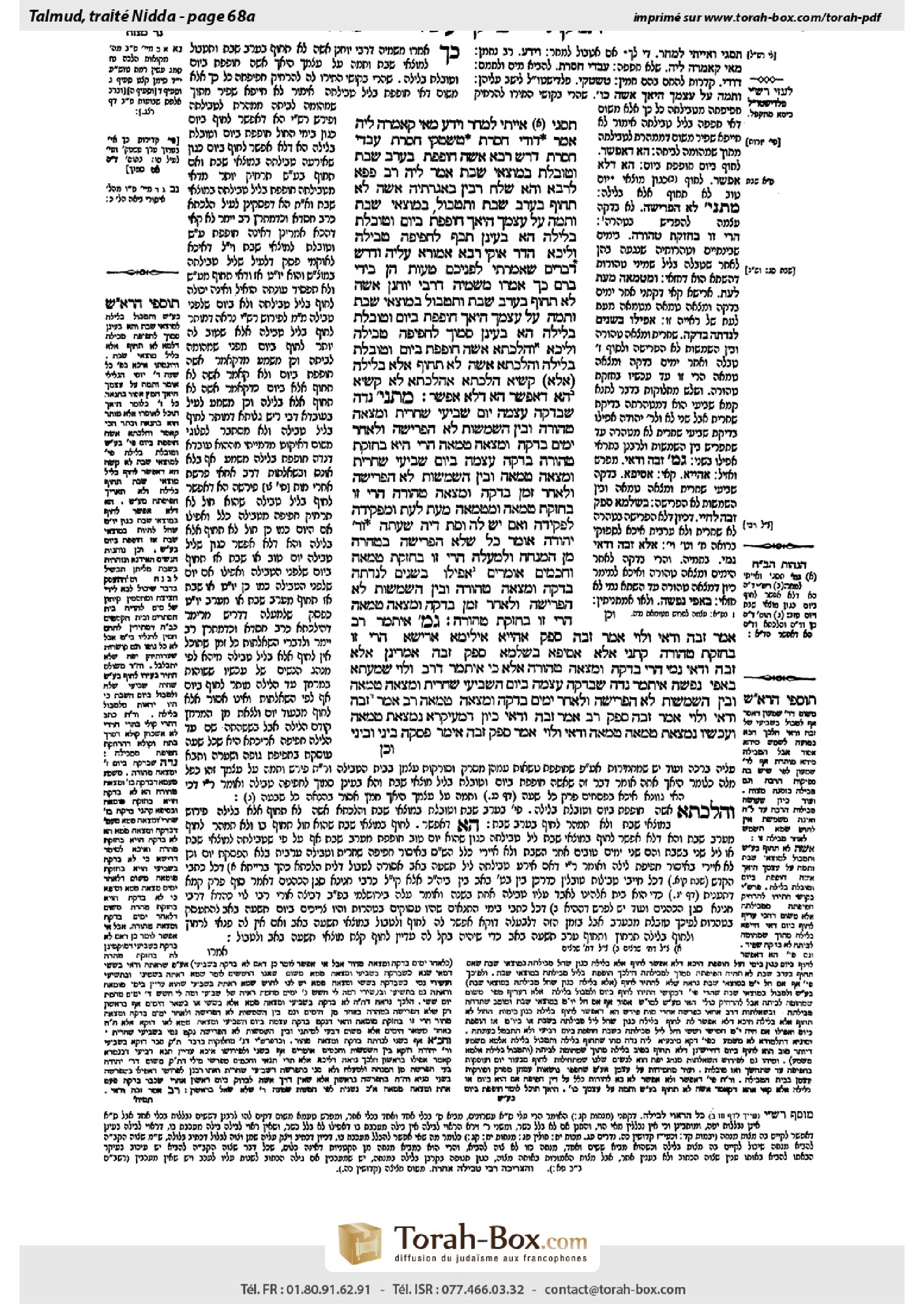
This page of Niddah includes the Aramaic text, an English translation and an AI-generated French translation, alongside the scan above.
נידה ס״ח א · Aramaic and Hebrew text
תִּסְגֵּי אַיְיתִי לִמְחַר, וִידַע מַאי קָאָמְרָה לֵיהּ, אֲמַר: דּוּדֵי חָסְרַתְּ, טַשְׁטָקֵי חָסְרַתְּ, עַבְדֵי חָסְרַתְּ?
דְּרַשׁ רָבָא: אִשָּׁה חוֹפֶפֶת בְּעֶרֶב שַׁבָּת וְטוֹבֶלֶת בְּמוֹצָאֵי שַׁבָּת. אֲמַר לֵיהּ רַב פָּפָּא לְרָבָא: וְהָא שְׁלַח רָבִין בְּאִגַּרְתֵּיהּ ״אִשָּׁה לֹא תָּחוֹף בְּעֶרֶב שַׁבָּת וְתִטְבּוֹל בְּמוֹצָאֵי שַׁבָּת״.
וּתְמַהּ עַל עַצְמְךָ: הֵיאַךְ חוֹפֶפֶת בַּיּוֹם וְטוֹבֶלֶת בַּלַּיְלָה, הָא בָּעֵינַן תֵּכֶף לַחֲפִיפָה טְבִילָה, וְלֵיכָּא!
הֲדַר אוֹקִי רָבָא אָמוֹרָא עֲלֵיהּ, וּדְרַשׁ: דְּבָרִים שֶׁאָמַרְתִּי לִפְנֵיכֶם, טָעוּת הֵן בְּיָדִי. בְּרַם כָּךְ אָמְרוּ מִשְּׁמֵיהּ דְּרַבִּי יוֹחָנָן: אִשָּׁה לֹא תָּחוֹף בְּעֶרֶב שַׁבָּת וְתִטְבּוֹל בְּמוֹצָאֵי שַׁבָּת, וּתְמַהּ עַל עַצְמְךָ: הֵיאַךְ חוֹפֶפֶת בַּיּוֹם וְטוֹבֶלֶת בַּלַּיְלָה? הָא בָּעֵינַן סָמוּךְ לַחֲפִיפָה טְבִילָה, וְלֵיכָּא!
וְהִלְכְתָא: אִשָּׁה חוֹפֶפֶת בַּיּוֹם וְטוֹבֶלֶת בַּלַּיְלָה. וְהִלְכְתָא: אִשָּׁה לֹא תָּחוֹף אֶלָּא בַּלַּיְלָה. (אֶלָּא) קַשְׁיָא הִלְכְתָא אַהִלְכְתָא!
לָא קַשְׁיָא — הָא דְּאֶפְשָׁר, הָא דְּלָא אֶפְשָׁר.
מַתְנִי' נִדָּה שֶׁבָּדְקָה עַצְמָהּ יוֹם שְׁבִיעִי שַׁחֲרִית, וּמָצְאָה טְהוֹרָה, וּבֵין הַשְּׁמָשׁוֹת לֹא הִפְרִישָׁה, וּלְאַחַר יָמִים בָּדְקָה וּמָצְאָה טְמֵאָה — הֲרֵי הִיא בְּחֶזְקַת טְהוֹרָה.
בָּדְקָה עַצְמָהּ בְּיוֹם שְׁבִיעִי שַׁחֲרִית וּמָצְאָה טְמֵאָה, וּבֵין הַשְּׁמָשׁוֹת לֹא הִפְרִישָׁה, וּלְאַחַר זְמַן בָּדְקָה וּמָצְאָה טְהוֹרָה — הֲרֵי זוֹ בְּחֶזְקַת טְמֵאָה.
וּמְטַמְּאָה מֵעֵת לְעֵת, וּמִפְּקִידָה לִפְקִידָה. וְאִם יֵשׁ לָהּ וֶסֶת — דַּיָּה שְׁעָתָהּ.
וְרַבִּי יְהוּדָה אוֹמֵר: כֹּל שֶׁלֹּא הִפְרִישָׁה בְּטָהֳרָה מִן הַמִּנְחָה וּלְמַעְלָה — הֲרֵי זוֹ בְּחֶזְקַת טְמֵאָה, וַחֲכָמִים אוֹמְרִים: אֲפִילּוּ בִּשְׁנַיִם לְנִדָּתָהּ בָּדְקָה וּמָצְאָה טְהוֹרָה, וּבֵין הַשְּׁמָשׁוֹת לֹא הִפְרִישָׁה, וּלְאַחַר זְמַן בָּדְקָה וּמָצְאָה טְמֵאָה — הֲרֵי זוֹ בְּחֶזְקַת טְהוֹרָה.
גְּמָ' אִיתְּמַר: רַב אָמַר: זָבָה וַדַּאי, וְלֵוִי אָמַר: זָבָה סָפֵק.
אַהֵיָיא? אִילֵּימָא אַרֵישָׁא — ״הֲרֵי זוֹ בְּחֶזְקַת טְהוֹרָה״ קָתָנֵי!
אֶלָּא אַסֵּיפָא, בִּשְׁלָמָא סְפֵק זָבָה אָמְרִינַן, אֶלָּא זָבָה וַדַּאי נָמֵי? הֲרֵי בָּדְקָה וּמָצְאָה טְהוֹרָה!
אֶלָּא, כִּי אִיתְּמַר דְּרַב וְלֵוִי — שְׁמַעְתָּא בְּאַפֵּי נַפְשַׁהּ אִיתְּמַר: נִדָּה שֶׁבָּדְקָה עַצְמָהּ בְּיוֹם הַשְּׁבִיעִי שַׁחֲרִית וּמָצְאָה טְמֵאָה, וּבֵין הַשְּׁמָשׁוֹת לֹא הִפְרִישָׁה, וּלְאַחַר יָמִים בָּדְקָה וּמָצְאָה טְמֵאָה — רַב אָמַר: זָבָה וַדַּאי, וְלֵוִי אָמַר: זָבָה סָפֵק.
רַב אָמַר: זָבָה וַדַּאי, כֵּיוָן דְּמֵעִיקָּרָא נִמְצֵאת טְמֵאָה, וְעַכְשָׁיו נִמְצֵאת טְמֵאָה — טְמֵאָה וַדַּאי. וְלֵוִי אָמַר: סְפֵק זָבָה, אֵימַר פְּסַקָה בֵּינֵי וּבֵינֵי.
Niddah 68a · English translation
Rather, it is sufficient if you come back again tomorrow and speak with me then about this matter. And Rav Naḥman bar Yitzḥak knew what she was saying to him. She was alluding to the fact that she had not washed her hair while it was still daylight, and therefore she could not immerse that evening. Rav Naḥman bar Yitzḥak said to her: Are you lacking kettles [dudei] to heat water to wash your hair? Are you lacking buckets [tashtekei] to bring the water to wash your hair? Are you lacking servants, who can help you prepare to wash your hair? It can be inferred from this story that Rav Naḥman bar Yitzḥak holds that it is permitted for a woman to wash her hair and immerse on the same night.
§ Rava taught: A woman may wash her hair on the eve of Shabbat and immerse at the conclusion of Shabbat. Rav Pappa said to Rava: But didn’t Ravin send the following halakha in his letter: A woman may not wash her hair on the eve of Shabbat and immerse at the conclusion of Shabbat? Instead, she should wash her hair after the conclusion of Shabbat immediately before she immerses.
And furthermore, you should be astounded with yourself: How did the Sages deem it permitted for a woman on a weekday to wash her hair during the day and immerse at night? Don’t we require that her immersion must be immediately after washing her hair? And if she washes her hair during the day, this requirement will not be fulfilled. The Sages reluctantly permitted a woman to wash her hair during the day, and they permitted this only due to the concern that she might not wash her hair properly if she would wait until night. Consequently, with regard to an immersion on the conclusion of Shabbat, she should avoid washing her hair a day or more in advance.
As a result of Rav Pappa’s comments, Rava then appointed an interpreter before him to publicize his retraction, and he taught: The statement I said to you was a mistake of mine. But in fact this is what the Sages said in the name of Rabbi Yoḥanan: A woman may not wash her hair on the eve of Shabbat and immerse after the conclusion of Shabbat. And furthermore you should be astounded with yourself. How can a woman wash her hair during the day and immerse at night? Don’t we require: Her immersion must be immediately after washing her hair? And if she washes her hair on the eve of Shabbat, this principle will not be fulfilled.
The Gemara concludes: And the halakha is that a woman may wash her hair during the day and immerse at night. And the halakha is that a woman may wash her hair only at night. The Gemara comments: This is difficult, as one halakha contradicts the other halakha.
The Gemara answers: It is not difficult. This ruling that she may wash her hair during the day is referring to a case where it is possible, e.g., when she immerses on a weeknight and can wash her hair shortly beforehand during the daytime. That ruling that she is permitted to wash her hair only at night is referring to a case where it is not possible, e.g., when her time for immersion is after the conclusion of Shabbat. Since she may not wash her hair on the eve of Shabbat for an immersion after the conclusion of Shabbat, she must wash her hair at night, after Shabbat has ended, immediately before she immerses.
MISHNA: In the case of a menstruating woman who examined herself on the seventh day of menstruation in the morning and found that she is ritually pure and eligible to immerse in a ritual bath that evening, but during twilight of the seventh day she did not perform an examination that marks the transition between the days when she has a flow of blood and the days when she no longer has a flow of blood but immersed despite not having performed the examination, and after several days she examined herself and found that she is ritually impure, the presumptive status of that woman is one of ritual purity from the time of her immersion until her examination, and all ritually pure items that she handled in the interim remain pure.
If she examined herself on the seventh day of menstruation in the morning and found that she is ritually impure, i.e., her menstrual flow continued, and during twilight of the seventh day she did not perform an examination to confirm the transition from ritual impurity to ritual purity but immersed nonetheless, and after several days she examined herself and found that she is ritually pure, the presumptive status of that woman is one of ritual impurity from the time of her immersion until her examination, and all ritually pure items that she handled in the interim are impure. Since she found blood during her last examination in her days of menstruation, the concern is that the flow of blood continued during the days that followed, and therefore her immersion on the eve of the eighth day was ineffective.
In a case where there was no blood found during the examination on the seventh morning and she did not examine herself during twilight, and several days later she discovered blood, where the mishna says that a woman’s presumptive status is one of ritual purity, that is the halakha only for the days following immersion. But she transmits ritual impurity to the ritually pure items that she handled before the examination in which she found blood for a twenty-four-hour period and from examination to examination, in accordance with the halakha of a woman who experiences bleeding (see 2a). And if she has a fixed menstrual cycle, on the day that she examined herself and found blood, her time is sufficient, i.e., it is assumed that the bleeding began then, and she does not transmit impurity retroactively.
And Rabbi Yehuda says: With regard to any woman who did not perform the examination marking her transition from ritual impurity to ritual purity on the seventh day from minḥa time onward, even if she performed an examination and found no blood that morning, the presumptive status of that woman is one of ritual impurity. And the Rabbis say: Even if on the second day of her menstruation she performed the examination and found that she is ritually pure, and she did not perform the examination marking her transition from ritual impurity to ritual purity on the seventh day during twilight, and after several days she examined herself and found that she is ritually impure, the presumptive status of that woman is one of ritual purity from the time of her immersion until her examination.
GEMARA: The Gemara cites a dispute between amora’im with regard to a case where a woman did not perform an examination indicating her transition from ritual impurity to ritual purity, and three days passed in which it is possible that she received the status of a zava, and then she found that she was ritually impure. It was stated that Rav says: This woman is a definite greater zava. And Levi says: She is an uncertain greater zava.
The Gemara asks: To which clause of the mishna does this dispute apply? If we say that Rav and Levi are referring to the first clause, i.e., a woman who examined herself on the morning of the seventh day and found herself to be ritually pure, but she did not examine herself at twilight, and several days later she examined herself and found herself to be impure, this cannot be correct, as the mishna teaches: The presumptive status of that woman is one of ritual purity. She is not a zava at all.
Rather, say that they are referring to the latter clause of the mishna, when she examined herself on the morning of the seventh day and found herself to be ritually impure. If so, granted Levi’s opinion is reasonable, as we say that this woman is an uncertain greater zava. But how can one explain Rav’s opinion that she is even a definite greater zava? After all, she examined herself and found that she is ritually pure. If so, how can she be a definite zava?
Rather, when the dispute of Rav and Levi was stated, it was stated as a distinct halakha unrelated to the mishna, as follows: With regard to a menstruating woman who examined herself on the seventh day in the morning and found that she was ritually impure, and at twilight of the seventh day she did not perform an examination to confirm her transition from ritual impurity to ritual purity, and after several days she examined herself and found that she is ritually impure, Rav says: This woman is a definite greater zava. And Levi says: She is an uncertain greater zava.
The Gemara explains their opinions. Rav says: This woman is a definite greater zava, since from the outset she found herself to be ritually impure, and now she found herself to also be ritually impure. Consequently, she is definitely impure. And Levi says: This woman is an uncertain greater zava, as one can say that perhaps she stopped experiencing bleeding in between the morning of her seventh day of menstruation when she first found herself to be impure and several days later, on the second occasion that she found herself to be impure.
Niddah 68a · Traduction française (IA)
Il suffit plutôt que tu reviennes demain et que tu me parles alors de cette affaire. Rav Naḥman bar Yitzḥak comprit ce qu’elle lui disait. Elle faisait allusion au fait qu’elle n’avait pas lavé ses cheveux alors qu’il faisait encore jour et qu’elle ne pouvait donc pas s’immerger ce soir-là. Rav Naḥman bar Yitzḥak lui dit : Te manque-t-il des chaudrons [dudei] pour faire chauffer de l’eau afin de te laver les cheveux ? Te manque-t-il des seaux [tashtekei] pour apporter l’eau nécessaire à te laver les cheveux ? Te manque-t-il des serviteurs pour t’aider à te préparer à te laver les cheveux ? On peut déduire de cette histoire que Rav Naḥman bar Yitzḥak estime qu’une femme est autorisée à se laver les cheveux et à s’immerger la même nuit.
§ Rava enseigna : Une femme peut se laver les cheveux la veille de Chabbat et s’immerger à la fin de Chabbat. Rav Pappa dit à Rava : Mais Ravin n’a-t-il pas transmis la halakha suivante dans sa lettre : Une femme ne peut pas se laver les cheveux la veille de Chabbat et s’immerger à la fin de Chabbat ? Elle doit plutôt se laver les cheveux après la fin de Chabbat, juste avant de s’immerger.
De plus, tu devrais t’étonner : comment les Sages ont-ils permis à une femme de se laver les cheveux en journée, un jour de semaine, et de s’immerger le soir ? N’exige-t-on pas que son immersion ait lieu immédiatement après qu’elle s’est lavé les cheveux ? Et si elle se lave les cheveux en journée, cette exigence ne sera pas satisfaite. Les Sages ont permis à contrecœur à une femme de se laver les cheveux en journée, et ils ne l’ont autorisée à le faire que par crainte qu’elle ne se lave pas correctement les cheveux si elle attendait la nuit. Par conséquent, lorsqu’elle doit s’immerger à la fin de Chabbat, elle doit éviter de se laver les cheveux un jour ou plus à l’avance.
À la suite des remarques de Rav Pappa, Rava désigna alors un interprète devant lui afin de rendre publique sa rétractation, et il enseigna : Ce que je vous ai dit était une erreur de ma part. En réalité, voici ce que les Sages ont dit au nom de Rabbi Yoḥanan : Une femme ne peut pas se laver les cheveux la veille de Chabbat et s’immerger après la fin de Chabbat. De plus, tu devrais t’étonner : comment une femme peut-elle se laver les cheveux en journée et s’immerger le soir ? N’exige-t-on pas que son immersion ait lieu immédiatement après qu’elle s’est lavé les cheveux ? Et si elle se lave les cheveux la veille de Chabbat, ce principe ne sera pas respecté.
La Guemara conclut : La halakha est qu’une femme peut se laver les cheveux en journée et s’immerger le soir. Et la halakha est qu’une femme ne peut se laver les cheveux que la nuit. La Guemara fait remarquer : Il y a là une difficulté, car ces deux halakhot se contredisent.
La Guemara répond : Il n’y a pas de difficulté. La décision selon laquelle elle peut se laver les cheveux en journée concerne un cas où cela est possible, par exemple lorsqu’elle s’immerge un soir de semaine et peut se laver les cheveux peu avant, pendant la journée. La décision selon laquelle elle ne peut se laver les cheveux que la nuit concerne un cas où cela n’est pas possible, par exemple lorsque le moment de son immersion est après la fin de Chabbat. Puisqu’elle ne peut pas se laver les cheveux la veille de Chabbat en vue d’une immersion après la fin de Chabbat, elle doit se laver les cheveux la nuit, après la fin de Chabbat, juste avant de s’immerger.
MICHNA : Dans le cas d’une femme menstruée qui s’est examinée le matin du septième jour de sa menstruation et a constaté qu’elle était rituellement pure et pouvait s’immerger dans un bain rituel ce soir-là, mais qui, au crépuscule du septième jour, n’a pas procédé à l’examen marquant la transition entre les jours où elle a des pertes de sang et ceux où elle n’en a plus, et s’est néanmoins immergée sans avoir effectué cet examen, puis s’est examinée plusieurs jours plus tard et a constaté qu’elle était rituellement impure, le statut présumé de cette femme est celui de la pureté rituelle depuis le moment de son immersion jusqu’à son examen, et tous les objets rituellement purs qu’elle a manipulés dans l’intervalle restent purs.
Si elle s’est examinée le matin du septième jour de sa menstruation et a constaté qu’elle était rituellement impure, c’est-à-dire que son écoulement menstruel se poursuivait, et si, au crépuscule du septième jour, elle n’a pas procédé à un examen pour confirmer le passage de l’impureté rituelle à la pureté rituelle, mais s’est néanmoins immergée, puis s’est examinée plusieurs jours plus tard et a constaté qu’elle était rituellement pure, le statut présumé de cette femme est celui de l’impureté rituelle depuis le moment de son immersion jusqu’à son examen, et tous les objets rituellement purs qu’elle a manipulés dans l’intervalle sont impurs. Puisqu’elle a trouvé du sang lors de son dernier examen pendant ses jours de menstruation, on craint que l’écoulement de sang se soit poursuivi les jours suivants ; son immersion à la veille du huitième jour n’a donc pas été valable.
Dans le cas où aucun sang n’a été trouvé lors de l’examen du matin du septième jour, où elle ne s’est pas examinée au crépuscule et où, plusieurs jours plus tard, elle a découvert du sang, lorsque la Michna dit que le statut présumé de la femme est celui de la pureté rituelle, cela ne vaut que pour les jours qui suivent l’immersion. Mais elle transmet l’impureté rituelle aux objets rituellement purs qu’elle a manipulés avant l’examen au cours duquel elle a trouvé du sang, pendant une période de vingt-quatre heures et d’un examen à l’autre, conformément à la halakha relative à une femme qui connaît un saignement (voir 2a). Et si elle a un cycle menstruel fixe, le jour où elle s’est examinée et a trouvé du sang, le moment où elle l’a trouvé fait foi : on suppose que le saignement a commencé alors, et elle ne transmet pas l’impureté rétroactivement.
Et Rabbi Yehuda dit : Pour toute femme qui n’a pas effectué, à partir de l’heure de minḥa, l’examen marquant le passage de l’impureté rituelle à la pureté rituelle le septième jour, même si elle s’est examinée et n’a trouvé aucun sang ce matin-là, le statut présumé est celui de l’impureté rituelle. Et les Sages disent : Même si, le deuxième jour de sa menstruation, elle s’est examinée et a constaté qu’elle était rituellement pure, qu’elle n’a pas effectué au crépuscule du septième jour l’examen marquant le passage de l’impureté rituelle à la pureté rituelle et que, plusieurs jours plus tard, elle s’est examinée et a constaté qu’elle était rituellement impure, le statut présumé de cette femme est celui de la pureté rituelle depuis le moment de son immersion jusqu’à son examen.
GUEMARA : La Guemara rapporte une controverse entre des amoraïm au sujet du cas où une femme n’a pas procédé à l’examen indiquant le passage de l’impureté rituelle à la pureté rituelle, où trois jours se sont écoulés pendant lesquels elle a peut-être acquis le statut de zava, et où elle a ensuite constaté qu’elle était rituellement impure. Rav dit : Cette femme est certainement une grande zava. Levi dit : Elle est peut-être une grande zava.
La Guemara demande : À quelle clause de la Michna cette controverse s’applique-t-elle ? Si l’on dit que Rav et Levi se réfèrent à la première clause, c’est-à-dire au cas d’une femme qui s’est examinée le matin du septième jour et s’est trouvée rituellement pure, mais ne s’est pas examinée au crépuscule, puis s’est examinée plusieurs jours plus tard et s’est trouvée impure, cela ne peut pas être correct, car la Michna enseigne : Le statut présumé de cette femme est celui de la pureté rituelle. Elle n’est pas du tout une zava.
Il faut plutôt dire qu’ils se réfèrent à la dernière clause de la Michna, où elle s’est examinée le matin du septième jour et s’est trouvée rituellement impure. Dans ce cas, l’opinion de Levi est certes raisonnable, puisqu’on dit que cette femme est peut-être une grande zava. Mais comment expliquer l’opinion de Rav, selon laquelle elle est certainement une grande zava ? Après tout, elle s’est examinée et s’est trouvée rituellement pure. Dès lors, comment peut-elle être certainement une zava ?
Il faut plutôt dire que la controverse entre Rav et Levi a été formulée comme une halakha distincte, sans rapport avec la Michna, de la manière suivante : Dans le cas d’une femme menstruée qui s’est examinée le matin du septième jour et s’est trouvée rituellement impure, qui n’a pas effectué au crépuscule du septième jour un examen confirmant le passage de l’impureté rituelle à la pureté rituelle, puis qui, plusieurs jours plus tard, s’est examinée et s’est trouvée rituellement impure, Rav dit : Cette femme est certainement une grande zava. Levi dit : Elle est peut-être une grande zava.
La Guemara explique leurs opinions. Rav dit : Cette femme est certainement une grande zava, puisqu’au départ elle s’est trouvée rituellement impure et que, maintenant, elle s’est trouvée elle aussi rituellement impure. Par conséquent, elle est certainement impure. Levi dit : Cette femme est peut-être une grande zava, car on peut dire qu’elle a peut-être cessé de saigner dans l’intervalle entre le matin du septième jour de sa menstruation, où elle s’est trouvée impure pour la première fois, et plusieurs jours plus tard, lorsqu’elle s’est trouvée impure pour la deuxième fois.
Traduction française générée par IA à partir de l’édition anglaise de Sefaria. Vérifie toujours un passage avec le texte source.
Text from Sefaria: William Davidson Edition - Vocalized Aramaic (CC BY NC); William Davidson Edition - English (CC BY NC).