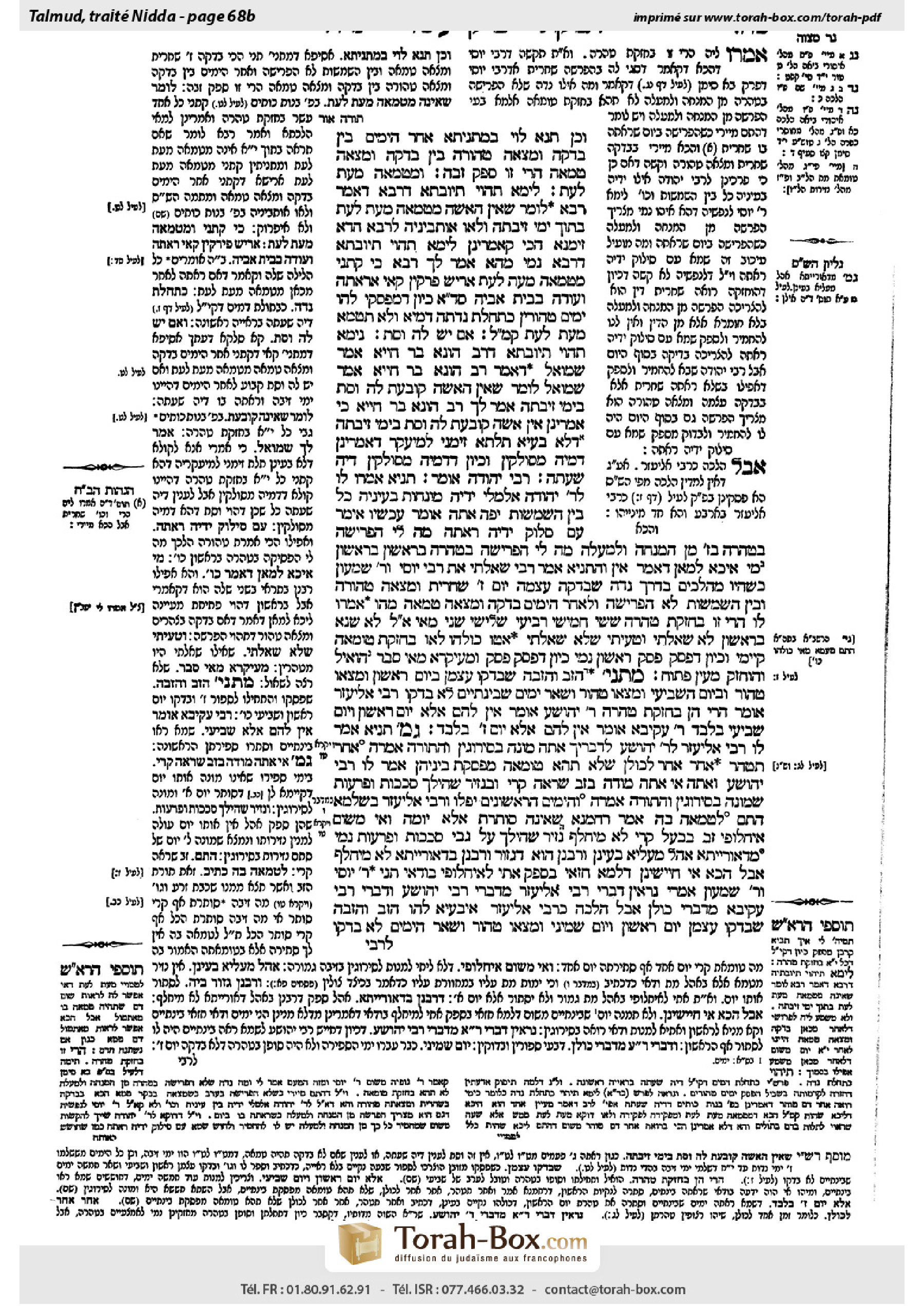
Niddah 68b: Talmud study for Daf Yomi
Daf Yomi is the daily study of one Talmud folio. Explore 37 tractates with scans, Hebrew text, Sefaria English and AI-generated French translations where annotated.
Passage selection and English or AI-generated French translation are available where the scan has annotations. Daf Study is independent of Torah-Box and Sefaria.
Browse Niddah · נידה · All tractatesNiddah 68b text and translations
This page of Niddah includes the Aramaic text, an English translation and an AI-generated French translation, alongside the scan above.
נידה ס״ח ב · Aramaic and Hebrew text
וְכֵן תָּנֵי לֵוִי בְּמַתְנִיתָא: אַחַר הַיָּמִים, בֵּין בָּדְקָה וּמָצְאָה טְהוֹרָה בֵּין בָּדְקָה וּמָצְאָה טְמֵאָה — הֲרֵי זוֹ סְפֵק זָבָה.
וּמְטַמְּאָה מֵעֵת לְעֵת. לֵימָא תִּהְוֵי תְּיוּבְתָּא דְּרָבָא! דְּאָמַר רָבָא: לוֹמַר שֶׁאֵין הָאִשָּׁה מְטַמְּאָה מֵעֵת לְעֵת בְּתוֹךְ יְמֵי זִיבָתָהּ!
וְלָאו אוֹתְבִינֵּיהּ לְרָבָא חֲדָא זִימְנָא! הָכִי קָאָמְרִינַן: לֵימָא תִּהְוֵי תְּיוּבְתָּא דְּרָבָא נָמֵי מֵהָא!
אָמַר לָךְ רָבָא: כִּי קָתָנֵי ״מְטַמְּאָה מֵעֵת לְעֵת״ — אַרֵישׁ פִּרְקִין קָאֵי, אַרָאֲתָה וְעוֹדָהּ בְּבֵית אָבִיהָ.
סָלְקָא דַעְתָּךְ אָמֵינָא, כֵּיוָן דְּמַפְסְקִי לְהוּ יָמִים טְהוֹרִין, כִּתְחִלַּת נִדָּתָהּ דָּמְיָא, וְלֹא תְּטַמֵּא מֵעֵת לְעֵת, קָא מַשְׁמַע לַן.
אִם יֵשׁ לָהּ וֶסֶת. נֵימָא תִּהְוֵי תְּיוּבְתָּא דְּרַב הוּנָא בַּר חִיָּיא אָמַר שְׁמוּאֵל, דְּאָמַר רַב הוּנָא בַּר חִיָּיא אָמַר שְׁמוּאֵל, לוֹמַר שֶׁאֵין הָאִשָּׁה קוֹבַעַת לָהּ וֶסֶת בִּימֵי זִיבָתָהּ.
אָמַר לְךָ רַב הוּנָא בַּר חִיָּיא: כִּי אָמְרִינַן אֵין אִשָּׁה קוֹבַעַת לָהּ וֶסֶת בִּימֵי זִיבָתָהּ, דְּלָא בָּעֲיָא תְּלָתָא זִימְנֵי לְמִיעְקַר, דְּאָמְרִינַן דָּמֶיהָ מְסוּלָּקִין, וְכֵיוָן דְּדָמֶיהָ מְסוּלָּקִין — דַּיָּהּ שְׁעָתָהּ.
רַבִּי יְהוּדָה אוֹמֵר. תַּנְיָא, אָמְרוּ לוֹ לְרַבִּי יְהוּדָה: אִלְמָלֵי יָדֶיהָ מוּנָּחוֹת בְּעֵינֶיהָ כׇּל בֵּין הַשְּׁמָשׁוֹת — יָפֶה אַתָּה אוֹמֵר.
עַכְשָׁיו אֵימַר: עִם סִלּוּק יָדֶיהָ רָאֲתָה? מָה לִי הִפְרִישָׁה בְּטָהֳרָה בַּשְּׁבִיעִי מִן הַמִּנְחָה וּלְמַעְלָה, מָה לִי הִפְרִישָׁה בְּטָהֳרָה בָּרִאשׁוֹן.
בָּרִאשׁוֹן — מִי אִיכָּא לְמַאן דְּאָמַר?
אִין, וְהָתַנְיָא: אָמַר רַבִּי: שָׁאַלְתִּי אֶת רַבִּי יוֹסֵי וְרַבִּי שִׁמְעוֹן כְּשֶׁהָיוּ מְהַלְּכִים בַּדֶּרֶךְ: נִדָּה שֶׁבָּדְקָה עַצְמָהּ יוֹם שְׁבִיעִי שַׁחֲרִית וּמָצְאָה טְהוֹרָה, וּבֵין הַשְּׁמָשׁוֹת לֹא הִפְרִישָׁה, וּלְאַחַר הַיָּמִים בָּדְקָה וּמָצְאָה טְמֵאָה — מַהוּ?
אָמְרוּ לִו: הֲרֵי זוֹ בְּחֶזְקַת טׇהֳרָה. שִׁשִּׁי, חֲמִישִׁי, רְבִיעִי, שְׁלִישִׁי, שֵׁנִי — מַאי? אָמְרוּ לִו: לָא שְׁנָא.
בָּרִאשׁוֹן לֹא שָׁאַלְתִּי, וְטָעִיתִי שֶׁלֹּא שָׁאַלְתִּי, אַטּוּ כּוּלְּהוּ לָאו בְּחֶזְקַת טוּמְאָה קָיְימִי? וְכֵיוָן דִּפְסַק — פְּסַק, רִאשׁוֹן נָמֵי כֵּיוָן דִּפְסַק — פְּסַק.
וּמֵעִיקָּרָא, מַאי סָבַר? הוֹאִיל וְהוּחְזַק מַעְיָן פָּתוּחַ.
מַתְנִי' הַזָּב וְהַזָּבָה, שֶׁבָּדְקוּ עַצְמָן בְּיוֹם רִאשׁוֹן וּמָצְאוּ טָהוֹר, וּבַיּוֹם הַשְּׁבִיעִי וּמָצְאוּ טָהוֹר, וּשְׁאָר יָמִים שֶׁבֵּינְתַיִים לֹא בָּדְקוּ — רַבִּי אֱלִיעֶזֶר אוֹמֵר: הֲרֵי הֵן בְּחֶזְקַת טׇהֳרָה. רַבִּי יְהוֹשֻׁעַ אוֹמֵר: אֵין לָהֶם אֶלָּא יוֹם רִאשׁוֹן וְיוֹם שְׁבִיעִי בִּלְבָד. רַבִּי עֲקִיבָא אוֹמֵר: אֵין לָהֶם אֶלָּא יוֹם שְׁבִיעִי בִּלְבָד.
גְּמָ' תַּנְיָא: אָמַר לוֹ רַבִּי אֱלִיעֶזֶר לְרַבִּי יְהוֹשֻׁעַ: לִדְבָרֶיךָ, אַתָּה מוֹנֶה בְּסֵירוּגִין, וְהַתּוֹרָה אָמְרָה ״אַחַר תִּטְהָר״, אַחַר אַחַר לְכוּלָּן, שֶׁלֹּא תְּהֵא טוּמְאָה מַפְסֶקֶת בֵּינֵיהֶן!
אָמַר לוֹ רַבִּי יְהוֹשֻׁעַ: וְאַתָּה אִי אַתָּה מוֹדֶה בְּזָב שֶׁרָאָה קֶרִי, וּבְנָזִיר שֶׁהִילֵּךְ סְכָכוֹת וּפְרָעוֹת, שֶׁמּוֹנֶה בְּסֵירוּגִין? וְהַתּוֹרָה אָמְרָה: ״וְהַיָּמִים הָרִאשׁוֹנִים יִפְּלוּ״.
וְרַבִּי אֱלִיעֶזֶר, בִּשְׁלָמָא הָתָם, ״לְטׇמְאָה בָהּ״ אָמַר רַחֲמָנָא — שֶׁאֵינָהּ סוֹתֶרֶת אֶלָּא יוֹמָהּ, וְאִי מִשּׁוּם אִיחַלּוֹפֵי זָב בְּבַעַל קֶרִי — לָא מִיחַלַּף.
נָזִיר שֶׁהִילֵּךְ עַל גַּבֵּי סְכָכוֹת וּפְרָעוֹת נָמֵי, מִדְּאוֹרָיְיתָא אֹהֶל מְעַלְּיָא בָּעֵינַן, וְרַבָּנַן הוּא דִּגְזוּר, וְרַבָּנַן בִּדְאוֹרָיְיתָא לָא מִיחַלַּף.
אֲבָל הָכָא — אִי חָיְישִׁינַן דִּלְמָא חֲזַאי, בְּסָפֵק אָתֵי לְאִיחַלּוֹפֵי בְּוַדַּאי.
תָּנֵי רַבִּי יוֹסֵי וְרַבִּי שִׁמְעוֹן אָמְרִי: נִרְאִין דִּבְרֵי רַבִּי אֱלִיעֶזֶר מִדִּבְרֵי רַבִּי יְהוֹשֻׁעַ, וְדִבְרֵי רַבִּי עֲקִיבָא מִדִּבְרֵי כּוּלָּן, אֲבָל הֲלָכָה כְּרַבִּי אֱלִיעֶזֶר.
אִיבַּעְיָא לְהוּ: הַזָּב וְהַזָּבָה שֶׁבָּדְקוּ עַצְמָן יוֹם רִאשׁוֹן וְיוֹם שְׁמִינִי וּמָצְאוּ טָהוֹר, וּשְׁאָר הַיָּמִים לֹא בָּדְקוּ,
Niddah 68b · English translation
And Levi taught similarly in a baraita: If a woman examined herself on the seventh day of menstruation and found herself to be impure, and she did not perform the examination to confirm her transition from ritual impurity to ritual purity, and after several days she examined herself, whether she examined herself and found herself to be ritually pure or whether she examined herself and found herself to be ritually impure, she is an uncertain greater zava.
§ The mishna teaches: But she transmits ritual impurity to the ritually pure items that she handled before the examination in which she found blood for a twenty-four-hour period. The Gemara suggests: Let us say that it is a conclusive refutation of the opinion of Rava, as Rava said, with regard to the statement in the mishna on 38b that a woman has a presumptive status of ritual purity during the eleven days of potential ziva: This serves to say that a woman does not transmit ritual impurity for a twenty-four-hour period before experiencing bleeding during her days of ziva.
The Gemara asks: But didn’t the Gemara already cite a conclusive refutation of the opinion of Rava one time, on 39a? The Gemara explains that this is what we are saying: Let us say that there is a conclusive refutation of the opinion of Rava from this mishna as well.
The Gemara responds that Rava could have said to you that when the mishna teaches: She transmits ritual impurity for a twenty-four-hour period, it is referring to the beginning of our chapter. Specifically, it is speaking of the mishna on 64b, which discusses the case of a young woman who saw menstrual blood before marriage while she was still in her father’s house. According to Beit Hillel she may engage in intercourse only the first night, during which the blood is considered the blood from the torn hymen rather than the blood of menstruation. This mishna is teaching that from that point onward, when she experiences bleeding she renders items impure retroactively for a twenty-four-hour period, like other women.
The Gemara explains that this ruling is necessary, as it might enter your mind to say that since her cycle of menstruation and ziva is interrupted by days when any blood she discharges is considered to be ritually pure, she now reverts back as though it is considered like the beginning of her days of menstruation, and she does not transmit ritual impurity retroactively for a twenty-four-hour period. Therefore, this mishna teaches us that she does transmit impurity retroactively.
§ The mishna teaches: And if she has a fixed menstrual cycle on the day that she examined herself and found blood, her time is sufficient and she does not transmit impurity retroactively. The Gemara asks: Shall we say that this is a conclusive refutation of the opinion of Rav Huna bar Ḥiyya, with regard to the ruling he says that Shmuel says? As Rav Huna bar Ḥiyya says that Shmuel says, with regard to the mishna on 38b that teaches that a woman has a presumptive status of ritual purity during the eleven days of potential ziva: This serves to say that a woman does not establish a fixed menstrual cycle during her days of ziva.
The Gemara answers that Rav Huna bar Ḥiyya could have said to you: When we say that a woman does not establish a fixed menstrual cycle during her days of ziva, we meant this only as a leniency, that she does not require three times to uproot any such cycle. Rather, she uproots it after one time when she does not experience bleeding in accordance with that cycle. As we say that her menstrual blood is removed during her days of ziva, and she is unlikely to discharge menstrual blood during that time. And since her blood is removed, if she established a fixed menstrual cycle it is sufficient for her to be deemed impure from the hour that she saw the menstrual flow. There is no decree of retroactive impurity on items that she previously touched due to the concern that the blood flow might have started earlier.
§ The mishna teaches that Rabbi Yehuda says: With regard to any woman who did not perform the examination indicating her transition from ritual impurity to ritual purity on the seventh day from minḥa time onward, even if she performed an examination and found no blood that morning, the presumptive status of that woman is one of ritual impurity. It is taught in a baraita that the Rabbis said to Rabbi Yehuda: If the halakha had been that a woman who will immerse must keep her hands placed in her eyes, a euphemism for her vagina, for the entire twilight period, what you say is fine. It would be reasonable to assume that since she did not examine herself at the end of the day she has a presumptive status of ritual impurity.
But now that you say that it is insufficient to examine herself in the morning, what is your reasoning? Evidently, you say that when she removed her hand from examining herself perhaps she saw blood and is impure. If so, what difference is it to me if she performed the examination indicating her transition from ritual impurity to ritual purity on the seventh day from minḥa time onward, and what difference is it to me if she performed the examination indicating her transition from ritual impurity to ritual purity on the first day of her counting?
The Gemara asks: Why do the Rabbis mention an examination on the first day of her counting? Is there one who said that if a woman examines herself only on the first day that is sufficient?
The Gemara answers: Yes, there is such an opinion, as it is taught in a baraita that Rabbi Yehuda HaNasi says: I asked Rabbi Yosei and Rabbi Shimon the following question when they were walking on the road: With regard to a menstruating woman who examined herself on the seventh day in the morning and found herself to be ritually pure, but at twilight she did not perform the examination indicating her transition from ritual impurity to ritual purity, and after several days she examined herself and found herself to be ritually impure, what is the halakha?
Rabbi Yosei and Rabbi Shimon said to him: She has a presumptive status of ritual purity up until the moment that she discovered that she was impure. Rabbi Yehuda HaNasi asked them additional questions: If she examined herself on the sixth day, or the fifth day, or the fourth day, or the third day, or even the second day, what is the halakha? Rabbi Yosei and Rabbi Shimon said to him: The halakha is no different. In all of these cases she has a presumptive status of ritual purity until she discovers that she is impure.
Rabbi Yehuda HaNasi comments: I did not ask about a woman who examined herself on the first day, and I erred in that I did not ask them. If I would have asked them they would have told me that even if she examined herself only on the first day, she still has a presumptive status of ritual purity. Rabbi Yehuda HaNasi explains his reasoning: Is that to say that on all of these other days she was not standing with a presumptive status of ritual impurity? And nevertheless, once she performed the examination and her blood is found to have stopped, it is considered to have stopped, and she now has the presumptive status of a woman whose bleeding has stopped. If so, on the first day too, once she performed the examination and her blood is found to have stopped, it is considered to have stopped, and she now has a presumptive status of a woman whose bleeding has stopped.
The Gemara asks: And initially, what did Rabbi Yehuda HaNasi hold? Why didn’t he ask them about a woman who examined herself only on the first day? The Gemara answers that he held that since she has a presumptive status that her spring, i.e., her uterus, is open, as she had just begun experiencing bleeding, an examination conducted on that day is ineffective. In any event, this baraita teaches that there is an opinion that even if a woman examined herself only on the first day, she has a presumptive status of ritual purity.
MISHNA: With regard to a zav and a zava, who are required to count and examine themselves on each of seven clean days before purification in a ritual bath, who examined themselves on the first day and found themselves ritually pure, i.e., with no blood, and they examined themselves on the seventh day and found themselves ritually pure, and on the rest of the intervening days they did not examine themselves, Rabbi Eliezer says: The presumptive status of the zav and the zava is one of ritual purity. Rabbi Yehoshua says: In that case, the zav and the zava have counted only the first day and the seventh day, two of the seven clean days, and they must count another five days to complete the tally. Rabbi Akiva says: The zav and the zava have counted only the seventh day, and they must count another six days to complete the tally.
GEMARA: It is taught in a baraita that Rabbi Eliezer said to Rabbi Yehoshua: According to your statement, that the first day is included in her count of seven, you are counting at intervals, i.e., with days in-between that do not count, and the Torah states: “But if she be purified of her ziva, then she shall count to herself seven days, and after that she shall be pure” (Leviticus 15:28). This teaches that the purification of a zava must be after the seven days, i.e., after all of the days, which must be consecutive so that there are no days of impurity separating between the seven clean days.
Rabbi Yehoshua says: And you too, do you not concede with regard to a zav who experienced a seminal emission during his count of seven clean days, and with regard to a nazirite who walked under overhanging boughs and protrusions that have items whose status of impurity is uncertain beneath them, that they count at intervals, as both are impure for one day before resuming their counting? And yet the Torah states with regard to a nazirite who definitely contracted ritual impurity from a corpse: “But the former days shall be void, because his consecration was defiled” (Numbers 6:12). This indicates that even in cases where the Torah says that one must count consecutively, it is permitted to count with intervals in between countings.
And how would Rabbi Eliezer respond to Rabbi Yehoshua’s claim? He would say: Granted, there in the cases of the zav and the nazirite, the Merciful One states: “This is the law of him that has an issue, and of him from whom an emission of semen goes out, so that he is thereby impure” (Leviticus 15:32). This teaches that when a zav experiences a seminal emission it overturns the counting of only that one day. And if one would claim that the Sages should issue a decree due to the concern that one might confuse the halakha of one who had an emission of ziva during the seven clean days with a zav who had a seminal emission during the seven clean days, that is not a concern. The reason is that an emission of a ziva will not be confused with the case of one who experienced a seminal emission.
Similarly, Rabbi Eliezer would say that in the case of a nazirite who walked under overhanging boughs and protrusions that have items whose status of impurity is uncertain beneath them, there is also no need to overturn all the previous days of counting, as by Torah law we require a full-fledged tent over a corpse, and it was the Sages who decreed that one who walks under overhanging boughs and protrusions is ritually impure. And a halakha that applies by rabbinic law will not be confused with a halakha that is mandated by Torah law.
But here, in the case of a zava who counts only the first and seventh day, if we are concerned that as she did not count the five intermediate days perhaps she saw blood during those days, and since what occurred on those days is uncertain, only the first day counts for her, then one might come to confuse this situation with a case where she is certain that she saw blood during the intermediate days. One might mistakenly think that even if she definitely experiences bleeding during the intermediate days she can still count the first day as one of her seven clean days before immersing.
It is taught in a baraita that Rabbi Yosei and Rabbi Shimon say: The statement of Rabbi Eliezer appears more correct than the statement of Rabbi Yehoshua, and the statement of Rabbi Akiva appears more correct than the statement of all of them. But nevertheless, the halakha is in accordance with the opinion of Rabbi Eliezer.
§ A dilemma was raised before the Sages: With regard to a zav and a zava who examined themselves on the first day of their seven clean days and found themselves to be pure, and they examined themselves again on the eighth day and found themselves to be pure, but they did not examine themselves on the remainder of the days,
Niddah 68b · Traduction française (IA)
Levi enseigna de même dans une baraïta : Si une femme s’examina le septième jour de ses règles et se trouva impure, sans effectuer l’examen destiné à confirmer son passage de l’impureté rituelle à la pureté rituelle, puis s’examina plusieurs jours plus tard, qu’elle se trouve alors rituellement pure ou rituellement impure, elle est une grande zava dont le statut est incertain.
§ La Michna enseigne : Mais elle transmet l’impureté rituelle aux objets purs qu’elle a manipulés avant l’examen au cours duquel elle a trouvé du sang, pour les vingt-quatre heures précédentes. La Guemara suggère : Disons que cela constitue une réfutation concluante de l’opinion de Rava. En effet, au sujet de l’affirmation de la Michna, en 38b, selon laquelle une femme est présumée rituellement pure pendant les onze jours où elle peut connaître une ziva, Rava a dit que cela signifie qu’une femme ne transmet pas l’impureté rituelle pour les vingt-quatre heures précédant un saignement survenu pendant ses jours de ziva.
La Guemara demande : Mais la Guemara n’a-t-elle pas déjà cité une réfutation concluante de l’opinion de Rava, en 39a ? La Guemara explique que voici ce que nous disons : Disons que cette Michna aussi apporte une réfutation concluante de l’opinion de Rava.
La Guemara répond que Rava aurait pu te dire que lorsque la Michna enseigne : « Elle transmet l’impureté rituelle pour les vingt-quatre heures précédentes », elle fait référence au début de notre chapitre. Plus précisément, il s’agit de la Michna en 64b, qui traite du cas d’une jeune femme ayant vu du sang menstruel avant son mariage, alors qu’elle était encore dans la maison de son père. Selon Beit Hillel, elle ne peut avoir de rapports que pendant la première nuit, durant laquelle le sang est considéré comme provenant de la rupture de l’hymen et non comme du sang menstruel. Cette Michna enseigne qu’à partir de ce moment, lorsqu’elle saigne, elle rend rétroactivement impurs les objets pour une période de vingt-quatre heures, comme les autres femmes.
La Guemara explique que cette règle est nécessaire, car on pourrait penser que, puisque son cycle menstruel et ses jours de ziva sont interrompus par des jours où tout sang qu’elle émet est considéré comme rituellement pur, elle revient alors à son statut initial, comme si elle était au début de ses jours de menstruation, et ne transmet donc pas rétroactivement l’impureté rituelle pour une période de vingt-quatre heures. La Michna nous enseigne donc qu’elle transmet bien l’impureté rétroactivement.
§ La Michna enseigne : Et si elle a un cycle menstruel fixe le jour où elle s’est examinée et a trouvé du sang, le moment où elle a trouvé du sang suffit et elle ne transmet pas l’impureté rétroactivement. La Guemara demande : Disons que cela constitue une réfutation concluante de l’opinion de Rav Huna bar Ḥiyya concernant la règle qu’il rapporte au nom de Shmuel. En effet, Rav Huna bar Ḥiyya rapporte au nom de Shmuel que, concernant la Michna en 38b, qui enseigne qu’une femme est présumée rituellement pure pendant les onze jours où elle peut connaître une ziva, cela signifie qu’une femme n’établit pas de cycle menstruel fixe pendant ses jours de ziva.
La Guemara répond que Rav Huna bar Ḥiyya aurait pu te dire : Lorsque nous disons qu’une femme n’établit pas de cycle menstruel fixe pendant ses jours de ziva, nous entendons cela uniquement comme un allègement : elle n’a pas besoin de trois occurrences pour abolir un tel cycle ; elle l’abolit dès la première fois où elle ne saigne pas conformément à ce cycle. En effet, nous disons que son sang menstruel est écarté pendant ses jours de ziva et qu’il est peu probable qu’elle en émette durant cette période. Puisque son sang est écarté, si elle avait établi un cycle menstruel fixe, il suffit de la considérer comme impure à partir de l’heure où elle a vu le flux menstruel. Il n’y a pas lieu de décréter une impureté rétroactive pour les objets qu’elle a touchés auparavant, au motif que le flux aurait pu commencer plus tôt.
§ La Michna enseigne que Rabbi Yehuda dit : Toute femme qui n’a pas effectué, à partir de l’heure de minḥa le septième jour, l’examen attestant son passage de l’impureté rituelle à la pureté rituelle a un statut présumé d’impureté rituelle, même si elle s’est examinée et n’a trouvé aucun sang le matin. Une baraïta enseigne que les Sages dirent à Rabbi Yehuda : Si la halakha exigeait qu’une femme qui doit s’immerger garde les mains posées sur ses yeux — expression pudique désignant son vagin — pendant toute la période du crépuscule, ce que tu dis serait juste. Il serait raisonnable de présumer que, puisqu’elle ne s’est pas examinée à la fin de la journée, elle est présumée rituellement impure.
Mais maintenant que tu dis qu’il ne suffit pas qu’elle s’examine le matin, quel est ton raisonnement ? De toute évidence, tu dis que, lorsqu’elle retire sa main après s’être examinée, elle a peut-être vu du sang et est donc impure. Dans ce cas, quelle différence cela fait-il qu’elle ait effectué l’examen attestant son passage de l’impureté rituelle à la pureté rituelle à partir de l’heure de minḥa le septième jour ou qu’elle l’ait effectué le premier jour de son décompte ?
La Guemara demande : Pourquoi les Sages mentionnent-ils un examen le premier jour de son décompte ? Quelqu’un a-t-il donc dit qu’il suffisait qu’une femme s’examine uniquement le premier jour ?
La Guemara répond : Oui, un avis de ce genre existe, car une baraïta enseigne que Rabbi Yehuda HaNasi dit : J’ai posé la question suivante à Rabbi Yosei et à Rabbi Shimon alors qu’ils marchaient sur la route : Quelle est la halakha concernant une femme menstruée qui s’est examinée le matin du septième jour et s’est trouvée rituellement pure, mais qui n’a pas effectué au crépuscule l’examen attestant son passage de l’impureté rituelle à la pureté rituelle, puis s’est examinée plusieurs jours plus tard et s’est trouvée rituellement impure ?
Rabbi Yosei et Rabbi Shimon lui dirent : Elle est présumée rituellement pure jusqu’au moment où elle découvre qu’elle est impure. Rabbi Yehuda HaNasi leur posa d’autres questions : Quelle est la halakha si elle s’est examinée le sixième jour, le cinquième, le quatrième, le troisième ou même le deuxième ? Rabbi Yosei et Rabbi Shimon lui dirent : La halakha est la même. Dans tous ces cas, elle est présumée rituellement pure jusqu’à ce qu’elle découvre qu’elle est impure.
Rabbi Yehuda HaNasi ajoute : Je ne les ai pas interrogés au sujet d’une femme qui s’était examinée le premier jour, et j’ai eu tort de ne pas le faire. Si je le leur avais demandé, ils m’auraient dit que même si elle ne s’était examinée que le premier jour, elle serait présumée rituellement pure. Rabbi Yehuda HaNasi explique son raisonnement : Est-ce à dire que, tous les autres jours, elle n’était pas présumée rituellement impure ? Pourtant, dès qu’elle s’est examinée et que l’on a constaté que son sang s’était arrêté, on considère qu’il s’est arrêté, et elle est désormais présumée être une femme dont le saignement a cessé. Si tel est le cas, le premier jour aussi, dès qu’elle s’est examinée et que l’on a constaté que son sang s’était arrêté, on considère qu’il s’est arrêté, et elle est désormais présumée être une femme dont le saignement a cessé.
La Guemara demande : Et initialement, quelle était l’opinion de Rabbi Yehuda HaNasi ? Pourquoi ne les a-t-il pas interrogés au sujet d’une femme qui s’était examinée uniquement le premier jour ? La Guemara répond qu’il pensait que, puisqu’elle était présumée avoir son « orifice » — c’est-à-dire son utérus — ouvert, car elle venait de commencer à saigner, un examen effectué ce jour-là était sans effet. Quoi qu’il en soit, cette baraïta enseigne qu’un avis considère que même si une femme ne s’est examinée que le premier jour, elle est présumée rituellement pure.
MICHNA : Un zav et une zava doivent compter sept jours purs et s’examiner chaque jour avant de se purifier dans un bain rituel. S’ils se sont examinés le premier jour et se sont trouvés rituellement purs, c’est-à-dire sans sang, puis se sont examinés le septième jour et se sont trouvés rituellement purs, mais ne se sont pas examinés pendant les autres jours intermédiaires, Rabbi Eliezer dit : Le zav et la zava sont présumés rituellement purs. Rabbi Yehoshua dit : Dans ce cas, le zav et la zava n’ont compté que le premier et le septième jour, soit deux des sept jours purs, et doivent compter cinq jours supplémentaires pour achever le décompte. Rabbi Akiva dit : Le zav et la zava n’ont compté que le septième jour et doivent compter six jours supplémentaires pour achever le décompte.
GUEMARA : Une baraïta enseigne que Rabbi Eliezer dit à Rabbi Yehoshua : Selon ce que tu affirmes, à savoir que le premier jour est inclus dans son décompte des sept jours, tu comptes par intervalles, c’est-à-dire en laissant des jours intermédiaires non comptabilisés. Or la Torah dit : « Mais si elle est purifiée de sa ziva, elle comptera pour elle-même sept jours, après quoi elle sera pure » (Lévitique 15:28). Cela enseigne qu’une zava ne se purifie qu’après les sept jours, c’est-à-dire après l’ensemble des jours, qui doivent être consécutifs, sans qu’aucun jour d’impureté ne s’intercale entre les sept jours purs.
Rabbi Yehoshua dit : Et toi aussi, ne reconnais-tu pas que, dans le cas d’un zav qui a eu une émission de sperme pendant son décompte des sept jours purs, et dans celui d’un nazir qui est passé sous des branches en surplomb et des avancées sous lesquelles se trouvent des objets dont le statut d’impureté est incertain, ils comptent par intervalles, puisque tous deux sont impurs pendant un jour avant de reprendre leur décompte ? Pourtant, la Torah dit au sujet d’un nazir qui a contracté avec certitude l’impureté rituelle au contact d’un cadavre : « Les jours précédents seront annulés, car sa consécration a été souillée » (Nombres 6:12). Cela indique que, même dans les cas où la Torah exige un décompte consécutif, il est permis de compter avec des intervalles entre les décomptes.
Et comment Rabbi Eliezer répondrait-il à l’argument de Rabbi Yehoshua ? Il dirait : Il est vrai que, dans les cas du zav et du nazir, le Miséricordieux dit : « Telle est la loi de celui qui a un écoulement et de celui qui a une émission de sperme, qui le rend impur » (Lévitique 15:32). Cela enseigne que, lorsqu’un zav a une émission de sperme, elle annule le décompte de ce seul jour. Et si l’on prétendait que les Sages devraient décréter une mesure de précaution, de peur que l’on confonde la halakha de celui qui a eu un écoulement de ziva pendant les sept jours purs avec celle d’un zav qui a eu une émission de sperme pendant ces sept jours, cette crainte n’est pas fondée. En effet, un écoulement de ziva ne sera pas confondu avec le cas de celui qui a eu une émission de sperme.
De même, Rabbi Eliezer dirait que, dans le cas d’un nazir passé sous des branches en surplomb et des avancées sous lesquelles se trouvent des objets dont le statut d’impureté est incertain, il n’est pas non plus nécessaire d’annuler tous les jours de décompte précédents. En effet, selon la Torah, il faut une véritable tente au-dessus d’un cadavre, et ce sont les Sages qui ont décrété qu’une personne passant sous des branches en surplomb et des avancées est rituellement impure. Une halakha relevant du droit rabbinique ne sera pas confondue avec une halakha imposée par la Torah.
Mais ici, dans le cas d’une zava qui ne compte que le premier et le septième jour, si l’on craint que, n’ayant pas compté les cinq jours intermédiaires, elle ait peut-être vu du sang ces jours-là, et que, puisque ce qui s’y est passé est incertain, seul le premier jour soit comptabilisé, on pourrait confondre cette situation avec le cas où elle est certaine d’avoir vu du sang pendant les jours intermédiaires. On pourrait croire à tort que, même si elle a certainement saigné pendant ces jours, elle peut tout de même compter le premier jour parmi ses sept jours purs avant de s’immerger.
Une baraïta enseigne que Rabbi Yosei et Rabbi Shimon disent : L’avis de Rabbi Eliezer semble plus juste que celui de Rabbi Yehoshua, et celui de Rabbi Akiva semble plus juste que tous les autres. Néanmoins, la halakha suit l’opinion de Rabbi Eliezer.
§ Une question fut soulevée devant les Sages : Un zav et une zava se sont examinés le premier jour de leurs sept jours purs et se sont trouvés purs, puis se sont de nouveau examinés le huitième jour et se sont trouvés purs, mais ne se sont pas examinés pendant les autres jours,
Traduction française générée par IA à partir de l’édition anglaise de Sefaria. Vérifie toujours un passage avec le texte source.
Text from Sefaria: William Davidson Edition - Vocalized Aramaic (CC BY NC); William Davidson Edition - English (CC BY NC).