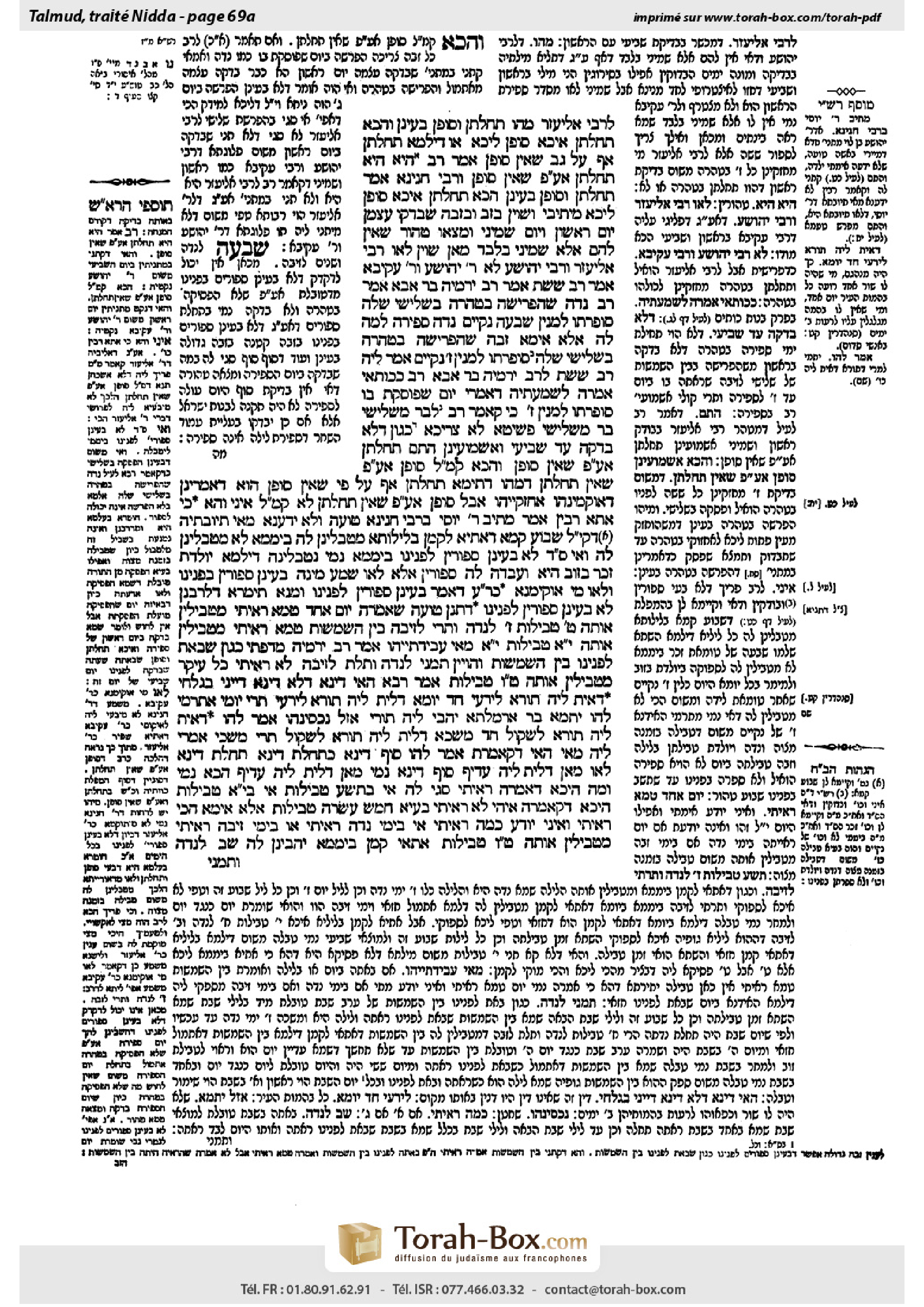
Niddah 69a: Talmud study for Daf Yomi
Daf Yomi is the daily study of one Talmud folio. Explore 37 tractates with scans, Hebrew text, Sefaria English and AI-generated French translations where annotated.
Passage selection and English or AI-generated French translation are available where the scan has annotations. Daf Study is independent of Torah-Box and Sefaria.
Browse Niddah · נידה · All tractatesNiddah 69a text and translations
This page of Niddah includes the Aramaic text, an English translation and an AI-generated French translation, alongside the scan above.
נידה ס״ט א · Aramaic and Hebrew text
לְרַבִּי אֱלִיעֶזֶר מַהוּ? תְּחִלָּתָן וְסוֹפָן בָּעֵינַן, וְהָכָא תְּחִלָּתָן אִיכָּא סוֹפָן לֵיכָּא, אוֹ דִילְמָא תְּחִלָּתָן אַף עַל גַּב שֶׁאֵין סוֹפָן?
אָמַר רַב: הִיא הִיא תְּחִלָּתָן, אַף עַל פִּי שֶׁאֵין סוֹפָן, וְרַבִּי חֲנִינָא אָמַר: תְּחִלָּתָן וְסוֹפָן בָּעֵינַן, הָכָא תְּחִלָּתָן אִיכָּא, סוֹפָן לֵיכָּא.
מֵיתִיבִי: וְשָׁוִין בְּזָב וּבְזָבָה שֶׁבָּדְקוּ עַצְמָן יוֹם רִאשׁוֹן וְיוֹם שְׁמִינִי וּמָצְאוּ טָהוֹר, שֶׁאֵין לָהֶם אֶלָּא שְׁמִינִי בִּלְבַד. מַאן שָׁוִין? לָאו רַבִּי אֱלִיעֶזֶר וְרַבִּי יְהוֹשֻׁעַ?
לָא, רַבִּי יְהוֹשֻׁעַ וְרַבִּי עֲקִיבָא.
אָמַר רַב שֵׁשֶׁת, אָמַר רַב יִרְמְיָה בַּר אַבָּא, אָמַר רַב: נִדָּה שֶׁהִפְרִישָׁה בְּטׇהֳרָה בַּשְּׁלִישִׁי שֶׁלָּהּ — סוֹפַרְתּוֹ לְמִנְיַן שִׁבְעָה נְקִיִּים.
נִדָּה, סְפִירָה לְמָה לַהּ? אֶלָּא אֵימָא: זָבָה שֶׁהִפְרִישָׁה בְּטׇהֳרָה בַּשְּׁלִישִׁי שֶׁלָּהּ — סוֹפַרְתּוֹ לְמִנְיַן שִׁבְעָה נְקִיִּים.
אֲמַר לֵיהּ רַב שֵׁשֶׁת לְרַב יִרְמְיָה בַּר אַבָּא: רַב כְּכוּתָאֵי אַמְרַהּ לִשְׁמַעְתֵּיהּ? דְּאָמְרִי: יוֹם שֶׁפּוֹסֶקֶת בּוֹ סוֹפַרְתּוֹ לְמִנְיַן שִׁבְעָה!
כִּי קָאָמַר רַב, לְבַר מִשְּׁלִישִׁי. בַּר מִשְּׁלִישִׁי? פְּשִׁיטָא! לָא צְרִיכָא, כְּגוֹן דְּלֹא בָּדְקָה עַד שְׁבִיעִי.
וְאַשְׁמְעִינַן הָתָם — תְּחִלָּתָן, אַף עַל פִּי שֶׁאֵין סוֹפָן, וְהָכָא קָא מַשְׁמַע לַן — סוֹפָן, אַף עַל פִּי שֶׁאֵין תְּחִלָּתָן.
דְּמַהוּ דְּתֵימָא: תְּחִלָּתָן אַף עַל פִּי שֶׁאֵין סוֹפָן הוּא דְּאָמְרִינַן, דְּאוֹקְמִינְהוּ אַחֶזְקַיְיהוּ, אֲבָל סוֹפָן אַף עַל פִּי שֶׁאֵין תְּחִלָּתָן — לָא, קָא מַשְׁמַע לַן.
אִינִי? וְהָא כִּי אֲתָא רָבִין אָמַר: מֵתִיב רַבִּי יוֹסֵי בְּרַבִּי חֲנִינָא ״טוֹעָה״.
וְלָא יָדַעְנָא מַאי תְּיוּבְתֵּיהּ, דְּקַיְימָא לַן: שָׁבוּעַ קַמָּא דְּאָתְיָא לְקַמַּן — בְּלֵילָוָתָא מַטְבְּלִינַן לַהּ, בִּימָמָא לָא מַטְבְּלִינַן לַהּ.
וְאִי סָלְקָא דַעְתָּךְ לָא בָּעֵינַן סְפוּרִין לְפָנֵינוּ, בִּימָמָא נָמֵי נַטְבְּלִינַהּ, דִּילְמָא יוֹלֶדֶת זָכָר בְּזוֹב הִיא, וְעָבְדָה לַהּ סְפוּרִין! אֶלָּא לָאו שְׁמַע מִינַּהּ בָּעֵינַן סְפוּרִין בְּפָנֵינוּ!
וְלָאו מִי אוֹקֵימְנָא כְּרַבִּי עֲקִיבָא, דְּאָמַר: בָּעֵינַן סְפוּרִין לְפָנֵינוּ?!
וּמְנָא תֵּימְרָא דִּלְרַבָּנַן לָא בָּעֵינַן סְפוּרִין לְפָנֵינוּ? דִּתְנַן: טוֹעָה שֶׁאָמְרָה ״יוֹם אֶחָד טָמֵא רָאִיתִי״, מַטְבִּילִין אוֹתָהּ תֵּשַׁע טְבִילוֹת.
שְׁבַע לְנִדָּה, וּתְרֵי לְזִיבָה. ״בֵּין הַשְּׁמָשׁוֹת טָמֵא רָאִיתִי״ — מַטְבִּילִין אוֹתָהּ אַחַת עֶשְׂרֵה טְבִילוֹת.
אַחַת עֶשְׂרֵה מַאי עֲבִידְתַּיְיהוּ? אָמַר רַב יִרְמְיָה מִדִּפְתִּי: כְּגוֹן שֶׁבָּאת לְפָנֵינוּ בֵּין הַשְּׁמָשׁוֹת,
וְהָוְיָין תַּמְנֵי לְנִדָּה וּתְלָת לְזִיבָה.
״לֹא רָאִיתִי כׇּל עִיקָּר״ — מַטְבִּילִין אוֹתָהּ חֲמֵשׁ עֶשְׂרֵה טְבִילוֹת. אָמַר רָבָא: הַאי דִּינָא דְּלָא דִּינָא, דָּיְינִי בְּגַלָּחֵי, דְּאִית לֵיהּ תּוֹרָא — לִירְעֵי חַד יוֹמָא, דְּלֵית לֵיהּ תּוֹרָא — לִירְעֵי תְּרֵי יוֹמֵי.
אִתְרְמִי לְהוּ יַתְמָא בַּר אַרְמַלְתָּא, יָהֲבִי לֵיהּ תּוֹרֵי, אֲזַל נַכְסִינְהוּ. אֲמַר לְהוּ: דְּאִית לֵיהּ תּוֹרָא — לִשְׁקוֹל חַד מַשְׁכָּא, דְּלֵית לֵיהּ תּוֹרָא — לִשְׁקוֹל תְּרֵי מַשְׁכֵי. אָמְרִי לֵיהּ: מַאי הַאי דְּקָאָמְרַתְּ? אֲמַר לְהוּ: סוֹף דִּינָא כִּתְחִלַּת דִּינָא, תְּחִלַּת דִּינָא — לָאו מַאן דְּלֵית לֵיהּ עֲדִיף? סוֹף דִּינָא נָמֵי — מַאן דְּלֵית לֵיהּ עָדִיף.
הָכָא נָמֵי, וּמָה הֵיכָא דְּאָמְרָה ״רָאִיתִי״ — סַגִּי לָהּ אִי בְּתֵשַׁע טְבִילוֹת אִי בְּאַחַת עֶשְׂרֵה טְבִילוֹת, הֵיכָא דְּקָאָמְרָה אִיהִי ״לָא רָאִיתִי״ — בָּעֲיָא חֲמֵשׁ עֶשְׂרֵה טְבִילוֹת?
אֶלָּא אֵימָא הָכִי: ״רָאִיתִי וְאֵינִי יוֹדֵעַ כַּמָּה רָאִיתִי, אִי בִּימֵי נִדָּה רָאִיתִי אוֹ בִּימֵי זִיבָה רָאִיתִי״ — מַטְבִּילִין אוֹתָהּ חֲמֵשׁ עֶשְׂרֵה טְבִילוֹת. אֲתַאי קַמַּן בִּימָמָא — יָהֲבִינַן לַהּ שַׁב לְנִדָּה
Niddah 69a · English translation
according to the opinion of Rabbi Eliezer, that if they examined themselves on the first and seventh days they are considered to be pure during the intermediate days as well, what is the halakha? Do we require the first and last days of the seven, and if so, here there is an examination on the first day, and yet there is no examination on the last day, but only on the eighth day? Or perhaps Rabbi Eliezer requires an examination only on the first of the days, and this is sufficient even though there is no examination on the last of the seven days.
Rav said: This case of examining on the first and eighth days is the same as that of examining on the first and seventh days, i.e., Rabbi Eliezer requires an examination only on the first of the days, and this examination is sufficient even though there is no examination on the last of the days. And Rabbi Ḥanina said: We require an examination on the first and last days of the seven, and here there is an examination on the first day but there is no examination on the last day. Consequently, Rabbi Eliezer would not permit a zav or a zava to count any of the days in this case.
The Gemara raises an objection to the opinion of Rav from a baraita: And the Sages agree with regard to a zav and a zava who examined themselves on the first day and on the eighth day and found themselves to be ritually pure, that they have only the eighth day as part of their count. The Gemara asks: Who are the Sages who agree to this? Are they not Rabbi Eliezer and Rabbi Yehoshua? These two Sages, who disagree in a case where the zav and zava examined themselves on the first and seventh days, are evidently the ones who agree in the case of a woman who performed an examination on the first and the eighth days. This seems to contradict Rav’s opinion.
The Gemara rejects this suggestion: No, the Sages referred to here are Rabbi Yehoshua and Rabbi Akiva. Both of them agree that in this case the first day is not included in the count. Conversely, Rabbi Eliezer would say that the first seven days are included in the count and the eighth day is unnecessary, as there is a presumptive status of ritual purity from her examination on the first day.
§ The Gemara cites another discussion with regard to which days are included in the count of seven clean days. Rav Sheshet says that Rav Yirmeya bar Abba says that Rav says: A menstruating woman who performed the examination marking the first step in her transition from ritual impurity to ritual purity on her third day counts that day as part of the number of seven clean days.
The Gemara asks: Why does a menstruating woman require any kind of counting? If this is during her days when she is expected to menstruate she may immerse after the conclusion of seven days, whether or not those days were clean. Rather, say that Rav meant as follows: A zava who performed the examination marking the first step in her transition from ritual impurity to ritual purity on her third day counts that day as part of the number of seven clean days.
Rav Sheshet said to Rav Yirmeya bar Abba: Did Rav say his halakha in accordance with the opinion of the Samaritans, who say that the day on which a zava ceases to experience the emission of ziva counts toward the number of seven clean days, and she does not need to count seven complete days?
Rav Yirmeya bar Abba replied: When Rav says his halakha, he meant apart from the third day. Rav Sheshet challenged: If Rav meant apart from the third day, that is obvious; there is no need for him to issue such a statement at all. Rav Yirmeya bar Abba replied: No, the statement that she begins counting immediately after the third day is necessary for a case where once she saw that she was clean after the third day of her ziva emissions she did not examine herself again until the seventh day.
And Rav is teaching us two halakhot. There, in the previous discussion with regard to the opinion of Rabbi Eliezer, Rav stated that an examination at the beginning is sufficient, even though there is no examination at the end of the seven days. And here he teaches us that an examination at the end of the seven days is sufficient, even though there is no examination at the beginning of the seven days, but only on the day when she ceased experiencing bleeding.
Rav Yirmeya adds that it is necessary to teach both halakhot, lest you say that we say that an examination at the beginning is sufficient even though there is no examination at the end of the seven days, as we establish the clean days in accordance with their presumptive status. But one might have thought that Rav would not permit her to consider all the days to have been clean in a case of an examination at the end of the seven days even though there is no examination at the beginning of the seven days, where no presumptive status was established. Therefore, this second statement of Rav teaches us that even if she only examined herself at the end of the seven clean days it is sufficient.
The Gemara raises a difficulty with regard to Rav Yirmeya’s explanation. Is that so? But when Ravin came from Eretz Yisrael he said: Rabbi Yosei, son of Rabbi Ḥanina, raised an objection to the opinion of Rabbi Yehoshua ben Levi, that a woman who is uncertain whether or not she miscarried an actual fetus must bring an offering (see 29a). The reason is that the majority of pregnant women carry actual fetuses. Rabbi Yosef objected to this from the case of a woman who was forgetful, i.e., a woman who left town when she was pregnant, and later returned no longer pregnant. It is unknown whether she miscarried an actual fetus, and if it was a fetus, whether it was male or female. The conclusion there was that she does not have any days when blood she discharges is considered ritually pure, which is the halakha following a birth, as her miscarriage might not have been a fetus at all. Apparently, here one does not follow the principle that the majority of pregnant women carry actual fetuses.
Ravin continues: And I do not know what his objection is, as the reason that she does not have any days when blood she discharges is considered ritually pure is not only due to the uncertainty as to whether or not she miscarried a fetus, but because it is also unknown when that miscarriage occurred, i.e., even if she miscarried a fetus, perhaps the days when blood she discharges is considered ritually pure had already been completed. As we maintain that the first week that she comes before us, when the court is uncertain with regard to her impurity, we tell her to immerse every night of that week, in the manner of a woman purifying herself after menstruation or childbirth, but we do not tell her to immerse during the daytime, as she has not counted seven clean days (see 29b).
The Gemara explains how this discussion apparently contradicts Rav Yirmeya’s explanation. And if it enters your mind that we do not require all seven clean days to be counted before us, i.e., if an examination on the seventh day is sufficient, let us tell her to immerse also during the daytime, as perhaps she gave birth to a male baby during her days of ziva, and already performed her seven days of counting before she came before the court. The Gemara concludes: Rather, must one not conclude from this statement of Ravin that we require that her seven clean days be counted before us, which is why the court does not instruct her to immerse during the daytime.
The Gemara rejects this contention. But didn’t we interpret that the baraita is in accordance with the opinion of Rabbi Akiva, who said that we require her seven clean days to be counted before us? By contrast, Rav’s statement was in accordance with the opinion of Rabbi Eliezer, who holds that the days do not need to be counted before us.
§ The Gemara stated earlier that according to the opinion of the Rabbis, the seven clean days do not need to be counted before us. The Gemara analyzes their opinion: And from where do you say that according to the opinion of the Rabbis we do not require that the seven days be counted before us? This is as we learned in a baraita: With regard to a woman who was forgetful and does not know whether she is now in her days of menstruation or days of ziva, who said: I saw blood on one day of impurity, the court instructs her to immerse nine immersions.
The baraita clarifies: Since there is no way of knowing whether she is a woman purifying herself after menstruation or after ziva, she must immerse seven immersions on the following seven nights, for purification from menstruation, as each of these days might be the last of the seven days of menstruation. And she must also immerse during two days as purification from ziva, i.e., on the day that she arrives, in case she experienced bleeding the day before, and on the following day, as perhaps she experienced bleeding on the day of her arrival. But if this woman says: I saw blood at twilight that renders me impure, the court instructs her to immerse eleven immersions.
The Gemara asks: These eleven days, what is their purpose? If she would normally require nine immersions, why does she require an extra two immersions if she experienced bleeding at twilight? Rav Yirmeya of Difti said: The baraita is referring specifically to a case where she came before us at twilight and says that she also experienced bleeding at twilight, but it is not clear whether she experienced bleeding on a previous day at twilight, or today at twilight.
Rav Yirmeya explains: Therefore, she requires eight immersions to purify herself from menstruation, seven in case each of the following nights is the night after the seventh day of menstruation, and the eighth in case she experienced bleeding during twilight of the day she arrived, and this occurred in a time which was actually part of the next day, such that she needs to immerse also on the eighth night from her arrival, and three additional immersions during the day to purify herself from ziva. She must immerse during the day three times: She must immerse immediately, because if she experienced bleeding on the previous day during twilight it may have still been day, and right now, at twilight, it might still be day; she must immerse on the next day, because if she experienced bleeding on the previous day during twilight it may have already been night; and she must immerse during the day following the next day, because perhaps she experienced bleeding this twilight after it was night.
If this woman who is forgetful with regard to her cycle of menstruation and ziva says: I have not seen any blood at all, the court instructs her to immerse fifteen immersions. Rava said, in reference to this final halakha in the baraita: This halakha is not a logical halakha. Rather, it is like the halakha that they judge in a place named Galaḥi. In that place they follow the behavior of Sodom, and say that with regard to one who has one ox, he must shepherd the local flocks one day, and one who does not have an ox must shepherd the local flocks for two days. It is not logical that a woman who has not experienced a flow of blood must immerse more times than one who has experienced a flow of blood.
Apropos the mention of Galaḥi, the Gemara relates an incident that occurred in that place. There was an orphan in that town, the son of a widow [armelata], who had no oxen of his own. The people of that town gave him their oxen to shepherd. This orphan went and slaughtered all of the oxen. He said to the townspeople: Whoever has an ox should take one skin, while one who does not have an ox should take two skins. The people of Galaḥi said to the orphan: What is this that you are saying, i.e., what is the reason? He said to them: The end of the law is like the beginning of the law: Isn’t the beginning of the law that one who has no ox is preferred, and must shepherd the oxen for two days? So too, with regard to the end of the law, one who has no ox is preferred and should receive two hides.
The Gemara returns to discuss Rava’s comment with regard to the ruling of the baraita: Here too one can claim: And if in a case where she says: I saw blood, it is sufficient for her to immerse either nine immersions or eleven immersions, so too, in a case where she says: I did not see any flow of blood at all, is it logical that she requires fifteen immersions?
Rather, say that this is what the baraita means: If a woman says: I saw a flow of blood but I do not know how many days I saw blood, and likewise I do not know whether I saw the flow during the days of menstruation or if I saw the flow during the days of ziva, in such a case, the court instructs her to immerse fifteen immersions. The reason for these immersions is as follows: If she comes before us during the daytime, we give her seven immersions, beginning from that night, to remove the impurity of menstruation. Any of those seven nights might be the night after the last of her days of menstruation.
Niddah 69a · Traduction française (IA)
Selon l’opinion de Rabbi Eliezer, qui estime que si elles se sont examinées le premier et le septième jour, elles sont considérées comme pures également pendant les jours intermédiaires, quelle est la halakha ? Faut-il qu’elles s’examinent le premier et le dernier des sept jours ? Si oui, dans le cas présent, elles se sont examinées le premier jour, mais pas le dernier : elles ne se sont examinées que le huitième jour. Ou peut-être Rabbi Eliezer n’exige-t-il un examen que le premier jour, ce qui suffit même en l’absence d’examen le dernier des sept jours.
Rav dit : Le cas d’un examen le premier et le huitième jour équivaut à celui d’un examen le premier et le septième jour ; autrement dit, Rabbi Eliezer n’exige un examen que le premier jour, et cela suffit même en l’absence d’examen le dernier jour. Rabbi Ḥanina dit : Il faut un examen le premier et le dernier des sept jours. Ici, il y a un examen le premier jour, mais pas le dernier. Par conséquent, Rabbi Eliezer ne permettrait pas à un zav ou à une zava de compter un quelconque jour dans ce cas.
La Guemara soulève une objection à l’opinion de Rav à partir d’une baraïta : Les Sages conviennent, au sujet d’un zav et d’une zava qui se sont examinés le premier et le huitième jour et se sont trouvés rituellement purs, que seul le huitième jour entre dans leur compte. La Guemara demande : Qui sont les Sages qui en conviennent ? Ne s’agit-il pas de Rabbi Eliezer et de Rabbi Yehoshua ? Ces deux Sages, qui sont en désaccord dans le cas où le zav et la zava se sont examinés le premier et le septième jour, sont manifestement ceux qui s’accordent dans le cas d’une femme qui s’est examinée le premier et le huitième jour. Cela semble contredire l’opinion de Rav.
La Guemara rejette cette interprétation : Non, les Sages dont il est question ici sont Rabbi Yehoshua et Rabbi Akiva. Tous deux conviennent que, dans ce cas, le premier jour n’est pas inclus dans le compte. En revanche, Rabbi Eliezer dirait que les sept premiers jours sont inclus dans le compte et que le huitième jour est superflu, puisqu’elle bénéficie d’une présomption de pureté rituelle fondée sur son examen du premier jour.
§ La Guemara rapporte une autre discussion sur les jours qui entrent dans le compte des sept jours purs. Rav Sheshet dit que Rav Yirmeya bar Abba rapporte au nom de Rav : Une femme menstruée qui a effectué, le troisième jour, l’examen marquant la première étape de son passage de l’impureté rituelle à la pureté rituelle compte ce jour parmi les sept jours purs.
La Guemara demande : Pourquoi une femme menstruée aurait-elle besoin de compter ? Si elle se trouve dans les jours où elle est censée avoir ses règles, elle peut s’immerger à la fin des sept jours, que ceux-ci aient été purs ou non. Il faut plutôt dire que Rav voulait dire ceci : Une zava qui a effectué, le troisième jour, l’examen marquant la première étape de son passage de l’impureté rituelle à la pureté rituelle compte ce jour parmi les sept jours purs.
Rav Sheshet dit à Rav Yirmeya bar Abba : Rav a-t-il énoncé sa halakha conformément à l’opinion des Samaritains, qui disent que le jour où une zava cesse d’avoir des écoulements de ziva compte parmi les sept jours purs et qu’elle n’a pas besoin de compter sept jours complets ?
Rav Yirmeya bar Abba répondit : Lorsque Rav énonce sa halakha, il entend qu’elle s’applique à l’exception du troisième jour. Rav Sheshet objecta : Si Rav voulait dire que cela s’applique à l’exception du troisième jour, c’est évident ; il n’avait pas besoin de faire une telle déclaration. Rav Yirmeya bar Abba répondit : Non, il était nécessaire de préciser qu’elle commence à compter immédiatement après le troisième jour dans le cas où, après ce troisième jour de ses écoulements de ziva, elle s’est constatée pure, puis ne s’est pas examinée de nouveau avant le septième jour.
Rav nous enseigne deux halakhot. Dans la discussion précédente sur l’opinion de Rabbi Eliezer, Rav a déclaré qu’un examen au début suffit, même en l’absence d’examen à la fin des sept jours. Ici, il nous enseigne qu’un examen à la fin des sept jours suffit, même en l’absence d’examen au début des sept jours : elle ne s’est examinée que le jour où elle a cessé de saigner.
Rav Yirmeya ajoute qu’il est nécessaire d’enseigner les deux halakhot, de peur que tu ne dises qu’un examen au début suffit en l’absence d’examen à la fin des sept jours, parce que nous tenons les jours pour purs en vertu de leur présomption. Mais on aurait pu penser que Rav ne permettrait pas de considérer tous les jours comme purs si l’examen n’a lieu qu’à la fin des sept jours et qu’il n’y a pas d’examen au début, puisqu’aucune présomption n’a été établie. C’est pourquoi cette seconde déclaration de Rav nous enseigne que même si elle ne s’est examinée qu’à la fin des sept jours purs, cela suffit.
La Guemara soulève une difficulté à propos de l’explication de Rav Yirmeya. En est-il ainsi ? Lorsque Ravin est venu d’Eretz Israël, il a dit : Rabbi Yosei, fils de Rabbi Ḥanina, a soulevé une objection à l’opinion de Rabbi Yehoshua ben Levi, selon laquelle une femme qui ne sait pas si elle a avorté un véritable fœtus doit apporter une offrande (voir 29a). La raison en est que la majorité des femmes enceintes portent de véritables fœtus. Rabbi Yosef lui a opposé le cas d’une femme oublieuse, c’est-à-dire d’une femme qui a quitté sa ville alors qu’elle était enceinte et qui est revenue plus tard sans l’être. On ignore si elle a avorté un véritable fœtus et, si c’était un fœtus, s’il était de sexe masculin ou féminin. La conclusion était qu’elle n’a aucun jour où le sang qu’elle perd est considéré comme rituellement pur, conformément à la halakha qui s’applique après un accouchement, car il se peut que sa fausse couche n’ait pas du tout concerné un fœtus. Il semble donc qu’ici on ne suive pas le principe selon lequel la majorité des femmes enceintes portent de véritables fœtus.
Ravin poursuit : Et je ne sais pas quelle est son objection, car la raison pour laquelle elle n’a aucun jour où le sang qu’elle perd est considéré comme rituellement pur ne tient pas seulement à l’incertitude quant à savoir si elle a avorté un fœtus ; on ignore aussi quand cet avortement a eu lieu. Autrement dit, même si elle a avorté un fœtus, il se peut que les jours où le sang qu’elle perd est considéré comme rituellement pur soient déjà passés. En effet, nous considérons que, durant la première semaine où elle se présente devant nous, alors que le tribunal ne sait pas si elle est impure, nous lui disons de s’immerger chaque nuit de cette semaine, comme une femme qui se purifie après ses règles ou après un accouchement ; mais nous ne lui disons pas de s’immerger pendant la journée, puisqu’elle n’a pas compté sept jours purs (voir 29b).
La Guemara explique en quoi cette discussion semble contredire l’explication de Rav Yirmeya. Et si tu pensais que nous n’exigeons pas que les sept jours purs aient tous été comptés en notre présence, c’est-à-dire qu’un examen le septième jour suffit, disons-lui de s’immerger également pendant la journée, car il se peut qu’elle ait mis au monde un garçon pendant ses jours de ziva et qu’elle ait déjà accompli les sept jours de compte avant de se présenter devant le tribunal. La Guemara conclut : Ne faut-il pas plutôt déduire de cette déclaration de Ravin que nous exigeons que ses sept jours purs soient comptés en notre présence, raison pour laquelle le tribunal ne lui ordonne pas de s’immerger pendant la journée ?
La Guemara rejette cet argument. Mais n’avons-nous pas interprété la baraïta comme étant conforme à l’opinion de Rabbi Akiva, qui disait que nous exigeons que ses sept jours purs soient comptés en notre présence ? En revanche, la déclaration de Rav était conforme à l’opinion de Rabbi Eliezer, selon laquelle les jours n’ont pas besoin d’être comptés en notre présence.
§ La Guemara a dit précédemment que, selon l’opinion des rabbins, les sept jours purs n’ont pas besoin d’être comptés en notre présence. La Guemara analyse leur opinion : D’où déduis-tu que, selon l’opinion des rabbins, nous n’exigeons pas que les sept jours soient comptés en notre présence ? De ce que nous avons appris dans une baraïta : Au sujet d’une femme oublieuse qui ne sait pas si elle se trouve actuellement dans ses jours de menstruation ou dans ses jours de ziva, et qui dit : « J’ai vu du sang un jour d’impureté », le tribunal lui ordonne de s’immerger neuf fois.
La baraïta précise : Comme il est impossible de savoir si elle se purifie après ses règles ou après une période de ziva, elle doit s’immerger sept fois au cours des sept nuits suivantes, pour se purifier de la menstruation, car chacune de ces nuits pourrait être celle qui suit le septième jour de menstruation. Elle doit aussi s’immerger pendant deux jours pour se purifier de la ziva : le jour de son arrivée, au cas où elle aurait saigné la veille, puis le lendemain, au cas où elle aurait saigné le jour de son arrivée. Mais si cette femme dit : « J’ai vu du sang au crépuscule, ce qui me rend impure », le tribunal lui ordonne de s’immerger onze fois.
La Guemara demande : À quoi servent ces onze immersions ? Si elle a normalement besoin de neuf immersions, pourquoi lui en faut-il deux de plus si elle a saigné au crépuscule ? Rav Yirmeya de Difti dit : La baraïta parle précisément du cas où elle s’est présentée devant nous au crépuscule et dit qu’elle a elle aussi saigné au crépuscule, mais on ne sait pas si elle a saigné un jour précédent au crépuscule ou aujourd’hui au crépuscule.
Rav Yirmeya explique : Elle a donc besoin de huit immersions pour se purifier de la menstruation : sept, au cas où chacune des nuits suivantes serait celle qui suit le septième jour de menstruation, et une huitième, au cas où elle aurait saigné au crépuscule le jour de son arrivée, à un moment qui faisait en réalité déjà partie du jour suivant, de sorte qu’elle doit aussi s’immerger la huitième nuit après son arrivée. Elle a besoin de trois immersions supplémentaires pendant la journée pour se purifier de la ziva. Elle doit s’immerger pendant la journée à trois reprises : immédiatement, car si elle a saigné au crépuscule la veille, il se peut qu’il ait encore fait jour et qu’en ce moment, au crépuscule, il fasse encore jour ; le lendemain, car si elle a saigné au crépuscule la veille, il se peut qu’il ait déjà fait nuit ; et pendant la journée qui suit le lendemain, car il se peut qu’elle ait saigné ce crépuscule-ci après la tombée de la nuit.
Si cette femme, qui ne se souvient pas de son cycle de menstruation et de ziva, dit : « Je n’ai vu aucun sang », le tribunal lui ordonne de s’immerger quinze fois. Rava dit, au sujet de cette dernière halakha de la baraïta : Cette halakha n’est pas logique ; elle ressemble plutôt à la halakha appliquée en un lieu nommé Galaḥi. Là-bas, ils suivent les usages de Sodome et disent que celui qui possède un bœuf doit garder les troupeaux locaux un jour, tandis que celui qui n’a pas de bœuf doit les garder deux jours. Il n’est pas logique qu’une femme qui n’a pas eu d’écoulement de sang doive s’immerger plus souvent qu’une femme qui en a eu un.
À propos de la mention de Galaḥi, la Guemara raconte un événement qui s’y est produit. Dans cette ville vivait un orphelin, fils d’une veuve [armelata], qui ne possédait aucun bœuf. Les habitants lui confièrent leurs bœufs à garder. L’orphelin partit et abattit tous les bœufs. Il dit aux habitants : « Que celui qui possède un bœuf prenne une peau, et que celui qui n’en possède pas en prenne deux. » Les habitants de Galaḥi dirent à l’orphelin : « Que veux-tu dire par là, autrement dit, pour quelle raison ? » Il leur répondit : « La conclusion de la loi suit le début de la loi : le début de la loi ne donne-t-il pas la préférence à celui qui n’a pas de bœuf, en lui imposant de garder les bœufs deux jours ? De même, à la fin de la loi, celui qui n’a pas de bœuf a la préférence et doit recevoir deux peaux. »
La Guemara revient au commentaire de Rava sur la décision de la baraïta : Ici aussi, on peut objecter : si, dans le cas où elle dit : « J’ai vu du sang », il lui suffit de s’immerger neuf ou onze fois, est-il logique que, dans le cas où elle dit : « Je n’ai vu aucun écoulement de sang », elle doive s’immerger quinze fois ?
Il faut plutôt dire que voici ce que signifie la baraïta : Si une femme dit : « J’ai eu un écoulement de sang, mais je ne sais pas combien de jours j’ai saigné, et je ne sais pas non plus si j’ai eu cet écoulement pendant les jours de menstruation ou pendant les jours de ziva », le tribunal lui ordonne de s’immerger quinze fois. Ces immersions s’expliquent ainsi : Si elle se présente devant nous pendant la journée, nous lui prescrivons sept immersions, à partir de cette nuit, pour la purifier de l’impureté de menstruation. Chacune de ces sept nuits pourrait être celle qui suit le dernier de ses jours de menstruation.
Traduction française générée par IA à partir de l’édition anglaise de Sefaria. Vérifie toujours un passage avec le texte source.
Text from Sefaria: William Davidson Edition - Vocalized Aramaic (CC BY NC); William Davidson Edition - English (CC BY NC).