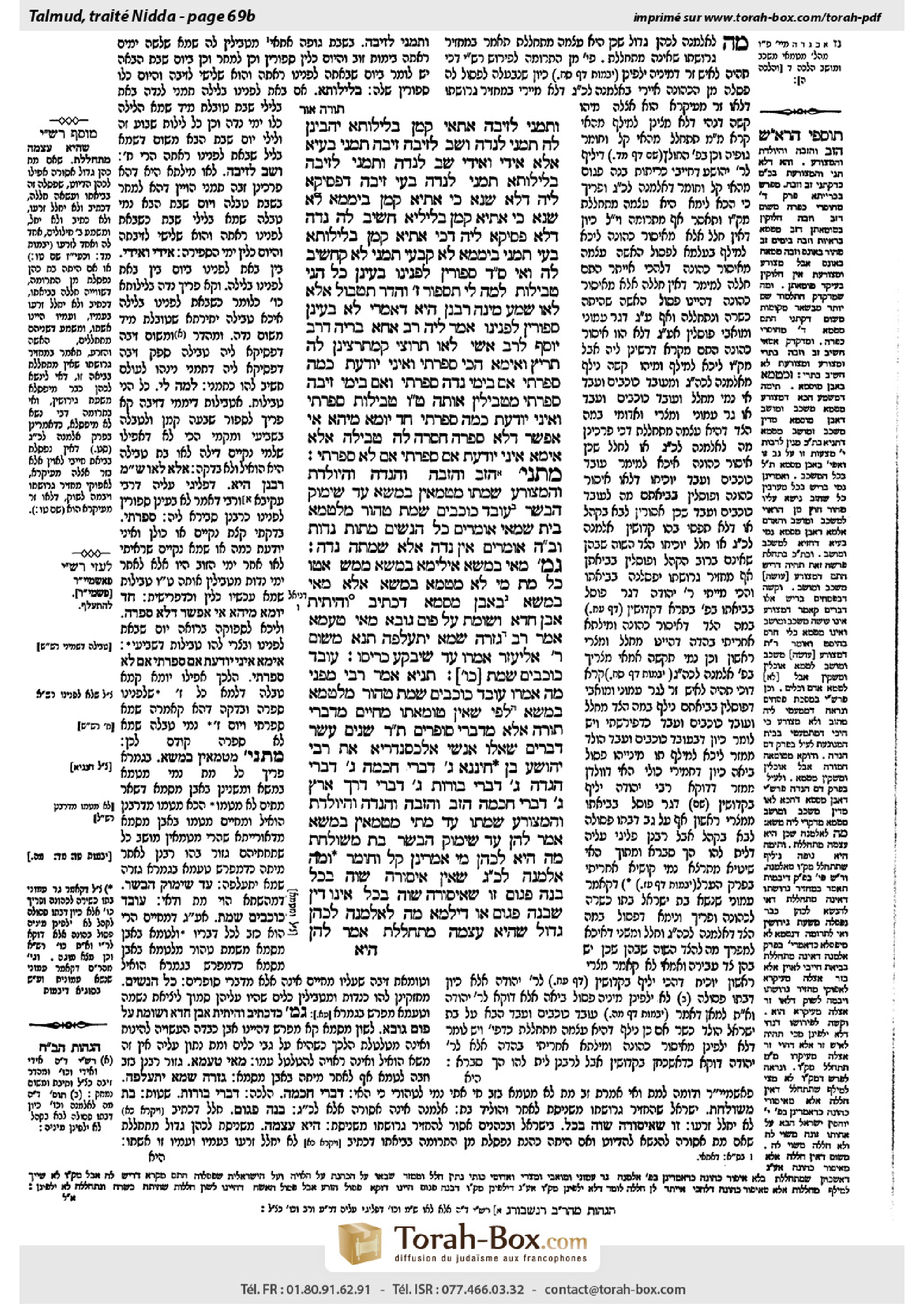
Niddah 69b: Talmud study for Daf Yomi
Daf Yomi is the daily study of one Talmud folio. Explore 37 tractates with scans, Hebrew text, Sefaria English and AI-generated French translations where annotated.
Passage selection and English or AI-generated French translation are available where the scan has annotations. Daf Study is independent of Torah-Box and Sefaria.
Browse Niddah · נידה · All tractatesNiddah 69b text and translations
This page of Niddah includes the Aramaic text, an English translation and an AI-generated French translation, alongside the scan above.
נידה ס״ט ב · Aramaic and Hebrew text
וְתַמְנֵי לְזִיבָה, אֲתַאי קַמַּן בְּלֵילָוָתָא — יָהֲבִינַן לַהּ תַּמְנֵי לְנִדָּה וְשַׁב לְזִיבָה.
זִיבָה, תַּמְנֵי בָּעֲיָא! אֶלָּא: אִידֵּי וְאִידֵּי — שַׁב לְנִדָּה, וְתַמְנֵי לְזִיבָה.
בְּלֵילָוָתָא, תַּמְנֵי לְנִדָּה בָּעֵי!
זִיבָה דִּפְסִיקָא לֵיהּ, דְּלָא שְׁנָא כִּי אָתְיָא קַמַּן בִּימָמָא, לָא שְׁנָא כִּי אָתְיָא קַמַּן בְּלֵילְיָא — חֲשִׁיב לַהּ. נִדָּה דְּלָא פְּסִיקָא לֵיהּ, דְּכִי אָתְיָא קַמַּן בְּלֵילָוָתָא — בָּעֵי תַּמְנֵי, בִּימָמָא — לָא קָבָעֵי תַּמְנֵי, לָא קָחָשֵׁיב לַהּ.
וְאִי סָלְקָא דַעְתָּךְ סְפוּרִין לְפָנֵינוּ בָּעֵינַן — כֹּל הָנֵי טְבִילוֹת לְמָה לִי? תִּסְפּוֹר שַׁב וַהֲדַר תִּטְבּוֹל! אֶלָּא לָאו שְׁמַע מִינַּהּ רַבָּנַן הִיא, דְּאָמְרִי: לָא בָּעֵינַן סְפוּרִין לְפָנֵינוּ.
אֲמַר לֵיהּ רַב אַחָא בְּרֵיהּ דְּרַב יוֹסֵף לְרַב אָשֵׁי: לָאו תָּרוֹצֵי קָמְתָרְצִינַן לַהּ? תָּרֵיץ וְאֵימָא הָכִי: ״סָפַרְתִּי וְאֵינִי יוֹדַעַת כַּמָּה סָפַרְתִּי, אִם בִּימֵי נִדָּה סָפַרְתִּי וְאִם בִּימֵי זִיבָה סָפַרְתִּי״ — מַטְבִּילִין אוֹתָהּ חֲמֵשׁ עֶשְׂרֵה טְבִילוֹת.
״סָפַרְתִּי וְאֵינִי יוֹדַעַת כַּמָּה סָפַרְתִּי״ — חַד יוֹמָא מִיהָא אִי אֶפְשָׁר דְּלָא סָפְרָה, חָסְרָה לָהּ טְבִילָה!
אֶלָּא אֵימָא: ״אֵינִי יוֹדַעַת אִם סָפַרְתִּי אִם לֹא סָפַרְתִּי״.
מַתְנִי' הַזָּב, וְהַזָּבָה, וְהַנִּדָּה, וְהַיּוֹלֶדֶת, וְהַמְּצוֹרָע שֶׁמֵּתוּ — מְטַמְּאִין בְּמַשָּׂא, עַד שֶׁיִּמּוֹק הַבָּשָׂר. נׇכְרִי שֶׁמֵּת — טָהוֹר מִלְּטַמֵּא.
בֵּית שַׁמַּאי אוֹמְרִים: כׇּל הַנָּשִׁים מֵתוֹת נִדּוֹת, וּבֵית הִלֵּל אוֹמְרִים: אֵין נִדָּה אֶלָּא שֶׁמֵּתָה נִדָּה.
גְּמָ' מַאי בְּמַשָּׂא? אִילֵּימָא בְּמַשָּׂא מַמָּשׁ — אַטּוּ כֹּל מֵת מִי לָא מְטַמֵּא בְּמַשָּׂא!
אֶלָּא מַאי בְּמַשָּׂא? בְּאֶבֶן מְסָמָא,
דִּכְתִיב: ״וְהֵיתָיִת אֶבֶן חֲדָא וְשׂוּמַת עַל פּוּם גּוּבָּא״.
מַאי טַעְמָא? אָמַר רַב: גְּזֵרָה, שֶׁמָּא יִתְעַלְּפֶה.
תָּנָא מִשּׁוּם רַבִּי אֱלִיעֶזֶר אָמְרוּ: עַד שֶׁיִּבָּקַע כְּרֵיסוֹ.
נׇכְרִי שֶׁמֵּת [כּוּ׳]. תַּנְיָא, אָמַר רַבִּי: מִפְּנֵי מָה אָמְרוּ נׇכְרִי שֶׁמֵּת טָהוֹר מִלְּטַמֵּא בְּמַשָּׂא? לְפִי שֶׁאֵין טוּמְאָתוֹ מֵחַיִּים מִדִּבְרֵי תוֹרָה, אֶלָּא מִדִּבְרֵי סוֹפְרִים.
תָּנוּ רַבָּנַן: שְׁנֵים עָשָׂר דְּבָרִים שָׁאֲלוּ אַנְשֵׁי אֲלֶכְּסַנְדְּרִיָּא אֶת רַבִּי יְהוֹשֻׁעַ בֶּן חִינָּנָא, שְׁלֹשָׁה דִּבְרֵי חָכְמָה, שְׁלֹשָׁה דִּבְרֵי הַגָּדָה, שְׁלֹשָׁה דִּבְרֵי בוּרוּת, שְׁלֹשָׁה דִּבְרֵי דֶּרֶךְ אֶרֶץ.
שְׁלֹשָׁה דִּבְרֵי חָכְמָה: הַזָּב וְהַזָּבָה וְהַנִּדָּה וְהַיּוֹלֶדֶת וְהַמְּצוֹרָע שֶׁמֵּתוּ, עַד מָתַי מְטַמְּאִין בְּמַשָּׂא? אָמַר לָהֶן: עַד שֶׁיִּמּוֹק הַבָּשָׂר.
בַּת מְשׁוּלַּחַת, מָה הִיא לְכֹהֵן?
מִי אָמְרִינַן קַל וָחוֹמֶר, וּמָה אַלְמָנָה לְכֹהֵן גָּדוֹל שֶׁאֵין אִיסּוּרָהּ שָׁוֶה בַּכֹּל — בְּנָהּ פָּגוּם, זוֹ שֶׁאִיסּוּרָהּ שָׁוֶה בַּכֹּל — אֵינוֹ דִּין שֶׁבְּנָהּ פָּגוּם? אוֹ דִילְמָא: מָה לְאַלְמָנָה לְכֹהֵן גָּדוֹל — שֶׁהִיא עַצְמָהּ מִתְחַלֶּלֶת.
אָמַר לָהֶן:
Niddah 69b · English translation
And she requires eight immersions during the day to purify her from her ziva, as it is possible that she experienced bleeding for three consecutive days, rendering her a greater zava, and one of those was on this day that she came before the court, and it is also possible that the day she arrived she did not experience bleeding, and she was a zava during her last clean day and had to immerse that day. If she comes before us at night, we give her eight immersions to purify herself from her menstruation, including one on the night that she comes before the court, and seven immersions during the day to purify herself from her ziva.
The Gemara raises a difficulty: With regard to her ziva, she still requires eight immersions. Since it is possible that she experienced bleeding for the third day on the day before coming to the court, she might be a greater zava, who starts her clean days only the day after she arrived. In addition, any of the first seven days may be the last clean day, on which she has to immerse herself. The Gemara answers: Rather, in both this case and that case she requires seven immersions to purify herself from the impurity of menstruation, and eight immersions to purify herself from the impurity of ziva.
The Gemara raises a further difficulty: If the woman comes at night to the court, she requires eight immersions to purify herself from her impurity of menstruation. Why does the baraita require her to immerse a total of only fifteen times when there are cases where she must immerse sixteen times?
The Gemara answers: With regard to purifying herself from the impurity of ziva, which can be taught in a distinct manner, as there is no difference whether she comes before us during the day and there is no difference whether she comes before us at night, the baraita counts the fixed amount of eight immersions. By contrast, with regard to purifying herself from menstruation, which the tanna cannot teach in a distinct manner, as when she comes before us at night she requires eight immersions but if she comes before us during the day she does not require eight immersions, the tanna did not count both options, but mentioned only seven immersions, which is the minimum number required.
The Gemara returns to the initial purpose of this discussion, which was to indicate that the Rabbis do not require all seven days of counting before the court. And if it enters your mind that we require seven days of counting before us, why do I need all of these immersions? She should count seven clean days and only afterward immerse. Rather, must one not conclude from this that the baraita is in accordance with the opinion of the Rabbis, who disagree with Rabbi Akiva and who say that we do not require seven days of counting before us?
Rav Aḥa, son of Rav Yosef, said to Rav Ashi, in rejection of this proof: But didn’t you resolve a difficulty in the baraita? Since you admit that the baraita in any event requires revision, resolve this difficulty too, and say this: If a woman comes and says: I counted clean days but I do not know how many days I counted, and I do not know whether I counted during the days of menstruation or whether I counted during the days of ziva, the court instructs her to immerse fifteen immersions. If so, there is no proof that the Rabbis hold that the counting does not need to be before the court.
The Gemara raises a difficulty with regard to this interpretation of the baraita: If it is referring to a case where the woman said: I counted clean days but I do not know how many days I counted, it is impossible that she did not count at least one clean day. If so, she should not be required to immerse on the eighth day, in which case she is lacking one immersion, as the baraita rules that she must immerse fifteen times.
The Gemara answers: Rather, say that she claims: I do not know if I counted any clean days or I did not count any clean days. Likewise, she does not know whether she saw the blood during her days of menstruation or during her days of ziva. Therefore, she must immerse fifteen times, as it is possible that she has not yet counted at all.
MISHNA: The corpses of a zav, and a zava, and a menstruating woman, and a woman after childbirth, and a leper, who died, transmit ritual impurity by carrying their corpses, until the flesh decays. With regard to the corpse of a gentile who died, although when alive he transmits impurity like a zav, once he dies he is ritually pure and is prevented from transmitting impurity.
Beit Shammai say: The status of all women when they die is as though they were menstruating women at the time of death. Therefore, the garments that they were wearing before they died are impure and require immersion. And Beit Hillel say: Only a woman who died with the impurity of a menstruating woman has the status of a menstruating woman after death.
GEMARA: The mishna teaches that the corpse of one of these impure people transmits ritual impurity by carrying. The Gemara asks: What does the mishna mean by the term: By carrying? If we say that it literally means by carrying, that is difficult: Is that to say that every other corpse does not impart ritual impurity by carrying? Since every corpse imparts impurity through carrying, why does the mishna need to specify this halakha in these specific cases?
Rather, what does the mishna mean when it states: By carrying [bemassa]? It means imparting impurity through a very heavy stone [even mesama]. There is a unique halakha with regard to the ritual impurity of a zav and a menstruating woman. If they sit on an item, even one that cannot become ritually impure, and beneath that item there is a vessel, although the weight of the zav or the menstruating woman has no physical effect on the vessel, it becomes ritually impure.
The Gemara notes that the word mesama is based on a verse, as it is written: “And a stone was brought and placed [vesumat] upon the mouth of the den; and the king sealed it with his own signet and with the signet of his lords, that nothing might be changed concerning Daniel” (Daniel 6:18). Accordingly, the mishna is teaching that although a corpse does not normally impart ritual impurity to vessels under a heavy stone, these specific types of corpses do transmit impurity in this manner.
The Gemara asks: What is the reason that the Sages decreed that these specific types of corpses impart ritual impurity through a heavy stone? Rav said: It is a decree due to the possibility that perhaps one of these people might faint while sitting on the heavy stone, and it might be mistakenly thought they are dead and do not impart impurity to the vessels beneath.
A tanna taught in a baraita that the Sages said in the name of Rabbi Eliezer: All of these types of corpses listed in the mishna impart ritual impurity through a heavy stone until the belly of the corpse bursts. The Sages imposed their decree only in cases where the corpse resembles a person who has fainted. Once the corpse is clearly no longer alive, it no longer imparts ritual impurity through a heavy stone.
§ The mishna teaches: With regard to the corpse of a gentile who died, although when alive he transmits impurity like a zav, once he dies he is ritually pure and is prevented from transmitting impurity. It is taught in a baraita that Rabbi Yehuda HaNasi said: For what reason did the Sages say that the corpse of a gentile who died is ritually pure and is prevented from transmitting impurity by carrying? Because his impurity that he transmits even when alive is not by Torah law, but by rabbinic law. The Sages decreed that every living gentile imparts ritual impurity in the manner of a zav; they did not extend their decree to include the corpse of a gentile in the manner of the corpse of a zav.
§ The Sages taught: The wise people of Alexandria asked twelve matters of Rabbi Yehoshua ben Ḥinnana. Three of them were matters of wisdom, three were matters of aggada, three were matters of ignorance, and three were matters of behavior.
The Gemara lists the questions. Three were matters of wisdom: The first question was with regard to a zav and a zava and a menstruating woman and a woman after childbirth and the leper, who died: Until when do they transmit ritual impurity by carrying? Rabbi Yehoshua said to them: Until the flesh decays. This is the halakha taught in the mishna.
The second question referred to the daughter of a wife who had been sent away by her husband, i.e., divorced, who then married another, but after her divorce from her second husband or his death she returned and remarried her first husband, to whom she is forbidden (see Deuteronomy 24:1–4), and a daughter was born from this marriage. What is her, i.e., the daughter’s, status with regard to marrying a priest?
Do we say an a fortiori inference: And if in the case of a widow married to a High Priest, whose prohibition does not apply to all, i.e., it is prohibited for her only to marry a High Priest (see Leviticus 21:13–15), and yet the lineage of her son is flawed, as he is disqualified from the priesthood, then in the case of this daughter of a remarried divorcée, whose prohibition applies equally to all men, is it not right that her son should be of flawed lineage? Or perhaps this comparison can be refuted: What is notable about a widow married to a High Priest? It is notable in that she herself is disqualified from the priesthood, i.e., if a High Priest engages in intercourse with her she is disqualified from partaking of teruma, whereas a remarried divorcée is not disqualified from partaking of teruma.
Rabbi Yehoshua said to them:
Niddah 69b · Traduction française (IA)
Elle a besoin de huit immersions pendant la journée pour se purifier de son état de zava, car il est possible qu’elle ait saigné pendant trois jours consécutifs et soit ainsi devenue une grande zava, et que l’un de ces jours soit celui où elle s’est présentée devant le tribunal. Il est également possible qu’elle n’ait pas saigné le jour de son arrivée et qu’elle ait été zava lors de son dernier jour propre, auquel cas elle devait s’immerger ce jour-là. Si elle se présente devant nous la nuit, nous lui prescrivons huit immersions pour se purifier de son impureté menstruelle, dont une pendant la nuit de sa comparution devant le tribunal, et sept immersions pendant la journée pour se purifier de son état de zava.
La Guemara soulève une difficulté : pour se purifier de son état de zava, elle a encore besoin de huit immersions. Puisqu’il est possible qu’elle ait saigné le troisième jour la veille de sa comparution devant le tribunal, elle pourrait être une grande zava, qui ne commence à compter ses jours propres que le lendemain de son arrivée. De plus, chacun des sept premiers jours peut être le dernier jour propre, auquel elle doit s’immerger. La Guemara répond : plutôt, dans les deux cas, elle a besoin de sept immersions pour se purifier de l’impureté menstruelle et de huit immersions pour se purifier de l’impureté liée à l’état de zava.
La Guemara soulève une autre difficulté : si la femme se présente au tribunal la nuit, elle a besoin de huit immersions pour se purifier de son impureté menstruelle. Pourquoi la baraïta ne lui prescrit-elle qu’un total de quinze immersions, alors qu’il existe des cas où elle doit s’immerger seize fois ?
La Guemara répond : pour se purifier de l’impureté liée à l’état de zava, qui peut être enseignée séparément, puisque cela ne change rien qu’elle se présente devant nous le jour ou la nuit, la baraïta compte le nombre fixe de huit immersions. En revanche, pour se purifier de l’impureté menstruelle, que le tanna ne peut enseigner séparément, car elle a besoin de huit immersions si elle se présente devant nous la nuit, mais pas si elle se présente le jour, le tanna n’a pas compté les deux possibilités ; il a mentionné seulement sept immersions, qui constituent le nombre minimal requis.
La Guemara revient à l’objectif initial de cette discussion, qui était de montrer que les Sages n’exigent pas que les sept jours de décompte se déroulent tous devant le tribunal. Or, si tu pensais qu’ils doivent se dérouler devant nous, pourquoi faudrait-il toutes ces immersions ? Qu’elle compte sept jours propres et ne s’immerge qu’ensuite. Ne faut-il pas plutôt en conclure que la baraïta suit l’opinion des Sages, qui s’opposent à Rabbi Akiva et disent que nous n’exigeons pas que les sept jours de décompte se déroulent devant nous ?
Rav Aḥa, fils de Rav Yosef, dit à Rav Ashi, pour réfuter cette preuve : Mais n’as-tu pas résolu une difficulté concernant la baraïta ? Puisque tu admets que la baraïta doit de toute façon être révisée, résous aussi cette difficulté et dis ceci : si une femme se présente et dit : « J’ai compté des jours propres, mais je ne sais pas combien j’en ai compté, et je ne sais pas si j’ai compté pendant mes jours de menstruation ou pendant mes jours de zava », le tribunal lui prescrit quinze immersions. Dans ce cas, rien ne prouve que, selon les Sages, le décompte n’a pas besoin de se dérouler devant le tribunal.
La Guemara soulève une difficulté concernant cette interprétation de la baraïta : si elle se rapporte au cas où la femme a dit : « J’ai compté des jours propres, mais je ne sais pas combien j’en ai compté », il est impossible qu’elle n’en ait pas compté au moins un. Elle ne devrait donc pas avoir à s’immerger le huitième jour ; il manquerait alors une immersion, puisque la baraïta statue qu’elle doit s’immerger quinze fois.
La Guemara répond : dis plutôt qu’elle affirme : « Je ne sais pas si j’ai compté des jours propres ou si je n’en ai compté aucun. » De même, elle ne sait pas si elle a vu du sang pendant ses jours de menstruation ou pendant ses jours de zava. Elle doit donc s’immerger quinze fois, car il est possible qu’elle n’ait encore rien compté.
MICHNA : Les cadavres d’un zav, d’une zava, d’une femme menstruée, d’une femme après l’accouchement et d’un lépreux transmettent l’impureté rituelle par leur portage jusqu’à ce que leur chair se décompose. Quant au cadavre d’un non-Juif, bien que celui-ci transmette de son vivant l’impureté comme un zav, il est rituellement pur après sa mort et ne transmet pas l’impureté.
Beit Shammaï disent : à leur mort, toutes les femmes sont considérées comme des femmes menstruées. Par conséquent, les vêtements qu’elles portaient avant de mourir sont impurs et doivent être immergés. Beit Hillel disent : seule une femme morte alors qu’elle était impure en tant que femme menstruée conserve ce statut après sa mort.
GUEMARA : La Michna enseigne que le cadavre de l’une de ces personnes impures transmet l’impureté par portage. La Guemara demande : Que signifie le terme « par portage » employé par la Michna ? Si nous disons qu’il désigne littéralement le portage, cela pose une difficulté : faut-il comprendre que tout autre cadavre ne transmet pas l’impureté rituelle par portage ? Puisque tout cadavre transmet l’impureté par portage, pourquoi la Michna doit-elle préciser cette halakha dans ces cas particuliers ?
Que signifie donc l’expression « par portage » [bemassa] employée par la Michna ? Elle désigne la transmission de l’impureté par une pierre très lourde [even mesama]. Il existe une halakha particulière concernant l’impureté rituelle d’un zav et d’une femme menstruée. S’ils s’assoient sur un objet, même si celui-ci ne peut pas contracter l’impureté rituelle, et qu’un ustensile se trouve sous cet objet, l’ustensile devient rituellement impur, bien que le poids du zav ou de la femme menstruée n’ait aucun effet physique sur lui.
La Guemara note que le mot mesama est fondé sur un verset, car il est écrit : « Une pierre fut apportée et placée [vesumat] sur l’ouverture de la fosse ; le roi la scella de son propre sceau et de celui de ses grands, afin que rien ne soit changé concernant Daniel » (Daniel 6:18). Ainsi, la Michna enseigne que, bien qu’un cadavre ne transmette normalement pas l’impureté rituelle aux ustensiles placés sous une pierre lourde, les cadavres de ces catégories précises transmettent l’impureté de cette manière.
La Guemara demande : Pour quelle raison les Sages ont-ils décrété que les cadavres de ces catégories précises transmettent l’impureté rituelle par une pierre lourde ? Rav dit : c’est un décret motivé par la possibilité que l’une de ces personnes s’évanouisse alors qu’elle est assise sur la pierre lourde et que l’on pense par erreur qu’elle est morte et ne transmet pas l’impureté aux ustensiles placés en dessous.
Un tanna enseigna dans une baraïta que les Sages ont dit au nom de Rabbi Eliezer : tous les cadavres de ces catégories mentionnées dans la Michna transmettent l’impureté rituelle par une pierre lourde jusqu’à ce que le ventre du cadavre éclate. Les Sages n’ont imposé leur décret que dans les cas où le cadavre ressemble à une personne évanouie. Dès qu’il est clairement établi que la personne n’est plus en vie, son cadavre ne transmet plus l’impureté rituelle par une pierre lourde.
§ La Michna enseigne : quant au cadavre d’un non-Juif, bien que celui-ci transmette de son vivant l’impureté comme un zav, il est rituellement pur après sa mort et ne transmet pas l’impureté. Une baraïta enseigne que Rabbi Yehouda HaNassi a dit : Pour quelle raison les Sages ont-ils dit que le cadavre d’un non-Juif est rituellement pur après sa mort et ne transmet pas l’impureté par portage ? Parce que l’impureté qu’il transmet même de son vivant n’est pas prescrite par la Torah, mais relève d’un décret rabbinique. Les Sages ont décrété que tout non-Juif vivant transmet l’impureté rituelle à la manière d’un zav ; ils n’ont pas étendu leur décret au cadavre d’un non-Juif à la manière du cadavre d’un zav.
§ Les Sages enseignent : les sages d’Alexandrie posèrent douze questions à Rabbi Yehoshua ben Ḥinnana. Trois concernaient la sagesse, trois l’aggada, trois l’ignorance et trois le comportement.
La Guemara énumère les questions. Trois concernaient la sagesse : la première portait sur un zav, une zava, une femme menstruée, une femme après l’accouchement et un lépreux décédés : jusqu’à quand transmettent-ils l’impureté rituelle par portage ? Rabbi Yehoshua leur répondit : jusqu’à ce que la chair se décompose. C’est la halakha enseignée dans la Michna.
La deuxième question portait sur la fille d’une femme qui avait été renvoyée par son mari, c’est-à-dire répudiée, puis avait épousé un autre homme. Après avoir divorcé de son second mari, ou après la mort de celui-ci, elle était revenue épouser son premier mari, auquel elle n’avait pas le droit de se remarier (voir Deutéronome 24:1–4), et une fille était née de cette union. Quel est le statut de cette fille quant à la possibilité d’épouser un prêtre ?
Faut-il tirer une déduction a fortiori : si, dans le cas d’une veuve qui épouse un grand prêtre, alors que l’interdiction ne s’applique pas à tous — puisqu’il lui est interdit d’épouser un grand prêtre seulement (voir Lévitique 21:13–15) —, la lignée de son fils est néanmoins entachée, celui-ci étant disqualifié de la prêtrise, alors, dans le cas de la fille d’une divorcée remariée à son premier mari, dont l’interdiction s’applique à tous les hommes sans distinction, n’est-il pas d’autant plus juste que son fils soit de lignée entachée ? Ou peut-être peut-on réfuter cette comparaison : qu’y a-t-il de particulier dans le cas d’une veuve qui épouse un grand prêtre ? C’est qu’elle-même est disqualifiée de la prêtrise : si un grand prêtre a des relations sexuelles avec elle, elle est disqualifiée pour consommer la terouma, tandis qu’une divorcée remariée n’est pas disqualifiée pour consommer la terouma.
Rabbi Yehoshua leur dit :
Traduction française générée par IA à partir de l’édition anglaise de Sefaria. Vérifie toujours un passage avec le texte source.
Text from Sefaria: William Davidson Edition - Vocalized Aramaic (CC BY NC); William Davidson Edition - English (CC BY NC).