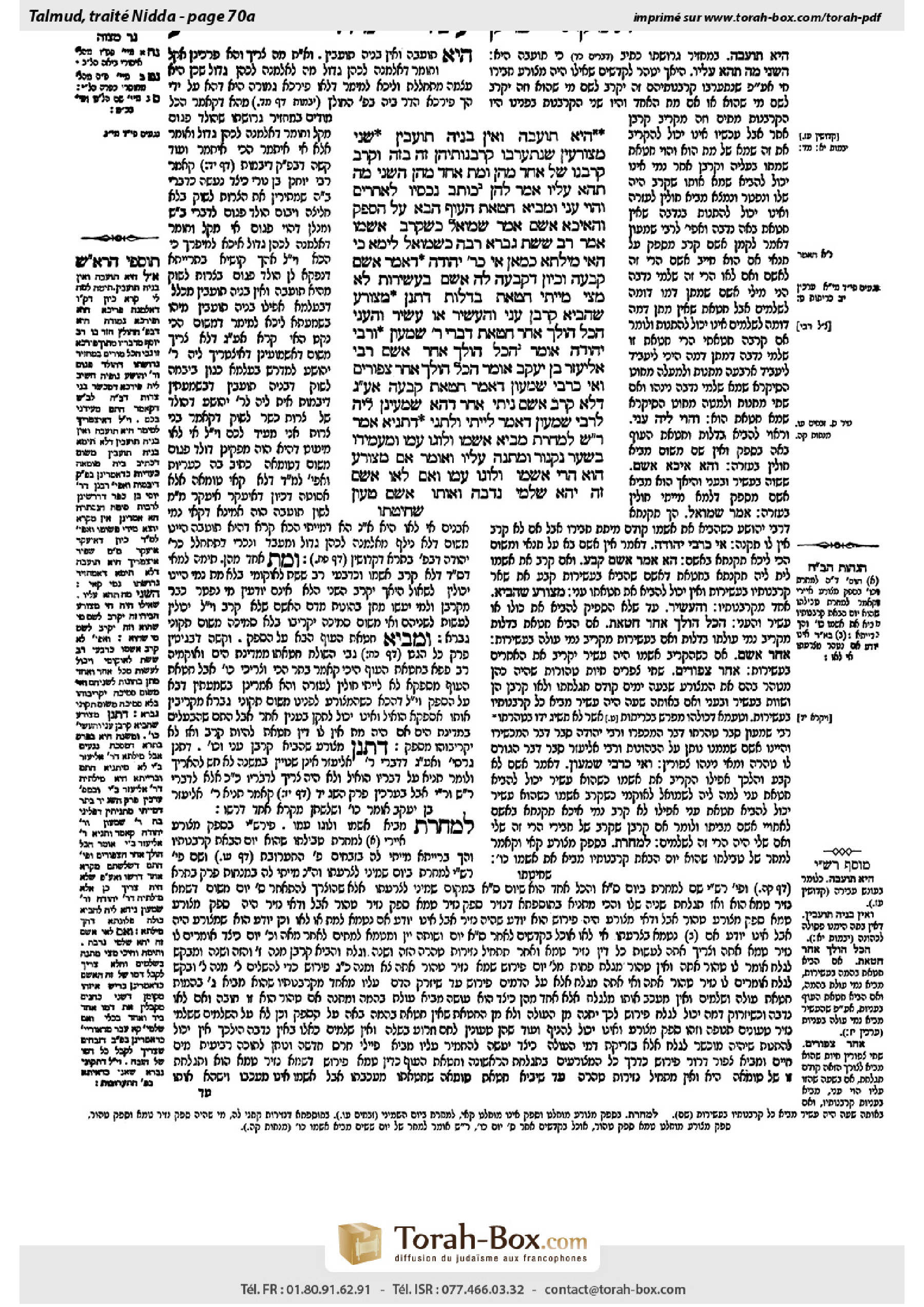
Niddah 70a: Talmud study for Daf Yomi
Daf Yomi is the daily study of one Talmud folio. Explore 37 tractates with scans, Hebrew text, Sefaria English and AI-generated French translations where annotated.
Passage selection and English or AI-generated French translation are available where the scan has annotations. Daf Study is independent of Torah-Box and Sefaria.
Browse Niddah · נידה · All tractatesNiddah 70a text and translations
This page of Niddah includes the Aramaic text, an English translation and an AI-generated French translation, alongside the scan above.
נידה ע׳ א · Aramaic and Hebrew text
הִיא תּוֹעֵבָה וְאֵין בָּנֶיהָ תּוֹעֲבִין.
שְׁנֵי מְצוֹרָעִין שֶׁנִּתְעָרְבוּ קׇרְבְּנוֹתֵיהֶן זֶה בָּזֶה, וְקָרַב קׇרְבָּנוֹ שֶׁל אֶחָד מֵהֶן, וּמֵת אֶחָד מֵהֶן — הַשֵּׁנִי מַה תְּהֵא עָלָיו?
אָמַר לָהֶן: כּוֹתֵב נְכָסָיו לַאֲחֵרִים, וְהָוֵי עָנִי, וּמֵבִיא חַטַּאת הָעוֹף הַבָּא עַל הַסָּפֵק.
וְהָאִיכָּא אָשָׁם! אָמַר שְׁמוּאֵל: כְּשֶׁקָּרַב אֲשָׁמוֹ.
אָמַר רַב שֵׁשֶׁת: גַּבְרָא רַבָּה כִּשְׁמוּאֵל לֵימָא כִּי הַאי מִילְּתָא? כְּמַאן? אִי כְּרַבִּי יְהוּדָה, דְּאָמַר: ״אָשָׁם קָבַעה״, וְכֵיוָן דְּקָבַעה לֵהּ אָשָׁם בַּעֲשִׁירוּת — לָא מָצֵי מַיְיתֵי חַטָּאת בְּדַלּוּת.
דִּתְנַן: מְצוֹרָע שֶׁהֵבִיא קׇרְבַּן עָנִי וְהֶעֱשִׁיר, אוֹ עָשִׁיר וְהֶעֱנִי — הַכֹּל הוֹלֵךְ אַחַר חַטָּאת, דִּבְרֵי רַבִּי שִׁמְעוֹן.
וְרַבִּי יְהוּדָה אוֹמֵר: הַכֹּל הוֹלֵךְ אַחַר אָשָׁם. רַבִּי אֱלִיעֶזֶר בֶּן יַעֲקֹב אוֹמֵר: הַכֹּל הוֹלֵךְ אַחַר צִפֳּורִים.
וְאִי כְּרַבִּי שִׁמְעוֹן, דְּאָמַר: חַטָּאת קָבְעָה, אַף עַל גַּב דְּלָא קְרַב אָשָׁם — נַיְתֵי אַחֵר, דְּהָא שָׁמְעִינַן לֵיהּ לְרַבִּי שִׁמְעוֹן דְּאָמַר: לַיְיתֵי וְלִתְנֵי.
דְּתַנְיָא, אָמַר רַבִּי שִׁמְעוֹן: לַמׇּחֳרָת מֵבִיא אֲשָׁמוֹ וְלוּגּוֹ עִמּוֹ, וּמַעֲמִידוֹ בְּשַׁעַר נִיקָנוֹר, וּמַתְנֶה עָלָיו וְאוֹמֵר: אִם מְצוֹרָע הוּא — הֲרֵי אֲשָׁמוֹ וְלוּגּוֹ עִמּוֹ, וְאִם לָאו — אָשָׁם זֶה יְהֵא שַׁלְמֵי נְדָבָה.
וְאוֹתוֹ אָשָׁם טָעוּן
Niddah 70a · English translation
With regard to one who remarries his divorced wife, the Torah states: “Her former husband, who sent her away, may not take her again to be his wife, after she is defiled, for that is an abomination before the Lord; and you shall not cause the land to sin, which the Lord your God gives you for an inheritance” (Deuteronomy 24:4). By inference, she, the divorced wife, is an abomination, but her children are not abominations. In other words, if he transgressed the prohibition and remarried this woman, the daughters from that marriage are not disqualified from marrying priests.
The third question was as follows: Two wealthy people who were lepers came to purify themselves and each brought a sin offering, a guilt offering, and a burnt offering. Their offerings became intermingled with each other, and the offering of one of them was sacrificed, and subsequently one of them died. What shall be with the second individual, i.e., how can he complete his purification process? If the other one had not died, they could both bring the remaining offering with the stipulation that it should be sacrificed on behalf of whoever is the owner. But now that one is dead, the other person may not bring the remaining animal, as one may not sacrifice a sin offering for one who is dead. He may also not bring another animal instead, as the animal that was already sacrificed might have been his, and one may not bring a second sin offering.
Rabbi Yehoshua said to them: The solution is for him to write a contract giving all his possessions to others, whom he trusts to return them as a gift later, and he is then considered to be destitute. And as a poor leper, he brings a bird sin offering, which can be brought even in a case of uncertainty.
The Gemara challenges: But there is the guilt offering that a leper must bring, and this must be an animal not a bird, and may not be brought in a case of uncertainty. How can this leper bring his guilt offering? Shmuel says: Rabbi Yehoshua was referring specifically to a case where his guilt offering had already been sacrificed, before the animals became intermingled.
Rav Sheshet said: Is it possible that a great man like Shmuel would say a statement like this? In accordance with whose opinion does this solution apply? If it is in accordance with the opinion of Rabbi Yehuda, who says that if the leper was wealthy when he sacrificed his guilt offering he has thereby fixed his manner of atonement, and must bring animals as his other two offerings, it is difficult: And once he fixed his guilt offering as an animal while he was wealthy, he may not bring a bird sin offering when he is destitute.
As we learned in a mishna (Nega’im 14:11): With regard to a leper who brought an offering of a destitute person and thereafter he became wealthy, or if he brought an offering of a wealthy person and thereafter he became destitute, everything follows after the sin offering; this is the statement of Rabbi Shimon. If he was wealthy when he brought the sin offering, he brings the burnt offering of the wealthy; if he was destitute at that time, he brings the burnt offering of the destitute.
And Rabbi Yehuda says: Everything, i.e., the sin offering and the burnt offering, follows after his status at the time that his guilt offering was brought. Rabbi Eliezer ben Ya’akov says: Everything follows after the offering of the birds, brought seven days earlier, at the start of his purification process.
Rav Sheshet continues: And if Rabbi Yehoshua’s statement is in accordance with the opinion of Rabbi Shimon, who said that the sin offering fixed the status of the remaining offerings, it is difficult: Why did Shmuel state that the case is where his guilt offering had already been sacrificed? Even if the guilt offering had not been sacrificed before the animals became intermingled, let him bring another animal as his guilt offering, and stipulate that if the guilt offering that was already slaughtered was his, this animal should be a peace offering. As we have heard that Rabbi Shimon said: Let him bring another animal and stipulate with regard to it.
As it is taught in a baraita that Rabbi Shimon says, with regard to a leper of uncertain status who must bring a guilt offering and a log of oil for his purification: The following day, on the eighth day of his purification, he brings his guilt offering and his log of oil with it, and the priest stands him at the Gate of Nicanor, and the leper stipulates with regard to the offering and says: If this person, i.e., I, was a leper, this is his guilt offering and this is his log of oil with it. And if not, this animal that I brought for a guilt offering shall be a voluntary peace offering, as the two offerings are sacrificed in the same manner.
And that guilt offering of uncertain status requires
Niddah 70a · Traduction française (IA)
Au sujet de celui qui reprend pour épouse sa femme divorcée, la Torah dit : « Son ancien mari, qui l’a renvoyée, ne pourra pas la reprendre pour en faire sa femme, après qu’elle a été souillée, car c’est une abomination devant le Seigneur ; et tu ne rendras pas le pays coupable, le pays que le Seigneur ton Dieu te donne en héritage » (Deutéronome 24:4). On en déduit que la femme divorcée est une abomination, mais que ses enfants ne sont pas des abominations. Autrement dit, s’il transgresse l’interdit et reprend cette femme pour épouse, les filles issues de cette union ne sont pas inaptes à épouser des prêtres.
La troisième question était la suivante : deux hommes riches, atteints de lèpre, vinrent se purifier et apportèrent chacun un sacrifice expiatoire, un sacrifice de culpabilité et un holocauste. Leurs offrandes se mélangèrent ; l’offrande de l’un d’eux fut sacrifiée, puis l’un des deux mourut. Que doit faire le second homme, c’est-à-dire comment peut-il achever son processus de purification ? Si l’autre n’était pas mort, ils pourraient tous deux apporter l’offrande restante, en stipulant qu’elle serait sacrifiée au nom de celui qui en est le propriétaire. Mais maintenant que l’un est mort, l’autre ne peut pas apporter l’animal restant, car on ne peut pas offrir un sacrifice expiatoire pour un mort. Il ne peut pas non plus apporter un autre animal à la place, car l’animal déjà sacrifié était peut-être le sien, et on ne peut pas apporter un second sacrifice expiatoire.
Rabbi Yehoshua leur dit : la solution consiste à rédiger un acte transférant tous ses biens à d’autres personnes, en qui il a confiance pour qu’elles les lui rendent ensuite en cadeau ; il est alors considéré comme indigent. En tant que lépreux pauvre, il apporte un sacrifice expiatoire d’oiseau, qui peut être offert même en cas de doute.
La Guemara objecte : mais il y a le sacrifice de culpabilité que le lépreux doit apporter, et celui-ci doit être un animal, non un oiseau, et ne peut pas être offert en cas de doute. Comment ce lépreux peut-il apporter son sacrifice de culpabilité ? Shmuel dit : Rabbi Yehoshua faisait précisément référence à un cas où le sacrifice de culpabilité de l’homme avait déjà été sacrifié, avant que les animaux ne se mélangent.
Rav Sheshet dit : est-il possible qu’un grand homme comme Shmuel ait tenu de tels propos ? Selon l’avis de qui cette solution s’applique-t-elle ? Si elle correspond à l’avis de Rabbi Yehuda, qui dit que si le lépreux était riche au moment où son sacrifice de culpabilité a été sacrifié, il a ainsi fixé la forme de son expiation et doit apporter des animaux pour ses deux autres offrandes, cela pose une difficulté : dès lors qu’il a fixé son sacrifice de culpabilité comme un sacrifice animal alors qu’il était riche, il ne peut pas apporter un sacrifice expiatoire d’oiseau lorsqu’il est indigent.
Comme nous l’avons appris dans une Michna (Nega’im 14:11) : au sujet d’un lépreux qui a apporté une offrande de pauvre puis est devenu riche, ou qui a apporté une offrande de riche puis est devenu pauvre, tout dépend du sacrifice expiatoire ; telle est la déclaration de Rabbi Shimon. S’il était riche au moment où il a apporté le sacrifice expiatoire, il apporte l’holocauste du riche ; s’il était indigent à ce moment-là, il apporte l’holocauste de l’indigent.
Et Rabbi Yehuda dit : tout, c’est-à-dire le sacrifice expiatoire et l’holocauste, dépend du statut qu’il avait au moment où son sacrifice de culpabilité a été apporté. Rabbi Eliezer ben Ya’akov dit : tout dépend de l’offrande des oiseaux, apportée sept jours auparavant, au début de son processus de purification.
Rav Sheshet poursuit : si la déclaration de Rabbi Yehoshua correspond à l’avis de Rabbi Shimon, qui a dit que le sacrifice expiatoire fixait le statut des offrandes restantes, cela pose une difficulté : pourquoi Shmuel a-t-il dit que le cas concernait un homme dont le sacrifice de culpabilité avait déjà été sacrifié ? Même si le sacrifice de culpabilité n’avait pas été sacrifié avant que les animaux ne se mélangent, qu’il apporte un autre animal comme sacrifice de culpabilité, en stipulant que, si le sacrifice de culpabilité déjà égorgé était le sien, cet animal sera un sacrifice rémunératoire. Car nous avons entendu Rabbi Shimon dire : qu’il apporte un autre animal et fasse une déclaration conditionnelle à son sujet.
Comme il est enseigné dans une baraïta que Rabbi Shimon dit, au sujet d’un lépreux dont le statut est incertain et qui doit apporter un sacrifice de culpabilité et un log d’huile pour sa purification : le lendemain, le huitième jour de sa purification, il apporte son sacrifice de culpabilité accompagné de son log d’huile. Le prêtre le place à la porte de Nicanor, et le lépreux stipule au sujet de l’offrande : « Si cette personne, c’est-à-dire moi, était lépreuse, ceci est son sacrifice de culpabilité et ceci est le log d’huile qui l’accompagne. Et si ce n’est pas le cas, cet animal que j’ai apporté comme sacrifice de culpabilité sera un sacrifice rémunératoire volontaire », car les deux offrandes sont sacrifiées de la même manière.
Et ce sacrifice de culpabilité au statut incertain exige
Traduction française générée par IA à partir de l’édition anglaise de Sefaria. Vérifie toujours un passage avec le texte source.
Text from Sefaria: William Davidson Edition - Vocalized Aramaic (CC BY NC); William Davidson Edition - English (CC BY NC).