Niddah 70b: Talmud study for Daf Yomi
Daf Yomi is the daily study of one Talmud folio. Explore 37 tractates with scans, Hebrew text, Sefaria English and AI-generated French translations where annotated.
Passage selection and English or AI-generated French translation are available where the scan has annotations. Daf Study is independent of Torah-Box and Sefaria.
Browse Niddah · נידה · All tractatesNiddah 70b text and translations
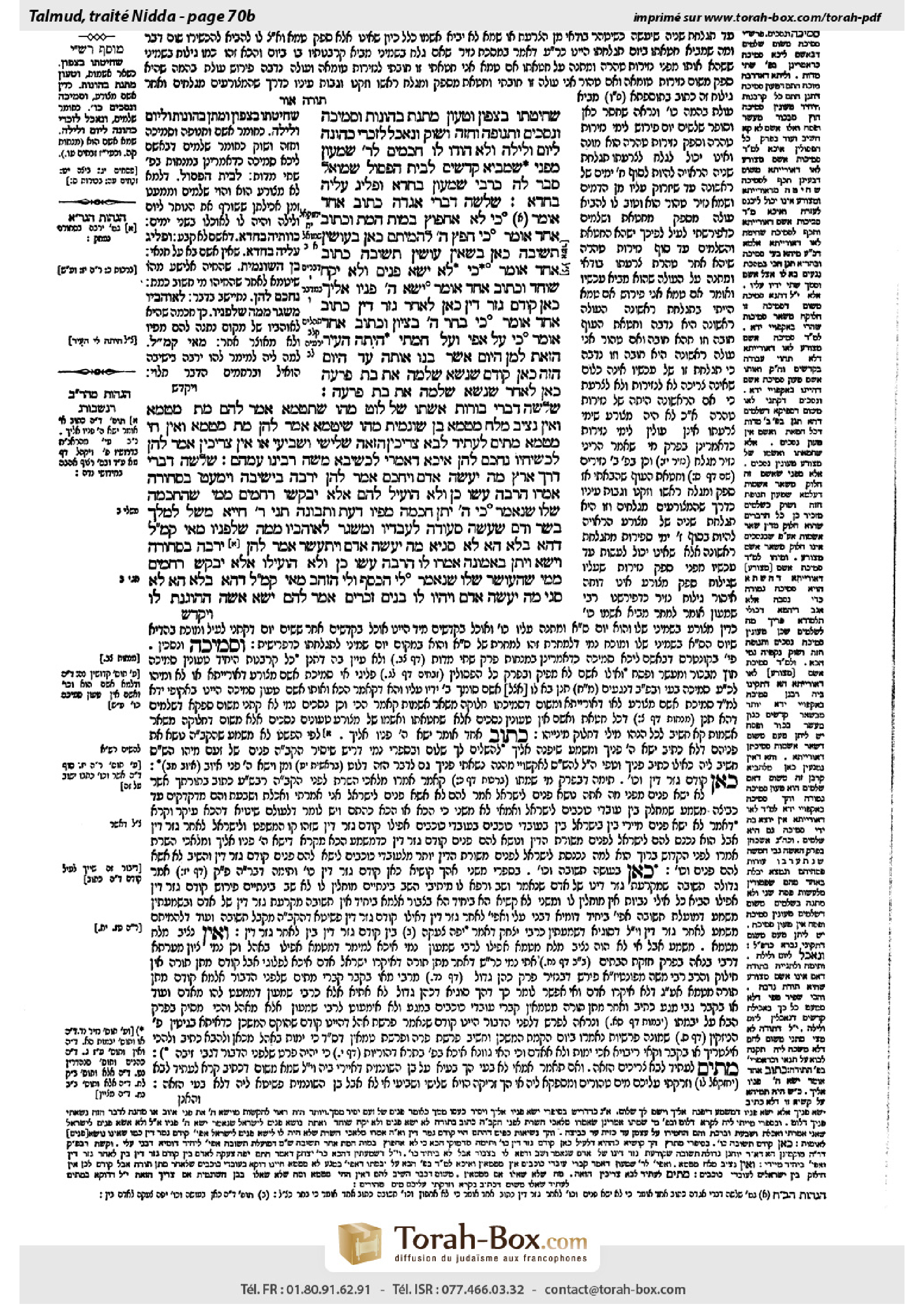
This page of Niddah includes the Aramaic text, an English translation and an AI-generated French translation, alongside the scan above.
נידה ע׳ ב · Aramaic and Hebrew text
שְׁחִיטָתוֹ בַּצָּפוֹן, וְטָעוּן מַתְּנַת בְּהוֹנוֹת, וּסְמִיכָה, וּנְסָכִים, וּתְנוּפָה, וְחָזֶה וָשׁוֹק, וְנֶאֱכָל לְזִכְרֵי כְהוּנָּה לְיוֹם וָלַיְלָה.
וְלֹא הוֹדוּ לוֹ חֲכָמִים לְרַבִּי שִׁמְעוֹן, מִפְּנֵי שֶׁמֵּבִיא קָדָשִׁים לְבֵית הַפְּסוּל!
שְׁמוּאֵל סָבַר לַהּ כְּרַבִּי שִׁמְעוֹן בַּחֲדָא, וּפְלִיג עֲלֵיהּ בַּחֲדָא.
שְׁלֹשָׁה דִּבְרֵי אַגָּדָה: כָּתוּב אֶחָד אוֹמֵר ״כִּי לֹא אֶחְפּוֹץ בְּמוֹת הַמֵּת״, וְכָתוּב אֶחָד אוֹמֵר ״כִּי חָפֵץ ה׳ לַהֲמִיתָם״! כָּאן בְּעוֹשִׂין תְּשׁוּבָה, כָּאן בְּשֶׁאֵין עוֹשִׂין תְּשׁוּבָה.
כָּתוּב אֶחָד אוֹמֵר: ״כִּי לֹא יִשָּׂא פָנִים וְלֹא יִקַּח שׁוֹחַד״, וְכָתוּב אֶחָד אוֹמֵר: ״יִשָּׂא ה׳ פָּנָיו אֵלֶיךָ״! כָּאן קוֹדֶם גְּזַר דִּין, כָּאן לְאַחַר גְּזַר דִּין.
כָּתוּב אֶחָד אוֹמֵר ״כִּי בָחַר ה׳ בְּצִיּוֹן״, וְכָתוּב אֶחָד אוֹמֵר ״כִּי עַל אַפִּי וְעַל חֲמָתִי הָיְתָה הָעִיר הַזֹּאת לְמִן הַיּוֹם אֲשֶׁר בָּנוּ אוֹתָהּ עַד הַיּוֹם הַזֶּה״! כָּאן קוֹדֶם שֶׁנָּשָׂא שְׁלֹמֹה אֶת בַּת פַּרְעֹה, כָּאן לְאַחַר שֶׁנָּשָׂא שְׁלֹמֹה אֶת בַּת פַּרְעֹה.
שְׁלֹשָׁה דִּבְרֵי בּוּרוּת: אִשְׁתּוֹ שֶׁל לוֹט, מַהוּ שֶׁתְּטַמֵּא? אָמַר לָהֶם: מֵת מְטַמֵּא, וְאֵין נְצִיב מֶלַח מְטַמֵּא.
בֶּן שׁוּנַמִּית, מַהוּ שֶׁיְּטַמֵּא? אָמַר לָהֶן: מֵת מְטַמֵּא, וְאֵין חַי מְטַמֵּא.
מֵתִים לֶעָתִיד לָבֹא, צְרִיכִין הַזָּאָה שְׁלִישִׁי וּשְׁבִיעִי אוֹ אֵין צְרִיכִין? אָמַר לָהֶן: לִכְשֶׁיִּחְיוּ נֶחְכַּם לָהֶן. אִיכָּא דְאָמְרִי: לִכְשֶׁיָּבֹא מֹשֶׁה רַבֵּינוּ עִמָּהֶם.
שְׁלֹשָׁה דִּבְרֵי דֶּרֶךְ אֶרֶץ, מָה יַעֲשֶׂה אָדָם וְיֶחְכַּם? אָמַר לָהֶן: יַרְבֶּה בִּישִׁיבָה, וִימַעֵט בִּסְחוֹרָה. אָמְרוּ: הַרְבֵּה עָשׂוּ כֵּן, וְלֹא הוֹעִיל לָהֶם! אֶלָּא יְבַקְּשׁוּ רַחֲמִים מִמִּי שֶׁהַחׇכְמָה שֶׁלּוֹ, שֶׁנֶּאֱמַר: ״כִּי ה׳ יִתֵּן חׇכְמָה מִפִּיו דַּעַת וּתְבוּנָה״.
תָּנֵי רַבִּי חִיָּיא: מָשָׁל לְמֶלֶךְ בָּשָׂר וָדָם שֶׁעָשָׂה סְעוּדָה לַעֲבָדָיו, וּמְשַׁגֵּר לְאוֹהֲבָיו מִמַּה שֶּׁלְּפָנָיו.
מַאי קָא מַשְׁמַע לַן? דְּהָא בְּלָא הָא לָא סַגִּיא.
מָה יַעֲשֶׂה אָדָם וְיִתְעַשֵּׁר? אָמַר לָהֶן: יַרְבֶּה בִּסְחוֹרָה, וְיִשָּׂא וְיִתֵּן בֶּאֱמוּנָה. אָמְרוּ לוֹ: הַרְבֵּה עָשׂוּ כֵּן, וְלֹא הוֹעִילוּ! אֶלָּא יְבַקֵּשׁ רַחֲמִים מִמִּי שֶׁהָעוֹשֶׁר שֶׁלּוֹ, שֶׁנֶּאֱמַר: ״לִי הַכֶּסֶף וְלִי הַזָּהָב״.
מַאי קָא מַשְׁמַע לַן, דְּהָא בְּלָא הָא לָא סַגִּי.
מָה יַעֲשֶׂה אָדָם וְיִהְיוּ לוֹ בָּנִים זְכָרִים? אָמַר לָהֶם: יִשָּׂא אִשָּׁה הַהוֹגֶנֶת לוֹ,
Niddah 70b · English translation
that its slaughter must be performed in the north of the Temple courtyard, as in the case of a guilt offering, and it requires placement of the blood on the right thumb and right big toe and right earlobe of the leper, as described in Leviticus 14:14, and it requires placing hands on the head of the animal, and the accompanying wine libations and waving of the breast and thigh, like a peace offering. And it is eaten by males of the priesthood for one day and the following night, like a guilt offering, rather than for two days, like a peace offering.
But the Rabbis did not concede to Rabbi Shimon, because they hold that he thereby brings sacrificial animals to a situation where the time that they may be eaten is restricted, thereby increasing the likelihood of disqualification, as it might be a peace offering, which may be eaten for two days and one night.
The Gemara answers that Shmuel holds in accordance with the opinion of Rabbi Shimon with regard to one halakha, i.e., that it is not the guilt offering that fixes whether the leper must bring the offerings of a wealthy person or a destitute person, but he disagrees with him with regard to one other halakha, as he does not permit such a stipulation in the case of a guilt offering.
The Gemara details the three matters of aggada that the sages of Alexandria asked Rabbi Yehoshua. One verse states: “For I have no pleasure in the death of him that dies, says the Lord God; but turn yourselves, and live” (Ezekiel 18:32). And one verse states, with regard to the sons of Eli the High Priest, who did not pay attention to the reproof of their father: “If one man sins against another, God shall judge him; but if a man sins against the Lord, who shall pray for him? But they did not listen to the voice of their father, because the Lord desired to kill them” (I Samuel 2:25). Rabbi Yehoshua replied to them: Here, the verse in Ezekiel is referring to a case where the sinners repent, whereas there, the verse in Samuel is speaking of a case where the sinners do not repent.
The sages of Alexandria also asked the following: One verse states: “For the Lord your God, He is God of gods, and Lord of lords, the great God, the mighty, and the awful, Who shows no favor nor takes graft” (Deuteronomy 10:17), and one verse states: “The Lord shall show favor to you and give you peace” (Numbers 6:26). How can this contradiction be resolved? Rabbi Yehoshua replied to them: Here, the verse in Numbers is dealing with the time before one’s sentence is issued, when God shows favor and forgives; there, the verse in Deuteronomy is referring to after the sentence has been issued, when He no longer forgives.
The sages of Alexandria further asked: One verse states: “For the Lord has chosen Zion; He has desired it for His dwelling place” (Psalms 132:13), and one verse states: “For this city has been to Me a provocation of My anger and of My fury from the day that they built it until this day, so that I should remove it from before My face” (Jeremiah 32:31). Rabbi Yehoshua replied to them: Here, the verse in Psalms is referring to the time before Solomon married Pharaoh’s daughter (see I Kings 3:1), whereas there, the verse in Jeremiah is speaking of the time after Solomon married Pharaoh’s daughter.
The Gemara lists the three matters of ignorance that the sages of Alexandria asked Rabbi Yehoshua. What is the halakha with regard to the wife of Lot, who was turned into a pillar of salt as she fled from the city of Sodom (Genesis 19:26), in terms of whether she transmits ritual impurity as a corpse? Rabbi Yehoshua said to them: A corpse transmits ritual impurity, but a pillar of salt, even if it was formerly a person, does not impart ritual impurity.
The sages of Alexandria also asked Rabbi Yehoshua: What is the halakha with regard to the son of the Shunammite woman, who died and was brought to life by Elisha (II Kings 4:33–36), in terms of whether he transmits ritual impurity as a corpse? Rabbi Yehoshua said to them: A corpse transmits ritual impurity, but a living person does not transmit ritual impurity, even if he had been dead temporarily.
The sages of Alexandria also asked Rabbi Yehoshua: With regard to the dead who will be resurrected in the future, will they require sprinkling with ashes of the red heifer on the third and seventh days, like one who is purified after coming into contact with a corpse, or will they not require that sprinkling? Rabbi Yehoshua said to them: When they come to life, we will be clever for them and clarify the halakha. There are those who say that Rabbi Yehoshua said to them: When Moses our teacher comes with them, he will tell us the correct halakha.
The sages of Alexandria also asked Rabbi Yehoshua three matters of behavior: What should a person do to become wise? Rabbi Yehoshua said to them: He should increase his time spent sitting in the study house and minimize his dealings in merchandise. The sages of Alexandria said to Rabbi Yehoshua: Many people have done so, and it did not help them to acquire wisdom. Rabbi Yehoshua responded: Rather, they should pray for mercy to receive wisdom from the One to Whom wisdom belongs, as it is stated: “For the Lord gives wisdom; out of His mouth comes knowledge and discernment” (Proverbs 2:6).
With regard to the subject of wisdom, Rabbi Ḥiyya teaches a parable of a flesh-and-blood king who prepared a feast for his servants. The servants eat the food placed before them, but in addition he sends some of the food that is before him to those he loves. Similarly, God sends some of His wisdom to those He loves, as the verse states: “For the Lord gives wisdom.”
The Gemara asks: Since the path to wisdom is through prayer, what is Rabbi Yehoshua teaching us when he says that one should increase his time spent sitting and studying? The Gemara answers that Rabbi Yehoshua is teaching that this, prayer, without that, sitting and learning, does not suffice.
The sages of Alexandria asked: What should a person do to become wealthy? Rabbi Yehoshua said to them: He should increase his time involved in merchandise and conduct his business faithfully. The sages of Alexandria said to Rabbi Yehoshua: Many people have done so, and it did not help them become rich. Rabbi Yehoshua replied: Rather, they should pray for mercy to receive wisdom from the One to Whom wealth belongs, as it is stated: “Mine is the silver, and Mine the gold, says the Lord of hosts” (Haggai 2:8).
The Gemara asks: Since the path to wealth is through prayer, what is Rabbi Yehoshua teaching us when he says that one should increase his time spent involved in merchandise and conduct his business faithfully? Once again, the Gemara answers: Rabbi Yehoshua is teaching that this, prayer, without that, being involved in honest business, does not suffice.
The sages of Alexandria further asked: What should a person do to have male children? Rabbi Yehoshua said to them: He should marry a woman who is fit for him
Niddah 70b · Traduction française (IA)
que son abattage doit être effectué au nord du parvis du Temple, comme celui d’un sacrifice de culpabilité ; que le sang doit être appliqué sur le pouce droit, le gros orteil droit et le lobe de l’oreille droite du lépreux, comme le décrit Lévitique 14:14 ; qu’il faut poser les mains sur la tête de l’animal, présenter les libations de vin et balancer la poitrine et la cuisse, comme pour un sacrifice de paix. Il est mangé par les prêtres de sexe masculin pendant un jour et la nuit suivante, comme un sacrifice de culpabilité, et non pendant deux jours, comme un sacrifice de paix.
Mais les Sages ne se sont pas rangés à l’avis de Rabbi Shimon, car ils considèrent qu’il expose ainsi les animaux destinés aux sacrifices à une situation où la durée pendant laquelle ils peuvent être consommés est limitée, ce qui accroît le risque qu’ils soient disqualifiés, puisqu’il pourrait s’agir d’un sacrifice de paix, qui peut être consommé pendant deux jours et une nuit.
La Guemara répond que Shmuel suit l’opinion de Rabbi Shimon sur un point de halakha — à savoir que ce n’est pas le sacrifice de culpabilité qui détermine si le lépreux doit apporter les offrandes d’une personne aisée ou d’une personne démunie —, mais qu’il est en désaccord avec lui sur un autre point de halakha, puisqu’il n’autorise pas une telle stipulation dans le cas d’un sacrifice de culpabilité.
La Guemara détaille les trois questions d’aggada que les sages d’Alexandrie posèrent à Rabbi Yehoshua. Un verset dit : « Car je ne prends aucun plaisir à la mort de celui qui meurt, dit le Seigneur Dieu ; convertissez-vous donc et vivez » (Ézéchiel 18:32). Un autre verset dit, au sujet des fils d’Éli, le Grand Prêtre, qui ne prêtèrent pas attention aux reproches de leur père : « Si un homme pèche contre un autre homme, Dieu le jugera ; mais si un homme pèche contre le Seigneur, qui intercédera pour lui ? Mais ils n’écoutèrent pas la voix de leur père, car le Seigneur voulait les faire mourir » (I Samuel 2:25). Rabbi Yehoshua leur répondit : ici, le verset d’Ézéchiel parle d’un cas où les pécheurs se repentent, tandis que là, le verset de Samuel parle d’un cas où ils ne se repentent pas.
Les sages d’Alexandrie posèrent également la question suivante : un verset dit : « Car le Seigneur votre Dieu est le Dieu des dieux et le Seigneur des seigneurs, le Dieu grand, puissant et redoutable, qui ne fait pas de favoritisme et n’accepte pas de pot-de-vin » (Deutéronome 10:17), et un autre verset dit : « Que le Seigneur te soit favorable et te donne la paix » (Nombres 6:26). Comment résoudre cette contradiction ? Rabbi Yehoshua leur répondit : ici, le verset des Nombres traite du moment qui précède le prononcé du jugement, lorsque Dieu se montre favorable et pardonne ; là, le verset du Deutéronome parle de l’après-jugement, lorsqu’Il ne pardonne plus.
Les sages d’Alexandrie posèrent encore la question suivante : un verset dit : « Car le Seigneur a choisi Sion ; Il l’a désirée pour en faire Sa demeure » (Psaumes 132:13), et un autre verset dit : « Car cette ville a provoqué Ma colère et Ma fureur depuis le jour où ils l’ont bâtie jusqu’à ce jour, au point que Je dois la faire disparaître de devant Ma face » (Jérémie 32:31). Rabbi Yehoshua leur répondit : ici, le verset des Psaumes se rapporte à la période antérieure au mariage de Salomon avec la fille de Pharaon (voir I Rois 3:1) ; là, le verset de Jérémie parle de la période postérieure à ce mariage.
La Guemara énumère les trois questions portant sur des sujets inconnus que les sages d’Alexandrie posèrent à Rabbi Yehoshua. Quelle est la halakha concernant la femme de Lot, qui fut changée en statue de sel alors qu’elle fuyait la ville de Sodome (Genèse 19:26) : transmet-elle l’impureté rituelle d’un cadavre ? Rabbi Yehoshua leur répondit : un cadavre transmet l’impureté rituelle, mais une statue de sel, même si elle fut autrefois une personne, ne transmet pas l’impureté rituelle.
Les sages d’Alexandrie demandèrent également à Rabbi Yehoshua : quelle est la halakha concernant le fils de la femme de Shounem, qui mourut puis fut ramené à la vie par Élisée (II Rois 4:33–36) : transmet-il l’impureté rituelle d’un cadavre ? Rabbi Yehoshua leur répondit : un cadavre transmet l’impureté rituelle, mais une personne vivante ne la transmet pas, même si elle a été morte temporairement.
Les sages d’Alexandrie demandèrent également à Rabbi Yehoshua : les morts qui ressusciteront à l’avenir devront-ils être aspergés avec les cendres de la vache rousse le troisième et le septième jour, comme celui qui se purifie après avoir été en contact avec un cadavre, ou n’auront-ils pas besoin de cette aspersion ? Rabbi Yehoshua leur répondit : lorsqu’ils reviendront à la vie, nous trouverons une solution pour eux et clarifierons la halakha. Selon certains, Rabbi Yehoshua leur répondit : lorsque Moïse, notre maître, viendra avec eux, il nous indiquera la halakha correcte.
Les sages d’Alexandrie posèrent également à Rabbi Yehoshua trois questions sur la conduite à tenir. Que doit faire une personne pour devenir sage ? Rabbi Yehoshua leur répondit : elle doit consacrer davantage de temps à étudier à la maison d’étude et réduire ses activités commerciales. Les sages d’Alexandrie dirent à Rabbi Yehoshua : beaucoup ont fait cela, mais cela ne les a pas aidés à acquérir la sagesse. Rabbi Yehoshua répondit : ils doivent plutôt implorer la miséricorde afin de recevoir la sagesse de Celui à qui elle appartient, comme il est dit : « Car le Seigneur donne la sagesse ; de Sa bouche viennent la connaissance et le discernement » (Proverbes 2:6).
À propos de la sagesse, Rabbi Ḥiyya enseigne une parabole au sujet d’un roi de chair et de sang qui préparait un festin pour ses serviteurs. Ceux-ci mangent les mets placés devant eux, mais le roi envoie aussi une partie des mets qui se trouvent devant lui à ceux qu’il aime. De même, Dieu accorde une part de Sa sagesse à ceux qu’Il aime, comme le dit le verset : « Car le Seigneur donne la sagesse. »
La Guemara demande : puisque le chemin qui mène à la sagesse passe par la prière, que nous enseigne Rabbi Yehoshua lorsqu’il dit qu’il faut consacrer davantage de temps à s’asseoir et à étudier ? La Guemara répond que Rabbi Yehoshua enseigne que ceci — la prière — ne suffit pas sans cela — s’asseoir et étudier.
Les sages d’Alexandrie demandèrent : que doit faire une personne pour devenir riche ? Rabbi Yehoshua leur répondit : elle doit consacrer davantage de temps aux activités commerciales et mener ses affaires avec intégrité. Les sages d’Alexandrie dirent à Rabbi Yehoshua : beaucoup ont fait cela, mais cela ne les a pas aidés à s’enrichir. Rabbi Yehoshua répondit : ils doivent plutôt implorer la miséricorde afin de recevoir la richesse de Celui à qui elle appartient, comme il est dit : « L’argent est à Moi, et l’or est à Moi, dit le Seigneur des armées » (Aggée 2:8).
La Guemara demande : puisque le chemin qui mène à la richesse passe par la prière, que nous enseigne Rabbi Yehoshua lorsqu’il dit qu’il faut consacrer davantage de temps aux activités commerciales et mener ses affaires avec intégrité ? Une fois encore, la Guemara répond que Rabbi Yehoshua enseigne que ceci — la prière — ne suffit pas sans cela — exercer honnêtement une activité commerciale.
Les sages d’Alexandrie demandèrent encore : que doit faire une personne pour avoir des enfants de sexe masculin ? Rabbi Yehoshua leur répondit : elle doit épouser une femme qui lui convient.
Traduction française générée par IA à partir de l’édition anglaise de Sefaria. Vérifie toujours un passage avec le texte source.
Text from Sefaria: William Davidson Edition - Vocalized Aramaic (CC BY NC); William Davidson Edition - English (CC BY NC).