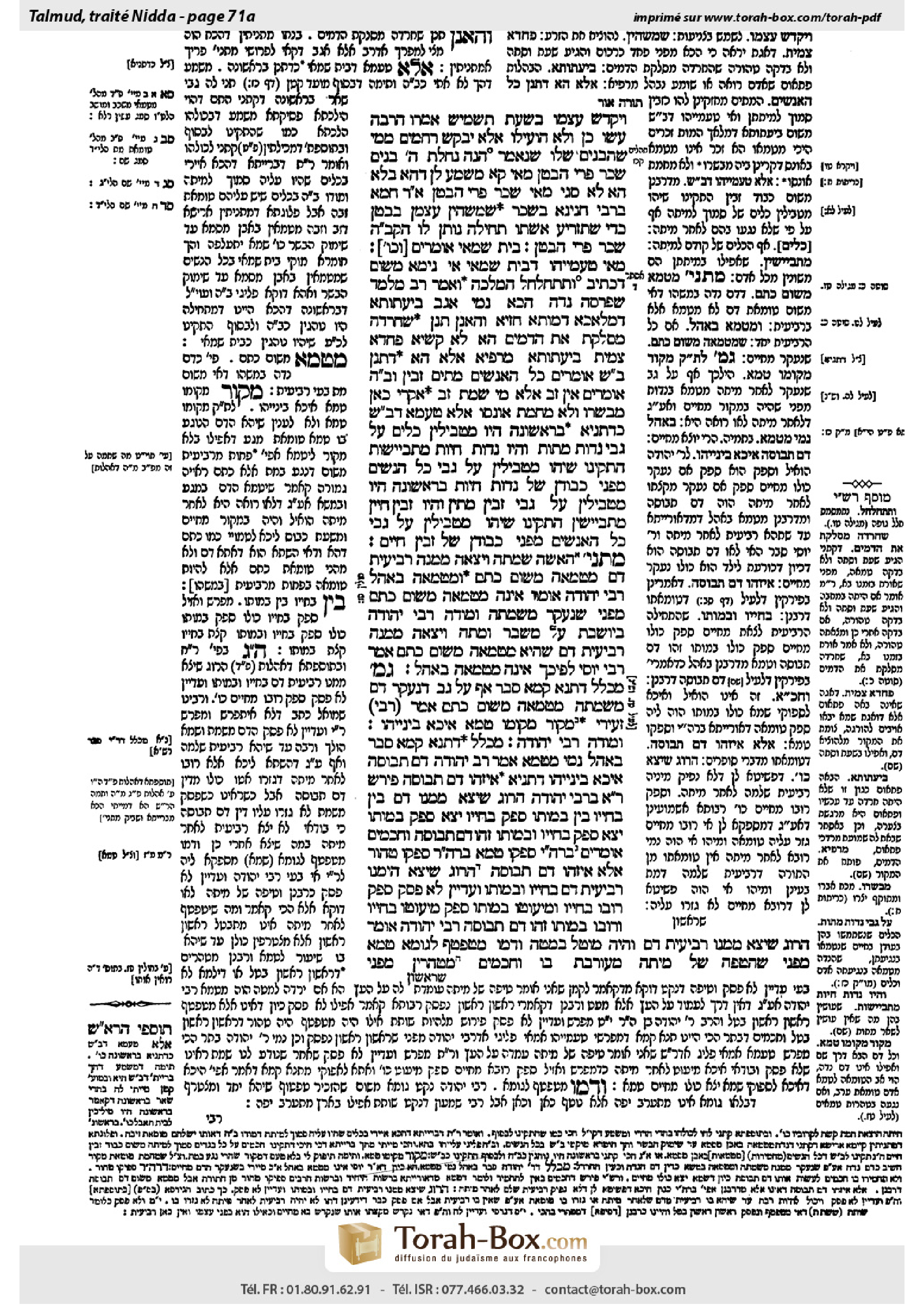
Niddah 71a: Talmud study for Daf Yomi
Daf Yomi is the daily study of one Talmud folio. Explore 37 tractates with scans, Hebrew text, Sefaria English and AI-generated French translations where annotated.
Passage selection and English or AI-generated French translation are available where the scan has annotations. Daf Study is independent of Torah-Box and Sefaria.
Browse Niddah · נידה · All tractatesNiddah 71a text and translations
This page of Niddah includes the Aramaic text, an English translation and an AI-generated French translation, alongside the scan above.
נידה ע״א א · Aramaic and Hebrew text
וַיְקַדֵּשׁ עַצְמוֹ בִּשְׁעַת תַּשְׁמִישׁ.
אָמְרוּ: הַרְבֵּה עָשׂוּ כֵּן, וְלֹא הוֹעִילוּ! אֶלָּא יְבַקֵּשׁ רַחֲמִים מִמִּי שֶׁהַבָּנִים שֶׁלּוֹ, שֶׁנֶּאֱמַר: ״הִנֵּה נַחֲלַת ה׳ בָּנִים שָׂכָר פְּרִי הַבָּטֶן״.
מַאי קָא מַשְׁמַע לַן? דְּהָא בְּלָא הָא לָא סַגִּי.
מַאי ״שָׂכָר פְּרִי הַבָּטֶן״? אָמַר רַבִּי חָמָא בְּרַבִּי חֲנִינָא: בִּשְׂכַר שֶׁמְּשַׁהִין עַצְמָן בַּבֶּטֶן, כְּדֵי (שֶׁתַּזְרִיעַ אִשְׁתּוֹ) [שֶׁיַּזְרִיעוּ נְשׁוֹתֵיהֶן] תְּחִילָּה — נוֹתֵן לוֹ הַקָּדוֹשׁ בָּרוּךְ הוּא שְׂכַר פְּרִי הַבֶּטֶן.
בֵּית שַׁמַּאי אוֹמְרִים [וְכוּ׳]. מַאי טַעְמַיְיהוּ דְּבֵית שַׁמַּאי? אִי נֵימָא מִשּׁוּם דִּכְתִיב ״וַתִּתְחַלְחַל הַמַּלְכָּה״, וְאָמַר רַב: מְלַמֵּד שֶׁפֵּרְסָה נִדָּה. הָכָא נָמֵי, אַגַּב בִּיעֲתוּתָא דְּמַלְאֲכָא דְמוֹתָא — חָזְיָא, וְהָאֲנַן תְּנַן שֶׁחֲרָדָה מְסַלֶּקֶת אֶת הַדָּמִים! הָא לָא קַשְׁיָא: פַּחְדָּא — צָמֵית, בִּיעֲתוּתָא — מְרַפְּיָא.
אֶלָּא, הָא דִּתְנַן: בֵּית שַׁמַּאי אוֹמְרִים: כׇּל הָאֲנָשִׁים מֵתִים זָבִין, וּבֵית הִלֵּל אוֹמְרִים: אֵין זָב אֶלָּא מִי שֶׁמֵּת זָב.
אִקְּרִי כָּאן ״מִבְּשָׂרוֹ״, וְלֹא מֵחֲמַת אוֹנְסוֹ!
אֶלָּא טַעְמָא דְּבֵית שַׁמַּאי, כִּדְתַנְיָא: בָּרִאשׁוֹנָה הָיוּ מַטְבִּילִין כֵּלִים עַל גַּבֵּי נִדּוֹת מֵתוֹת, וְהָיוּ נִדּוֹת חַיּוֹת מִתְבַּיְּישׁוֹת — הִתְקִינוּ שֶׁיְּהוּ מַטְבִּילִין עַל גַּבֵּי כׇּל הַנָּשִׁים, מִפְּנֵי כְּבוֹדָן שֶׁל נִדּוֹת חַיּוֹת.
בָּרִאשׁוֹנָה הָיוּ מַטְבִּילִין עַל גַּבֵּי זָבִין מֵתִין, וְהָיוּ זָבִין חַיִּין מִתְבַּיְּישִׁין — הִתְקִינוּ שֶׁיְּהוּ מַטְבִּילִין עַל גַּבֵּי כׇּל הָאֲנָשִׁים, מִפְּנֵי כְּבוֹדָן שֶׁל זָבִין חַיִּים.
מַתְנִי' הָאִשָּׁה שֶׁמֵּתָה, וְיָצְאָה מִמֶּנָּה רְבִיעִית דָּם — מְטַמְּאָה מִשּׁוּם כֶּתֶם, וּמְטַמְּאָה בְּאֹהֶל.
רַבִּי יְהוּדָה אוֹמֵר: אֵינָהּ מְטַמְּאָה מִשּׁוּם כֶּתֶם, מִפְּנֵי שֶׁנֶּעֱקַר מִשֶּׁמֵּתָה. וּמוֹדֶה רַבִּי יְהוּדָה בְּיוֹשֶׁבֶת עַל מַשְׁבֵּר וָמֵתָה, וְיָצְאָה מִמֶּנָּה רְבִיעִית דָּם שֶׁהִיא מְטַמְּאָה מִשּׁוּם כֶּתֶם. אָמַר רַבִּי יוֹסֵי: לְפִיכָךְ אֵינָהּ מְטַמְּאָה בְּאֹהֶל.
גְּמָ' מִכְּלָל דְּתַנָּא קַמָּא סָבַר, אַף עַל גַּב דְּנֶעֱקַר דָּם מִשֶּׁמֵּתָה, מְטַמְּאָה מִשּׁוּם כֶּתֶם?
אָמַר רַבִּי זְעֵירִי: מָקוֹר מְקוֹמוֹ טָמֵא אִיכָּא בֵּינַיְיהוּ.
וּמוֹדֶה רַבִּי יְהוּדָה.
מִכְּלָל דְּתַנָּא קַמָּא סָבַר בְּאֹהֶל נָמֵי מְטַמֵּא? אָמַר רַב יְהוּדָה: דַּם תְּבוּסָה אִיכָּא בֵּינַיְיהוּ.
דְּתַנְיָא: אֵיזֶהוּ דַּם תְּבוּסָה? פֵּירֵשׁ רַבִּי אֶלְעָזָר בְּרַבִּי יְהוּדָה: הָרוּג שֶׁיָּצָא מִמֶּנּוּ דָּם בֵּין בְּחַיָּיו בֵּין בְּמוֹתוֹ, סָפֵק בְּחַיָּיו יָצָא, סָפֵק בְּמוֹתוֹ יָצָא, סָפֵק בְּחַיָּיו וּבְמוֹתוֹ — זֶהוּ דַּם תְּבוּסָה.
וַחֲכָמִים אוֹמְרִים: בִּרְשׁוּת הַיָּחִיד — סְפֵקוֹ טָמֵא, בִּרְשׁוּת הָרַבִּים — סְפֵקוֹ טָהוֹר.
אֶלָּא אֵיזֶהוּ דַּם תְּבוּסָה? הָרוּג שֶׁיָּצָא הֵימֶנּוּ רְבִיעִית דָּם בְּחַיָּיו וּבְמוֹתוֹ, וַעֲדַיִין לֹא פָּסַק, סָפֵק רוּבּוֹ בְּחַיָּיו וּמִיעוּטוֹ בְּמוֹתוֹ, סְפֵק מִיעוּטוֹ בְּחַיָּיו וְרוּבּוֹ בְּמוֹתוֹ — זֶהוּ דַּם תְּבוּסָה.
רַבִּי יְהוּדָה אוֹמֵר: הָרוּג שֶׁיָּצָא מִמֶּנּוּ רְבִיעִית דָּם, וְהָיָה מוּטָּל בַּמִּטָּה וְדָמוֹ מְטַפְטֵף לְגוּמָּא — טָמֵא, מִפְּנֵי שֶׁהַטִּפָּה שֶׁל מִיתָה מְעוֹרֶבֶת בּוֹ. וַחֲכָמִים מְטַהֲרִין, מִפְּנֵי
Niddah 71a · English translation
and sanctify himself by acting modestly at the time of sexual intercourse.
The sages of Alexandria said to Rabbi Yehoshua: Many people have done so, and it did not help them. Rabbi Yehoshua said: Rather, they should pray to receive sons from the One to Whom sons belong, as it is stated: “Behold, children are a heritage of the Lord; the fruit of the womb is a reward” (Psalms 127:3).
The Gemara again asks: Since the path to sons is through prayer, what is Rabbi Yehoshua teaching us when he said that one should marry an appropriate woman and conduct himself with modesty during intercourse? The Gemara answers: Rabbi Yehoshua is teaching that this, prayer, without that, marrying an appropriate woman and being modest, does not suffice.
With regard to the verse from Psalms, the Gemara asks: What is the meaning of the phrase: “The fruit of the womb is a reward” (Psalms 127:3)? What act is rewarded here? Rabbi Ḥama, son of Rabbi Ḥanina, says: In reward for men withholding their semen in their belly in order to allow their wives to emit seed first, the Holy One, Blessed be He, gives him the reward of the fruit of the womb, i.e., sons.
§ The mishna teaches that Beit Shammai say: The status of all women when they die is as though they were menstruating women. The Gemara asks: What is the reason for the opinion of Beit Shammai? If we say that their opinion is due to that which is written: “Then the queen was exceedingly distressed [vatitḥalḥal]” (Esther 4:4), this is difficult. The Gemara first explains the derivation. And Rav said: This teaches that she began to menstruate out of fear, as the cavities [ḥalalim] of her body opened. Here too, when a woman is about to die, due to the fear of the Angel of Death she sees blood. This is difficult, as didn’t we learn in a mishna (39a) that trepidation eliminates the flow of menstrual blood? The Gemara answers: This is not difficult. Anxiety generated by extended worry contracts the muscles and prevents the blood from flowing, but sudden fear relaxes the muscles and causes the blood to flow.
But if the reason Beit Shammai hold that all women who die have the status of menstruating women is due to fear, then what about that which we learned in a baraita: Beit Shammai say: The status of all men when they die is as though they were zavim; and Beit Hillel say: Only a man who died with the impurity of a zav has the status of a zav. If the reason that Beit Shammai maintain that all women who die have the status of menstruating women is due to fear of the Angel of Death, presumably they also should consider all men who die to have the status of a zav for the same reason.
But this is difficult, as I will apply here the principle stated with regard to a zav: “An issue out of his flesh” (Leviticus 15:2) renders a man impure, but not an issue due to circumstances beyond his control. If a man has a discharge of ziva due to an illness or some accident, he does not become impure. Consequently, if he has a discharge due to fear after seeing the Angel of Death, he would not become ritually impure.
Rather, the reason for the opinion of Beit Shammai is as it is taught in a baraita: At first they would ritually immerse all the utensils that had been used by women who died while menstruating, which had thereby contracted ritual impurity even if the utensils did not touch the women after their death. And as a result, the living menstruating women were embarrassed, as they saw that the status of a menstruating woman is so severe that it remains even after death. The Sages therefore instituted that one must immerse the utensils which had been used by all dying women, due to the honor of living menstruating women.
Similarly, at first they would immerse all the utensils that had been used by zavin, men suffering from gonorrhea, who died, as the utensils had thereby contracted ritual impurity even if the utensils did not touch the men after their death. And as a result, the living zavin were embarrassed. Therefore, the Sages instituted that one must immerse the utensils that had been used by all dying men, due to the honor of the living zavin.
MISHNA: With regard to a woman who died, and after her death a quarter-log of blood emerged from her body, although the blood emerged after death, it transmits ritual impurity by touching and carrying, due to the impurity of the spot of blood of a menstruating woman. This impurity as blood of menstruation applies to any amount of blood she emits, despite the halakha that generally, the blood of a corpse transmits impurity only if it is at least a quarter-log in volume. And as it is a quarter-log of blood, it transmits impurity in a tent, as it is the blood of a corpse.
Rabbi Yehuda says: That quarter-log of blood does not transmit impurity due to the impurity of the spot of blood of a menstruating woman, because that blood was displaced after she died. And Rabbi Yehuda concedes in the case of a woman who is sitting in childbirth on the travailing chair [mashber] and she died, and a quarter-log of blood emerged from her body, that this blood transmits ritual impurity due to the impurity of the spot of blood of a menstruating woman. In that case, the blood was displaced while she was still alive. Rabbi Yosei said: For that reason, that quarter-log of blood does not transmit impurity in a tent, as it did not come from a corpse.
GEMARA: The mishna teaches that according to Rabbi Yehuda a quarter-log of blood that emerges from a woman after death does not transmit impurity due to the impurity of a spot of blood of a menstruating woman, despite the fact that it came from the uterus. The Gemara raises a difficulty: By inference one might think that the first tanna holds that even though the blood was displaced after she died, it renders one ritually impure due to the impurity of a blood spot. This is not reasonable, as a dead woman cannot attain the status of a menstruating woman.
Rabbi Ze’eiri said: Even the first tanna agrees that blood from the uterus which leaves the body after death does not impart impurity as a spot. Rather, the difference between the opinions of the first tanna and Rabbi Yehuda is whether the place of a woman’s source, i.e., her uterus, is impure, and therefore any blood that passes through there is impure, even if it left her body after death. The first tanna maintains that even blood that appears after her death transmits impurity like the blood of menstruation, as it passed through the uterus when she was still alive, whereas Rabbi Yehuda holds that this blood does not transmit impurity as blood of menstruation, despite the fact that it passed through her uterus.
§ The mishna teaches: And Rabbi Yehuda concedes in the case of a woman who was sitting in childbirth when she died, that the quarter-log of blood which emerged from her body transmits the ritual impurity of the spot of the blood of a menstruating woman. And Rabbi Yosei said: For that reason, that quarter-log of blood does not transmit impurity in a tent.
The Gemara asks: By inference, one might conclude that the first tanna, i.e., Rabbi Yehuda, holds that the blood which emerges from a woman who died during childbirth also transmits impurity in a tent. This cannot be correct, as the blood left her while she was still alive. Rav Yehuda said: The difference between Rabbi Yehuda and Rabbi Yosei is with regard to blood of submission discharged from a body at the time of death, which contains a mixture of blood that leaves a person when he is still alive and blood that emerges after his death. Rabbi Yehuda holds that the blood which emerges from a woman who dies during childbirth is blood of submission, which transmits impurity in a tent by rabbinic law. Rabbi Yosei maintains that it is clear that this blood emerged from her body before she died, and therefore it is not blood of submission.
As it is taught in a baraita: What is blood of submission, which imparts ritual impurity (see 62b)? Rabbi Elazar, son of Rabbi Yehuda, explained: The case is one of a person who was killed, from whom a quarter-log of blood emerged, a flow which began while he was alive and continued after his death, and it is uncertain whether a full quarter-log emerged while he was alive and therefore does not transmit ritual impurity, and it is uncertain whether it emerged out after his death, in which case it imparts ritual impurity by Torah law, and it is uncertain whether the quarter-log emerged partly while he was alive and partly after his death. That is blood of submission.
And the Rabbis say that this is not blood of submission, but a case of uncertain ritual impurity by Torah law, as it might all have emerged after death. Therefore, one applies the principle that in a private domain a case of uncertainty is considered to be ritually impure, whereas in a public domain a case of uncertainty is considered to be ritually pure.
Rather, what is blood of submission? The case is one of a person who has been killed from whom a quarter-log of blood emerged while he was alive and continued emerging after his death and has still not stopped coming out. It is clear that a full quarter-log did not emerge after his death, but it is uncertain whether the majority emerged while he was alive and the minority after his death, and equally uncertain whether the minority emerged while he was alive and the majority after his death. That is blood of submission.
Rabbi Yehuda says: In the case of one who has been killed from whom a quarter-log of blood emerged, and he was lying in a bed and his blood was dripping into a hole in the ground, the blood in the ground is ritually impure, because the drop of death is mixed with it. And the Rabbis deem it ritually pure, because
Niddah 71a · Traduction française (IA)
et se sanctifier en se conduisant avec pudeur au moment des relations conjugales.
Les sages d’Alexandrie dirent à Rabbi Yehoshua : Beaucoup ont agi ainsi, et cela ne leur a pas réussi. Rabbi Yehoshua répondit : Ils doivent plutôt prier pour recevoir des fils de Celui à qui appartiennent les fils, comme il est dit : « Voici, les enfants sont un héritage de l’Éternel ; le fruit des entrailles est une récompense » (Psaumes 127,3).
La Guemara demande à nouveau : Puisque le chemin qui mène à avoir des fils passe par la prière, que nous enseigne Rabbi Yehoshua en disant qu’il faut épouser une femme qui convient et se conduire avec pudeur pendant les relations conjugales ? La Guemara répond : Rabbi Yehoshua enseigne que ceci — la prière — sans cela — épouser une femme qui convient et se conduire avec pudeur — ne suffit pas.
À propos du verset des Psaumes, la Guemara demande : Que signifie l’expression « le fruit des entrailles est une récompense » (Psaumes 127,3) ? Quelle action est ainsi récompensée ? Rabbi Ḥama, fils de Rabbi Ḥanina, dit : En récompense du fait que les hommes retiennent leur semence dans leur ventre afin de laisser d’abord leurs femmes émettre leur semence, le Saint, béni soit-Il, leur accorde le fruit des entrailles, c’est-à-dire des fils.
§ La Michna enseigne que, selon Beit Shammaï, toutes les femmes ont, à leur mort, le statut de femmes menstruées. La Guemara demande : Quelle est la raison de l’opinion de Beit Shammaï ? Si l’on disait que leur opinion est fondée sur ce qui est écrit : « Alors la reine fut profondément troublée [vatitḥalḥal] » (Esther 4,4), cela poserait difficulté. La Guemara expose d’abord la déduction. Rav a dit : Cela enseigne qu’elle se mit à avoir ses règles sous l’effet de la peur, car les cavités [ḥalalim] de son corps s’ouvrirent. De même ici, lorsqu’une femme est sur le point de mourir, elle voit du sang à cause de la peur de l’Ange de la Mort. Cela pose difficulté, car n’avons-nous pas appris dans une Michna (39a) que l’effroi arrête l’écoulement du sang menstruel ? La Guemara répond : Il n’y a pas de difficulté. L’angoisse causée par une inquiétude prolongée contracte les muscles et empêche le sang de s’écouler, tandis qu’une peur soudaine relâche les muscles et provoque l’écoulement du sang.
Mais si Beit Shammaï considèrent que toutes les femmes qui meurent ont le statut de femmes menstruées par peur, qu’en est-il de ce que nous avons appris dans une baraïta : Beit Shammaï disent que tous les hommes ont, à leur mort, le statut de zavim ; et Beit Hillel disent que seul un homme qui meurt alors qu’il est atteint d’impureté de zav a le statut de zav. Si Beit Shammaï considèrent que toutes les femmes qui meurent ont le statut de femmes menstruées à cause de la peur de l’Ange de la Mort, ils devraient, semble-t-il, considérer aussi que tous les hommes qui meurent ont le statut de zavim, pour la même raison.
Mais cela pose difficulté, car on peut appliquer ici le principe énoncé au sujet d’un zav : « Un écoulement provenant de sa chair » (Lévitique 15,2) rend un homme impur, mais pas un écoulement dû à des circonstances indépendantes de sa volonté. Si un homme a un écoulement de ziva à cause d’une maladie ou d’un accident, il ne devient pas impur. Par conséquent, s’il a un écoulement sous l’effet de la peur après avoir vu l’Ange de la Mort, il ne devrait pas devenir rituellement impur.
La raison de l’opinion de Beit Shammaï est plutôt celle enseignée dans une baraïta : Au début, on immergeait tous les ustensiles qui avaient été utilisés par des femmes mortes alors qu’elles étaient menstruées, car ils avaient ainsi contracté l’impureté rituelle, même s’ils n’avaient pas touché les femmes après leur mort. En conséquence, les femmes menstruées encore en vie étaient gênées, car elles voyaient que le statut d’une femme menstruée était si grave qu’il persistait même après la mort. Les Sages instituèrent donc que l’on devait immerger les ustensiles utilisés par toutes les femmes mourantes, par égard pour les femmes menstruées encore en vie.
De même, au début, on immergeait tous les ustensiles qui avaient été utilisés par des zavim — des hommes souffrant de gonorrhée — morts, car ils avaient ainsi contracté l’impureté rituelle, même s’ils n’avaient pas touché les hommes après leur mort. En conséquence, les zavim encore en vie étaient gênés. Les Sages instituèrent donc que l’on devait immerger les ustensiles utilisés par tous les hommes mourants, par égard pour les zavim encore en vie.
MICHNA : À propos d’une femme morte dont un quart de log de sang est sorti du corps après sa mort : bien que le sang soit sorti après sa mort, il transmet l’impureté rituelle par contact et par port, en raison de l’impureté d’une tache de sang menstruel. Cette impureté due au sang menstruel s’applique à toute quantité de sang qu’elle émet, malgré la halakha selon laquelle, en règle générale, le sang d’un cadavre ne transmet l’impureté que si son volume atteint au moins un quart de log. Et puisqu’il s’agit d’un quart de log de sang, il transmet l’impureté sous une tente, car c’est le sang d’un cadavre.
Rabbi Yehuda dit : Ce quart de log de sang ne transmet pas l’impureté en raison de l’impureté d’une tache de sang menstruel, car ce sang s’est déplacé après sa mort. Rabbi Yehuda admet toutefois le cas d’une femme assise sur le siège d’accouchement [mashber], en plein travail, qui meurt et dont un quart de log de sang sort du corps : ce sang transmet l’impureté rituelle en raison de l’impureté d’une tache de sang menstruel. Dans ce cas, le sang s’est déplacé alors qu’elle était encore en vie. Rabbi Yosei dit : Pour cette raison, ce quart de log de sang ne transmet pas l’impureté sous une tente, car il ne provient pas d’un cadavre.
GUEMARA : La Michna enseigne que, selon Rabbi Yehuda, un quart de log de sang qui sort du corps d’une femme après sa mort ne transmet pas l’impureté en raison de l’impureté d’une tache de sang menstruel, bien qu’il provienne de l’utérus. La Guemara soulève une difficulté : On pourrait en déduire que le premier tanna considère que, même si le sang s’est déplacé après sa mort, il rend impur en raison de l’impureté d’une tache de sang. Cela n’est pas raisonnable, car une femme morte ne peut pas acquérir le statut de femme menstruée.
Rabbi Ze’eiri dit : Même le premier tanna admet que le sang provenant de l’utérus et qui quitte le corps après la mort ne transmet pas l’impureté en tant que tache. La différence entre l’opinion du premier tanna et celle de Rabbi Yehuda porte plutôt sur la question de savoir si l’endroit d’où provient le sang d’une femme, c’est-à-dire son utérus, est impur et rend donc impur tout sang qui le traverse, même si celui-ci quitte son corps après sa mort. Le premier tanna considère que même le sang qui apparaît après sa mort transmet l’impureté comme du sang menstruel, car il a traversé l’utérus alors qu’elle était encore en vie ; Rabbi Yehuda, en revanche, considère que ce sang ne transmet pas l’impureté comme du sang menstruel, bien qu’il ait traversé son utérus.
§ La Michna enseigne : Rabbi Yehuda admet le cas d’une femme qui était assise en plein accouchement lorsqu’elle est morte : le quart de log de sang sorti de son corps transmet l’impureté rituelle d’une tache de sang menstruel. Rabbi Yosei dit : Pour cette raison, ce quart de log de sang ne transmet pas l’impureté sous une tente.
La Guemara demande : On pourrait en déduire que le premier tanna, c’est-à-dire Rabbi Yehuda, considère que le sang qui sort d’une femme morte pendant l’accouchement transmet également l’impureté sous une tente. Cela ne peut être exact, puisque le sang a quitté son corps alors qu’elle était encore en vie. Rav Yehuda dit : La différence entre Rabbi Yehuda et Rabbi Yosei concerne le sang de cessation, qui s’écoule d’un corps au moment de la mort et contient un mélange de sang qui quitte la personne alors qu’elle est encore en vie et de sang qui apparaît après sa mort. Rabbi Yehuda considère que le sang qui sort d’une femme morte pendant l’accouchement est du sang de cessation, qui transmet l’impureté sous une tente par décision rabbinique. Rabbi Yosei soutient qu’il est certain que ce sang est sorti de son corps avant sa mort et qu’il ne s’agit donc pas de sang de cessation.
Comme il est enseigné dans une baraïta : Qu’est-ce que le sang de cessation, qui transmet l’impureté rituelle (voir 62b) ? Rabbi Elazar, fils de Rabbi Yehuda, expliqua : Il s’agit du cas d’une personne tuée, dont un quart de log de sang est sorti en un écoulement qui a commencé alors qu’elle était en vie et s’est poursuivi après sa mort. On ne sait pas si un quart de log entier est sorti alors qu’elle était en vie, auquel cas le sang ne transmet pas l’impureté rituelle, ni s’il est sorti après sa mort, auquel cas il transmet l’impureté rituelle selon la Torah, ni si le quart de log est sorti en partie alors qu’elle était en vie et en partie après sa mort. Voilà ce qu’est le sang de cessation.
Et les Rabbins disent qu’il ne s’agit pas de sang de cessation, mais d’un cas d’impureté rituelle incertaine selon la Torah, car il se peut que tout le sang soit sorti après la mort. On applique donc le principe selon lequel, dans un domaine privé, un cas d’incertitude est considéré comme rituellement impur, tandis que, dans un domaine public, un cas d’incertitude est considéré comme rituellement pur.
Mais alors, qu’est-ce que le sang de cessation ? Il s’agit du cas d’une personne tuée, dont un quart de log de sang est sorti alors qu’elle était en vie et a continué de s’écouler après sa mort, sans s’être encore arrêté. Il est certain qu’un quart de log entier n’est pas sorti après sa mort, mais on ne sait pas si la majeure partie est sortie alors qu’elle était en vie et la moindre partie après sa mort, ou si, à l’inverse, la moindre partie est sortie alors qu’elle était en vie et la majeure partie après sa mort. Voilà ce qu’est le sang de cessation.
Rabbi Yehuda dit : Dans le cas d’une personne tuée, dont un quart de log de sang est sorti, qui gisait sur un lit et dont le sang gouttait dans un trou creusé dans le sol, le sang dans le trou est rituellement impur, car la goutte de la mort s’y mêle. Les Rabbins le considèrent comme rituellement pur, car
Traduction française générée par IA à partir de l’édition anglaise de Sefaria. Vérifie toujours un passage avec le texte source.
Text from Sefaria: William Davidson Edition - Vocalized Aramaic (CC BY NC); William Davidson Edition - English (CC BY NC).