Niddah 71b: Talmud study for Daf Yomi
Daf Yomi is the daily study of one Talmud folio. Explore 37 tractates with scans, Hebrew text, Sefaria English and AI-generated French translations where annotated.
Passage selection and English or AI-generated French translation are available where the scan has annotations. Daf Study is independent of Torah-Box and Sefaria.
Browse Niddah · נידה · All tractatesNiddah 71b text and translations
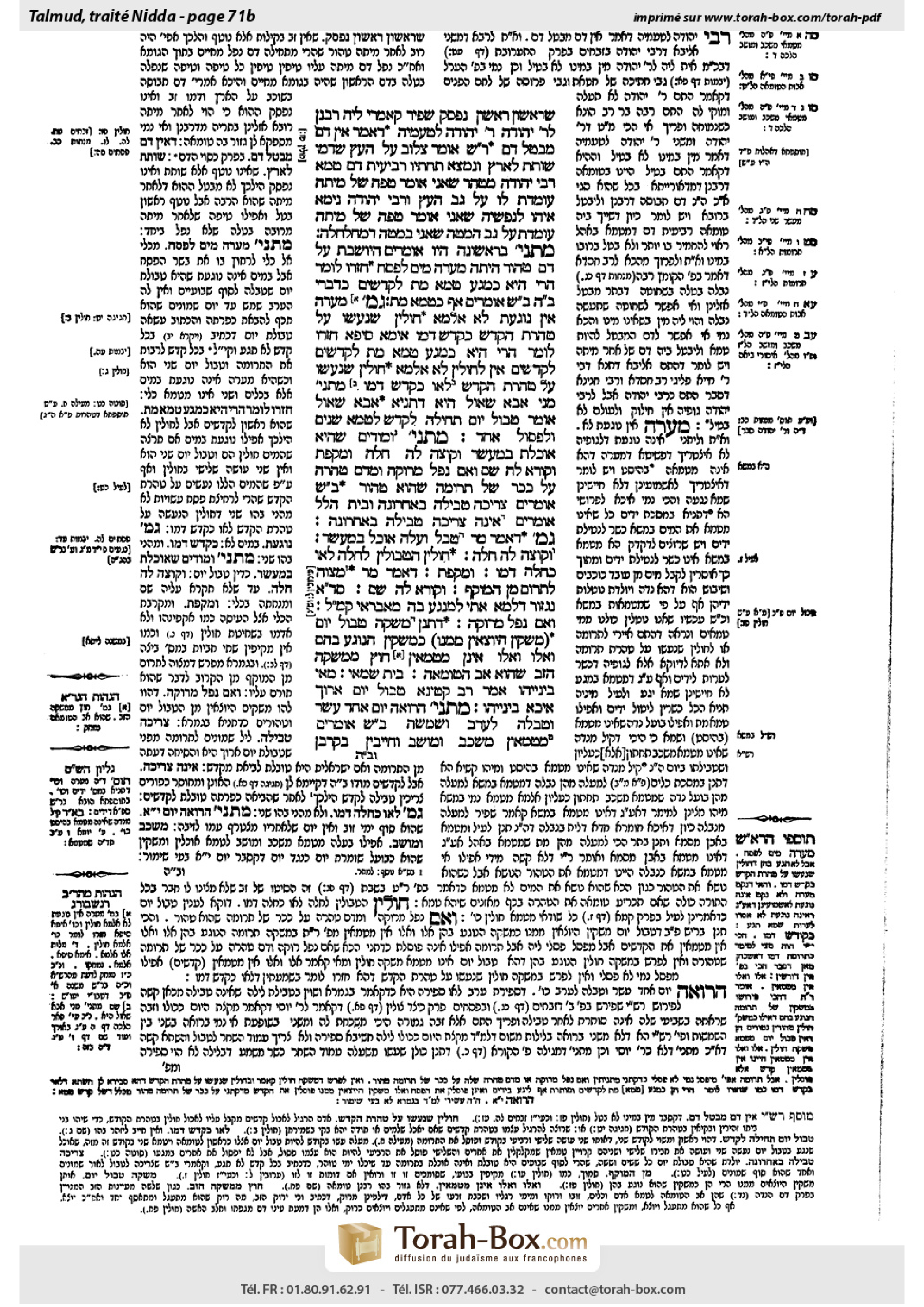
This page of Niddah includes the Aramaic text, an English translation and an AI-generated French translation, alongside the scan above.
נידה ע״א ב · Aramaic and Hebrew text
שֶׁרִאשׁוֹן רִאשׁוֹן נִפְסָק. שַׁפִּיר קָאָמְרִי לֵיהּ רַבָּנַן לְרַבִּי יְהוּדָה! רַבִּי יְהוּדָה לְטַעְמֵיהּ דְּאָמַר: אֵין דָּם מְבַטֵּל דָּם.
רַבִּי שִׁמְעוֹן אוֹמֵר: צָלוּב עַל הָעֵץ, שֶׁדָּמוֹ שׁוֹתֵת לָאָרֶץ, וְנִמְצָא תַּחְתָּיו רְבִיעִית דָּם — טָמֵא. רַבִּי יְהוּדָה מְטַהֵר, שֶׁאֲנִי אוֹמֵר: טִפָּה שֶׁל מִיתָה עוֹמֶדֶת לוֹ עַל גַּב הָעֵץ.
וְרַבִּי יְהוּדָה, נֵימָא אִיהוּ לְנַפְשֵׁיהּ: שֶׁאֲנִי אוֹמֵר ״טִפָּה שֶׁל מִיתָה עוֹמֶדֶת עַל גַּב הַמִּטָּה״! שָׁאנֵי מִטָּה, דִּמְחַלְחֲלָה.
מַתְנִי' בָּרִאשׁוֹנָה הָיוּ אוֹמְרִים: הַיּוֹשֶׁבֶת עַל דַּם טוֹהַר הָיְתָה מְעָרָה מַיִם לְפֶסַח.
חָזְרוּ לוֹמַר: הֲרֵי הִיא כְּמַגַּע טְמֵא מֵת לְקָדָשִׁים, כְּדִבְרֵי בֵּית הִלֵּל. בֵּית שַׁמַּאי אוֹמְרִים: אַף כִּטְמֵא מֵת.
גְּמָ' מְעָרָה — אִין, נוֹגַעַת — לָא. אַלְמָא: חוּלִּין שֶׁנַּעֲשׂוּ עַל טׇהֳרַת הַקֹּדֶשׁ — כְּקֹדֶשׁ דָּמוּ.
אֵימָא סֵיפָא: חָזְרוּ לוֹמַר הֲרֵי הִיא כְּמַגַּע טְמֵא מֵת לְקָדָשִׁים — לְקָדָשִׁים אִין, לְחוּלִּין לָא, אַלְמָא: חוּלִּין שֶׁנַּעֲשׂוּ עַל טׇהֳרַת הַקֹּדֶשׁ לָאו כְּקֹדֶשׁ דָּמוּ!
מַתְנִיתִין מַנִּי? אַבָּא שָׁאוּל הִיא, דְּתַנְיָא: אַבָּא שָׁאוּל אוֹמֵר: טְבוּל יוֹם תְּחִילָּה לַקֹּדֶשׁ, לְטַמֵּא שְׁנַיִם וְלִפְסוֹל אֶחָד.
מַתְנִי' וּמוֹדִים שֶׁהִיא אוֹכֶלֶת בְּמַעֲשֵׂר, וְקוֹצָה לָהּ חַלָּה, וּמַקֶּפֶת וְקוֹרָא לָהּ שֵׁם,
וְאִם נָפַל מֵרוּקָּהּ וּמִדַּם טׇהֳרָהּ עַל כִּכָּר שֶׁל תְּרוּמָה — שֶׁהוּא טָהוֹר.
בֵּית שַׁמַּאי אוֹמְרִים: צְרִיכָה טְבִילָה בָּאַחֲרוֹנָה, וּבֵית הִלֵּל אוֹמְרִים: אֵינָהּ צְרִיכָה טְבִילָה בָּאַחֲרוֹנָה.
גְּמָ' דְּאָמַר מָר: טָבַל וְעָלָה — אוֹכֵל בְּמַעֲשֵׂר.
וְקוֹצָה לָהּ חַלָּה. חוּלִּין הַטְּבוּלִין לְחַלָּה — לָאו כְּחַלָּה דָּמוּ.
וּמַקֶּפֶת. דְּאָמַר מָר: מִצְוָה לִתְרוֹם מִן הַמּוּקָּף.
וְקוֹרָא לָהּ שֵׁם. סָלְקָא דַעְתָּךְ אָמֵינָא: נִגְזוֹר, דִּלְמָא אָתֵי לְמִנְּגַּע בַּהּ מֵאַבָּרַאי? קָא מַשְׁמַע לַן.
וְאִם נָפַל מֵרוּקָּהּ. דִּתְנַן: מַשְׁקֵה טְבוּל יוֹם מַשְׁקִין הַיּוֹצְאִין מִמֶּנּוּ (כְּמַשְׁקִין) [כְּמַשְׁקֶה] הַנּוֹגֵעַ בָּהֶם, וְאֵלּוּ וְאֵלּוּ אֵינָן מְטַמְּאִין, חוּץ מִמַּשְׁקֵה הַזָּב שֶׁהוּא אַב הַטּוּמְאָה.
בֵּית שַׁמַּאי. מַאי בֵּינַיְיהוּ? אָמַר רַב קַטִּינָא: טְבוּל יוֹם אָרוֹךְ אִיכָּא בֵּינַיְיהוּ.
מַתְנִי' הָרוֹאָה יוֹם אַחַד עָשָׂר, וְטָבְלָה לָעֶרֶב, וְשִׁמְּשָׁה —
בֵּית שַׁמַּאי אוֹמֵר: מְטַמְּאִין מִשְׁכָּב וּמוֹשָׁב, וְחַיָּיבִין בְּקׇרְבָּן.
Niddah 71b · English translation
each first drop and every other first drop is separated from the other drops of blood, i.e., it did not flow in a steady stream. Since the blood initially emerged while he was alive and is pure, every drop of blood which emerged after his death is nullified when it falls into that blood, and therefore the entire puddle of blood is ritually pure. The Gemara asks: The Rabbis are saying well to Rabbi Yehuda; how does he respond to their claim? The Gemara answers that Rabbi Yehuda conforms to his line of reasoning, as he said: Blood does not nullify blood.
Rabbi Shimon says: In the case of one who is crucified on wood, whose blood does not drip but runs down the wood to the earth, and a quarter-log of blood is found underneath him, the blood is ritually impure. Rabbi Yehuda deems the blood ritually pure. He explains his reasoning: As I say that the quarter-log of blood found underneath the body came out while he was still alive, and the drop of blood that came out after his death remains on the wood.
The Gemara raises a difficulty with regard to the opinion of Rabbi Yehuda. And Rabbi Yehuda, let him say to himself with regard to one who was killed on a bed and his blood is dripping into a hole in the ground: As I say that all the blood found underneath the body emerged while he was still alive and the drop of blood that came out after his death remains on the bed. Why does Rabbi Yehuda deem the blood ritually impure in such a case? The Gemara answers: The case of the bed is different, as the blood seeps through the bed onto the floor, whereas in the case of one who is crucified some of the blood may remain on the tree.
MISHNA: Initially the Sages would say, with regard to a woman who gave birth and observed the seven or fourteen days of impurity for a male or female child, respectively, and then immersed in a ritual bath and who is observing the period of the blood of purity, that she would pour water from a vessel in her hands to rinse the Paschal offering. Although it is permitted for such a woman to engage in intercourse with her husband, her halakhic status is like that of one who immersed that day and the sun has not yet set. She therefore assumes second-degree ritual impurity and confers third-degree ritual impurity upon teruma with which she comes into contact. Consequently, she may touch the vessel, as second-degree ritual impurity does not render a vessel impure. She may not touch the water, as it is designated for rinsing the Paschal offering and therefore it is treated with the sanctity of sacrificial food, which is rendered impure by second-degree ritual impurity.
The Sages then said: Her status is like that of one who came into contact with one impure with impurity imparted by a corpse, i.e., one with first-degree ritual impurity, who renders consecrated items impure. But with regard to all non-sacred items, even non-sacred items treated with the sanctity of sacrificial food, such as the water used to rinse the Paschal offering, she has second-degree ritual impurity. Consequently, it is permitted for her to touch not only the vessel, but the water inside it as well, in accordance with the statement of Beit Hillel. Beit Shammai say: The status of the woman is even like that of one who is impure due to contact with a corpse, who is a primary source of ritual impurity and renders even a non-sacred vessel impure.
GEMARA: The mishna teaches: A woman who gave birth, observed the days of impurity, immersed in a ritual bath, and who is now observing the period of the blood of purity would pour water from a vessel in her hands to rinse the Paschal offering. The Gemara infers: Pouring from a vessel, yes, this is permitted, but she may not touch the water itself. Apparently, non-sacred produce, e.g., even liquid such as the water for rinsing the Paschal offering, that was prepared according to the level of ritual purity required for sacrificial food, i.e., with the same stringencies as required for sacrificial food, is considered like sacrificial food.
But now say the latter clause of the mishna: The Sages then said: Her status is like that of one who came into contact with one impure with impurity imparted by a corpse, i.e., one with first-degree ritual impurity, who renders consecrated items impure. This indicates that with regard to consecrated items, yes, she renders them impure, but with regard to non-sacred items, e.g., the water used to rinse the Paschal offering, she does not render them impure. Apparently, non-sacred produce that was prepared according to the level of ritual purity required for sacrificial food is not considered like sacrificial food.
The Gemara explains: Whose opinion is expressed in the latter clause of the mishna? It is the opinion of Abba Shaul, as it is taught in a baraita that Abba Shaul says: With regard to one who was ritually impure who immersed that day and is waiting for nightfall for the purification process to be completed, he has the status of one who is impure with first-degree impurity with regard to sacrificial food, in that he renders two items of sacrificial food impure, and disqualifies one additional item. In other words, the first item of sacrificial food that he touches assumes the status of second-degree impurity. A second item that comes into contact with the first item assumes third-degree impurity. A third item that comes into contact with the second assumes fourth-degree impurity and is therefore disqualified from being eaten, but it does not impart impurity to other items.
MISHNA: And Beit Shammai concede to Beit Hillel that a woman observing the days of purity partakes of second-tithe produce, as it is permitted for one who immersed that day to eat second-tithe produce. And she separates part of her dough as ḥalla, and she draws the vessel with the part of the dough that she separated near the rest of the dough, and she designates it with the name of ḥalla.
And Beit Shammai further concede to Beit Hillel that if a drop from her saliva or from the blood of purity fell onto a loaf of teruma, the loaf is ritually pure, as any liquid discharged from the body of one who immersed that day is ritually pure.
There is another dispute between the tanna’im with regard to a woman who completed her days of purity. Beit Shammai say: Her immersion at the end of the days of impurity does not render it permitted for her to enter the Temple or to partake of teruma; rather, she requires immersion even at the conclusion of the days of purity. And Beit Hillel say: She does not require immersion at the conclusion of the days of purity to render it permitted for her to partake of teruma, as the immersion at the end of the days of impurity is sufficient.
GEMARA: The mishna teaches that Beit Shammai concede to Beit Hillel that the woman observing the days of purity partakes of second-tithe produce. The Gemara explains that the reason is as the Master said: When the period of ritual impurity of a zav or leper has been completed, and he immersed during the day and ascended from the ritual bath, he may partake of second tithe immediately.
The mishna teaches: And she separates part of her dough as ḥalla. The Gemara explains that non-consecrated food that is untithed produce with regard to ḥalla, as it has not had ḥalla separated from it, e.g., this dough from which a piece has been set aside for the future separation of ḥalla, is not considered like ḥalla, and therefore is not rendered impure by the contact of a woman observing the days of purity.
The mishna also teaches that she draws the vessel with the part of the dough that she separated near the rest of the dough. The Gemara explains that this is as the Master said: It is a mitzva to separate teruma from produce that is situated nearby the produce it comes to exempt, ab initio.
The mishna states: And she designates it with the name of ḥalla. The Gemara explains that it is necessary for the tanna to teach this halakha, as it might enter your mind to say: Let us decree lest she comes to touch the ḥalla from the outside. Therefore, the mishna teaches us that there is no such decree.
The mishna teaches: And Beit Shammai concede to Beit Hillel that if a drop from her saliva or from the blood of purity fell onto a loaf of teruma, that the loaf is ritually pure, as any liquid discharged from the body of one who immersed that day is ritually pure. The Gemara explains that the reason is as we learned in a mishna (Tevul Yom 2:1): The halakha with regard to liquids that emerge from one who immersed himself that day from his state of ritual impurity is like that of liquids that he touches. And both these and those, the liquids that emanated from him and the liquids that he touched, do not transmit ritual impurity. This is the halakha except for liquids that come from a zav, who is a primary source of ritual impurity.
The mishna teaches that Beit Shammai say: Her immersion at the end of the days of impurity does not render her permitted; rather, she requires immersion even at the end of the days of purity. And Beit Hillel say: The immersion at the end of the days of impurity is sufficient. The Gemara asks: What is the difference between them, i.e., what is the basis of their dispute? Rav Ketina said: The difference between them is with regard to the status of one who immersed that day, i.e., at the end of his time of impurity, and a long time has passed since the immersion. Beit Shammai hold that as a long time has passed, i.e., thirty-three days after the birth of a boy or sixty-six days after the birth of a girl, she may not rely on that immersion. Beit Hillel maintain that she may still rely on that initial immersion.
MISHNA: There is a dispute with regard to a woman who sees blood on the eleventh day, which is the final day of the period fit for the flow of a zava. It is permitted for her to engage in intercourse with her husband after observing one clean day corresponding to the one day that she saw blood, but in this case, she failed to observe one clean day. Rather, she immersed in a ritual bath that evening, the eve of the twelfth day, and then engaged in intercourse with her husband.
Beit Shammai say: Since she did not observe that corresponding clean day, she retains the status of a zava. Therefore both she, the zava, and her husband, who engaged in intercourse with a zava, transmit impurity to items designated for lying or sitting, to the extent that these transmit impurity to food and drink that came in contact with them, and in her case, to people as well. And each of them is liable to bring a sin offering for participating in intercourse involving a zava.
Niddah 71b · Traduction française (IA)
Chaque première goutte, ainsi que chacune des autres premières gouttes, est séparée des autres gouttes de sang, c’est-à-dire que le sang ne s’est pas écoulé en un flot continu. Puisque le sang est d’abord sorti alors qu’il était encore vivant et qu’il est pur, chaque goutte de sang sortie après sa mort est annulée lorsqu’elle tombe dans ce sang ; toute la flaque de sang est donc rituellement pure. La Guemara demande : Les Sages répondent à bon droit à Rabbi Yehouda ; comment réplique-t-il à leur argument ? La Guemara répond que Rabbi Yehouda reste fidèle à son raisonnement, puisqu’il a dit : Le sang n’annule pas le sang.
Rabbi Shimon dit : Dans le cas d’un homme crucifié sur une pièce de bois, dont le sang ne goutte pas, mais s’écoule le long du bois jusqu’au sol, si l’on trouve sous lui un quart de log de sang, ce sang est rituellement impur. Rabbi Yehouda estime que le sang est rituellement pur. Il explique son raisonnement : Je considère que le quart de log de sang trouvé sous le corps est sorti alors qu’il était encore vivant, tandis que la goutte de sang sortie après sa mort est restée sur le bois.
La Guemara soulève une difficulté concernant l’opinion de Rabbi Yehouda. Rabbi Yehouda ne devrait-il pas se dire, au sujet d’un homme tué sur un lit, dont le sang goutte dans un trou creusé dans le sol : Je considère que tout le sang trouvé sous le corps est sorti alors qu’il était encore vivant, tandis que la goutte de sang sortie après sa mort est restée sur le lit ? Pourquoi Rabbi Yehouda estime-t-il que le sang est rituellement impur dans un tel cas ? La Guemara répond : Le cas du lit est différent, car le sang passe à travers le lit et s’écoule sur le sol, tandis que dans le cas d’un homme crucifié, une partie du sang peut rester sur le bois.
MICHNA : Au début, les Sages disaient qu’une femme qui a accouché, observé les sept ou les quatorze jours d’impureté, selon qu’elle a donné naissance à un garçon ou à une fille, puis s’est immergée dans un bain rituel et observe la période du sang de pureté, peut verser de l’eau d’un récipient qu’elle tient dans ses mains pour rincer l’offrande pascale. Bien qu’une telle femme soit autorisée à avoir des relations avec son mari, son statut selon la halakha est celui d’une personne qui s’est immergée ce jour-là et dont le soleil ne s’est pas encore couché. Elle est donc considérée comme ayant une impureté rituelle de deuxième degré et transmet une impureté rituelle de troisième degré à la terouma qu’elle touche. Elle peut donc toucher le récipient, car une impureté rituelle de deuxième degré ne rend pas un récipient impur. Elle ne peut pas toucher l’eau, car celle-ci est destinée à rincer l’offrande pascale et est donc traitée comme un aliment sacrificiel, que rend impur une impureté rituelle de deuxième degré.
Les Sages dirent ensuite : Son statut est celui d’une personne qui a été en contact avec quelqu’un d’impur par l’impureté transmise par un cadavre, c’est-à-dire une personne ayant une impureté rituelle de premier degré, qui rend impurs les objets consacrés. Toutefois, pour tous les objets profanes, même ceux qui sont traités avec la sainteté des aliments sacrificiels, comme l’eau utilisée pour rincer l’offrande pascale, elle a une impureté rituelle de deuxième degré. Elle peut donc toucher non seulement le récipient, mais aussi l’eau qu’il contient, conformément à l’avis de Beit Hillel. Beit Shammai disent : Le statut de cette femme est même celui d’une personne impure du fait d’un contact avec un cadavre, qui est une source primaire d’impureté rituelle et rend impur même un récipient profane.
GUEMARA : La Michna enseigne qu’une femme qui a accouché, observé les jours d’impureté, s’est immergée dans un bain rituel et observe maintenant la période du sang de pureté versait de l’eau d’un récipient qu’elle tenait dans ses mains pour rincer l’offrande pascale. On en déduit qu’elle peut verser l’eau depuis un récipient, oui, mais qu’elle ne peut pas toucher l’eau elle-même. Apparemment, les produits profanes — par exemple un liquide comme l’eau destinée à rincer l’offrande pascale — préparés selon le degré de pureté rituelle requis pour les aliments sacrificiels, c’est-à-dire soumis aux mêmes exigences que ces aliments, sont considérés comme des aliments sacrificiels.
Mais considérons maintenant la dernière partie de la Michna : Les Sages dirent ensuite que son statut est celui d’une personne qui a été en contact avec quelqu’un d’impur par l’impureté transmise par un cadavre, c’est-à-dire une personne ayant une impureté rituelle de premier degré, qui rend impurs les objets consacrés. Cela indique qu’elle rend impurs les objets consacrés, oui, mais qu’elle ne rend pas impurs les objets profanes, par exemple l’eau utilisée pour rincer l’offrande pascale. Apparemment, les produits profanes préparés selon le degré de pureté rituelle requis pour les aliments sacrificiels ne sont pas considérés comme des aliments sacrificiels.
La Guemara explique : De qui est l’opinion exprimée dans la dernière partie de la Michna ? C’est celle d’Abba Shaoul, comme l’enseigne une baraïta dans laquelle Abba Shaoul dit : Celui qui est rituellement impur, s’est immergé ce jour-là et attend le coucher du soleil pour que le processus de purification s’achève a, en ce qui concerne les aliments sacrificiels, le statut d’une personne ayant une impureté de premier degré : il rend impurs deux aliments sacrificiels et en disqualifie un autre. Autrement dit, le premier aliment sacrificiel qu’il touche acquiert le statut d’une impureté de deuxième degré. Un deuxième aliment qui entre en contact avec le premier acquiert une impureté de troisième degré. Un troisième aliment qui entre en contact avec le deuxième acquiert une impureté de quatrième degré et est donc impropre à la consommation, mais ne transmet pas l’impureté à d’autres aliments.
MICHNA : Beit Shammai concèdent à Beit Hillel qu’une femme qui observe les jours de pureté consomme des produits de la seconde dîme, puisqu’une personne qui s’est immergée ce jour-là est autorisée à consommer des produits de la seconde dîme. Elle prélève une partie de sa pâte au titre de la ḥalla, rapproche du reste de la pâte le récipient contenant la partie prélevée, puis la désigne comme ḥalla.
Beit Shammai concèdent en outre à Beit Hillel que si une goutte de sa salive ou de son sang de pureté tombe sur un pain de terouma, celui-ci est rituellement pur, car tout liquide excrété par le corps d’une personne qui s’est immergée ce jour-là est rituellement pur.
Il existe un autre désaccord entre les tannaïm au sujet d’une femme qui a achevé ses jours de pureté. Beit Shammai disent : Son immersion à la fin des jours d’impureté ne l’autorise pas à entrer dans le Temple ni à consommer de la terouma ; elle doit plutôt s’immerger de nouveau à la fin des jours de pureté. Beit Hillel disent : Elle n’a pas besoin de s’immerger à la fin des jours de pureté pour être autorisée à consommer de la terouma, car l’immersion à la fin des jours d’impureté suffit.
GUEMARA : La Michna enseigne que Beit Shammai concèdent à Beit Hillel que la femme qui observe les jours de pureté consomme des produits de la seconde dîme. La Guemara explique que cela s’explique par ce qu’a enseigné le Maître : Une fois achevée la période d’impureté rituelle d’un zav ou d’un lépreux, celui-ci peut consommer immédiatement des produits de la seconde dîme après s’être immergé pendant la journée et être sorti du bain rituel.
La Michna enseigne : Elle prélève une partie de sa pâte au titre de la ḥalla. La Guemara explique que les aliments profanes qui ne sont pas encore prélevés au titre de la ḥalla, puisqu’on n’en a pas encore prélevé la ḥalla — comme cette pâte dont une partie a été mise de côté en vue du prélèvement ultérieur de la ḥalla — ne sont pas considérés comme de la ḥalla et ne sont donc pas rendus impurs par le contact d’une femme qui observe les jours de pureté.
La Michna enseigne également qu’elle rapproche du reste de la pâte le récipient contenant la partie qu’elle a prélevée. La Guemara explique que cela correspond à ce qu’a enseigné le Maître : Il est une mitsva de prélever la terouma sur des produits situés à proximité des produits qu’elle vient exempter, a priori.
La Michna dit : Elle la désigne comme ḥalla. La Guemara explique que le tanna devait enseigner cette halakha, car on aurait pu penser : Décrétons, de peur qu’elle ne touche la ḥalla de l’extérieur. La Michna nous enseigne donc qu’aucune telle règle n’a été décrétée.
La Michna enseigne que Beit Shammai concèdent à Beit Hillel que si une goutte de sa salive ou de son sang de pureté tombe sur un pain de terouma, celui-ci est rituellement pur, car tout liquide excrété par le corps d’une personne qui s’est immergée ce jour-là est rituellement pur. La Guemara explique que cela s’appuie sur ce que nous avons appris dans une Michna (Tevul Yom 2:1) : La halakha concernant les liquides provenant d’une personne qui s’est immergée ce jour-là après avoir été rituellement impure est la même que celle concernant les liquides qu’elle touche. Ni les uns ni les autres — les liquides qui proviennent d’elle et ceux qu’elle a touchés — ne transmettent l’impureté rituelle. Cette règle admet une exception : les liquides provenant d’un zav, qui est une source primaire d’impureté rituelle.
La Michna enseigne que Beit Shammai disent : Son immersion à la fin des jours d’impureté ne la rend pas apte ; elle doit plutôt s’immerger de nouveau à la fin des jours de pureté. Beit Hillel disent : L’immersion à la fin des jours d’impureté suffit. La Guemara demande : Quelle est la différence entre eux, c’est-à-dire sur quoi porte leur désaccord ? Rav Ketina dit : Leur désaccord porte sur le statut d’une personne qui s’est immergée ce jour-là, c’est-à-dire à la fin de sa période d’impureté, et pour laquelle un long délai s’est écoulé depuis l’immersion. Beit Shammai estiment qu’après un long délai — c’est-à-dire trente-trois jours après la naissance d’un garçon ou soixante-six jours après celle d’une fille — elle ne peut plus se fier à cette immersion. Beit Hillel soutiennent qu’elle peut encore se fier à cette immersion initiale.
MICHNA : Il existe un désaccord au sujet d’une femme qui voit du sang le onzième jour, dernier jour de la période pendant laquelle peut survenir l’écoulement d’une zava. Elle peut avoir des relations avec son mari après avoir observé un jour de pureté correspondant à l’unique jour où elle a vu du sang ; dans ce cas, cependant, elle n’a pas observé ce jour de pureté. Au contraire, elle s’est immergée dans un bain rituel ce soir-là, la veille du douzième jour, puis a eu des relations avec son mari.
Beit Shammai disent : Puisqu’elle n’a pas observé le jour de pureté correspondant, elle conserve le statut de zava. Par conséquent, elle, la zava, et son mari, qui a eu des relations avec une zava, transmettent l’impureté aux objets destinés à servir de couche ou de siège ; ces objets transmettent à leur tour l’impureté aux aliments et aux boissons qui entrent en contact avec eux et, dans le cas de la femme, également aux personnes. Chacun d’eux est passible d’apporter un sacrifice expiatoire pour avoir eu des relations impliquant une zava.
Traduction française générée par IA à partir de l’édition anglaise de Sefaria. Vérifie toujours un passage avec le texte source.
Text from Sefaria: William Davidson Edition - Vocalized Aramaic (CC BY NC); William Davidson Edition - English (CC BY NC).