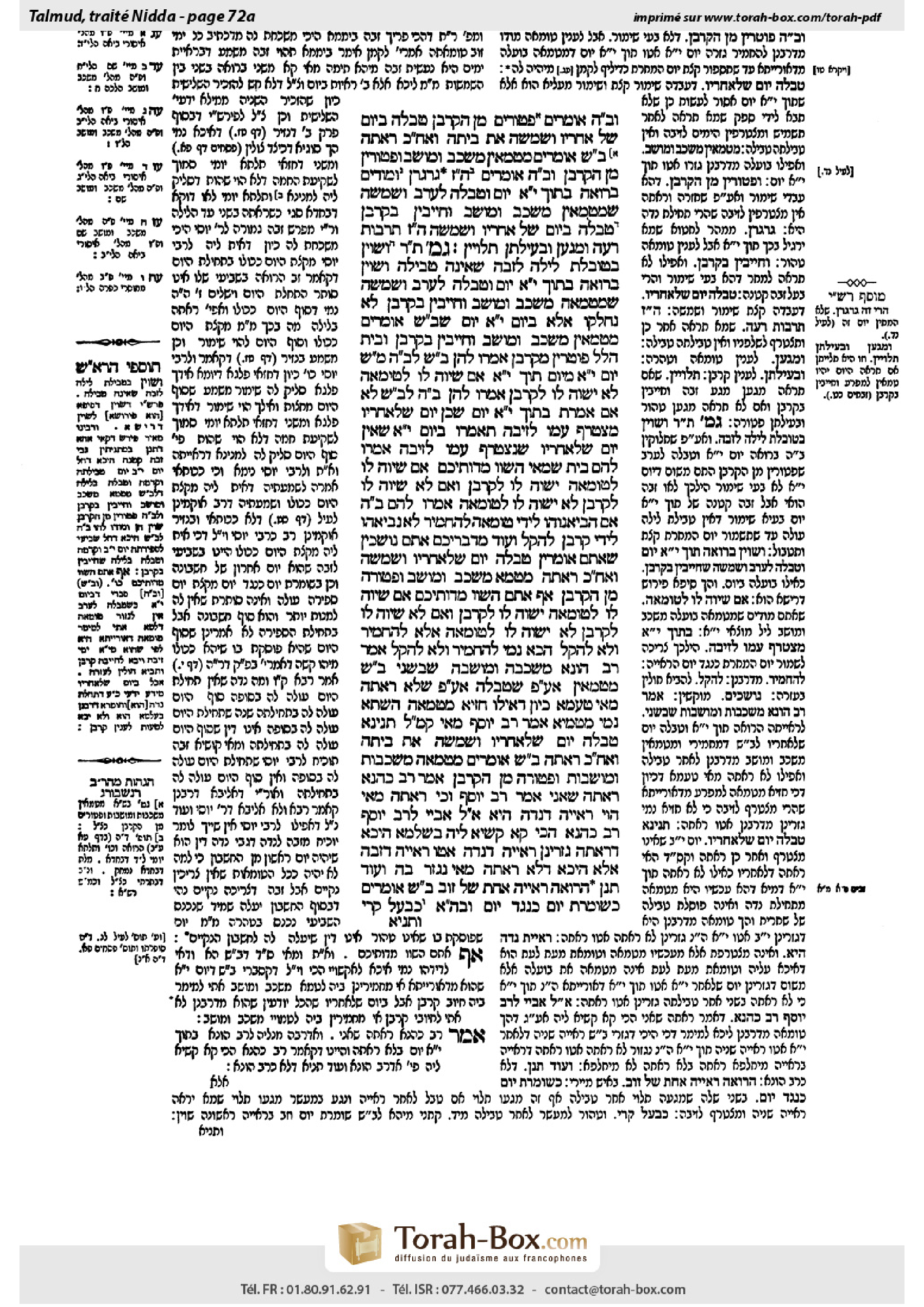
Niddah 72a: Talmud study for Daf Yomi
Daf Yomi is the daily study of one Talmud folio. Explore 37 tractates with scans, Hebrew text, Sefaria English and AI-generated French translations where annotated.
Passage selection and English or AI-generated French translation are available where the scan has annotations. Daf Study is independent of Torah-Box and Sefaria.
Browse Niddah · נידה · All tractatesNiddah 72a text and translations
This page of Niddah includes the Aramaic text, an English translation and an AI-generated French translation, alongside the scan above.
נידה ע״ב א · Aramaic and Hebrew text
וּבֵית הִלֵּל אוֹמְרִים: פְּטוּרִים מִן הַקׇּרְבָּן.
טָבְלָה בַּיּוֹם שֶׁלְּאַחֲרָיו, וְשִׁמְּשָׁה אֶת בֵּיתָהּ, וְאַחַר כָּךְ רָאֲתָה — בֵּית שַׁמַּאי אוֹמְרִים: מְטַמְּאִין מִשְׁכָּב וּמוֹשָׁב, וּפְטוּרִין מִן הַקׇּרְבָּן.
וּבֵית הִלֵּל אוֹמְרִים: הֲרֵי זֶה גַּרְגְּרָן, וּמוֹדִים בְּרוֹאָה בְּתוֹךְ אַחַד עָשָׂר יוֹם, וְטָבְלָה לָעֶרֶב וְשִׁמְּשָׁה — שֶׁמְּטַמְּאִין מִשְׁכָּב וּמוֹשָׁב, וְחַיָּיבִין בְּקׇרְבָּן.
טָבְלָה בַּיּוֹם שֶׁלְּאַחֲרָיו, וְשִׁמְּשָׁה — הֲרֵי זֶה תַּרְבּוּת רָעָה, וּמַגָּעָן וּבְעִילָתָן תְּלוּיִין.
גְּמָ' תָּנוּ רַבָּנַן: וְשָׁוִין בִּטְבִילַת לַיְלָה לְזָבָה — שֶׁאֵינָהּ טְבִילָה, וְשָׁוִין בְּרוֹאָה בְּתוֹךְ אַחַד עָשָׂר יוֹם וְטָבְלָה לָעֶרֶב וְשִׁמְּשָׁה — שֶׁמְּטַמְּאָה מִשְׁכָּב וּמוֹשָׁב, וְחַיָּיבִין בְּקׇרְבָּן.
לֹא נֶחְלְקוּ אֶלָּא בְּיוֹם אַחַד עָשָׂר יוֹם, שֶׁבֵּית שַׁמַּאי אוֹמְרִים: מְטַמְּאִין מִשְׁכָּב וּמוֹשָׁב וְחַיָּיבִין בְּקׇרְבָּן, וּבֵית הִלֵּל פּוֹטְרִין מִקׇּרְבָּן.
אָמְרוּ לָהֶן בֵּית שַׁמַּאי לְבֵית הִלֵּל: מַאי שְׁנָא יוֹם אַחַד עָשָׂר מִיּוֹם תּוֹךְ אַחַד עָשָׂר? אִם שָׁיוָה לוֹ לַטּוּמְאָה, לֹא יִשְׁוֶה לוֹ לַקׇּרְבָּן?
אָמְרוּ לָהֶן בֵּית הִלֵּל לְבֵית שַׁמַּאי: לֹא, אִם אָמַרְתָּ בְּתוֹךְ אַחַד עָשָׂר יוֹם, שֶׁכֵּן יוֹם שֶׁלְּאַחֲרָיו מִצְטָרֵף עִמּוֹ לְזִיבָה, תֹּאמְרוּ בְּיוֹם אַחַד עָשָׂר, שֶׁאֵין יוֹם שֶׁלְּאַחֲרָיו מִצְטָרֵף עִמּוֹ לְזִיבָה?!
אָמְרוּ לָהֶם בֵּית שַׁמַּאי: הַשְׁווּ מִדּוֹתֵיכֶם! אִם שָׁיוָה לוֹ לַטּוּמְאָה — יִשְׁוֶה לוֹ לַקׇּרְבָּן, וְאִם לֹא שָׁיוָה לוֹ לַקׇּרְבָּן — לֹא יִשְׁוֶה לוֹ לַטּוּמְאָה.
אָמְרוּ לָהֶם בֵּית הִלֵּל: אִם הֲבֵיאנוּהוּ לִידֵי טוּמְאָה לְהַחֲמִיר, לֹא נְבִיאֵהוּ לִידֵי קׇרְבָּן לְהָקֵל.
וְעוֹד מִדִּבְרֵיכֶם אַתֶּם נוֹשְׁכִין, שֶׁאַתֶּם אוֹמְרִין: טָבְלָה יוֹם שֶׁלְּאַחֲרָיו, וְשִׁמְּשָׁה, וְאַחַר כָּךְ רָאֲתָה — מְטַמֵּא מִשְׁכָּב וּמוֹשָׁב, וּפְטוּרָה מִן הַקׇּרְבָּן. אַף אַתֶּם הַשְׁווּ מִדּוֹתֵיכֶם: אִם שָׁיוָה לוֹ לַטּוּמְאָה, יִשְׁוֶה לוֹ לַקׇּרְבָּן.
וְאִם לֹא שָׁיוָה לוֹ לְקׇרְבָּן, לֹא יִשְׁוֶה לוֹ לַטּוּמְאָה! אֶלָּא לְהַחְמִיר וְלֹא לְהָקֵל; הָכָא נָמֵי — לְהַחְמִיר וְלֹא לְהָקֵל.
אָמַר רַב הוּנָא: מִשְׁכָּבָהּ וּמוֹשָׁבָהּ שֶׁבַּשֵּׁנִי, בֵּית שַׁמַּאי מְטַמְּאִין, אַף עַל פִּי שֶׁטָּבְלָה, אַף עַל פִּי שֶׁלֹּא רָאֲתָה. מַאי טַעְמָא? כֵּיוָן דְּאִילּוּ חָזְיָא מְטַמְּאָה, הַשְׁתָּא נָמֵי מְטַמְּיָא.
אָמַר רַב יוֹסֵף: מַאי קָא מַשְׁמַע לַן? תְּנֵינָא: טָבְלָה יוֹם שֶׁלְּאַחֲרָיו, וְשִׁמְּשָׁה אֶת בֵּיתָהּ, וְאַחַר כָּךְ רָאֲתָה — בֵּית שַׁמַּאי אוֹמְרִים: מְטַמְּאָה מִשְׁכָּבוֹת וּמוֹשָׁבוֹת, וּפְטוּרָה מִן הַקׇּרְבָּן!
אָמַר רַב כָּהֲנָא: רָאֲתָה שָׁאנֵי.
אָמַר רַב יוֹסֵף: וְכִי רָאֲתָה, מַאי הָוֵי? רְאִיָּיה דְּנִדָּה הִיא!
אֲמַר לֵיהּ אַבָּיֵי לְרַב יוֹסֵף: רַב כָּהֲנָא הָכִי קָא קַשְׁיָא לֵיהּ — בִּשְׁלָמָא הֵיכָא דְּרָאֲתָה, גָּזְרִינַן רְאִיָּיה דְּנִדָּה אַטּוּ רְאִיָּיה דְּזָבָה, אֶלָּא הֵיכָא דְּלָא רָאֲתָה, מַאי נִגְזַר בָּהּ?
וְעוֹד תְּנַן: הָרוֹאָה רְאִיָּיה אַחַת שֶׁל זוֹב — בֵּית שַׁמַּאי אוֹמְרִים: כְּשׁוֹמֶרֶת יוֹם כְּנֶגֶד יוֹם, וּבֵית הִלֵּל אוֹמְרִים: כְּבַעַל קֶרִי.
Niddah 72a · English translation
And Beit Hillel say: Although they transmit impurity to items designated for lying or sitting, they are exempt from bringing the sin offering. Since the twelfth day is unfit for the flow of a zava, and even if she were to experience bleeding on the eleventh, twelfth, and thirteenth days she would not become a greater zava, one who experiences bleeding on the eleventh does not need to observe a corresponding clean day.
If the woman immersed on the day following the eleventh day and she engaged in intercourse with the man of her house, i.e., her husband, on that twelfth day and then saw blood, Beit Shammai say: They transmit impurity to items designated for lying or sitting by rabbinic law, as the Sages issued a decree of impurity in the case when the second day is the twelfth day, due to a case when the second day is within the eleven days fit for the flow of a zava. And they are exempt from bringing the sin offering, as she observed part of the twelfth day, and the bleeding she experienced after engaging in intercourse, which occurred during her period of menstruation, is not fit to be appended to the discharge of the zava on the eleventh day.
And Beit Hillel say: That husband is a glutton, as he could not wait for the conclusion of the twelfth day before engaging in intercourse. Nevertheless, the Sages did not issue a decree of impurity. And Beit Hillel concede to Beit Shammai in a case where the woman sees blood in the midst of the eleven-day period, and she immersed in the evening and engaged in intercourse with her husband without observing a corresponding clean day, that they transmit impurity to items designated for lying or sitting. And each of them is liable to bring a sin offering for participating in intercourse involving a zava.
If she saw blood in the midst of the eleven days and observed part of a corresponding clean day and immersed on the day following the day that she saw blood and engaged in intercourse with her husband, that is wayward conduct, as the possibility exists that she will experience bleeding after intercourse that will be appended to the bleeding of the previous day, rendering her a zava and disqualifying the immersion. And the status of ritually impure items with which they came into contact and the status of their intercourse is contingent upon whether she experiences bleeding on the day of her immersion, in which case the ritually pure items become impure and they are liable to bring a sin offering, or whether she does not experience bleeding that day, in which case the ritually pure items remain pure and the woman and man are exempt from bringing a sin offering.
GEMARA: The Sages taught in a baraita: And Beit Shammai and Beit Hillel agree with regard to a woman who immersed at night to purify herself after having been a lesser zava, that it is not a valid immersion. And Beit Shammai and Beit Hillel also agree with regard to a woman who sees blood in the midst of her eleven days of ziva, rendering her a lesser zava who must wait one clean day and immerse the day after, but she immersed in the first evening without waiting one clean day and engaged in intercourse with her husband, that she transmits impurity to items designated for lying or sitting that came in contact with the couple, and she and her husband are liable to bring a sin offering.
They disagree only in the case of a woman who sees blood on the eleventh day of her days of ziva, and immersed that evening, and engaged in intercourse with her husband. As Beit Shammai say: They transmit impurity to items designated for lying or sitting and are liable to bring a sin offering, and Beit Hillel deem them exempt from bringing a sin offering.
The baraita continues: Beit Shammai said to Beit Hillel: What the difference between the eleventh day itself and another day in the midst of the eleven days of ziva? If you equate the eleventh day to the other days with regard to ritual impurity, will you not equate it with regard to liability to bring an offering?
Beit Hillel said to Beit Shammai: No, if you say that she is liable to bring an offering if she experiences bleeding in the midst of the eleven days, that is because the following day combines with it as a day of ziva. Will you say the same with regard to the eleventh day, when the following day does not combine with it as a day of ziva?
Beit Shammai said to Beit Hillel: Apply your method equally. If you equate the two cases, bleeding on the eleventh day and bleeding on one of the other days of ziva, with regard to ritual impurity, equate them also with regard to liability to bring an offering. And if you do not equate them with regard to liability to bring an offering, do not equate them with regard to ritual impurity either.
Beit Hillel said to Beit Shammai: Even if we have brought a woman who experiences bleeding on the eleventh day and the man who engages in intercourse with her to ritual impurity, due to a decree to be stringent, so that people should not confuse one who experiences bleeding on the eleventh day with one who experiences bleeding during the other days with regard to ritual impurity, we will not bring them to the liability of bringing an offering, to be lenient. It would be a leniency to permit them to bring an unnecessary and therefore a non-sacred animal into the Temple courtyard.
And furthermore, from your own statement you are refuted, as you say that if she immersed on the following day and engaged in intercourse, and afterward she saw blood, she transmits impurity to items designated for lying or sitting, but she is exempt from bringing the offering. You too should apply your method equally. If you equate a zava who immersed on the twelfth day with one who immersed on the night after the eleventh day with regard to ritual impurity, equate these cases also with regard to liability to bring an offering.
And if you do not equate them with regard to liability to bring an offering, do not equate them with regard to ritual impurity either. Beit Hillel continued: Rather, you agree with us that the two are equated to be stringent, but not to be lenient. We say that here too, the two should be equated to be stringent but not to be lenient.
§ Rav Huna says, in further clarification of Beit Shammai’s opinion: If a woman experiences bleeding during the eleven days of ziva and must observe one clean day, but did not wait until the conclusion of that second day before immersing, with regard to her items designated for lying or sitting, on the second day, Beit Shammai render them impure by rabbinic law. This is the halakha even though she has immersed in a ritual bath and even though she did not see any blood after her immersion. What is the reason? Since if she would see blood she would render these surfaces ritually impure by Torah law, now too she renders them ritually impure by rabbinic law.
Rav Yosef said: What is Rav Huna teaching us? We already learn in the mishna: If the woman immersed on the day following the eleventh day and she engaged in intercourse with the man of her house on that twelfth day and then saw blood, Beit Shammai say: They transmit impurity to items designated for lying or sitting by rabbinic law. And they are exempt from bringing the sin offering. Her impurity applies by rabbinic law, lest this case be confused with one where she experiences bleeding during the eleven days when she would be impure by Torah law. By inference, if she experienced bleeding on one of her eleven days and immersed on the following day, she would likewise render items designated for lying or sitting ritually impure by rabbinic law.
Rav Kahana said: Rav Huna is teaching that Beit Shammai render her ritually impure even if she does not experience bleeding. Based on the mishna alone, one might have thought that the case where she saw blood is different, and it is only in this situation that Beit Shammai render her impure by rabbinic law.
Rav Yosef said, in refutation of Rav Kahana’s claim: And if she saw blood on the twelfth day, what of it? A discharge of blood on the twelfth day is a sighting of a menstruating woman, which does not render her a zava by Torah law. Therefore, it is comparable to a case where she experienced bleeding on one day during her eleven days of ziva and immersed on the following day, and she does not experience bleeding on that following day at all.
Abaye said to Rav Yosef: This is what is difficult for Rav Kahana: Granted, in a case where she saw blood on the twelfth day, it stands to reason that we decree impurity with regard to a sighting of a menstruating woman due to a sighting of a zava. But in a case where she did not see any blood at all, for what reason should the Sages decree impurity upon her?
Abaye continues: And furthermore, we learned in a mishna (Zavim 1:1): If a man sees one sighting of ziva (see 35b), Beit Shammai say: His status on the following day is like that of a woman who observes a clean day for a day she experiences a discharge. In other words, he must immerse and observe that day in purity, and if he touches tithes their status is suspended, since if he sees another discharge on that day, they are retroactively impure. And Beit Hillel say: His status is like that of a man who experiences a seminal emission, who is purified by his immersion, and therefore any tithes this man touches on the second day remain pure even if he later experiences a second discharge.
Niddah 72a · Traduction française (IA)
Et Beit Hillel disent : Bien qu’ils transmettent l’impureté aux objets destinés à servir de couche ou de siège, ils sont dispensés d’apporter le sacrifice expiatoire. Puisque le douzième jour ne peut pas être un jour de flux de zava et que, même si elle saignait les onzième, douzième et treizième jours, elle ne deviendrait pas une grande zava, celle qui saigne le onzième jour n’a pas à observer un jour propre correspondant.
Si la femme s’est immergée le jour suivant le onzième jour, a eu des relations avec l’homme de sa maison, c’est-à-dire son mari, ce douzième jour, puis a vu du sang, Beit Shammai disent : Ils transmettent l’impureté aux objets destinés à servir de couche ou de siège par décret rabbinique, car les Sages ont décrété l’impureté dans le cas où le deuxième jour est le douzième, en raison du cas où le deuxième jour tombe au cours des onze jours où un flux de zava peut survenir. Et ils sont dispensés d’apporter le sacrifice expiatoire, puisqu’elle a observé une partie du douzième jour et que le saignement survenu après ses relations, pendant sa période menstruelle, ne peut pas être rattaché au flux de zava du onzième jour.
Et Beit Hillel disent : Cet époux est un glouton, puisqu’il n’a pas pu attendre la fin du douzième jour avant d’avoir des relations. Néanmoins, les Sages n’ont pas décrété l’impureté. Beit Hillel concèdent toutefois à Beit Shammai que, si la femme voit du sang au cours des onze jours, s’immerge le soir et a des relations avec son mari sans observer un jour propre correspondant, ils transmettent l’impureté aux objets destinés à servir de couche ou de siège. Chacun d’eux est alors tenu d’apporter un sacrifice expiatoire pour avoir eu des relations avec une zava.
Si elle a vu du sang au cours des onze jours, a observé une partie du jour propre correspondant, puis s’est immergée le jour suivant celui où elle a vu du sang et a eu des relations avec son mari, c’est une conduite téméraire, car il est possible qu’elle saigne après les relations et que ce sang soit rattaché à celui de la veille, ce qui ferait d’elle une zava et invaliderait l’immersion. Le statut des objets rituellement purs qu’ils ont touchés et celui de leurs relations dépend de la question de savoir si elle saigne le jour de son immersion : si elle saigne, les objets rituellement purs deviennent impurs et ils sont tenus d’apporter un sacrifice expiatoire ; si elle ne saigne pas ce jour-là, les objets rituellement purs restent purs et la femme comme l’homme sont dispensés d’apporter un sacrifice expiatoire.
GUEMARA : Les Sages ont enseigné dans une baraïta : Beit Shammai et Beit Hillel conviennent qu’une femme qui s’est immergée la nuit afin de se purifier après avoir été une petite zava n’a pas accompli une immersion valide. Beit Shammai et Beit Hillel conviennent également qu’une femme qui voit du sang au cours des onze jours de ziva, devenant ainsi une petite zava qui doit attendre un jour propre et s’immerger le jour suivant, mais qui s’est immergée dès le premier soir sans attendre un jour propre et a eu des relations avec son mari, transmet l’impureté aux objets destinés à servir de couche ou de siège qui sont entrés en contact avec le couple, et qu’elle et son mari sont tenus d’apporter un sacrifice expiatoire.
Leur désaccord ne porte que sur le cas d’une femme qui voit du sang le onzième jour de ses jours de ziva, s’immerge ce soir-là et a des relations avec son mari. Beit Shammai disent : Ils transmettent l’impureté aux objets destinés à servir de couche ou de siège et sont tenus d’apporter un sacrifice expiatoire ; Beit Hillel les dispensent d’apporter un sacrifice expiatoire.
La baraïta poursuit : Beit Shammai dirent à Beit Hillel : Quelle différence y a-t-il entre le onzième jour lui-même et un autre jour au cours des onze jours de ziva ? Si vous assimilez le onzième jour aux autres jours en matière d’impureté rituelle, ne l’assimilerez-vous pas aussi à ces jours quant à l’obligation d’apporter un sacrifice ?
Beit Hillel dirent à Beit Shammai : Non. Si vous dites qu’elle est tenue d’apporter un sacrifice lorsqu’elle saigne au cours des onze jours, c’est parce que le jour suivant s’y associe comme jour de ziva. Direz-vous la même chose du onzième jour, alors que le jour suivant ne s’y associe pas comme jour de ziva ?
Beit Shammai dirent à Beit Hillel : Appliquez votre méthode de façon cohérente. Si vous assimilez les deux cas — un saignement le onzième jour et un saignement l’un des autres jours de ziva — en matière d’impureté rituelle, assimilez-les aussi quant à l’obligation d’apporter un sacrifice. Et si vous ne les assimilez pas quant à cette obligation, ne les assimilez pas non plus en matière d’impureté rituelle.
Beit Hillel dirent à Beit Shammai : Même si nous avons soumis à l’impureté rituelle la femme qui saigne le onzième jour et l’homme qui a des relations avec elle, par décret de rigueur, afin que l’on ne confonde pas celle qui saigne le onzième jour avec celle qui saigne pendant les autres jours en matière d’impureté rituelle, nous ne les soumettrons pas à l’obligation d’apporter un sacrifice, ce qui reviendrait à faire preuve de mansuétude. Ce serait une indulgence que de leur permettre d’introduire dans le parvis du Temple un animal dont l’offrande est superflue et qui, par conséquent, n’est pas consacré.
De plus, votre propre déclaration vous réfute, puisque vous dites que si elle s’est immergée le jour suivant, a eu des relations, puis a vu du sang, elle transmet l’impureté aux objets destinés à servir de couche ou de siège, mais est dispensée d’apporter le sacrifice. Vous aussi, appliquez votre méthode de façon cohérente. Si vous assimilez une zava qui s’est immergée le douzième jour à une femme qui s’est immergée dans la nuit suivant le onzième jour en matière d’impureté rituelle, assimilez également ces cas quant à l’obligation d’apporter un sacrifice.
Et si vous ne les assimilez pas quant à l’obligation d’apporter un sacrifice, ne les assimilez pas non plus en matière d’impureté rituelle. Beit Hillel poursuivirent : Au contraire, vous convenez avec nous que les deux cas sont assimilés par rigueur, mais pas par indulgence. Nous disons qu’ici aussi, les deux cas doivent être assimilés par rigueur, mais pas par indulgence.
§ Rav Huna précise davantage l’opinion de Beit Shammai : si une femme saigne pendant les onze jours de ziva et doit observer un jour propre, mais n’attend pas la fin de ce deuxième jour avant de s’immerger, Beit Shammai déclarent impurs par décret rabbinique, le deuxième jour, les objets destinés à lui servir de couche ou de siège. Cette halakha s’applique même si elle s’est immergée dans un mikvé et même si elle n’a vu aucun sang après son immersion. Pourquoi ? Puisque, si elle voyait du sang, elle rendrait ces surfaces impures selon la Torah écrite, elle les rend également impures à présent par décret rabbinique.
Rav Yossef dit : Que nous enseigne Rav Huna ? Nous l’apprenons déjà dans la Michna : si la femme s’est immergée le jour suivant le onzième jour, a eu des relations avec l’homme de sa maison ce douzième jour, puis a vu du sang, Beit Shammai disent : Ils transmettent l’impureté aux objets destinés à servir de couche ou de siège par décret rabbinique. Et ils sont dispensés d’apporter le sacrifice expiatoire. Son impureté s’applique par décret rabbinique, de peur que ce cas ne soit confondu avec celui où elle saigne pendant les onze jours, auquel cas elle serait impure selon la Torah écrite. On peut en déduire que, si elle a saigné l’un des onze jours et s’est immergée le jour suivant, elle rendrait de même impurs par décret rabbinique les objets destinés à servir de couche ou de siège.
Rav Kahana dit : Rav Huna enseigne que Beit Shammai la déclarent rituellement impure même si elle ne saigne pas. À partir de la Michna seule, on aurait pu penser que le cas où elle a vu du sang est différent et que Beit Shammai ne la déclarent impure par décret rabbinique que dans cette situation.
Rav Yossef dit, réfutant l’argument de Rav Kahana : Et si elle a vu du sang le douzième jour, qu’importe ? Un écoulement de sang le douzième jour est une vision de femme menstruée, qui ne fait pas d’elle une zava selon la Torah écrite. Ce cas est donc comparable à celui où elle a saigné un jour pendant les onze jours de ziva, s’est immergée le jour suivant et n’a pas saigné du tout ce jour-là.
Abayé dit à Rav Yossef : Voici ce qui pose problème à Rav Kahana : certes, dans le cas où elle a vu du sang le douzième jour, il est logique de décréter l’impureté pour une vision de femme menstruée, en raison d’une vision de zava. Mais dans le cas où elle n’a vu aucun sang, pour quelle raison les Sages devraient-ils décréter son impureté ?
Abayé poursuit : De plus, nous avons appris dans une Michna (Zavim 1:1) : Si un homme a une seule vision de ziva (voir 35b), Beit Shammai disent : Son statut le jour suivant est celui d’une femme qui observe un jour propre pour un jour où elle a eu un écoulement. Autrement dit, il doit s’immerger et observer ce jour en état de pureté ; s’il touche des dîmes, leur statut est suspendu, car s’il a un nouvel écoulement ce jour-là, elles seront impures rétroactivement. Beit Hillel disent : Son statut est celui d’un homme qui a eu une émission séminale, lequel est purifié par son immersion ; ainsi, toutes les dîmes que cet homme touche le deuxième jour restent pures, même s’il a par la suite un deuxième écoulement.
Traduction française générée par IA à partir de l’édition anglaise de Sefaria. Vérifie toujours un passage avec le texte source.
Text from Sefaria: William Davidson Edition - Vocalized Aramaic (CC BY NC); William Davidson Edition - English (CC BY NC).