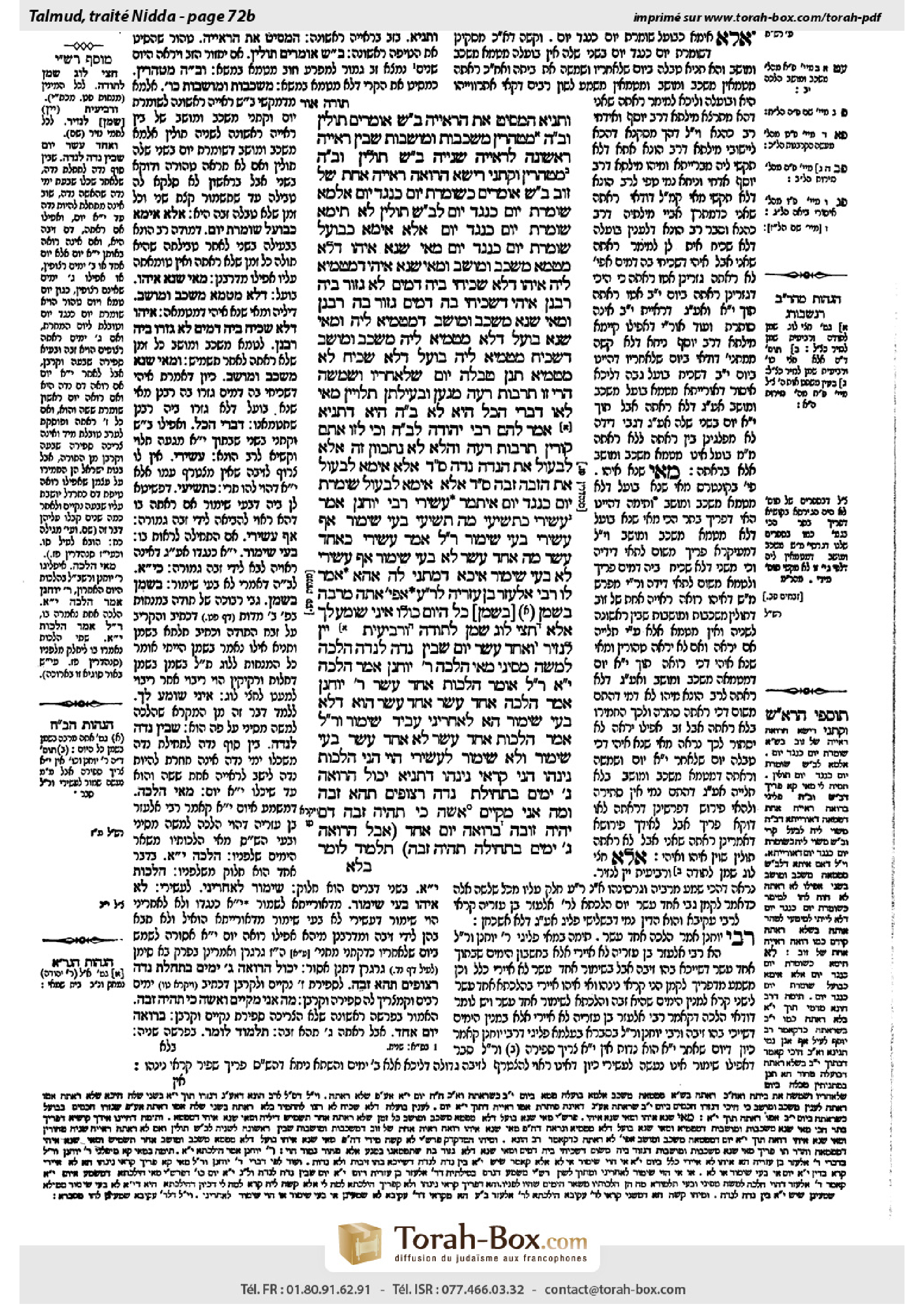
Niddah 72b: Talmud study for Daf Yomi
Daf Yomi is the daily study of one Talmud folio. Explore 37 tractates with scans, Hebrew text, Sefaria English and AI-generated French translations where annotated.
Passage selection and English or AI-generated French translation are available where the scan has annotations. Daf Study is independent of Torah-Box and Sefaria.
Browse Niddah · נידה · All tractatesNiddah 72b text and translations
This page of Niddah includes the Aramaic text, an English translation and an AI-generated French translation, alongside the scan above.
נידה ע״ב ב · Aramaic and Hebrew text
וְתַנְיָא: הַמֵּסִיט אֶת הָרְאִיָּיה — בֵּית שַׁמַּאי אוֹמְרִים: תּוֹלִין, וּבֵית הִלֵּל מְטַהֲרִין.
מִשְׁכָּבוֹת וּמוֹשָׁבוֹת שֶׁבֵּין רְאִיָּיה רִאשׁוֹנָה לִרְאִיָּיה שְׁנִיָּיה, בֵּית שַׁמַּאי תּוֹלִין, וּבֵית הִלֵּל מְטַהֲרִין.
וְקָתָנֵי רֵישָׁא: הָרוֹאָה רְאִיָּיה אַחַת שֶׁל זוֹב, בֵּית שַׁמַּאי אוֹמְרִים: כְּשׁוֹמֶרֶת יוֹם כְּנֶגֶד יוֹם. אַלְמָא שׁוֹמֶרֶת יוֹם כְּנֶגֶד יוֹם לְבֵית שַׁמַּאי תּוֹלִין.
לָא תֵּימָא ״שׁוֹמֶרֶת יוֹם כְּנֶגֶד יוֹם״, אֶלָּא אֵימָא ״כְּבוֹעֵל שׁוֹמֶרֶת יוֹם כְּנֶגֶד יוֹם״.
מַאי שְׁנָא אִיהוּ דְּלָא מְטַמֵּא מִשְׁכָּב וּמוֹשָׁב, וּמַאי שְׁנָא אִיהִי דִּמְטַמְּיָא לֵיהּ?
אִיהוּ דְּלָא שְׁכִיחִי בֵּיהּ דָּמִים — לָא גְּזוּר בֵּיהּ רַבָּנַן, אִיהִי דִּשְׁכִיחִי בַּהּ דָּמִים — גְּזוּר בַּהּ רַבָּנַן.
וּמַאי שְׁנָא מִשְׁכָּב וּמוֹשָׁב — דִּמְטַמְּיָא לֵיהּ, וּמַאי שְׁנָא בּוֹעֵל — דְּלָא מְטַמְּיָא לֵיהּ?
מִשְׁכָּב וּמוֹשָׁב דִּשְׁכִיחַ — מְטַמְּיָא לֵיהּ, בּוֹעֵל דְּלָא שְׁכִיחַ — לָא מְטַמְּיָא.
תְּנַן: טָבְלָה יוֹם שֶׁלְּאַחֲרָיו, וְשִׁמְּשָׁה — הֲרֵי זוֹ תַּרְבּוּת רָעָה.
מַגָּעָן וּבְעִילָתָן תְּלוּיִין. מַאי לַָאו דִּבְרֵי הַכֹּל הִיא?
לָא, בֵּית הִלֵּל הִיא, דְּתַנְיָא: אָמַר לָהֶם רַבִּי יְהוּדָה לְבֵית הִלֵּל: וְכִי לָזוֹ אַתֶּם קוֹרִין תַּרְבּוּת רָעָה? וַהֲלֹא לֹא נִתְכַּוֵּון זֶה אֶלָּא לִבְעוֹל אֶת הַנִּדָּה! נִדָּה סָלְקָא דַּעְתָּךְ?
אֶלָּא אֵימָא: ״לִבְעוֹל אֶת הַזָּבָה״. זָבָה סָלְקָא דַעְתָּךְ? אֶלָּא אֵימָא: ״לִבְעוֹל שׁוֹמֶרֶת יוֹם כְּנֶגֶד יוֹם״.
אִיתְּמַר: עֲשִׂירִי, רַבִּי יוֹחָנָן אָמַר: עֲשִׂירִי כִּתְשִׁיעִי, מָה תְּשִׁיעִי בָּעֵי שִׁימּוּר — אַף עֲשִׂירִי בָּעֵי שִׁימּוּר.
רֵישׁ לָקִישׁ אָמַר: עֲשִׂירִי כְּאַחַד עָשָׂר, מָה אַחַד עָשָׂר לָא בָּעֵי שִׁימּוּר — אַף עֲשִׂירִי לָא בָּעֵי שִׁימּוּר.
אִיכָּא דְמַתְנֵי לַהּ אַהָא, אָמַר לוֹ רַבִּי אֶלְעָזָר בֶּן עֲזַרְיָה לְרַבִּי עֲקִיבָא: אֲפִילּוּ אַתָּה מְרַבֶּה ״בַּשֶּׁמֶן״ [״בַּשֶּׁמֶן״] כָּל הַיּוֹם כּוּלּוֹ, אֵינִי שׁוֹמֵעַ לְךָ! אֶלָּא חֲצִי לוֹג שֶׁמֶן לַתּוֹדָה, וּרְבִיעִית יַיִן לַנָּזִיר, וְאַחַד עָשָׂר יוֹם שֶׁבֵּין נִדָּה לְנִדָּה — הֲלָכָה לְמֹשֶׁה מִסִּינַי.
מַאי הֲלָכָה? רַבִּי יוֹחָנָן אָמַר: הִלְכַת אַחַד עָשָׂר, רֵישׁ לָקִישׁ אוֹמֵר: הִלְכוֹת אַחַד עָשָׂר.
רַבִּי יוֹחָנָן אָמַר: הִלְכַת אַחַד עָשָׂר — אַחַד עָשָׂר הוּא דְּלָא בָּעֵי שִׁימּוּר, הָא לְאַחֲרִינֵי עָבֵיד שִׁימּוּר. וְרֵישׁ לָקִישׁ אָמַר: הִלְכוֹת אַחַד עָשָׂר — לָא אַחַד עָשָׂר בָּעֵי שִׁימּוּר, וְלָא שִׁימּוּר לַעֲשִׂירִי הָוֵי.
הָנֵי הֲלָכוֹת נִינְהוּ? הָנֵי קְרָאֵי נִינְהוּ! דְּתַנְיָא: יָכוֹל הָרוֹאָה שְׁלֹשָׁה יָמִים בִּתְחִילַּת נִדָּה רְצוּפִים תְּהֵא זָבָה.
וּמָה אֲנִי מְקַיֵּים ״אִשָּׁה כִּי תִהְיֶה זָבָה דָּם יִהְיֶה זוֹבָהּ״? בְּרוֹאָה יוֹם אֶחָד, (אֲבָל הָרוֹאָה שְׁלֹשָׁה יָמִים בַּתְּחִילָּה תִּהְיֶה זָבָה), תַּלְמוּד לוֹמַר:
Niddah 72b · English translation
And it is taught in a baraita: If one moves the discharge seen by a zav on the first day, Beit Shammai say: Due to the uncertainty, his status of ritual purity is contingent upon whether he sees another emission. If the zav sees a discharge a second time he will retroactively have been a full-fledged zav and his discharge renders one who moves it impure. But if he does not see another discharge he will remain like one who experienced a seminal emission, which means that his discharge does not render one who moves it impure. And Beit Hillel deem him pure. The discharge has the status of a seminal emission and does not transmit impurity to one who moves it.
The baraita continues: With regard to items designated for lying or sitting and their status between the first sighting and the second sighting, Beit Shammai say: Due to the uncertainty their status of ritual purity is contingent upon whether he sees another emission, and Beit Hillel deem them pure.
Abaye explains Rav Kahana’s difficulty with Rav Huna’s opinion: It is taught in the first clause of the baraita that if a man sees one sighting of ziva, Beit Shammai say: His status is like that of a woman who observes a clean day for a day she experiences a discharge. Apparently, according to the opinion of Beit Shammai the ritual purity status of a woman who observes a clean day for a day she experiences a discharge is contingent upon whether she experiences an emission of blood. This is difficult for Rav Huna, who explains that Beit Shammai hold that a woman who observes a clean day for each day of discharge is definitely impure, by rabbinic law.
The Gemara answers that Rav Huna would explain: Do not say that his status is like that of a woman who observes a clean day for a day. Rather, say that he is like one who engages in intercourse with a woman who observes a clean day for a day after she has immersed. Rav Huna agrees that items designated for lying or sitting that this man sits or lies on is ritually impure only if she experiences bleeding before the end of the day.
The Gemara asks: What is different with regard to him, a man who engages in intercourse with a woman who is observing a clean day for a day, that he does not transmit impurity to items designated for lying or sitting, and what is different with regard to her, that woman herself, that she does transmit impurity to items designated for lying or sitting?
The Gemara explains: With regard to him, as he does not frequently see blood, the Sages did not issue a decree rendering him impure to such an extent, if the woman has not seen blood on the second day. Whereas with regard to her, as she does frequently see blood, the Sages did issue a decree rendering her definitely impure to this degree.
The Gemara further inquires: And since a decree was applied to her, as she commonly sees blood, what is different with regard to items designated for lying or sitting, that she transmits impurity to them, and what is different with regard to the one who engages in intercourse with her, that she does not render him impure?
The Gemara answers: With regard to items designated for lying or sitting, she renders them ritually impure because she frequently sits or lies on them, whereas with regard to one who engages in intercourse with her, which is not nearly as frequent, she does not render him ritually impure.
The Gemara raises another difficulty with regard to Rav Huna’s opinion. We learned in the mishna: If she saw blood on the eleventh day and observed part of a corresponding clean day and immersed on the day following the day that she saw blood and engaged in intercourse with her husband, that is wayward conduct, as the possibility exists that she will experience bleeding after intercourse that will be appended to the bleeding of the previous day, rendering her a zava and disqualifying the immersion.
The mishna adds: And the status of ritually impure items with which they came into contact and the status of their intercourse is contingent upon whether she experiences bleeding on the day of her immersion. The Gemara explains the difficulty. What, is it not correct to say that all, i.e., Beit Shammai and Beit Hillel, agree with this clause of the mishna? If so, Beit Shammai concur that this woman renders items impure only due to uncertainty. This is not in accordance with the statement of Rav Huna.
The Gemara answers: No, this clause of the mishna is only in accordance with the opinion of Beit Hillel. As it is taught in a baraita that Rabbi Yehuda said to Beit Hillel: Do you call this type of behavior wayward conduct? But he intended only to engage in intercourse with a menstruating woman. The Gemara questions the meaning of Rabbi Yehuda’s statement. Can it enter your mind that he intended to engage in intercourse with a menstruating woman? The mishna and baraita are not referring to a man who engages in intercourse with a menstruating woman.
Rather, say that Rabbi Yehuda meant that this man intended only to engage in intercourse with a zava. The Gemara rejects this formulation as well: Can it enter your mind that Rabbi Yehuda said he intended to engage in intercourse with a zava? The mishna and baraita are not referring to a man who engages in intercourse with a zava either. Rather, say that Rabbi Yehuda meant that this man intended to engage in intercourse with a woman who observes a clean day for a day she experiences a discharge. This baraita indicates that the latter clause of the mishna is only according to the opinion of Beit Hillel, as Rabbi Yehuda directed his comments specifically to them.
§ The Gemara cites another discussion concerning a woman who experiences bleeding toward the end of her eleven days of ziva. It was stated with regard to a woman who experiences bleeding on the tenth day of her eleven days of ziva, that Rav Yoḥanan says: The tenth day is considered like the ninth, i.e., just as the ninth day requires the observance of a day clean from discharges on the following day, so too does the tenth day require observance of a day in case she experiences bleeding on the eleventh day.
Reish Lakish says: The tenth day is considered like the eleventh day, as in such a case it is impossible for her to experience bleeding for the three consecutive days within the eleven days of ziva. Just as the eleventh day does not require the observance of a day clean from discharges, so too the tenth day does not require the observance of a day clean from discharges, since even if she experiences bleeding on both the eleventh and the twelfth days, the last of the three consecutive days was already the start of her days of menstruation, and therefore she does not become a greater zava.
There are those who teach the dispute between Rabbi Yoḥanan and Reish Lakish with regard to this case: Rabbi Elazar ben Azarya said to Rabbi Akiva: Even if you were to amplify and derive halakhot from the repeated terms “in oil,” “in oil,” stated with regard to the thanks offering (see Leviticus 7:12) for the entire day, I would not listen to you and accept your claim. Rather, the halakha that one-half of a log is the requisite amount of oil for the thanks offering, and the halakha that one-quarter of a log is the amount of wine for a nazirite, and the halakha that a woman who experiences an emission of blood during the eleven days that are between one period of menstruation and the next period of menstruation is a zava, each of these is a halakha transmitted to Moses from Sinai. None of the halakhot are derived from verses.
The Gemara asks: What is the halakha mentioned here with regard to the eleven days between one period of menstruation and the next? Rabbi Yoḥanan says: It is referring to the halakha that distinguishes the first ten days from the eleventh day. Reish Lakish says: It is referring to two halakhot that distinguish the first ten days from the eleventh.
The Gemara elaborates: Rabbi Yoḥanan says that this is referring to the halakha which distinguishes the first ten days from the eleventh. It is the eleventh that does not require the observance of a day clean from discharges, but for the other ten days she must perform observance. And Reish Lakish says: It is referring to two halakhot that distinguish the first ten days from the eleventh. The eleventh day does not require observance, and it does not serve as a day of observance for the tenth day, i.e., the tenth day also does not require observance. The tenth day does not require observing since day eleven is excluded from being a day of observation for the previous day.
The Gemara raises a difficulty with regard to Rabbi Elazar ben Azarya’s claim that the eleven days of ziva is a halakha transmitted to Moses from Sinai. Are these halakhot transmitted to Moses from Sinai? Not so; rather, these are derived from verses. As it is taught in a baraita: One might have thought that one who sees blood for three consecutive days at the beginning of the days of menstruation will be a zava and is required to count seven clean days and to bring an offering afterward (see Leviticus 15:28–30).
And if so, how do I realize the meaning of the verse: “And if a woman has a flow, and her flow on her flesh be blood, she shall be in her impurity seven days; and whoever touches her shall be impure until the evening” (Leviticus 15:19)? This is referring to one who sees blood on only one day. But perhaps one who sees blood for three days at the beginning of her days of menstruation should become a zava? The verse states:
Niddah 72b · Traduction française (IA)
Et il est enseigné dans une baraïta : Si quelqu’un déplace l’écoulement observé par un zav le premier jour, Beit Chammaï disent : En raison du doute, son statut de pureté rituelle dépend de la question de savoir s’il observera un nouvel écoulement. Si le zav observe un écoulement une deuxième fois, il aura rétroactivement le statut de zav à part entière, et son écoulement rendra impur celui qui le déplace. Mais s’il n’observe pas d’autre écoulement, il conservera le statut de celui qui a eu une émission séminale, ce qui signifie que son écoulement ne rend pas impur celui qui le déplace. Beit Hillel le déclarent pur. L’écoulement a le statut d’une émission séminale et ne transmet pas l’impureté à celui qui le déplace.
La baraïta poursuit : En ce qui concerne les objets destinés à servir de couche ou de siège et leur statut entre le premier et le deuxième écoulement, Beit Chammaï disent : En raison du doute, leur statut de pureté rituelle dépend de la question de savoir s’il observera un nouvel écoulement ; Beit Hillel les déclarent purs.
Abayé explique la difficulté que Rav Kahana soulève à propos de l’opinion de Rav Houna : Dans la première partie de la baraïta, il est enseigné que si un homme observe un seul écoulement de zivah, Beit Chammaï disent : Son statut est celui d’une femme qui observe un jour de pureté pour un jour où elle a eu un écoulement. Il semble donc que, selon Beit Chammaï, le statut de pureté rituelle d’une femme qui observe un jour de pureté pour chaque jour d’écoulement dépend de la question de savoir si elle connaît un nouvel écoulement de sang. Cela pose une difficulté à Rav Houna, qui explique que Beit Chammaï considèrent qu’une femme qui observe un jour de pureté pour chaque jour d’écoulement est certainement impure selon la loi rabbinique.
La Guemara répond que Rav Houna expliquerait ainsi : Ne dis pas que son statut est celui d’une femme qui observe un jour de pureté pour un jour. Dis plutôt qu’il est comme un homme qui a des rapports sexuels avec une femme qui observe un jour de pureté pour un jour, après qu’elle s’est immergée. Rav Houna reconnaît que les objets destinés à servir de couche ou de siège sur lesquels cet homme s’assoit ou s’allonge ne sont rituellement impurs que si elle connaît un saignement avant la fin de la journée.
La Guemara demande : En quoi cet homme, qui a des rapports sexuels avec une femme observant un jour de pureté pour un jour, diffère-t-il, puisqu’il ne transmet pas l’impureté aux objets destinés à servir de couche ou de siège ? Et en quoi cette femme elle-même diffère-t-elle, puisqu’elle transmet l’impureté à ces objets ?
La Guemara explique : En ce qui le concerne, comme il ne voit pas fréquemment de sang, les Sages n’ont pas décrété qu’il soit impur à ce point si la femme n’a pas vu de sang le deuxième jour. En revanche, en ce qui la concerne, comme elle voit fréquemment du sang, les Sages ont décrété qu’elle soit certainement impure à ce degré.
La Guemara poursuit son examen : Et puisqu’un décret a été appliqué à son égard, car elle voit couramment du sang, en quoi les objets destinés à servir de couche ou de siège diffèrent-ils, puisqu’elle leur transmet l’impureté ? Et en quoi celui qui a des rapports sexuels avec elle diffère-t-il, puisqu’elle ne le rend pas impur ?
La Guemara répond : Elle rend ces objets rituellement impurs parce qu’elle s’assoit ou s’allonge fréquemment sur eux, tandis qu’elle ne rend pas rituellement impur celui qui a des rapports sexuels avec elle, car cela se produit beaucoup moins souvent.
La Guemara soulève une autre difficulté à propos de l’opinion de Rav Houna. Nous avons appris dans la Michna : Si elle voit du sang le onzième jour, observe une partie du jour correspondant de pureté, puis s’immerge le jour suivant celui où elle a vu du sang et a des rapports sexuels avec son mari, il s’agit d’une conduite inconsidérée, car il est possible qu’elle saigne après les rapports sexuels. Ce saignement s’ajouterait alors à celui du jour précédent, la rendant zava et invalidant son immersion.
La Michna ajoute : Le statut des objets rituellement impurs avec lesquels ils sont entrés en contact, ainsi que celui de leurs rapports sexuels, dépend de la question de savoir si elle saigne le jour de son immersion. La Guemara expose la difficulté : N’est-il pas exact de dire que tous, c’est-à-dire Beit Chammaï et Beit Hillel, sont d’accord avec cette partie de la Michna ? Si tel est le cas, Beit Chammaï conviennent que cette femme ne rend ces objets impurs qu’en raison d’un doute. Cela n’est pas conforme à l’énoncé de Rav Houna.
La Guemara répond : Non, cette partie de la Michna correspond uniquement à l’opinion de Beit Hillel. Car il est enseigné dans une baraïta que Rabbi Yehouda dit à Beit Hillel : « Appelez-vous ce genre de conduite inconsidérée ? Il avait seulement l’intention d’avoir des rapports sexuels avec une femme menstruée. » La Guemara interroge le sens de la déclaration de Rabbi Yehouda. Peut-on penser qu’il avait l’intention d’avoir des rapports sexuels avec une femme menstruée ? La Michna et la baraïta ne parlent pas d’un homme qui a des rapports sexuels avec une femme menstruée.
Dis plutôt que Rabbi Yehouda voulait dire que cet homme avait seulement l’intention d’avoir des rapports sexuels avec une zava. La Guemara rejette également cette formulation : Peut-on penser que Rabbi Yehouda ait dit qu’il avait l’intention d’avoir des rapports sexuels avec une zava ? La Michna et la baraïta ne parlent pas non plus d’un homme qui a des rapports sexuels avec une zava. Dis plutôt que Rabbi Yehouda voulait dire que cet homme avait seulement l’intention d’avoir des rapports sexuels avec une femme qui observe un jour de pureté pour un jour où elle a eu un écoulement. Cette baraïta indique que la dernière partie de la Michna correspond uniquement à l’opinion de Beit Hillel, puisque Rabbi Yehouda s’adressait spécifiquement à eux.
§ La Guemara cite une autre discussion concernant une femme qui saigne vers la fin de ses onze jours de zivah. Au sujet d’une femme qui saigne le dixième jour de ses onze jours de zivah, Rav Yoḥanan dit : Le dixième jour est considéré comme le neuvième ; autrement dit, de même que le neuvième jour impose d’observer le lendemain un jour sans écoulement, de même le dixième jour impose d’observer un jour, au cas où elle saignerait le onzième jour.
Reish Lakish dit : Le dixième jour est considéré comme le onzième, car dans ce cas, il lui est impossible de saigner pendant trois jours consécutifs au cours des onze jours de zivah. De même que le onzième jour n’impose pas d’observer un jour sans écoulement, de même le dixième jour n’impose pas cette observation, puisque même si elle saigne les onzième et douzième jours, le dernier des trois jours consécutifs tombe déjà au début de ses jours de menstruation ; elle ne devient donc pas une zava de degré supérieur.
Certains enseignent le désaccord entre Rabbi Yoḥanan et Reish Lakish à propos de ce cas : Rabbi Elazar ben Azarya dit à Rabbi Akiva : « Même si tu multipliais les déductions de halakhot à partir des termes répétés “dans l’huile”, “dans l’huile”, énoncés au sujet de l’offrande de gratitude (voir Lévitique 7:12), pour toute la journée, je ne t’écouterais pas et n’accepterais pas ton argument. La halakha selon laquelle la quantité requise d’huile pour l’offrande de gratitude est d’un demi-log, celle selon laquelle la quantité de vin pour un nazir est d’un quart de log, et celle selon laquelle une femme qui connaît un écoulement de sang pendant les onze jours séparant une période de menstruation de la suivante est une zava, sont toutes des halakhot transmises à Moïse au Sinaï. Aucune de ces halakhot n’est déduite de versets. »
La Guemara demande : Quelle est la halakha mentionnée ici à propos des onze jours séparant une période de menstruation de la suivante ? Rav Yoḥanan dit : Il s’agit de la halakha qui distingue les dix premiers jours du onzième. Reish Lakish dit : Il s’agit de deux halakhot qui distinguent les dix premiers jours du onzième.
La Guemara développe : Rav Yoḥanan dit qu’il s’agit de la halakha qui distingue les dix premiers jours du onzième : le onzième jour n’impose pas d’observer un jour sans écoulement, tandis que, pour les dix autres jours, elle doit observer un tel jour. Reish Lakish dit qu’il s’agit de deux halakhot qui distinguent les dix premiers jours du onzième : le onzième jour n’impose pas d’observation et ne sert pas non plus de jour d’observation pour le dixième ; autrement dit, le dixième jour n’impose pas non plus d’observation. Il n’est pas nécessaire d’observer après le dixième jour, puisque le onzième jour ne peut pas servir de jour d’observation pour le jour précédent.
La Guemara soulève une difficulté à propos de l’affirmation de Rabbi Elazar ben Azarya selon laquelle les onze jours de zivah constituent une halakha transmise à Moïse au Sinaï. Ces halakhot sont-elles transmises à Moïse au Sinaï ? Ce n’est pas le cas : elles sont plutôt déduites de versets. Car il est enseigné dans une baraïta : On aurait pu penser que celle qui voit du sang pendant trois jours consécutifs au début de ses jours de menstruation devient une zava, doit compter sept jours de pureté, puis apporter un sacrifice (voir Lévitique 15:28–30).
Et si tel était le cas, comment comprendre le sens du verset : « Si une femme a un écoulement et que cet écoulement sur sa chair soit du sang, elle restera sept jours dans son impureté ; quiconque la touchera sera impur jusqu’au soir » (Lévitique 15:19) ? Cela fait référence à celle qui voit du sang un seul jour. Mais peut-être celle qui voit du sang pendant trois jours au début de ses jours de menstruation devrait-elle devenir une zava ? Le verset dit :
Traduction française générée par IA à partir de l’édition anglaise de Sefaria. Vérifie toujours un passage avec le texte source.
Text from Sefaria: William Davidson Edition - Vocalized Aramaic (CC BY NC); William Davidson Edition - English (CC BY NC).