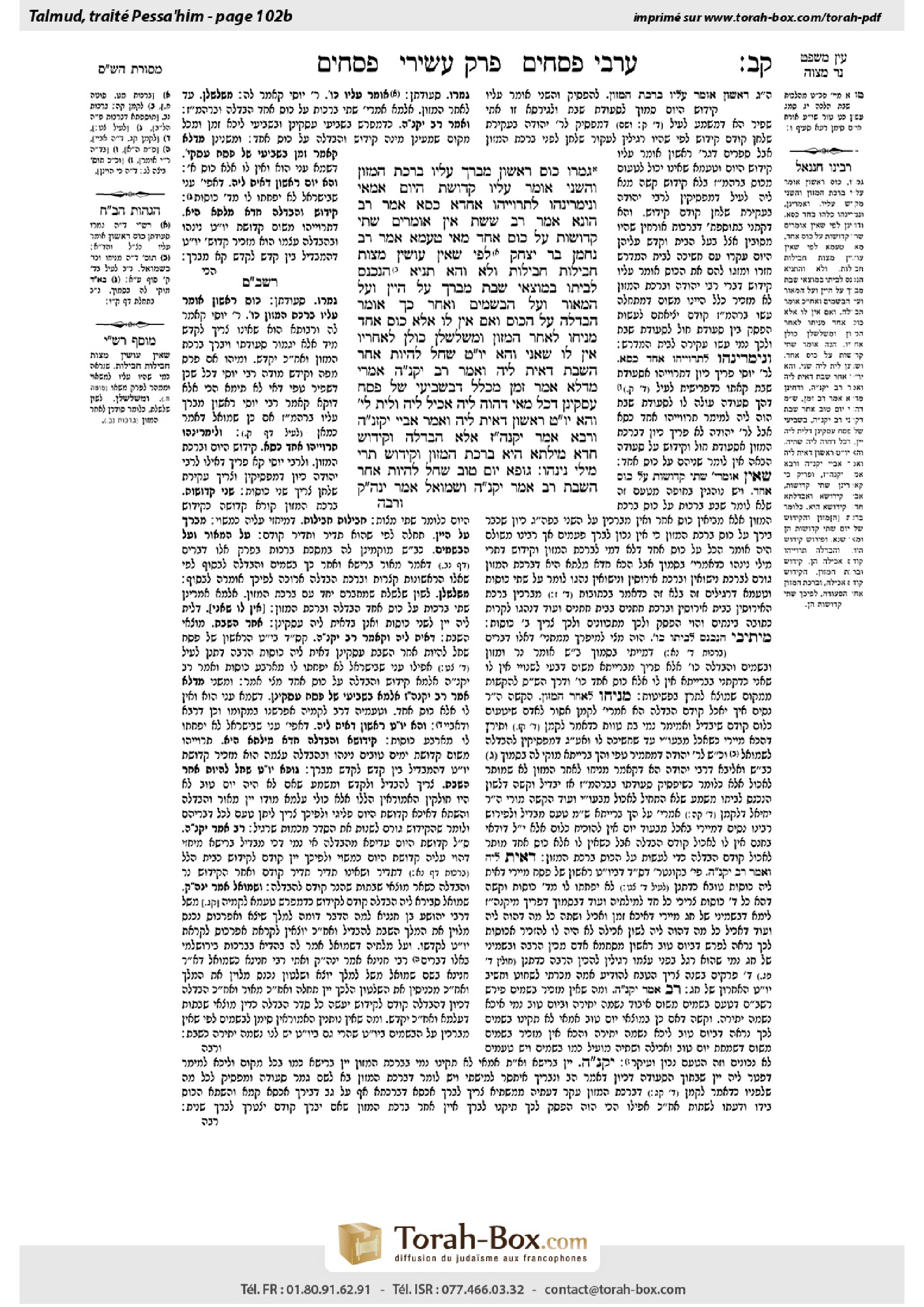
Pesachim 102b: Talmud study for Daf Yomi
Daf Yomi is the daily study of one Talmud folio. Explore 37 tractates with scans, Hebrew text, Sefaria English and AI-generated French translations where annotated.
Passage selection and English or AI-generated French translation are available where the scan has annotations. Daf Study is independent of Torah-Box and Sefaria.
Browse Pesachim · פסחים · All tractatesPesachim 102b text and translations
This page of Pesachim includes the Aramaic text, an English translation and an AI-generated French translation, alongside the scan above.
פסחים ק״ב ב · Aramaic and Hebrew text
גָּמְרוּ, כּוֹס רִאשׁוֹן מְבָרֵךְ עָלָיו בִּרְכַּת הַמָּזוֹן וְהַשֵּׁנִי אוֹמֵר עָלָיו קְדוּשַּׁת הַיּוֹם. אַמַּאי? וְנֵימְרִינְהוּ לְתַרְוַיְיהוּ אַחֲדָא כָּסָא!
אָמַר רַב הוּנָא אָמַר רַב שֵׁשֶׁת: אֵין אוֹמְרִים שְׁתֵּי קְדוּשּׁוֹת עַל כּוֹס אֶחָד. מַאי טַעְמָא? אָמַר רַב נַחְמָן בַּר יִצְחָק: לְפִי שֶׁאֵין עוֹשִׂין מִצְוֹת חֲבִילוֹת חֲבִילוֹת.
וְלָא? וְהָא תַּנְיָא: הַנִּכְנָס לְבֵיתוֹ בְּמוֹצָאֵי שַׁבָּת מְבָרֵךְ עַל הַיַּיִן וְעַל הַמָּאוֹר וְעַל הַבְּשָׂמִים, וְאַחַר כָּךְ אוֹמֵר הַבְדָּלָה עַל הַכּוֹס. וְאִם אֵין לוֹ אֶלָּא כּוֹס אֶחָד — מַנִּיחוֹ לְאַחַר הַמָּזוֹן וּמְשַׁלְשְׁלָן כּוּלָּן לְאַחֲרָיו. אֵין לוֹ שָׁאנֵי.
וְהָא יוֹם טוֹב שֶׁחָל לִהְיוֹת אַחַר הַשַּׁבָּת, דְּאִית לֵיהּ, וְאָמַר רַב יַקְנֶ״ה!
אָמְרִי: מִדְּלָא אָמַר זְמַן, מִכְּלָל דְּבִשְׁבִיעִי שֶׁל פֶּסַח עָסְקִינַן, דְּכׇל מַאי דַּהֲוָה לֵיהּ אָכֵיל לֵיהּ, וְלֵית לֵיהּ.
וְהָא יוֹם טוֹב רִאשׁוֹן דְּאִית לֵיהּ, וְאָמַר אַבָּיֵי: יַקְזְנָ״ה, וְרָבָא אָמַר: יַקְנְהָ״ז.
אֶלָּא: הַבְדָּלָה וְקִידּוּשׁ חֲדָא מִילְּתָא הִיא, בִּרְכַּת הַמָּזוֹן וְקִידּוּשׁ תְּרֵי מִילֵּי נִינְהוּ.
גּוּפָא. יוֹם טוֹב שֶׁחָל לִהְיוֹת אַחַר הַשַּׁבָּת, רַב אָמַר: יַקְנֶ״ה. וּשְׁמוּאֵל אָמַר: יִנְהַ״ק.
Pesachim 102b · English translation
Rabbi Yosei maintains that once they have finished their meal, they bring out two cups; over the first cup one recites the Grace after Meals, and over the second cup he recites the sanctification of the day. The Gemara asks: Why do they need two cups? And let them say both of them, Grace after Meals and kiddush, over one cup.
Rav Huna said that Rav Sheshet said: One does not recite two sanctifications, i.e., for two mitzvot such as Grace after Meals and kiddush, over one cup. What is the reason for this halakha? Rav Naḥman bar Yitzḥak said: Because one does not perform mitzvot in bundles. If someone performs multiple mitzvot all in one go, he gives the impression that they are a burdensome obligation that he wants to complete as fast as possible.
And does one not perform multiple mitzvot together? But wasn’t it taught in a baraita: One who enters his home at the conclusion of Shabbat recites the blessing over the wine, and then over the light, and then over the spices, and thereafter he recites havdala over the cup of wine. And if he has only one cup of wine, he leaves it for after he eats his food, and uses it for Grace after Meals, and arranges all of the other blessings together thereafter. This baraita indicates that one may use the same cup both for Grace after Meals and havdala. The Gemara answers: We cannot prove anything from here, as a case where one does not have an additional cup is different. One who has two cups of wine is required to recite Grace after Meals over one of the cups and havdala over the other one.
The Gemara continues its line of questioning: But there is the case of a Festival that occurs after Shabbat, when presumably one has enough wine. And nevertheless, Rav said that the proper order of the blessings is according to the Hebrew acronym yod, kuf, nun, heh: The blessing over the wine [yayin], kiddush, the blessing over the candle [ner], and havdala. This ruling shows that one recites kiddush and havdala over the same cup of wine.
They say in answer to this question: From the fact that Rav did not say that one recites the blessing for time, Who has given us life [sheheḥiyanu], sustained us, and brought us to this time, this proves by inference that we are dealing with the seventh day of Passover, which is the only Festival day on which one does not recite the blessing for time. If so, it is possible that whatever wine this person had, he has already consumed over the course of the Festival, and he does not have enough wine left for two separate cups.
The Gemara asks: But there is the case of the first Festival night that occurs after Shabbat, when one has wine, and nevertheless Abaye said that the order of the blessings in this instance follows the Hebrew acronym yod, kuf, zayin, nun, heh: The blessing over wine [yayin]; kiddush; the blessing for time [zeman]; the blessing over the candle [ner]; and havdala. And Rava said that the order of the blessings is in accordance with the acronym yod, kuf, nun, heh, zayin: Wine [yayin]; kiddush; candle [ner]; havdala; and the blessing for time [zeman]. Although Abaye and Rava dispute the correct order of the blessings, they agree that one recites multiple blessings over a single cup of wine.
Rather, the Gemara rejects the previous explanation in favor of the following: Havdala and kiddush are one matter, as they both mark and draw attention to the sanctity of certain days. By contrast, Grace after Meals and kiddush are two entirely different matters. Therefore, one who recites both of them over the same cup of wine is combining two unrelated mitzvot, apparently so that he can be done with them as quickly as possible. Consequently, this practice is prohibited.
After raising the issue of the proper order of the blessings for kiddush on a Festival that occurs right after Shabbat, the Gemara addresses the matter itself. With regard to a Festival that occurs after Shabbat, Rav said that the proper order of the blessings follows the acronym yod, kuf, nun, heh: Wine [yayin], kiddush, candle [ner], and havdala; and Shmuel said the proper order is yod, nun, heh, kuf: Wine [yayin], candle [ner], havdala, and kiddush.
Pesachim 102b · Traduction française (IA)
Rabbi Yossei soutient qu’une fois le repas terminé, on apporte deux coupes : sur la première, on récite la bénédiction après le repas, et sur la seconde, la sanctification du jour. La Guemara demande : Pourquoi faut-il deux coupes ? Ne peut-on pas réciter les deux bénédictions, celle après le repas et le kiddouch, sur une seule coupe ?
Rav Houna a dit au nom de Rav Chéchet : On ne récite pas deux sanctifications, c’est-à-dire pour deux mitsvot telles que la bénédiction après le repas et le kiddouch, sur une seule coupe. Quelle est la raison de cette halakha ? Rav Naḥman bar Yitsḥak a dit : Parce qu’on n’accomplit pas les mitsvot en faisceau. Si quelqu’un accomplit plusieurs mitsvot toutes à la fois, il donne l’impression qu’elles sont des obligations pesantes dont il veut s’acquitter au plus vite.
Mais n’accomplit-on donc pas plusieurs mitsvot ensemble ? N’a-t-on pas enseigné dans une baraïta : Celui qui rentre chez lui à la fin du Chabbat récite la bénédiction sur le vin, puis celle sur la lumière, puis celle sur les aromates, et ensuite la havdala sur la coupe de vin. S’il n’a qu’une seule coupe de vin, il la garde pour après le repas et l’utilise pour la bénédiction après le repas, puis récite ensemble toutes les autres bénédictions. Cette baraïta indique qu’on peut utiliser la même coupe pour la bénédiction après le repas et la havdala. La Guemara répond : On ne peut rien en déduire, car le cas où l’on ne dispose pas d’une coupe supplémentaire est différent. Celui qui a deux coupes de vin doit réciter la bénédiction après le repas sur l’une et la havdala sur l’autre.
La Guemara poursuit son raisonnement : Mais il y a le cas d’un jour de fête qui tombe après le Chabbat, où l’on a vraisemblablement suffisamment de vin. Pourtant, Rav a dit que l’ordre approprié des bénédictions suit l’acronyme hébreu yod, kuf, nun, hé : la bénédiction sur le vin [yayin], le kiddouch, la bénédiction sur la bougie [ner], puis la havdala. Cette décision montre que l’on récite le kiddouch et la havdala sur la même coupe de vin.
On répond à cette question : Le fait que Rav n’ait pas mentionné la bénédiction du temps, « Qui nous a fait vivre » [sheheḥiyanu], nous a soutenus et nous a fait parvenir à ce moment, prouve par déduction qu’il s’agit du septième jour de Pessaḥ, le seul jour de fête où l’on ne récite pas la bénédiction du temps. Dans ce cas, il est possible que cette personne ait déjà consommé tout le vin dont elle disposait au cours de la fête et qu’il ne lui en reste pas assez pour remplir deux coupes distinctes.
La Guemara demande : Mais il y a le cas de la première nuit de fête qui tombe après le Chabbat, où l’on a du vin. Pourtant, Abayé a dit que l’ordre des bénédictions dans ce cas suit l’acronyme hébreu yod, kuf, zayin, nun, hé : la bénédiction sur le vin [yayin], le kiddouch, la bénédiction du temps [zeman], la bénédiction sur la bougie [ner], puis la havdala. Rava a dit, quant à lui, que l’ordre suit l’acronyme yod, kuf, nun, hé, zayin : le vin [yayin], le kiddouch, la bougie [ner], la havdala, puis la bénédiction du temps [zeman]. Bien qu’Abayé et Rava soient en désaccord sur l’ordre correct des bénédictions, ils conviennent que l’on récite plusieurs bénédictions sur une seule coupe de vin.
La Guemara écarte plutôt l’explication précédente et propose la suivante : la havdala et le kiddouch relèvent d’un même domaine, car tous deux marquent et mettent en évidence la sainteté de certains jours. En revanche, la bénédiction après le repas et le kiddouch relèvent de domaines entièrement différents. Par conséquent, celui qui les récite tous deux sur la même coupe de vin associe deux mitsvot sans lien, apparemment pour s’en acquitter au plus vite. Cette pratique est donc interdite.
Après avoir soulevé la question de l’ordre approprié des bénédictions pour le kiddouch lors d’un jour de fête qui suit immédiatement le Chabbat, la Guemara examine la question elle-même. Pour un jour de fête qui tombe après le Chabbat, Rav a dit que l’ordre approprié des bénédictions suit l’acronyme yod, kuf, nun, hé : le vin [yayin], le kiddouch, la bougie [ner], puis la havdala ; et Chmouel a dit que l’ordre suit yod, nun, hé, kuf : le vin [yayin], la bougie [ner], la havdala, puis le kiddouch.
Traduction française générée par IA à partir de l’édition anglaise de Sefaria. Vérifie toujours un passage avec le texte source.
Text from Sefaria: William Davidson Edition - Vocalized Aramaic (CC BY NC); William Davidson Edition - English (CC BY NC).