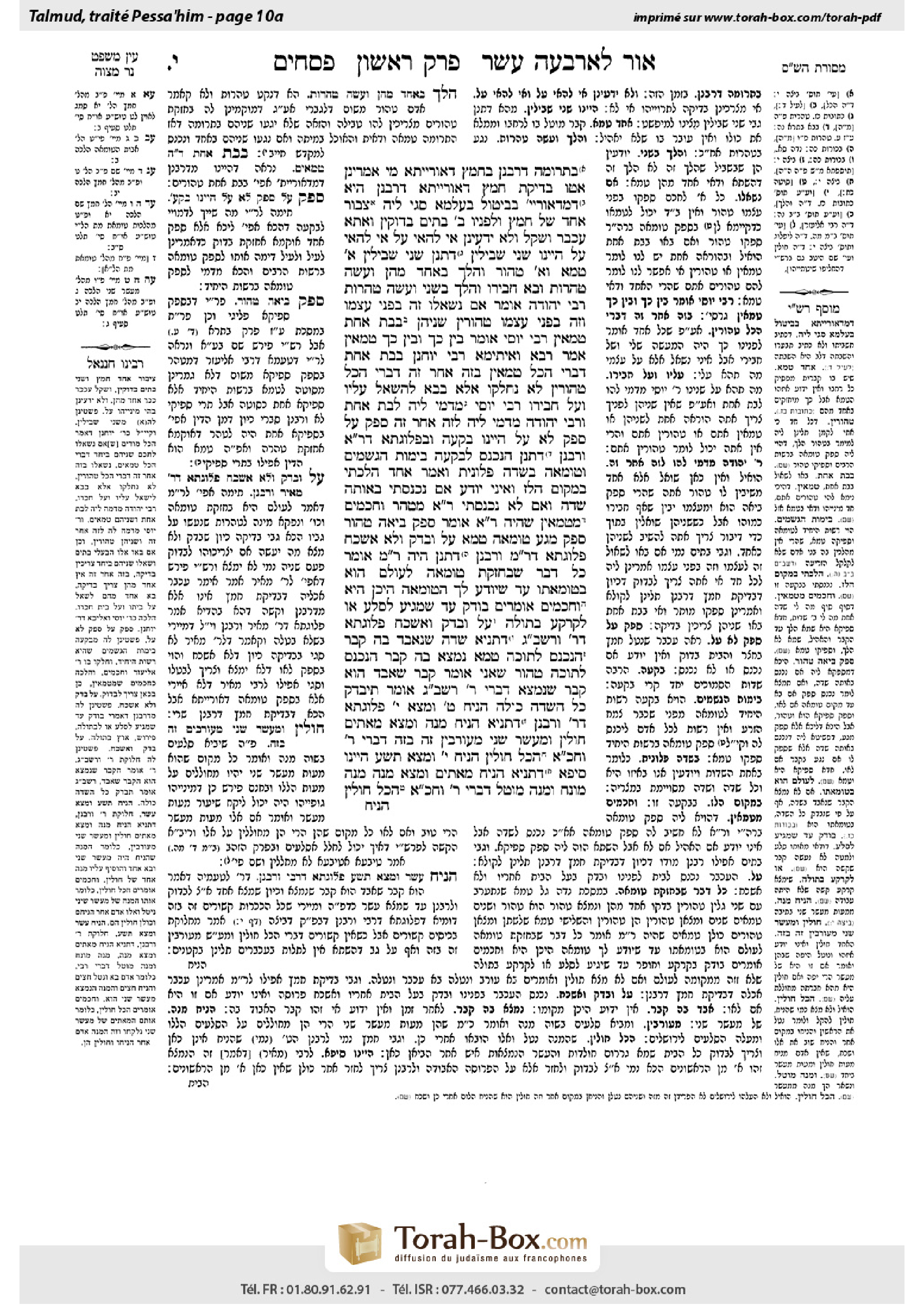
Pesachim 10a: Talmud study for Daf Yomi
Daf Yomi is the daily study of one Talmud folio. Explore 37 tractates with scans, Hebrew text, Sefaria English and AI-generated French translations where annotated.
Passage selection and English or AI-generated French translation are available where the scan has annotations. Daf Study is independent of Torah-Box and Sefaria.
Browse Pesachim · פסחים · All tractatesPesachim 10a text and translations
This page of Pesachim includes the Aramaic text, an English translation and an AI-generated French translation, alongside the scan above.
פסחים י׳ א · Aramaic and Hebrew text
בִּתְרוּמָה דְּרַבָּנַן. בְּחָמֵץ דְּאוֹרָיְיתָא מִי אָמְרִינַן?! אַטּוּ בְּדִיקַת חָמֵץ דְּאוֹרָיְיתָא? דְּרַבָּנַן הִיא! דְּמִדְּאוֹרָיְיתָא בְּבִיטּוּל בְּעָלְמָא סַגִּי לֵיהּ.
צִבּוּר אֶחָד שֶׁל חָמֵץ וּלְפָנָיו שְׁנֵי בָתִּים בְּדוּקִין, וַאֲתָא עַכְבָּר וּשְׁקַל, וְלָא יָדְעִינַן אִי לְהַאי עָל אִי לְהַאי עָל — הַיְינוּ שְׁנֵי שְׁבִילִין. דִּתְנַן: שְׁנֵי שְׁבִילִין, אֶחָד טָמֵא וְאֶחָד טָהוֹר, וְהָלַךְ בְּאֶחָד מֵהֶן וְעָשָׂה טְהָרוֹת, וּבָא חֲבֵירוֹ וְהָלַךְ בַּשֵּׁנִי וְעָשָׂה טְהָרוֹת.
רַבִּי יְהוּדָה אוֹמֵר: אִם נִשְׁאֲלוּ זֶה בִּפְנֵי עַצְמוֹ וְזֶה בִּפְנֵי עַצְמוֹ — טְהוֹרִין. שְׁנֵיהֶן בְּבַת אַחַת — טְמֵאִין. רַבִּי יוֹסִי אוֹמֵר: בֵּין כָּךְ וּבֵין כָּךְ טְמֵאִין.
אָמַר רָבָא וְאִיתֵּימָא רַבִּי יוֹחָנָן: בְּבַת אַחַת — דִּבְרֵי הַכֹּל טְמֵאִין. בְּזֶה אַחַר זֶה — דִּבְרֵי הַכֹּל טְהוֹרִין. לֹא נֶחְלְקוּ אֶלָּא בְּבָא לְהִשָּׁאֵל עָלָיו וְעַל חֲבֵירוֹ. רַבִּי יוֹסֵי מְדַמֵּי לֵיהּ לְבַת אַחַת, וְרַבִּי יְהוּדָה מְדַמֵּי לֵיהּ לְזֶה אַחַר זֶה.
סָפֵק עָל, סָפֵק לָא עָל — הַיְינוּ בִּקְעָה, וּבִפְלוּגְתָּא דְּרַבִּי אֱלִיעֶזֶר וְרַבָּנַן.
דִּתְנַן: הַנִּכְנָס לְבִקְעָה בִּימוֹת הַגְּשָׁמִים, וְטוּמְאָה בְּשָׂדֶה פְּלוֹנִית, וְאָמַר אֶחָד: הָלַכְתִּי בַּמָּקוֹם הַלָּז, וְאֵינִי יוֹדֵעַ אִם נִכְנַסְתִּי בְּאוֹתָהּ שָׂדֶה וְאִם לֹא נִכְנַסְתִּי. רַבִּי אֱלִיעֶזֶר מְטַהֵר, וַחֲכָמִים מְטַמְּאִין.
שֶׁהָיָה רַבִּי אֱלִיעֶזֶר אוֹמֵר: סְפֵק בִּיאָה — טָהוֹר, סְפֵק מַגַּע טוּמְאָה — טָמֵא.
עָל, וּבְדַק וְלָא אַשְׁכַּח — פְּלוּגְתָּא דְּרַבִּי מֵאִיר וְרַבָּנַן, דִּתְנַן: הָיָה רַבִּי מֵאִיר אוֹמֵר: כׇּל דָּבָר שֶׁבְּחֶזְקַת טוּמְאָה, לְעוֹלָם הוּא בְּטוּמְאָתוֹ עַד שֶׁיִּוָּדַע לָךְ הַטּוּמְאָה הֵיכָן הִיא.
וַחֲכָמִים אוֹמְרִים: בּוֹדֵק עַד שֶׁמַּגִּיעַ לְסֶלַע אוֹ לְקַרְקַע בְּתוּלָה.
עָל, וּבְדַק וְאַשְׁכַּח — פְּלוּגְתָּא דְּרַבִּי וְרַבָּן שִׁמְעוֹן בֶּן גַּמְלִיאֵל.
דְּתַנְיָא: שָׂדֶה שֶׁנֶּאֱבַד בָּהּ קֶבֶר — הַנִּכְנָס לְתוֹכָהּ טָמֵא. נִמְצָא בָּהּ קֶבֶר — הַנִּכְנָס לְתוֹכָהּ טָהוֹר, שֶׁאֲנִי אוֹמֵר: קֶבֶר שֶׁאָבַד הוּא קֶבֶר שֶׁנִּמְצָא — דִּבְרֵי רַבִּי. רַבָּן שִׁמְעוֹן בֶּן גַּמְלִיאֵל אוֹמֵר: תִּיבָּדֵק כׇּל הַשָּׂדֶה כּוּלָּהּ.
הִנִּיחַ תֵּשַׁע וּמָצָא עֶשֶׂר — פְּלוּגְתָּא דְּרַבִּי וְרַבָּנַן. דְּתַנְיָא: הִנִּיחַ מָנֶה וּמָצָא מָאתַיִם, חוּלִּין וּמַעֲשֵׂר שֵׁנִי מְעוֹרָבִין זֶה בָּזֶה — דִּבְרֵי רַבִּי.
וַחֲכָמִים אוֹמְרִים: הַכֹּל חוּלִּין.
הִנִּיחַ עֶשֶׂר וּמָצָא תֵּשַׁע הַיְינוּ סֵיפָא, דְּתַנְיָא: הִנִּיחַ מָאתַיִם וּמָצָא מָנֶה — מָנֶה מוּנָּח וּמָנֶה מוּטָל, דִּבְרֵי רַבִּי.
וַחֲכָמִים אוֹמְרִים: הַכֹּל חוּלִּין.
Pesachim 10a · English translation
only with regard to teruma that in modern times is sacred by rabbinic law, as the Torah obligation to separate teruma was abrogated after the destruction of the First Temple. However, with regard to leavened bread, which is prohibited by Torah law, do we say that this principle applies? The Gemara responds: Is that to say that the search for leavened bread is required by Torah law? It is a rabbinic ordinance, as by Torah law, mere nullification is sufficient. Since the issue at hand is not the Torah prohibition of leaven but the rabbinic ordinance to search one’s house, this halakha is comparable to the case of baskets of teruma and non-sacred produce.
The Gemara presents another situation: In a case where there is one pile of leavened bread and before it there are two houses that were searched, and a mouse came and took a morsel from the pile, and we do not know if it entered this house or if it entered that house, this is akin to the case of two paths, as we learned in a mishna: There were two paths, one of which was ritually impure due to a corpse buried there, and one of which was ritually pure. And someone walked on one of them, but he does not remember which, and afterward he engaged in handling items of ritual purity, e.g., teruma or consecrated items; and another person came and walked on the second path, and he too does not remember which path it was, and he also engaged in handling items of ritual purity.
Rabbi Yehuda says: If this one asked a Sage by himself, and that one asked a Sage by himself, they are both pure. When considered separately, each person retains his presumptive status of ritual purity. However, if they both came to ask at the same time, they are both ritually impure. Since one of the two certainly passed on the impure path, even though it is uncertain which, both are deemed impure due to that uncertainty. Rabbi Yosei says: One way or another they are both ritually impure.
Rava said, and some say it was Rabbi Yoḥanan who said: If they came at the same time, everyone agrees that they are ritually impure, as even Rabbi Yehuda concedes that this is the halakha. If they came independently, one after the other, everyone agrees that they are ritually pure. They disagree only with regard to a case where one comes to ask about himself and about the other. Rabbi Yosei likens this case to one where they come to ask at the same time, and Rabbi Yehuda likens it to a case where they come one after the other.
The Gemara addresses another case: If one saw a mouse take leaven and there is uncertainty whether the mouse entered a house that was already searched and uncertainty whether the mouse did not enter that house, that is akin to the halakha of ritual impurity in a valley, and is subject to the dispute between Rabbi Eliezer and the Rabbis.
As we learned in a mishna with regard to one who enters a valley during the rainy season, when seeds are sprouting, people do not have permission to wander in the field of another, as they might harm the plants. For the purpose of this halakha a valley in the rainy season is considered a private domain, and there is a general principle that in the case of uncertainty concerning whether or not one contracted ritual impurity in a private domain he is ritually impure. And if there was ritual impurity in a certain field, and one person said: I walked in that place, in the valley, and I do not know whether I entered that field or whether I did not enter, Rabbi Eliezer deems him pure, and the Rabbis deem him impure.
Rabbi Eliezer deems him pure, as Rabbi Eliezer would say: Concerning uncertainty with regard to entry, i.e., whether or not he entered the place, he is ritually pure; however, if one certainly entered the place and the uncertainty is with regard to contact with ritual impurity, he is ritually impure. According to this opinion, the principle with regard to uncertain impurity in the private domain applies only in a case where the uncertainty is with regard to contact. The Rabbis, however, do not distinguish between these situations, as they maintain he is impure regardless of whether the uncertainty is with regard to entry or with regard to contact. This dispute applies to the case of whether or not one is required to conduct an additional search for leaven in a case where there is uncertainty whether or not leaven was taken into the house.
The Gemara discusses another case: If one saw a mouse enter a house with leaven in its mouth and someone searched and did not find any leaven there, this is akin to the dispute between Rabbi Meir and the Rabbis. As we learned in a mishna, Rabbi Meir would say: Any object that has the presumptive status of ritual impurity, i.e., it is certain that an impure object was buried in a particular place, that place forever remains in its ritual impurity, even if it was excavated and the source of impurity was not found, until it becomes known to you where the ritual impurity is. The assumption is that the impurity was not found because the search was not conducted properly.
And the Rabbis say in this case: He continues searching until he reaches bedrock or virgin soil, under which there is certainly no ritual impurity. If he searched that extensively and failed to discover any impurity, it is apparently no longer there. This dispute applies to the aforementioned case involving leaven.
The Gemara analyzes yet another case: If one saw a mouse enter a house with leaven in its mouth and one searched and found a morsel of leaven there, but there is uncertainty whether or not the morsel that he found is the morsel that the mouse took into the house, this would be akin to the dispute between Rabbi Yehuda HaNasi and Rabban Shimon ben Gamliel.
As it was taught in a baraita: With regard to a field in which a grave was lost, i.e., there is certainly a grave located in the field but its precise location is unknown, one who enters the field is ritually impure, as he might have stepped on the grave. If a grave was later found and marked in the field, one who enters and walks on the other parts of the field is ritually pure, as I say: The grave that was previously lost is the grave that was subsequently found. This is the statement of Rabbi Yehuda HaNasi. Rabban Shimon ben Gamliel says: The entire field must be searched, as perhaps the grave discovered is not the one that was lost. This dispute applies to the above case of leaven.
The Gemara discusses another situation: If a person placed nine morsels of leaven and found ten, indicating that mice had added at least one morsel, this is akin to the dispute between Rabbi Yehuda HaNasi and the Rabbis. As it was taught in a baraita with regard to a person who placed a maneh, one hundred dinars, of second tithe, and found two hundred dinars: Since it is evident that someone came and placed at least one extra maneh there whose status is unclear, the pile is presumed to contain non-sacred money and second-tithe money intermingled with each other. The assumption is that the additional money is non-sacred, and it is impossible to determine which is the non-sacred money and which is the second-tithe money. This is the statement of Rabbi Yehuda HaNasi.
And the Rabbis say: It is all non-sacred money. Since someone else was clearly involved, it is possible that he took the maneh and left behind two hundred other dinars. Consequently, it is impossible to identify any of this money as the original maneh. This same reasoning can be applied to the case of leaven. Since there were undoubtedly mice present, it is possible that the mice took the morsels, moved them, and replaced them with other morsels. As a result, the entire house must be searched again.
The Gemara raises the reverse situation. If one placed ten morsels and found nine, this is comparable to the case mentioned in the latter clause of that same baraita, as it was taught in the baraita: If one left two hundred dinars of second-tithe money and found a maneh, presumably, one maneh from the initial two hundred remains placed, and the other maneh is taken and missing. This is the statement of Rabbi Yehuda HaNasi.
And the Rabbis say, in keeping with their aforementioned opinion: It is all non-sacred money, as the assumption is that whoever took part of the money actually took it all, and this is a different maneh. Since it is different money, it is presumably non-sacred money, not second-tithe money. This dispute applies to the case where one finds fewer morsels of leaven than he left.
Pesachim 10a · Traduction française (IA)
Cela ne vaut que pour la terouma qui, de nos jours, n’est sacrée qu’en vertu d’une loi rabbinique, puisque l’obligation de prélever la terouma imposée par la Torah a été abrogée après la destruction du Premier Temple. Mais, pour le pain levé, interdit par la Torah, peut-on dire que ce principe s’applique ? La Guemara répond : Est-ce à dire que la recherche du pain levé est une obligation de la Torah ? C’est une ordonnance rabbinique, car, selon la Torah, il suffit de l’annuler. Puisque la question ne porte pas sur l’interdiction du levain par la Torah, mais sur l’ordonnance rabbinique imposant de fouiller sa maison, cette halakha est comparable au cas des paniers de terouma et de produits non consacrés.
La Guemara présente une autre situation : il y a un tas de pain levé et, devant lui, deux maisons qui ont été fouillées. Une souris vient prendre un morceau dans le tas, mais on ignore si elle est entrée dans cette maison ou dans l’autre. Cela ressemble au cas des deux chemins, comme nous l’avons appris dans une Michna : il y avait deux chemins, dont l’un était rituellement impur parce qu’un mort y était enterré, tandis que l’autre était rituellement pur. Quelqu’un a emprunté l’un d’eux, mais ne se souvient plus lequel, puis a manipulé des objets soumis aux règles de pureté rituelle, par exemple de la terouma ou des objets consacrés. Une autre personne a ensuite emprunté le second chemin, sans se souvenir non plus lequel c’était, et a elle aussi manipulé des objets soumis aux règles de pureté rituelle.
Rabbi Yehouda dit : si l’un a consulté un Sage de son côté et l’autre a consulté un Sage de son côté, ils sont tous deux purs. Considérés séparément, chacun conserve son statut présumé de pureté rituelle. Cependant, s’ils sont venus consulter en même temps, ils sont tous deux rituellement impurs. Puisque l’un des deux a certainement emprunté le chemin impur, même si l’on ignore lequel, tous deux sont considérés comme impurs en raison de cette incertitude. Rabbi Yossei dit : dans tous les cas, ils sont tous deux rituellement impurs.
Rava a dit — et certains disent que c’est Rabbi Yo’hanan qui l’a dit : s’ils sont venus en même temps, tous sont d’accord qu’ils sont rituellement impurs, car même Rabbi Yehouda reconnaît que telle est la halakha. S’ils sont venus séparément, l’un après l’autre, tous sont d’accord qu’ils sont rituellement purs. Leur désaccord ne porte que sur le cas où l’un vient consulter au sujet de lui-même et de l’autre. Rabbi Yossei assimile ce cas à celui où ils viennent consulter en même temps, tandis que Rabbi Yehouda l’assimile à celui où ils viennent l’un après l’autre.
La Guemara aborde un autre cas : si quelqu’un a vu une souris prendre du pain levé et qu’il y a une incertitude quant au fait que la souris soit entrée dans une maison déjà fouillée ou qu’elle n’y soit pas entrée, cela ressemble à la règle de l’impureté rituelle dans une vallée et relève du désaccord entre Rabbi Eliezer et les Sages.
En effet, nous avons appris dans une Michna, au sujet de celui qui entre dans une vallée pendant la saison des pluies, lorsque les semences poussent, que les gens ne sont pas autorisés à circuler dans le champ d’autrui, car ils risqueraient d’endommager les plantes. Pour l’application de cette halakha, une vallée durant la saison des pluies est considérée comme un domaine privé ; or, un principe général veut que, lorsqu’on ignore si l’on a contracté ou non une impureté rituelle dans un domaine privé, on est rituellement impur. Si un champ donné était impur rituellement et qu’une personne a dit : « J’ai marché à cet endroit, dans la vallée, mais je ne sais pas si je suis entrée dans ce champ ou non », Rabbi Eliezer la déclare pure, tandis que les Sages la déclarent impure.
Rabbi Eliezer la déclare pure, car, selon lui, en cas d’incertitude quant à l’entrée, c’est-à-dire quant au fait d’être entré ou non dans l’endroit, on est rituellement pur. En revanche, si l’on est certainement entré dans l’endroit et que l’incertitude porte sur le contact avec l’impureté rituelle, on est rituellement impur. Selon cette opinion, le principe relatif à une impureté incertaine dans un domaine privé ne s’applique que lorsque l’incertitude porte sur le contact. Les Sages, eux, ne distinguent pas ces situations : ils estiment que la personne est impure, que l’incertitude porte sur l’entrée ou sur le contact. Ce désaccord s’applique au cas où l’on se demande s’il faut procéder à une recherche supplémentaire du levain alors qu’on ignore si du levain a été introduit dans la maison.
La Guemara examine un autre cas : si quelqu’un a vu une souris entrer dans une maison avec du pain levé dans la bouche, puis qu’une personne a fouillé sans y trouver de pain levé, cela ressemble au désaccord entre Rabbi Meïr et les Sages. En effet, nous avons appris dans une Michna que Rabbi Meïr disait : tout objet ayant un statut présumé d’impureté rituelle — c’est-à-dire lorsqu’il est certain qu’un objet impur a été enterré à un endroit donné — maintient cet endroit dans son état d’impureté rituelle pour toujours, même si l’on a creusé sans trouver la source de l’impureté, jusqu’à ce que l’on sache où se trouve l’impureté rituelle. On suppose que l’impureté n’a pas été trouvée parce que la recherche n’a pas été effectuée correctement.
Les Sages disent dans ce cas : on continue à fouiller jusqu’à atteindre le roc ou le sol vierge, sous lequel il n’y a certainement aucune impureté rituelle. Si l’on a fouillé aussi profondément sans découvrir d’impureté, celle-ci ne s’y trouve apparemment plus. Ce désaccord s’applique au cas du pain levé mentionné précédemment.
La Guemara analyse encore un autre cas : si quelqu’un a vu une souris entrer dans une maison avec du pain levé dans la bouche, puis qu’une personne a fouillé et y a trouvé un morceau de pain levé, mais qu’on ignore si le morceau trouvé est celui que la souris a introduit dans la maison, cela ressemble au désaccord entre Rabbi Yehouda HaNassi et Rabban Shimon ben Gamliel.
Comme il a été enseigné dans une baraïta : dans le cas d’un champ où une tombe a été perdue, c’est-à-dire qu’il est certain qu’une tombe se trouve dans le champ, mais qu’on ignore son emplacement exact, celui qui entre dans le champ est rituellement impur, car il a pu marcher sur la tombe. Si l’on trouve ensuite une tombe et qu’on la marque dans le champ, celui qui entre et marche dans les autres parties du champ est rituellement pur, car je considère que la tombe qui avait été perdue est celle qui a été retrouvée par la suite. Telle est la déclaration de Rabbi Yehouda HaNassi. Rabban Shimon ben Gamliel dit : il faut fouiller tout le champ, car il se peut que la tombe découverte ne soit pas celle qui avait été perdue. Ce désaccord s’applique au cas du pain levé exposé ci-dessus.
La Guemara examine une autre situation : si une personne a déposé neuf morceaux de pain levé et en a trouvé dix, ce qui indique que des souris en ont ajouté au moins un, cela ressemble au désaccord entre Rabbi Yehouda HaNassi et les Sages. En effet, il a été enseigné dans une baraïta, au sujet d’une personne qui a déposé un maneh, soit cent dinars, de seconde dîme et en a trouvé deux cents dinars : puisqu’il est manifeste que quelqu’un est venu déposer au moins un maneh supplémentaire, dont le statut est incertain, on présume que le tas contient de l’argent non consacré mêlé à de l’argent de seconde dîme. On suppose que l’argent ajouté est non consacré, mais il est impossible de déterminer quelle somme est non consacrée et quelle somme relève de la seconde dîme. Telle est la déclaration de Rabbi Yehouda HaNassi.
Les Sages disent : tout cet argent est non consacré. Puisqu’il est évident qu’une autre personne est intervenue, il se peut qu’elle ait pris le maneh et laissé derrière elle deux cents autres dinars. Par conséquent, il est impossible d’identifier quoi que ce soit dans cette somme comme étant le maneh d’origine. Le même raisonnement peut s’appliquer au cas du pain levé. Puisqu’il y avait certainement des souris, il se peut qu’elles aient pris les morceaux, les aient déplacés et les aient remplacés par d’autres morceaux. Il faut donc fouiller de nouveau toute la maison.
La Guemara soulève la situation inverse. Si quelqu’un a déposé dix morceaux et en a trouvé neuf, cela correspond au cas mentionné dans la dernière partie de cette même baraïta. En effet, il a été enseigné dans la baraïta : si quelqu’un a laissé deux cents dinars d’argent de seconde dîme et n’en a trouvé qu’un maneh, on présume qu’un maneh sur les deux cents déposés est toujours là, tandis que l’autre maneh a été pris et manque. Telle est la déclaration de Rabbi Yehouda HaNassi.
Les Sages disent, conformément à l’opinion qu’ils ont exprimée précédemment : tout cet argent est non consacré, car on suppose que celui qui a pris une partie de l’argent l’a en réalité pris en totalité et que l’argent trouvé est un autre maneh. Puisqu’il s’agit d’un autre argent, on présume qu’il est non consacré et non de seconde dîme. Ce désaccord s’applique au cas où l’on trouve moins de morceaux de pain levé que l’on en avait déposés.
Traduction française générée par IA à partir de l’édition anglaise de Sefaria. Vérifie toujours un passage avec le texte source.
Text from Sefaria: William Davidson Edition - Vocalized Aramaic (CC BY NC); William Davidson Edition - English (CC BY NC).