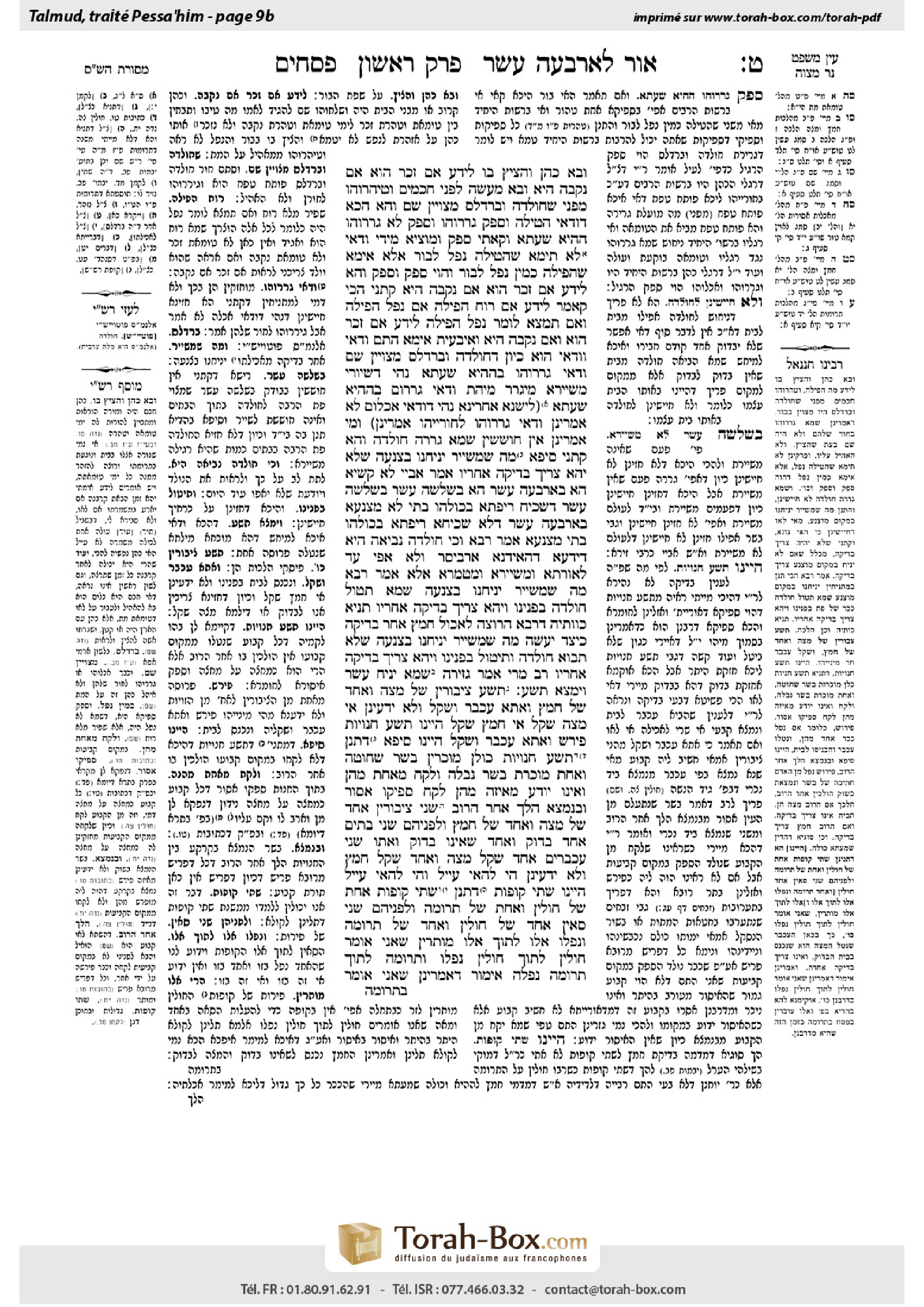
Pesachim 9b: Talmud study for Daf Yomi
Daf Yomi is the daily study of one Talmud folio. Explore 37 tractates with scans, Hebrew text, Sefaria English and AI-generated French translations where annotated.
Passage selection and English or AI-generated French translation are available where the scan has annotations. Daf Study is independent of Torah-Box and Sefaria.
Browse Pesachim · פסחים · All tractatesPesachim 9b text and translations
This page of Pesachim includes the Aramaic text, an English translation and an AI-generated French translation, alongside the scan above.
פסחים ט׳ ב · Aramaic and Hebrew text
וּבָא כֹּהֵן וְהֵצִיץ בּוֹ לֵידַע אִם זָכָר הוּא אִם נְקֵבָה הִיא. וּבָא מַעֲשֶׂה לִפְנֵי חֲכָמִים, וְטִיהֲרוּהוּ, מִפְּנֵי שֶׁחוּלְדָּה וּבַרְדְּלָס מְצוּיִין שָׁם.
וְהָא הָכָא — דְּוַדַּאי הֵטִילָה, וְסָפֵק גֵּרְרוּהוּ וְסָפֵק לֹא גֵּרְרוּהוּ הָהִיא שַׁעְתָּא, וְקָאָתֵי סָפֵק וּמוֹצִיא מִידֵי וַדַּאי! לָא תֵּימָא ״שֶׁהֵטִילָה נֵפֶל לְבוֹר״, אֶלָּא אֵימָא: ״שֶׁהִפִּילָה כְּמִין נֵפֶל לְבוֹר״, וְהָוֵי סָפֵק וְסָפֵק.
וְהָא ״לֵידַע אִם זָכָר הוּא אִם נְקֵבָה הִיא״ קָתָנֵי! הָכִי קָאָמַר: לֵידַע אִם רוּחַ הִפִּילָה, אִם נֵפֶל הִפִּילָה. וְאִם תִּמְצָא לוֹמַר נֵפֶל הִפִּילָה: לֵידַע אִם זָכָר הוּא וְאִם נְקֵבָה הִיא.
וְאִיבָּעֵית אֵימָא: הָתָם וַדַּאי וּוַדַּאי הוּא, כֵּיוָן דְּחוּלְדָּה וּבַרְדְּלָס מְצוּיִין שָׁם — וַדַּאי גֵּרְרוּהוּ בְּהָהִיא שַׁעְתָּא. נְהִי דְּשַׁיּוֹרֵי מְשַׁיְּירָא — מִיגְרָר מִיהַת וַדַּאי גֵּרְרוּם בְּהָהִיא שַׁעְתָּא. (לִישָּׁנָא אַחֲרִינָא: נְהִי דְּוַדַּאי אֲכָלוּם לָא אָמְרִינַן, וַדַּאי גֵּרְרוּהוּ לְחוֹרַיְיהוּ — אָמְרִינַן.)
וּמִי אָמְרִינַן אֵין חוֹשְׁשִׁין שֶׁמָּא גֵּרְרָה חוּלְדָּה? וְהָא קָתָנֵי סֵיפָא: מַה שֶּׁמְּשַׁיֵּיר יַנִּיחֶנּוּ בְּצִנְעָה, שֶׁלֹּא יְהֵא צָרִיךְ בְּדִיקָה אַחֲרָיו.
אָמַר אַבָּיֵי: לָא קַשְׁיָא הָא — בְּאַרְבָּעָה עָשָׂר, הָא — בִּשְׁלֹשָׁה עָשָׂר. בִּשְׁלֹשָׁה עָשָׂר דִּשְׁכִיחַ רִיפְתָּא בְּכוּלְּהוּ בָּתֵּי — לָא מַצְנְעָא. בְּאַרְבָּעָה עָשָׂר דְּלָא שְׁכִיחָא רִיפְתָּא בְּכוּלְּהוּ בָּתֵּי — מַצְנְעָא.
אָמַר רָבָא: וְכִי חוּלְדָּה נְבִיאָה הִיא! דְּיָדְעָא דְּהָאִידָּנָא אַרְבֵּיסַר, וְלָא אָפֵי עַד לְאוּרְתָּא, וּמְשַׁיְּירָא וּמְטַמְּרָא?! אֶלָּא, אָמַר רָבָא: מַה שֶּׁמְּשַׁיֵּיר — יַנִּיחֶנּוּ בְּצִנְעָה, שֶׁמָּא תִּטּוֹל חוּלְדָּה בְּפָנֵינוּ, וִיהֵא צָרִיךְ בְּדִיקָה אַחֲרָיו.
תַּנְיָא כְּווֹתֵיהּ דְּרָבָא: הָרוֹצֶה לֶאֱכוֹל חָמֵץ אַחַר בְּדִיקָה, כֵּיצַד יַעֲשֶׂה? מַה שֶּׁמְּשַׁיֵּיר יַנִּיחֶנּוּ בְּצִנְעָה, שֶׁלֹּא תָּבוֹא חוּלְדָּה וְתִיטּוֹל בְּפָנֵינוּ, וִיהֵא צָרִיךְ בְּדִיקָה אַחֲרָיו.
רַב מָרִי אָמַר: גְּזֵירָה שֶׁמָּא יַנִּיחַ עֶשֶׂר וְיִמְצָא תֵּשַׁע.
תֵּשַׁע צִיבּוּרִין שֶׁל מַצָּה וְאֶחָד שֶׁל חָמֵץ, וַאֲתָא עַכְבָּר וּשְׁקַל. וְלָא יָדְעִינַן אִי מַצָּה שְׁקַל אִי חָמֵץ שְׁקַל — הַיְינוּ תֵּשַׁע חֲנוּיוֹת. פֵּירֵשׁ, וַאֲתָא עַכְבָּר וּשְׁקַל — הַיְינוּ סֵיפָא.
דִּתְנַן: תֵּשַׁע חֲנוּיוֹת, כּוּלָּן מוֹכְרִין בְּשַׂר שְׁחוּטָה, וְאַחַת מוֹכֶרֶת בְּשַׂר נְבֵלָה, וְלָקַח מֵאַחַת מֵהֶן, וְאֵינוֹ יוֹדֵעַ מֵאֵיזֶה מֵהֶן לָקַח — סְפֵיקוֹ אָסוּר.
וּבַנִּמְצָא — הַלֵּךְ אַחַר הָרוֹב.
שְׁנֵי צִיבּוּרִין, אֶחָד שֶׁל מַצָּה וְאֶחָד שֶׁל חָמֵץ. וְלִפְנֵיהֶם שְׁנֵי בָתִּים, אֶחָד בָּדוּק וְאֶחָד שֶׁאֵינוֹ בָּדוּק. וַאֲתוֹ שְׁנֵי עַכְבָּרִים, אֶחָד שְׁקַל מַצָּה, וְאֶחָד שְׁקַל חָמֵץ. וְלָא יָדְעִינַן הֵי לְהַאי עָיֵיל וְהֵי לְהַאי עָיֵיל, הַיְינוּ שְׁתֵּי קוּפּוֹת.
דִּתְנַן: שְׁתֵּי קוּפּוֹת, אַחַת שֶׁל חוּלִּין וְאַחַת שֶׁל תְּרוּמָה. וְלִפְנֵיהֶם שְׁנֵי סְאִין, אֶחָד שֶׁל חוּלִּין וְאֶחָד שֶׁל תְּרוּמָה. וְנָפְלוּ אֵלּוּ לְתוֹךְ אֵלּוּ — מוּתָּרִין. שֶׁאֲנִי אוֹמֵר, חוּלִּין לְתוֹךְ חוּלִּין נָפְלוּ, וּתְרוּמָה לְתוֹךְ תְּרוּמָה נָפְלָה.
אֵימוֹר דְּאָמְרִינַן ״שֶׁאֲנִי אוֹמֵר״
Pesachim 9b · English translation
and a priest came and glanced at the baby to ascertain whether it is male or whether it is female, as a woman who has just given birth, even to a stillborn, is ritually impure for different lengths of time, depending on whether she gave birth to a male or a female (see Leviticus 12). And the incident came before the Sages, to rule whether or not the priest contracted ritual impurity when standing over the corpse, and they deemed him ritually pure. The basis for this ruling was due to the fact that as a marten and a polecat [bardelas] are found there, it is likely that the baby was dragged away before the priest arrived at the pit.
And yet here, where it is certain that she threw the stillborn baby into the pit, and it is uncertain whether a marten or polecat dragged it away and it is uncertain whether it did not drag it away at that time, the Sages nevertheless ruled that an uncertainty comes and overrides a certainty. The Gemara rejects this contention: Do not say in the baraita that she certainly threw a stillborn into a pit; rather, say that she threw an object similar to a stillborn into a pit. Perhaps it was not a stillborn baby; it might have simply been congealed blood, which does not transmit impurity. And therefore, this is a conflict between uncertainty and uncertainty. It is unclear whether there was anything in the pit that could have rendered the priest ritually impure, and even if there was, it might have already been dragged away.
The Gemara retorts: But isn’t it taught in the baraita: To ascertain whether it is male or whether it is female, indicating that the only uncertainty was with regard to gender; it was certainly a stillborn baby. The Gemara rejects this proof, as this is what the baraita is saying: The priest sought to ascertain whether she miscarried mere wind, i.e., an amorphous mass, or if she miscarried a stillborn baby. And if you say that she miscarried a stillborn, he sought to ascertain whether it is male or whether it is female.
And if you wish, say instead: There it is not a conflict between certainty and uncertainty; rather it is between certainty and certainty. Since a marten and a polecat are found there, they certainly dragged it away at that time, without delay. Although martens leave part of their food, in any case they certainly dragged the baby to their holes at that time. Another version of this answer: Although we do not say that they certainly ate the stillborn, we do say that they certainly dragged it to their holes. Consequently, the ruling in this case does not contradict the general principle that an uncertainty does not override a certainty.
The Gemara proceeds to analyze a more fundamental aspect of the mishna: And do we say that one need not be concerned that perhaps a marten dragged the leaven? But isn’t it taught in the last clause, in the next mishna: With regard to the leaven that one leaves after the search, he should place it in a concealed location, so that it will not require searching after it? Apparently, there is concern lest a marten take some of the remaining leaven.
Abaye said: This is not difficult; this ruling is referring to the fourteenth of Nisan, whereas that ruling is referring to the thirteenth. The Gemara elaborates: On the thirteenth of Nisan, when bread is still found in every house, the marten does not conceal the leaven, and therefore there is no concern that perhaps the marten dragged the leaven elsewhere and concealed it. However, on the fourteenth of Nisan, when bread is not found in any of the houses, the marten hides the leaven.
Rava said in surprise: And is the marten a prophetess that knows that now is the fourteenth of Nisan and no one will bake until the evening, and it leaves over bread and conceals it in its hole? Rather, Rava rejected Abaye’s answer and said: With regard to the leaven that one leaves after the search, he should place it in a concealed location, lest a marten take it before us and it will require searching after it. Only if one actually sees the marten take the leaven, is he required to search after it.
It was taught in a baraita in accordance with the opinion of Rava: One who wishes to eat leavened bread after his search, what should he do? With regard to the leaven that one leaves after the search, he should place it in a concealed location, so that a marten will not come and take it before us, and he will need to search the house after it.
Rav Mari said that there is a different resolution of the apparent contradiction between the baraitot: One conceals the leaven that he found, due to a decree lest he place ten pieces of bread and find only nine. Since the tenth piece is missing, he will be obligated to conduct an additional search.
Apropos the issue of leaven taken by a rodent, the Gemara analyzes a series of similar cases. In a case where there were nine piles of matza and one pile of leavened bread, and one saw a mouse come and take a morsel from a pile, and we do not know if it took matza or if it took leavened bread, this is akin to the case of nine stores in the mishna cited below. If a portion became separated from one of the piles and we did not know if it was matza or leaven, and one saw a mouse come and take it, that is akin to the case mentioned in the latter clause of that mishna.
The Gemara elaborates. As we learned in a baraita: With regard to nine stores in a city, all of which sell kosher meat from a slaughtered animal, and one other store that sells meat from unslaughtered animal carcasses, and a person took meat from one of them and he does not know from which one he took the meat, in this case of uncertainty, the meat is prohibited. This ruling is based on the principle: The legal status of an item fixed in its place is that of an uncertainty that is equally balanced. In this case, when it comes to determining whether or not this meat comes from a kosher store, the two types of stores are regarded as though they were equal in number.
This baraita continues: And in the case of meat found outside, follow the majority. If most stores in the city sell kosher meat one can assume that the meat he found is kosher, based on the principle: Any item separated, i.e., not fixed in its place, is presumed to have been separated from the majority. By the same token, if most stores in that city sell non-kosher meat, the meat found is presumed to be non-kosher. These two principles can be applied to the cases involving piles of matza and leaven: If the morsel was separated from the piles when taken by the mouse, follow the majority. However, if the mouse took the morsel from one of the piles, the legal status of the morsel is that of an equally balanced uncertainty concerning whether it was taken from a pile of matza or a pile of leaven, and the owner is required to conduct an additional search.
The Gemara discusses another case: There are two piles, one of matza and one of leavened bread, and before them there are two houses, one which was searched and one which was not searched, and two mice came, and in our presence one took matza and one took leavened bread. Each mouse went into a different house, and we do not know which mouse entered this house and which mouse entered that house. It is unclear whether or not the mouse that took the leaven entered the house that was searched. This situation is akin to the case of two baskets.
As we learned in the Tosefta: There are two baskets, one filled with non-sacred produce and the other one filled with teruma, and before them are two vessels each containing a se’a of produce, one filled with non-sacred produce and the other one filled with teruma. And these, the contents of each of the baskets, fell into those, each of the se’a vessels. It is possible that the teruma fell into the non-sacred produce, and it is prohibited for non-priests to eat a mixture of teruma and non-sacred produce. Nevertheless, the contents of the se’a vessel containing the non-sacred produce is permitted, as I say that the non-sacred produce fell into the non-sacred produce and the teruma fell into the teruma. Likewise, with regard to leaven, presumably the mouse took the leaven into the house that had not been searched, and there is no need to conduct an additional search of the house that was already searched.
The Gemara rejects this comparison: Say that we state and apply the principle: As I say, and assume that everything occurred in a way that preserves the produce in its permitted state
Pesachim 9b · Traduction française (IA)
et un prêtre vint jeter un coup d'œil au bébé pour déterminer s'il était de sexe masculin ou de sexe féminin, car une femme qui vient d'accoucher, même d'un mort-né, est en état d'impureté rituelle pendant des durées différentes, selon qu'elle a accouché d'un garçon ou d'une fille (voir Lévitique 12). L'affaire fut portée devant les Sages pour trancher si le prêtre avait contracté une impureté rituelle en se tenant au-dessus du cadavre, et ils le déclarèrent rituellement pur. La base de ce jugement résidait dans le fait que, comme des martres et des putois [bardelas] se trouvent sur place, il est probable que le bébé ait été emporté avant l'arrivée du prêtre au puits.
Et pourtant, ici, où il est certain qu'elle a jeté le bébé mort-né dans le puits, et où il est incertain qu'une martre ou un putois l'ait emporté et incertain qu'il ne l'ait pas emporté à ce moment-là, les Sages ont néanmoins statué qu'une incertitude vient annuler une certitude. La Guemara rejette cette objection : Ne dites pas que la baraïta affirme qu'elle a certainement jeté un mort-né dans un puits ; mais dites plutôt qu'elle a jeté un objet ressemblant à un mort-né dans un puits. Peut-être ne s'agissait-il pas d'un bébé mort-né ; il se pourrait que ce ne fût que du sang coagulé, qui ne transmet pas l'impureté. Et par conséquent, il s'agit d'un conflit entre incertitude et incertitude. Il est incertain s'il y avait quelque chose dans le puits qui aurait pu rendre le prêtre rituellement impur, et même s'il y en avait, il se pourrait qu'il ait déjà été emporté.
La Guemara rétorque : Mais n'est-il pas enseigné dans la baraïta : « Pour déterminer s'il est de sexe masculin ou de sexe féminin », ce qui indique que la seule incertitude portait sur le sexe ; il s'agissait certainement d'un bébé mort-né. La Guemara rejette cette preuve, car c'est ce que la baraïta signifie : Le prêtre cherchait à déterminer si elle avait expulsé de simples gaz, c'est-à-dire une masse amorphe, ou si elle avait expulsé un bébé mort-né. Et si vous dites qu'elle a expulsé un mort-né, il cherchait à déterminer s'il était de sexe masculin ou de sexe féminin.
Et si vous le souhaitez, dites plutôt : Là, il ne s'agit pas d'un conflit entre certitude et incertitude ; mais plutôt entre certitude et certitude. Puisque des martres et des putois se trouvent sur place, ils l'ont certainement emporté à ce moment-là, sans délai. Bien que les martres laissent une partie de leur nourriture, dans tous les cas, ils ont certainement emporté le bébé vers leurs terriers à ce moment-là. Une autre version de cette réponse : Bien que nous ne disions pas qu'ils ont certainement mangé le mort-né, nous disons qu'ils l'ont certainement emporté vers leurs terriers. Par conséquent, la décision dans ce cas ne contredit pas le principe général selon lequel une incertitude n'annule pas une certitude.
La Guemara procède à l'analyse d'un aspect plus fondamental de la Michna : Et disons-nous qu'on n'a pas à craindre qu'une martre ait peut-être emporté la levure ? Mais n'est-il pas enseigné dans la dernière clause, dans la Michna suivante : « Concernant la levure qu'on laisse après la recherche, il faut la placer dans un endroit caché, afin qu'elle ne nécessite pas de recherche ultérieure » ? Apparemment, il y a une crainte qu'une martre ne prenne une partie de la levure restante.
Abaye a dit : Ce n'est pas difficile ; cette règle fait référence au quatorzième jour de Nissan, tandis que celle-là fait référence au treizième. La Guemara précise : Le treizième jour de Nissan, quand le pain est encore trouvé dans chaque maison, la martre ne cache pas la levure, et par conséquent il n'y a pas de crainte qu'une martre ait peut-être emporté la levure ailleurs et l'ait cachée. Cependant, le quatorzième jour de Nissan, quand le pain n'est plus trouvé dans aucune des maisons, la martre cache la levure.
Rava a dit avec surprise : Et la martre est-elle une prophétesse qui sait que c'est maintenant le quatorzième jour de Nissan et que personne ne cuira jusqu'au soir, et qu'elle laisse du pain et le cache dans sa terrier ? Plutôt, Rava a rejeté la réponse d'Abaye et a dit : Concernant la levure qu'on laisse après la recherche, il faut la placer dans un endroit caché, de peur qu'une martre ne la prenne avant nous et qu'elle nécessite une recherche ultérieure. Seulement si on voit réellement la martre prendre la levure, est-on tenu de la rechercher.
Il est enseigné dans une baraïta conformément à l'opinion de Rava : Celui qui souhaite manger du pain levé après sa recherche, que doit-il faire ? Concernant la levure qu'on laisse après la recherche, il faut la placer dans un endroit caché, afin qu'une martre ne vienne pas la prendre avant nous, et qu'il ait besoin de rechercher la maison après elle.
Rav Mari a déclaré qu'il existe une résolution différente de l'apparente contradiction entre les baraïtot : On cache la levure qu'on a trouvée, par décret, de peur qu'on ne place dix morceaux de pain et n'en trouve que neuf. Puisque le dixième morceau manque, on sera obligé de mener une recherche supplémentaire.
Concernant la question de la levure prise par un rongeur, la Guemara analyse une série de cas similaires. Dans un cas où il y avait neuf tas de matsa et un tas de pain levé, et où l'on a vu une souris venir prendre une miette d'un tas, et où l'on ne sait pas si elle a pris de la matsa ou du pain levé, cela est analogue au cas des neuf boutiques dans la Michna citée ci-dessous. Si une portion s'est détachée de l'un des tas et que nous ne savions pas si c'était de la matsa ou de la levure, et qu'on a vu une souris venir la prendre, cela est analogue au cas mentionné dans la dernière clause de cette Michna.
La Guemara précise. Comme nous l'avons appris dans une baraïta : Concernant neuf boutiques dans une ville, toutes vendant de la viande casher d'un animal abattu, et une autre boutique qui vend de la viande d'animaux non abattus, et qu'une personne a pris de la viande de l'une d'entre elles et qu'il ne sait pas de laquelle il a pris la viande, dans ce cas d'incertitude, la viande est interdite. Ce jugement est basé sur le principe : Le statut légal d'un objet fixé à sa place est celui d'une incertitude équilibrée. Dans ce cas, lorsqu'il s'agit de déterminer si cette viande provient d'une boutique casher, les deux types de boutiques sont considérés comme s'ils étaient égaux en nombre.
Cette baraïta se poursuit : Et dans le cas de viande trouvée à l'extérieur, on suit la majorité. Si la plupart des boutiques de la ville vendent de la viande casher, on peut supposer que la viande qu'il a trouvée est casher, sur la base du principe : Tout objet détaché, c'est-à-dire non fixé à sa place, est présumé avoir été détaché de la majorité. De même, si la plupart des boutiques de cette ville vendent de la viande non casher, la viande trouvée est présumée non casher. Ces deux principes peuvent être appliqués aux cas impliquant des tas de matsa et de hamets : Si le morceau a été détaché des tas lorsqu'il a été pris par la souris, on suit la majorité. Cependant, si la souris a pris le morceau d'un des tas, le statut juridique du morceau est celui d'une incertitude équilibrée concernant le fait de savoir s'il a été pris d'un tas de matsa ou d'un tas de hamets, et le propriétaire est tenu de procéder à une recherche supplémentaire.
La Guemara discute d'un autre cas : Il y a deux tas, l'un de matsa et l'autre de pain levé, et devant eux se trouvent deux maisons, l'une qui a été fouillée et l'autre qui ne l'a pas été, et deux souris sont venues, et devant nous, l'une a pris de la matsa et l'autre a pris du pain levé. Chaque souris est entrée dans une maison différente, et nous ne savons pas quelle souris est entrée dans cette maison et laquelle est entrée dans celle-là. Il est incertain que la souris qui a pris le levain soit entrée dans la maison qui a été fouillée. Cette situation est comparable au cas des deux paniers.
Comme nous l'avons appris dans la Tosefta : Il y a deux paniers, l'un rempli de produits non sacrés et l'autre rempli de terouma, et devant eux se trouvent deux récipients contenant chacun un se'a de produits, l'un rempli de produits non sacrés et l'autre rempli de terouma. Et ceux-ci, le contenu de chacun des paniers, sont tombés dans ceux-là, chacun des récipients de se'a. Il est possible que la terouma soit tombée dans les produits non sacrés, et il est interdit aux non-prêtres de manger un mélange de terouma et de produits non sacrés. Néanmoins, le contenu du récipient de se'a contenant les produits non sacrés est permis, car je dis que les produits non sacrés sont tombés dans les produits non sacrés et que la terouma est tombée dans la terouma. De même, en ce qui concerne le levain, il est présumé que la souris a emporté le levain dans la maison qui n'avait pas été fouillée, et il n'est pas nécessaire de procéder à une recherche supplémentaire de la maison qui avait déjà été fouillée.
La Guemara rejette cette comparaison : Disons que nous énonçons et appliquons le principe : Comme je dis, et supposons que tout s'est produit de manière à préserver les produits dans leur état permis.
Traduction française générée par IA à partir de l’édition anglaise de Sefaria. Vérifie toujours un passage avec le texte source.
Text from Sefaria: William Davidson Edition - Vocalized Aramaic (CC BY NC); William Davidson Edition - English (CC BY NC).