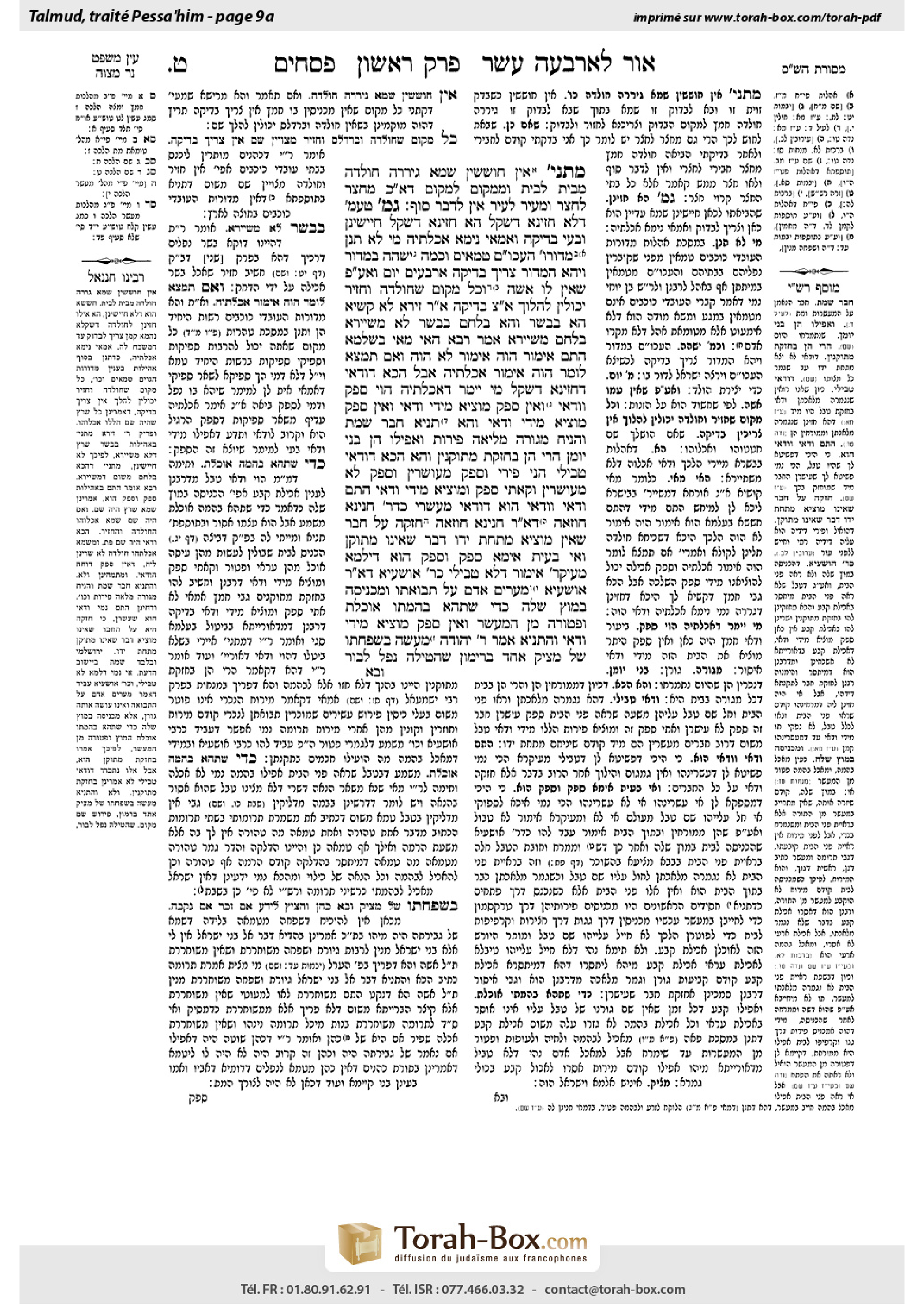
Pesachim 9a: Talmud study for Daf Yomi
Daf Yomi is the daily study of one Talmud folio. Explore 37 tractates with scans, Hebrew text, Sefaria English and AI-generated French translations where annotated.
Passage selection and English or AI-generated French translation are available where the scan has annotations. Daf Study is independent of Torah-Box and Sefaria.
Browse Pesachim · פסחים · All tractatesPesachim 9a text and translations
This page of Pesachim includes the Aramaic text, an English translation and an AI-generated French translation, alongside the scan above.
פסחים ט׳ א · Aramaic and Hebrew text
מַתְנִי׳ אֵין חוֹשְׁשִׁין שֶׁמָּא גֵּירְרָה חוּלְדָּה מִבַּיִת לְבַיִת וּמִמָּקוֹם לְמָקוֹם, דְּאִם כֵּן מֵחָצֵר לְחָצֵר וּמֵעִיר לָעִיר — אֵין לַדָּבָר סוֹף.
גְּמָ׳ טַעְמָא דְּלָא חֲזֵינָא דִּשְׁקַל, הָא חֲזֵינָא דִּשְׁקַל — חָיְישִׁינַן, וּבָעֵי בְּדִיקָה.
וְאַמַּאי? נֵימָא אֲכַלְתֵּיהּ! מִי לָא תְּנַן: מְדוֹרוֹת הַגּוֹיִם טְמֵאִים. וְכַמָּה יִשְׁהֶה בְּמָדוֹר וִיהֵא הַמָּדוֹר צָרִיךְ בְּדִיקָה — אַרְבָּעִים יוֹם.
וְאַף עַל פִּי שֶׁאֵין לוֹ אִשָּׁה. וְכׇל מָקוֹם שֶׁחוּלְדָּה וַחֲזִיר יְכוֹלִין לַהֲלוֹךְ — אֵין צָרִיךְ בְּדִיקָה!
אָמַר רַבִּי זֵירָא, לָא קַשְׁיָא: הָא בְּבָשָׂר, וְהָא בְּלֶחֶם. בְּבָשָׂר — לָא מְשַׁיְּירָא. בְּלֶחֶם — מְשַׁיְּירָא.
אָמַר רָבָא: הַאי מַאי? בִּשְׁלָמָא הָתָם — אֵימוֹר הֲוָה, אֵימוֹר לָא הֲוָה. וְאִם תִּמְצָא לוֹמַר הֲוָה — אֵימוֹר אֲכַלְתֵּיהּ. אֲבָל הָכָא, דְּוַדַּאי דַּחֲזֵינָא דִּשְׁקַל — מִי יֵימַר דַּאֲכַלְתֵּיהּ? הָוֵי סָפֵק וּוַדַּאי, וְאֵין סָפֵק מוֹצִיא מִידֵי וַדַּאי.
וְאֵין סָפֵק מוֹצִיא מִידֵי וַדַּאי?! וְהָא תַּנְיָא: חָבֵר שֶׁמֵּת וְהִנִּיחַ מְגוּרָה מְלֵיאָה פֵּירוֹת, וַאֲפִילּוּ הֵן בְּנֵי יוֹמָן — הֲרֵי הֵן בְּחֶזְקַת מְתוּקָּנִין. וְהָא הָכָא, דְּוַדַּאי טְבִילִי הָנֵי פֵּירֵי, וְסָפֵק מְעוּשָּׂרִין וְסָפֵק לֹא מְעוּשָּׂרִין, וְקָאָתֵי סָפֵק וּמוֹצִיא מִידֵי וַדַּאי!
הָתָם וַדַּאי וּוַדַּאי הוּא, דְּוַדַּאי מְעַשְּׂרִי, כִּדְרַבִּי חֲנִינָא חוֹזָאָה. דְּאָמַר רַבִּי חֲנִינָא חוֹזָאָה: חֲזָקָה עַל חָבֵר שֶׁאֵין מוֹצִיא מִתַּחַת יָדוֹ דָּבָר שֶׁאֵינוֹ מְתוּקָּן.
וְאִי בָּעֵית אֵימָא: סָפֵק וְסָפֵק הוּא, דִּילְמָא מֵעִקָּרָא אֵימוֹר דְּלָא טְבִילִי, כְּרַבִּי אוֹשַׁעְיָא.
דְּאָמַר רַבִּי אוֹשַׁעְיָא: מַעֲרִים אָדָם עַל תְּבוּאָתוֹ, וּמַכְנִיסָהּ בַּמּוֹץ שֶׁלָּהּ, כְּדֵי שֶׁתְּהֵא בְּהֶמְתּוֹ אוֹכֶלֶת וּפְטוּרָה מִן הַמַּעֲשֵׂר.
וְאֵין סָפֵק מוֹצִיא מִידֵי וַדַּאי?! וְהָתַנְיָא אָמַר רַבִּי יְהוּדָה: מַעֲשֶׂה בְּשִׁפְחָתוֹ שֶׁל מֵצִיק אֶחָד בְּרִימּוֹן שֶׁהֵטִילָה נֵפֶל לְבוֹר,
Pesachim 9a · English translation
MISHNA: After conducting the search, one need not be concerned that perhaps a marten dragged leaven from house to house, or from place to place, placing leaven in a house that was already searched. As if so, one need also be concerned that perhaps leaven might have been dragged from courtyard to courtyard and from city to city. In that case, there is no end to the matter, and it would be impossible to rely on any search for leaven.
GEMARA: The Gemara infers from the mishna: The reason that one need not search again is that we did not see the marten drag the leaven from the house; however, if we saw the marten drag leaven from the house, we are indeed concerned that it dragged the leaven into the second house, and it therefore requires searching for leaven.
The Gemara raises a difficulty: But why is this so? Let us say that the marten ate the bread it took. Didn’t we learn in a mishna: The residences of gentiles are ritually impure, as their wives may have miscarried, and due to the fact that gentiles would bury their stillborn babies in their houses, all their residences are deemed ritually impure due to the possibility of impurity imparted by a corpse. And how long must a gentile have stayed in a residence for the residence to require searching? He must have lived there for forty days. The reason is that until forty days after conception the miscarried fetus is not classified as a stillborn, as it is not sufficiently developed before that stage.
This mishna continues: And this decree applies even though the gentile resident has no wife. In issuing the decree, the Sages did not distinguish between a married couple and a single man, so that people would not err in its application (Me’iri). And any place where a marten or a pig can enter unimpeded need not be searched, as presumably if a stillborn was buried there, one of these animals would have taken it. As this mishna indicates that there is a presumption that martens eat whatever they find, the Gemara suggests that the same should apply to leaven. Therefore, even if one actually saw the marten take the bread, he can assume that the animal ate it, obviating the need for an additional search.
Rabbi Zeira said: This is not difficult, as in this case, where no search is required, it is referring to flesh, whereas in that case, where one is required to search again, it is referring to bread. Rabbi Zeira elaborates: With regard to flesh, a marten does not leave remnants behind, and therefore the stillborn would have been entirely consumed. With regard to bread, however, the marten leaves remnants behind, requiring an additional search.
Rava said: What is this comparison? These cases are not comparable. Granted, there, with regard to the stillborn, one could say that it was in the house and one could say that it was not in the house. And even if you say it was there, say that the marten ate it. The very presence of the stillborn in the house is based on an assumption, and even if it was there, it was probably consumed. However, here, where one definitely saw the marten take the bread, who will say that the marten ate it? It is a conflict between an uncertainty whether or not the marten ate the bread, and a certainty that the bread was there. The principle is that an uncertainty does not override a certainty.
The Gemara raises a difficulty against this principle: And is it so that an uncertainty does not override a certainty? But wasn’t it taught in a baraita: With regard to a ḥaver who died and left a storehouse filled with produce, even if the produce was there only that day, the fruit has the presumptive status of produce that was ritually prepared, i.e., properly tithed. The assumption is that the owner tithed it himself or commanded others to do so. However, here, this produce was certainly untithed at the outset, and there is uncertainty whether they are tithed or whether they are not tithed. Despite this conflict, the uncertainty whether they were tithed comes and overrides the certainty that they were untithed produce.
The Gemara rejects this contention: There, the conflict is between certainty and certainty, as the produce is certainly tithed, in accordance with the statement of Rabbi Ḥanina Ḥoza’a. As Rabbi Ḥanina Ḥoza’a said: There is a presumption with regard to a ḥaver that he does not allow produce that is not ritually prepared, to leave his possession. It is therefore certain that the produce is tithed.
And if you wish, say instead that in that case the conflict is between uncertainty and uncertainty, as perhaps one could say that the produce was never initially untithed. It is possible that there was never an obligation to tithe this produce, in accordance with the opinion of Rabbi Oshaya.
As Rabbi Oshaya said: A person may employ artifice to circumvent obligations incumbent upon him in dealing with his grain, and bring it into the courtyard in its chaff so that his animal may eat from it. And this grain is exempt from tithes. Although the obligation to tithe produce that has been fully processed applies even to animal fodder, it is permitted to feed one’s animal untithed produce that has not been fully processed. In light of this halakha it is possible that the fruit of the ḥaver in the storehouse may not have been subject to the obligation to be tithed. Consequently, the aforementioned case involving produce is a conflict between two uncertain factors, as it is uncertain whether or not the owner was obligated to tithe the produce in the first place, and even if he was required to do so, it is uncertain whether or not the ḥaver tithed it.
The Gemara raises a further difficulty against Rava: And is it so that an uncertainty does not override a certainty? But wasn’t it taught in a baraita that Rabbi Yehuda said: There was an incident involving the maidservant of a certain violent person in the city of Rimon, who threw a stillborn baby into a pit,
Pesachim 9a · Traduction française (IA)
MICHNA : Après avoir effectué la recherche, il n’est pas nécessaire de craindre qu’une fouine ait transporté du hamets d’une maison à l’autre ou d’un endroit à l’autre, et en ait déposé dans une maison déjà inspectée. Car, si c’était le cas, il faudrait aussi craindre que du hamets ait été transporté d’une cour à l’autre et d’une ville à l’autre. On n’en finirait plus, et il serait impossible de se fier à une recherche du hamets.
GUEMARA : La Guemara déduit de la Michna que si l’on n’a pas à effectuer une nouvelle recherche, c’est parce qu’on n’a pas vu la fouine transporter du hamets hors de la maison. En revanche, si l’on a vu la fouine transporter du hamets hors de la maison, on craint effectivement qu’elle l’ait apporté dans la seconde maison, qui doit donc faire l’objet d’une recherche du hamets.
La Guemara soulève une difficulté : pourquoi en est-il ainsi ? Ne peut-on pas dire que la fouine a mangé le pain qu’elle a pris ? N’avons-nous pas appris dans une Michna : Les résidences des non-Juifs sont rituellement impures, car leurs femmes ont pu faire une fausse couche et, comme les non-Juifs enterraient leurs bébés mort-nés dans leurs maisons, toutes leurs résidences sont considérées comme rituellement impures en raison de la possibilité d’une impureté due à un cadavre. Combien de temps un non-Juif doit-il avoir habité une résidence pour que celle-ci doive être inspectée ? Il doit y avoir vécu quarante jours. En effet, jusqu’à quarante jours après la conception, le fœtus expulsé lors d’une fausse couche n’est pas considéré comme un mort-né, car il n’est pas suffisamment développé avant ce stade.
La Michna poursuit : Cette règle s’applique même si le résident non juif n’a pas d’épouse. En édictant cette règle, les Sages n’ont pas distingué entre un couple marié et un homme célibataire, afin que les gens ne se trompent pas dans son application (Meïri). Et tout endroit où une fouine ou un porc peut entrer sans obstacle n’a pas besoin d’être inspecté, car on présume que si un mort-né y avait été enterré, l’un de ces animaux l’aurait emporté. Puisque cette Michna indique qu’on présume que les fouines mangent tout ce qu’elles trouvent, la Guemara propose d’appliquer la même règle au hamets. Ainsi, même si l’on a effectivement vu la fouine prendre le pain, on peut supposer que l’animal l’a mangé, ce qui dispense d’une recherche supplémentaire.
Rabbi Zeïra dit : La difficulté se résout ainsi : dans le cas où aucune recherche n’est requise, il s’agit de chair, tandis que dans le cas où une nouvelle recherche est requise, il s’agit de pain. Rabbi Zeïra précise : Pour la chair, une fouine ne laisse pas de restes ; le mort-né aurait donc été entièrement dévoré. En revanche, pour le pain, la fouine laisse des restes, ce qui nécessite une recherche supplémentaire.
Rava dit : Quelle comparaison peut-on faire ? Ces cas ne sont pas comparables. Certes, concernant le mort-né, on peut dire qu’il se trouvait dans la maison, mais aussi qu’il ne s’y trouvait pas. Et même si l’on dit qu’il s’y trouvait, on peut dire que la fouine l’a mangé. La présence même du mort-né dans la maison repose sur une présomption et, même s’il s’y trouvait, il a probablement été dévoré. Mais ici, où l’on a certainement vu la fouine prendre le pain, qui peut affirmer qu’elle l’a mangé ? Il y a d’un côté une incertitude quant au fait que la fouine ait mangé ou non le pain et, de l’autre, la certitude que le pain était là. Le principe est qu’une incertitude ne l’emporte pas sur une certitude.
La Guemara soulève une difficulté contre ce principe : Est-il vrai qu’une incertitude ne l’emporte pas sur une certitude ? N’a-t-on pas enseigné dans une baraïta : Lorsqu’un haver meurt en laissant un entrepôt rempli de produits, même si ces produits ne s’y trouvaient que depuis ce jour-là, les fruits ont le statut présumé de produits préparés rituellement, c’est-à-dire correctement soumis à la dîme. On suppose que leur propriétaire les a lui-même soumis à la dîme ou qu’il a demandé à d’autres de le faire. Or, dans ce cas, ces produits étaient certainement non soumis à la dîme au départ, et il est incertain qu’ils aient été soumis à la dîme ou non. Malgré cette opposition, l’incertitude quant au fait qu’ils aient été soumis à la dîme l’emporte sur la certitude qu’il s’agissait de produits non soumis à la dîme.
La Guemara rejette cette objection : Dans ce cas, l’opposition est entre une certitude et une certitude, car les produits ont certainement été soumis à la dîme, conformément à l’enseignement de Rabbi Ḥanina Ḥoza’a. Rabbi Ḥanina Ḥoza’a a en effet dit : On présume qu’un haver ne laisse pas sortir de sa possession des produits qui n’ont pas été préparés rituellement. Il est donc certain que les produits ont été soumis à la dîme.
Et si tu veux, dis plutôt que, dans ce cas, l’opposition est entre une incertitude et une incertitude, car on peut dire que les produits n’étaient peut-être pas soumis à la dîme dès le départ. Il est possible qu’il n’y ait jamais eu d’obligation de soumettre ces produits à la dîme, conformément à l’avis de Rabbi Oshaya.
Rabbi Oshaya a en effet dit : Une personne peut recourir à un artifice pour contourner les obligations qui lui incombent concernant son grain, et le faire entrer dans la cour encore enveloppé de sa balle, afin que son animal puisse en manger. Ce grain est exempt de la dîme. Bien que l’obligation de soumettre à la dîme les produits entièrement transformés s’applique même au fourrage destiné aux animaux, il est permis de donner à son animal des produits qui n’ont pas été soumis à la dîme et qui n’ont pas été entièrement transformés. À la lumière de cette halakha, il est possible que les fruits de l’entrepôt du haver n’aient pas été soumis à l’obligation de la dîme. Par conséquent, le cas susmentionné concernant les produits oppose deux facteurs incertains : on ne sait pas si le propriétaire était tenu de soumettre les produits à la dîme au départ et, même s’il y était tenu, on ne sait pas si le haver les a soumis à la dîme.
La Guemara soulève une nouvelle difficulté contre Rava : Est-il vrai qu’une incertitude ne l’emporte pas sur une certitude ? N’a-t-on pas enseigné dans une baraïta que Rabbi Yehouda a dit : Il arriva que la servante d’un homme violent, dans la ville de Rimon, jeta un bébé mort-né dans une fosse,
Traduction française générée par IA à partir de l’édition anglaise de Sefaria. Vérifie toujours un passage avec le texte source.
Text from Sefaria: William Davidson Edition - Vocalized Aramaic (CC BY NC); William Davidson Edition - English (CC BY NC).