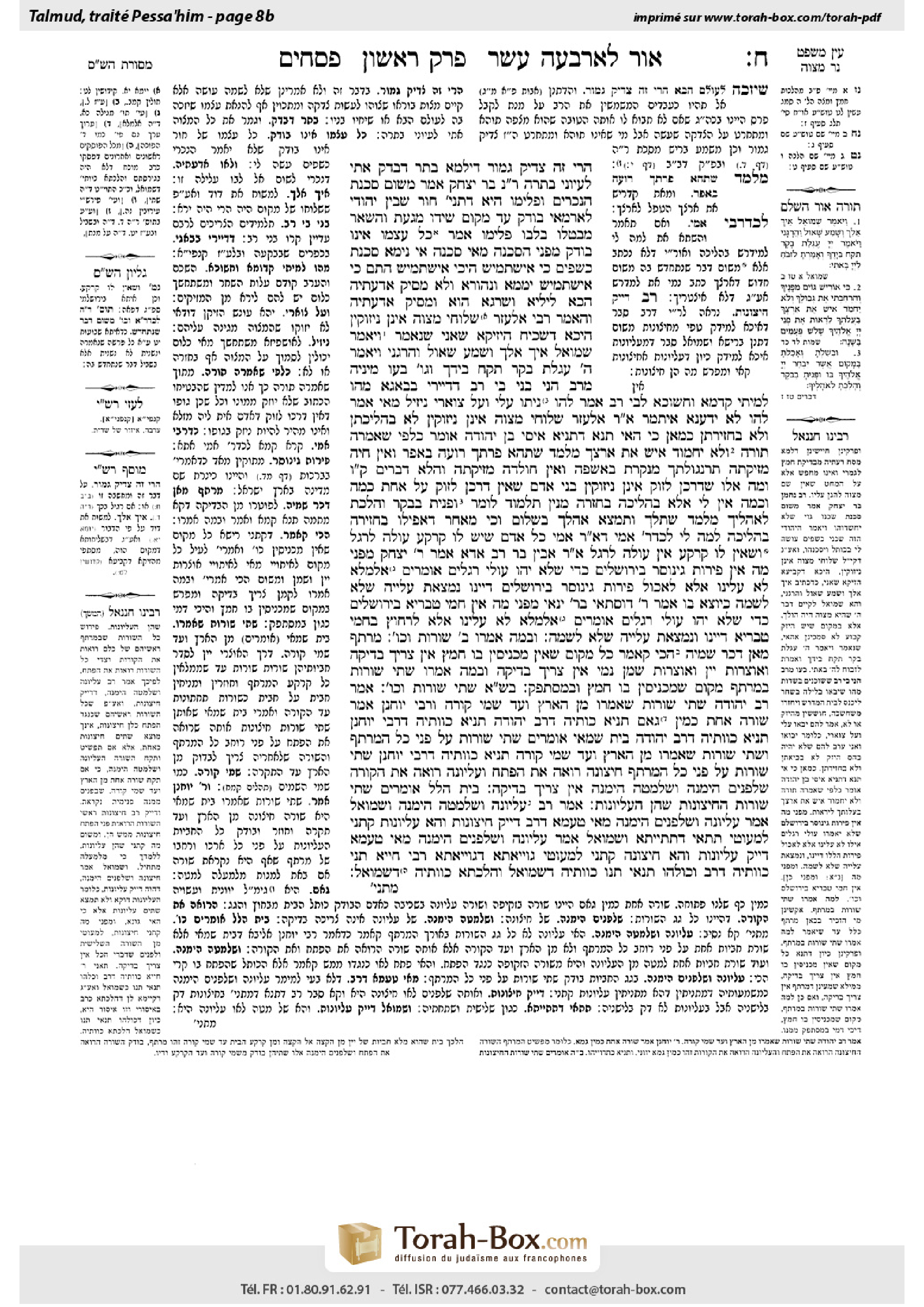
Pesachim 8b: Talmud study for Daf Yomi
Daf Yomi is the daily study of one Talmud folio. Explore 37 tractates with scans, Hebrew text, Sefaria English and AI-generated French translations where annotated.
Passage selection and English or AI-generated French translation are available where the scan has annotations. Daf Study is independent of Torah-Box and Sefaria.
Browse Pesachim · פסחים · All tractatesPesachim 8b text and translations
This page of Pesachim includes the Aramaic text, an English translation and an AI-generated French translation, alongside the scan above.
פסחים ח׳ ב · Aramaic and Hebrew text
הֲרֵי זֶה צַדִּיק גָּמוּר! דִּילְמָא בָּתַר דְּבָדֵק אָתֵי לְעַיּוֹנֵי בָּתְרַהּ.
רַב נַחְמָן בַּר יִצְחָק אָמַר: מִשּׁוּם סַכָּנַת הַגּוֹיִם, וּפְלֵימוֹ הִיא. דְּתַנְיָא: חוֹר שֶׁבֵּין יְהוּדִי לְאַרְמַאי — בּוֹדֵק עַד מְקוֹם שֶׁיָּדוֹ מַגַּעַת, וְהַשְּׁאָר מְבַטְּלוֹ בְּלִבּוֹ. פְּלֵימוֹ אָמַר: כׇּל עַצְמוֹ אֵינוֹ בּוֹדֵק מִפְּנֵי הַסַּכָּנָה.
מַאי סַכָּנָה, אִי נֵימָא סַכָּנַת כְּשָׁפִים, כִּי אִישְׁתַּמַּישׁ הֵיכִי אִישְׁתַּמַּישׁ? הָתָם כִּי אִישְׁתַּמַּישׁ — יְמָמָא וּנְהוֹרָא, וְלָא מַסִּיק אַדַּעְתֵּיהּ. הָכָא — לֵילְיָא וּשְׁרָגָא הוּא, וּמַסֵּיק אַדַּעְתֵּיהּ.
וְהָאָמַר רַבִּי אֶלְעָזָר: שְׁלוּחֵי מִצְוָה אֵינָן נִיזּוֹקִין! הֵיכָא דִּשְׁכִיחַ הֶיזֵּיקָא שָׁאנֵי. שֶׁנֶּאֱמַר: ״וַיֹּאמֶר שְׁמוּאֵל אֵיךְ אֵלֵךְ וְשָׁמַע שָׁאוּל וַהֲרָגָנִי וַיֹּאמֶר ה׳ עֶגְלַת בָּקָר תִּקַּח בְּיָדֶךָ וְגוֹ׳״.
בְּעוֹ מִינֵּיהּ מֵרַב: הָנֵי בְּנֵי בֵּי רַב דְּדָיְירִי בְּבָאגָא, מַהוּ לְמֵיתֵי קַדְמָא וַחֲשׁוֹכָא לְבֵי רַב? אֲמַר לְהוּ: נֵיתוֹ עֲלַי וְעַל צַוָּארִי. נֵיזִיל מַאי? אֲמַר לְהוּ: לָא יָדַעְנָא.
אִיתְּמַר, אָמַר רַבִּי אֶלְעָזָר: שְׁלוּחֵי מִצְוָה אֵינָן נִיזּוֹקִין לֹא בַּהֲלִיכָתָן וְלֹא בַּחֲזִירָתָן. כְּמַאן?
כִּי הַאי תַּנָּא דְּתַנְיָא, אִיסִי בֶּן יְהוּדָה אוֹמֵר: כְּלַפֵּי שֶׁאָמְרָה תּוֹרָה ״וְלֹא יַחְמֹד אִישׁ אֶת אַרְצְךָ״, מְלַמֵּד שֶׁתְּהֵא פָּרָתְךָ רוֹעָה בָּאֲפָר וְאֵין חַיָּה מַזִּיקָתָהּ, תַּרְנְגוֹלְתְּךָ מְנַקֶּרֶת בָּאַשְׁפָּה וְאֵין חוּלְדָּה מַזִּיקָתָהּ.
וַהֲלֹא דְּבָרִים קַל וָחוֹמֶר: וּמָה אֵלּוּ שֶׁדַּרְכָּן לִזּוֹק — אֵינָן נִיזּוֹקִין, בְּנֵי אָדָם שֶׁאֵין דַּרְכָּן לִזּוֹק — עַל אַחַת כַּמָּה וְכַמָּה. אֵין לִי אֶלָּא בַּהֲלִיכָה, בַּחֲזָרָה מִנַּיִן? תַּלְמוּד לוֹמַר: ״וּפָנִיתָ בַבֹּקֶר וְהָלַכְתָּ לְאֹהָלֶיךָ״, מְלַמֵּד שֶׁתֵּלֵךְ וְתִמְצָא אָהָלְךָ בְּשָׁלוֹם.
וְכִי מֵאַחַר דַּאֲפִילּוּ בַּחֲזִירָה, בַּהֲלִיכָה לְמָה לִי? לְכִדְרַבִּי אַמֵּי. דְּאָמַר רַבִּי אַמֵּי: כׇּל אָדָם שֶׁיֵּשׁ לוֹ קַרְקַע — עוֹלֶה לָרֶגֶל, וְשֶׁאֵין לוֹ קַרְקַע — אֵין עוֹלֶה לָרֶגֶל.
אָמַר רַבִּי אָבִין בַּר רַב אַדָּא אָמַר רַבִּי יִצְחָק: מִפְּנֵי מָה אֵין פֵּרוֹת גִּינּוֹסַר בִּירוּשָׁלַיִם? כְּדֵי שֶׁלֹּא יְהוּ עוֹלֵי רְגָלִים אוֹמְרִים: אִלְמָלֵא לֹא עָלִינוּ אֶלָּא לֶאֱכוֹל פֵּרוֹת גִּינּוֹסַר בִּירוּשָׁלַיִם — דַּיֵּינוּ. נִמְצֵאת עֲלִיָּיה שֶׁלֹּא לִשְׁמָהּ.
כַּיּוֹצֵא בּוֹ, אָמַר רַבִּי דּוֹסְתַּאי בְּרַבִּי יַנַּאי: מִפְּנֵי מָה אֵין חַמֵּי טְבֶרְיָא בִּירוּשָׁלַיִם? כְּדֵי שֶׁלֹּא יְהוּ עוֹלֵי רְגָלִים אוֹמְרִים: אִלְמָלֵא לֹא עָלִינוּ אֶלָּא לִרְחֹץ בְּחַמֵּי טְבֶרְיָא — דַּיֵּינוּ, וְנִמְצֵאת עֲלִיָּיה שֶׁלֹּא לִשְׁמָהּ.
וּבַמָּה אָמְרוּ שְׁתֵּי שׁוּרוֹת וְכוּ׳. מַרְתֵּף מַאן דְּכַר שְׁמֵיהּ?
הָכִי קָאָמַר: כׇּל מָקוֹם שֶׁאֵין מַכְנִיסִין בּוֹ חָמֵץ — אֵין צָרִיךְ בְּדִיקָה, וְאוֹצְרוֹת יַיִן וְאוֹצְרוֹת שֶׁמֶן נָמֵי אֵין צָרִיךְ בְּדִיקָה, וּבַמָּה אָמְרוּ שְׁתֵּי שׁוּרוֹת בַּמַּרְתֵּף — מָקוֹם שֶׁמַּכְנִיסִין בּוֹ חָמֵץ, וּבְמִסְתַּפֵּק.
בֵּית שַׁמַּאי אוֹמְרִים שְׁתֵּי שׁוּרוֹת וְכוּ׳. אָמַר רַב יְהוּדָה: שְׁתֵּי שׁוּרוֹת שֶׁאָמְרוּ, מִן הָאָרֶץ וְעַד שְׁמֵי קוֹרָה. וְרַבִּי יוֹחָנָן אָמַר: שׁוּרָה אַחַת כְּמִין גַּאם.
תַּנְיָא כְּוָתֵיהּ דְּרַב יְהוּדָה, תַּנְיָא כְּווֹתֵיהּ דְּרַבִּי יוֹחָנָן. תַּנְיָא כְּווֹתֵיהּ דְּרַב יְהוּדָה, בֵּית שַׁמַּאי אוֹמְרִים: שְׁתֵּי שׁוּרוֹת עַל פְּנֵי כׇּל הַמַּרְתֵּף, וּשְׁתֵּי שׁוּרוֹת שֶׁאָמְרוּ — מִן הָאָרֶץ וְעַד שְׁמֵי קוֹרָה. תַּנְיָא כְּווֹתֵיהּ דְּרַבִּי יוֹחָנָן: שְׁתֵּי שׁוּרוֹת עַל פְּנֵי כׇּל הַמַּרְתֵּף — חִיצוֹנָה רוֹאָה אֶת הַפֶּתַח, וְעֶלְיוֹנָה רוֹאָה אֶת הַקּוֹרָה. שֶׁלִּפְנִים הֵימֶנָּה, וְשֶׁלְּמַטָּה הֵימֶנָּה — אֵין צָרִיךְ בְּדִיקָה.
בֵּית הִלֵּל אוֹמְרִים שְׁתֵּי שׁוּרוֹת הַחִיצוֹנוֹת שֶׁהֵן הָעֶלְיוֹנוֹת. אָמַר רַב: עֶלְיוֹנָה וְשֶׁלְּמַטָּה הֵימֶנָּה, וּשְׁמוּאֵל אָמַר: עֶלְיוֹנָה וְשֶׁלִּפְנִים הֵימֶנָּה. מַאי טַעְמָא דְּרַב — דָּיֵיק ״חִיצוֹנוֹת״. וְהָא עֶלְיוֹנוֹת קָתָנֵי! לְמַעוֹטֵי תַּתָּאֵי דְתַתָּיָיתָא.
וּשְׁמוּאֵל אָמַר: עֶלְיוֹנָה וְשֶׁלִּפְנִים הֵימֶנָּה. מַאי טַעְמָא — דָּיֵיק ״עֶלְיוֹנוֹת״. וְהָא חִיצוֹנָה קָתָנֵי! לְמַעוֹטֵי גַּוָיָיאתָא דְגַוָיָיאתָא. רַבִּי חִיָּיא תָּנֵי כְּווֹתֵיהּ דְּרַב, וְכוּלְּהוּ תַּנָּאֵי תָּנוּ כְּווֹתֵיהּ דִּשְׁמוּאֵל, וְהִלְכְתָא כְּווֹתֵיהּ דִּשְׁמוּאֵל.
Pesachim 8b · English translation
this person is a full-fledged righteous person as far as that mitzva is concerned? These ulterior motives, e.g., seeking a reward, do not detract from the value of the mitzva. The Gemara answers: There is still concern lest he look for the needle after he searched for leaven and completed the search. There is danger that since he already completed the mitzva, its merit will not protect him when he is searching for the needle.
Rav Naḥman bar Yitzḥak said: The danger referred to by the Tosefta is the danger posed by gentiles. And this ruling is in accordance with the opinion of the tanna Pelimu. As it was taught in a baraita: With regard to a hole in a wall located between the residences of a Jew and a gentile, one searches in the hole as far as his hand reaches, and the rest he renders null and void in his heart. Pelimu said: One does not search the entire hole at all, due to the danger involved.
The Gemara asks: Due to what danger? If we say it is due to the danger of sorcery, i.e., the gentile will suspect the Jew of casting spells on him and will come to hate him and threaten him, if so, when he made use of the hole in the first place, how did he make use of it without arousing the enmity of his gentile neighbor? If the hole is never used there is no need to search it in any case. The Gemara answers: There, when he made use of the hole, it was during the day and there was light, and the gentile would not raise the suspicion that the Jew was casting spells in his mind. Here, it is during the night and the search is performed with a lamp, and the gentile would raise the suspicion that the Jew was casting spells in his mind.
The Gemara raises a difficulty: But didn’t Rabbi Elazar say that those on the path to perform a mitzva are not susceptible to harm throughout the process of performing the mitzva? The Gemara responds: In a place where danger is commonplace it is different, as one should not rely on a miracle, as it is stated with regard to God’s command to Samuel to anoint David as king in place of Saul: “And Samuel said: How will I go, and Saul will hear and kill me; and God said: Take in your hand a calf and say: I have come to offer a sacrifice to God” (I Samuel 16:2). Even when God Himself issued the command, there is concern with regard to commonplace dangers.
They raised a dilemma before Rav: With regard to those members of the school of Rav who live in the fields [baga] far away from the city, what is the halakha as to whether they may come early before dawn and in the evening after dark to Rav’s school, or should they be concerned about robbers? He said to them: Let them come, and responsibility for their safety is upon me and my neck. They asked him: What is your opinion about returning home? He said to them: I do not know if it is possible to rely on the protection of the mitzva when returning home.
On a related note, it was stated that Rabbi Elazar said: Those on the path to perform a mitzva are not susceptible to harm; neither when they go nor when they return. The Gemara asks: In accordance with whose opinion did he say this?
The Gemara answers: It is in accordance with the opinion of this tanna, as it was taught in a baraita that Isi ben Yehuda says: With regard to that which the Torah said: “And no man shall covet your land, when you go up to appear before God your Lord three times in the year” (Exodus 34:24), this teaches that your cow shall graze in the meadow and no beast will harm it, and your rooster shall peck in the garbage dump and no marten [ḥulda] shall harm it. In other words, your property will be protected while everyone ascends to Jerusalem for the Festival, despite the fact that the farm will not be defended.
And are these matters not inferred a fortiori? And if those animals that typically are harmed by other animals are not harmed, due to the protection provided by the mitzva, people who typically are not harmed, as they are capable of protecting themselves, all the more so, will not be harmed due to the protection provided by the mitzva of ascending to Jerusalem for the Festival. I have only derived that one is protected when going to Jerusalem; from where is it derived that one is protected even when returning from the Temple? The verse states: “You shall roast and eat the Paschal lamb in the place which God your Lord shall choose; and you shall turn in the morning and go to your tents” (Deuteronomy 16:7). This teaches that you shall go and upon your return find your tent in peace, unharmed.
The Gemara asks: And once we derived that the merit of a mitzva protects a person even when returning, why do I need a source to teach that he is protected when he goes? This teaching could also be derived by means of an a fortiori inference. The Gemara answers: Actually, the first verse is interpreted in accordance with the opinion of Rabbi Ami, as Rabbi Ami said: Any person who has land in his possession is obligated to ascend to the Temple for the three pilgrim Festivals. And one who does not have land in his possession is not obligated to ascend for the Festivals, as the verse states: Your land, in the context of the obligation to ascend to Jerusalem for the three Pilgrim Festivals.
Apropos the ascent to Jerusalem for a Festival and the performance of a mitzva with ulterior motives, the Gemara cites that which Rabbi Avin bar Rav Adda said that Rabbi Yitzḥak said: Due to what reason are there no fruits of Ginnosar, which were of the highest quality, growing in Jerusalem? Why is Jerusalem not graced with this produce? The reason is so that the pilgrims would not say: If we had ascended only to eat the fruit of Ginnosar, it would have been sufficient for us. The ascent to Jerusalem would then be performed not for its own sake.
On a similar note, Rabbi Dostai, son of Rabbi Yannai, said: Due to what reason are the hot springs of Tiberias not located in Jerusalem? It is so that the pilgrims would not say: If we had only ascended to bathe in the hot springs of Tiberias, it would have been sufficient for us. The ascent to Jerusalem would then be performed not for its own sake.
We learned in the mishna: And with regard to what did the Sages of previous generations say that one must search two rows of wine barrels in a cellar, etc. The Gemara asks: A cellar, who mentioned anything about that? What led the tanna to begin a discussion of a wine cellar?
The Gemara answers that this is what the tanna is saying: Any place into which one does not take leaven does not require searching, and wine storages and oil storages also do not require searching. And with regard to what did the Sages say that one must search two rows in a cellar? This statement is referring to a place into which one brings leavened bread, and where one supplies wine from the storage during the meal.
We learned in the mishna that Beit Shammai say that one must search the first two rows across the entire cellar. Rav Yehuda said: The two rows that they stated are two full rows in the front, from the ground up to the ceiling. And Rabbi Yoḥanan said: These two rows are one row at a right angle, like the shape of the letter gamma [gam], i.e., the entire length and height of the front row and the entire top row of the barrels along the length and width of the cellar.
The Gemara comments: One baraita was taught in accordance with the opinion of Rav Yehuda, and one baraita was taught in accordance with the opinion of Rabbi Yoḥanan. One baraita was taught in accordance with the opinion of Rav Yehuda: Beit Shammai say that one must search two rows across the entire front of the cellar, and the two rows that were stated are from the ground up to the ceiling. One baraita was taught in accordance with the opinion of Rabbi Yoḥanan: One must search two rows across the entire cellar, i.e., the outer row that faces the door, and the upper row that faces the ceiling. The rows inward from the outermost one and the rows lower than the uppermost one do not require searching.
We further learned in the mishna that Beit Hillel say: It is sufficient to search the two external rows, which are the upper ones. There is an amoraic dispute with regard to this statement. Rav said it is referring to the uppermost row of barrels and the row that is beneath it. And Shmuel said it means the uppermost front row and the next one that is inward into the cellar. What is the reason for the opinion of Rav? He infers from the term: Outer rows, that Beit Hillel mean that both rows face outward. The Gemara raises a difficulty: But doesn’t the mishna also teach: Upper rows, indicating that both rows are adjacent to the ceiling? The Gemara answers: This term comes to exclude the lowest of the lower rows. One must search only the top two rows.
And Shmuel said the mishna is referring to the uppermost front row and the next one that is inward into the cellar. What is the reason for the opinion of Shmuel? He infers from the term: Upper rows, that one must search the first two rows on the top level of barrels. The Gemara raises a difficulty: But doesn’t the mishna also teach: Outer row? The Gemara answers that this word comes to exclude the innermost of the inner rows. One must search only the two outermost rows. The Gemara comments: Rabbi Ḥiyya teaches a baraita in accordance with the opinion of Rav, and all the other tanna’im, who recite the mishnayot and baraitot by heart, teach in accordance with the opinion of Shmuel. The Gemara concludes: And the halakha is in accordance with the opinion of Shmuel.
Pesachim 8b · Traduction française (IA)
Cette personne est-elle un juste à part entière en ce qui concerne cette mitsva ? Ces intentions intéressées, par exemple la recherche d’une récompense, ne diminuent pas la valeur de la mitsva. La Guemara répond : Il reste à craindre qu’il cherche l’aiguille après avoir cherché le hamets et achevé la recherche. Il y a un risque que, puisqu’il a déjà accompli la mitsva, son mérite ne le protège pas lorsqu’il cherchera l’aiguille.
Rav Naḥman bar Yitsḥak dit : Le danger auquel fait référence la Tosefta est celui que représentent les non-Juifs. Cette décision suit l’avis du tanna Pelimu. En effet, il a été enseigné dans une baraïta : à propos d’un trou dans un mur situé entre la demeure d’un Juif et celle d’un non-Juif, on inspecte le trou aussi loin que la main peut atteindre, et l’on annule le reste dans son cœur. Pelimu dit : on n’inspecte pas du tout le trou, en raison du danger que cela comporte.
La Guemara demande : De quel danger s’agit-il ? Si l’on dit qu’il s’agit du danger de la sorcellerie, c’est-à-dire que le non-Juif soupçonnera le Juif de lui jeter des sorts, le haïra et le menacera, alors, lorsque le Juif s’est servi du trou auparavant, comment a-t-il pu le faire sans éveiller l’hostilité de son voisin non juif ? Si le trou n’est jamais utilisé, il n’est de toute façon pas nécessaire de l’inspecter. La Guemara répond : Là-bas, lorsqu’il s’est servi du trou, c’était pendant la journée et il faisait clair ; le non-Juif ne soupçonnait donc pas le Juif de lui jeter des sorts. Ici, c’est la nuit et l’inspection se fait à la lampe ; le non-Juif soupçonnera alors le Juif de lui jeter des sorts.
La Guemara soulève une difficulté : Mais Rabbi Elazar n’a-t-il pas dit que ceux qui sont en chemin pour accomplir une mitsva ne sont pas exposés au danger pendant tout le processus de son accomplissement ? La Guemara répond : Dans un endroit où le danger est courant, c’est différent, car il ne faut pas compter sur un miracle, comme il est dit à propos de l’ordre donné par Dieu à Samuel d’oindre David comme roi à la place de Saül : « Samuel dit : Comment irais-je ? Saül l’apprendra et me tuera. Dieu dit : Prends avec toi un veau et dis : Je suis venu offrir un sacrifice à Dieu » (I Samuel 16, 2). Même lorsque Dieu lui-même donne l’ordre, on tient compte des dangers courants.
On posa cette question à Rav : Quel est le statut des membres de l’école de Rav qui vivent dans les champs [baga], loin de la ville ? Peuvent-ils venir à l’école de Rav tôt, avant l’aube, et le soir, après la tombée de la nuit, ou doivent-ils craindre les brigands ? Il leur dit : Qu’ils viennent ; je prends sur moi la responsabilité de leur sécurité, au péril de ma vie. Ils lui demandèrent : Que penses-tu de leur retour chez eux ? Il leur dit : Je ne sais pas s’il est possible de compter sur la protection de la mitsva lorsqu’ils rentrent chez eux.
À ce propos, il a été dit que Rabbi Elazar a déclaré : Ceux qui sont en chemin pour accomplir une mitsva ne sont pas exposés au danger, ni à l’aller ni au retour. La Guemara demande : Selon l’avis de quel tanna a-t-il dit cela ?
La Guemara répond : Cela suit l’avis de ce tanna, comme il a été enseigné dans une baraïta qu’Isi ben Yehuda dit : À propos de ce que la Torah a dit : « Nul ne convoitera ton pays lorsque tu monteras te présenter devant Dieu ton Seigneur trois fois par an » (Exode 34, 24), cela enseigne que ta vache paîtra dans le pré sans qu’aucune bête lui fasse de mal, et que ton coq picorera dans le tas d’ordures sans qu’aucune fouine [ḥulda] lui fasse de mal. Autrement dit, tes biens seront protégés lorsque tous monteront à Jérusalem pour la fête, même si la ferme ne sera pas gardée.
Et ces choses ne se déduisent-elles pas a fortiori ? Si les animaux, qui sont habituellement victimes d’autres animaux, ne subissent aucun dommage grâce à la protection que procure la mitsva, les hommes, qui ne sont généralement pas victimes de telles attaques puisqu’ils peuvent se défendre, à plus forte raison ne subiront-ils aucun dommage grâce à la protection que procure la mitsva de monter à Jérusalem pour la fête. Je n’ai déduit jusqu’ici que l’on est protégé en allant à Jérusalem ; d’où déduit-on que l’on est protégé même au retour du Temple ? Le verset dit : « Tu feras cuire et mangeras le sacrifice de Pessaḥ au lieu que Dieu ton Seigneur choisira ; puis, le matin, tu repartiras vers tes tentes » (Deutéronome 16, 7). Cela enseigne que tu partiras et qu’à ton retour, tu trouveras ta tente en paix, sans dommage.
La Guemara demande : Et puisqu’on a déduit que le mérite d’une mitsva protège une personne même lorsqu’elle rentre, pourquoi faut-il une source pour enseigner qu’elle est protégée à l’aller ? Cela pourrait également se déduire a fortiori. La Guemara répond : En réalité, le premier verset s’interprète selon l’avis de Rabbi Ami, car Rabbi Ami a dit : Toute personne qui possède une terre est tenue de monter au Temple pour les trois fêtes de pèlerinage. Celui qui ne possède pas de terre n’est pas tenu de monter pour les fêtes, comme l’indiquent les mots « ton pays » dans le contexte de l’obligation de monter à Jérusalem pour les trois fêtes de pèlerinage.
À propos de la montée à Jérusalem pour une fête et de l’accomplissement d’une mitsva avec des intentions intéressées, la Guemara rapporte ce que Rabbi Avin bar Rav Adda a dit au nom de Rabbi Yitsḥak : Pourquoi n’y a-t-il pas à Jérusalem de fruits de Ginnosar, qui étaient d’une qualité exceptionnelle ? Pourquoi Jérusalem n’est-elle pas pourvue de ces fruits ? C’est afin que les pèlerins ne disent pas : « Si nous étions montés uniquement pour manger les fruits de Ginnosar, cela nous aurait suffi. » La montée à Jérusalem aurait alors été accomplie non pour elle-même.
Dans le même ordre d’idées, Rabbi Dostai, fils de Rabbi Yannai, a dit : Pourquoi les sources chaudes de Tibériade ne se trouvent-elles pas à Jérusalem ? C’est afin que les pèlerins ne disent pas : « Si nous étions montés uniquement pour nous baigner dans les sources chaudes de Tibériade, cela nous aurait suffi. » La montée à Jérusalem aurait alors été accomplie non pour elle-même.
Nous avons appris dans la Michna : Et à propos de quoi les Sages des générations précédentes ont-ils dit qu’il faut inspecter deux rangées de tonneaux de vin dans une cave, etc. La Guemara demande : Une cave, qui en avait parlé ? Qu’est-ce qui a conduit le tanna à commencer par parler d’une cave à vin ?
La Guemara répond que voici ce que dit le tanna : Tout endroit où l’on n’apporte pas de hamets n’a pas besoin d’être inspecté ; les réserves de vin et d’huile n’ont pas non plus besoin d’être inspectées. Et à propos de quoi les Sages ont-ils dit qu’il faut inspecter deux rangées dans une cave ? Cette déclaration concerne un endroit où l’on apporte du pain hamets et où l’on se sert du vin entreposé pendant le repas.
Nous avons appris dans la Michna que Beit Shammaï dit qu’il faut inspecter les deux premières rangées sur toute la longueur de la cave. Rav Yehuda a dit : les deux rangées mentionnées sont deux rangées complètes à l’avant, du sol jusqu’au plafond. Rabbi Yoḥanan a dit : ces deux rangées forment un angle droit, comme la lettre grecque gamma [gam] : toute la longueur et toute la hauteur de la rangée avant, ainsi que toute la rangée supérieure de tonneaux, sur la longueur et la largeur de la cave.
La Guemara fait remarquer : Une baraïta a été enseignée selon l’avis de Rav Yehuda, et une autre selon l’avis de Rabbi Yoḥanan. Voici la baraïta enseignée selon l’avis de Rav Yehuda : Beit Shammaï dit qu’il faut inspecter deux rangées sur toute la façade de la cave ; les deux rangées mentionnées vont du sol jusqu’au plafond. Voici la baraïta enseignée selon l’avis de Rabbi Yoḥanan : il faut inspecter deux rangées sur toute la cave, c’est-à-dire la rangée extérieure, face à la porte, et la rangée supérieure, près du plafond. Il n’est pas nécessaire d’inspecter les rangées situées derrière la rangée extérieure ni celles qui se trouvent plus bas que la rangée supérieure.
Nous avons également appris dans la Michna que Beit Hillel dit : il suffit d’inspecter les deux rangées extérieures, qui sont les rangées supérieures. Il existe une controverse entre les amoraïm à propos de cette déclaration. Rav dit qu’il s’agit de la rangée de tonneaux la plus haute et de celle qui se trouve juste en dessous. Shmuel dit qu’il s’agit de la rangée supérieure à l’avant et de la suivante, située plus à l’intérieur de la cave. Quelle est la raison de l’avis de Rav ? Il déduit des mots « rangées extérieures » que Beit Hillel veut dire que les deux rangées sont tournées vers l’extérieur. La Guemara soulève une difficulté : Mais la Michna n’enseigne-t-elle pas aussi « rangées supérieures », ce qui indique que les deux rangées sont près du plafond ? La Guemara répond : Ces mots viennent exclure la rangée la plus basse parmi les rangées inférieures. Il faut inspecter uniquement les deux rangées du haut.
Shmuel dit que la Michna parle de la rangée supérieure à l’avant et de celle qui la suit, située plus à l’intérieur de la cave. Quelle est la raison de l’avis de Shmuel ? Il déduit des mots « rangées supérieures » qu’il faut inspecter les deux premières rangées au niveau supérieur des tonneaux. La Guemara soulève une difficulté : Mais la Michna n’enseigne-t-elle pas également « rangée extérieure » ? La Guemara répond que ce mot vient exclure la plus intérieure des rangées intérieures. Il faut inspecter uniquement les deux rangées les plus extérieures. La Guemara fait remarquer : Rabbi Ḥiyya enseigne une baraïta selon l’avis de Rav, tandis que tous les autres tannaïm, qui récitent par cœur les Michnayot et les baraïtot, enseignent selon l’avis de Shmuel. La Guemara conclut : Et la halakha suit l’avis de Shmuel.
Traduction française générée par IA à partir de l’édition anglaise de Sefaria. Vérifie toujours un passage avec le texte source.
Text from Sefaria: William Davidson Edition - Vocalized Aramaic (CC BY NC); William Davidson Edition - English (CC BY NC).