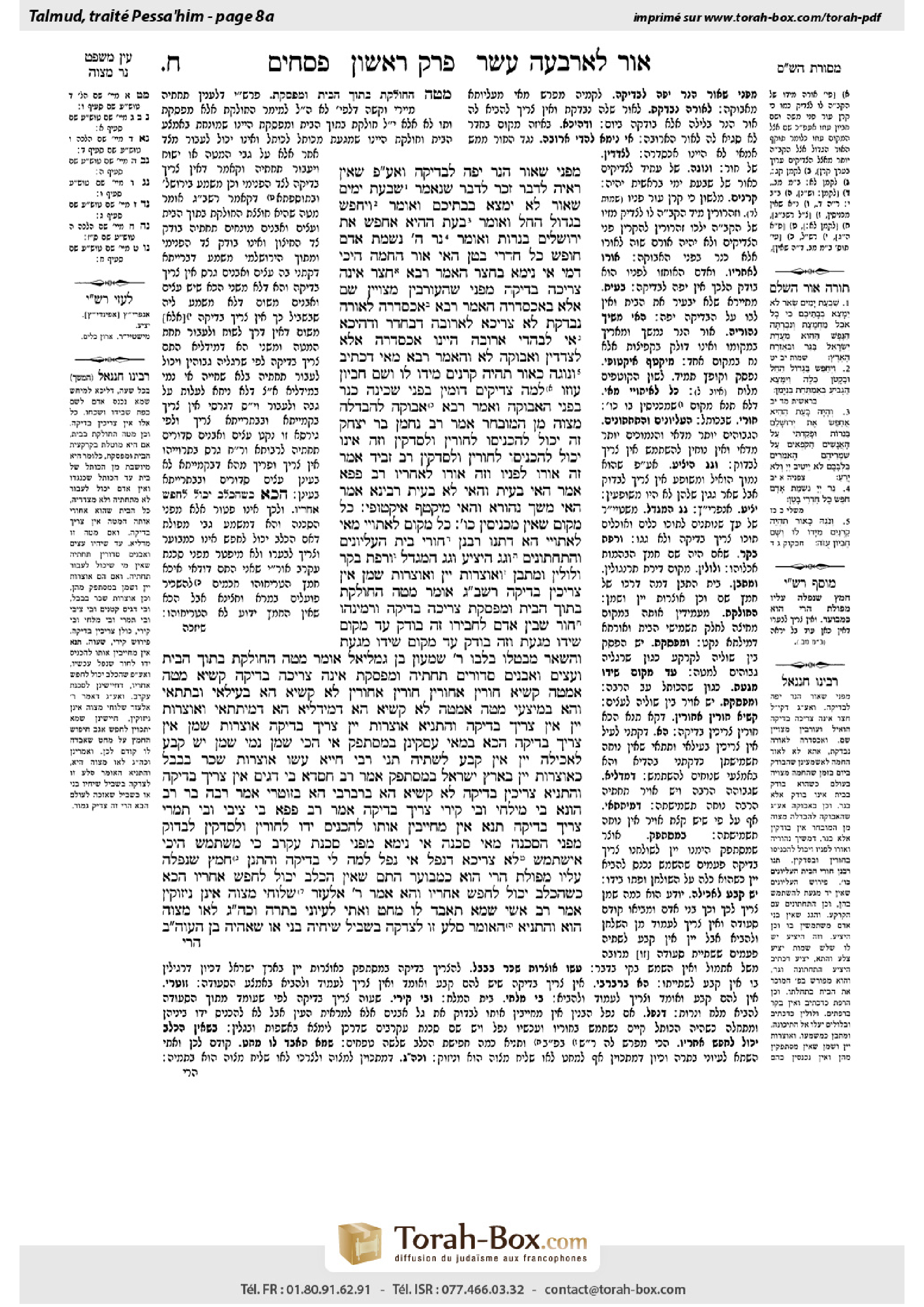
Pesachim 8a: Talmud study for Daf Yomi
Daf Yomi is the daily study of one Talmud folio. Explore 37 tractates with scans, Hebrew text, Sefaria English and AI-generated French translations where annotated.
Passage selection and English or AI-generated French translation are available where the scan has annotations. Daf Study is independent of Torah-Box and Sefaria.
Browse Pesachim · פסחים · All tractatesPesachim 8a text and translations
This page of Pesachim includes the Aramaic text, an English translation and an AI-generated French translation, alongside the scan above.
פסחים ח׳ א · Aramaic and Hebrew text
מִפְּנֵי שֶׁאוֹר הַנֵּר יָפֶה לַבְּדִיקָה. וְאַף עַל פִּי שֶׁאֵין רְאָיָה לַדָּבָר — זֵכֶר לַדָּבָר, שֶׁנֶּאֱמַר: ״שִׁבְעַת יָמִים שְׂאֹר לֹא יִמָּצֵא בְּבָתֵּיכֶם״, וְאוֹמֵר: ״וַיְחַפֵּשׂ בַּגָּדוֹל הֵחֵל״, וְאוֹמֵר: ״בָּעֵת הַהִיא אֲחַפֵּשׂ אֶת יְרוּשָׁלִַים בַּנֵּרוֹת״, וְאוֹמֵר: ״נֵר ה׳ נִשְׁמַת אָדָם חֹפֵשׂ כׇּל חַדְרֵי בָטֶן״.
הַאי אוֹר הַחַמָּה הֵיכִי דָמֵי? אִי נֵימָא בְּחָצֵר, הָאָמַר רָבָא: חָצֵר אֵינָהּ צְרִיכָה בְּדִיקָה, מִפְּנֵי שֶׁהָעוֹרְבִין מְצוּיִין שָׁם. אֶלָּא בְּאַכְסַדְרָה, הָאָמַר רָבָא: אַכְסַדְרָה לְאוֹרָהּ נִבְדֶּקֶת!
לָא צְרִיכָא, לַאֲרוּבָּה דִּבְחֶדֶר. וּדְהֵיכָא? אִי לְבַהֲדֵי אֲרוּבָּה — הַיְינוּ אַכְסַדְרָה. אֶלָּא לִצְדָדִין.
וַאֲבוּקָה לָא? וְהָאָמַר רָבָא, מַאי דִּכְתִיב: ״וְנֹגַהּ כָּאוֹר תִּהְיֶה קַרְנַיִם מִיָּדוֹ לוֹ וְשָׁם חֶבְיוֹן עֻזּוֹ״, לְמָה צַדִּיקִים דּוֹמִין בִּפְנֵי שְׁכִינָה — כַּנֵּר בִּפְנֵי הָאֲבוּקָה. וְאָמַר רָבָא: אֲבוּקָה לְהַבְדָּלָה מִצְוָה מִן הַמּוּבְחָר!
אָמַר רַב נַחְמָן בַּר יִצְחָק: זֶה — יָכוֹל לְהַכְנִיסוֹ לְחוֹרִין וְלִסְדָקִין, וְזֶה — אֵינוֹ יָכוֹל לְהַכְנִיסוֹ לְחוֹרִין וְלִסְדָקִין. רַב זְבִיד אָמַר: זֶה — אוֹרוֹ לְפָנָיו, וָזֶה — אוֹרוֹ לְאַחֲרָיו. רַב פָּפָּא אֲמַר: הַאי — בְּעִית, וְהַאי — לָא בְּעִית. רָבִינָא אֲמַר: הַאי — מְשִׁךְ נְהוֹרָא, וְהַאי — מִיקַּטַּף אִיקַּטּוֹפֵי.
כׇּל מָקוֹם שֶׁאֵין מַכְנִיסִין כּוּ׳. ״כׇּל מָקוֹם״ לְאֵתוֹיֵי מַאי? לְאֵתוֹיֵי הָא דְּתָנוּ רַבָּנַן: חוֹרֵי בַּיִת הָעֶלְיוֹנִים וְהַתַּחְתּוֹנִים, וְגַג הַיָּצִיעַ, וְגַג הַמִּגְדָּל, וְרֶפֶת בָּקָר, וְלוּלִין, וּמַתְבֵּן, וְאוֹצְרוֹת יַיִן וְאוֹצְרוֹת שֶׁמֶן — אֵין צְרִיכִין בְּדִיקָה. רַבָּן שִׁמְעוֹן בֶּן גַּמְלִיאֵל אוֹמֵר: מִטָּה הַחוֹלֶקֶת בְּתוֹךְ הַבַּיִת וּמַפְסֶקֶת — צְרִיכָה בְּדִיקָה.
וּרְמִינְהוּ: חוֹר שֶׁבֵּין אָדָם לַחֲבֵירוֹ — זֶה בּוֹדֵק עַד מָקוֹם שֶׁיָּדוֹ מַגַּעַת, וְזֶה בּוֹדֵק עַד מָקוֹם שֶׁיָּדוֹ מַגַּעַת, וְהַשְּׁאָר מְבַטְּלוֹ בְּלִבּוֹ. רַבָּן שִׁמְעוֹן בֶּן גַּמְלִיאֵל אוֹמֵר: מִטָּה הַחוֹלֶקֶת בְּתוֹךְ הַבַּיִת, וְעֵצִים וַאֲבָנִים סְדוּרִים תַּחְתֶּיהָ, וּמַפְסֶקֶת — אֵינָהּ צְרִיכָה בְּדִיקָה.
קַשְׁיָא מִטָּה אַמִּטָּה, קַשְׁיָא חוֹרִין אַחוֹרִין!
חוֹרִין אַחוֹרִין לָא קַשְׁיָא: הָא — בְּעִילָּאֵי וּבְתַתָּאֵי, וְהָא — בְּמִיצְעֵי. מִטָּה אַמִּטָּה לָא קַשְׁיָא: הָא — דְּמִידַּלְּיָא, הָא — דְּמִיתַּתַּאי.
וְאוֹצְרוֹת יַיִן אֵין צָרִיךְ בְּדִיקָה?! וְהָתַנְיָא: אוֹצְרוֹת יַיִן — צָרִיךְ בְּדִיקָה, אוֹצְרוֹת שֶׁמֶן — אֵין צָרִיךְ בְּדִיקָה! הָכָא בְּמַאי עָסְקִינַן — בְּמִסְתַּפֵּק. אִי הָכִי, שֶׁמֶן נָמֵי!
שֶׁמֶן — יֵשׁ קֶבַע לַאֲכִילָה. יַיִן — אֵין קֶבַע לִשְׁתִיָּה.
תָּנֵי רַבִּי חִיָּיא: עָשׂוּ אוֹצְרוֹת שֵׁכָר בְּבָבֶל כְּאוֹצְרוֹת יַיִן בְּאֶרֶץ יִשְׂרָאֵל, בְּמִסְתַּפֵּק.
אָמַר רַב חִסְדָּא: בֵּי דָגִים אֵין צָרִיךְ בְּדִיקָה. וְהָתַנְיָא צְרִיכִין בְּדִיקָה! לָא קַשְׁיָא: הָא — בְּרַבְרְבֵי, הָא — בְּזוּטְרֵי.
אָמַר רַבָּה בַּר רַב הוּנָא: בֵּי מִילְחֵי וּבֵי קִירֵי צָרִיךְ בְּדִיקָה. אָמַר רַב פָּפָּא: בֵּי צִיבֵי וּבֵי תַמְרֵי צָרִיךְ בְּדִיקָה.
תָּנָא: אֵין מְחַיְּיבִין אוֹתוֹ לְהַכְנִיס יָדוֹ לְחוֹרִין וְלִסְדָקִין לִבְדּוֹק — מִפְּנֵי הַסַּכָּנָה. מַאי סַכָּנָה? אִי נֵימָא מִפְּנֵי סַכָּנַת עַקְרָב — כִּי מִשְׁתַּמַּשׁ, הֵיכִי אִישְׁתַּמַּשׁ? לָא צְרִיכָא, דִּנְפַל.
אִי נְפַל, לְמָה לִי בְּדִיקָה? וְהָתְנַן: חָמֵץ שֶׁנָּפְלָה עָלָיו מַפּוֹלֶת — הֲרֵי הוּא כִּמְבוֹעָר! הָתָם שֶׁאֵין הַכֶּלֶב יָכוֹל לְחַפֵּשׂ אַחֲרָיו, הָכָא כְּשֶׁהַכֶּלֶב יָכוֹל לְחַפֵּשׂ אַחֲרָיו.
וְהָא אָמַר רַבִּי אֶלְעָזָר: שְׁלוּחֵי מִצְוָה אֵינָן נִיזּוֹקִין? אָמַר רַב אָשֵׁי: שֶׁמָּא תֹּאבַד לוֹ מַחַט, וְאָתֵי לְעַיּוֹנֵי בָּתְרַהּ.
וּכְהַאי גַּוְונָא לָאו מִצְוָה הוּא?! וְהָתַנְיָא: הָאוֹמֵר ״סֶלַע זוֹ לִצְדָקָה בִּשְׁבִיל שֶׁיִּחְיֶה בְּנִי״ אוֹ ״שֶׁאֶהְיֶה בֶּן הָעוֹלָם הַבָּא״ —
Pesachim 8a · English translation
because the light of a lamp is effective for searching. And even though there is no proof for this matter, there is an allusion to this matter, as it is stated: “Seven days leaven shall not be found in your houses” (Exodus 12:19), and it says: “And he searched, starting with the eldest, and ending with the youngest; and the goblet was found in Benjamin’s sack…” (Genesis 44:12). And it says: “At that time I will search Jerusalem with lamps” (Zephaniah 1:12), and it says: “The spirit of man is the lamp of God, searching all the inward parts” (Proverbs 20:27).
The Gemara asks a question: This light of the sun, by which one may not conduct the search for leaven, what are the circumstances of this case? If we say it is referring to conducting a search in the courtyard, didn’t Rava say that a courtyard does not require searching, due to the ravens and other birds that are found there, and will certainly eat any leaven there? Rather, perhaps this ruling is referring to a portico, which is not frequented by ravens. However, this cannot be the correct interpretation either, as didn’t Rava say with regard to that case that a portico may be searched by its own light, i.e., one need not use a lamp at all when searching a portico, but one may search it by sunlight?
The Gemara answers: No, this statement with regard to sunlight is necessary with regard to the skylight that is in a room. The Gemara asks: And with regard to the area to which the tanna is referring, where in the room is it located? If he is referring to the place opposite the skylight, the legal status of that area is like that of a portico, as its abundant sunlight is adequate to search for leaven. Rather, the tanna is referring to the sides of the room. In those areas, one cannot rely on the sunlight from the skylight. He must search by the light of the lamp.
The Gemara asks: And is the light of a torch not bright enough for searching? But didn’t Rava say: What is the meaning of that which is written, “And a brightness appears as the light; He has rays at His side; and there is the hiding of His power” (Habakkuk 3:4), which indicates that God will provide rays of glory for the righteous in the future? The Sages explained this verse by means of a parable: To what are the righteous comparable before the Divine Presence? They are comparable to a lamp in the face of a torch. This statement indicates that the light of a torch is significantly greater than that of a lamp, and consequently a torch should be more effective in the search for leaven. And likewise Rava said: One who uses a torch for the blessing over fire in havdala has performed the mitzva in the optimal manner. Apparently, the light of a torch is greater than that of a lamp.
Rav Naḥman bar Yitzḥak said: The baraita does not prohibit the use of a torch due to its failure to provide sufficient light. Rather, it is due to the fact that one can put this lamp into holes and crevices, as it is a small flame, and one cannot put that torch into holes and crevices, as it is a large flame.
Rav Zevid said: This lamp projects its light before it, facilitating the search, and that torch projects its light behind it, on the person conducting the search.
Rav Pappa said: The reason is that when using this torch one fears starting a fire, and when using that lamp he does not fear starting a fire.
Ravina said: This lamp consistently draws light, and the light of that torch fluctuates. Although overall the torch provides greater light than a lamp, it is less effective for use in a search.
We learned in the mishna: Any place into which one does not typically take leaven does not require searching. The Gemara asks: What does the inclusive phrase: Any place, come to include? The Gemara answers that it comes to include that which the Sages taught in a baraita: The upper and lower holes in the wall of a house that are difficult to use, as well as a veranda roof, a closet roof, a cowshed, chicken coops, a storehouse for straw, a wine cellar, and a storeroom for oil; all these do not require that a search be conducted. Rabban Shimon ben Gamliel says: A bed that divides the area inside a house and space separates the bottom of the bed from the floor requires a search, as there might be leaven beneath it.
The Gemara raises a contradiction between this baraita and another: With regard to a hole in a wall that is between a house belonging to one person and a house belonging to another, this neighbor searches to the point that his hand reaches, and that neighbor searches to the point that his hand reaches. And as for leaven found in the rest of the hole, each one renders it null and void in his heart. Rabban Shimon ben Gamliel says: A bed that divides the area inside a house, with wood and stones placed under it, and space separates the bottom of the bed from the wood and stones beneath it, does not require searching.
This is difficult due to a contradiction between the ruling with regard to a bed in the first baraita, where Rabban Shimon ben Gamliel says that it requires a search, and the ruling with regard to a bed in the second baraita, where he rules that no search is required. Furthermore, it is similarly difficult due to a contradiction between the ruling with regard to holes in the first baraita, that a search is not required, and the ruling with regard to holes in the second baraita, that a search is required.
The Gemara answers: The apparent contradiction between the first ruling with regard to holes and the second ruling with regard to holes is not difficult. This baraita, which rules that one need not search them, is referring to upper and lower holes, which are difficult to use. And that baraita, which rules that one is required to search them, is referring to intermediate holes, whose use is convenient. The apparent contradiction between the first ruling with regard to a bed and the second ruling with regard to a bed is similarly not difficult. This baraita, which rules that one is required to search them, is referring to a bed that is raised off the floor, and that ruling, that one need not search them, is referring to a bed that is low and the space beneath it cannot be used, and presumably, there is no leaven there.
With regard to this baraita, the Gemara asks: And do wine storages not require searching? But wasn’t it taught in a baraita: Wine storages require searching; oil storages do not require searching. The Gemara answers: With what are we dealing here? It is a case where one supplies wine from the storage during the meal. The Gemara raises a difficulty: If so, then in the case of oil storages, if one supplies oil from the storage during the meal, he should be obligated to search there as well.
The Gemara answers: With regard to oil, there is a fixed quantity used for eating a meal. A person knows how much oil he will require before the meal begins, and he will therefore supply himself with any oil that he will need before the meal, and no leaven will enter the storage. However, with regard to wine, there is no fixed quantity used for drinking, as one does not know how much wine he will drink during the meal. Consequently, it is possible that he will descend to his wine cellar with bread in his hand to replenish his supply of wine.
Rabbi Ḥiyya teaches: The Sages rendered the legal status of the beer storages in Babylonia like that of wine storages in Eretz Yisrael, with regard to one who supplies wine from the storage during the meal. Any storage from which one replenishes his supply during the meal requires searching for leaven.
Rav Ḥisda said: A fish storage does not require searching. The Gemara raises a difficulty: But wasn’t it taught in a baraita that a fish storage requires searching? The Gemara answers: This is not difficult; this lenient ruling is referring to large fish, and that stringent ruling deals with small fish. Since one does not know exactly how many small fish he will require for the meal, he might need to replenish his supply during his meal.
Rabba bar Rav Huna said: A salt storage and a storage for candles require searching for leaven, as one might have entered those storages during a meal. Rav Pappa likewise said: A wood storage and a storage for dates require searching for the same reason.
It was taught in the Tosefta: The Sages do not require one to place his hand into holes and crevices to search for leaven, due to the danger involved. The Gemara asks: Due to what danger? If we say it is due to the danger of a scorpion that might be in this hole, when he made use of the hole in the first place, how did he make use of it if there were scorpions there? If the hole is never used, there is no need to search it in any case. The Gemara answers: No, it is necessary to search this hole in a case where leaven fell into it unintentionally.
The Gemara asks: If the tanna is referring to a case where leaven fell into the hole, again, why do I need to conduct a search? But didn’t we learn in a mishna with regard to leaven upon which a rockslide fell, it is considered removed from the owner’s possession? Here too, any leaven that fell into the hole should be considered removed. The Gemara answers: There, where the tanna said it is as though it were removed, he is referring to a case where the rockslide buries the leaven so that even a dog cannot search for it. Here, it is referring a hole that is not so deep, and therefore a dog can search for it and extract the leaven from the hole.
The Gemara questions the halakha in the Tosefta from a different angle. Why is there any concern about danger in this case? But didn’t Rabbi Elazar say: Those on the path to perform a mitzva are not susceptible to harm throughout the process of performing the mitzva? Rav Ashi said: Here we are concerned lest he will also have lost a needle in the same place, and he will look for it while he is searching for the leaven. Since he is not merely searching for leaven, the merit of the mitzva will not protect him.
The Gemara asks: And in a case like that, where there is personal interest intermingled with the performance of a mitzva, is it not nevertheless considered a mitzva? But wasn’t it taught in a baraita that one who says: I am contributing this sela to charity so that my son will live, or if he says: I am performing the mitzva so that I will be one destined for the World-to-Come,
Pesachim 8a · Traduction française (IA)
car la lumière d’une lampe est efficace pour effectuer une recherche. Et bien qu’il n’y ait pas de preuve à ce sujet, il en existe une allusion, comme il est dit : « Pendant sept jours, on ne trouvera pas de levain dans vos maisons » (Exode 12, 19), et il est dit : « Il fouilla, en commençant par l’aîné et en terminant par le plus jeune ; la coupe fut trouvée dans le sac de Benjamin… » (Genèse 44, 12). Et il est dit : « En ce temps-là, je fouillerai Jérusalem avec des lampes » (Sophonie 1, 12), et il est dit : « Le souffle de l’homme est la lampe de Dieu, qui fouille toutes les profondeurs de son être » (Proverbes 20, 27).
La Guemara pose une question : dans quelles circonstances la lumière du soleil, à laquelle on ne peut pas effectuer la recherche du levain, est-elle en cause ? Si l’on dit qu’il s’agit d’une recherche dans une cour, Rava n’a-t-il pas dit qu’une cour n’a pas besoin d’être fouillée, en raison des corbeaux et des autres oiseaux qui s’y trouvent et qui mangeront certainement tout levain qui s’y trouverait ? Peut-être s’agit-il plutôt d’une loggia, où les corbeaux ne vont pas. Mais cette interprétation ne peut pas non plus être correcte, car Rava n’a-t-il pas dit à ce sujet qu’on peut fouiller une loggia à la lumière du jour, c’est-à-dire qu’il n’est nullement nécessaire d’utiliser une lampe pour la fouiller, mais qu’on peut le faire à la lumière du soleil ?
La Guemara répond : Non, cette affirmation concernant la lumière du soleil est nécessaire à propos de la lucarne qui se trouve dans une pièce. La Guemara demande : à quelle partie de la pièce le tanna fait-il référence ? S’il vise l’endroit situé juste en face de la lucarne, son statut est celui d’une loggia, car la lumière abondante suffit à y rechercher le levain. Le tanna vise donc les côtés de la pièce. Dans ces endroits, on ne peut pas compter sur la lumière qui vient de la lucarne ; il faut y effectuer la recherche à la lumière d’une lampe.
La Guemara demande : la lumière d’une torche n’est-elle pas assez vive pour effectuer la recherche ? Rava n’a-t-il pas dit : quel est le sens de ce qui est écrit : « Sa splendeur est comme la lumière ; des rayons sortent de son côté, et là se cache sa puissance » (Habacuc 3, 4), ce qui indique que Dieu accordera à l’avenir des rayons de gloire aux justes ? Les Sages expliquent ce verset au moyen d’une parabole : à quoi les justes sont-ils comparables devant la Présence divine ? À une lampe face à une torche. Cette affirmation indique que la lumière d’une torche est nettement plus forte que celle d’une lampe et que, par conséquent, une torche devrait être plus efficace pour rechercher le levain. De même, Rava a dit : celui qui utilise une torche pour la bénédiction sur le feu lors de la havdala accomplit la mitsva de manière optimale. Apparemment, la lumière d’une torche est plus forte que celle d’une lampe.
Rav Naḥman bar Yitzḥak dit : la baraïta n’interdit pas l’emploi d’une torche parce qu’elle ne fournit pas une lumière suffisante. C’est plutôt parce qu’on peut introduire cette lampe dans les trous et les fissures, puisqu’elle a une petite flamme, tandis qu’on ne peut pas introduire cette torche dans les trous et les fissures, car sa flamme est grande. Rav Zevid dit : cette lampe projette sa lumière devant elle, ce qui facilite la recherche, tandis que cette torche projette sa lumière derrière elle, sur la personne qui effectue la recherche. Rav Pappa dit : la raison est que, lorsqu’on utilise cette torche, on craint de provoquer un incendie, alors qu’avec cette lampe, on ne le craint pas. Ravina dit : la lumière de cette lampe reste constante, tandis que celle de cette torche vacille. Bien que, dans l’ensemble, la torche fournisse une lumière plus forte qu’une lampe, elle est moins efficace pour effectuer une recherche.
Nous avons appris dans la Michna : tout endroit où l’on n’a pas coutume d’introduire du levain n’a pas besoin d’être fouillé. La Guemara demande : qu’est-ce que l’expression inclusive « tout endroit » vient inclure ? La Guemara répond qu’elle inclut ce que les Sages ont enseigné dans une baraïta : les trous supérieurs et inférieurs, difficiles d’accès, dans le mur d’une maison, ainsi que le toit d’une véranda, le dessus d’un placard, une étable, des poulaillers, un grenier à paille, une cave à vin et une réserve d’huile ; aucun de ces endroits n’a besoin d’être fouillé. Rabban Shimon ben Gamliel dit : un lit qui divise l’espace intérieur d’une maison et dont le fond est séparé du sol par un espace doit être fouillé, car il peut y avoir du levain dessous.
La Guemara soulève une contradiction entre cette baraïta et une autre : s’agissant d’un trou dans un mur entre la maison d’une personne et celle d’une autre, chaque voisin fouille jusqu’à l’endroit que sa main peut atteindre. Quant au levain qui se trouverait dans le reste du trou, chacun le considère comme nul dans son cœur. Rabban Shimon ben Gamliel dit : un lit qui divise l’espace intérieur d’une maison, sous lequel sont placés du bois et des pierres, et dont le fond est séparé de ces matériaux par un espace, n’a pas besoin d’être fouillé.
Il y a là une difficulté, en raison de la contradiction entre la règle concernant le lit dans la première baraïta, où Rabban Shimon ben Gamliel dit qu’il doit être fouillé, et celle concernant le lit dans la seconde baraïta, où il statue qu’aucune recherche n’est nécessaire. De même, il y a une difficulté en raison de la contradiction entre la règle concernant les trous dans la première baraïta, selon laquelle aucune recherche n’est nécessaire, et celle concernant les trous dans la seconde baraïta, selon laquelle une recherche est nécessaire.
La Guemara répond : la contradiction apparente entre la première règle concernant les trous et la seconde règle à leur sujet ne pose pas de difficulté. Cette baraïta, qui statue qu’il n’est pas nécessaire de les fouiller, parle des trous supérieurs et inférieurs, difficiles d’accès. L’autre baraïta, qui statue qu’il faut les fouiller, parle des trous intermédiaires, faciles d’accès. La contradiction apparente entre la première et la seconde règle concernant un lit ne pose pas non plus de difficulté. Cette baraïta, qui statue qu’il faut le fouiller, parle d’un lit surélevé ; l’autre règle, selon laquelle il n’est pas nécessaire de le fouiller, parle d’un lit bas, sous lequel l’espace ne peut pas être utilisé et où, vraisemblablement, il n’y a pas de levain.
À propos de cette baraïta, la Guemara demande : les réserves de vin n’ont-elles pas besoin d’être fouillées ? N’a-t-on pas enseigné dans une baraïta : les réserves de vin doivent être fouillées ; les réserves d’huile n’ont pas besoin de l’être ? La Guemara répond : de quel cas s’agit-il ici ? D’un cas où l’on va chercher du vin dans la réserve pendant le repas. La Guemara soulève une difficulté : dans ce cas, s’agissant des réserves d’huile, si l’on va y chercher de l’huile pendant le repas, on devrait également être tenu de les fouiller.
La Guemara répond : en ce qui concerne l’huile, la quantité utilisée pour un repas est fixe. Une personne sait de quelle quantité d’huile elle aura besoin avant le début du repas ; elle se procurera donc avant le repas toute l’huile dont elle aura besoin, et aucun levain n’entrera dans la réserve. En revanche, la quantité de vin que l’on boit n’est pas fixe, car on ne sait pas combien de vin on boira pendant le repas. Il est donc possible qu’une personne descende à sa cave à vin avec du pain à la main pour refaire son stock de vin.
Rabbi Ḥiyya enseigne : les Sages ont conféré aux réserves de bière de Babylonie le même statut qu’aux réserves de vin d’Eretz Israël, concernant le cas de celui qui va chercher du vin dans la réserve pendant le repas. Toute réserve dans laquelle on va se réapprovisionner pendant le repas doit être fouillée à la recherche de levain.
Rav Ḥisda dit : une réserve de poisson n’a pas besoin d’être fouillée. La Guemara soulève une difficulté : n’a-t-on pas enseigné dans une baraïta qu’une réserve de poisson doit être fouillée ? La Guemara répond : il n’y a pas de difficulté ; cette règle indulgente concerne les gros poissons, tandis que cette règle rigoureuse concerne les petits poissons. Comme on ne sait pas exactement combien de petits poissons il faudra pour le repas, on peut être amené à se réapprovisionner pendant le repas.
Rabba bar Rav Huna dit : une réserve de sel et une réserve de bougies doivent être fouillées à la recherche de levain, car on peut y être entré pendant un repas. Rav Pappa dit également : une réserve de bois et une réserve de dattes doivent être fouillées pour la même raison.
Il a été enseigné dans la Tossefta : les Sages n’obligent pas à introduire la main dans les trous et les fissures pour rechercher le levain, en raison du danger encouru. La Guemara demande : de quel danger s’agit-il ? Si l’on dit qu’il s’agit du danger d’un scorpion qui pourrait se trouver dans ce trou, comment a-t-on pu utiliser le trou au départ s’il y avait des scorpions ? Si le trou n’est jamais utilisé, il n’est de toute façon pas nécessaire de le fouiller. La Guemara répond : non, il est nécessaire de fouiller ce trou dans le cas où du levain y est tombé par inadvertance.
La Guemara demande : si le tanna parle d’un cas où du levain est tombé dans le trou, pourquoi faut-il encore effectuer une recherche ? N’avons-nous pas appris dans une Michna que le levain recouvert par un éboulement est considéré comme retiré de la possession de son propriétaire ? Ici aussi, tout levain tombé dans le trou devrait être considéré comme retiré de sa possession. La Guemara répond : là, lorsque le tanna dit qu’il est comme s’il avait été retiré, il parle d’un cas où l’éboulement ensevelit le levain de telle sorte que même un chien ne peut pas le trouver. Ici, il s’agit d’un trou qui n’est pas si profond ; un chien peut donc y chercher le levain et l’en extraire.
La Guemara remet en question la halakha de la Tossefta sous un autre angle. Pourquoi y aurait-il le moindre souci de danger dans ce cas ? Rabbi Elazar n’a-t-il pas dit : ceux qui sont en chemin pour accomplir une mitsva ne sont pas exposés au danger pendant toute la durée de l’accomplissement de la mitsva ? Rav Ashi dit : ici, on craint qu’il ait également perdu une aiguille au même endroit et qu’il la cherche en même temps que le levain. Puisqu’il ne recherche pas uniquement du levain, le mérite de la mitsva ne le protégera pas.
La Guemara demande : dans un cas comme celui-ci, où un intérêt personnel est mêlé à l’accomplissement d’une mitsva, cela n’est-il pas malgré tout considéré comme une mitsva ? N’a-t-on pas enseigné dans une baraïta que celui qui dit : « Je donne cette sela à la tsédaka afin que mon fils vive », ou qui dit : « J’accomplis la mitsva afin de faire partie de ceux qui sont destinés au Monde futur »,
Traduction française générée par IA à partir de l’édition anglaise de Sefaria. Vérifie toujours un passage avec le texte source.
Text from Sefaria: William Davidson Edition - Vocalized Aramaic (CC BY NC); William Davidson Edition - English (CC BY NC).