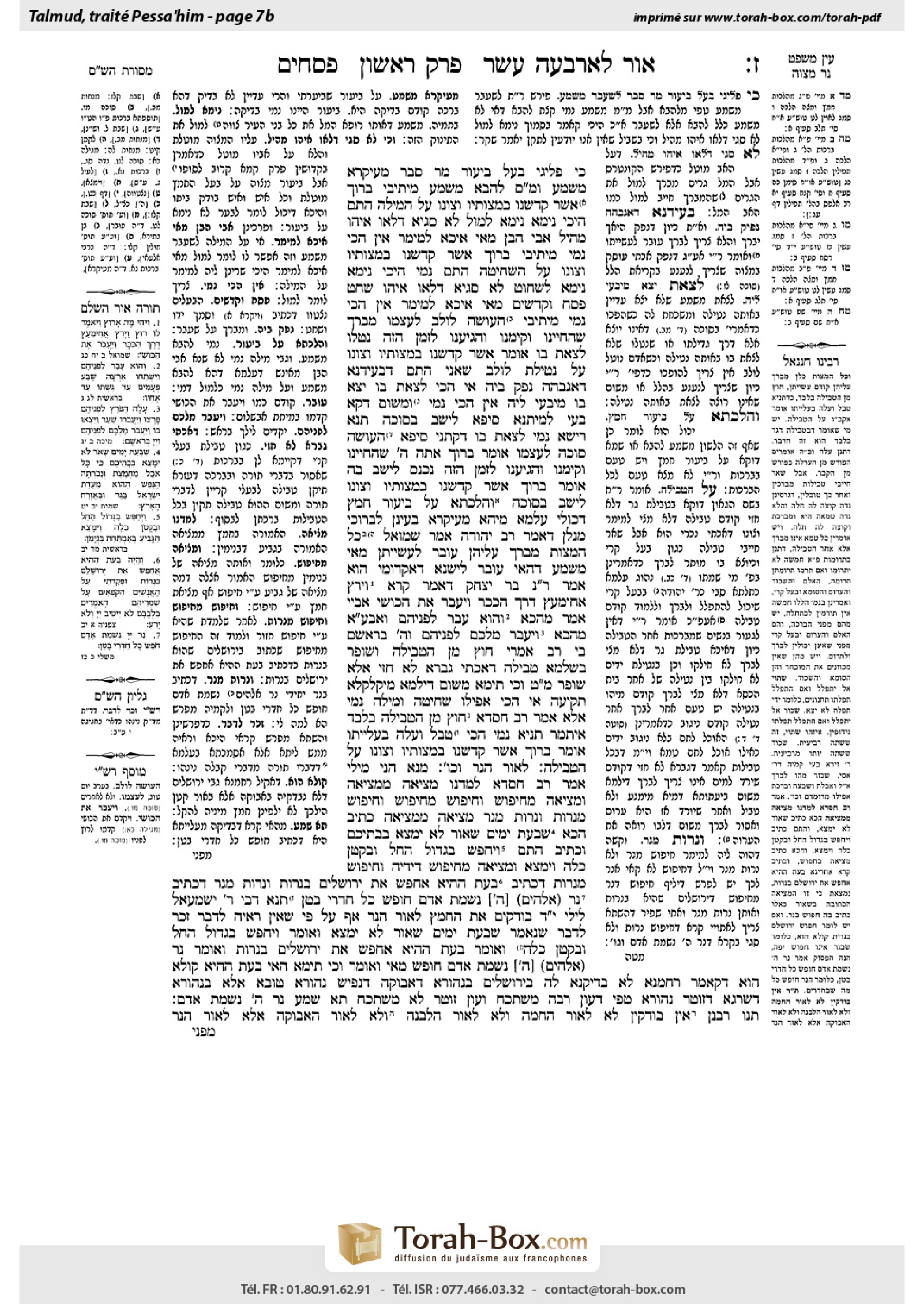
Pesachim 7b: Talmud study for Daf Yomi
Daf Yomi is the daily study of one Talmud folio. Explore 37 tractates with scans, Hebrew text, Sefaria English and AI-generated French translations where annotated.
Passage selection and English or AI-generated French translation are available where the scan has annotations. Daf Study is independent of Torah-Box and Sefaria.
Browse Pesachim · פסחים · All tractatesPesachim 7b text and translations
This page of Pesachim includes the Aramaic text, an English translation and an AI-generated French translation, alongside the scan above.
פסחים ז׳ ב · Aramaic and Hebrew text
כִּי פְּלִיגִי בְּ״עַל בִּיעוּר״. מָר סָבַר: מֵעִיקָּרָא מַשְׁמַע, וּמָר סָבַר: לְהַבָּא מַשְׁמַע.
מֵיתִיבִי: ״בָּרוּךְ ... אֲשֶׁר קִדְּשָׁנוּ בְּמִצְוֹתָיו וְצִוָּנוּ עַל הַמִּילָה״!
הָתָם, הֵיכִי נֵימָא? נֵימָא ״לָמוּל״ — לָא סַגִּיא דְּלָאו אִיהוּ מָהֵיל? אֲבִי הַבֵּן מַאי אִיכָּא לְמֵימַר? אִין הָכִי נָמֵי.
מֵיתִיבִי: ״בָּרוּךְ ... אֲשֶׁר קִדְּשָׁנוּ בְּמִצְוֹתָיו וְצִוָּנוּ עַל הַשְּׁחִיטָה״! הָתָם נָמֵי, הֵיכִי נֵימָא? נֵימָא ״לִשְׁחוֹט״ — לָא סַגִּיא דְּלָאו אִיהוּ שָׁחֵט?
פֶּסַח וְקׇדָשִׁים מַאי אִיכָּא לְמֵימַר? אִין הָכִי נָמֵי.
מֵיתִיבִי: הָעוֹשֶׂה לוּלָב לְעַצְמוֹ, מְבָרֵךְ: ״שֶׁהֶחֱיָינוּ וְקִיְּמָנוּ וְהִגִּיעָנוּ לַזְּמַן הַזֶּה״. נְטָלוֹ לָצֵאת בּוֹ, אוֹמֵר: ״אֲשֶׁר קִדְּשָׁנוּ בְּמִצְוֹתָיו וְצִוָּנוּ עַל נְטִילַת לוּלָב״! שָׁאנֵי הָתָם, דִּבְעִידָּנָא דְּאַגְבְּהֵהּ נְפַק בֵּיהּ.
אִי הָכִי: ״לָצֵאת בּוֹ״? ״יָצָא בּוֹ״ מִיבְּעֵי לֵיהּ! אִין הָכִי נָמֵי, וּמִשּׁוּם דְּקָא בָּעֵי לְמִיתְנָא סֵיפָא: ״לֵישֵׁב בַּסּוּכָּה״, תְּנָא רֵישָׁא נָמֵי ״לָצֵאת בּוֹ״.
דְּקָתָנֵי סֵיפָא: הָעוֹשֶׂה סוּכָּה לְעַצְמוֹ, אוֹמֵר: ״בָּרוּךְ אַתָּה ה׳ ... שֶׁהֶחֱיָינוּ וְקִיְּמָנוּ וְהִגִּיעָנוּ לַזְּמַן הַזֶּה״. נִכְנַס לֵישֵׁב בָּהּ, אוֹמֵר: ״בָּרוּךְ ... אֲשֶׁר קִדְּשָׁנוּ בְּמִצְוֹתָיו וְצִוָּנוּ לֵישֵׁב בַּסּוּכָּה״. וְהִלְכְתָא: ״עַל בִּיעוּר חָמֵץ״.
דְּכוּלֵּי עָלְמָא מִיהָא, מֵעִיקָּרָא בָּעִינַן לְבָרוֹכֵי, מְנָלַן? דְּאָמַר רַב יְהוּדָה אָמַר שְׁמוּאֵל: כׇּל הַמִּצְוֹת מְבָרֵךְ עֲלֵיהֶן עוֹבֵר לַעֲשִׂיָּיתָן.
מַאי מַשְׁמַע דְּהַאי ״עוֹבֵר״ לִישָּׁנָא דְּאַקְדּוֹמֵי הוּא? אָמַר רַב נַחְמָן בַּר יִצְחָק, דְּאָמַר קְרָא: ״וַיָּרׇץ אֲחִימַעַץ דֶּרֶךְ הַכִּכָּר וַיַּעֲבֹר אֶת הַכּוּשִׁי״. אַבָּיֵי אָמַר, מֵהָכָא: ״וְהוּא עָבַר לִפְנֵיהֶם״. וְאִיבָּעֵית אֵימָא מֵהָכָא: ״וַיַּעֲבֹר מַלְכָּם לִפְנֵיהֶם וַה׳ בְּרֹאשָׁם״.
בֵּי רַב אָמְרִי: חוּץ מִן הַטְּבִילָה וְשׁוֹפָר. בִּשְׁלָמָא טְבִילָה — דְּאַכַּתִּי גַּבְרָא לָא חֲזֵי. אֶלָּא שׁוֹפָר מַאי טַעְמָא? וְכִי תֵּימָא מִשּׁוּם דִּילְמָא מִיקַּלְקְלָא תְּקִיעָה. אִי הָכִי, אֲפִילּוּ שְׁחִיטָה וּמִילָה נָמֵי!
אֶלָּא אָמַר רַב חִסְדָּא: חוּץ מִן הַטְּבִילָה בִּלְבַד אִיתְּמַר. תַּנְיָא נָמֵי הָכִי: טָבַל וְעָלָה, בַּעֲלִיָּיתוֹ אוֹמֵר: ״בָּרוּךְ ... אֲשֶׁר קִדְּשָׁנוּ בְּמִצְוֹתָיו וְצִוָּנוּ עַל הַטְּבִילָה״.
לְאוֹר הַנֵּר וְכוּ׳. מְנָא הָנֵי מִילֵּי? אָמַר רַב חִסְדָּא: לָמַדְנוּ מְצִיאָה מִמְּצִיאָה, וּמְצִיאָה מֵחִיפּוּשׂ, וְחִיפּוּשׂ מֵחִיפּוּשׂ, וְחִיפּוּשׂ מִנֵּרוֹת, וְנֵרוֹת מִנֵּר.
מְצִיאָה מִמְּצִיאָה — כְּתִיב הָכָא: ״שִׁבְעַת יָמִים שְׂאֹר לֹא יִמָּצֵא בְּבָתֵּיכֶם״, וּכְתִיב הָתָם: ״וַיְחַפֵּשׂ בַּגָּדוֹל הֵחֵל וּבַקָּטֹן כִּלָּה וַיִּמָּצֵא״. וּמְצִיאָה מֵחִיפּוּשׂ דִּידֵיהּ.
וְחִיפּוּשׂ מִנֵּרוֹת, דִּכְתִיב: ״בָּעֵת הַהִיא אֲחַפֵּשׂ אֶת יְרוּשָׁלִַים בַּנֵּרוֹת״, וְנֵרוֹת מִנֵּר, דִּכְתִיב: ״נֵר (אֱלֹהִים) [ה׳] נִשְׁמַת אָדָם חֹפֵשׂ כׇּל חַדְרֵי בָטֶן״.
תָּנָא דְּבֵי רַבִּי יִשְׁמָעֵאל: לֵילֵי אַרְבָּעָה עָשָׂר בּוֹדְקִים אֶת הֶחָמֵץ לְאוֹר הַנֵּר. אַף עַל פִּי שֶׁאֵין רְאָיָה לְדָבָר, זֵכֶר לַדָּבָר, שֶׁנֶּאֱמַר: ״שִׁבְעַת יָמִים שְׂאֹר לֹא יִמָּצֵא״, וְאוֹמֵר: ״וַיְחַפֵּשׂ בַּגָּדוֹל הֵחֵל וּבַקָּטֹן כִּלָּה״, וְאוֹמֵר: ״בָּעֵת הַהִיא אֲחַפֵּשׂ אֶת יְרוּשָׁלִַים בַּנֵּרוֹת״, וְאוֹמֵר: ״נֵר (אֱלֹהִים) [ה׳] נִשְׁמַת אָדָם חֹפֵשׂ״.
מַאי ״וְאוֹמֵר״?
וְכִי תֵּימָא: הַאי ״בָּעֵת הָהִיא״ — קוּלָּא הוּא דְּקָאָמַר רַחֲמָנָא: לָא בָּדֵיקְנָא לַהּ בִּירוּשָׁלַיִם בִּנְהוֹרָא דַאֲבוּקָה — דִּנְפִישׁ נְהוֹרָא טוּבָא, אֶלָּא בִּנְהוֹרָא דִשְׁרָגָא — דְּזוּטַר נְהוֹרָא טְפֵי, דְּעָוֹן רַבָּה מִשְׁתְּכַח וְעָוֹן זוּטַר לָא מִשְׁתְּכַח, תָּא שְׁמַע: ״נֵר ה׳ נִשְׁמַת אָדָם״.
תָּנוּ רַבָּנַן: אֵין בּוֹדְקִין לֹא לְאוֹר הַחַמָּה, וְלֹא לְאוֹר הַלְּבָנָה, וְלֹא לְאוֹר הָאֲבוּקָה, אֶלָּא לְאוֹר הַנֵּר,
Pesachim 7b · English translation
Where they disagree is with regard to the formula: Concerning the elimination of leaven. One Sage, Rav Pappi, maintains that it is referring to an act that was performed previously. Since this formula is referring to the removal of leaven as a task already completed, it would be more appropriate for a blessing recited after performance of that mitzva was completed. And the other Sage, Rav Pappa, maintains that this expression refers to the future.
The Gemara raises an objection to Rav Pappi’s opinion from the formula of the blessing recited just prior to circumcision: Blessed are You…Who has made us holy through His mitzvot and has commanded us concerning circumcision. Apparently this expression indeed is referring to a future act.
The Gemara rejects this contention: That is no proof, as what alternative formula can we recite there? If we say: He, Who has made us holy through His mitzvot and commanded us to circumcise, is there no alternative to he himself, i.e., the boy’s father, circumcising his son? The father is commanded to circumcise his son, and he may appoint one who is not commanded to circumcise his son to act in his stead. Therefore, the more general formula of the blessing is recited: About the circumcision. The Gemara raises a difficulty: In a case where the child’s father himself circumcises his son, what can be said? The Gemara responds: Yes, it is indeed so. If the father himself performs the circumcision he in fact recites the blessing: And has commanded us to circumcise.
The Gemara raises an objection to Rav Pappi’s opinion. The blessing recited over ritual slaughter is: Blessed…Who has made us holy through His mitzvot and has commanded us concerning slaughtering. This blessing likewise indicates that this formula is appropriate prior to an action. The Gemara again rejects this claim: There too, what alternative formula can we recite? If we say: Who has commanded us to slaughter, is there no alternative to his slaughtering the animal? There is no mitzva to slaughter an animal. It is merely the necessary preparation before one may eat meat. Therefore, the more general formula of the blessing is recited: Concerning slaughtering.
The Gemara raises a difficulty: If so, with regard to the slaughter of the Paschal lamb and other consecrated animals, what can be said? One is indeed commanded to slaughter these animals. The Gemara answers: Yes, it is indeed so. When slaughtering the Paschal lamb or any other offering, one recites: Who has commanded us to slaughter.
The Gemara raises an objection to Rav Pappi’s opinion from the Tosefta: One who prepares a lulav for himself recites the blessing: Who has given us life, sustained us, and brought us to this time. When he takes it to fulfill with it the obligation to take the lulav, he says: Who has made us holy through His mitzvot and has commanded us concerning the taking of the lulav. Although he has yet to perform the mitzva, he does not recite the formula: To take. The Gemara answers: It is different there, as at the time when he lifts the lulav before he recites the blessing, he already fulfilled his obligation by Torah law. Consequently, the formula: Concerning the taking, is indeed more appropriate for an action that he has already performed.
The Gemara raises an objection: If so, the statement that he takes it to fulfill his obligation with it is imprecise, as the tanna should have said that he took the lulav with which he already fulfilled his obligation. The Gemara answers: Yes, it is indeed so; the tanna should have formulated the halakha in that manner. But due to the fact that he wants to teach the latter clause of the baraita: One who comes to sit in the sukka, he likewise taught in the first clause: To fulfill his obligation with it. This phrase maintains the consistency of the language of the Tosefta, even though it is imprecise with regard to the halakha of lulav.
As it teaches in the latter clause of this baraita: One who erects a sukka for himself recites: Blessed are You, God, Who has given us life, sustained us, and brought us to this time. When he enters to sit in the sukka he says: Blessed…Who has made us holy through His mitzvot and has commanded us to sit in the sukka. In summary, no conclusive proof has been found for either side of this debate. The Gemara concludes: And the halakha is that one should recite: Concerning the removal of leaven, as that expression is referring to the future as well.
The Gemara poses a question: In any event, it is clear from the previous discussion that everyone agrees that one is required to recite a blessing prior to performing a mitzva. From where do we derive this principle? It is as Rav Yehuda said that Shmuel said: With regard to all the mitzvot, one recites a blessing over them prior to [over] their performance.
The Gemara asks: From where may it be inferred that the word over is the language of priority? Rav Naḥman bar Yitzḥak said that the verse said: “And Ahimaaz ran by the way of the plain, and overran [vaya’avor] the Cushite” (II Samuel 18:23), i.e., Ahimaaz overtook the Cushite. Abaye said: It is derived from here: “And he passed [avar] before them” (Genesis 33:3). And if you wish, say instead that the proof is from here: “And their king passed [vaya’avor] before them and God at their head” (Micah 2:13).
In the school of Rav they say: One recites a blessing prior to performing all mitzvot, except for the ritual immersion after a nocturnal emission and the blowing of the shofar. The Gemara elaborates: Granted one does not recite a blessing prior to immersion, as this man who has not yet immersed is still unfit to recite a blessing because he is ritually impure. However, with regard to a shofar, what is the reason that one does not recite a blessing before sounding the shofar? And lest you say the reason is due to a concern lest the sounding of the shofar emerge flawed, and the blessing will be in vain, if so, one should not recite a blessing even prior to ritual slaughter and circumcision, as in those cases too one might fail to perform the action in the requisite manner.
Rather, Rav Ḥisda said: Except for prior to immersion alone was stated, due to the aforementioned reason. The Gemara adds: That was also taught in a baraita: With regard to one who immersed for ritual purification after a nocturnal emission and emerged, as he emerges he recites: Blessed…Who has made us holy through His mitzvot and commanded us concerning immersion.
The mishna states that one searches for leaven by the light of the lamp, etc. The Gemara asks: From where are these matters, i.e., that the search should be conducted by the light of the lamp, derived? Rav Ḥisda said: We derive it by the hermeneutic principles of verbal analogy and juxtaposition: The term finding in one context is derived from finding in another context, and finding is derived from the word searching, and this searching is derived from searching elsewhere, and searching there is derived from the word lamps, and lamps is derived from lamp.
The Gemara cites the relevant verses included in the above derivation. Finding in one context is derived from finding in another context by verbal analogy, as it is written here: “Seven days leaven shall not be found in your houses” (Exodus 12:19), and it is written there: “And he searched, starting with the eldest, and ending with the youngest; and the goblet was found in Benjamin’s sack” (Genesis 44:12). And the word finding in this verse is connected to searching in that same verse by juxtaposition, as the verse says: “And he searched... and was found.”
And searching is derived from lamps by means of juxtaposition, as it is written: “And it shall come to pass that at that time I will search Jerusalem with lamps” (Zephaniah 1:12). And finally, the word lamps is derived from lamp by means of juxtaposition, as it is written: “The spirit of man is the lamp of God, searching all the inward parts” (Proverbs 20:27). Together these verses indicate that the search for leaven must be conducted by the light of the lamp.
Similarly, the school of Rabbi Yishmael taught: On the night of the fourteenth one searches for leavened bread by the light of the lamp. Although there is no absolute proof for this matter, there is an allusion to this matter, as it is stated: “Seven days leaven shall not be found in your houses,” and it says: “And he searched, starting with the eldest, and ending with the youngest; and the goblet was found.” And it says: “At that time I will search Jerusalem with lamps,” and it says: “The spirit of man is the lamp of God, searching all the inward parts.”
With regard to this teaching, the Gemara asks a question: What is the reason for the last citation introduced by the final And the verse says? Why doesn’t the previous verse, “At that time I will search Jerusalem with lamps,” provide sufficient proof that the search must be conducted by the light of the lamp?
And the Gemara answers: The last verse is necessary, lest you say that this verse: “At that time, etc.” is a leniency, as God is saying: I will not search Jerusalem by the light of a torch, whose light is great, and through which I will expose every sin. Rather, I will search by the light of a small lamp, whose light is smaller, which will ensure that great sins will be discovered and small sins will not be discovered. To counter this argument, the tanna states: Come and hear, “The spirit of man is the lamp of God, searching all the inward parts.” This verse indicates that everything will be found by the light of the lamp, which is the most effective manner of searching.
The Sages taught: One does not search for leaven, neither by the light of the sun, nor by the light of the moon, nor by the light of a torch. Rather, the search should be conducted by the light of a lamp,
Pesachim 7b · Traduction française (IA)
Le désaccord porte sur la formule « concernant l’élimination du levain ». Rav Pappi estime qu’elle désigne une action déjà accomplie. Puisque cette formule présente l’élimination du levain comme une tâche achevée, elle conviendrait davantage à une bénédiction récitée après l’accomplissement de cette mitsva. Rav Pappa, quant à lui, estime que cette expression se rapporte à l’avenir.
La Guemara objecte à l’opinion de Rav Pappi en invoquant la formule de la bénédiction récitée juste avant la circoncision : « Béni sois-Tu… qui nous as sanctifiés par Tes mitsvot et nous as ordonné la circoncision. » Cette expression semble bien se rapporter à une action future.
La Guemara rejette cette objection : cela ne prouve rien, car quelle autre formule pourrait-on réciter dans ce cas ? Si l’on disait : « Qui nous a sanctifiés par Ses mitsvot et nous a ordonné de circoncire », qui d’autre que lui-même, c’est-à-dire le père du garçon, circoncira son fils ? Le père a l’obligation de circoncire son fils, mais il peut désigner quelqu’un qui n’a pas cette obligation pour agir à sa place. C’est pourquoi on récite la formule plus générale de la bénédiction : « Concernant la circoncision. » La Guemara soulève une difficulté : si le père de l’enfant circoncit lui-même son fils, que peut-on dire ? La Guemara répond : oui, c’est bien ainsi. Si le père procède lui-même à la circoncision, il récite effectivement la bénédiction : « Et nous a ordonné de circoncire. »
La Guemara objecte à l’opinion de Rav Pappi. La bénédiction récitée sur l’abattage rituel est : « Béni… qui nous as sanctifiés par Tes mitsvot et nous as ordonné concernant l’abattage. » Cette bénédiction indique elle aussi que cette formule convient avant une action. La Guemara rejette de nouveau cette objection : là aussi, quelle autre formule pourrait-on réciter ? Si l’on disait : « Qui nous a ordonné d’abattre », qui d’autre pourrait abattre l’animal à sa place ? Il n’y a pas de mitsva d’abattre un animal ; c’est simplement une préparation nécessaire avant de pouvoir manger de la viande. C’est pourquoi on récite la formule plus générale de la bénédiction : « Concernant l’abattage. »
La Guemara soulève une difficulté : si tel est le cas, que dire de l’abattage de l’agneau pascal et des autres animaux consacrés ? On a bel et bien l’obligation d’abattre ces animaux. La Guemara répond : oui, c’est bien ainsi. Lorsqu’on abat l’agneau pascal ou toute autre offrande, on récite : « Qui nous a ordonné d’abattre. »
La Guemara objecte à l’opinion de Rav Pappi en citant la Tosefta : celui qui prépare un loulav pour lui-même récite la bénédiction : « Qui nous a fait vivre, nous a maintenus et nous a fait parvenir à cette époque. » Lorsqu’il le prend pour s’acquitter de l’obligation de prendre le loulav, il dit : « Qui nous a sanctifiés par Ses mitsvot et nous a ordonné concernant la prise du loulav. » Bien qu’il n’ait pas encore accompli la mitsva, il ne récite pas la formule « de prendre ». La Guemara répond : le cas est différent, car, au moment où il soulève le loulav avant de réciter la bénédiction, il s’est déjà acquitté de son obligation selon la Torah. Par conséquent, la formule « concernant la prise » convient effectivement davantage à une action déjà accomplie.
La Guemara objecte : dans ce cas, l’énoncé selon lequel il le prend pour s’acquitter de son obligation par son intermédiaire est imprécis, car le tanna aurait dû dire qu’il a pris le loulav avec lequel il s’était déjà acquitté de son obligation. La Guemara répond : oui, c’est bien ainsi ; le tanna aurait dû formuler la halakha de cette manière. Mais comme il veut enseigner dans la dernière clause de la baraïta : « Celui qui vient s’asseoir dans la soukka », il a également enseigné dans la première clause : « Pour s’acquitter de son obligation par son intermédiaire. » Cette expression assure la cohérence du libellé de la Tosefta, bien qu’elle soit imprécise concernant la halakha du loulav.
Car la dernière clause de cette baraïta enseigne : celui qui construit une soukka pour lui-même récite : « Béni sois-Tu, Dieu, qui nous as fait vivre, nous as maintenus et nous as fait parvenir à cette époque. » Lorsqu’il entre pour s’asseoir dans la soukka, il dit : « Béni… qui nous as sanctifiés par Ses mitsvot et nous as ordonné de nous asseoir dans la soukka. » En résumé, aucune preuve concluante n’a été trouvée en faveur de l’un ou l’autre avis dans ce débat. La Guemara conclut : la halakha est que l’on doit réciter « concernant l’élimination du levain », car cette expression se rapporte aussi à l’avenir.
La Guemara pose une question : quoi qu’il en soit, il ressort clairement de la discussion précédente que tous s’accordent à dire qu’il faut réciter une bénédiction avant d’accomplir une mitsva. D’où tirons-nous ce principe ? C’est comme l’a dit Rav Yehouda au nom de Chmouel : pour toutes les mitsvot, on récite une bénédiction à leur sujet avant [au sujet de] leur accomplissement.
La Guemara demande : d’où peut-on déduire que le mot « sur » exprime l’antériorité ? Rav Naḥman bar Yitzḥak a dit que le verset dit : « Ahimaaz courut par le chemin de la plaine et devança [vaya’avor] le Koushite » (II Samuel 18:23), c’est-à-dire qu’Ahimaaz dépassa le Koushite. Abaye a dit que cela se déduit d’ici : « Il passa [avar] devant eux » (Genèse 33:3). Et si tu préfères, dis plutôt que la preuve vient d’ici : « Leur roi passa [vaya’avor] devant eux, et Dieu était à leur tête » (Michée 2:13).
À l’école de Rav, on dit que l’on récite une bénédiction avant d’accomplir toutes les mitsvot, à l’exception de l’immersion rituelle après une émission nocturne et de la sonnerie du chofar. La Guemara développe : il est compréhensible qu’on ne récite pas de bénédiction avant l’immersion, puisque cet homme, qui ne s’est pas encore immergé, n’est pas encore apte à réciter une bénédiction, étant en état d’impureté rituelle. Cependant, concernant le chofar, pourquoi ne récite-t-on pas de bénédiction avant de sonner du chofar ? Et si tu dis que c’est par crainte que la sonnerie du chofar ne soit pas correctement exécutée, auquel cas la bénédiction serait vaine, alors on ne devrait pas non plus réciter de bénédiction avant l’abattage rituel et la circoncision, car, dans ces cas aussi, on pourrait ne pas accomplir l’action de la manière requise.
Rav Ḥisda a plutôt dit qu’il a été dit : « sauf avant l’immersion », pour la raison mentionnée plus haut. La Guemara ajoute : cela a aussi été enseigné dans une baraïta : celui qui s’est immergé pour se purifier après une émission nocturne et qui est sorti de l’eau récite, au moment où il en sort : « Béni… qui nous as sanctifiés par Ses mitsvot et nous a ordonné concernant l’immersion. »
La Michna enseigne que l’on recherche le levain à la lumière d’une lampe, etc. La Guemara demande : d’où tire-t-on ces règles, c’est-à-dire que la recherche doit être effectuée à la lumière d’une lampe ? Rav Ḥisda a dit : nous le déduisons au moyen des principes herméneutiques de l’analogie verbale et de la juxtaposition : le terme « trouver » dans un contexte est déduit du terme « trouver » dans un autre contexte, « trouver » est relié au mot « chercher », cette recherche est reliée à une recherche ailleurs, cette recherche-là est reliée au mot « lampes », et « lampes » est relié au mot « lampe ».
La Guemara cite les versets pertinents qui entrent dans cette déduction. Le terme « trouver » dans un contexte est déduit par analogie verbale du terme « trouver » dans un autre contexte, comme il est écrit ici : « Pendant sept jours, on ne trouvera pas de levain dans vos maisons » (Exode 12:19), et il est écrit là : « Il fouilla, en commençant par l’aîné et en terminant par le plus jeune ; et la coupe fut trouvée dans le sac de Benjamin » (Genèse 44:12). Le mot « trouver » dans ce verset est relié à « fouiller », dans le même verset, par juxtaposition, puisque le verset dit : « Il fouilla… et fut trouvé. »
La recherche est reliée aux lampes par juxtaposition, comme il est écrit : « En ce temps-là, je fouillerai Jérusalem avec des lampes » (Sophonie 1:12). Enfin, le mot « lampes » est relié au mot « lampe » par juxtaposition, comme il est écrit : « L’esprit de l’homme est la lampe de Dieu, qui fouille toutes les profondeurs » (Proverbes 20:27). Ensemble, ces versets indiquent que la recherche du levain doit être effectuée à la lumière d’une lampe.
De même, l’école de Rabbi Yishmael a enseigné : dans la nuit du quatorzième, on recherche le pain levé à la lumière d’une lampe. Bien qu’il n’y ait pas de preuve absolue sur ce point, il en existe une allusion, comme il est dit : « Pendant sept jours, on ne trouvera pas de levain dans vos maisons », et il est dit : « Il fouilla, en commençant par l’aîné et en terminant par le plus jeune ; et la coupe fut trouvée. » Il est aussi dit : « En ce temps-là, je fouillerai Jérusalem avec des lampes », et il est dit : « L’esprit de l’homme est la lampe de Dieu, qui fouille toutes les profondeurs. »
À propos de cet enseignement, la Guemara pose une question : pourquoi la dernière citation, introduite par le dernier « et il est dit », est-elle nécessaire ? Pourquoi le verset précédent, « En ce temps-là, je fouillerai Jérusalem avec des lampes », ne suffit-il pas à prouver que la recherche doit être effectuée à la lumière d’une lampe ?
La Guemara répond : le dernier verset est nécessaire, de peur que tu ne dises que ce verset — « En ce temps-là, etc. » — exprime une indulgence, comme si Dieu disait : « Je ne fouillerai pas Jérusalem à la lumière d’une torche, dont la lumière est puissante et me permettrait de révéler chaque péché. Au contraire, je fouillerai à la lumière d’une petite lampe, dont la lumière est plus faible, de sorte que les grands péchés seront découverts, mais pas les petits. » Pour réfuter cet argument, le tanna dit : « Viens et entends : “L’esprit de l’homme est la lampe de Dieu, qui fouille toutes les profondeurs.” » Ce verset indique que tout sera découvert à la lumière de la lampe, qui est le moyen le plus efficace pour fouiller.
Les Sages ont enseigné : on ne recherche pas le levain à la lumière du soleil, ni à la lumière de la lune, ni à la lumière d’une torche. La recherche doit plutôt être effectuée à la lumière d’une lampe,
Traduction française générée par IA à partir de l’édition anglaise de Sefaria. Vérifie toujours un passage avec le texte source.
Text from Sefaria: William Davidson Edition - Vocalized Aramaic (CC BY NC); William Davidson Edition - English (CC BY NC).