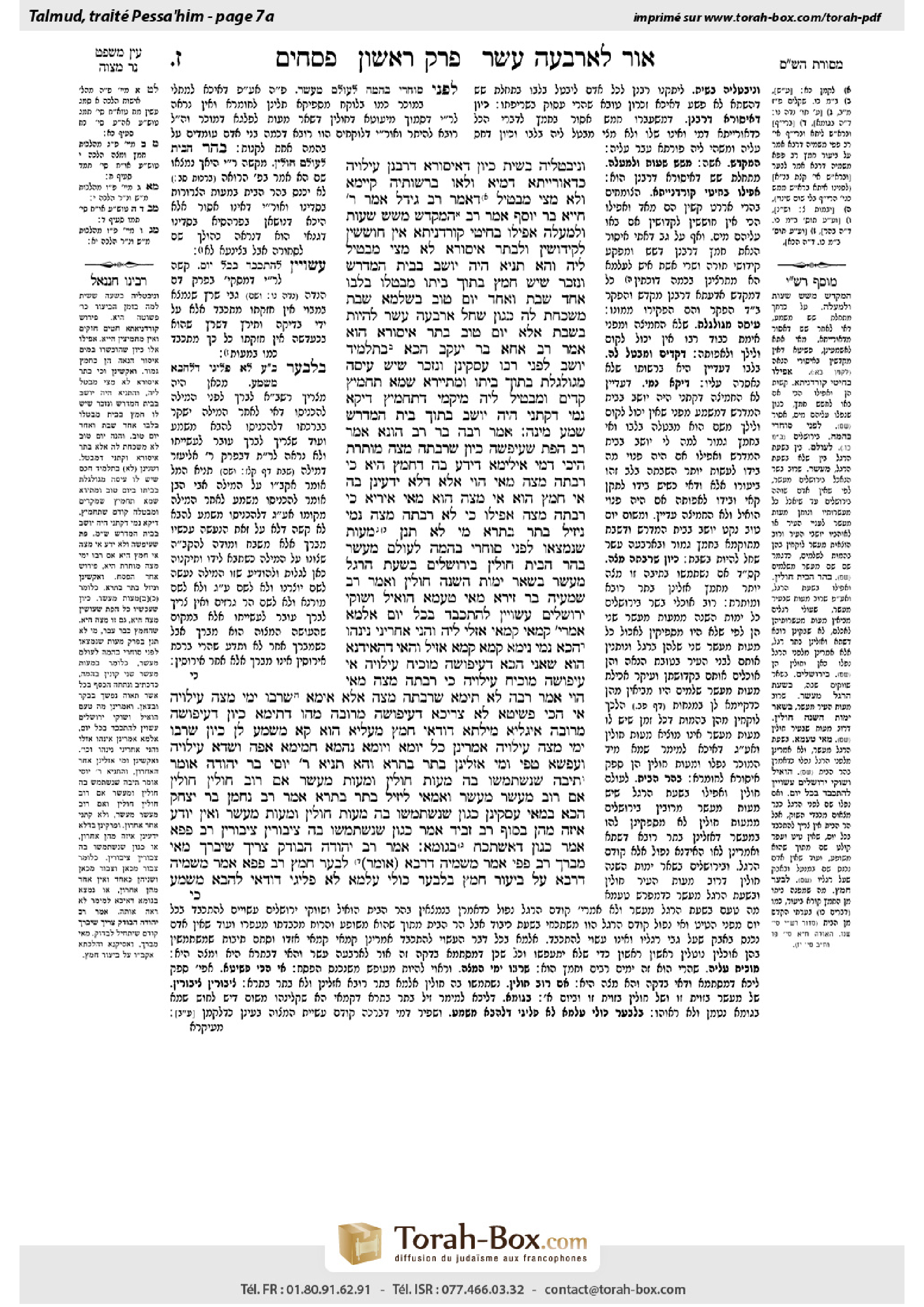
Pesachim 7a: Talmud study for Daf Yomi
Daf Yomi is the daily study of one Talmud folio. Explore 37 tractates with scans, Hebrew text, Sefaria English and AI-generated French translations where annotated.
Passage selection and English or AI-generated French translation are available where the scan has annotations. Daf Study is independent of Torah-Box and Sefaria.
Browse Pesachim · פסחים · All tractatesPesachim 7a text and translations
This page of Pesachim includes the Aramaic text, an English translation and an AI-generated French translation, alongside the scan above.
פסחים ז׳ א · Aramaic and Hebrew text
וְנִיבַטְּלֵיהּ בְּשֵׁית! כֵּיוָן דְּאִיסּוּרָא דְרַבָּנַן עִילָּוֵיהּ — כִּדְאוֹרָיְיתָא דָּמְיָא, וְלָאו בִּרְשׁוּתֵיהּ קָיְימָא, וְלָא מָצֵי מְבַטֵּיל.
דְּאָמַר רַב גִּידֵּל אָמַר רַבִּי חִיָּיא בַּר יוֹסֵף אָמַר רַב: הַמְקַדֵּשׁ מִשֵּׁשׁ שָׁעוֹת וּלְמַעְלָה, אֲפִילּוּ בְּחִיטֵּי קוּרְדִּנְיָתָא — אֵין חוֹשְׁשִׁין לְקִידּוּשִׁין.
וּלְבָתַר אִיסּוּרָא לָא מָצֵי מְבַטֵּיל לֵיהּ? וְהָא תַּנְיָא: הָיָה יוֹשֵׁב בְּבֵית הַמִּדְרָשׁ וְנִזְכַּר שֶׁיֵּשׁ חָמֵץ בְּתוֹךְ בֵּיתוֹ — מְבַטְּלוֹ בְּלִבּוֹ, אֶחָד שַׁבָּת וְאֶחָד יוֹם טוֹב. בִּשְׁלָמָא שַׁבָּת, מַשְׁכַּחַתְּ לַהּ, כְּגוֹן שֶׁחָל אַרְבָּעָה עָשָׂר לִהְיוֹת בַּשַּׁבָּת. אֶלָּא יוֹם טוֹב — בָּתַר אִיסּוּרָא הוּא!
אָמַר רַב אַחָא בַּר יַעֲקֹב: הָכָא בְּתַלְמִיד יוֹשֵׁב לִפְנֵי רַבּוֹ עָסְקִינַן, וְנִזְכַּר שֶׁיֵּשׁ עִיסָּה מְגוּלְגֶּלֶת בְּתוֹךְ בֵּיתוֹ, וּמִתְיָירֵא שֶׁמָּא תַּחֲמִיץ. קָדֵים וּמְבַטֵּיל לַיהּ מִיקַּמֵּי דְּתַחְמִיץ.
דַּיְקָא נָמֵי, דְּקָתָנֵי: הָיָה יוֹשֵׁב בְּתוֹךְ בֵּית הַמִּדְרָשׁ. שְׁמַע מִינַּהּ.
אָמַר רַבָּה בַּר רַב הוּנָא אָמַר רַב: הַפַּת שֶׁעִיפְּשָׁה. כֵּיוָן שֶׁרָבְתָה מַצָּה — מוּתֶּרֶת. הֵיכִי דָּמֵי? אִילֵּימָא דְּיָדַע בַּהּ דְּחָמֵץ הִיא — כִּי רָבְתָה מַצָּה מַאי הָוֵי?
אֶלָּא דְּלָא יָדְעִינַן בָּהּ אִי חָמֵץ הוּא אִי מַצָּה הוּא — מַאי אִירְיָא כִּי רָבְתָה מַצָּה? אֲפִילּוּ כִּי לֹא רָבְתָה מַצָּה נָמֵי, נֵיזִיל בָּתַר בָּתְרָא.
מִי לָא תְּנַן: מָעוֹת שֶׁנִּמְצְאוּ לִפְנֵי סוֹחֲרֵי בְהֵמָה — לְעוֹלָם מַעֲשֵׂר. בְּהַר הַבַּיִת — חוּלִּין.
בִּירוּשָׁלַיִם, בִּשְׁעַת הָרֶגֶל — מַעֲשֵׂר, בִּשְׁאָר יְמוֹת הַשָּׁנָה — חוּלִּין.
וְאָמַר רַב שְׁמַעְיָה בַּר זֵירָא: מַאי טַעְמָא — הוֹאִיל וְשׁוּקֵי יְרוּשָׁלַיִם עֲשׂוּיִין לְהִתְכַּבֵּד בְּכׇל יוֹם. אַלְמָא אָמְרִינַן: קַמָּאֵי קַמָּאֵי אָזְלִי לֵיהּ, וְהָנֵי אַחֲרִינֵי נִינְהוּ. הָכָא נָמֵי, נֵימָא: קַמָּא קַמָּא אָזֵיל, וְהַאי דְּהָאִידָּנָא הוּא.
שָׁאנֵי הָכָא דְּעִיפּוּשָׁהּ מוֹכִיחַ עִילָּוָיהּ. אִי עִיפּוּשָׁהּ מוֹכִיחַ עִילָּוָיהּ, כִּי רָבְתָה מַצָּה מַאי הָוֵי? אָמַר רַבָּה: לָא תֵּימָא שֶׁרָבְתָה מַצָּה, אֶלָּא אֵימָא: שֶׁרַבּוּ יְמֵי מַצָּה עִילָּוָיהּ.
אִי הָכִי, פְּשִׁיטָא! לָא צְרִיכָא, דְּעִיפּוּשָׁהּ מְרוּבֶּה. מַהוּ דְּתֵימָא: כֵּיוָן דְּעִיפּוּשָׁהּ מְרוּבֶּה — אִיגַּלְּיָא מִילְּתָא דְּוַדַּאי חָמֵץ מְעַלְּיָא הוּא, קָא מַשְׁמַע לַן:
כֵּיוָן שֶׁרַבּוּ יְמֵי מַצָּה עִילָּוָיהּ, אָמְרִינַן: כׇּל יוֹמָא וְיוֹמָא נַהֲמָא חַמִּימָא אֲפָה, וּשְׁדָא עִילָּוָיהּ וְעָפְשָׁא טְפֵי.
וּמִי אָזְלִינַן בָּתַר בָּתְרָא? וְהָא תַּנְיָא, רַבִּי יוֹסֵי בַּר יְהוּדָה אוֹמֵר: תֵּיבָה שֶׁנִּשְׁתַּמְּשׁוּ בָּהּ מְעוֹת חוּלִּין וּמְעוֹת מַעֲשֵׂר, אִם רוֹב חוּלִּין — חוּלִּין, אִם רוֹב מַעֲשֵׂר — מַעֲשֵׂר. וְאַמַּאי? לֵיזִיל בָּתַר בָּתְרָא!
אָמַר רַב נַחְמָן בַּר יִצְחָק: הָכָא בְּמַאי עָסְקִינַן — כְּגוֹן שֶׁנִּשְׁתַּמְּשׁוּ בָּהּ מְעוֹת חוּלִּין וּמְעוֹת מַעֲשֵׂר, וְאֵין יוֹדֵעַ אֵיזֶה מֵהֶן בַּסּוֹף. רַב זְבִיד אָמַר: כְּגוֹן שֶׁנִּשְׁתַּמְּשׁוּ בָּהּ צִיבּוּרִין צִיבּוּרִין. רַב פָּפָּא אָמַר: כְּגוֹן דְּאִישְׁתְּכַח בְּגוּמָּא.
אָמַר רַב יְהוּדָה: הַבּוֹדֵק צָרִיךְ שֶׁיְּבָרֵךְ. מַאי מְבָרֵךְ? רַב פַּפֵּי אָמַר מִשְּׁמֵיהּ דְּרָבָא: (אוֹמֵר) ״לְבַעֵר חָמֵץ״. רַב פָּפָּא אָמַר מִשְּׁמֵיהּ דְּרָבָא: ״עַל בִּיעוּר חָמֵץ״. בִּ״לְבַעֵר״ — כּוּלֵּי עָלְמָא לָא פְּלִיגִי דְּוַדַּאי לְהַבָּא מַשְׁמַע.
Pesachim 7a · English translation
The Gemara asks: But let him render the leaven null and void during the sixth hour, when he burns it. The Gemara answers: Since there is a rabbinic prohibition that takes effect on the leaven, as it is prohibited to derive benefit from it after the fifth hour, its legal status is like that of leaven prohibited by Torah law, and therefore it is not in his possession and he is unable to nullify it.
The Gemara continues: There is proof that the Sages were stringent with regard to leaven prohibited by rabbinic law, as Rav Giddel said that Rabbi Ḥiyya bar Yosef said that Rav said: With regard to a man who betroths a woman on the fourteenth of Nisan from the beginning of the sixth hour and onward, even if he does so with wheat from the mountains [kurdanaita], which is particularly hard and there is no certainty that it will ferment even if water falls on it, nevertheless, as it is possible that the wheat leavened, its legal status is that of leaven. Consequently, it is prohibited to derive benefit from this wheat, which is legally worthless. Therefore, if a man gives the wheat to a woman for the purpose of betrothal, one need not be concerned that it is a betrothal. The reason is that a betrothal is effective only if the man gives the woman an object worth at least a peruta. In this case the Sages disqualify the betrothal and allow the woman to marry another man, despite the fact that by Torah law she is betrothed to the first man, as the leaven with which he betrothed her is prohibited only by rabbinic law.
The Gemara raises a difficulty: And is it indeed the case that after the leaven has become prohibited one is unable to render it null and void? But wasn’t it taught in a baraita: If one was sitting in the study hall and he remembered that there is leavened bread in his house, he should render it null and void in his heart, both on Shabbat and on the Festival? The Gemara analyzes this statement: Granted, on Shabbat you can find this case, as one can nullify the leaven before it becomes prohibited, in a case where the fourteenth of Nisan occurs on Shabbat and he remembers to nullify the leaven before the prohibition takes effect. However, if he remembered on the Festival itself, it is after the prohibition has taken effect, as the Festival has already begun, and yet the baraita says that one may render the leaven null and void.
Rav Aḥa bar Ya’akov said: Here we are dealing with a student sitting before his teacher, and he remembers that there is kneaded dough in his house, and he is afraid lest it leaven before he can return home to warn the members of his household. Since the dough has not yet leavened and is not yet prohibited, he can take earlier action and render it null and void before it becomes leavened.
The Gemara comments: The language of the baraita is also precise in accordance with this explanation, as the baraita teaches: If one was sitting in the study hall. This indicates that the dough has not yet risen, and the problem is that he cannot arrive home in time to prevent it from rising. However, if it had already become leavened, rendering it null and void will not remedy the situation even if he were home. The Gemara concludes: Indeed, learn from this proof that Rav Aḥa bar Ya’akov’s interpretation is correct.
Rabba bar Rav Huna said that Rav said: With regard to a vessel that contains several loaves in which there was bread that became moldy, and it is not evident whether it is leaven or matza, once there was more matza than leaven in the vessel, it is permitted. The Gemara first analyzes the case itself: What are the circumstances? If you say that he knows that this loaf is leavened bread, even if there were more matza, what of it? What difference does it make that most of the food is matza, if it is clear that this loaf is leaven?
Rather, Rav must be speaking of a case where we do not know whether it is leavened bread or whether it is matza. However, in that case, why discuss specifically a situation where there was more matza in the vessel? Even in a case where there was not more matza in the vessel as well, the questionable loaf is likely to be matza, as let us follow the last item placed in the vessel, which even on the first day of Passover would be matza.
Didn’t we learn in a mishna: With regard to coins that were found before animal merchants in Jerusalem, they are always assumed to be money of the second tithe, as most of the animals purchased in Jerusalem were bought with that money. This halakha applies both during a Festival and throughout the year, as people would purchase animals for meat with their second-tithe money, and it can therefore be assumed that these coins have the status of second tithe. However, if the money was found on the Temple Mount it is non-sacred money, even during a Festival. It can be assumed that one who enters the Temple Mount has already purchased all the animals that he required beforehand. Any coins in his possession are non-sacred money, not tithes.
If the money was found elsewhere in Jerusalem during the Festival, when many people came to Jerusalem with their second-tithe money, the coins are presumed to be second-tithe money. However, if the coins were found during the rest of the year, it is non-sacred money.
The Gemara explains the proof. And Rav Shemaya bar Zeira said: What is the reason that during the rest of the year the coins are considered non-sacred money, even on the day after the Festival? Since the markets of Jerusalem tend to be cleaned every day, any money left there would already have been found by the street cleaners. Consequently, any coins found there were left there recently. Apparently, we say that the first ones are gone and these objects are later ones. Here too, with regard to moldy bread, let us say: The first ones have been eaten and are gone, and this food is from now and is undoubtedly matza.
The Gemara rejects this proof: It is different here, as the mold proves about the loaf that it is leaven, as food does not become moldy unless it has been sitting for a long time. The Gemara retorts: If its mold proves about the loaf that it is leaven, if there was more matza in the vessel, what of it? Even in that case, the very fact that it is moldy proves that it is leaven. Rabba said: Do not say there was more matza than leaven in the vessel; rather, say that several days of eating matza have passed over the vessel. In other words, several days of the Festival, during which matza is consumed, have passed. Therefore, it is more likely that the moldy loaf is matza.
The Gemara asks: If so, it is obvious that the moldy loaf is matza, not leaven. The Gemara answers: No, it is necessary to teach this halakha with regard to a situation where its mold is extensive. Lest you say: Since its mold is extensive the matter is revealed that it is certainly leavened bread, therefore Rav teaches us that one cannot be entirely sure that this is the case.
The Gemara explains the reason for the uncertainty. Since several days of eating matza have passed over the vessel, we say: Each and every day he baked warm loaves, which he placed upon the previous days’ matza, causing it to grow moldier. Therefore, it is possible that even though only a brief time has passed, the matza has grown very moldy, due to the moisture and heat inside the vessel.
In regard to the aforementioned principle, the Gemara asks: And do we, in general, follow the last item in determining the identity of the item in question? But wasn’t it taught in a baraita that Rabbi Yosei bar Yehuda says: With regard to a box that people used for both non-sacred coins and second-tithe coins, if the majority of its use was for non-sacred money, the coins are considered non-sacred. If the majority of its use was for second-tithe coins, the coins are considered second-tithe money. The Gemara asks: But why is this so? Let us follow the last item placed in the box.
Rav Naḥman bar Yitzḥak said: With what are we dealing here? We are dealing with a case where people used the box for both non-sacred coins and second-tithe coins, and he does not know which of the two kinds of money was placed there last.
Rav Zevid said: The baraita is referring to a case where he used one part of the box for piles of non-sacred coins and another part of the box for piles of second-tithe coins. In this case, there was no definitive most recent use of the box, as a coin may have moved from one side of the box to the other.
Rav Pappa said: We are dealing with a case where the coin was found in a hole in the box. The concern is that this coin might not be of the type last placed into the box. Instead, it is possible that this coin remained from a previous use and was not removed because it was obscured in the hole.
Rav Yehuda said: One who searches for leaven must recite a blessing. The Gemara asks: What blessing does he recite, i.e., what is the correct formula of the blessing? Rav Pappi said in the name of Rava that one recites: Who has made us holy through His mitzvot and has commanded us to remove leavened bread. Rav Pappa said in the name of Rava: One should recite: Concerning the removal of leavened bread. The Gemara comments: With regard to the formula: To remove, everyone agrees that it certainly refers to the future. This formulation undoubtedly indicates that the person reciting the blessing is about to begin fulfilling the mitzva of removing leaven, and it is therefore an appropriate blessing.
Pesachim 7a · Traduction française (IA)
La Guemara demande : Mais qu’il rende le levain nul et non avenu pendant la sixième heure, au moment où il le brûle. La Guemara répond : Puisqu’une interdiction rabbinique s’applique au levain — car il est interdit d’en tirer profit après la cinquième heure —, son statut juridique est celui d’un levain interdit par la Torah. Il n’est donc pas en sa possession et il ne peut pas le rendre nul et non avenu.
La Guemara poursuit : Il est prouvé que les Sages se sont montrés rigoureux à l’égard du levain interdit par décret rabbinique, car Rav Giddel a dit que Rabbi Ḥiyya bar Yosef a dit que Rav a dit : À propos d’un homme qui épouse une femme le quatorze Nissan, à partir du début de la sixième heure, même s’il le fait avec du blé des montagnes [kurdanaita], particulièrement dur et dont on n’est pas certain qu’il fermentera même si de l’eau tombe dessus, néanmoins, puisqu’il est possible que le blé ait fermenté, il a le statut de levain. Par conséquent, il est interdit d’en tirer profit et ce blé est juridiquement sans valeur. Aussi, si un homme donne ce blé à une femme en vue de l’épouser, il n’y a pas lieu de craindre que le mariage soit valide. En effet, le mariage n’est effectif que si l’homme donne à la femme un objet valant au moins une perouta. Dans ce cas, les Sages invalident le mariage et permettent à la femme d’épouser un autre homme, bien que, selon la Torah, elle soit mariée au premier homme, puisque le levain avec lequel il l’a épousée n’est interdit que par décret rabbinique.
La Guemara soulève une difficulté : Est-il vraiment vrai qu’une fois que le levain est devenu interdit, on ne peut pas le rendre nul et non avenu ? N’a-t-on pas enseigné dans une baraïta : Si quelqu’un est assis à la maison d’étude et se souvient qu’il y a du pain levé chez lui, qu’il le rende nul et non avenu dans son cœur, aussi bien le Chabbat que le jour de fête ? La Guemara analyse cette affirmation : Il est compréhensible que ce cas puisse se présenter le Chabbat, car on peut rendre le levain nul avant qu’il ne devienne interdit, si le quatorze Nissan tombe un Chabbat et qu’il se souvient de le rendre nul avant que l’interdiction ne prenne effet. En revanche, s’il s’en souvient le jour même de la fête, l’interdiction a déjà pris effet, puisque la fête a commencé, et pourtant la baraïta dit qu’on peut rendre le levain nul et non avenu.
Rav Aḥa bar Ya’akov a dit : Il s’agit ici d’un élève assis devant son maître, qui se souvient qu’il y a de la pâte pétrie chez lui et craint qu’elle ne fermente avant qu’il puisse rentrer prévenir les membres de son foyer. Comme la pâte n’a pas encore fermenté et n’est pas encore interdite, il peut agir par anticipation et la rendre nulle et non avenue avant qu’elle ne fermente.
La Guemara fait remarquer que la formulation de la baraïta est également précise et conforme à cette explication, car elle enseigne : « Si quelqu’un était assis à la maison d’étude. » Cela indique que la pâte n’a pas encore levé et que le problème est qu’il ne peut pas rentrer à temps pour empêcher qu’elle ne lève. En revanche, si elle avait déjà fermenté, la rendre nulle et non avenue ne changerait rien, même s’il était chez lui. La Guemara conclut : En effet, déduis de là que l’interprétation de Rav Aḥa bar Ya’akov est correcte.
Rabba bar Rav Huna a dit que Rav a dit : À propos d’un récipient contenant plusieurs pains, parmi lesquels se trouve un pain moisi, sans qu’on puisse déterminer s’il s’agit de pain levé ou de matsa, dès lors qu’il y avait davantage de matsa que de pain levé dans le récipient, le pain est permis. La Guemara examine d’abord le cas lui-même : De quelles circonstances s’agit-il ? Si tu dis qu’on sait que ce pain est du pain levé, qu’importe qu’il y ait davantage de matsa ? En quoi cela change-t-il quoi que ce soit que la majeure partie du contenu soit de la matsa, si l’on sait que ce pain est du pain levé ?
Il faut plutôt dire que Rav parle d’un cas où l’on ne sait pas s’il s’agit de pain levé ou de matsa. Mais alors, pourquoi évoquer spécifiquement une situation où il y avait davantage de matsa dans le récipient ? Même s’il n’y avait pas davantage de matsa dans le récipient, le pain douteux serait vraisemblablement de la matsa, car suivons le dernier élément placé dans le récipient : même le premier jour de Pessaḥ, il s’agirait de matsa.
N’avons-nous pas appris dans une Michna : Les pièces trouvées devant les marchands de bétail à Jérusalem sont toujours présumées être de l’argent de la seconde dîme, car la plupart des animaux achetés à Jérusalem l’étaient avec cet argent. Cette halakha s’applique aussi bien pendant une fête que le reste de l’année, car les gens achetaient des animaux pour leur viande avec l’argent de la seconde dîme ; on peut donc présumer que ces pièces ont le statut d’argent de la seconde dîme. Toutefois, si l’argent a été trouvé sur le mont du Temple, il s’agit d’argent profane, même pendant une fête. On peut présumer que celui qui entre sur le mont du Temple a déjà acheté auparavant tous les animaux dont il avait besoin. Les pièces qu’il a sur lui sont de l’argent profane, et non de l’argent de la dîme.
Si l’argent a été trouvé ailleurs à Jérusalem pendant la fête, alors que beaucoup de gens venaient à Jérusalem avec leur argent de la seconde dîme, les pièces sont présumées être de l’argent de la seconde dîme. En revanche, si les pièces ont été trouvées le reste de l’année, il s’agit d’argent profane.
La Guemara explique la preuve. Rav Shemaya bar Zeira a dit : Pourquoi les pièces sont-elles considérées comme de l’argent profane le reste de l’année, même le lendemain de la fête ? Parce que les marchés de Jérusalem sont généralement nettoyés chaque jour ; tout argent qui y serait resté aurait donc déjà été trouvé par les balayeurs. Par conséquent, les pièces qu’on y trouve ont été laissées là récemment. Apparemment, nous disons que les premières ont disparu et que celles-ci sont arrivées plus tard. De même ici, à propos du pain moisi, disons que les premiers pains ont été mangés et ont disparu, et que ce pain date d’aujourd’hui et est assurément de la matsa.
La Guemara rejette cette preuve : Ici, le fait que le pain soit moisi prouve qu’il s’agit de pain levé, car un aliment ne moisit que s’il est resté longtemps. La Guemara rétorque : Si le fait qu’il soit moisi prouve qu’il s’agit de pain levé, qu’importe qu’il y ait davantage de matsa dans le récipient ? Même dans ce cas, le simple fait qu’il soit moisi prouve qu’il s’agit de pain levé. Rabba a dit : Ne dis pas qu’il y avait davantage de matsa que de pain levé dans le récipient ; dis plutôt que plusieurs jours de consommation de matsa se sont écoulés depuis que le récipient a été rempli. Autrement dit, plusieurs jours de la fête, durant lesquels on consomme de la matsa, se sont écoulés. Il est donc plus vraisemblable que le pain moisi soit de la matsa.
La Guemara demande : Dans ce cas, il est évident que le pain moisi est de la matsa et non du pain levé. La Guemara répond : Non, il est nécessaire d’enseigner cette halakha dans une situation où la moisissure est abondante. De peur que tu ne dises : « Puisque la moisissure est abondante, il est évident qu’il s’agit de pain levé », Rav nous enseigne qu’on ne peut pas en être absolument certain.
La Guemara explique la raison de cette incertitude. Comme plusieurs jours de consommation de matsa se sont écoulés depuis que le récipient a été rempli, nous disons que chaque jour, il a cuit des pains chauds qu’il a déposés sur la matsa des jours précédents, la faisant moisir davantage. Il est donc possible que, même si peu de temps s’est écoulé, la matsa soit devenue très moisie à cause de l’humidité et de la chaleur à l’intérieur du récipient.
À propos du principe mentionné précédemment, la Guemara demande : En général, déterminons-nous l’identité de l’objet en question d’après le dernier objet qui y a été placé ? N’a-t-on pas enseigné dans une baraïta que Rabbi Yosei bar Yehuda dit : À propos d’une boîte que l’on utilisait à la fois pour des pièces profanes et pour des pièces de la seconde dîme, si elle servait principalement à l’argent profane, les pièces sont considérées comme de l’argent profane. Si elle servait principalement aux pièces de la seconde dîme, elles sont considérées comme de l’argent de la seconde dîme. La Guemara demande : Mais pourquoi en est-il ainsi ? Ne suivons-nous pas le dernier objet placé dans la boîte ?
Rav Naḥman bar Yitzḥak a dit : De quel cas s’agit-il ici ? D’un cas où l’on utilisait la boîte à la fois pour des pièces profanes et pour des pièces de la seconde dîme, et où l’on ne sait pas laquelle des deux sortes d’argent y a été placée en dernier. Rav Zevid a dit : La baraïta parle d’un cas où l’on utilisait une partie de la boîte pour des piles de pièces profanes et une autre partie pour des piles de pièces de la seconde dîme. Dans ce cas, il n’y a pas eu d’usage le plus récent déterminé de la boîte, car une pièce a pu passer d’un côté à l’autre. Rav Pappa a dit : Il s’agit d’un cas où la pièce a été trouvée dans un trou de la boîte. On craint que cette pièce ne soit pas du même type que celles qui ont été placées en dernier dans la boîte. Il est plutôt possible qu’elle soit restée d’un usage antérieur et qu’on ne l’ait pas retirée parce qu’elle était dissimulée dans le trou.
Rav Yehuda a dit : Celui qui recherche le levain doit réciter une bénédiction. La Guemara demande : Quelle bénédiction récite-t-il, c’est-à-dire quelle est la formule correcte de la bénédiction ? Rav Pappi a dit au nom de Rava qu’on récite : « Qui nous a sanctifiés par Ses mitsvot et nous a ordonné d’éliminer le pain levé. » Rav Pappa a dit au nom de Rava qu’on doit réciter : « Concernant l’élimination du pain levé. » La Guemara fait remarquer que, dans la formule « éliminer », tout le monde convient qu’elle se rapporte nécessairement à l’avenir. Cette formulation indique sans aucun doute que la personne qui récite la bénédiction est sur le point de commencer à accomplir la mitsva d’éliminer le levain ; c’est donc une bénédiction appropriée.
Traduction française générée par IA à partir de l’édition anglaise de Sefaria. Vérifie toujours un passage avec le texte source.
Text from Sefaria: William Davidson Edition - Vocalized Aramaic (CC BY NC); William Davidson Edition - English (CC BY NC).