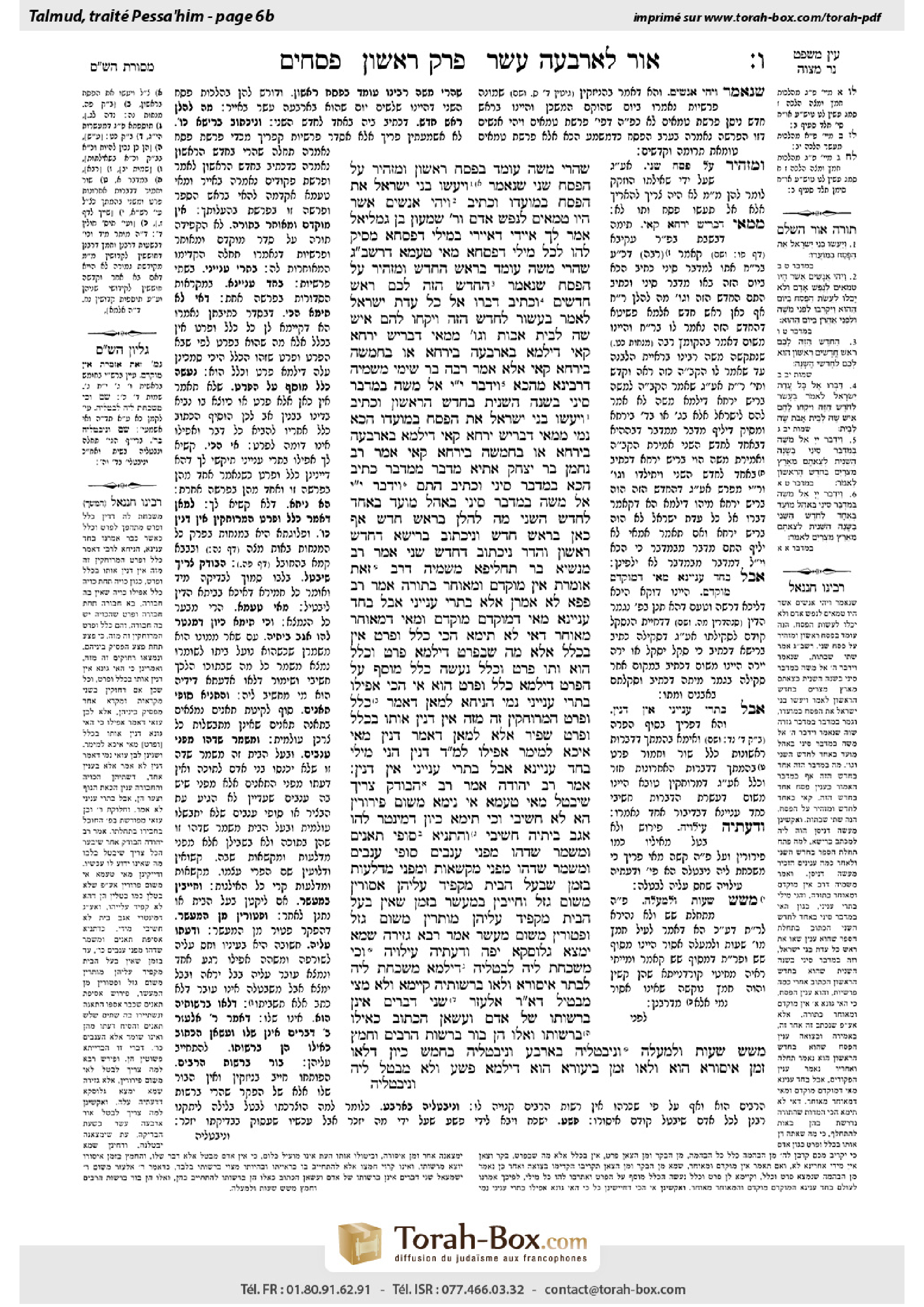
Pesachim 6b: Talmud study for Daf Yomi
Daf Yomi is the daily study of one Talmud folio. Explore 37 tractates with scans, Hebrew text, Sefaria English and AI-generated French translations where annotated.
Passage selection and English or AI-generated French translation are available where the scan has annotations. Daf Study is independent of Torah-Box and Sefaria.
Browse Pesachim · פסחים · All tractatesPesachim 6b text and translations
This page of Pesachim includes the Aramaic text, an English translation and an AI-generated French translation, alongside the scan above.
פסחים ו׳ ב · Aramaic and Hebrew text
שֶׁהֲרֵי מֹשֶׁה עוֹמֵד בְּפֶסַח רִאשׁוֹן, וּמַזְהִיר עַל הַפֶּסַח שֵׁנִי, שֶׁנֶּאֱמַר: ״וְיַעֲשׂוּ בְנֵי יִשְׂרָאֵל אֶת הַפָּסַח בְּמוֹעֲדוֹ״, וּכְתִיב: ״וַיְהִי אֲנָשִׁים אֲשֶׁר הָיוּ טְמֵאִים לְנֶפֶשׁ אָדָם״.
וְרַבָּן שִׁמְעוֹן בֶּן גַּמְלִיאֵל אָמַר לָךְ: אַיְּידֵי דְּאַיְירִי בְּמִילֵּי דְפִסְחָא, מַסִּיק לְהוּ לְכׇל מִילֵּי דְפִסְחָא.
מַאי טַעְמָא דְּרַבָּן שִׁמְעוֹן בֶּן גַּמְלִיאֵל? שֶׁהֲרֵי מֹשֶׁה עוֹמֵד בְּרֹאשׁ הַחֹדֶשׁ, וּמַזְהִיר עַל הַפֶּסַח, שֶׁנֶּאֱמַר: ״הַחֹדֶשׁ הַזֶּה לָכֶם רֹאשׁ חֳדָשִׁים״, וּכְתִיב: ״דַּבְּרוּ אֶל כׇּל עֲדַת יִשְׂרָאֵל לֵאמֹר בֶּעָשֹׂר לַחֹדֶשׁ הַזֶּה וְיִקְחוּ לָהֶם אִישׁ שֶׂה לְבֵית אָבוֹת וְגוֹ׳״.
מִמַּאי דִּבְרֵישׁ יַרְחָא קָאֵי? דִּילְמָא בְּאַרְבְּעָה בְּיַרְחָא אוֹ בְּחַמְשָׁה בְּיַרְחָא קָאֵי?
אֶלָּא אָמַר רַבָּה בַּר שִׁימִי מִשְּׁמֵיהּ דְּרָבִינָא, מֵהָכָא: ״וַיְדַבֵּר ה׳ אֶל מֹשֶׁה בְמִדְבַּר סִינַי בַּשָּׁנָה הַשֵּׁנִית בַּחֹדֶשׁ הָרִאשׁוֹן״, וּכְתִיב: ״וְיַעֲשׂוּ בְנֵי יִשְׂרָאֵל אֶת הַפָּסַח בְּמוֹעֲדוֹ״. הָכָא נָמֵי, מִמַּאי דִּבְרֵישׁ יַרְחָא קָאֵי? דִּילְמָא בְּאַרְבְּעָה בְּיַרְחָא אוֹ בְּחַמְשָׁה בְּיַרְחָא קָאֵי?
אָמַר רַב נַחְמָן בַּר יִצְחָק: אַתְיָא ״מִדְבָּר״ מִ״מִּדְבָּר״. כְּתִיב הָכָא: ״בְּמִדְבַּר סִינַי״, וּכְתִיב הָתָם: ״וַיְדַבֵּר ה׳ אֶל מֹשֶׁה בְּמִדְבַּר סִינַי בְּאֹהֶל מוֹעֵד בְּאֶחָד לַחֹדֶשׁ הַשֵּׁנִי״. מָה לְהַלָּן בְּרֹאשׁ חֹדֶשׁ — אַף כָּאן בְּרֹאשׁ חֹדֶשׁ.
וְנִיכְתּוֹב בְּרֵישָׁא דְּחֹדֶשׁ רִאשׁוֹן, וַהֲדַר נִיכְתּוֹב דְּחֹדֶשׁ שֵׁנִי. אָמַר רַב מְנַשְּׁיָא בַּר תַּחְלִיפָא מִשְּׁמֵיהּ דְּרַב: זֹאת אוֹמֶרֶת אֵין מוּקְדָּם וּמְאוּחָר בַּתּוֹרָה.
אָמַר רַב פָּפָּא: לָא אֲמַרַן אֶלָּא בִּתְרֵי עִנְיָינֵי, אֲבָל בְּחַד עִנְיָינָא, מַאי דְּמוּקְדָּם — מוּקְדָּם, וּמַאי דִּמְאוּחָר — מְאוּחָר. דְּאִי לָא תֵּימָא הָכִי, ״כְּלָל וּפְרָט — אֵין בַּכְּלָל אֶלָּא מַה שֶּׁבַּפְּרָט״, דִּילְמָא פְּרָט וּכְלָל הוּא!
וְתוּ, ״פְּרָט וּכְלָל נַעֲשֶׂה כְּלָל מוּסָף עַל הַפְּרָט״, דִּילְמָא כְּלָל וּפְרָט הוּא!
אִי הָכִי, אֲפִילּוּ בִּתְרֵי עִנְיָינֵי נָמֵי! הָנִיחָא לְמַאן דְּאָמַר ״כְּלָל וּפְרָט הַמְרוּחָקִין זֶה מִזֶּה — אֵין דָּנִין אוֹתוֹ בִּכְלָל וּפְרָט״, שַׁפִּיר, אֶלָּא לְמַאן דְּאָמַר ״דָּנִין״, מַאי אִיכָּא לְמֵימַר?
אֲפִילּוּ לְמַאן דְּאָמַר ״דָּנִין״, הָנֵי מִילֵּי — בְּחַד עִנְיָינָא. אֲבָל בִּתְרֵי עִנְיָינֵי — אֵין דָּנִין.
אָמַר רַב יְהוּדָה אָמַר רַב: הַבּוֹדֵק צָרִיךְ שֶׁיְּבַטֵּל. מַאי טַעְמָא, אִי נֵימָא מִשּׁוּם פֵּירוּרִין — הָא לָא חֲשִׁיבִי.
וְכִי תֵּימָא: כֵּיוָן דִּמְינַטַּר לְהוּ אַגַּב בֵּיתֵיהּ — חֲשִׁיבִי, וְהָתַנְיָא: סוֹפֵי תְאֵנִים, וּמְשַׁמֵּר שָׂדֵהוּ מִפְּנֵי עֲנָבִים. סוֹפֵי עֲנָבִים, וּמְשַׁמֵּר שָׂדֵהוּ מִפְּנֵי מִקְשָׁאוֹת וּמִפְּנֵי מִדְלָעוֹת,
בִּזְמַן שֶׁבַּעַל הַבַּיִת מַקְפִּיד עֲלֵיהֶן — אֲסוּרִין מִשּׁוּם גֵּזֶל, וְחַיָּיבִין בְּמַעֲשֵׂר. בִּזְמַן שֶׁאֵין בַּעַל הַבַּיִת מַקְפִּיד עֲלֵיהֶן — מוּתָּרִין מִשּׁוּם גֵּזֶל, וּפְטוּרִין מִשּׁוּם מַעֲשֵׂר.
אָמַר רָבָא: גְּזֵירָה שֶׁמָּא יִמְצָא גְּלוּסְקָא יָפָה וְדַעְתֵּיהּ עִילָּוֵיהּ. וְכִי מַשְׁכַּחַתְּ לֵיהּ לְבַטְּלֵיהּ!
דִּילְמָא מַשְׁכַּחַתְּ לֵיהּ לְבָתַר אִיסּוּרָא, וְלָאו בִּרְשׁוּתֵיהּ קָיְימָא, וְלָא מָצֵי מְבַטֵּיל. דְּאָמַר רַבִּי אֶלְעָזָר: שְׁנֵי דְבָרִים אֵינָן בִּרְשׁוּתוֹ שֶׁל אָדָם, וַעֲשָׂאָן הַכָּתוּב כְּאִילּוּ בִּרְשׁוּתוֹ, וְאֵלּוּ הֵן: בּוֹר בִּרְשׁוּת הָרַבִּים, וְחָמֵץ מִשֵּׁשׁ שָׁעוֹת וּלְמַעְלָה.
וְנִיבַטְּלֵיהּ בְּאַרְבַּע, וְנִיבַטְּלֵיהּ בְּחָמֵשׁ? כֵּיוָן דְּלָאו זְמַן אִיסּוּרָא הוּא וְלָאו זְמַן בִּיעוּרָא הוּא, דִּילְמָא פָּשַׁע וְלָא מְבַטֵּל לֵיהּ.
Pesachim 6b · English translation
The Gemara explains that this halakha is derived from the fact that Moses was standing at the time of the first Pesaḥ, on the fourteenth of Nisan, and warning the people about the halakhot of the second Pesaḥ, which occurred a month later, on the fourteenth of Iyyar. As it is stated that God said to Moses: “Let the children of Israel perform the Pesaḥ at its appointed time” (Numbers 9:2). A subsequent verse says: “And Moses told the children of Israel to perform the Pesaḥ, and they performed the Pesaḥ in the first month on the fourteenth of the month in the evening, in the desert of Sinai” (Numbers 9:4–5). And it is written in the next verse: “And there were people who were impure due to a dead body and could not perform the Passover on that day, and they came before Moses and before Aaron on that day” (Numbers 9:6), at which point Moses explained the halakhot of the second Pesaḥ to them. This proves that one begins studying the halakhot of the Festival thirty days beforehand.
And Rabban Shimon ben Gamliel could have said to you in rejecting that proof: Since Moses was speaking with regard to the laws of Passover, he completed teaching all the matters of Passover, including those of the second Pesaḥ. Consequently, one cannot derive a principle from this case.
The Gemara asks: What is the reason for Rabban Shimon ben Gamliel’s ruling? He explains that Moses was standing on the first day of Nisan and warning about the performance of the first Pesaḥ, as it is stated: “This month shall be for you the beginning of the months, the first of the months of the year” (Exodus 12:2). And it is written in the next verse: “Speak to the entire congregation of Israel, saying: On the tenth day of this month they shall take for them every man a lamb, according to their fathers’ houses, a lamb for each household” (Exodus 12:3). The Torah proceeds to detail the halakhot of the Paschal lamb sacrificed on the fourteenth day of that month.
The Gemara asks: Although this source does indicate that one should study the halakhot of Passover prior to the Festival, from where is it derived that he was standing and saying these matters on the day of the New Moon? Perhaps he was standing on the fourth of the month or on the fifth of the month of Nisan?
Rather, Rabba bar Shimi said in the name of Ravina: The halakha is derived from here: “And God spoke to Moses in the wilderness of Sinai, in the first month of the second year after they came out of the land of Egypt” (Numbers 9:1), and it is written: “And let the children of Israel perform the Pesaḥ at its appointed time” (Numbers 9:2). Evidently, Moses taught the halakhot of Passover two weeks prior to the Festival. The Gemara asks: Here too, from where is it derived that he was standing on the day of the New Moon? Perhaps he was standing on the fourth of the month or on the fifth of the month?
Rav Naḥman bar Yitzḥak said: The halakha is derived by means of a verbal analogy between the term wilderness written here and the term wilderness written previously. It is written here: “In the wilderness of Sinai,” and it is written there: “And God spoke to Moses in the wilderness of Sinai in the Tent of Meeting on the first of the second month” (Numbers 1:1). Just as there it occurred on the day of the New Moon, on the first of the month, so too here, with regard to Passover, it was on the day of the New Moon.
The Gemara asks: If so, let the Torah write first that which occurred in the first month and then let it write that which occurred in the second month, as the portion of the Paschal lamb preceded the beginning of the book of Numbers chronologically. Rav Menashiya bar Taḥlifa said in the name of Rav: That is to say that there is no earlier and later, i.e., there is no absolute chronological order, in the Torah, as events that occurred later in time can appear earlier in the Torah.
Rav Pappa said: This principle applies only when the Torah deals with two separate matters, but within one matter, that which is written earlier occurred earlier, and that which is written later occurred later; as, if you do not say so but you claim that there is no definite order within each matter, then the hermeneutic principle: When a generalization is followed by a detail the generalization refers only to that which is specified in the detail, is problematic. This principle is valid only if there is a definite order to the verses and words in each matter. If there is no definite order, perhaps it is actually a detail followed by a generalization, which is interpreted by means of an alternate hermeneutic principle with different results.
And furthermore, this is equally difficult with regard to the hermeneutic principle: “When a detail is followed by a generalization, the generalization becomes an addition to the detail, adding cases dissimilar to the detail. Here too, perhaps it is a generalization followed by a detail, as there is no defined order. Apparently, there must be a fixed order within a given matter.
The Gemara asks: If so, based on the above reasoning one cannot apply these principles even with regard to two matters. This statement works out well according to the opinion of the one who said: With regard to a generalization and a detail that appear in the Torah removed from one another, one cannot derive a halakha from it with the principle of a generalization and a detail. However, according to the one who said: One derives from a generalization and a detail that are removed from one another by means of said principle, what is there to say?
The Gemara answers: Even according to the one who said that one derives a halakha from a generalization and a detail that are removed from one another, this applies only with regard to one matter, i.e., verses dealing with the same issue, even if they do not appear together. However, if they address two different matters, one cannot derive a halakha from a generalization and a detail, as the Torah is not written in absolute chronological order.
Rav Yehuda said that Rav said: One who searches for leaven must render all his leaven null and void, cognitively and verbally. The Gemara asks: What is the reason for this? If you say it is due to crumbs that he failed to detect in his search, they are inherently insignificant, and null and void by definition.
And lest you say: Since they are protected on account of their very presence in his house, whose protection is important to him, they are significant and are not null and void, wasn’t it taught in the Tosefta that this is not the case? When the end of the fig season arrives, and those remaining figs on the trees are few and of inferior quality, there is room to assume that the owner has renounced his ownership over them. However, he continues to guard his field due to the grapes, which are harvested at that time. Similarly, when the end of the grape season arrives, those few remaining grapes are of inferior quality and the owner guards his field due to the cucumbers and due to the gourds, which have not yet been harvested.
When the owner is particular about the figs and the grapes respectively, it is prohibited to take them, due to the prohibition against robbery, and one with permission to eat them is obligated due to the mitzva to separate the tithe from them, as they are considered like any other fruit. When the owner is not particular about them, it is permitted to eat them due to the fact that the prohibition against robbery does not apply, and one who eats them is exempt due to the fact that the obligation to separate the tithe does not apply, as they are ownerless property. This indicates that if one is not particular about an object, even if it is located in property that he is guarding for another purpose, that object is not thereby rendered significant. The same reasoning applies to breadcrumbs that remain in one’s house.
Rava said: The reason for the requirement to render leaven null and void is based on a decree lest he find a fine cake [geluska] among the leaven that he did not destroy and his thoughts are upon it. Due to its significance, he will hesitate before removing it and will be in violation of the prohibition against owning leaven. The Gemara asks: And let him nullify it when he finds it.
The Gemara rejects this suggestion. Perhaps he will find it only after it is already forbidden, and at that time it is no longer in his possession and he is therefore unable to nullify leaven when it is already Passover, as Rabbi Elazar said: Two items are not in a person’s possession in terms of legal ownership, and yet the Torah rendered him responsible for them as though they were in his property. And these are they: An open pit in the public domain, for which the one who excavated it is liable to pay any damages it causes even though it does not belong to him; and leaven in one’s house from the sixth hour on the fourteenth of Nisan and onward. As this leaven has no monetary value, since it is prohibited to eat or to derive benefit from it, it is not his property, and nevertheless he violates a prohibition if it remains in his domain.
The Gemara returns to the issue of the nullification of leaven. If so, let him render the leaven null and void during the fourth hour or let him render it null and void during the fifth hour of the fourteenth of Nisan. Why is he required to do so when he searches for leaven on the evening of the fourteenth? The Gemara answers: Since the fourth hour is neither the time of the prohibition of the leaven nor the time of its removal, it is a nondescript point in time. There is concern that perhaps he will be negligent and will not render it null and void, and the leaven will remain in his possession.
Pesachim 6b · Traduction française (IA)
La Guemara explique que cette halakha se déduit du fait que Moïse se tenait là au moment du premier Pessa’h, le quatorzième jour de Nissan, et mettait le peuple en garde au sujet des halakhot du second Pessa’h, qui avait lieu un mois plus tard, le quatorzième jour d’Iyar. En effet, il est dit que Dieu parla ainsi à Moïse : « Que les enfants d’Israël célèbrent le Pessa’h au temps fixé » (Nombres 9, 2). Un verset ultérieur dit : « Moïse dit aux enfants d’Israël de célébrer le Pessa’h, et ils célébrèrent le Pessa’h le premier mois, le quatorzième jour du mois, au soir, dans le désert du Sinaï » (Nombres 9, 4-5). Et le verset suivant dit : « Il y avait des hommes qui étaient impurs à cause d’un mort et ne pouvaient célébrer le Pessa’h ce jour-là ; ils se présentèrent devant Moïse et devant Aaron ce jour-là » (Nombres 9, 6), et Moïse leur expliqua alors les halakhot du second Pessa’h. Cela prouve que l’on commence à étudier les halakhot de la fête trente jours à l’avance.
Rabban Shimon ben Gamliel aurait pu te répondre, pour réfuter cette preuve : puisque Moïse parlait des lois de Pessa’h, il enseigna tous les sujets relatifs à Pessa’h, y compris ceux du second Pessa’h. On ne peut donc tirer de ce cas aucun principe général.
La Guemara demande : Quelle est la raison de la décision de Rabban Shimon ben Gamliel ? Il explique que Moïse se tenait là le premier jour de Nissan et mettait le peuple en garde au sujet de la célébration du premier Pessa’h, comme il est dit : « Ce mois-ci sera pour vous le commencement des mois ; il sera pour vous le premier des mois de l’année » (Exode 12, 2). Et le verset suivant dit : « Parle à toute l’assemblée d’Israël et dis : Le dixième jour de ce mois, que chacun prenne un agneau pour sa famille, un agneau par maisonnée » (Exode 12, 3). La Torah détaille ensuite les halakhot de l’agneau pascal offert le quatorzième jour de ce mois.
La Guemara demande : Bien que cette source indique effectivement qu’il faut étudier les halakhot de Pessa’h avant la fête, d’où déduit-on qu’il se tenait là et enseignait ces règles le jour de la nouvelle lune ? Peut-être se tenait-il là le quatrième ou le cinquième jour de Nissan ?
Rabba bar Shimi dit plutôt au nom de Ravina : la halakha se déduit d’ici : « Dieu parla à Moïse dans le désert du Sinaï, le premier mois de la deuxième année après leur sortie du pays d’Égypte » (Nombres 9, 1), et il est écrit : « Que les enfants d’Israël célèbrent le Pessa’h au temps fixé » (Nombres 9, 2). Il est donc manifeste que Moïse enseigna les halakhot de Pessa’h deux semaines avant la fête. La Guemara demande : Ici aussi, d’où déduit-on qu’il se tenait là le jour de la nouvelle lune ? Peut-être se tenait-il là le quatrième ou le cinquième jour du mois ?
Rav Naḥman bar Yitzḥak dit : la halakha se déduit au moyen d’une analogie verbale entre le terme « désert » écrit ici et le terme « désert » écrit précédemment. Il est écrit ici : « dans le désert du Sinaï », et il est écrit là : « Dieu parla à Moïse dans le désert du Sinaï, dans la tente d’assignation, le premier jour du deuxième mois » (Nombres 1, 1). De même que là, cela eut lieu le jour de la nouvelle lune, le premier du mois, de même ici, au sujet de Pessa’h, cela eut lieu le jour de la nouvelle lune.
La Guemara demande : Si tel est le cas, que la Torah écrive d’abord ce qui s’est passé le premier mois, puis ce qui s’est passé le deuxième mois, puisque le passage de l’agneau pascal précède chronologiquement le début du livre des Nombres. Rav Menashiya bar Taḥlifa dit au nom de Rav : cela signifie que, dans la Torah, il n’y a pas de succession chronologique absolue, c’est-à-dire que des événements survenus plus tard peuvent être rapportés plus tôt dans la Torah.
Rav Pappa dit : ce principe ne s’applique que lorsque la Torah traite de deux sujets distincts. Mais, à l’intérieur d’un même sujet, ce qui est écrit en premier s’est produit en premier, et ce qui est écrit ensuite s’est produit ensuite. En effet, si l’on n’admettait pas cela et que l’on soutenait qu’il n’existe pas d’ordre déterminé même à l’intérieur de chaque sujet, le principe herméneutique selon lequel une généralité suivie d’un détail limite la généralité à ce qui est précisé dans le détail poserait problème. Ce principe n’est valable que si les versets et les mots sont disposés selon un ordre déterminé à l’intérieur de chaque sujet. En l’absence d’un tel ordre, il se pourrait qu’il s’agisse en réalité d’un détail suivi d’une généralité, interprété au moyen d’un autre principe herméneutique, qui aboutirait à des résultats différents.
En outre, la même difficulté se pose à propos du principe herméneutique suivant : « Lorsqu’un détail est suivi d’une généralité, la généralité s’ajoute au détail et inclut des cas qui diffèrent de celui-ci. » Ici aussi, il pourrait s’agir d’une généralité suivie d’un détail, puisqu’il n’existe pas d’ordre défini. Il apparaît donc qu’il doit y avoir un ordre fixe à l’intérieur d’un sujet donné.
La Guemara demande : Si tel est le cas, selon le raisonnement qui précède, on ne peut appliquer ces principes même à deux sujets distincts. Cela s’entend selon l’opinion de celui qui dit que, lorsqu’une généralité et un détail apparaissent dans la Torah à distance l’un de l’autre, on ne peut en déduire une halakha au moyen du principe de la généralité et du détail. Mais, selon celui qui dit que l’on déduit une halakha d’une généralité et d’un détail éloignés l’un de l’autre au moyen de ce principe, que peut-on répondre ?
La Guemara répond : même selon celui qui dit que l’on déduit une halakha d’une généralité et d’un détail éloignés l’un de l’autre, cela ne s’applique que lorsqu’il s’agit d’un seul sujet, c’est-à-dire de versets portant sur la même question, même s’ils ne sont pas contigus. En revanche, s’ils traitent de deux sujets différents, on ne peut déduire une halakha d’une généralité et d’un détail, car la Torah n’est pas écrite selon un ordre chronologique absolu.
Rav Yehuda dit au nom de Rav : celui qui recherche le hamets doit annuler tout son hamets, par la pensée et par la parole. La Guemara demande : Pour quelle raison ? Si l’on répond que c’est à cause des miettes qu’il n’a pas détectées lors de sa recherche, elles sont intrinsèquement négligeables et, par définition, déjà annulées.
Et si l’on répond que, puisqu’elles sont protégées du fait même qu’elles se trouvent chez lui, cette protection lui important, elles ont de la valeur et ne sont donc pas annulées, la Tossefta n’enseigne-t-elle pas le contraire ? Lorsque la saison des figues touche à sa fin et que les figues qui restent sur les arbres sont peu nombreuses et de qualité inférieure, on peut supposer que le propriétaire a renoncé à ses droits sur elles. Cependant, il continue de garder son champ à cause des raisins, que l’on récolte à cette période. De même, lorsque la saison des raisins touche à sa fin, les quelques raisins qui restent sont de qualité inférieure et le propriétaire garde son champ à cause des concombres et des courges, qui n’ont pas encore été récoltés.
Lorsque le propriétaire tient respectivement aux figues et aux raisins, il est interdit de les prendre en raison de l’interdiction du vol, et celui qui est autorisé à les manger est tenu d’en prélever la dîme, puisqu’ils sont considérés comme n’importe quels autres fruits. Lorsque le propriétaire n’y tient pas, il est permis de les manger, car l’interdiction du vol ne s’applique pas, et celui qui les mange est dispensé de l’obligation d’en prélever la dîme, puisqu’ils sont considérés comme des biens sans propriétaire. Cela indique que si quelqu’un ne tient pas à un objet, le fait qu’il se trouve dans un bien qu’il garde pour une autre raison ne le rend pas pour autant important. Le même raisonnement s’applique aux miettes de pain qui restent chez quelqu’un.
Rava dit : la raison pour laquelle il faut annuler le hamets repose sur un décret, de peur qu’il ne trouve parmi le hamets qu’il n’a pas détruit un beau gâteau [geluska], auquel il tient. En raison de sa valeur, il hésitera à l’enlever et enfreindra l’interdiction de posséder du hamets. La Guemara demande : Pourquoi ne l’annulerait-il pas lorsqu’il le trouve ?
La Guemara rejette cette suggestion. Peut-être ne le trouvera-t-il qu’une fois que le hamets sera déjà interdit, et, à ce moment-là, il ne sera plus en sa possession ; il ne pourra donc pas annuler le hamets alors que Pessa’h a déjà commencé. En effet, Rabbi Elazar a dit : deux choses ne sont pas en la possession d’une personne au regard de la propriété légale, et pourtant la Torah la rend responsable comme si elles se trouvaient dans ses biens. Les voici : une fosse ouverte sur la voie publique, dont celui qui l’a creusée est tenu de réparer les dommages qu’elle cause, bien qu’elle ne lui appartienne pas ; et le hamets qui se trouve dans la maison de quelqu’un à partir de la sixième heure du quatorzième jour de Nissan. Comme ce hamets n’a aucune valeur pécuniaire, puisqu’il est interdit de le manger ou d’en tirer profit, il n’est pas sa propriété. Néanmoins, il transgresse une interdiction s’il reste dans son domaine.
La Guemara revient à la question de l’annulation du hamets. Dans ce cas, qu’il l’annule pendant la quatrième heure, ou pendant la cinquième heure du quatorzième jour de Nissan. Pourquoi doit-il le faire lorsqu’il recherche le hamets, le soir du quatorzième ? La Guemara répond : puisque la quatrième heure n’est ni le moment où le hamets devient interdit ni celui où il doit être éliminé, c’est un moment indéterminé. On craint qu’il ne fasse preuve de négligence et ne l’annule pas, de sorte que le hamets restera en sa possession.
Traduction française générée par IA à partir de l’édition anglaise de Sefaria. Vérifie toujours un passage avec le texte source.
Text from Sefaria: William Davidson Edition - Vocalized Aramaic (CC BY NC); William Davidson Edition - English (CC BY NC).