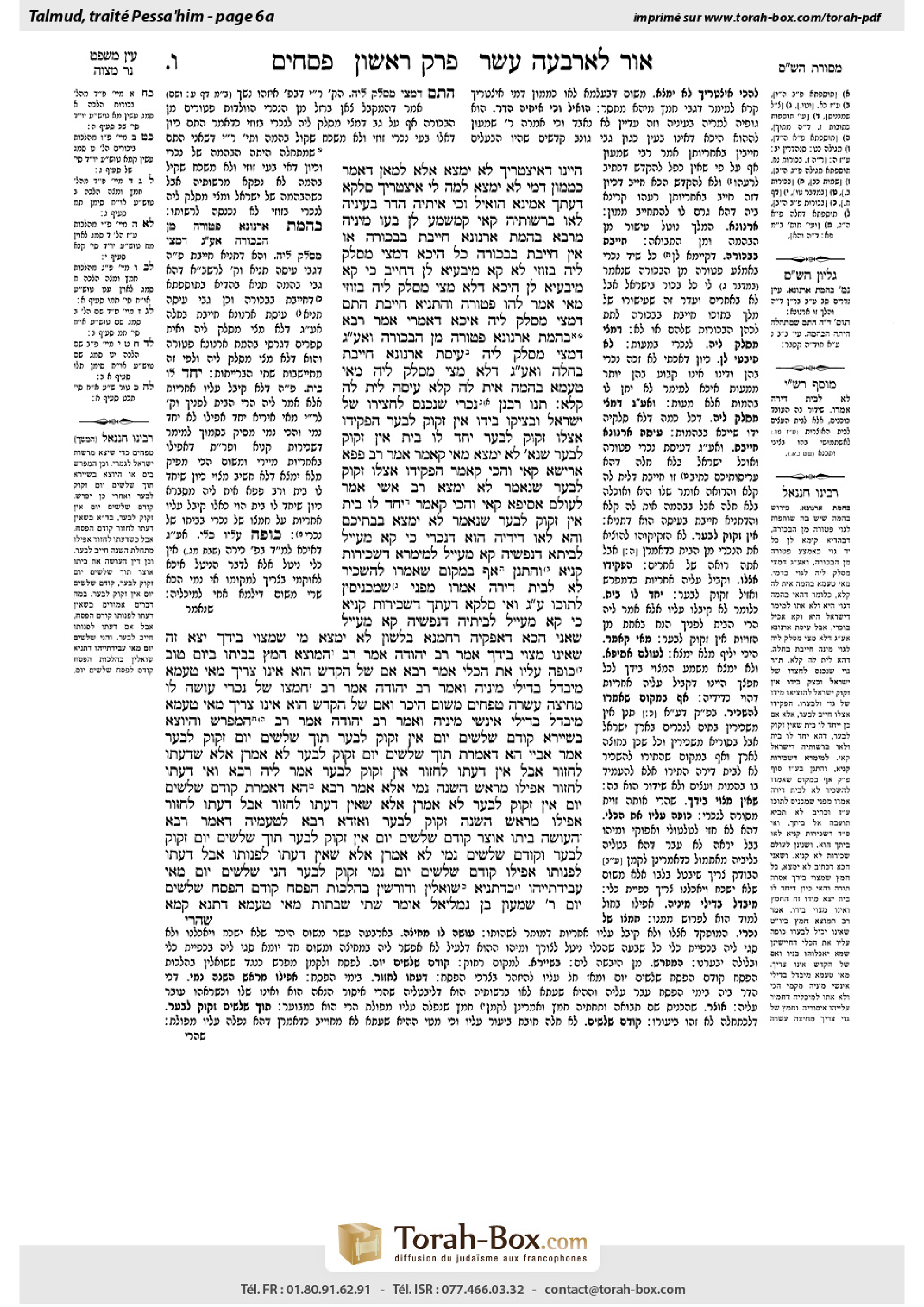
Pesachim 6a: Talmud study for Daf Yomi
Daf Yomi is the daily study of one Talmud folio. Explore 37 tractates with scans, Hebrew text, Sefaria English and AI-generated French translations where annotated.
Passage selection and English or AI-generated French translation are available where the scan has annotations. Daf Study is independent of Torah-Box and Sefaria.
Browse Pesachim · פסחים · All tractatesPesachim 6a text and translations
This page of Pesachim includes the Aramaic text, an English translation and an AI-generated French translation, alongside the scan above.
פסחים ו׳ א · Aramaic and Hebrew text
הַיְינוּ דְּאִיצְטְרִיךְ ״לֹא יִמָּצֵא״. אֶלָּא לְמַאן דְּאָמַר כְּמָמוֹן דָּמֵי — ״לֹא יִמָּצֵא״ לְמָה לִי? אִיצְטְרִיךְ, סָלְקָא דַּעְתָּךְ אָמֵינָא: הוֹאִיל וְכִי אִיתֵיהּ הָדַר בְּעֵינֵיהּ — לָאו בִּרְשׁוּתֵיהּ קָאֵי, קָמַשְׁמַע לַן.
בְּעוֹ מִינֵּיהּ מֵרָבָא: בֶּהֱמַת אַרְנוֹנָא חַיֶּיבֶת בִּבְכוֹרָה, אוֹ אֵין חַיֶּיבֶת בִּבְכוֹרָה? כֹּל הֵיכָא דְּמָצֵי מְסַלֵּק לֵיהּ בְּזוּזֵי — לָא קָא מִיבַּעְיָא לַן דְּחַיָּיב.
כִּי קָא מִיבַּעְיָא לַן — הֵיכָא דְּלָא מָצֵי מְסַלֵּק לֵיהּ בְּזוּזֵי, מַאי? אֲמַר לְהוּ: פְּטוּרָה. וְהָתַנְיָא: חַיֶּיבֶת! הָתָם דְּמָצֵי מְסַלֵּק לֵיהּ.
אִיכָּא דְּאָמְרִי, אָמַר רָבָא: בֶּהֱמַת אַרְנוֹנָא פְּטוּרָה מִן הַבְּכוֹרָה, וְאַף עַל גַּב דְּמָצֵי מְסַלֵּק לֵיהּ. עִיסַּת אַרְנוֹנָא חַיֶּיבֶת בְּחַלָּה, וְאַף עַל גַּב דְּלָא מָצֵי מְסַלֵּק לֵיהּ.
מַאי טַעְמָא: בְּהֵמָה אִית לַהּ קָלָא, עִיסָּה לֵית לַהּ קָלָא.
תָּנוּ רַבָּנַן: גּוֹי שֶׁנִּכְנַס לַחֲצֵירוֹ שֶׁל יִשְׂרָאֵל וּבְצֵיקוֹ בְּיָדוֹ — אֵין זָקוּק לְבַעֵר. הִפְקִידוֹ אֶצְלוֹ — זָקוּק לְבַעֵר. יִחֵד לוֹ בַּיִת — אֵין זָקוּק לְבַעֵר, שֶׁנֶּאֱמַר ״לֹא יִמָּצֵא״.
מַאי קָאָמַר? אָמַר רַב פָּפָּא: אַרֵישָׁא קָאֵי, וְהָכִי קָאָמַר: הִפְקִידוֹ אֶצְלוֹ — זָקוּק לְבַעֵר, שֶׁנֶּאֱמַר ״לֹא יִמָּצֵא״.
רַב אָשֵׁי אָמַר: לְעוֹלָם אַסֵּיפָא קָאֵי, וְהָכִי קָאָמַר: יִחֵד לוֹ בַּיִת — אֵין זָקוּק לְבַעֵר, שֶׁנֶּאֱמַר ״לֹא יִמָּצֵא בְּבָתֵּיכֶם״, וְהָא לָאו דִּידֵיהּ הוּא, דְּגוֹי כִּי קָא מְעַיֵּיל — לְבֵיתָא דְנַפְשֵׁיהּ קָא מְעַיֵּיל.
לְמֵימְרָא דִּשְׂכִירוּת קָנְיָא?! וְהָתְנַן: אַף בְּמָקוֹם שֶׁאָמְרוּ לְהַשְׂכִּיר — לֹא לְבֵית דִּירָה אָמְרוּ, מִפְּנֵי שֶׁמַּכְנִיסִין לְתוֹכוֹ עֲבוֹדַת גִּלּוּלִים. וְאִי סָלְקָא דַּעְתָּךְ דִּשְׂכִירוּת קָנְיָא, כִּי קָא מְעַיֵּיל — לְבֵיתֵיהּ דְּנַפְשֵׁיהּ קָא מְעַיֵּיל?
שָׁאנֵי הָכָא, דְּאַפְּקֵיהּ רַחֲמָנָא בִּלְשׁוֹן ״לֹא יִמָּצֵא״ — מִי שֶׁמָּצוּי בְּיָדְךָ, יָצָא זֶה שֶׁאֵינוֹ מָצוּי בְּיָדְךָ.
אָמַר רַב יְהוּדָה אָמַר רַב: הַמּוֹצֵא חָמֵץ בְּבֵיתוֹ בְּיוֹם טוֹב — כּוֹפֶה עָלָיו אֶת הַכְּלִי. אָמַר רָבָא: אִם שֶׁל הֶקְדֵּשׁ הוּא — אֵינוֹ צָרִיךְ. מַאי טַעְמָא — מִיבְדָּל בְּדִילִי מִינֵּיהּ.
וְאָמַר רַב יְהוּדָה אָמַר רַב: חֲמֵצוֹ שֶׁל גּוֹי, עוֹשֶׂה לוֹ מְחִיצָה עֲשָׂרָה טְפָחִים מִשּׁוּם הֶיכֵּר. וְאִם שֶׁל הֶקְדֵּשׁ הוּא — אֵינוֹ צָרִיךְ. מַאי טַעְמָא? מִיבְדָּל בְּדִילִי אִינָשֵׁי מִינֵּיהּ.
וְאָמַר רַב יְהוּדָה אָמַר רַב: הַמְפָרֵשׁ, וְהַיּוֹצֵא בִּשְׁיָירָא, קוֹדֶם שְׁלֹשִׁים יוֹם — אֵין זָקוּק לְבַעֵר, תּוֹךְ שְׁלֹשִׁים יוֹם — זָקוּק לְבַעֵר. אָמַר אַבָּיֵי: הָא דְּאָמְרַתְּ תּוֹךְ שְׁלֹשִׁים יוֹם — זָקוּק לְבַעֵר, לָא אֲמַרַן אֶלָּא שֶׁדַּעְתּוֹ לַחֲזוֹר, אֲבָל אֵין דַּעְתּוֹ לַחֲזוֹר — אֵין זָקוּק לְבַעֵר.
אֲמַר לֵיהּ רָבָא: וְאִי דַּעְתּוֹ לַחֲזוֹר, אֲפִילּוּ מֵרֹאשׁ הַשָּׁנָה נָמֵי! אֶלָּא אָמַר רָבָא: הָא דְּאָמְרַתְּ קוֹדֶם שְׁלֹשִׁים יוֹם אֵין זָקוּק לְבַעֵר, לָא אֲמַרַן אֶלָּא שֶׁאֵין דַּעְתּוֹ לַחֲזוֹר, אֲבָל דַּעְתּוֹ לַחֲזוֹר — אֲפִילּוּ מֵרֹאשׁ הַשָּׁנָה זָקוּק לְבַעֵר.
וְאַזְדָּא רָבָא לְטַעְמֵיהּ. דְּאָמַר רָבָא: הָעוֹשֶׂה בֵּיתוֹ אוֹצָר, קוֹדֶם שְׁלֹשִׁים יוֹם — אֵין זָקוּק לְבַעֵר. תּוֹךְ שְׁלֹשִׁים יוֹם — זָקוּק לְבַעֵר.
וְקוֹדֶם שְׁלֹשִׁים נָמֵי, לָא אֲמַרַן אֶלָּא שֶׁאֵין דַּעְתּוֹ לְפַנּוֹתוֹ, אֲבָל דַּעְתּוֹ לְפַנּוֹתוֹ — אֲפִילּוּ קוֹדֶם שְׁלֹשִׁים יוֹם נָמֵי זָקוּק לְבַעֵר.
הָנֵי שְׁלֹשִׁים יוֹם, מַאי עֲבִידְתַּיְיהוּ? כִּדְתַנְיָא: שׁוֹאֲלִין וְדוֹרְשִׁין בְּהִלְכוֹת הַפֶּסַח קוֹדֶם הַפֶּסַח שְׁלֹשִׁים יוֹם. רַבָּן שִׁמְעוֹן בֶּן גַּמְלִיאֵל אוֹמֵר: שְׁתֵּי שַׁבָּתוֹת. מַאי טַעְמָא דְּתַנָּא קַמָּא —
Pesachim 6a · English translation
That is the reason that it is necessary for the Torah to write: It shall not be found, to indicate that there is a halakha unique to leaven. In this case, it is considered as though it were in his possession. However, according to the one who said: The legal status of an object that effects monetary loss is like that of money, why do I need the phrase: It shall not be found? Obviously, the leaven is prohibited, as it is considered his property. The Gemara answers: It is nonetheless necessary, as it could enter your mind to say: Since when the leaven is intact it returns to the gentile in its pure, unadulterated form, it retroactively did not stand in the Jew’s possession and the Jew did not violate the prohibition against having leaven found on his property. Therefore, the verse teaches us that it is considered as though the leaven belonged to the Jew.
They raised a dilemma before Rava: Is the owner of an animal born into a herd from which the royal tax [arnona] is collected obligated in the mitzva to give the firstborn animal to a priest, as the animal still belongs to a Jew? Or perhaps he is not obligated to give the firstborn animal to the priest, as the obligation does not take effect on an animal partly owned by a gentile. The Gemara elaborates on the parameters of raising the dilemma: In any case where the Jew could dismiss the gentile tax collector with money in lieu of the animals, we do not raise the dilemma, as he is clearly obligated in the mitzva of the firstborn. The authorities own no part of the animal; the Jew merely owes them a monetary debt. Therefore, the animal is the property of the Jew exclusively.
The situation when we do raise the dilemma is specifically where the Jew cannot dismiss the gentile tax collector with money. What is the halakha is this case? He said to them: The owner is exempt from the mitzva of the firstborn. The Sages raised a difficulty: But wasn’t it taught in a baraita that he is obligated in the mitzva of the firstborn? He replied: There it is speaking of a case where the Jew could dismiss the gentile tax collector with money.
Some say that Rava said: The owner of an animal born into a herd from which the royal tax is collected is exempt from the mitzva of a firstborn, even though the Jew could dismiss the gentile tax collector with money. However, the owner of dough from which the royal tax is collected is obligated in ḥalla, despite the fact that the owner of dough partially owned by a gentile is generally not obligated. This is the halakha even though the Jew cannot dismiss the gentile tax collector by paying him the value of the dough.
The Gemara explains: What is the reason for the difference between the halakha of a firstborn animal and the halakha of ḥalla? An animal generates publicity; as everyone knows that this Jew’s animal was confiscated by the authorities, no one will suspect him of intentionally refraining from fulfilling the mitzva. In contrast, dough does not generate publicity. Since not everyone knows that the dough is partially owned by a gentile, those who see a Jew failing to separate ḥalla will suspect him of neglecting the mitzva.
The Sages taught in a baraita: With regard to a gentile who enters the courtyard of a Jew with his dough in his hand, the Jew need not remove the leaven by evicting the gentile from his property. However, if the gentile deposited the leaven with him, and the Jew accepted responsibility, he must remove it. If he designated a room in his house for the gentile to place his leavened food, he need not remove it, as it is stated: “It shall not be found” (Exodus 12:19).
The Gemara asks: What is the tanna of the baraita saying? How does the verse: It shall not be found, prove this halakha? Rav Pappa said: The verse cited is referring to the first clause of the baraita, and this is what the tanna is saying: If the gentile deposited the leavened dough with the Jew, he, i.e., the Jew, must remove the dough from his property, as it is stated: It shall not be found.
Rav Ashi said: Actually, the verse cited is referring to the last clause of the baraita, and this is what the tanna is saying: If he designated a room in his house for the gentile to place the leavened dough, he need not remove it, as it is stated: It shall not be found in your houses, and that house is not his; since when the gentile brings the dough into the house, he brings it into his own house, as the space was designated for his use.
The Gemara asks: Is that to say that rental denotes that the renter acquires the rented space as he would a full-fledged acquisition with regard to responsibility for that space? But didn’t we learn in a mishna: Even in a place with regard to which they said it is permitted for a Jew to rent houses to gentiles, e.g., in Syria, they did not say that one may rent it for use as a residence, because the gentiles will bring idolatry into it. And if it enters your mind to say that rental denotes that the renter acquires the rented space as he would a full-fledged acquisition, when the gentile brings the idols into the house he brings them into his own house. Why, then, is it prohibited for the owner to rent it to a gentile?
The Gemara answers: It is different here with regard to leaven, as the Merciful One expresses it using the language: It shall not be found, meaning, that which is found in your possession is prohibited, excluding this leaven, which is not found in your possession. However, with regard to other prohibitions, one who rents a place to others remains somewhat responsible for his property, despite the fact that he does not live there.
Rav Yehuda said that Rav said: One who finds leavened bread in his house on the Festival, i.e., the first day of Passover, covers it with a vessel and burns it at the conclusion of the Festival day. Rava said: If that leaven is consecrated, he need not cover it. What is the reason for this difference? The reason is that people distance themselves from consecrated food in any case, due to the severity of the prohibition against misuse of consecrated property. Therefore, there is no concern that he will eat it.
And Rav Yehuda said that Rav said: If leavened bread belonging to a gentile is in a Jew’s house, he, i.e., the Jew, should erect a barrier ten handbreadths high around it on the fourteenth of Nisan, as a conspicuous marker, so that he will not mistakenly eat it. And if the leaven is consecrated, he need not do so. What is the reason for this halakha? Since people distance themselves from consecrated food, they will not mistakenly eat it.
And Rav Yehuda said that Rav said: With regard to one who sets sail, or one who departs in a caravan traveling to a distant place; if he did so before it was thirty days prior to Passover, he need not remove the leaven from his possession. If he departs within thirty days of the Festival, he must remove the leaven. Abaye said: That which you said, that within thirty days one must remove the leaven, we only said this in a case where his intention is to return home adjacent to Passover (Ran). However, in a case where it is not his intention to return before Passover, he need not remove the leaven.
Rava said to him: But if he intends to return home shortly before the Festival, even if he was gone from Rosh HaShana, shouldn’t he remove the leaven, as failure to do so will lead to his arriving home and discovering leaven in his house just before the Festival? Rather, Rava said: According to that which you said, i.e., that if he leaves before it was thirty days prior to Passover he need not remove the leaven, we said this halakha only if he does not intend to return before Passover. However, if he intends to return, even if he was gone from Rosh HaShana, he must remove the leaven.
And Rava followed his line of reasoning stated elsewhere, as Rava maintains that one must remove all leaven from his possession within thirty days of Passover, even if he will not be there on the Festival itself. As Rava said: With regard to one who turns his house into a storehouse, and there is leaven beneath the stored grain, if he does so before it was thirty days prior to Passover, he need not remove the leaven. Since the leaven is concealed, it is considered removed after the fact. If it is within thirty days, he must remove the leaven, as it is not considered removed ab initio.
And even if this occurred before it was thirty days prior to Passover, we only said that he is not obligated to remove the leaven if it is not his intention to clear away the stored grain before Passover. However, if his intention is to clear away the grain before Passover, he must remove the leaven even before it was thirty days prior to Passover, as perhaps he will not have time to remove the leaven before the Festival.
The Gemara asks: What is the purpose of this period of thirty days that renders it significant? The Gemara answers: As it was taught in a baraita: One asks about and teaches the halakhot of Passover thirty days before Passover. Rabban Shimon ben Gamliel says: One begins studying those halakhot two weeks before the Festival. The Gemara asks: What is the reason for the opinion of the first tanna, that one begins studying the halakhot of Passover thirty days before the Festival?
Pesachim 6a · Traduction française (IA)
C’est pourquoi la Torah doit écrire : « Il ne devra pas s’en trouver », afin d’indiquer qu’il existe une halakha propre au levain. Dans ce cas, c’est comme s’il était en sa possession. Mais, selon celui qui affirme que le statut juridique d’un objet qui entraîne une perte financière est celui de l’argent, pourquoi ai-je besoin de l’expression « Il ne devra pas s’en trouver » ? De toute évidence, le levain est interdit, puisqu’il est considéré comme sa propriété. La Guemara répond : Cette expression est néanmoins nécessaire, car on pourrait penser que, puisque le levain intact retourne au non-Juif sous sa forme pure et non altérée, il n’a rétrospectivement jamais été en possession du Juif, et que celui-ci n’a donc pas transgressé l’interdiction d’avoir du levain sur ses biens. Le verset nous enseigne donc que le levain est considéré comme appartenant au Juif.
On soumit à Rava le cas suivant : le propriétaire d’un animal né dans un troupeau soumis à la redevance royale [arnona] est-il tenu d’accomplir la mitsva de donner au prêtre le premier-né de l’animal, puisque celui-ci appartient encore à un Juif ? Ou bien n’est-il pas tenu de donner le premier-né au prêtre, car l’obligation ne s’applique pas à un animal appartenant en partie à un non-Juif ? La Guemara précise les paramètres de la question : dans tous les cas où le Juif peut se libérer du collecteur d’impôts non juif en lui versant de l’argent plutôt que de lui remettre des animaux, la question ne se pose pas, puisqu’il est clairement tenu d’accomplir la mitsva du premier-né. Les autorités ne possèdent aucune part de l’animal ; le Juif leur doit simplement une somme d’argent. L’animal appartient donc exclusivement au Juif.
La question se pose précisément dans le cas où le Juif ne peut pas se libérer du collecteur d’impôts non juif en lui versant de l’argent. Quelle est la halakha dans ce cas ? Il leur répondit : le propriétaire est dispensé de la mitsva du premier-né. Les Sages soulevèrent une difficulté : Mais n’a-t-il pas été enseigné dans une baraïta qu’il est tenu d’accomplir la mitsva du premier-né ? Il répondit : Là, il s’agit d’un cas où le Juif pouvait se libérer du collecteur d’impôts non juif en lui versant de l’argent.
Certains disent que Rava a déclaré : le propriétaire d’un animal né dans un troupeau soumis à la redevance royale est dispensé de la mitsva du premier-né, même si le Juif pouvait se libérer du collecteur d’impôts non juif en lui versant de l’argent. En revanche, le propriétaire d’une pâte soumise à la redevance royale est tenu à la mitsva de la ‘hala, bien que, généralement, le propriétaire d’une pâte appartenant en partie à un non-Juif n’y soit pas tenu. Cela reste la halakha même si le Juif ne peut pas se libérer du collecteur d’impôts non juif en lui versant la valeur de la pâte.
La Guemara explique : quelle est la raison de la différence entre la halakha du premier-né animal et celle de la ‘hala ? L’animal est un fait notoire : tout le monde sait que l’animal de ce Juif a été saisi par les autorités ; personne ne le soupçonnera donc de s’être volontairement abstenu d’accomplir la mitsva. À l’inverse, la pâte n’est pas un fait notoire. Comme tout le monde ne sait pas qu’elle appartient en partie à un non-Juif, ceux qui voient un Juif ne pas prélever la ‘hala le soupçonneront de négliger la mitsva.
Les Sages ont enseigné dans une baraïta : si un non-Juif entre dans la cour d’un Juif avec sa pâte à la main, le Juif n’a pas à éliminer le levain en chassant le non-Juif de sa propriété. Toutefois, si le non-Juif lui a confié le levain et que le Juif en a accepté la responsabilité, il doit l’éliminer. S’il a réservé une pièce de sa maison pour que le non-Juif y dépose ses aliments levés, il n’a pas à l’éliminer, comme il est dit : « Il ne devra pas s’en trouver » (Exode 12, 19).
La Guemara demande : que dit le tanna de la baraïta ? En quoi le verset « Il ne devra pas s’en trouver » prouve-t-il cette halakha ? Rav Pappa dit : le verset cité se rapporte à la première partie de la baraïta, et voici ce que dit le tanna : si le non-Juif a confié la pâte levée au Juif, celui-ci, c’est-à-dire le Juif, doit retirer la pâte de sa propriété, comme il est dit : « Il ne devra pas s’en trouver ».
Rav Ashi dit : en réalité, le verset cité se rapporte à la dernière partie de la baraïta, et voici ce que dit le tanna : s’il a réservé une pièce de sa maison pour que le non-Juif y dépose la pâte levée, il n’a pas à l’éliminer, comme il est dit : « Il ne devra pas s’en trouver dans vos maisons » ; or cette maison n’est pas la sienne. Lorsque le non-Juif apporte la pâte dans la maison, il l’apporte chez lui, puisque cet espace a été réservé à son usage.
La Guemara demande : cela signifie-t-il qu’une location confère au locataire la jouissance de l’espace loué comme s’il l’avait pleinement acquis, en ce qui concerne la responsabilité de cet espace ? Mais n’avons-nous pas appris dans une Michna : même dans un lieu où l’on a dit qu’un Juif peut louer des maisons à des non-Juifs, par exemple en Syrie, on n’a pas dit qu’il pouvait les louer à usage d’habitation, car les non-Juifs y introduiraient des objets d’idolâtrie. Et si l’on pensait qu’une location confère au locataire la jouissance de l’espace loué comme s’il l’avait pleinement acquis, lorsque le non-Juif apporte les idoles dans la maison, il les apporte chez lui. Pourquoi est-il alors interdit au propriétaire de la louer à un non-Juif ?
La Guemara répond : le cas du levain est différent, car le Miséricordieux l’exprime par les termes « Il ne devra pas s’en trouver », ce qui signifie que ce qui se trouve en votre possession est interdit, à l’exclusion de ce levain, qui ne se trouve pas en votre possession. En revanche, pour les autres interdictions, celui qui loue un lieu à autrui demeure, dans une certaine mesure, responsable de ses biens, bien qu’il n’y habite pas.
Rav Yehouda dit au nom de Rav : celui qui trouve du pain levé dans sa maison pendant le jour de fête, c’est-à-dire le premier jour de Pessa’h, le couvre d’un récipient et le brûle à la fin de ce jour de fête. Rava dit : si ce levain est consacré, il n’a pas besoin de le couvrir. Quelle est la raison de cette différence ? Les gens s’éloignent de toute façon des aliments consacrés, en raison de la gravité de l’interdiction de faire un usage profane des biens consacrés. On ne craint donc pas qu’il le mange.
Rav Yehouda dit également au nom de Rav : si du pain levé appartenant à un non-Juif se trouve dans la maison d’un Juif, celui-ci, c’est-à-dire le Juif, doit, le quatorze nissan, ériger tout autour une barrière de dix palmes de haut, en guise de repère bien visible, afin de ne pas le manger par erreur. Si le levain est consacré, il n’a pas besoin de le faire. Quelle est la raison de cette halakha ? Les gens s’éloignent des aliments consacrés et ne les mangeront donc pas par erreur.
Rav Yehouda dit également au nom de Rav : celui qui prend la mer ou part en caravane vers une destination lointaine, s’il part plus de trente jours avant Pessa’h, n’a pas besoin d’éliminer le levain de sa possession. S’il part dans les trente jours précédant la fête, il doit éliminer le levain. Abayé dit : la règle que tu as énoncée, selon laquelle il faut éliminer le levain dans les trente jours précédant la fête, ne s’applique, avons-nous dit, que si son intention est de rentrer chez lui à l’approche de Pessa’h (Ran). En revanche, s’il n’a pas l’intention de rentrer avant Pessa’h, il n’a pas besoin d’éliminer le levain.
Rava lui dit : mais s’il a l’intention de rentrer chez lui peu avant la fête, même s’il est parti depuis Roch Hachana, ne devrait-il pas éliminer le levain, puisque, s’il ne le fait pas, il risque de rentrer et d’en trouver dans sa maison juste avant la fête ? Rava dit plutôt : conformément à ce que tu as dit, à savoir que celui qui part plus de trente jours avant Pessa’h n’a pas besoin d’éliminer le levain, cette halakha ne s’applique, avons-nous dit, que s’il n’a pas l’intention de rentrer avant Pessa’h. En revanche, s’il a l’intention de rentrer, même s’il est parti depuis Roch Hachana, il doit éliminer le levain.
Et Rava reste cohérent avec sa position exprimée ailleurs, car il estime qu’il faut éliminer tout levain de sa possession dans les trente jours précédant Pessa’h, même si l’on ne sera pas présent pendant la fête. En effet, Rava a dit : si quelqu’un transforme sa maison en entrepôt et que du levain se trouve sous les céréales entreposées, s’il le fait plus de trente jours avant Pessa’h, il n’a pas besoin d’éliminer le levain. Puisque celui-ci est caché, il est considéré après coup comme éliminé. S’il le fait dans les trente jours précédant Pessa’h, il doit éliminer le levain, car on ne considère pas qu’il ait été éliminé d’emblée.
Et même si cela s’est produit plus de trente jours avant Pessa’h, nous avons dit qu’il n’est pas tenu d’éliminer le levain uniquement s’il n’a pas l’intention de dégager les céréales entreposées avant Pessa’h. En revanche, s’il a l’intention de dégager les céréales avant Pessa’h, il doit éliminer le levain même plus de trente jours avant Pessa’h, car il pourrait ne pas avoir le temps de l’éliminer avant la fête.
La Guemara demande : quelle est l’importance de cette période de trente jours, qui lui confère un statut particulier ? La Guemara répond : comme il a été enseigné dans une baraïta : on commence à s’enquérir des halakhot de Pessa’h et à les enseigner trente jours avant Pessa’h. Rabban Shimon ben Gamliel dit : on commence à étudier ces halakhot deux semaines avant la fête. La Guemara demande : quelle est la raison de l’opinion du premier tanna, selon laquelle on commence à étudier les halakhot de Pessa’h trente jours avant la fête ?
Traduction française générée par IA à partir de l’édition anglaise de Sefaria. Vérifie toujours un passage avec le texte source.
Text from Sefaria: William Davidson Edition - Vocalized Aramaic (CC BY NC); William Davidson Edition - English (CC BY NC).