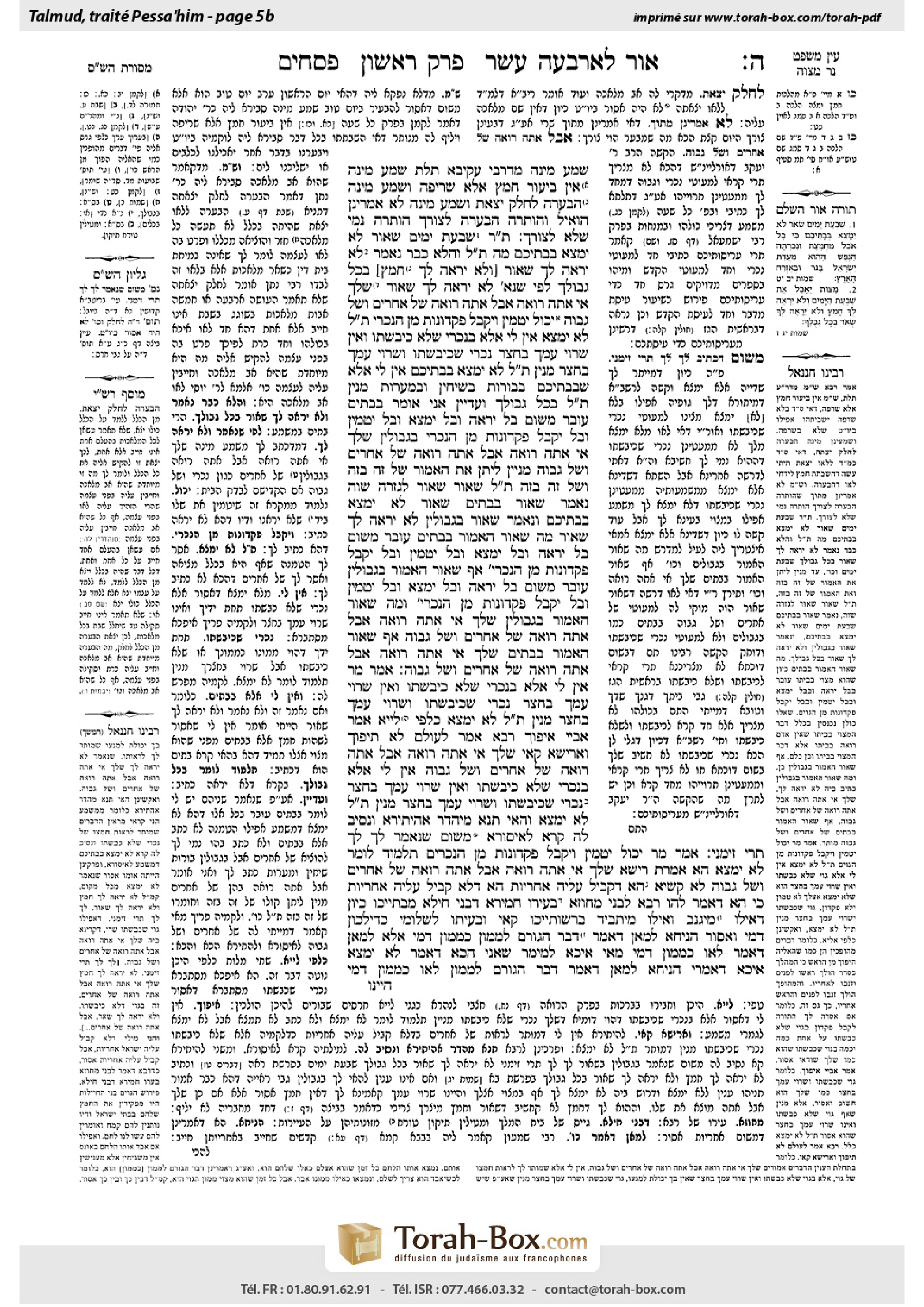
Pesachim 5b: Talmud study for Daf Yomi
Daf Yomi is the daily study of one Talmud folio. Explore 37 tractates with scans, Hebrew text, Sefaria English and AI-generated French translations where annotated.
Passage selection and English or AI-generated French translation are available where the scan has annotations. Daf Study is independent of Torah-Box and Sefaria.
Browse Pesachim · פסחים · All tractatesPesachim 5b text and translations
This page of Pesachim includes the Aramaic text, an English translation and an AI-generated French translation, alongside the scan above.
פסחים ה׳ ב · Aramaic and Hebrew text
שְׁמַע מִינַּהּ מִדְּרַבִּי עֲקִיבָא תְּלָת. שְׁמַע מִינַּהּ: אֵין בִּיעוּר חָמֵץ אֶלָּא שְׂרֵיפָה, וּשְׁמַע מִינַּהּ: הַבְעָרָה לְחַלֵּק יָצָאת, וּשְׁמַע מִינַּהּ: לָא אָמְרִינַן הוֹאִיל וְהוּתְּרָה הַבְעָרָה לְצוֹרֶךְ — הוּתְּרָה נָמֵי שֶׁלֹּא לְצוֹרֶךְ.
תָּנוּ רַבָּנַן: ״שִׁבְעַת יָמִים שְׂאֹר לֹא יִמָּצֵא בְּבָתֵּיכֶם״. מַה תַּלְמוּד לוֹמַר? וַהֲלֹא כְּבָר נֶאֱמַר: ״לֹא יֵרָאֶה לְךָ שְׂאֹר [וְלֹא יֵרָאֶה לְךָ חָמֵץ] בְּכׇל גְּבֻלֶךָ״!
לְפִי שֶׁנֶּאֱמַר: ״לֹא יֵרָאֶה לְךָ שְׂאֹר״ — שֶׁלְּךָ אִי אַתָּה רוֹאֶה, אֲבָל אַתָּה רוֹאֶה שֶׁל אֲחֵרִים וְשֶׁל גָּבוֹהַּ. יָכוֹל יַטְמִין וִיקַבֵּל פִּקְדוֹנוֹת מִן הַגּוֹי — תַּלְמוּד לוֹמַר ״לֹא יִמָּצֵא״.
אֵין לִי אֶלָּא בְּגוֹי שֶׁלֹּא כִּיבַּשְׁתּוֹ, וְאֵין שָׁרוּי עִמְּךָ בֶּחָצֵר. גּוֹי שֶׁכִּיבַּשְׁתּוֹ, וְשָׁרוּי עִמְּךָ בֶּחָצֵר מִנַּיִן? תַּלְמוּד לוֹמַר: ״לֹא יִמָּצֵא בְּבָתֵּיכֶם״.
אֵין לִי אֶלָּא שֶׁבְּבָתֵּיכֶם. בְּבוֹרוֹת בְּשִׁיחִין וּבִמְעָרוֹת מִנַּיִן? תַּלְמוּד לוֹמַר ״בְּכׇל גְּבֻלֶךָ״.
וַעֲדַיִין אֲנִי אוֹמֵר: בַּבָּתִּים עוֹבֵר מִשּׁוּם בַּל יֵרָאֶה וּבַל יִמָּצֵא וּבַל יַטְמִין וּבַל יְקַבֵּל פִּקְדוֹנוֹת מִן הַגּוֹי. בַּגְּבוּלִין — שֶׁלְּךָ אִי אַתָּה רוֹאֶה, אֲבָל אַתָּה רוֹאֶה שֶׁל אֲחֵרִים וְשֶׁל גָּבוֹהַּ. מִנַּיִין לִיתֵּן אֶת הָאָמוּר שֶׁל זֶה בָּזֶה וְשֶׁל זֶה בָּזֶה?
תַּלְמוּד לוֹמַר: ״שְׂאוֹר״ ״שְׂאוֹר״ לִגְזֵירָה שָׁוָה. נֶאֱמַר שְׂאוֹר בַּבָּתִּים: ״שְׂאֹר לֹא יִמָּצֵא בְּבָתֵּיכֶם״, וְנֶאֱמַר שְׂאֹר בַּגְּבוּלִין: ״לֹא יֵרָאֶה לְךָ שְׂאֹר״. מָה שְׂאוֹר הָאָמוּר בַּבָּתִּים — עוֹבֵר מִשּׁוּם בַּל יֵרָאֶה וּבַל יִמָּצֵא וּבַל יַטְמִין וּבַל יְקַבֵּל פִּקְדוֹנוֹת מִן הַגּוֹיִם, אַף שְׂאוֹר הָאָמוּר בַּגְּבוּלִין — עוֹבֵר מִשּׁוּם בַּל יֵרָאֶה וּבַל יִמָּצֵא וּבַל יַטְמִין וּבַל יְקַבֵּל פִּקְדוֹנוֹת מִן הַגּוֹיִם.
וּמָה שְׂאוֹר הָאָמוּר בַּגְּבוּלִין — שֶׁלְּךָ אִי אַתָּה רוֹאֶה, אֲבָל אַתָּה רוֹאֶה שֶׁל אֲחֵרִים וְשֶׁל גָּבוֹהַּ, אַף שְׂאוֹר הָאָמוּר בַּבָּתִּים — שֶׁלְּךָ אִי אַתָּה רוֹאֶה, אֲבָל אַתָּה רוֹאֶה שֶׁל אֲחֵרִים וְשֶׁל גָּבוֹהַּ.
אָמַר מָר: אֵין לִי אֶלָּא בְּגוֹי שֶׁלֹּא כִּיבַּשְׁתּוֹ, וְאֵין שָׁרוּי עִמְּךָ בֶּחָצֵר. גּוֹי שֶׁכִּיבַּשְׁתּוֹ, וְשָׁרוּי עִמְּךָ בֶּחָצֵר מִנַּיִן? תַּלְמוּד לוֹמַר ״לֹא יִמָּצֵא״.
כְּלַפֵּי לְיָיא! אָמַר אַבָּיֵי: אֵיפוֹךְ.
רָבָא אָמַר: לְעוֹלָם לָא תֵּיפוֹךְ, וְאַרֵישָׁא קָאֵי: שֶׁלְּךָ אִי אַתָּה רוֹאֶה, אֲבָל אַתָּה רוֹאֶה שֶׁל אֲחֵרִים וְשֶׁל גָּבוֹהַּ. אֵין לִי אֶלָּא בְּגוֹי שֶׁלֹּא כִּיבַּשְׁתּוֹ, וְאֵין שָׁרוּי עִמְּךָ בֶּחָצֵר. גּוֹי שֶׁכִּיבַּשְׁתּוֹ, וְשָׁרוּי עִמְּךָ בֶּחָצֵר, מִנַּיִן? תַּלְמוּד לוֹמַר ״לֹא יִמָּצֵא״.
וְהַאי תַּנָּא מְיהַדַּר אַהֶיתֵּירָא, וְנָסֵיב לֵהּ קְרָא לְאִיסּוּרָא?! מִשּׁוּם שֶׁנֶּאֱמַר ״לְךָ״ ״לְךָ״ תְּרֵי זִימְנֵי.
אָמַר מָר: יָכוֹל יַטְמִין וִיקַבֵּל פִּקְדוֹנוֹת מִן הַגּוֹיִם, תַּלְמוּד לוֹמַר: ״לֹא יִמָּצֵא״. הָא אָמְרַתְּ רֵישָׁא: שֶׁלְּךָ אִי אַתָּה רוֹאֶה, אֲבָל אַתָּה רוֹאֶה שֶׁל אֲחֵרִים וְשֶׁל גָּבוֹהַּ!
לָא קַשְׁיָא: הָא — דְּקַבֵּיל עֲלֵיהּ אַחְרָיוּת, הָא — דְּלָא קַבֵּיל עֲלֵיהּ אַחְרָיוּת.
כִּי הָא דְּאָמַר לְהוּ רָבָא לִבְנֵי מָחוֹזָא: בַּעִירוּ חֲמִירָא דִבְנֵי חֵילָא מִבָּתַּיְיכוּ. כֵּיוָן דְּאִילּוּ מִיגְּנֵב וְאִילּוּ מִיתְּבִיד בִּרְשׁוּתַיְיכוּ קָאֵי וּבָעִיתוּ לְשַׁלּוֹמֵי — כְּדִילְכוֹן דָּמֵי, וְאָסוּר.
הָנִיחָא לְמַאן דְּאָמַר דָּבָר הַגּוֹרֵם לְמָמוֹן — כְּמָמוֹן דָּמֵי. אֶלָּא לְמַאן דְּאָמַר לָאו כְּמָמוֹן דָּמֵי, מַאי אִיכָּא לְמֵימַר?
שָׁאנֵי הָכָא, דְּאָמַר ״לֹא יִמָּצֵא״.
אִיכָּא דְּאָמְרִי: הָנִיחָא לְמַאן דְּאָמַר דָּבָר הַגּוֹרֵם לְמָמוֹן — לָאו כְּמָמוֹן דָּמֵי,
Pesachim 5b · English translation
Learn from the statement of Rabbi Akiva three halakhot. Learn from it that the removal of leavened bread can be performed only by means of burning. Rabbi Akiva bases his opinion on the fact that it is prohibited to kindle a fire on the Festival.
And second, learn from it that the prohibition against kindling a fire on Shabbat was specifically singled out in the Torah to divide the various primary categories of labor and to establish liability for performance of each of them. The dissenting opinion is that kindling is singled out to teach that there is no capital punishment for performing that primary category of labor.
And third, learn from it that we do not say: Since it is permitted to kindle a fire for the purpose of preparing food, it is also permitted to light a fire not for the purpose of preparing food, e.g., to burn leaven.
The Sages taught in a baraita: “Seven days leaven shall not be found in your houses” (Exodus 12:19). To what purpose does the verse state this prohibition? Wasn’t it already stated: “And no leaven shall be seen with you, neither shall there be leavened bread seen with you, in all your borders” (Exodus 13:7)?
The baraita answers: Because it is stated: “And no leaven shall be seen with you,” which teaches that your own leaven you may not see, but you may see leaven that belongs to others, i.e., gentiles, and leaven consecrated to God. In light of this halakha, I might have thought that one may conceal leaven in one’s home or accept deposits of leaven from a gentile. Therefore, the verse states: “Shall not be found,” meaning that one may not retain any type of leaven in one’s house at all.
The tanna continues: Had only this verse been stated, I would have derived nothing other than this halakha with regard to a gentile whom you did not overcome and who does not dwell with you in the courtyard. With regard to a gentile whom you overcame and who dwells with you in the courtyard, from where do we know that he is also included in this prohibition? The verse states: “It shall not be found in your houses” at all, i.e., anywhere in one’s possession.
The baraita further states that from the verse: “It shall not be found in your houses,” I have derived nothing other than the fact that this prohibition applies to leaven that is actually in your houses. From where is it derived that this halakha applies even to leaven in pits, ditches, and caves? The verse states: In all your borders, i.e., anywhere that belongs to you.
And still I can say: If there is leaven in your houses, one violates the prohibition that leaven shall not be seen and the prohibition that it shall not be found, as well as the prohibitions of you shall not conceal and you shall not receive deposits from a gentile. Meanwhile, in your borders, outside your home, your own leaven you may not see, but you may see leaven that belongs to others, i.e., gentiles, and leaven consecrated to God. From where is it derived that it is proper to apply the prohibition that was said about this place to that place, and the prohibition that was said about that place to this place?
The tanna answers that the verse states the term leaven with regard to houses and the term leaven with regard to borders as a verbal analogy. It states leaven with regard to houses: “Seven days leaven shall not be found in your houses,” and it states leaven with regard to borders: “Neither shall there be leaven seen with you.” Just as for the leaven stated with regard to houses one transgresses the prohibition that leaven shall not be seen and the prohibition that it shall not be found, and the prohibitions of one shall not conceal and one shall not receive deposits from a gentile, so too, for the leaven stated with regard to borders, one transgresses the prohibition that leaven shall not be seen and the prohibition that it shall not be found, and the prohibitions of one shall not conceal and one shall not receive deposits from a gentile.
The converse is also true: Just as concerning the leaven stated with regard to borders, your own leaven you may not see, but you may see leaven that belongs to others, i.e., gentiles, and leaven consecrated to God, so too, concerning the leaven stated with regard to houses: Your own leaven you may not see, but you may see leaven that belongs to others and leaven consecrated to God.
The Gemara addresses several difficult aspects of this baraita. The Master said: I would have derived nothing other than this halakha with regard to a gentile whom you did not overcome and who does not dwell with you in the courtyard. With regard to a gentile whom you overcame and who dwells with you in the courtyard, from where is it derived that he is also included in this prohibition? The verse states: “It shall not be found in your houses.”
The Gemara questions the logic of this proof. On the contrary; the prohibition regarding the leaven of a gentile who is subservient to and lives with a Jew is more obvious than the prohibition regarding the leaven of a gentile who is neither. The tanna should have started with the leaven belonging to a gentile who is subservient to a Jew. Abaye said: Reverse the order of the statement: I might have thought that only leaven owned by a gentile whom you overcame and who dwells with you in the courtyard is prohibited; but leaven owned by a gentile whom you did not overcome and who does not dwell with you in the courtyard is permitted.
Rava said: Actually, do not reverse the order, as this statement is not in fact a continuation of the previous one and instead it applies to the first clause of the baraita, which deals with the time when leaven is permitted. The entire statement should read as follows: Your own leaven you may not see, but you may see leaven that belongs to others, i.e., gentiles, and leaven consecrated to God, as one is not commanded to remove leaven that belongs to a gentile. I have derived nothing other than this halakha with regard to a gentile whom you did not overcome and who does not dwell with you in the courtyard, as the leaven belonging to that gentile is in no way tied to the Jew. With regard to a gentile whom you overcame and who dwells with you in the courtyard, from where is it derived that he is also included in this leniency? The verse states: “It shall not be found.”
The Gemara raises a difficulty: This tanna seeks permission for seeing the leaven of a gentile, and yet he cites a verse to establish a prohibition. The Gemara answers that the tanna did not cite proof from the phrase: It shall not be found. Due to the fact that it is stated: “No leaven shall be seen with you in all your borders” (Exodus 13:7) and “No leaven shall be seen with you in all your borders” (Deuteronomy 16:4) twice, one of them is superfluous and may be appended to: It shall not be found, creating the prohibition: It shall not be found with you. Only leaven belonging to a Jew is prohibited.
The Gemara continues its analysis of the baraita. The Master said: I might have thought that one may conceal leaven in one’s home or accept deposits of leaven from the gentiles. Therefore, the verse states: It shall not be found. The Gemara asks: But didn’t you say in the first clause of the baraita: Your own leaven you may not see, but you may see leaven that belongs to others and leaven consecrated to God, indicating that it is permitted to have leaven in one’s house if it belongs to a gentile?
The Gemara answers: This is not difficult; in this case it is prohibited, as he accepted upon himself responsibility to pay for the leaven if it is destroyed. Therefore, it is considered as though the leaven belonged to him. In that case it is permitted, as he did not accept upon himself responsibility, and therefore the leaven remains the full-fledged property of the gentile.
That ruling is like that which Rava said to the residents of Meḥoza: Remove the leavened bread that belongs to the members of the gentile army from your houses. Gentile soldiers would bring flour with them and force the people in the city to prepare bread on their behalf. Rava explained the rationale for his ruling: Since if the flour were stolen or if it were lost, it stands in your possession and you would be required to pay for it, its legal status is as if it were yours, and it is prohibited to keep it during Passover.
The Gemara raises a difficulty: This explanation works out well according to the one who said: The legal status of an object that effects monetary loss is like that of money. If an item is inherently or currently worthless, but if it is lost or stolen one would be obligated to pay to replace it, its legal status is like that of money. Therefore, the Jews’ responsibility for the leaven renders its legal status as if it belonged to them. However, according to the one who said: The legal status of an object that effects monetary loss is not like that of money, what can be said?
The Gemara answers: It is different here, as the verse said: “It shall not be found,” indicating that leaven may not be found in any place, even if there is only a token connection between the leaven and the Jew in whose property it is situated, and even if he is not required to pay for it if it is lost or stolen.
Some state a contrary version of the above discussion. This explanation works out well according to the one who said: The legal status of an object that effects monetary loss is not like that of money.
Pesachim 5b · Traduction française (IA)
De la déclaration de Rabbi Akiva, apprends trois halakhot. Apprends-en que l’élimination du hamets ne peut se faire que par le feu. Rabbi Akiva fonde son avis sur le fait qu’il est interdit d’allumer un feu pendant un jour de fête. Deuxièmement, apprends-en que l’interdiction d’allumer un feu le Chabbat a été spécifiquement mentionnée dans la Torah afin de distinguer les différentes catégories principales de travaux et d’établir la responsabilité pour l’exécution de chacune d’elles. Selon l’avis divergent, l’allumage du feu a été spécifiquement mentionné pour enseigner que l’exécution de cette catégorie principale de travail n’entraîne pas de peine capitale. Troisièmement, apprends-en que nous ne disons pas : « Puisqu’il est permis d’allumer un feu pour préparer de la nourriture, il est également permis d’en allumer un sans que ce soit pour préparer de la nourriture », par exemple pour brûler le hamets.
Les Sages ont enseigné dans une baraïta : « Pendant sept jours, on ne trouvera pas de levain dans vos maisons » (Exode 12:19). Dans quel but le verset énonce-t-il cette interdiction ? N’est-il pas déjà dit : « On ne verra pas chez toi de levain, ni de pain levé, sur tout ton territoire » (Exode 13:7) ?
La baraïta répond : Puisqu’il est dit : « On ne verra pas chez toi de levain », cela enseigne que tu ne peux pas voir ton propre levain, mais que tu peux voir celui qui appartient à autrui, c’est-à-dire aux non-Juifs, ainsi que le levain consacré à Dieu. À la lumière de cette halakha, j’aurais pu penser qu’on peut cacher du levain dans sa maison ou accepter en dépôt le levain d’un non-Juif. Le verset dit donc : « On ne trouvera pas », ce qui signifie qu’on ne peut conserver aucun type de levain dans sa maison.
Le tanna poursuit : Si seul ce verset avait été énoncé, je n’en aurais déduit que cette halakha concernant un non-Juif que tu n’as pas soumis et qui n’habite pas avec toi dans la cour. D’où savons-nous que cette interdiction s’applique aussi à un non-Juif que tu as soumis et qui habite avec toi dans la cour ? Le verset dit : « On n’en trouvera pas dans vos maisons », c’est-à-dire nulle part dans ton domaine.
La baraïta ajoute que du verset « On n’en trouvera pas dans vos maisons », je n’ai déduit que l’application de cette interdiction au levain qui se trouve effectivement dans vos maisons. D’où déduit-on que cette halakha s’applique aussi au levain qui se trouve dans des fosses, des tranchées et des grottes ? Le verset dit : « Sur tout votre territoire », c’est-à-dire partout où vous avez des biens.
Et pourtant, je pourrais dire ceci : si du levain se trouve dans vos maisons, on transgresse l’interdiction de voir du levain et celle de le trouver, ainsi que les interdictions de le cacher et d’accepter en dépôt celui d’un non-Juif. En revanche, sur votre territoire, à l’extérieur de votre maison, tu ne peux pas voir ton propre levain, mais tu peux voir celui qui appartient à autrui, c’est-à-dire aux non-Juifs, ainsi que le levain consacré à Dieu. D’où déduit-on qu’il convient d’appliquer à cet endroit l’interdiction énoncée à propos de l’autre endroit, et à l’autre endroit celle énoncée à propos de celui-ci ?
Le tanna répond que le verset emploie le terme « levain » à propos des maisons et le terme « levain » à propos du territoire, établissant ainsi une analogie verbale. Il est dit, à propos des maisons : « Pendant sept jours, on ne trouvera pas de levain dans vos maisons », et, à propos du territoire : « On ne verra pas de levain chez toi ». De même que, pour le levain mentionné à propos des maisons, on transgresse l’interdiction de voir du levain et celle de le trouver, ainsi que les interdictions de le cacher et d’accepter en dépôt celui d’un non-Juif, de même, pour le levain mentionné à propos du territoire, on transgresse l’interdiction de voir du levain et celle de le trouver, ainsi que les interdictions de le cacher et d’accepter en dépôt celui d’un non-Juif.
La réciproque est également vraie : de même que, pour le levain mentionné à propos du territoire, tu ne peux pas voir ton propre levain, mais tu peux voir celui qui appartient à autrui, c’est-à-dire aux non-Juifs, ainsi que le levain consacré à Dieu, de même, pour le levain mentionné à propos des maisons, tu ne peux pas voir ton propre levain, mais tu peux voir celui qui appartient à autrui ainsi que le levain consacré à Dieu.
La Guemara examine plusieurs aspects difficiles de cette baraïta. Le maître a dit : « Je n’aurais déduit que cette halakha concernant un non-Juif que tu n’as pas soumis et qui n’habite pas avec toi dans la cour. » D’où déduit-on que cette interdiction inclut aussi un non-Juif que tu as soumis et qui habite avec toi dans la cour ? Le verset dit : « On n’en trouvera pas dans vos maisons. »
La Guemara conteste la logique de cette preuve. Au contraire, l’interdiction concernant le levain d’un non-Juif soumis à un Juif et vivant avec lui est plus évidente que celle concernant le levain d’un non-Juif qui n’est ni soumis au Juif ni domicilié avec lui. Le tanna aurait dû commencer par le levain appartenant à un non-Juif soumis à un Juif. Abayé dit : Inverse l’ordre de la déclaration : « J’aurais pu penser que seul le levain appartenant à un non-Juif que tu as soumis et qui habite avec toi dans la cour est interdit, mais que le levain appartenant à un non-Juif que tu n’as pas soumis et qui n’habite pas avec toi dans la cour est permis. »
Rava dit : En réalité, n’inverse pas l’ordre, car cette déclaration ne fait pas suite à la précédente ; elle s’applique plutôt à la première partie de la baraïta, qui traite de la période où le levain est permis. La déclaration entière doit se lire ainsi : « Tu ne peux pas voir ton propre levain, mais tu peux voir celui qui appartient à autrui, c’est-à-dire aux non-Juifs, ainsi que le levain consacré à Dieu », car on n’a pas l’obligation d’éliminer le levain appartenant à un non-Juif. « Je n’aurais déduit que cette halakha concernant un non-Juif que tu n’as pas soumis et qui n’habite pas avec toi dans la cour », puisque le levain de ce non-Juif n’a aucun lien avec le Juif. D’où déduit-on que cette indulgence inclut aussi un non-Juif que tu as soumis et qui habite avec toi dans la cour ? Le verset dit : « On n’en trouvera pas. »
La Guemara soulève une difficulté : ce tanna cherche à autoriser le fait de voir le levain d’un non-Juif, et pourtant il cite un verset établissant une interdiction. La Guemara répond que le tanna n’a pas apporté comme preuve les mots « On n’en trouvera pas ». Puisqu’il est écrit deux fois : « On ne verra pas de levain chez toi, sur tout ton territoire » (Exode 13:7) et « On ne verra pas de levain chez toi, sur tout ton territoire » (Deutéronome 16:4), l’une de ces occurrences est superflue et peut être rattachée à « On n’en trouvera pas », formant ainsi l’interdiction : « On n’en trouvera pas chez toi ». Seul le levain appartenant à un Juif est interdit.
La Guemara poursuit son analyse de la baraïta. Le maître a dit : « J’aurais pu penser qu’on peut cacher du levain dans sa maison ou accepter en dépôt du levain des non-Juifs. » Le verset dit donc : « On n’en trouvera pas. » La Guemara demande : Mais n’as-tu pas dit dans la première partie de la baraïta : « Tu ne peux pas voir ton propre levain, mais tu peux voir celui qui appartient à autrui ainsi que le levain consacré à Dieu », ce qui indique qu’il est permis d’avoir du levain dans sa maison s’il appartient à un non-Juif ?
La Guemara répond : Il n’y a pas de difficulté : dans ce cas, c’est interdit, car il a accepté la responsabilité d’indemniser le propriétaire si le levain est détruit. Il est donc considéré comme si le levain lui appartenait. Dans l’autre cas, c’est permis, car il n’a pas accepté d’en assumer la responsabilité ; le levain reste donc pleinement la propriété du non-Juif.
Cette décision correspond à ce que Rava a dit aux habitants de Meḥoza : « Retirez de vos maisons le hamets appartenant aux membres de l’armée non juive. » Les soldats non juifs apportaient de la farine avec eux et forçaient les habitants de la ville à leur préparer du pain. Rava expliqua le motif de sa décision : puisque, si la farine était volée ou perdue, vous en aviez la garde et deviez la remplacer, elle avait le statut de votre propre bien ; il était donc interdit de la conserver pendant Pessaḥ.
La Guemara soulève une difficulté : cette explication convient selon celui qui dit qu’un objet dont la perte engagerait une responsabilité financière a le statut d’argent. Si un objet est intrinsèquement ou actuellement sans valeur, mais qu’en cas de perte ou de vol on serait tenu de le remplacer, il a le statut d’argent. Ainsi, la responsabilité des Juifs à l’égard du levain lui confère le statut d’un bien leur appartenant. Mais que peut-on dire selon celui qui affirme qu’un objet dont la perte engagerait une responsabilité financière n’a pas le statut d’argent ?
La Guemara répond : Ici, le cas est différent, car le verset dit : « On n’en trouvera pas », ce qui indique que le levain ne doit se trouver en aucun lieu, même s’il n’existe qu’un lien ténu entre le levain et le Juif dans les biens duquel il se trouve, et même si celui-ci n’est pas tenu de le remplacer en cas de perte ou de vol.
Certains rapportent une version contraire de la discussion précédente. Cette explication convient selon celui qui dit qu’un objet dont la perte engagerait une responsabilité financière n’a pas le statut d’argent.
Traduction française générée par IA à partir de l’édition anglaise de Sefaria. Vérifie toujours un passage avec le texte source.
Text from Sefaria: William Davidson Edition - Vocalized Aramaic (CC BY NC); William Davidson Edition - English (CC BY NC).